27/08/2015 AKHTAR KAMAL 1
27/08/2015
akhtar kamal 2
FLEXIBLE MANUFACTURING
SYSTEM
By: Akhtar Kamal
Flexible Manufacturing System
• Introduction
• Elements of F.M.S.
• Objective of F.M.S.
• Classification of F.M.S.
• F.M.S. layout
• Advantages & Limitation
• Application
• Manufacturing Flexibility
27/08/2015akhtar kamal 3
Introduction to Flexible Manufacturing System (FMS)
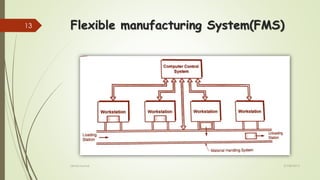
• A flexible manufacturing system (FMS) is a highly automated
Group Technology machine cell, consisting of a group or
processing workstations (usually CNC machine tools),
interconnected by an automated material handling and
storage system, and controlled by a distributed computer
system.
• The reason the FMS is called flexible is that it is capable of
processing a variety of different part styles simultaneously
at the various workstations, and the mix of part styles and
quantities of production can be adjusted in response to
changing demand patterns.
27/08/2015akhtar kamal 4
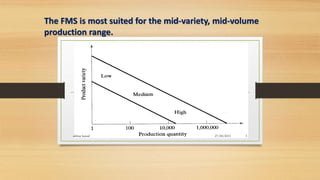
The FMS is most suited for the mid-variety, mid-volume
production range.
27/08/2015akhtar kamal 5
Components of FMS
• There are several basic components of an FMS:
1. Workstations.
2. Material handling and storage systems.
3. Computer control system.
4. People are required to manage and operate the
system.
27/08/2015akhtar kamal 6
1.Workstations
• Following are the types of workstations typically
found in an FMS:
1. Load/Unload Stations.
2. Machining Stations.
3. Other processing Stations. (punching, shearing,
welding, etc.)
4. Assembly Station.
5. Other Stations and Equipment. (Inspection, Vision,
etc)
27/08/2015akhtar kamal 7
2.Material Handling and Storage System
• Functions of the Handling System
1. Independent movement of work parts between stations.
2. Handle a variety of work part configurations.
3. Temporary storage.
4. Convenient access for loading and unloading work parts.
5. Compatible with computer control.
27/08/2015akhtar kamal 8
3.Computer Control System
• The FMS includes a distributed computer system that is
interfaced to …
 the workstations,
 Material handling system, and
 Other hardware components.
• Human are needed to manage the operations of the FMS.
Functions typically performed by human includes:-
 Loading raw work parts into the system,
 Unloading finished parts (or assemblies) from the system,
 Changing and setting tools,
 Equipment maintenance and repair,
 NC part programming in a machining system, and
 Programming and operation the computer system.
4.Human Resources
27/08/2015akhtar kamal 9
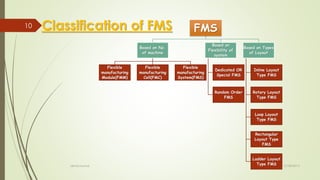
FMS
Based on No.
of machine
Flexible
manufacturing
Module(FMM)
Flexible
manufacturing
Cell(FMC)
Flexible
manufacturing
System(FMS)
Based on
Flexibility of
system
Dedicated OR
Special FMS
Random Order
FMS
Based on Types
of Layout
Inline Layout
Type FMS
Rotary Layout
Type FMS
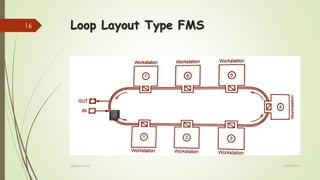
Loop Layout
Type FMS
Rectangular
Layout Type
FMS
Ladder Layout
Type FMS
Classification of FMS
27/08/2015akhtar kamal
10
Flexible manufacturing Module(FMM)
27/08/2015akhtar kamal
11
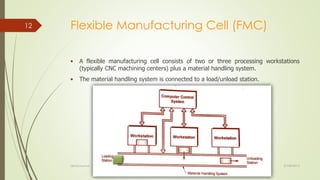
Flexible Manufacturing Cell (FMC)
• A flexible manufacturing cell consists of two or three processing workstations
(typically CNC machining centers) plus a material handling system.
• The material handling system is connected to a load/unload station.
27/08/2015akhtar kamal
12
Flexible manufacturing System(FMS)
27/08/2015akhtar kamal
13
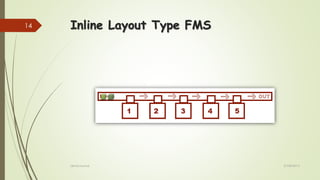
Inline Layout Type FMS
27/08/2015akhtar kamal
14
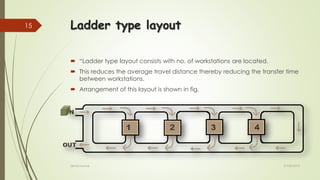
Ladder type layout
 “Ladder type layout consists with no. of workstations are located.
 This reduces the average travel distance thereby reducing the transfer time
between workstations.
 Arrangement of this layout is shown in fig.
27/08/2015akhtar kamal
15
Loop Layout Type FMS
27/08/2015akhtar kamal
16
Thank You
27/08/2015akhtar kamal 17
Advantages of flexible manufacturing
systems
1. Increased machine utilization
2.Lesser number of machines required
3.Reduction in floor space requirement
4. Greater flexibility
5.Reduction in inventory
6. Lower manufacturing lead time
7.Reduced labor requirement
8. Better product quality and productivity
9. Extended period production
27/08/2015akhtar kamal 18
Limitation of flexible manufacturing
systems
1. High initial cost
2. High maintenance cost
3. Worker unemployment
27/08/2015akhtar kamal 19
Application of flexible manufacturing
systems
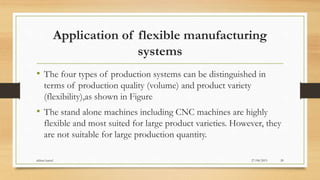
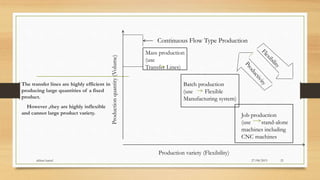
• The four types of production systems can be distinguished in
terms of production quality (volume) and product variety
(flexibility),as shown in Figure
• The stand alone machines including CNC machines are highly
flexible and most suited for large product varieties. However, they
are not suitable for large production quantity.
27/08/2015akhtar kamal 20
Mass production
(use
Transfer Lines)
Batch production
(use Flexible
Manufacturing system)
Job production
(use stand-alone
machines including
CNC machines
Continuous Flow Type Production
Production variety (Flexibility)
Productionquantity(Volume)
The transfer lines are highly efficient in
producing large quantities of a fixed
product.
However ,they are highly inflexible
and cannot large product variety.
27/08/2015akhtar kamal 21
Thank you
27/08/2015akhtar kamal 22

Flexible Manufacturing System

  • 1.
  • 2.
    27/08/2015 akhtar kamal 2 FLEXIBLEMANUFACTURING SYSTEM By: Akhtar Kamal
  • 3.
    Flexible Manufacturing System •Introduction • Elements of F.M.S. • Objective of F.M.S. • Classification of F.M.S. • F.M.S. layout • Advantages & Limitation • Application • Manufacturing Flexibility 27/08/2015akhtar kamal 3
  • 4.
    Introduction to FlexibleManufacturing System (FMS) • A flexible manufacturing system (FMS) is a highly automated Group Technology machine cell, consisting of a group or processing workstations (usually CNC machine tools), interconnected by an automated material handling and storage system, and controlled by a distributed computer system. • The reason the FMS is called flexible is that it is capable of processing a variety of different part styles simultaneously at the various workstations, and the mix of part styles and quantities of production can be adjusted in response to changing demand patterns. 27/08/2015akhtar kamal 4
  • 5.
    The FMS ismost suited for the mid-variety, mid-volume production range. 27/08/2015akhtar kamal 5
  • 6.
    Components of FMS •There are several basic components of an FMS: 1. Workstations. 2. Material handling and storage systems. 3. Computer control system. 4. People are required to manage and operate the system. 27/08/2015akhtar kamal 6
  • 7.
    1.Workstations • Following arethe types of workstations typically found in an FMS: 1. Load/Unload Stations. 2. Machining Stations. 3. Other processing Stations. (punching, shearing, welding, etc.) 4. Assembly Station. 5. Other Stations and Equipment. (Inspection, Vision, etc) 27/08/2015akhtar kamal 7
  • 8.
    2.Material Handling andStorage System • Functions of the Handling System 1. Independent movement of work parts between stations. 2. Handle a variety of work part configurations. 3. Temporary storage. 4. Convenient access for loading and unloading work parts. 5. Compatible with computer control. 27/08/2015akhtar kamal 8
  • 9.
    3.Computer Control System •The FMS includes a distributed computer system that is interfaced to …  the workstations,  Material handling system, and  Other hardware components. • Human are needed to manage the operations of the FMS. Functions typically performed by human includes:-  Loading raw work parts into the system,  Unloading finished parts (or assemblies) from the system,  Changing and setting tools,  Equipment maintenance and repair,  NC part programming in a machining system, and  Programming and operation the computer system. 4.Human Resources 27/08/2015akhtar kamal 9
  • 10.
    FMS Based on No. ofmachine Flexible manufacturing Module(FMM) Flexible manufacturing Cell(FMC) Flexible manufacturing System(FMS) Based on Flexibility of system Dedicated OR Special FMS Random Order FMS Based on Types of Layout Inline Layout Type FMS Rotary Layout Type FMS Loop Layout Type FMS Rectangular Layout Type FMS Ladder Layout Type FMS Classification of FMS 27/08/2015akhtar kamal 10
  • 11.
  • 12.
    Flexible Manufacturing Cell(FMC) • A flexible manufacturing cell consists of two or three processing workstations (typically CNC machining centers) plus a material handling system. • The material handling system is connected to a load/unload station. 27/08/2015akhtar kamal 12
  • 13.
  • 14.
    Inline Layout TypeFMS 27/08/2015akhtar kamal 14
  • 15.
    Ladder type layout “Ladder type layout consists with no. of workstations are located.  This reduces the average travel distance thereby reducing the transfer time between workstations.  Arrangement of this layout is shown in fig. 27/08/2015akhtar kamal 15
  • 16.
    Loop Layout TypeFMS 27/08/2015akhtar kamal 16
  • 17.
  • 18.
    Advantages of flexiblemanufacturing systems 1. Increased machine utilization 2.Lesser number of machines required 3.Reduction in floor space requirement 4. Greater flexibility 5.Reduction in inventory 6. Lower manufacturing lead time 7.Reduced labor requirement 8. Better product quality and productivity 9. Extended period production 27/08/2015akhtar kamal 18
  • 19.
    Limitation of flexiblemanufacturing systems 1. High initial cost 2. High maintenance cost 3. Worker unemployment 27/08/2015akhtar kamal 19
  • 20.
    Application of flexiblemanufacturing systems • The four types of production systems can be distinguished in terms of production quality (volume) and product variety (flexibility),as shown in Figure • The stand alone machines including CNC machines are highly flexible and most suited for large product varieties. However, they are not suitable for large production quantity. 27/08/2015akhtar kamal 20
  • 21.
    Mass production (use Transfer Lines) Batchproduction (use Flexible Manufacturing system) Job production (use stand-alone machines including CNC machines Continuous Flow Type Production Production variety (Flexibility) Productionquantity(Volume) The transfer lines are highly efficient in producing large quantities of a fixed product. However ,they are highly inflexible and cannot large product variety. 27/08/2015akhtar kamal 21
  • 22.