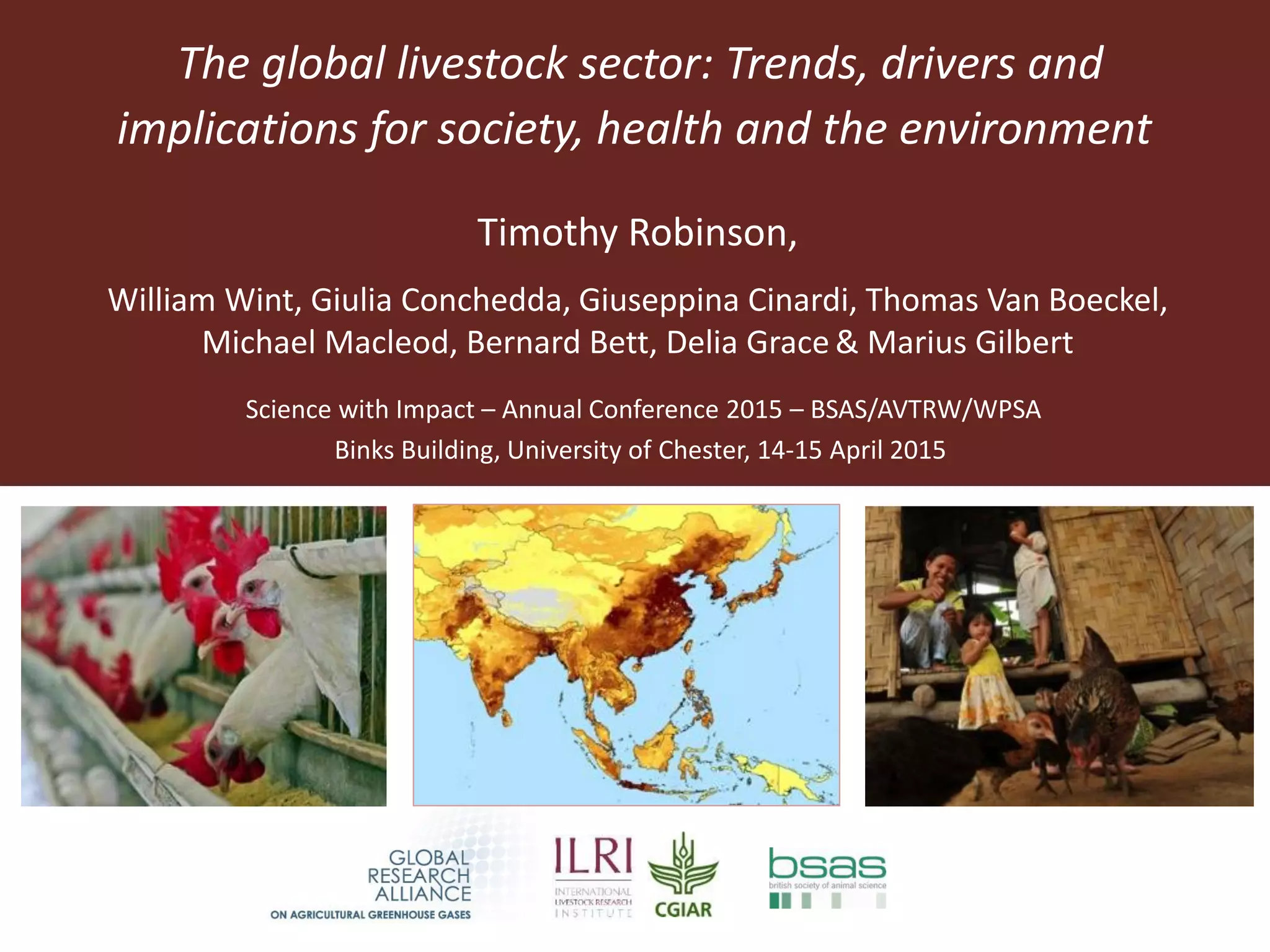
The global livestock sector: Trends, drivers and
implications for society, health and the environment
Science with Impact – Annual Conference 2015 – BSAS/AVTRW/WPSA
Binks Building, University of Chester, 14-15 April 2015
Timothy Robinson,
William Wint, Giulia Conchedda, Giuseppina Cinardi, Thomas Van Boeckel,
Michael Macleod, Bernard Bett, Delia Grace & Marius Gilbert
Overview
• The global livestock sector
• Trends and drivers
• Mapping livestock distributions and
production systems
• Livestock and livelihoods
• Livestock, health and nutrition
• Livestock and the environment
• Bringing it all together:
Animal health and greenhouse gas emissions
The global livestock sector
• Livestock numbers (FAOSTAT 2012)
• 1.8 billion cattle and buffalo
• 2.5 billion sheep and goats
• 1.5 billion pigs
• 30.6 billion poultry
• Sector accounts for 30% of the land
surface
• 70% of all agricultural land
• 8% of human water use
The global livestock sector
Health
and nutrition
Equity and
growth
Climate and
natural
resource use
Livestock
production
The global livestock sectorPoliciesandinstitutional
change
Economic
growth
Trade&marketing
Changing
diets
Energy prices
Health
and nutrition
Equity and
growth
Livestock
production
Climate and
natural
resource use
• Demographic and social drivers
• Population: + 32% or 9.6 billion people by 2050
• Income growth: + 2% per year by 2050
• Urbanization: 70% will live in cities by 2050
➜ Growth in demand for animal source foods
• + 70% by 2050
• + 200 million tonnes of meat
➜ Structural changes in the livestock sector
• Shift from ruminant to monogastric
• Intensification of production
➜ Impinges on global public goods
• Poverty and growth
• Health and nutrition
• Climate and natural resources
• Integrated approach to socially desirable livestock
sector development
• Need reliable data and information to guide policy
The changing livestock sector
Livestock to 2030 – demand growth
Consumption of Animal Source Foods is increasing faster
in developing countries than in developed countries
Millionsoftonnes
Year
Developed
Developing
Disaggregating demand growth
Growth in poultry
consumption in China to 2030
Demand growth attributable
to population growth
Demand growth
attributable to
changing consumption
patterns
Demand growth as a
function of both
Demand in
2000
Implications for production
• Rural population growth
→ EXPANSION
• Urban population growth
• Increasing wealth
• Changing consumption patterns
→ INTENSIFICATION
Livestock distribution and production
Livestock distribution
modelling
Livestock maps by
production system
Livestock production
estimates
Global livestock
maps
Production systems
modelling
Sub-national
Livestock data
Herd / production
modelling
Data collection, cleaning
and geo-registration
Global distribution of pigs
Source: Robinson et al. (2014)
Pigs per square kilometre (2006)
Mapped based on
rural population
Difference
(total – extensive)
% backyard
% intensive
Monogastric production systems
Livestock
distribution
Extensive
production
Intensive
production
Chicken systemsOutput/inputratio(logkg-1stock-1year-1)
Log per-capita GDP (US$/person/year)
From World Bank data
Source: Gilbert et al. (under review)
Chicken systems
Log per-capita GDP (US$/person/year)
From World Bank data
Proportionofextensivelyraisedchickens
Source: Gilbert et al. (under review)
Chicken systems
Extensive chicken
production
Intensive chicken
production
Source: Gilbert et al. (under review)
http://www.livestock.geo-wiki.org
The global livestock sector
Health
and nutrition
Equity and
growth
Climate and
natural
resource use
Livestock
production
Livestock and livelihoods
• Value of livestock sector c. $1.4 trillion
• Account for 40% of agricultural GDP
• Employs 1.3 billion people
• Provides 17% of calories and 26% of
protein, globally
• Provides valuable micronutrients to the
poor
• Provides livelihoods for 800 million
poor small-holders
• Contribute nutrients and traction for
mixed farming
• Utilises primary production of no direct
value for human consumption
• Serves as a bank, and insurance against
hard times (e.g. drought)
Otte et al. (2013)
AfriPop
Population
Rural population
Agricultural population Poor farmers
Livestock keepers Poor livestock keepers
Livestock and livelihoods
Source: Robinson et al. (2011)
Poor Livestock Keepers
National, rural poverty lines
Livestock and livelihoods
Livestock, health and nutrition
• Nutrition
• Positive: Hunger, malnutrition, stunting, cognitive
impairment
• Negative: Obesity and associated health risks
• Diseases
• Food-borne diseases
• 39% OIE diseases are zoonotic
• Aflatoxin poisoning
• Antimicrobial resistance
• Poverty
• Poor people are less healthy
• Livestock contribute to livelihoods and resilience
• Economic losses from endemic diseases of
production
• Climate change
• Reduced food security
• Heat waves, floods and droughts
• Changing VBD risks
Nutrition: the double-edged sword
Livestock are key to both sides
• Over one third of all adults across the
world – 1.46 billion people – are obese or
overweight
• Between 1980 and 2008, the numbers of
people affected in the developing world
more than tripled, from 250 million to
904 million
• Diets are changing with income rises in
developing countries, shifting from starch
to meat, milk, fats and sugar, fruit and
vegetables
• We live in a world more than with
800 million hungry and 165 million
stunted children
• Animal-Source Foods provide 17%
of calories and 26% of protein
• Animal-Source Foods provide
valuable micronutrients to the
poor
Nutrition: the double-edged sword
Source: Dobbs et al. 2014
Obesity is one of the top three social burdens
generated by human beings
But to what extent is livestock
consumption contributing?
• Overeating
• Physical inactivity
• High-fat diets (ASF)
• Diets high in refined carbohydrates
• Sugared soft drinks
• Excessive alcohol consumption
Obesity causes some 5% of global deaths
• More than 2 billion are sickened each year from
the food they eat
• Millions more die from zoonotic diseases that
emerge from, or persist in, agricultural
ecosystems
• Diseases recently emerged from animals make up
25% of the infectious disease burden in least
developed countries and kill one in ten people
who live there
➜ We have proven agricultural interventions
which can tackle the diseases associated with
agriculture
➜ $25 billion invested in zoonotic disease control
would bring benefits worth $125 billion
Diseases related to livestock farming
(Source: Grace 2012)
H7N9 risk prediction
Emerging diseases – Avian Influenza
Source: Gilbert et al. (2014)
Source: Gilbert et al. (under review)
Data mining extensive and intensive chicken production
Intensification trajectories
Source: Gilbert et al. (under review)
Intensification trajectories
Creating bootstrapped models
Source: Gilbert et al. (under review)
Intensification trajectories
Applying models to all countries
Source: Gilbert et al. (under review)
Intensification trajectories
Here is China…
Intensification trajectories
… and several other important countries for AI in humans
Intensification trajectories
Focus on these countries, standardized to 2010 data
Focus on these countries, standardized to 2030 FAO projections
Intensification trajectories
South Asia
Source: Gilbert et al. (under review)
Intensification trajectories
Focus on these countries, standardized to 2030 FAO projections
Source: Gilbert et al. (under review)
Intensification trajectories
Focus on these countries, standardized to 2050 FAO projections
Antimicrobial resistance
• USA: at least 2 million people get drug-
resistant infections each year, and at least
23,000 die from them
• USA: 80% of antimicrobial sales are in the
agricultural sector
• Total consumption in the livestock sector in
2010 estimated at 63,151 tons
• Global antimicrobial consumption will rise by
67% by 2030
• It will nearly double in BRICS (Brazil, Russia,
India, China, and South Africa) countries
• China’s livestock industry by itself could soon
be consuming almost one third of world’s
available antibiotics
Antimicrobial resistance
Source: Van Boeckel et al. 2015
Global antimicrobial use in food animals
(mg per 10km pixel)
Antimicrobial resistance
• The European Union banned the use of
antibiotics to boost animals' growth in 2006
• There is a ‘voluntary’ ban in the USA
• Chick-fil-A, McDonalds and Costco stopping
antimicrobial use in the production chain
➜ Concerted action – multi-stakeholder
platforms
➜ Strengthen the evidence base linking
agricultural use to AMR in the medical sector
➜ Appropriate approaches in different settings
– poor countries may not have the
‘resilience’ or ‘capacity’ of Europe in
withstanding a blanket ban, for example
Livestock and the environment
➜ ADAPTATION
➜ Capacity to respond
to changes
Livestock
Environment
GHG emissions
Climate change
Carbon sequestration
Land use change
Pollution
Water resource availability
Feed availability
Nutrient cycling
Land degradation
Biodiversity
➜ MITIGATION
➜ Climate-smart
agriculture
Source: Gerber et al. (2013)
• 14.5% of all anthropogenic GHG emissions
• Beef production generates 6 times more GHG emissions per unit of protein
than pork, chicken and eggs
KilogramsofCO2eperkilogramofprotein
Contribution to climate change
Source: Gerber et al. 2013
per unit of
edible
protein
Livestock emissions
Source: Gerber et al. 2013
Livestock emissions
per unit of
land
Source : Shaw et al. (2014)
Economic benefits over 20
years of trypanosomosis
removal
Cattle
production
system
Pastoral
Agro-
pastoral
Mixed
farming
(general)
Mixed
farming
(Ethiopia)
Low oxen 63 82 90 102
Medium
oxen
– 98 122 135
High oxen – 118 152 161
High dairy – 142 148 –
Cattle density
Tsetse distribution
Production systems
Herd model
Burden of disease
Herd growth and spread
Value of production
Production systems
Economic benefits per animal (US$)
Bringing it all together
Decrease in emissions intensity arising from
trypanosomosis removal
ReductioninEI
Production system
Results
Source: MacLeod et al. (submitted)
Results
• Removal of trypanosomosis leads
to significant increases in
production and emissions across
all the systems
• Production increases by more than
emissions so EI decreases
• The biggest decrease in EI is in the
high yield dairy systems
• Demonstrates a clear link between
improving productivity and
decreasing EI
% change in emissions intensity
Source: MacLeod et al. (submitted)
In conclusion
‘The fundamental interconnectedness of all things’
• Rapid demand growth for Animal Source
Foods – particularly in developing and
emerging economies
• The response of the livestock sector to this
growth has major implications for global,
interconnected, public goods
• This calls for integrated solutions to guide
sector development along a sustainable
pathway
• These are global issues and require global
responses
Thank You !

The global livestock sector: Trends, drivers and implications for society, health and the environment

  • 1.
    The global livestocksector: Trends, drivers and implications for society, health and the environment Science with Impact – Annual Conference 2015 – BSAS/AVTRW/WPSA Binks Building, University of Chester, 14-15 April 2015 Timothy Robinson, William Wint, Giulia Conchedda, Giuseppina Cinardi, Thomas Van Boeckel, Michael Macleod, Bernard Bett, Delia Grace & Marius Gilbert
  • 2.
    Overview • The globallivestock sector • Trends and drivers • Mapping livestock distributions and production systems • Livestock and livelihoods • Livestock, health and nutrition • Livestock and the environment • Bringing it all together: Animal health and greenhouse gas emissions
  • 3.
    The global livestocksector • Livestock numbers (FAOSTAT 2012) • 1.8 billion cattle and buffalo • 2.5 billion sheep and goats • 1.5 billion pigs • 30.6 billion poultry • Sector accounts for 30% of the land surface • 70% of all agricultural land • 8% of human water use
  • 4.
    The global livestocksector Health and nutrition Equity and growth Climate and natural resource use Livestock production
  • 5.
    The global livestocksectorPoliciesandinstitutional change Economic growth Trade&marketing Changing diets Energy prices Health and nutrition Equity and growth Livestock production Climate and natural resource use
  • 6.
    • Demographic andsocial drivers • Population: + 32% or 9.6 billion people by 2050 • Income growth: + 2% per year by 2050 • Urbanization: 70% will live in cities by 2050 ➜ Growth in demand for animal source foods • + 70% by 2050 • + 200 million tonnes of meat ➜ Structural changes in the livestock sector • Shift from ruminant to monogastric • Intensification of production ➜ Impinges on global public goods • Poverty and growth • Health and nutrition • Climate and natural resources • Integrated approach to socially desirable livestock sector development • Need reliable data and information to guide policy The changing livestock sector
  • 7.
    Livestock to 2030– demand growth Consumption of Animal Source Foods is increasing faster in developing countries than in developed countries Millionsoftonnes Year Developed Developing
  • 8.
    Disaggregating demand growth Growthin poultry consumption in China to 2030 Demand growth attributable to population growth Demand growth attributable to changing consumption patterns Demand growth as a function of both Demand in 2000
  • 9.
    Implications for production •Rural population growth → EXPANSION • Urban population growth • Increasing wealth • Changing consumption patterns → INTENSIFICATION
  • 10.
    Livestock distribution andproduction Livestock distribution modelling Livestock maps by production system Livestock production estimates Global livestock maps Production systems modelling Sub-national Livestock data Herd / production modelling Data collection, cleaning and geo-registration
  • 11.
    Global distribution ofpigs Source: Robinson et al. (2014) Pigs per square kilometre (2006)
  • 12.
    Mapped based on ruralpopulation Difference (total – extensive) % backyard % intensive Monogastric production systems Livestock distribution Extensive production Intensive production
  • 13.
    Chicken systemsOutput/inputratio(logkg-1stock-1year-1) Log per-capitaGDP (US$/person/year) From World Bank data Source: Gilbert et al. (under review)
  • 14.
    Chicken systems Log per-capitaGDP (US$/person/year) From World Bank data Proportionofextensivelyraisedchickens Source: Gilbert et al. (under review)
  • 15.
    Chicken systems Extensive chicken production Intensivechicken production Source: Gilbert et al. (under review)
  • 16.
  • 17.
    The global livestocksector Health and nutrition Equity and growth Climate and natural resource use Livestock production
  • 18.
    Livestock and livelihoods •Value of livestock sector c. $1.4 trillion • Account for 40% of agricultural GDP • Employs 1.3 billion people • Provides 17% of calories and 26% of protein, globally • Provides valuable micronutrients to the poor • Provides livelihoods for 800 million poor small-holders • Contribute nutrients and traction for mixed farming • Utilises primary production of no direct value for human consumption • Serves as a bank, and insurance against hard times (e.g. drought) Otte et al. (2013)
  • 19.
    AfriPop Population Rural population Agricultural populationPoor farmers Livestock keepers Poor livestock keepers Livestock and livelihoods
  • 20.
    Source: Robinson etal. (2011) Poor Livestock Keepers National, rural poverty lines Livestock and livelihoods
  • 21.
    Livestock, health andnutrition • Nutrition • Positive: Hunger, malnutrition, stunting, cognitive impairment • Negative: Obesity and associated health risks • Diseases • Food-borne diseases • 39% OIE diseases are zoonotic • Aflatoxin poisoning • Antimicrobial resistance • Poverty • Poor people are less healthy • Livestock contribute to livelihoods and resilience • Economic losses from endemic diseases of production • Climate change • Reduced food security • Heat waves, floods and droughts • Changing VBD risks
  • 22.
    Nutrition: the double-edgedsword Livestock are key to both sides • Over one third of all adults across the world – 1.46 billion people – are obese or overweight • Between 1980 and 2008, the numbers of people affected in the developing world more than tripled, from 250 million to 904 million • Diets are changing with income rises in developing countries, shifting from starch to meat, milk, fats and sugar, fruit and vegetables • We live in a world more than with 800 million hungry and 165 million stunted children • Animal-Source Foods provide 17% of calories and 26% of protein • Animal-Source Foods provide valuable micronutrients to the poor
  • 23.
    Nutrition: the double-edgedsword Source: Dobbs et al. 2014 Obesity is one of the top three social burdens generated by human beings But to what extent is livestock consumption contributing? • Overeating • Physical inactivity • High-fat diets (ASF) • Diets high in refined carbohydrates • Sugared soft drinks • Excessive alcohol consumption Obesity causes some 5% of global deaths
  • 24.
    • More than2 billion are sickened each year from the food they eat • Millions more die from zoonotic diseases that emerge from, or persist in, agricultural ecosystems • Diseases recently emerged from animals make up 25% of the infectious disease burden in least developed countries and kill one in ten people who live there ➜ We have proven agricultural interventions which can tackle the diseases associated with agriculture ➜ $25 billion invested in zoonotic disease control would bring benefits worth $125 billion Diseases related to livestock farming (Source: Grace 2012)
  • 25.
    H7N9 risk prediction Emergingdiseases – Avian Influenza Source: Gilbert et al. (2014)
  • 26.
    Source: Gilbert etal. (under review) Data mining extensive and intensive chicken production Intensification trajectories
  • 27.
    Source: Gilbert etal. (under review) Intensification trajectories Creating bootstrapped models
  • 28.
    Source: Gilbert etal. (under review) Intensification trajectories Applying models to all countries
  • 29.
    Source: Gilbert etal. (under review) Intensification trajectories Here is China…
  • 30.
    Intensification trajectories … andseveral other important countries for AI in humans
  • 31.
    Intensification trajectories Focus onthese countries, standardized to 2010 data
  • 32.
    Focus on thesecountries, standardized to 2030 FAO projections Intensification trajectories
  • 33.
    South Asia Source: Gilbertet al. (under review) Intensification trajectories Focus on these countries, standardized to 2030 FAO projections
  • 34.
    Source: Gilbert etal. (under review) Intensification trajectories Focus on these countries, standardized to 2050 FAO projections
  • 35.
    Antimicrobial resistance • USA:at least 2 million people get drug- resistant infections each year, and at least 23,000 die from them • USA: 80% of antimicrobial sales are in the agricultural sector • Total consumption in the livestock sector in 2010 estimated at 63,151 tons • Global antimicrobial consumption will rise by 67% by 2030 • It will nearly double in BRICS (Brazil, Russia, India, China, and South Africa) countries • China’s livestock industry by itself could soon be consuming almost one third of world’s available antibiotics
  • 36.
    Antimicrobial resistance Source: VanBoeckel et al. 2015 Global antimicrobial use in food animals (mg per 10km pixel)
  • 37.
    Antimicrobial resistance • TheEuropean Union banned the use of antibiotics to boost animals' growth in 2006 • There is a ‘voluntary’ ban in the USA • Chick-fil-A, McDonalds and Costco stopping antimicrobial use in the production chain ➜ Concerted action – multi-stakeholder platforms ➜ Strengthen the evidence base linking agricultural use to AMR in the medical sector ➜ Appropriate approaches in different settings – poor countries may not have the ‘resilience’ or ‘capacity’ of Europe in withstanding a blanket ban, for example
  • 38.
    Livestock and theenvironment ➜ ADAPTATION ➜ Capacity to respond to changes Livestock Environment GHG emissions Climate change Carbon sequestration Land use change Pollution Water resource availability Feed availability Nutrient cycling Land degradation Biodiversity ➜ MITIGATION ➜ Climate-smart agriculture
  • 39.
    Source: Gerber etal. (2013) • 14.5% of all anthropogenic GHG emissions • Beef production generates 6 times more GHG emissions per unit of protein than pork, chicken and eggs KilogramsofCO2eperkilogramofprotein Contribution to climate change
  • 40.
    Source: Gerber etal. 2013 per unit of edible protein Livestock emissions
  • 41.
    Source: Gerber etal. 2013 Livestock emissions per unit of land
  • 42.
    Source : Shawet al. (2014) Economic benefits over 20 years of trypanosomosis removal Cattle production system Pastoral Agro- pastoral Mixed farming (general) Mixed farming (Ethiopia) Low oxen 63 82 90 102 Medium oxen – 98 122 135 High oxen – 118 152 161 High dairy – 142 148 – Cattle density Tsetse distribution Production systems Herd model Burden of disease Herd growth and spread Value of production Production systems Economic benefits per animal (US$) Bringing it all together
  • 43.
    Decrease in emissionsintensity arising from trypanosomosis removal ReductioninEI Production system Results Source: MacLeod et al. (submitted)
  • 44.
    Results • Removal oftrypanosomosis leads to significant increases in production and emissions across all the systems • Production increases by more than emissions so EI decreases • The biggest decrease in EI is in the high yield dairy systems • Demonstrates a clear link between improving productivity and decreasing EI % change in emissions intensity Source: MacLeod et al. (submitted)
  • 45.
    In conclusion ‘The fundamentalinterconnectedness of all things’ • Rapid demand growth for Animal Source Foods – particularly in developing and emerging economies • The response of the livestock sector to this growth has major implications for global, interconnected, public goods • This calls for integrated solutions to guide sector development along a sustainable pathway • These are global issues and require global responses
  • 46.