Better lives through livestock
The application of One Health: Observations
from eastern and southern Africa
Theo Knight-Jones
Principal scientist
International Livestock Research Institute (ILRI)
2
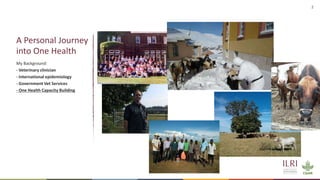
My Background:
- Veterinary clinician
- International epidemiology
- Government Vet Services
- One Health Capacity Building
A Personal Journey
into One Health
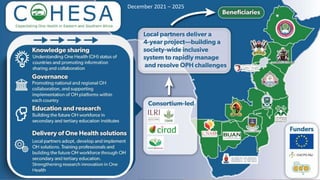
December 2021 – 2025
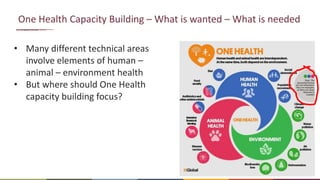
One Health Capacity Building – What is wanted – What is needed
• Many different technical areas
involve elements of human –
animal – environment health
• But where should One Health
capacity building focus?
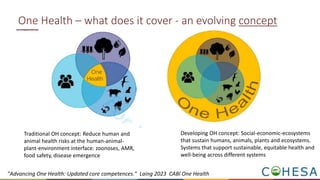
One Health – what does it cover - an evolving concept
Traditional OH concept: Reduce human and
animal health risks at the human-animal-
plant-environment interface: zoonoses, AMR,
food safety, disease emergence
Developing OH concept: Social-economic-ecosystems
that sustain humans, animals, plants and ecosystems.
Systems that support sustainable, equitable health and
well-being across different systems
"Advancing One Health: Updated core competences." Laing 2023 CABI One Health
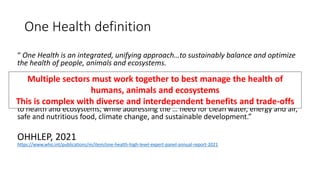
One Health definition
“ One Health is an integrated, unifying approach…to sustainably balance and optimize
the health of people, animals and ecosystems.
It recognizes the health of humans, domestic and wild animals, plants, and the wider
environment (including ecosystems) are closely linked and interdependent.
The approach mobilizes multiple sectors, disciplines and communities to tackle threats
to health and ecosystems, while addressing the … need for clean water, energy and air,
safe and nutritious food, climate change, and sustainable development.”
OHHLEP, 2021
https://www.who.int/publications/m/item/one-health-high-level-expert-panel-annual-report-2021
Multiple sectors must work together to best manage the health of
humans, animals and ecosystems
This is complex with diverse and interdependent benefits and trade-offs
One Health Capacity Building
When is it wanted – When is it needed
One Health approaches are needed when:
• 1) Need to consider multi-sectoral, diverse impacts for decision making
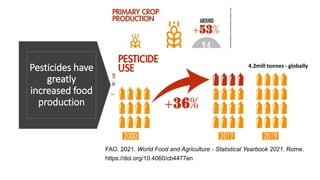
Pesticides have
greatly
increased food
production
FAO. 2021. World Food and Agriculture - Statistical Yearbook 2021. Rome.
https://doi.org/10.4060/cb4477en
4.2mill tonnes - globally
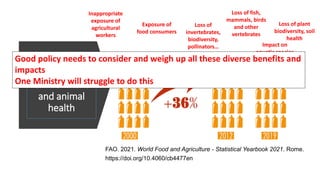
Impacts on
human,
environment
and animal
health
FAO. 2021. World Food and Agriculture - Statistical Yearbook 2021. Rome.
https://doi.org/10.4060/cb4477en
Inappropriate
exposure of
agricultural
workers
Exposure of
food consumers
Loss of
invertebrates,
biodiversity,
pollinators… Impact on
aquatic species
Loss of plant
biodiversity, soil
health
Loss of fish,
mammals, birds
and other
vertebrates
MISUSE
Good policy needs to consider and weigh up all these diverse benefits and
impacts
One Ministry will struggle to do this
One Health approaches are needed when:
• 1) Need to consider multi-sectoral, diverse impacts for decision making
Policy formulation
• 2) Coordinated joined-up approaches need to be implemented
Policy Implementation
One Health Capacity Building
When is it wanted – When is it needed
One Health Game theory
the added value of a One Health approach
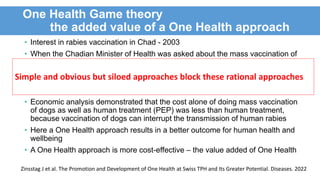
• Interest in rabies vaccination in Chad - 2003
• When the Chadian Minister of Health was asked about the mass vaccination of
dogs to eliminate human rabies, he replied that he was responsible for the
people and not for the dogs
• Asked about the same issue, the Minister of Animal Production replied that his
priority was cattle and not dogs
• Economic analysis demonstrated that the cost alone of doing mass vaccination
of dogs as well as human treatment (PEP) was less than human treatment,
because vaccination of dogs can interrupt the transmission of human rabies
• Here a One Health approach results in a better outcome for human health and
wellbeing
• A One Health approach is more cost-effective – the value added of One Health
Zinsstag J et al. The Promotion and Development of One Health at Swiss TPH and Its Greater Potential. Diseases. 2022
Simple and obvious but siloed approaches block these rational approaches
12
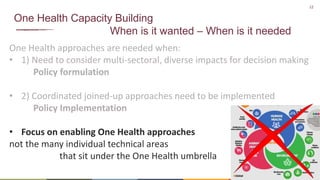
One Health approaches are needed when:
• 1) Need to consider multi-sectoral, diverse impacts for decision making
Policy formulation
• 2) Coordinated joined-up approaches need to be implemented
Policy Implementation
• Focus on enabling One Health approaches
not the many individual technical areas
that sit under the One Health umbrella
One Health Capacity Building
When is it wanted – When is it needed
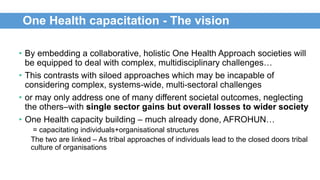
One Health capacitation - The vision
• By embedding a collaborative, holistic One Health Approach societies will
be equipped to deal with complex, multidisciplinary challenges…
• This contrasts with siloed approaches which may be incapable of
considering complex, systems-wide, multi-sectoral challenges
• or may only address one of many different societal outcomes, neglecting
the others–with single sector gains but overall losses to wider society
• One Health capacity building – much already done, AFROHUN…
= capacitating individuals+organisational structures
The two are linked – As tribal approaches of individuals lead to the closed doors tribal
culture of organisations
14
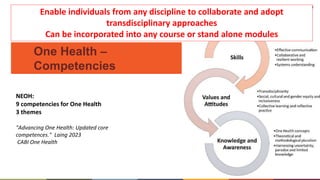
One Health –
Competencies
NEOH:
9 competencies for One Health
3 themes
"Advancing One Health: Updated core
competences." Laing 2023
CABI One Health
Approaches for One Health capacity building
Enable individuals from any discipline to collaborate and adopt
transdisciplinary approaches
Can be incorporated into any course or stand alone modules
15
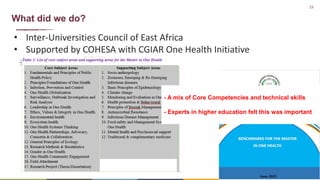
What did we do?
• Inter-Universities Council of East Africa
• Supported by COHESA with CGIAR One Health Initiative
- A mix of Core Competencies and technical skills
- Experts in higher education felt this was important
16
One Health Capacity Building – Making it real
• One Health experts can become abstract
• “Academics talking in ivory towers…”
• Implementors (public and private) deal with specific issues
• RVF, AMR, Agrochemicals, Land encroachment…
• But need to be able to take a One Health approach
• Training must be delivered in a way that engages and allows
competencies to be applied directly to these specific issues
One Health Game theory
the added value of a One Health approach
• Rabies vaccination in Chad - 2003
• When the Chadian Minister of Health was asked about the mass
vaccination of dogs to eliminate human rabies, he replied that he was
responsible for the people and not for the dogs
• Asked about the same issue, the Minister of Animal Production replied
that his priority was cattle and not dogs
• Economic analysis demonstrated that the cost of doing mass
vaccination of dogs and human treatment (PEP) was less than human
treatment alone, because vaccination of dogs can interrupt the
transmission of rabies
• Here a One Health approach results in a better outcome for human
health and wellbeing
Zinsstag J et al. The Promotion and Development of One Health at Swiss TPH and Its Greater Potential. Diseases. 2022
One Health – What are the successes?
-Need to show the value of taking a One Health approach
-Need a clear incentive for change and investment
18
One Health Capacity Building – Where to target
• Capacitating individuals – but who?
• Professionals on the job
• Higher Education curricula – modules and longer courses
• Challenges – Time taken to make and adopt new courses
• Uncertain career from OH specialist qualifications
• But to influence behaviour concepts need to be introduced at a young age
• Primary school?
19
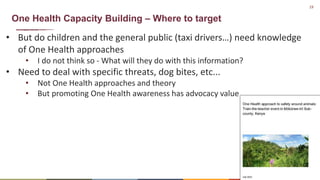
One Health Capacity Building – Where to target
• But do children and the general public (taxi drivers…) need knowledge
of One Health approaches
• I do not think so - What will they do with this information?
• Need to deal with specific threats, dog bites, etc...
• Not One Health approaches and theory
• But promoting One Health awareness has advocacy value
20
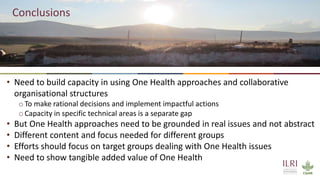
• Need to build capacity in using One Health approaches and collaborative
organisational structures
oTo make rational decisions and implement impactful actions
oCapacity in specific technical areas is a separate gap
• But One Health approaches need to be grounded in real issues and not abstract
• Different content and focus needed for different groups
• Efforts should focus on target groups dealing with One Health issues
• Need to show tangible added value of One Health
Conclusions
THANK YOU

The application of One Health: Observations from eastern and southern Africa

  • 1.
    Better lives throughlivestock The application of One Health: Observations from eastern and southern Africa Theo Knight-Jones Principal scientist International Livestock Research Institute (ILRI)
  • 2.
    2 My Background: - Veterinaryclinician - International epidemiology - Government Vet Services - One Health Capacity Building A Personal Journey into One Health
  • 3.
  • 4.
    One Health CapacityBuilding – What is wanted – What is needed • Many different technical areas involve elements of human – animal – environment health • But where should One Health capacity building focus?
  • 5.
    One Health –what does it cover - an evolving concept Traditional OH concept: Reduce human and animal health risks at the human-animal- plant-environment interface: zoonoses, AMR, food safety, disease emergence Developing OH concept: Social-economic-ecosystems that sustain humans, animals, plants and ecosystems. Systems that support sustainable, equitable health and well-being across different systems "Advancing One Health: Updated core competences." Laing 2023 CABI One Health
  • 6.
    One Health definition “One Health is an integrated, unifying approach…to sustainably balance and optimize the health of people, animals and ecosystems. It recognizes the health of humans, domestic and wild animals, plants, and the wider environment (including ecosystems) are closely linked and interdependent. The approach mobilizes multiple sectors, disciplines and communities to tackle threats to health and ecosystems, while addressing the … need for clean water, energy and air, safe and nutritious food, climate change, and sustainable development.” OHHLEP, 2021 https://www.who.int/publications/m/item/one-health-high-level-expert-panel-annual-report-2021 Multiple sectors must work together to best manage the health of humans, animals and ecosystems This is complex with diverse and interdependent benefits and trade-offs
  • 7.
    One Health CapacityBuilding When is it wanted – When is it needed One Health approaches are needed when: • 1) Need to consider multi-sectoral, diverse impacts for decision making
  • 8.
    Pesticides have greatly increased food production FAO.2021. World Food and Agriculture - Statistical Yearbook 2021. Rome. https://doi.org/10.4060/cb4477en 4.2mill tonnes - globally
  • 9.
    Impacts on human, environment and animal health FAO.2021. World Food and Agriculture - Statistical Yearbook 2021. Rome. https://doi.org/10.4060/cb4477en Inappropriate exposure of agricultural workers Exposure of food consumers Loss of invertebrates, biodiversity, pollinators… Impact on aquatic species Loss of plant biodiversity, soil health Loss of fish, mammals, birds and other vertebrates MISUSE Good policy needs to consider and weigh up all these diverse benefits and impacts One Ministry will struggle to do this
  • 10.
    One Health approachesare needed when: • 1) Need to consider multi-sectoral, diverse impacts for decision making Policy formulation • 2) Coordinated joined-up approaches need to be implemented Policy Implementation One Health Capacity Building When is it wanted – When is it needed
  • 11.
    One Health Gametheory the added value of a One Health approach • Interest in rabies vaccination in Chad - 2003 • When the Chadian Minister of Health was asked about the mass vaccination of dogs to eliminate human rabies, he replied that he was responsible for the people and not for the dogs • Asked about the same issue, the Minister of Animal Production replied that his priority was cattle and not dogs • Economic analysis demonstrated that the cost alone of doing mass vaccination of dogs as well as human treatment (PEP) was less than human treatment, because vaccination of dogs can interrupt the transmission of human rabies • Here a One Health approach results in a better outcome for human health and wellbeing • A One Health approach is more cost-effective – the value added of One Health Zinsstag J et al. The Promotion and Development of One Health at Swiss TPH and Its Greater Potential. Diseases. 2022 Simple and obvious but siloed approaches block these rational approaches
  • 12.
    12 One Health approachesare needed when: • 1) Need to consider multi-sectoral, diverse impacts for decision making Policy formulation • 2) Coordinated joined-up approaches need to be implemented Policy Implementation • Focus on enabling One Health approaches not the many individual technical areas that sit under the One Health umbrella One Health Capacity Building When is it wanted – When is it needed
  • 13.
    One Health capacitation- The vision • By embedding a collaborative, holistic One Health Approach societies will be equipped to deal with complex, multidisciplinary challenges… • This contrasts with siloed approaches which may be incapable of considering complex, systems-wide, multi-sectoral challenges • or may only address one of many different societal outcomes, neglecting the others–with single sector gains but overall losses to wider society • One Health capacity building – much already done, AFROHUN… = capacitating individuals+organisational structures The two are linked – As tribal approaches of individuals lead to the closed doors tribal culture of organisations
  • 14.
    14 One Health – Competencies NEOH: 9competencies for One Health 3 themes "Advancing One Health: Updated core competences." Laing 2023 CABI One Health Approaches for One Health capacity building Enable individuals from any discipline to collaborate and adopt transdisciplinary approaches Can be incorporated into any course or stand alone modules
  • 15.
    15 What did wedo? • Inter-Universities Council of East Africa • Supported by COHESA with CGIAR One Health Initiative - A mix of Core Competencies and technical skills - Experts in higher education felt this was important
  • 16.
    16 One Health CapacityBuilding – Making it real • One Health experts can become abstract • “Academics talking in ivory towers…” • Implementors (public and private) deal with specific issues • RVF, AMR, Agrochemicals, Land encroachment… • But need to be able to take a One Health approach • Training must be delivered in a way that engages and allows competencies to be applied directly to these specific issues
  • 17.
    One Health Gametheory the added value of a One Health approach • Rabies vaccination in Chad - 2003 • When the Chadian Minister of Health was asked about the mass vaccination of dogs to eliminate human rabies, he replied that he was responsible for the people and not for the dogs • Asked about the same issue, the Minister of Animal Production replied that his priority was cattle and not dogs • Economic analysis demonstrated that the cost of doing mass vaccination of dogs and human treatment (PEP) was less than human treatment alone, because vaccination of dogs can interrupt the transmission of rabies • Here a One Health approach results in a better outcome for human health and wellbeing Zinsstag J et al. The Promotion and Development of One Health at Swiss TPH and Its Greater Potential. Diseases. 2022 One Health – What are the successes? -Need to show the value of taking a One Health approach -Need a clear incentive for change and investment
  • 18.
    18 One Health CapacityBuilding – Where to target • Capacitating individuals – but who? • Professionals on the job • Higher Education curricula – modules and longer courses • Challenges – Time taken to make and adopt new courses • Uncertain career from OH specialist qualifications • But to influence behaviour concepts need to be introduced at a young age • Primary school?
  • 19.
    19 One Health CapacityBuilding – Where to target • But do children and the general public (taxi drivers…) need knowledge of One Health approaches • I do not think so - What will they do with this information? • Need to deal with specific threats, dog bites, etc... • Not One Health approaches and theory • But promoting One Health awareness has advocacy value
  • 20.
    20 • Need tobuild capacity in using One Health approaches and collaborative organisational structures oTo make rational decisions and implement impactful actions oCapacity in specific technical areas is a separate gap • But One Health approaches need to be grounded in real issues and not abstract • Different content and focus needed for different groups • Efforts should focus on target groups dealing with One Health issues • Need to show tangible added value of One Health Conclusions
  • 21.