Dairy Cattle
Introduction
Unit Map: Follow Along in your
packet
WHAT ARE YOU LEARNING?
AS.06.02 Basic: Recognize, ID, and
Eval disease and parasites in
animals
AS.03.01: ID breeds and species
Know Understand Do!
Know
 Types of
Dairy Cattle
 Industry
Procedures
 Care
Procedures
Understand
 Variation in
cattle purposes
 Milking and
Dairy Food
Processing
 Disease
Prevention
Methods
Do
 Profile Dairy
Cattle
 Outline Milking
 ID common
Diseases
Key Learning: Dairy Cattle Industry
 Unit EQ: How can consumers influence
the Dairy Industry?
Concept : Care and
Diseases
Lesson EQ:
How can disease
effect industry?
Vocab
Mastitis, Milk Fever,
Prolapse
Concept : Industry
Lesson EQ:
How is the Dairy
industry so
efficient?
Vocab
Iodine Solution,
Milking Claw,
Specialty Product
Concept : Types
Lesson EQ:
How are dairy
breeds
selected?
Vocab
Milk Fat,
Efficiency,
Dairy Breed
Dirty Jobs Dairy Cow Midwife: Intro
Video
Activity in Video 2 Sent Description 2 words you Don’t
Know , or that were
defined
Cleaning Stalls
Milking
Manure management
Artificial Insemination
Calving
Emergency “C” Section
Let’s Review Mike’s Activities
Activity Where we will Discuss in
this Unit
Cleaning stalls Management and care
Milking Products and Industry
Manure management Management and care
Artificial Insemination Management and care
Calving Anatomy, Management
C Section Anatomy and Care and
Diseases
Dairy Cattle
Breeds
Warm-up
First thing that comes to
mind when you see….
Lesson Essential Question
How are Dairy Breeds
Selected?
Graphic Organizer
Breed Looks Like Is a good dairy
cow because …
Holstein
 Dominate the industry
 +90% of the dairy cattle in the US
 Officially known as Holstein-Fresians
 From Netherlands and Northern Germany
 Arrived in US in mid-1800s
 Typically black and white in color
 Total milk solids % are lower
 Solids refer to milk fat solids found in milk.
These are used to determine quality and
use of the milk produced by that breed of
cattle
Holstein
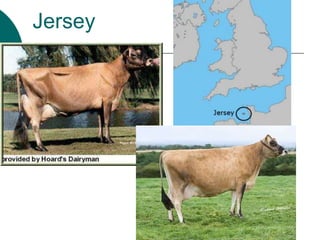
Jersey
 2nd in popularity
 Developed on the island of Jersey, off the
coast of France
 First imported early 1800s
 Coat color ranges from light tan to
almost black
 Ability to efficiently convert feed to milk
 Lower body maintenance needs
 Amount of milk produced per cow is lower
 Total solids %- highest of all breeds
Jersey
Brown Swiss
 3rd most popular
 Originated Switzerland
 Came to US in mid-18002
 Normally brown to gray
 Similar to Holsteins in size
 Known for ability to produce milk in hot
climates
 2nd in milk production
 Total solids % in middle of all breeds
Brown Swiss
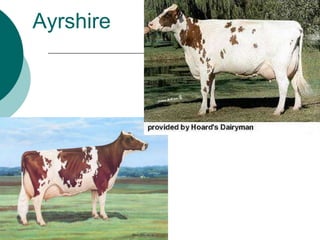
Ayrshire
 Red and white
 Imported early 1800s
 Milk production midrange of all breeds
 Total solids % low
 Originated Ayr district of Scotland
Ayrshire
Guernsey
 Developed Island of Guernsey (coast of
France)
 Imported early 1800s
 Medium sized red and white breed
 Golden Guernsey milk lower in total solids
then Jersey milk
 Deep yellow/golden milk due to beta
carotene (precursor to vitamin A)
Guernsey
Milking Shorthorn
 3,150 in 2008
 Originated from base stock of beef
shorthorns and may be red,
white, red and white or roan.
 Known for high levels of
fertility, grazing efficiency, and
ease of management
Milking Shorthorn
ID- Tell me what breed the
picture is aloud
ID- Tell me what breed the
picture is
ID- Tell me what breed the
picture is
Dairy Judging for Production
 Competition between farmers
 Compete for money and prestige within
the industry
 Dairy Cattle Judged On:
 Physical Appearance
 Fore legs, Rear Legs, Utter, Hooks, Pins,
Top Line (Spine)
 Other areas to consider when
choosing cattle for production:
 Mothering ability, efficiency on feed
and grass, Quality of Milk, Milk solids
and fat
Activity: 1 Find Answer,
all Write Round Robin
 Students will be given a packet on how to judge dairy
cattle. They will answer the questions and then judge
the pictures they are given.
 Answer the following summary questions
1. Who designed the judging booklet?
2. What categories are dairy cattle judged on? (in the front of the
packet)
1. Explain what the judge would be looking at/for each of the 4 categories.
3. Write a sentence using the following for each of the 4 categories
1. Positive Term
2. Negative Term
4. What should you do when placing a heifer class?
5. What do we find on dairy scorecard?
6. What is the typical judging format for a contest?
7. Give one helpful hint in deciding a placing
8. Explain how someone would present and prepare oral reasoning
when judging cattle
9. Why would we have these contests?
Summary
 What is Dairy judging and why it
important?
 What is the MOST important
area/category that is “graded” with
points when dairy Judging? Give an
example of a POSITIVE trait in this
category to support your answer
Summary
 Think, write share
 How are Dairy Breeds Selected?
 Judged?
 Why have this?
Dairy Cattle
Industry Overview
Warm-up: Rally Robin
Name all the DAIRY
products you know!
Activity
 Dairy Products Packets with Questions
 Review Videos
 Cheese: http://www.discovery.com/tv-
shows/dirty-jobs/videos/cheesemaker.htm
 Butter:
http://www.youtube.com/watch?v=qwb2uZL
SLhw
 Ice Cream :
http://www.youtube.com/watch?v=Tcqm6O
-Ik0U
Essential Question
 How is the Dairy industry so
efficient ?
Summarize and Share
 Summarize the process for HOW
your product is made in 3
sentences….
 Go SHARE with someone NOT in
your table line
 Your goal… Gain a basic 3 sentence
summary of ALL products
(Butter/Ice Cream/ Cheese)
Dairy Cattle Industry
 Most difficult to manage
 High producing dairy cows bred to give large
amounts of milk that can overwhelm the
animal without proper management
 Value of dairy products exceeded $37 billion
nationally
 Most labor intensive
 Milking 2-3 times a day, 7 days a week
 Consumer demand lower fat diets
 Food scientists respond with specialty
items
 Ex: Fat-free yogurt, cream cheese, and
frozen dairy deserts
Dairy Cattle Industry
Rank in Production-
top 5
California
Wisconsin
New York
Pennsylvania
Idaho
Looking at the next slide…
 Think Share
 What is this graph telling you?
 Think write share
 What trends do you see?
Dairy Cattle Industry
Dairy Cattle Industry: Important
Trend
Fewer dairy farms own
more cows but still
more milk per farm
because of more milk
per cow
Dairy Cattle Industry
 2008- 70,000 operational dairy farms
 40 years ago- 2 million dairy farms
 # of farm declines, but pounds of milk
increased by 20,000 pounds per cow
 2009- 9.2 million dairy cows in the US
produced over 185 billion pounds of milk
worth over $37 billion
 US leads the world in milk production per
cow and in total milk production
Hoard’s Dairymen Activity:
Exploring the Industry
 Complete (ON A SEPARATE SHEET
OF PAPER) page 4 of your
worksheet packet.
 This will be collected! (not your
packet, just your work provided on
the separate sheet of paper.)
Hoard’s Dairyman Activity
 Choose your magazine.
 Answer the following:
1. What is the Hoard’s Dairyman?
2. Why would this magazine be produced?
3. Choose an article in the magazine. Read the magazine.
Provide a summary. Include something interesting you
learned in the article. Why do you think this article was
written.
4. Find 3 patterns you notice throughout the magazine. Explain
the patterns
5. What sort of products do you see? What are they used for?
6. These magazines contain research related articles. Find a
research related article and explain what was researched,
why it was researched, and why dairy farmers might find the
information useful. Does the research suggest a change in
practices? If so, what changes?
7. Why would this periodical (magazine regularly printed) be an
asset to the Dairy industry?
Dairy Cattle
Milking
Pair Share Review
How did Mike Rowe Milk the
Cows?
Milking
Cows are milked 2 times
a day, some 3 times
Fill in organizer as we go
The Milking Process
1. At milking time, wash
the teats, wear gloves
Disinfecting the teats and
triggers the release of
oxytocin, which initiates
milk let-down
The Milking Process
The Milking Process
2. Teats are then dried
with individual paper
towels
The Milking Process
The Milking Process
3. One inflation of the
milking claw is placed on
each teat or quarter
The Milking Process
The Milking Process
4. Vacuum applied to
claw, which draws the
milk from the udder.
Flow meter determines
amount of milk being
produced by cow
The Milking Process
The Milking Process
5. When milk stops, flow
meter reads 0 milk
intake and milking claw
falls off automatically
The Milking Process
6. Each teat is then
dipped in Iodine to
prevent bacterial
invasion
Total time: 7 minutes
The Milking Process
Pair Share Review
 Rally Robin
 A Even Steps
 B odd Steps
 How do we milk a cow?
 Pair Share?
 What do you think is the most
important step and why?
Now What?
 Milk from all cows is collected into a
large vat (holding container)
 Normally underground to protect from
extreme temperatures
 Milk is transferred to a transport
truck and taken to the processing
plant.
What happens next!?
 Let’s Find out!
 Butter, Cheese, Ice Cream, Milk
processing activity. Answer the
questions in your packet using the
reading with a partner
 You will be assigned a specific dairy
product
 We will then summarize the process
and share with our classmates
Review
 Draw the milking process and
include what happens to milk after
it is collected from the cattle
Let’s Practice!
 Milking Lab
 Gloves, Cotton Balls
 What does the glove represent?
 What does the cotton ball
represent?
 Why is this an accurate
representation for milking?
 Why might this NOT be an accurate
representation for milking?
Dairy Cattle
Parasites and
Diseases
Pair Share
Why might diseases be extra
detrimental (bad) to the industry
and for us as consumers?
Graphic Organizer for Diseases
Disease Description Possible
prevention/tre
atment
Why its BAD in
the Dairy
industry
Mastitis Infection in the
udder,
inflammation of
mammary gland
Keep clean
before and after
milking. Allow
cattle rest on
clean areas
Mast. Milk cannot
be consumed and
will sour any milk
it comes in
contact with. It
cannot be sold
Lesson Essential Question
How can disease
influence the dairy
industry?
Mastitis
Infection and inflammation
of the udder
Causes greatest economic
loss to the industry
Acute-hot, swollen udder-
drop in milk production
Treated with antibiotics
Ketosis
Metabolic disorder with a
negative energy balance
Caused by underfeeding,
stress, other infections
Treated by IV of glucose
injections
Displaced Abomasum
“twisted stomach”
When abomasum moves to
an abnormal position
Caused by feeding too
much silage or concentrate
before calving
Veterinarian consulted for
treatment
Milk Fever
Imbalance of calcium
muscle paralysis and
prevents cows from
standing
 calcium and phosphorus
supplements to prevent
Treated with infusion of
calcium salts
Retained Placenta
Placenta not expelled after
birth
Quickly become infected
Vet remove or allow it to
hang and it will release
Caused by heat stress, low
vitamin E, and selenium in
bloodstream
Metritis
Resulting infection of a
retained placenta
Abnormal discharge from
vulva, go off feed, and
stand with backs arched
Antibiotics treat
Prolapsed Uterus
 Uterus muscles become weak
during parturition process (birthing)
 Uterus flips inside out
 Uterus exits the animal
 If this happens multiple times, the
animal will be culled (kicked out of the
herd)
Disease Summary
 BSE= Mad Cow Disease
 Read your article round robin with
your group of 4
 Then Think, Write, Share
 How did this disease possibly effect two
industries (and which two). Be sure to
explain what BSE is and how it affects
cattle (signs and symptoms) and how it
is contracted.
Dairy Cattle
Anatomy
Warm-up
Remember Dairy
Judging? What
categories were
judged? Which are
related to anatomy ?
Thought Question
How can anatomy
effect a dairy cow’s
production? (of milk)
Activity!
Fill in the pictures as we
go.
Anatomy
Anatomy: Udder
 Cows udders have
four compartments
with one test
hanging from each
 Cells remove water
and nutrients and
convert it to milk
 The milk drips into
a cistern which
holds the milk
 When teat is
squeezed, milk is
released
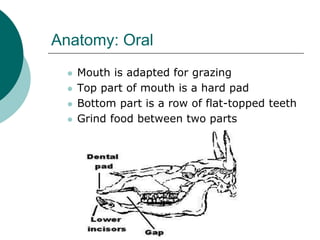
Anatomy: Oral
 Mouth is adapted for grazing
 Top part of mouth is a hard pad
 Bottom part is a row of flat-topped teeth
 Grind food between two parts
Dairy Digestion
 Using the TAN Vet Science Books
 Draw/Trace cattle digestion on pg 109
 Label your drawing
 Starting at the bottom of page 113 ..
“Cattle, Sheep and goats….” outline the
digestion process in Dairy Cattle using the
graphic organizer below
Part/ Organ What it Does/ What is going
on!?
Esophagus Hollow tube, takes food to stomach
Anatomy
Stomach and Digestion
 4 parts
 Cows swallow their food and then regurgitate a
“cud” which is then chewed well and swallowed
 Rumen- largest part, holds up to 50 gallons of
partially digested food
 Good bacteria here help break down
 Reticulum- if cow eats something it shouldn’t
have, it goes here
 Where ‘cud’ comes from
Stomach
 Omasum- the filter.
 Some water absorbed
 Filters through all the food the cow eats.
 Cud is pressed and broken down further
 Abomasum- this part like the humans
stomach
 “True Stomach”
 Food is finally digested here
 Essential nutrients are passed to the
bloodstream
 Remainder passed to the intestines
Using Your Animal Science
Books…
 Find a chapter that discusses
ruminant digestion
 Outline the steps to the process of
digestion in a ruminant. Be sure to
include what is happening at each
step
Digestion in Ruminants 10 Step
Program. Did you get them all!?
 1. Forage- Find food
 2. Masticate- Chew Food
 3. Swallow
 4. Rumen: Food fermented and broken down
 5. Reticulum: cud thrown up into mouth
 6. Remastication: rechewed and re swallowed
 7. Omasum: food broken down more, some
water absorbed
 8. Abomasum: True Stomach, digestion starts
here
 9. Intestines
 10. Out as manure
Activity
 Compare/Contrast
 Bovine, Canine, and Human dental
anatomy
Dairy Cattle
Management
Management Sections
 Housing
 Milking
 Nutrition
 Breeding
Warm-up: Pair Share
 Where would YOU rather live and
why?
Big ideas to understand…
 Dairy cattle are grouped by ages, life
stages, and purpose
 Put the following housing stages into
categories where you feel they fit… either Age:
Life Stage: or Purpose or IDK what this word
even means…
 Discuss with your face partner one word, its
category, and WHY you placed it there
Newborn, Heifer, Gestating, Lactating, Calving, Nursery,
Adult, Dry Cow, Calf
Newborn and Young
Calves Housing
 Individual stalls, inside or outside
 Better ventilation outside
 Less respiratory disease
 Calf hutches popular after weaning
 At 8 weeks, heifers
normally grouped with
other heifers of similar
age
 Separate heifer growing
barn
 Open front sheds are also
popular
Traditional Housing: One
year +
 Tie-stall barns- tied to individual stalls during
milking and the rest of the day released into
pasture at night in summer
 Free-stall housing- allow cows to enter and
leave as they wish. Feed bunk at center. Milked
in tie-stalls or a milking parlour
Traditional Milking
 Parlour System- cows come to the milker.
 Group enters at a time- udders at chest level
for milker in a pit. All cows washed and milked
at same time. Increase # of cows a person can
milk per hour
 Robotic Milking
system- reduce
milking labor
requirements. Allow
cows access 24 hours a
day. Sensors
Robotic Milker “anatomy”
Calf Care/Nutrition
 Starts within 24 hours of birth
 Colostrum- first milk
 Calves are weaned immediately after
receiving colostrum
 Cows returned to the milking herd after
parturition
 Parturition- giving birth in cows
 Calves raised by humans
 Replace milk with water gradually
 12 weeks to 1 year- fed a grain mix
Heifer Nutrition
 Heifer: Female who has not given birth
yet (1 to 2 years old)
 After breeding, heifers fed free-choice,
high-quality forage
 Grain mix may be added to ensure proper
development and provide minerals and
vitamins since farmer is “hoping”
heifer is preg
 High protein food allows for cow to
“carry” her calf nutritionally
Lactating Dairy Cows
 Lactating: producing milk
 Lactating cows require high quality food
to sustain good milk production
 Normally lasts about 10 months
 Nutritional needs dependent on body size
and milk production
 Cows are “dry” (milking stopped) about 60
days before the next expected calf
 Dry cow: not producing milk. This is a
“rest” period
Dry Dairy Cattle
 Cows are “dry” (milking stopped) about 60
days before the next expected calf
 Dry cow: not producing milk. This is a
“rest” period
Dry cows fed a diet of forages.
Not high quality
Often fed grain to provide
vitamins, minerals and salt
Breeding
 Most dairy cows in the US are purebreds
 First to adopt artificial insemination on a large
scale
 Most dairy cows are a result of artificial
insemination
 Artificial insemination (AI)- placing of sperm
in the reproductive tract of the female by
means other than that of the natural breeding
process
 Producers using AI release cows to watch for
standing heat at least twice a day
 Standing heat- animal will “stand” and accept
being mounted as a sign of being ready to
mate
Breeding
 After Heat is detected:
 Animal will be separated and
AI-ed with chosen semen
 Based on the mother’s cow
“defects”, appropriate semen will
be chosen from a stockpile/bank
to improve the next generation
(her calf)
 Example: Too high in the tail, bull
semen from a bull with a lower tail
head would be used to ensure the
calf has a low tail head. (From Mike Rowe
video!)
Activity
IT IS ON YOUR TEST!!
 Graphic organizer/Representation
Dairy farms work on a cycle of activity.
Depict this cycle and use the following
vocabulary words
 Parturition, AI, Milking, Lactating,
Dry, Heifer, Calf, Weaned, Colostrum,
Pregnancy, High Protein Diet, Milk
Replacer, Grass (not high quality)
 START WITH HEIFER
Dairy Management Video
 Have your packet out to answer the
questions
 This serves as a great REVIEW of
this unit!
Dirty Jobs Video
 25 THINGS YOU LEARNED ABOUT
(Vocab or fact) that is mentioned in
the Dirty Jobs Video
Test Review
 Define: Ruminant, Dairy Cow, Iodine Solution,
Parturition, Free Range, Heifer, Lactating, Dry Cow,
Inflation, Claw, AI, Rumen, Abomasum, Omasum,
Reticulum, Rumination
 Explain the 10 steps in ruminant digestion.
1. What are the 2 types of Housing?
2. What are the steps in the milking process?
3. What is the current trend in the dairy industry?
4. Dairy Gross External and Internal Anatomy
5. Top producing states
6. Top Dairy Breeds and including characteristics
7. Explain what we look for in Dairy Judging?
8. What are common activities that happen daily on a dairy farm?
(think video!) Know the purpose of each
9. How do we manage (house) cattle throughout their life (3
categories) know an example of each and HOW they are housed…
10. Explain special features of ruminant prehension methods and each
stomach compartment
11. Know common dairy diseases, their description and symptoms.

Dairy CattleFINAL.ppt

  • 1.
  • 2.
    Unit Map: FollowAlong in your packet WHAT ARE YOU LEARNING? AS.06.02 Basic: Recognize, ID, and Eval disease and parasites in animals AS.03.01: ID breeds and species
  • 3.
    Know Understand Do! Know Types of Dairy Cattle  Industry Procedures  Care Procedures Understand  Variation in cattle purposes  Milking and Dairy Food Processing  Disease Prevention Methods Do  Profile Dairy Cattle  Outline Milking  ID common Diseases
  • 4.
    Key Learning: DairyCattle Industry  Unit EQ: How can consumers influence the Dairy Industry? Concept : Care and Diseases Lesson EQ: How can disease effect industry? Vocab Mastitis, Milk Fever, Prolapse Concept : Industry Lesson EQ: How is the Dairy industry so efficient? Vocab Iodine Solution, Milking Claw, Specialty Product Concept : Types Lesson EQ: How are dairy breeds selected? Vocab Milk Fat, Efficiency, Dairy Breed
  • 5.
    Dirty Jobs DairyCow Midwife: Intro Video Activity in Video 2 Sent Description 2 words you Don’t Know , or that were defined Cleaning Stalls Milking Manure management Artificial Insemination Calving Emergency “C” Section
  • 6.
    Let’s Review Mike’sActivities Activity Where we will Discuss in this Unit Cleaning stalls Management and care Milking Products and Industry Manure management Management and care Artificial Insemination Management and care Calving Anatomy, Management C Section Anatomy and Care and Diseases
  • 7.
  • 8.
    Warm-up First thing thatcomes to mind when you see….
  • 9.
    Lesson Essential Question Howare Dairy Breeds Selected?
  • 10.
    Graphic Organizer Breed LooksLike Is a good dairy cow because …
  • 11.
    Holstein  Dominate theindustry  +90% of the dairy cattle in the US  Officially known as Holstein-Fresians  From Netherlands and Northern Germany  Arrived in US in mid-1800s  Typically black and white in color  Total milk solids % are lower  Solids refer to milk fat solids found in milk. These are used to determine quality and use of the milk produced by that breed of cattle
  • 12.
  • 13.
    Jersey  2nd inpopularity  Developed on the island of Jersey, off the coast of France  First imported early 1800s  Coat color ranges from light tan to almost black  Ability to efficiently convert feed to milk  Lower body maintenance needs  Amount of milk produced per cow is lower  Total solids %- highest of all breeds
  • 14.
  • 15.
    Brown Swiss  3rdmost popular  Originated Switzerland  Came to US in mid-18002  Normally brown to gray  Similar to Holsteins in size  Known for ability to produce milk in hot climates  2nd in milk production  Total solids % in middle of all breeds
  • 16.
  • 17.
    Ayrshire  Red andwhite  Imported early 1800s  Milk production midrange of all breeds  Total solids % low  Originated Ayr district of Scotland
  • 18.
  • 19.
    Guernsey  Developed Islandof Guernsey (coast of France)  Imported early 1800s  Medium sized red and white breed  Golden Guernsey milk lower in total solids then Jersey milk  Deep yellow/golden milk due to beta carotene (precursor to vitamin A)
  • 20.
  • 21.
    Milking Shorthorn  3,150in 2008  Originated from base stock of beef shorthorns and may be red, white, red and white or roan.  Known for high levels of fertility, grazing efficiency, and ease of management
  • 22.
  • 23.
    ID- Tell mewhat breed the picture is aloud
  • 24.
    ID- Tell mewhat breed the picture is
  • 25.
    ID- Tell mewhat breed the picture is
  • 26.
    Dairy Judging forProduction  Competition between farmers  Compete for money and prestige within the industry  Dairy Cattle Judged On:  Physical Appearance  Fore legs, Rear Legs, Utter, Hooks, Pins, Top Line (Spine)  Other areas to consider when choosing cattle for production:  Mothering ability, efficiency on feed and grass, Quality of Milk, Milk solids and fat
  • 27.
    Activity: 1 FindAnswer, all Write Round Robin  Students will be given a packet on how to judge dairy cattle. They will answer the questions and then judge the pictures they are given.  Answer the following summary questions 1. Who designed the judging booklet? 2. What categories are dairy cattle judged on? (in the front of the packet) 1. Explain what the judge would be looking at/for each of the 4 categories. 3. Write a sentence using the following for each of the 4 categories 1. Positive Term 2. Negative Term 4. What should you do when placing a heifer class? 5. What do we find on dairy scorecard? 6. What is the typical judging format for a contest? 7. Give one helpful hint in deciding a placing 8. Explain how someone would present and prepare oral reasoning when judging cattle 9. Why would we have these contests?
  • 28.
    Summary  What isDairy judging and why it important?  What is the MOST important area/category that is “graded” with points when dairy Judging? Give an example of a POSITIVE trait in this category to support your answer
  • 29.
    Summary  Think, writeshare  How are Dairy Breeds Selected?  Judged?  Why have this?
  • 30.
  • 31.
    Warm-up: Rally Robin Nameall the DAIRY products you know!
  • 32.
    Activity  Dairy ProductsPackets with Questions  Review Videos  Cheese: http://www.discovery.com/tv- shows/dirty-jobs/videos/cheesemaker.htm  Butter: http://www.youtube.com/watch?v=qwb2uZL SLhw  Ice Cream : http://www.youtube.com/watch?v=Tcqm6O -Ik0U
  • 33.
    Essential Question  Howis the Dairy industry so efficient ?
  • 34.
    Summarize and Share Summarize the process for HOW your product is made in 3 sentences….  Go SHARE with someone NOT in your table line  Your goal… Gain a basic 3 sentence summary of ALL products (Butter/Ice Cream/ Cheese)
  • 35.
    Dairy Cattle Industry Most difficult to manage  High producing dairy cows bred to give large amounts of milk that can overwhelm the animal without proper management  Value of dairy products exceeded $37 billion nationally  Most labor intensive  Milking 2-3 times a day, 7 days a week  Consumer demand lower fat diets  Food scientists respond with specialty items  Ex: Fat-free yogurt, cream cheese, and frozen dairy deserts
  • 37.
    Dairy Cattle Industry Rankin Production- top 5 California Wisconsin New York Pennsylvania Idaho
  • 38.
    Looking at thenext slide…  Think Share  What is this graph telling you?  Think write share  What trends do you see?
  • 39.
  • 40.
    Dairy Cattle Industry:Important Trend Fewer dairy farms own more cows but still more milk per farm because of more milk per cow
  • 41.
    Dairy Cattle Industry 2008- 70,000 operational dairy farms  40 years ago- 2 million dairy farms  # of farm declines, but pounds of milk increased by 20,000 pounds per cow  2009- 9.2 million dairy cows in the US produced over 185 billion pounds of milk worth over $37 billion  US leads the world in milk production per cow and in total milk production
  • 42.
    Hoard’s Dairymen Activity: Exploringthe Industry  Complete (ON A SEPARATE SHEET OF PAPER) page 4 of your worksheet packet.  This will be collected! (not your packet, just your work provided on the separate sheet of paper.)
  • 43.
    Hoard’s Dairyman Activity Choose your magazine.  Answer the following: 1. What is the Hoard’s Dairyman? 2. Why would this magazine be produced? 3. Choose an article in the magazine. Read the magazine. Provide a summary. Include something interesting you learned in the article. Why do you think this article was written. 4. Find 3 patterns you notice throughout the magazine. Explain the patterns 5. What sort of products do you see? What are they used for? 6. These magazines contain research related articles. Find a research related article and explain what was researched, why it was researched, and why dairy farmers might find the information useful. Does the research suggest a change in practices? If so, what changes? 7. Why would this periodical (magazine regularly printed) be an asset to the Dairy industry?
  • 44.
  • 45.
    Pair Share Review Howdid Mike Rowe Milk the Cows?
  • 46.
    Milking Cows are milked2 times a day, some 3 times Fill in organizer as we go
  • 47.
    The Milking Process 1.At milking time, wash the teats, wear gloves Disinfecting the teats and triggers the release of oxytocin, which initiates milk let-down
  • 48.
  • 49.
    The Milking Process 2.Teats are then dried with individual paper towels
  • 50.
  • 51.
    The Milking Process 3.One inflation of the milking claw is placed on each teat or quarter
  • 52.
  • 53.
    The Milking Process 4.Vacuum applied to claw, which draws the milk from the udder. Flow meter determines amount of milk being produced by cow
  • 54.
  • 55.
    The Milking Process 5.When milk stops, flow meter reads 0 milk intake and milking claw falls off automatically
  • 56.
    The Milking Process 6.Each teat is then dipped in Iodine to prevent bacterial invasion Total time: 7 minutes
  • 57.
  • 58.
    Pair Share Review Rally Robin  A Even Steps  B odd Steps  How do we milk a cow?  Pair Share?  What do you think is the most important step and why?
  • 59.
    Now What?  Milkfrom all cows is collected into a large vat (holding container)  Normally underground to protect from extreme temperatures  Milk is transferred to a transport truck and taken to the processing plant.
  • 60.
    What happens next!? Let’s Find out!  Butter, Cheese, Ice Cream, Milk processing activity. Answer the questions in your packet using the reading with a partner  You will be assigned a specific dairy product  We will then summarize the process and share with our classmates
  • 61.
    Review  Draw themilking process and include what happens to milk after it is collected from the cattle
  • 62.
    Let’s Practice!  MilkingLab  Gloves, Cotton Balls  What does the glove represent?  What does the cotton ball represent?  Why is this an accurate representation for milking?  Why might this NOT be an accurate representation for milking?
  • 63.
  • 64.
    Pair Share Why mightdiseases be extra detrimental (bad) to the industry and for us as consumers?
  • 65.
    Graphic Organizer forDiseases Disease Description Possible prevention/tre atment Why its BAD in the Dairy industry Mastitis Infection in the udder, inflammation of mammary gland Keep clean before and after milking. Allow cattle rest on clean areas Mast. Milk cannot be consumed and will sour any milk it comes in contact with. It cannot be sold
  • 66.
    Lesson Essential Question Howcan disease influence the dairy industry?
  • 67.
    Mastitis Infection and inflammation ofthe udder Causes greatest economic loss to the industry Acute-hot, swollen udder- drop in milk production Treated with antibiotics
  • 68.
    Ketosis Metabolic disorder witha negative energy balance Caused by underfeeding, stress, other infections Treated by IV of glucose injections
  • 69.
    Displaced Abomasum “twisted stomach” Whenabomasum moves to an abnormal position Caused by feeding too much silage or concentrate before calving Veterinarian consulted for treatment
  • 70.
    Milk Fever Imbalance ofcalcium muscle paralysis and prevents cows from standing  calcium and phosphorus supplements to prevent Treated with infusion of calcium salts
  • 71.
    Retained Placenta Placenta notexpelled after birth Quickly become infected Vet remove or allow it to hang and it will release Caused by heat stress, low vitamin E, and selenium in bloodstream
  • 72.
    Metritis Resulting infection ofa retained placenta Abnormal discharge from vulva, go off feed, and stand with backs arched Antibiotics treat
  • 73.
    Prolapsed Uterus  Uterusmuscles become weak during parturition process (birthing)  Uterus flips inside out  Uterus exits the animal  If this happens multiple times, the animal will be culled (kicked out of the herd)
  • 74.
    Disease Summary  BSE=Mad Cow Disease  Read your article round robin with your group of 4  Then Think, Write, Share  How did this disease possibly effect two industries (and which two). Be sure to explain what BSE is and how it affects cattle (signs and symptoms) and how it is contracted.
  • 75.
  • 76.
    Warm-up Remember Dairy Judging? What categorieswere judged? Which are related to anatomy ?
  • 77.
    Thought Question How cananatomy effect a dairy cow’s production? (of milk)
  • 78.
    Activity! Fill in thepictures as we go.
  • 79.
  • 80.
    Anatomy: Udder  Cowsudders have four compartments with one test hanging from each  Cells remove water and nutrients and convert it to milk  The milk drips into a cistern which holds the milk  When teat is squeezed, milk is released
  • 81.
    Anatomy: Oral  Mouthis adapted for grazing  Top part of mouth is a hard pad  Bottom part is a row of flat-topped teeth  Grind food between two parts
  • 82.
    Dairy Digestion  Usingthe TAN Vet Science Books  Draw/Trace cattle digestion on pg 109  Label your drawing  Starting at the bottom of page 113 .. “Cattle, Sheep and goats….” outline the digestion process in Dairy Cattle using the graphic organizer below Part/ Organ What it Does/ What is going on!? Esophagus Hollow tube, takes food to stomach
  • 83.
  • 84.
    Stomach and Digestion 4 parts  Cows swallow their food and then regurgitate a “cud” which is then chewed well and swallowed  Rumen- largest part, holds up to 50 gallons of partially digested food  Good bacteria here help break down  Reticulum- if cow eats something it shouldn’t have, it goes here  Where ‘cud’ comes from
  • 85.
    Stomach  Omasum- thefilter.  Some water absorbed  Filters through all the food the cow eats.  Cud is pressed and broken down further  Abomasum- this part like the humans stomach  “True Stomach”  Food is finally digested here  Essential nutrients are passed to the bloodstream  Remainder passed to the intestines
  • 86.
    Using Your AnimalScience Books…  Find a chapter that discusses ruminant digestion  Outline the steps to the process of digestion in a ruminant. Be sure to include what is happening at each step
  • 87.
    Digestion in Ruminants10 Step Program. Did you get them all!?  1. Forage- Find food  2. Masticate- Chew Food  3. Swallow  4. Rumen: Food fermented and broken down  5. Reticulum: cud thrown up into mouth  6. Remastication: rechewed and re swallowed  7. Omasum: food broken down more, some water absorbed  8. Abomasum: True Stomach, digestion starts here  9. Intestines  10. Out as manure
  • 88.
    Activity  Compare/Contrast  Bovine,Canine, and Human dental anatomy
  • 89.
  • 90.
    Management Sections  Housing Milking  Nutrition  Breeding
  • 91.
    Warm-up: Pair Share Where would YOU rather live and why?
  • 92.
    Big ideas tounderstand…  Dairy cattle are grouped by ages, life stages, and purpose  Put the following housing stages into categories where you feel they fit… either Age: Life Stage: or Purpose or IDK what this word even means…  Discuss with your face partner one word, its category, and WHY you placed it there Newborn, Heifer, Gestating, Lactating, Calving, Nursery, Adult, Dry Cow, Calf
  • 93.
    Newborn and Young CalvesHousing  Individual stalls, inside or outside  Better ventilation outside  Less respiratory disease  Calf hutches popular after weaning  At 8 weeks, heifers normally grouped with other heifers of similar age  Separate heifer growing barn  Open front sheds are also popular
  • 94.
    Traditional Housing: One year+  Tie-stall barns- tied to individual stalls during milking and the rest of the day released into pasture at night in summer  Free-stall housing- allow cows to enter and leave as they wish. Feed bunk at center. Milked in tie-stalls or a milking parlour
  • 95.
    Traditional Milking  ParlourSystem- cows come to the milker.  Group enters at a time- udders at chest level for milker in a pit. All cows washed and milked at same time. Increase # of cows a person can milk per hour  Robotic Milking system- reduce milking labor requirements. Allow cows access 24 hours a day. Sensors
  • 96.
  • 97.
    Calf Care/Nutrition  Startswithin 24 hours of birth  Colostrum- first milk  Calves are weaned immediately after receiving colostrum  Cows returned to the milking herd after parturition  Parturition- giving birth in cows  Calves raised by humans  Replace milk with water gradually  12 weeks to 1 year- fed a grain mix
  • 98.
    Heifer Nutrition  Heifer:Female who has not given birth yet (1 to 2 years old)  After breeding, heifers fed free-choice, high-quality forage  Grain mix may be added to ensure proper development and provide minerals and vitamins since farmer is “hoping” heifer is preg  High protein food allows for cow to “carry” her calf nutritionally
  • 99.
    Lactating Dairy Cows Lactating: producing milk  Lactating cows require high quality food to sustain good milk production  Normally lasts about 10 months  Nutritional needs dependent on body size and milk production  Cows are “dry” (milking stopped) about 60 days before the next expected calf  Dry cow: not producing milk. This is a “rest” period
  • 100.
    Dry Dairy Cattle Cows are “dry” (milking stopped) about 60 days before the next expected calf  Dry cow: not producing milk. This is a “rest” period Dry cows fed a diet of forages. Not high quality Often fed grain to provide vitamins, minerals and salt
  • 101.
    Breeding  Most dairycows in the US are purebreds  First to adopt artificial insemination on a large scale  Most dairy cows are a result of artificial insemination  Artificial insemination (AI)- placing of sperm in the reproductive tract of the female by means other than that of the natural breeding process  Producers using AI release cows to watch for standing heat at least twice a day  Standing heat- animal will “stand” and accept being mounted as a sign of being ready to mate
  • 102.
    Breeding  After Heatis detected:  Animal will be separated and AI-ed with chosen semen  Based on the mother’s cow “defects”, appropriate semen will be chosen from a stockpile/bank to improve the next generation (her calf)  Example: Too high in the tail, bull semen from a bull with a lower tail head would be used to ensure the calf has a low tail head. (From Mike Rowe video!)
  • 103.
    Activity IT IS ONYOUR TEST!!  Graphic organizer/Representation Dairy farms work on a cycle of activity. Depict this cycle and use the following vocabulary words  Parturition, AI, Milking, Lactating, Dry, Heifer, Calf, Weaned, Colostrum, Pregnancy, High Protein Diet, Milk Replacer, Grass (not high quality)  START WITH HEIFER
  • 104.
    Dairy Management Video Have your packet out to answer the questions  This serves as a great REVIEW of this unit!
  • 105.
    Dirty Jobs Video 25 THINGS YOU LEARNED ABOUT (Vocab or fact) that is mentioned in the Dirty Jobs Video
  • 106.
    Test Review  Define:Ruminant, Dairy Cow, Iodine Solution, Parturition, Free Range, Heifer, Lactating, Dry Cow, Inflation, Claw, AI, Rumen, Abomasum, Omasum, Reticulum, Rumination  Explain the 10 steps in ruminant digestion. 1. What are the 2 types of Housing? 2. What are the steps in the milking process? 3. What is the current trend in the dairy industry? 4. Dairy Gross External and Internal Anatomy 5. Top producing states 6. Top Dairy Breeds and including characteristics 7. Explain what we look for in Dairy Judging? 8. What are common activities that happen daily on a dairy farm? (think video!) Know the purpose of each 9. How do we manage (house) cattle throughout their life (3 categories) know an example of each and HOW they are housed… 10. Explain special features of ruminant prehension methods and each stomach compartment 11. Know common dairy diseases, their description and symptoms.