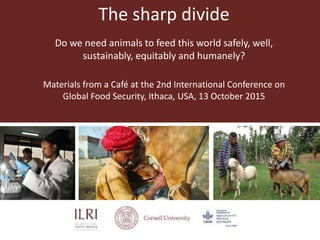
The sharp divide
Do we need animals to feed this world safely, well,
sustainably, equitably and humanely?
Materials from a Café at the 2nd International Conference on
Global Food Security, Ithaca, USA, 13 October 2015
Background
• Livestock, the fastest-growing, highest-value and a highly controversial
agriculture sector, is at a crossroads. Following a new set of 17 sustainable
development goals, the current and potential roles of livestock systems in
food and nutrition security and other aspects of sustainable development,
including the environment, human health and livelihoods, continue to be
debated.
• Opinions are sharply divided in the industrialized world between those
who consider animals to be more part of the solution and those who
consider them to be more part of the problem.
• Using the format of lively and critical debate led by key players in the
livestock food system, workshop participants will identify challenges and
formulate actionable responses to advance the roles livestock play in
sustainable global food security.
Agenda
• Welcome by the co-chairs
• Short presentations
– We have to have more meat, eggs, milk and
animals – Delia Grace
– We want to have more meat, eggs, milk and
animals – Chris Delgado
– We mustn’t have more meat, eggs, milk and
animals – Tara Garnett
• Group exercises and feedback
Delia Grace
Why the world must eat animal-
source foods
Nutritional divides
Animal-source foods are a big part of meeting global nutritional
as well as food needs and demands.
Of the world’s 7 billion people, only a small percentage are fed
and nourished.
It is a shocking indictment of the global food system that, in the
21st century, most of the world’s population have sub-optimal
diets:
1 billion going to bed hungry
2 billion are vulnerable to food insecurity
1 billion have diets that do not meet all their nutritional
requirements
1 billion suffer the effects of over-consumption
Nutritional divides among 7 billion people today
hungry people
vulnerable to food
insecurity
inadequate diets
overconsumers
balanced diets
Billions could benefit from more Animal-Source Foods (ASF)
Billions could benefit from safer ASF
• 100% of raw and pasteurised milk in Assam
fails standards
• 24% of boiled milk in Abidjan unacceptable for
B. cereus
• 98% of meat in Ibadan unacceptable
• 30% of intensive chicken in South Africa
unacceptable for S. aureus
• 77% farmed fish in Egypt unacceptable bacteria
• 46% of Nairobi milk and 93% of Addis milk
unacceptable aflatoxins
ASF supports diets and livelihoods
 500 million smallholders produce 80% of food in poor
countries.
 43% of the workforce are women.
% production by smallholder livestock farms
Beef Chicken
(meat)
Small ruminant
(meat)
Milk Pork Eggs
East Africa >85 60-90
Bangladesh 65 77 78 65 77
India (< 2ha land) 75 92 92 69 71
Thailand 43 37
Vietnam 95 80
The ‘Goldilocks’ solution
Not too little
Not too much
Just right!
Goldilocks syndrome: Just 20 grams of animal-derived protein
a day ---such as in half a litre (2.5 cups) of milk, 80 grams (2.8
ounces) of beef, or 2.5 eggs --- can combat under-nutrition,
helping children to develop to their full potential.
Chris Delgado
Why the world wants to eat animal-
source foods
Actual average consumption of animal-based protein since 1961 and
projected to 2050 in selected countries based on FAO
g/capita/day
United States
Japan
European Union
Brazil
WORLD
China
India
Indonesia
Nigeria
Ethiopia
0
10
20
30
40
50
60
70
80
1961 1970 1980 1990 2000 2010 2020 2030 2040 2050
FAO (2015) data 1961–2011 Alexandratos & Bruinsma, 2012, interpolated
Note: The Alexandratos & Bruinsma 2012 projections covered 2006-2050. Their trend result was carried
forward here from the FAOStat actual data point for 2011.
Source: J. Ranganathan et al., Shifting Diets, Installment 11 of the World Resources Report, WRI, forthcoming.
Consumer-Level Ratios of Beef to Pork in the US
2006-2014
1.00
1.05
1.10
1.15
1.20
1.25
1.30
1.35
1.40
1.45
2006 2007 2008 2009 2010 2011 2012 2013 2014
Consumption Prices
Ratio of Per Capita
Consumption by Weight
Ratio of Retail
Prices
Source: Data from USDA (various)
In a nutshell, demand for animal protein
• May have peaked in recent years in some of the OECD countries
• May rise again even there, depending on incomes, but prices and
quality will drive product choices (pork versus beef, say)
• Has without doubt risen rapidly and broadly since the early 1980s in
the emerging countries (developing countries are more than 2/3 of
global consumption meat now, up from less than 1/3 in 1980)
• It will likely continue to do so as the global middle class doubles by
2030 and will continue to expand
• Consumption is still too low now on even an average basis in the
poorest countries (< 10 g/capita/day all animal-sourced compared to
norm of 50 g all sources)
• Poorest people are below averages and likely way below needs for
protein and micronutrients that animal-source foods are often best
at delivering under developing country (esp. rural) conditions
Tara Garnett
Why the world must not eat animal-
source foods
14.5% global
GHG emissions
Drive
deforestation
Eat 40% grains
produced
Use 70% of
farmland
Use 17% of
agricultural
irrigation water
Pollute water
sources
Farming animals for meat, milk & eggs: bads now outweighing goods
BUT over
0.75bn poor
people
depend on
animal
farming
70% diseases
from
wild/farmed
animals
People like
meat; culturally
important
Make use of
byproducts and
leftover land
Too much is not good
for you
Rich in protein &
essential nutrients Leather, wool, glues
SI, waste
cuts, diet
shifts
Bajželj et al. 2014
16
BAU,waste
cuts, diet
changes
BAU
yields
BAU &
waste
cuts
SI SI &
waste cuts
Climate change: production improvements & waste management necessary but not sufficient
Bajželj et al. 2014
Changes in diets (higher consumption of meat, sugars, refined fats
and oils) have contributed to increases in Type II diabetes,
coronary heart disease and other diseases.
Lower GHG-emitting diets such as a Mediterranean diet (more
vegetable- and fish-based, but some meat), pescetarian diets and
vegetarian diets have been linked to reductions in the incidence
of such diseases.
Adoption of such diets is predicted to have environmental
benefits in terms of both lower GHG emissions and reduced land-
use requirements, compared to both a 2009 “average” global diet,
and an income-dependent predicted diet based on the 2009
average.
Improvement
on status quo
Tilman & Clark 2014. Global diets link environmental
sustainability and human health Nature 515, 518–522
Emerging academic consensus: health-environment synergies possible
Most fat people live
in developing
countries
Source: ODI. 2014. Future
Diets
Group exercises to discuss the
dimensions of livestock
development most likely to
contribute to sustainable food
security
Group process
1. Participatory matrix scoring. Participants are asked to assign 20 ‘beans’ to
6 different dimensions where actions are most likely to advance the roles
livestock play in sustainable global food security. More beans=more
likelihood of advancement.
2. The six dimensions were: Economics/Livelihoods, Equity, Environment,
Nutrition/Health, Resilience, and Productivity
3. Rapporteur records choices in an xls file.
4. Rapporteurs also record gender, ‘development perspective’ (north versus
south) and ‘animal products perspective’ (1) “we have to …” 2) “we want
to …” 3) “we mustn’t … “ have more meat, eggs, milk and animals)
5. Participants discuss choices
6. Excel charts are generated for each group, and for the room as a whole.
Feedback from the group exercises
The charts show how different
categories of people in the room
ranked different intervention
dimensions
Differences between development
and consumption categories could
be explained. Differences by gender
were more difficult to explain.
0
1
2
3
4
5
6
7
Equity
Economics/Livelihoods
Environment
Resilience
Productivity
Nutrition/Health
PERCEIVED IMPORTANCE OF DIMENSIONS
BY CONSUMPTION PERSPECTIVE
have to want to mustn't
0
1
2
3
4
5
6
Equity
Economics/Livelihoods
Environment
Resilience
Productivity
Nutrition/Health
PERCEIVED IMPORTANCE OF DIMENSIONS
BY DEVELOPMENT PERSPECTIVE
north south
0
1
2
3
4
5
6
Equity
Economics/Livelihoods
Environment
Resilience
Productivity
Nutrition/Health
PERCEIVED IMPORTANCE OF DIMENSIONS
BY GENDER
female male
Acknowledgements
The initial co-chairs were Alice Pell (Cornell University) and
Shirley Tarawali (ILRI). Tarawali was replaced by Delia Grace on
the day.
The scoring exercise was designed by Peter Ballantyne (ILRI)
adapted from a tool developed by Alan Duncan (ILRI).
Our thanks also to Andrew Mude, Susan MacMillan, Ylva Ran
and others who contributed to the plenary process or
rapporteured the groups.
The presentation has a Creative Commons license. You are free to re-use or distribute this work, provided credit is given to ILRI.
better lives through livestock
ilri.org

The sharp divide: Do we need animals to feed this world safely, well, sustainably, equitably and humanely?

  • 1.
    The sharp divide Dowe need animals to feed this world safely, well, sustainably, equitably and humanely? Materials from a Café at the 2nd International Conference on Global Food Security, Ithaca, USA, 13 October 2015
  • 2.
    Background • Livestock, thefastest-growing, highest-value and a highly controversial agriculture sector, is at a crossroads. Following a new set of 17 sustainable development goals, the current and potential roles of livestock systems in food and nutrition security and other aspects of sustainable development, including the environment, human health and livelihoods, continue to be debated. • Opinions are sharply divided in the industrialized world between those who consider animals to be more part of the solution and those who consider them to be more part of the problem. • Using the format of lively and critical debate led by key players in the livestock food system, workshop participants will identify challenges and formulate actionable responses to advance the roles livestock play in sustainable global food security.
  • 3.
    Agenda • Welcome bythe co-chairs • Short presentations – We have to have more meat, eggs, milk and animals – Delia Grace – We want to have more meat, eggs, milk and animals – Chris Delgado – We mustn’t have more meat, eggs, milk and animals – Tara Garnett • Group exercises and feedback
  • 4.
    Delia Grace Why theworld must eat animal- source foods
  • 5.
    Nutritional divides Animal-source foodsare a big part of meeting global nutritional as well as food needs and demands. Of the world’s 7 billion people, only a small percentage are fed and nourished. It is a shocking indictment of the global food system that, in the 21st century, most of the world’s population have sub-optimal diets: 1 billion going to bed hungry 2 billion are vulnerable to food insecurity 1 billion have diets that do not meet all their nutritional requirements 1 billion suffer the effects of over-consumption
  • 6.
    Nutritional divides among7 billion people today hungry people vulnerable to food insecurity inadequate diets overconsumers balanced diets Billions could benefit from more Animal-Source Foods (ASF)
  • 7.
    Billions could benefitfrom safer ASF • 100% of raw and pasteurised milk in Assam fails standards • 24% of boiled milk in Abidjan unacceptable for B. cereus • 98% of meat in Ibadan unacceptable • 30% of intensive chicken in South Africa unacceptable for S. aureus • 77% farmed fish in Egypt unacceptable bacteria • 46% of Nairobi milk and 93% of Addis milk unacceptable aflatoxins
  • 8.
    ASF supports dietsand livelihoods  500 million smallholders produce 80% of food in poor countries.  43% of the workforce are women. % production by smallholder livestock farms Beef Chicken (meat) Small ruminant (meat) Milk Pork Eggs East Africa >85 60-90 Bangladesh 65 77 78 65 77 India (< 2ha land) 75 92 92 69 71 Thailand 43 37 Vietnam 95 80
  • 9.
    The ‘Goldilocks’ solution Nottoo little Not too much Just right! Goldilocks syndrome: Just 20 grams of animal-derived protein a day ---such as in half a litre (2.5 cups) of milk, 80 grams (2.8 ounces) of beef, or 2.5 eggs --- can combat under-nutrition, helping children to develop to their full potential.
  • 10.
    Chris Delgado Why theworld wants to eat animal- source foods
  • 11.
    Actual average consumptionof animal-based protein since 1961 and projected to 2050 in selected countries based on FAO g/capita/day United States Japan European Union Brazil WORLD China India Indonesia Nigeria Ethiopia 0 10 20 30 40 50 60 70 80 1961 1970 1980 1990 2000 2010 2020 2030 2040 2050 FAO (2015) data 1961–2011 Alexandratos & Bruinsma, 2012, interpolated Note: The Alexandratos & Bruinsma 2012 projections covered 2006-2050. Their trend result was carried forward here from the FAOStat actual data point for 2011. Source: J. Ranganathan et al., Shifting Diets, Installment 11 of the World Resources Report, WRI, forthcoming.
  • 12.
    Consumer-Level Ratios ofBeef to Pork in the US 2006-2014 1.00 1.05 1.10 1.15 1.20 1.25 1.30 1.35 1.40 1.45 2006 2007 2008 2009 2010 2011 2012 2013 2014 Consumption Prices Ratio of Per Capita Consumption by Weight Ratio of Retail Prices Source: Data from USDA (various)
  • 13.
    In a nutshell,demand for animal protein • May have peaked in recent years in some of the OECD countries • May rise again even there, depending on incomes, but prices and quality will drive product choices (pork versus beef, say) • Has without doubt risen rapidly and broadly since the early 1980s in the emerging countries (developing countries are more than 2/3 of global consumption meat now, up from less than 1/3 in 1980) • It will likely continue to do so as the global middle class doubles by 2030 and will continue to expand • Consumption is still too low now on even an average basis in the poorest countries (< 10 g/capita/day all animal-sourced compared to norm of 50 g all sources) • Poorest people are below averages and likely way below needs for protein and micronutrients that animal-source foods are often best at delivering under developing country (esp. rural) conditions
  • 14.
    Tara Garnett Why theworld must not eat animal- source foods
  • 15.
    14.5% global GHG emissions Drive deforestation Eat40% grains produced Use 70% of farmland Use 17% of agricultural irrigation water Pollute water sources Farming animals for meat, milk & eggs: bads now outweighing goods BUT over 0.75bn poor people depend on animal farming 70% diseases from wild/farmed animals People like meat; culturally important Make use of byproducts and leftover land Too much is not good for you Rich in protein & essential nutrients Leather, wool, glues
  • 16.
    SI, waste cuts, diet shifts Bajželjet al. 2014 16 BAU,waste cuts, diet changes BAU yields BAU & waste cuts SI SI & waste cuts Climate change: production improvements & waste management necessary but not sufficient Bajželj et al. 2014
  • 17.
    Changes in diets(higher consumption of meat, sugars, refined fats and oils) have contributed to increases in Type II diabetes, coronary heart disease and other diseases. Lower GHG-emitting diets such as a Mediterranean diet (more vegetable- and fish-based, but some meat), pescetarian diets and vegetarian diets have been linked to reductions in the incidence of such diseases. Adoption of such diets is predicted to have environmental benefits in terms of both lower GHG emissions and reduced land- use requirements, compared to both a 2009 “average” global diet, and an income-dependent predicted diet based on the 2009 average.
  • 18.
    Improvement on status quo Tilman& Clark 2014. Global diets link environmental sustainability and human health Nature 515, 518–522 Emerging academic consensus: health-environment synergies possible Most fat people live in developing countries Source: ODI. 2014. Future Diets
  • 19.
    Group exercises todiscuss the dimensions of livestock development most likely to contribute to sustainable food security
  • 20.
    Group process 1. Participatorymatrix scoring. Participants are asked to assign 20 ‘beans’ to 6 different dimensions where actions are most likely to advance the roles livestock play in sustainable global food security. More beans=more likelihood of advancement. 2. The six dimensions were: Economics/Livelihoods, Equity, Environment, Nutrition/Health, Resilience, and Productivity 3. Rapporteur records choices in an xls file. 4. Rapporteurs also record gender, ‘development perspective’ (north versus south) and ‘animal products perspective’ (1) “we have to …” 2) “we want to …” 3) “we mustn’t … “ have more meat, eggs, milk and animals) 5. Participants discuss choices 6. Excel charts are generated for each group, and for the room as a whole.
  • 21.
    Feedback from thegroup exercises The charts show how different categories of people in the room ranked different intervention dimensions Differences between development and consumption categories could be explained. Differences by gender were more difficult to explain.
  • 22.
  • 23.
  • 24.
  • 25.
    Acknowledgements The initial co-chairswere Alice Pell (Cornell University) and Shirley Tarawali (ILRI). Tarawali was replaced by Delia Grace on the day. The scoring exercise was designed by Peter Ballantyne (ILRI) adapted from a tool developed by Alan Duncan (ILRI). Our thanks also to Andrew Mude, Susan MacMillan, Ylva Ran and others who contributed to the plenary process or rapporteured the groups.
  • 26.
    The presentation hasa Creative Commons license. You are free to re-use or distribute this work, provided credit is given to ILRI. better lives through livestock ilri.org

Editor's Notes

  • #7 Animal-source foods are a big part of meeting global nutritional as well as food needs and demands. Of the world’s 7 billion people, only a small percentage are fed and nourished. It is a shocking indictment of the global food system that, in the 21st century, most of the world’s population have sub-optimal diets: 1 billion going to bed hungry 2 billion are vulnerable to food insecurity 1 billion have diets that do not meet all their nutritional requirements 1 billion suffer the effects of over-consumption
  • #16 Water %: Mekonnen, M.M. and Hoekstra, A.Y. (2010) The green, blue and grey water footprint of farm animals and animal products, Value of Water Research Report Series No. 48, UNESCO-IHE, Delft, the Netherlands.