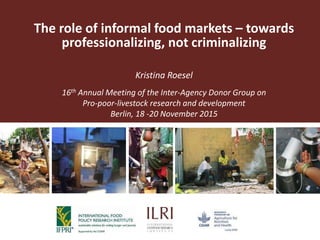
The role of informal food markets – towards
professionalizing, not criminalizing
Kristina Roesel
16th Annual Meeting of the Inter-Agency Donor Group on
Pro-poor-livestock research and development
Berlin, 18 -20 November 2015
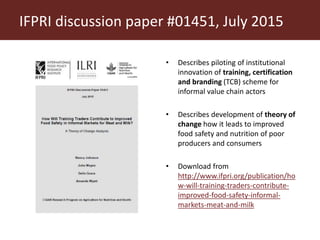
IFPRI discussion paper #01451, July 2015
• Describes piloting of institutional
innovation of training, certification
and branding (TCB) scheme for
informal value chain actors
• Describes development of theory of
change how it leads to improved
food safety and nutrition of poor
producers and consumers
• Download from
http://www.ifpri.org/publication/ho
w-will-training-traders-contribute-
improved-food-safety-informal-
markets-meat-and-milk
Outline
• What and who are these informal markets?
• Evidence for constraints and opportunities
• How TCB could lead to improvements
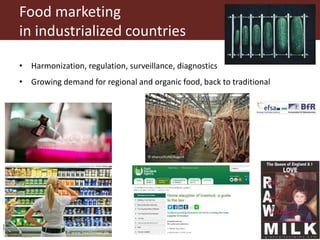
Food marketing
in industrialized countries
• Harmonization, regulation, surveillance, diagnostics
• Growing demand for regional and organic food, back to traditional
© www.healthnews.de
© alliance/KUNZ/Augenk
© AP / David Goldman
Food marketing in developing countries
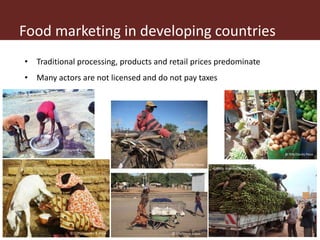
• Traditional processing, products and retail prices predominate
• Many actors are not licensed and do not pay taxes
© CSRS/Valentin B. Koné
© UoG/Kennedy Bomfeh
© ILRI/Stevie Mann
© ILRI/Michel Dione
© ILRI/Danilo Pezo
© Daily Monitor/Abubaker Lubowa
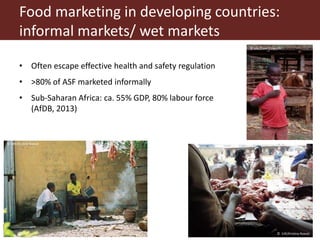
• Often escape effective health and safety regulation
• >80% of ASF marketed informally
• Sub-Saharan Africa: ca. 55% GDP, 80% labour force
(AfDB, 2013)
Food marketing in developing countries:
informal markets/ wet markets
© ILRI/Dave Elsworth
© ILRI/Kristina Roesel
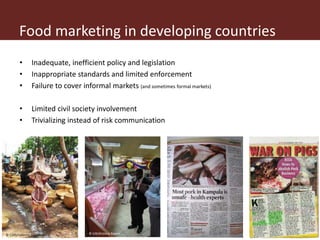
• Inadequate, inefficient policy and legislation
• Inappropriate standards and limited enforcement
• Failure to cover informal markets (and sometimes formal markets)
• Limited civil society involvement
• Trivializing instead of risk communication
Food marketing in developing countries
© CSRS/Valentin Bognan Koné © ILRI/Kristina Roesel
8
0
10
20
30
40
50
60
70
80
90
100
Poor total bacteria Unacceptable total
bacteria
Unacceptable
faecal bacteria
Unaccpetable
Staph
Unacceptable
listeria
Any unacceptable
Supermarket
Wet market
Village
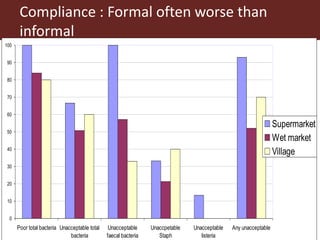
Compliance : Formal often worse than
informal
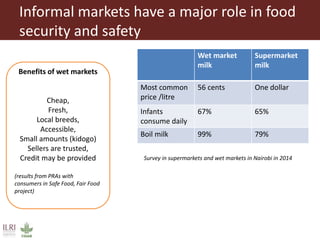
Informal markets have a major role in food
security and safety
Benefits of wet markets
Cheap,
Fresh,
Local breeds,
Accessible,
Small amounts (kidogo)
Sellers are trusted,
Credit may be provided
(results from PRAs with
consumers in Safe Food, Fair Food
project)
Wet market
milk
Supermarket
milk
Most common
price /litre
56 cents One dollar
Infants
consume daily
67% 65%
Boil milk 99% 79%
Survey in supermarkets and wet markets in Nairobi in 2014
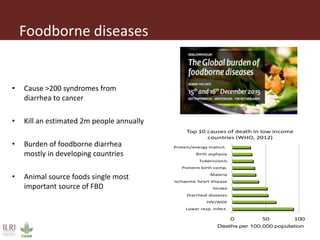
Foodborne diseases
• Cause >200 syndromes from
diarrhea to cancer
• Kill an estimated 2m people annually
• Burden of foodborne diarrhea
mostly in developing countries
• Animal source foods single most
important source of FBD
0 50 100
Lower resp. infect.
HIV/AIDS
Diarrheal diseases
Stroke
Ischaemic heart disease
Malaria
Preterm birth comp.
Tuberculosis
Birth asphysia
Protein/energy malnut.
Deaths per 100,000 population
Top 10 causes of death in low income
countries (WHO, 2012)
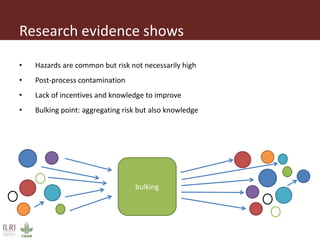
Research evidence shows
• Hazards are common but risk not necessarily high
• Post-process contamination
• Lack of incentives and knowledge to improve
• Bulking point: aggregating risk but also knowledge
bulking
© ILRI/Stevie Mann
© ILRI/Ben Lukuyu
© ILRI/Apollo Habtamu
© ILRI/Brad Collins
© ILRI/Stevie Mann
© SUA/Fortunate Shija
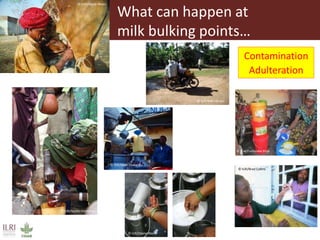
Contamination
Adulteration
What can happen at
milk bulking points…
© ILRI/Dave Elsworth
Professionalizing, not criminalizing:
a trader-based intervention
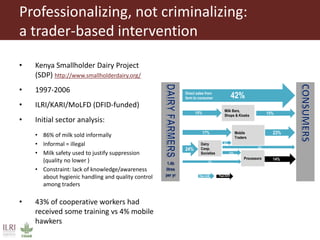
• Kenya Smallholder Dairy Project
(SDP) http://www.smallholderdairy.org/
• 1997-2006
• ILRI/KARI/MoLFD (DFID-funded)
• Initial sector analysis:
• 86% of milk sold informally
• Informal = illegal
• Milk safety used to justify suppression
(quality no lower )
• Constraint: lack of knowledge/awareness
about hygienic handling and quality control
among traders
• 43% of cooperative workers had
received some training vs 4% mobile
hawkers
1.4b
litres
per yr
Direct sales from
farm to consumer
Milk Bars,
Shops & Kiosks
42%
15% 15%
Mobile
Traders
23%17%
Dairy
Coop.
Societies
24%
6%
6%
12%
Processors
2%
14%
Raw milk Past./UHT
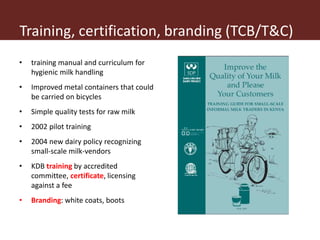
• training manual and curriculum for
hygienic milk handling
• Improved metal containers that could
be carried on bicycles
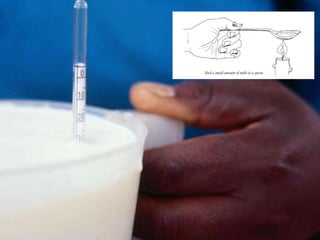
• Simple quality tests for raw milk
• 2002 pilot training
• 2004 new dairy policy recognizing
small-scale milk-vendors
• KDB training by accredited
committee, certificate, licensing
against a fee
• Branding: white coats, boots
Training, certification, branding (TCB/T&C)
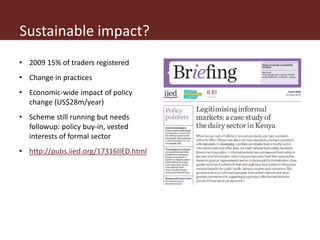
• 2009 15% of traders registered
• Change in practices
• Economic-wide impact of policy
change (US$28m/year)
• Scheme still running but needs
followup: policy buy-in, vested
interests of formal sector
• http://pubs.iied.org/17316IIED.html
Sustainable impact?
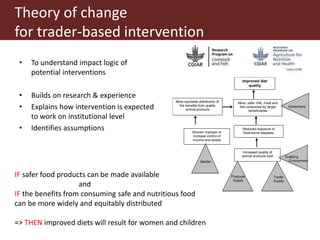
Theory of change
for trader-based intervention
• To understand impact logic of
potential interventions
• Builds on research & experience
• Explains how intervention is expected
to work on institutional level
• Identifies assumptions
Improved diet
quality
More, safer milk, meat and
fish consumed by target
beneficiaries
Increased quality of
animal products sold
Women maintain or
increase control of
income and assets
Producer
Supply
Gender
Reduced exposure to
food-borne diseases
Enabling
Environment
More equitable distribution of
the benefits from quality
animal products
Trader
Supply
Consumers
IF safer food products can be made available
and
IF the benefits from consuming safe and nutritious food
can be more widely and equitably distributed
=> THEN improved diets will result for women and children
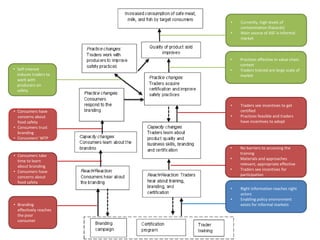
• Currently, high levels of
contamination (hazards)
• Main source of ASF is informal
market
• Practices effective in value chain
context
• Traders trained are large scale of
market
• Traders see incentives to get
certified
• Practices feasible and traders
have incentives to adopt
• No barriers to accessing the
training
• Materials and approaches
relevant, appropriate effective
• Traders see incentives for
participation
• Right information reaches right
actors
• Enabling policy environment
exists for informal markets
• Self-interest
induces traders to
work with
producers on
safety
• Consumers have
concerns about
food safety
• Consumers trust
branding
• Consumers‘ WTP
• Consumers take
time to learn
about branding
• Consumers have
concerns about
food safety
• Branding
effectively reaches
the poor
consumer
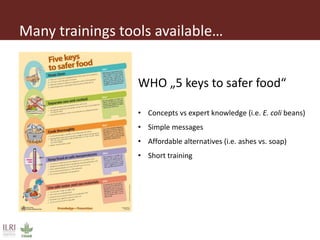
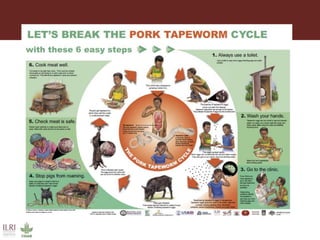
Many trainings tools available…
WHO „5 keys to safer food“
• Concepts vs expert knowledge (i.e. E. coli beans)
• Simple messages
• Affordable alternatives (i.e. ashes vs. soap)
• Short training
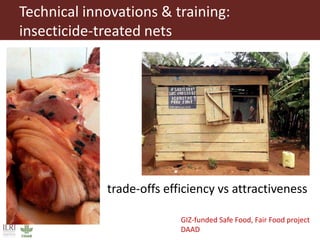
Technical innovations & training:
insecticide-treated nets
GIZ-funded Safe Food, Fair Food project
DAAD
trade-offs efficiency vs attractiveness
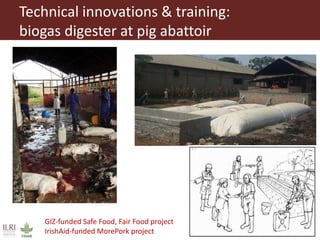
GIZ-funded Safe Food, Fair Food project
IrishAid-funded MorePork project
Technical innovations & training:
biogas digester at pig abattoir
The presentation has a Creative Commons licence. You are free to re-use or distribute this work, provided credit is given to ILRI.
Kristina Roesel
Project coordinator “Safe Food, Fair Food”
Freie Universität Berlin/ILRI
k.roesel@cgiar.org
http://safefoodfairfood.ilri.org
Better lives through livestock
www.ilri.org
THANK YOU!

The role of informal food markets—Towards professionalizing, not criminalizing

  • 1.
    The role ofinformal food markets – towards professionalizing, not criminalizing Kristina Roesel 16th Annual Meeting of the Inter-Agency Donor Group on Pro-poor-livestock research and development Berlin, 18 -20 November 2015
  • 2.
    IFPRI discussion paper#01451, July 2015 • Describes piloting of institutional innovation of training, certification and branding (TCB) scheme for informal value chain actors • Describes development of theory of change how it leads to improved food safety and nutrition of poor producers and consumers • Download from http://www.ifpri.org/publication/ho w-will-training-traders-contribute- improved-food-safety-informal- markets-meat-and-milk
  • 3.
    Outline • What andwho are these informal markets? • Evidence for constraints and opportunities • How TCB could lead to improvements
  • 4.
    Food marketing in industrializedcountries • Harmonization, regulation, surveillance, diagnostics • Growing demand for regional and organic food, back to traditional © www.healthnews.de © alliance/KUNZ/Augenk © AP / David Goldman
  • 5.
    Food marketing indeveloping countries • Traditional processing, products and retail prices predominate • Many actors are not licensed and do not pay taxes © CSRS/Valentin B. Koné © UoG/Kennedy Bomfeh © ILRI/Stevie Mann © ILRI/Michel Dione © ILRI/Danilo Pezo © Daily Monitor/Abubaker Lubowa
  • 6.
    • Often escapeeffective health and safety regulation • >80% of ASF marketed informally • Sub-Saharan Africa: ca. 55% GDP, 80% labour force (AfDB, 2013) Food marketing in developing countries: informal markets/ wet markets © ILRI/Dave Elsworth © ILRI/Kristina Roesel © ILRI/Kristina Roesel
  • 7.
    • Inadequate, inefficientpolicy and legislation • Inappropriate standards and limited enforcement • Failure to cover informal markets (and sometimes formal markets) • Limited civil society involvement • Trivializing instead of risk communication Food marketing in developing countries © CSRS/Valentin Bognan Koné © ILRI/Kristina Roesel
  • 8.
    8 0 10 20 30 40 50 60 70 80 90 100 Poor total bacteriaUnacceptable total bacteria Unacceptable faecal bacteria Unaccpetable Staph Unacceptable listeria Any unacceptable Supermarket Wet market Village Compliance : Formal often worse than informal
  • 9.
    Informal markets havea major role in food security and safety Benefits of wet markets Cheap, Fresh, Local breeds, Accessible, Small amounts (kidogo) Sellers are trusted, Credit may be provided (results from PRAs with consumers in Safe Food, Fair Food project) Wet market milk Supermarket milk Most common price /litre 56 cents One dollar Infants consume daily 67% 65% Boil milk 99% 79% Survey in supermarkets and wet markets in Nairobi in 2014
  • 10.
    Foodborne diseases • Cause>200 syndromes from diarrhea to cancer • Kill an estimated 2m people annually • Burden of foodborne diarrhea mostly in developing countries • Animal source foods single most important source of FBD 0 50 100 Lower resp. infect. HIV/AIDS Diarrheal diseases Stroke Ischaemic heart disease Malaria Preterm birth comp. Tuberculosis Birth asphysia Protein/energy malnut. Deaths per 100,000 population Top 10 causes of death in low income countries (WHO, 2012)
  • 11.
    Research evidence shows •Hazards are common but risk not necessarily high • Post-process contamination • Lack of incentives and knowledge to improve • Bulking point: aggregating risk but also knowledge bulking
  • 12.
    © ILRI/Stevie Mann ©ILRI/Ben Lukuyu © ILRI/Apollo Habtamu © ILRI/Brad Collins © ILRI/Stevie Mann © SUA/Fortunate Shija Contamination Adulteration What can happen at milk bulking points… © ILRI/Dave Elsworth
  • 13.
    Professionalizing, not criminalizing: atrader-based intervention • Kenya Smallholder Dairy Project (SDP) http://www.smallholderdairy.org/ • 1997-2006 • ILRI/KARI/MoLFD (DFID-funded) • Initial sector analysis: • 86% of milk sold informally • Informal = illegal • Milk safety used to justify suppression (quality no lower ) • Constraint: lack of knowledge/awareness about hygienic handling and quality control among traders • 43% of cooperative workers had received some training vs 4% mobile hawkers 1.4b litres per yr Direct sales from farm to consumer Milk Bars, Shops & Kiosks 42% 15% 15% Mobile Traders 23%17% Dairy Coop. Societies 24% 6% 6% 12% Processors 2% 14% Raw milk Past./UHT
  • 14.
    • training manualand curriculum for hygienic milk handling • Improved metal containers that could be carried on bicycles • Simple quality tests for raw milk • 2002 pilot training • 2004 new dairy policy recognizing small-scale milk-vendors • KDB training by accredited committee, certificate, licensing against a fee • Branding: white coats, boots Training, certification, branding (TCB/T&C)
  • 16.
    • 2009 15%of traders registered • Change in practices • Economic-wide impact of policy change (US$28m/year) • Scheme still running but needs followup: policy buy-in, vested interests of formal sector • http://pubs.iied.org/17316IIED.html Sustainable impact?
  • 17.
    Theory of change fortrader-based intervention • To understand impact logic of potential interventions • Builds on research & experience • Explains how intervention is expected to work on institutional level • Identifies assumptions Improved diet quality More, safer milk, meat and fish consumed by target beneficiaries Increased quality of animal products sold Women maintain or increase control of income and assets Producer Supply Gender Reduced exposure to food-borne diseases Enabling Environment More equitable distribution of the benefits from quality animal products Trader Supply Consumers IF safer food products can be made available and IF the benefits from consuming safe and nutritious food can be more widely and equitably distributed => THEN improved diets will result for women and children
  • 18.
    • Currently, highlevels of contamination (hazards) • Main source of ASF is informal market • Practices effective in value chain context • Traders trained are large scale of market • Traders see incentives to get certified • Practices feasible and traders have incentives to adopt • No barriers to accessing the training • Materials and approaches relevant, appropriate effective • Traders see incentives for participation • Right information reaches right actors • Enabling policy environment exists for informal markets • Self-interest induces traders to work with producers on safety • Consumers have concerns about food safety • Consumers trust branding • Consumers‘ WTP • Consumers take time to learn about branding • Consumers have concerns about food safety • Branding effectively reaches the poor consumer
  • 19.
    Many trainings toolsavailable… WHO „5 keys to safer food“ • Concepts vs expert knowledge (i.e. E. coli beans) • Simple messages • Affordable alternatives (i.e. ashes vs. soap) • Short training
  • 21.
    Technical innovations &training: insecticide-treated nets GIZ-funded Safe Food, Fair Food project DAAD trade-offs efficiency vs attractiveness
  • 22.
    GIZ-funded Safe Food,Fair Food project IrishAid-funded MorePork project Technical innovations & training: biogas digester at pig abattoir
  • 24.
    The presentation hasa Creative Commons licence. You are free to re-use or distribute this work, provided credit is given to ILRI. Kristina Roesel Project coordinator “Safe Food, Fair Food” Freie Universität Berlin/ILRI k.roesel@cgiar.org http://safefoodfairfood.ilri.org Better lives through livestock www.ilri.org THANK YOU!

Editor's Notes

  • #9 Pathogens in pig meat in Vietnam – similar findings for milk in India, milk in Kenya, meat in Nigeria, meat in Gambia