Livestock headwinds:
Help or hindrance to sustainable development?
Jimmy Smith, Director General
International Livestock Research Institute (ILRI)
Borlaug Summer Institute at thePurdue Center for Global Food Security
5 June 2018
Key messages
Globally, livestock is the fastest growing,
most valuable and most controversial
agricultural subsector.
Meeting the rising demand for milk, meat and eggs
in lower income countries is both a challenge and
an opportunity—a big opportunity—for sustainable
development.
Livestock enterprises worldwide contribute to every
one of the 17 of the UN’s Sustainable Development
Goals—and directly to 8 of them.
GLOBAL OVERVIEW
of the
LIVESTOCK SECTOR
On average, animal-source foods make up
5 of the top 10 global commodity values
0
50,000
100,000
150,000
200,000
250,000
300,000
Rice, paddy Milk, whole
fresh cow
Meat, pig Maize Wheat Meat,
chicken
Meat, cattle Potatoes Eggs, hen, in
shell
Sugar cane
Current million USD
(average values 2005–2014; animal-source foods: USD825 billion)
0
50
100
150
200
250
E.AsiaPacific
China
SouthAsia
SSA
Highincome
Demand for livestock products in lower income
regions is growing rapidly to 2000–2030 (%)
0
50
100
150
200
250
E.AsiaPacific
China
SouthAsia
SSA
Highincome
0
50
100
150
200
250
300
350
400
E.AsiaPacific
China
SouthAsia
SSA
Highincome
0
50
100
150
200
250
E.AsiaPacific
China
SouthAsia
SSA
Highincome
Estimates of the % growth in demand for animal-source foods in different world regions, 2005 vs 2030.
Source: Estimates were developed using the IMPACT model, courtesy Dolapo Enahoro, ILRI.
Beef Pork
Poultry Milk
Meat consumption gains in developing countries are
greatly outpacing those of developed
0
50
100
150
200
250
300
350
1980 1990 2002 2015 2030 2050
Millionmetrictonnes
developing
developed
These increases are not due to overconsumption by the poor.
E.g., in 2016, average meat consumption was 8 times more in the EU than in Africa:
EU = 69 kg per person | SSA = 8 kg per person
8%
57%
10%
10%
15%
Africa Asia N.America Europe RoW
On any given day, the world has more than 29 billion
head of poultry, pigs, cattle, buffalo, sheep and goats
poultry birds pigs cattle and buffalo sheep and goats
4%
58%9%
19%
10%
Africa Asia N.America Europe RoW
20%
40%6%
7%
27%
Africa Asia N.America Europe RoW
34%
49%
0%
7%
10%
Africa Asia N.America Europe RoW
There is great potential for increasing efficiencies
where demand for livestock is growing fastest
0
100
200
300
400
500
600
700
0
5
10
15
20
25
Africa Asia Europe Northern America RoW
No.animals(millions)
Production(milliontonnes)
Beef and buffalo meat
(all animals included, even those raised solely for dairy)
production (million tonnes) no. animals (million)
Diverging production levels of animal-source foods
in high- versus low- and middle-income countriesProduction(millionsoftonnes)
LMICs
Year
HICs
Livestock build both global and national economies
• The global livestock sector on average makes up
40% of agricultural gross domestic product (GDP).
• In developing countries, livestock contributions
to agricultural GDP varies greatly, from 15–80%—
and is growing.
• It’s estimated that the market value of Africa’s animal-
source foods will grow to some USD151 billion by 2050.
• Varied activities all along the world’s numerous livestock
value chains provide uncommonly large numbers of jobs.
Source: Herrero et al. 2014
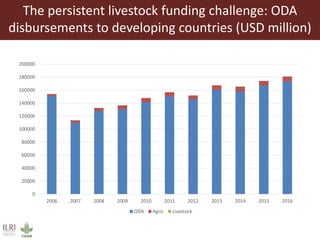
The persistent livestock funding challenge: ODA
disbursements to developing countries (USD million)
0
20000
40000
60000
80000
100000
120000
140000
160000
180000
200000
2006 2007 2008 2009 2010 2011 2012 2013 2014 2015 2016
ODA Agric Livestock
The percentage of ODA disbursements to
livestock (green) vs agriculture (red) is negligible
0
0.5
1
1.5
2
2.5
3
3.5
4
4.5
5
2002 2003 2004 2005 2006 2007 2008 2009 2010 2011 2012 2013 2014 2015 2016
agric % ODA Livestock % ODA
LIVESTOCK’S
CONTRIBUTIONS
TO
SUSTAINABLE
GLOBAL
DEVELOPMENT
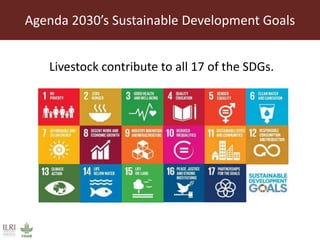
Agenda 2030’s Sustainable Development Goals
Livestock contribute to all 17 of the SDGs.
Agenda 2030’s Sustainable Development Goals
Livestock contribute directly to 8 of the goals.
FOOD AND
NUTRITIONAL
SECURITY
LIVELIHOODS AND
ECONOMIC GROWTH
HUMAN AND
ANIMAL HEALTH
4 major livestock pathways exist
for achieving the Sustainable Development Goals
CLIMATE AND
NATURALRESOURCES
PATHWAY 1:
Food and Nutritional Security
Animal products provide 40% of global
daily protein supply (18% of total kcal)
0
20
40
60
80
100
120
1961 2013 1961 2013 1961 2013 1961 2013 1961 2013
Daily protein (g/capita/day)
protein animal products
Africa Americas Asia Europe Oceania
Nutritional divides among 7 billion people today
Hungry people
stunted children
insufficient
nutrients
overweight/obese
balanced diets
Healthcare for
obesity economic
cost: $2 trillion
11% of GNP lost
annually in Africa
and Asia from
poor nutrition
Less than one
third well fed and
nourished
Meat consumption average 2016
EU = 69 kg/capita
SSA = 8 kg/capita
Animal-source foods are critical
for both physical and cognitive growth
• Globally, 156 million young children are stunted.
• Milk, meat and eggs provide key nutrients (vitamins A, B12,
choline, iron, zinc) in highly bioavailable forms for humans.
• Eggs and animal milk—among ‘nature’s first foods’—are
especially critical for addressing nutrient deficiencies in
undernourished people
• New evidence from Ecuador shows that eating just one egg a
day can reduce stunting among in 6–9 month-old babies.
Animal-source foods are critical for human health,
especially for new mothers and young children
Nutrition in the first 1000 days of life
Nutritionists
are generating
growing evidence
that it is impossible
for babies to achieve
adequate nutrition in the
first 1000 days of life
without access to
animal-source
foods.
Nutrition in the first 1000 days of life
ILRI livestock research on
food and nutritional security
• ILRI works to increase the
productivity of livestock in
low-income countries—e.g.,
through better feeds, breeds
and health—to greatly
augment food supplies.
• ILRI works to better nourish
as well as feed poor people
through livestock-derived
foods.
• ILRI promotes ‘nutrition-
sensitive livestock
interventions’ to increase the
availability, affordability,
access and use of animal-
source foods.
• A new ILRI study recommends
ring-fencing access to milk,
meat and eggs for new
mothers and children in their
first 1000 days of life.
PATHWAY 2:
Livelihoods and Economic Growth
Livestock livelihoods
• 70% of the world’s rural poor rely greatly on
livestock for their livelihoods.
• Of the >600M poor livestock keepers in
the world, two-thirds are rural women.
• >100M landless people keep livestock.
• For the poor, up to 40% of benefits from
livestock keeping are non-market and
intangible—mostly insurance and financing.
• Most livestock products in developing
countries are sold ‘informally’ and locally,
with their production, processing and sale
creating many jobs all along the value chain.
Livestock provide livelihoods
Various sources: BMGF, FAO, ILRI
Smallholders still dominate
livestock production in many countries
Region
(definition of
‘smallholder’)
% production by smallholder livestock farms
Beef Chicken
meat
Sheep/goat
meat
Milk Pork Eggs
East Africa 60-90
(≤ 6 milking
animals)
Bangladesh
(< 3ha land)
65 77 78 65 96 77
India
(< 2ha land)
75 92 92 69 most 71
Vietnam
(small scale)
90 65 80 70
Philippines
(backyard)
85 41 99 44 64 25
Demand for livestock commodities in developing
economies will be met—the question is how
Scenario #1
Meeting livestock demand by
importing livestock products
Scenario #2
Meeting livestock demand by
importing livestock industrial production know-how
Scenario #3
Meeting livestock demand by
transforming smallholder livestock systems
Demand for livestock commodities in developing
economies will be met—the question is how
ILRI livestock research on
livelihoods and economic growth
• ILRI produces evidence to
guide livestock investment
and related policy decisions in
and for developing countries.
• ILRI uses integrated strategies
to improve the performance
of smallholder livestock value
chains.
• ILRI generates gender-
equitable livestock options
for better lives of women
and men alike.
• ILRI evidence for an Ethiopian
Livestock Master Plan has
informed USD150M new
livestock investments.
• 25 ILRI-supported dairy
enterprises in India’s
Uttarakhand benefit >5,000
women farmers, increasing
their milk supplies by 300%.
• Women in 4 African countries
have access to superior chick-
en breeds developed by ILRI.
PATHWAY 3:
Human and Animal Health
Big opportunities exist for livestock-health
to address antimicrobial resistance (AMR)
By following a 3R approach to rational drug use:
• Reduce overuse of antimicrobials via
policy, regulatory and market incentives.
• Replace antimicrobials with livestock vaccines and
disease-resistant livestock breeds wherever possible.
• Refine practices in animal husbandry and biosecurity.
By ensuring essential partnerships and investments
• Collaboration among both countries and the
health, livestock and environment sectors.
• WHO-OIE-FAO Global Action Plan on AMR.
• An annual investment of USD9 billion will generate
USD10–27 trillion in global benefits (2017–2050).
13 zoonoses sicken 2.4 billion people, kill 2.2 million people
and affect more than 1 in 7 livestock each year
Controlling (zoonotic) livestock diseases
stops their transmission to humans
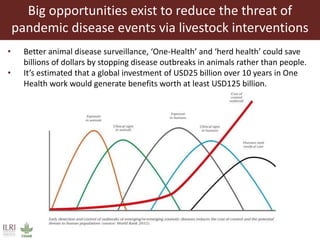
Big opportunities exist to reduce the threat of
pandemic disease events via livestock interventions
• Better animal disease surveillance, ‘One-Health’ and ‘herd health’ could save
billions of dollars by stopping disease outbreaks in animals rather than people.
• It’s estimated that a global investment of USD25 billion over 10 years in One
Health work would generate benefits worth at least USD125 billion.
• Animal-source foods
are an important part
of the diets of the poor.
• The most nutritious
animal-source foods
are also the riskiest.
• Enhancing traditional
food processing is an
overlooked opportunity
for providing better
nutrition, health, income
and gender equity
for poor people.
Food safety
ILRI livestock research on
human and animal health
• ILRI models are improving
herd health & livestock
productivity.
• ILRI products are improving
food safety in the informal
markets of developing
countries.
• ILRI tools are helping
disease control agents stop
zoonotic diseases and their
human pandemics.
• 1.8M African cattle have been
protected against lethal East Coast
fever by an ILRI-supported vaccine,
which is greatly raising milk yields
and disposable incomes.
• ILRI training of milk processors
and sellers in India’s Assam state
has made dairy products much
safer for one million people.
• An ILRI decision-support tool for
Rift Valley fever protects 50 million
people in East Africa from infection.
PATHWAY 4:
Climate and Natural Resources
Intensity of current greenhouse gas emissions
generated in livestock production
(Herrero et al., 2014)
Production of the greenhouse gas methane
falls as animal productivity rises
Meeting the rising livestock demand
through improved livestock production and efficiency
• Create productivity-efficiency win-wins
 The US reduced its carbon footprint per unit of milk by
63% over 60 years by improving cow productivity.
 South Asia’s dairy sector has similar potential to reduce
its greenhouse gas emissions—by 38%.
• Obtain accurate livestock greenhouse gas emission figures
 Support developing-country-led solutions to climate
change as specified in their nationally appropriate
mitigation actions.
• Make more use of ‘new science’
 Develop ‘low carbon’ cows, e.g. by modifying their rumen.
• Support livestock’s essential role in a robust bio-economy
 Make optimal and balanced use of biomass.
Competition for land and grains?
Maybe not!
Inedible by humans
86%
Could be eaten by
humans
14%
6 billion tonnes dry feed
Feed production
10%
Grassland that
could be
converted for
crops
14%
Pastures/rangelands -
not suitable for crops
27%
Crop agriculture
49%
5 billion ha global agricultural area
Latest for 1 kg boneless meat:
2.8kg human-edible food for ruminants
3.2kg human-edible food for monogastrics
ILRI livestock research on
climate and natural resources
• ILRI enhances people’s
adaptation to climate
change in ways that also
mitigate climate change.
• ILRI-generated tools and
options help people to
intensify their small-scale
livestock production in
sustainable ways.
• Work across ILRI helps
people and communities to
use livestock assets to build
their resilience to shocks.
• ILRI research on livestock
greenhouse gas emissions in
Kenya is helping developing-
world governments to refine
their climate change mitigation
strategies.
• 170,000 farmers in Zimbabwe
benefitted from an ILRI project
improving livestock feed, crop-
livestock integration & markets.
• ILRI’s index-based livestock
insurance in Kenya and Ethiopia
is helping >10,000 pastoralists
better cope with drought.
Key messages
Globally, livestock is the fastest growing,
most valuable and most controversial
agricultural subsector.
Meeting the rising demand for milk, meat and eggs
in lower income countries is both a challenge and
an opportunity—a big opportunity—for sustainable
development.
Livestock enterprises worldwide contribute to every
one of the 17 of the UN’s Sustainable Development
Goals—and directly to 8 of them.
A FINAL WORD
Welcome to ILRI!
I hope my talk has
helped to address
some of the myths
about livestock.
I hope that you
consider a career
in livestock research.
Like Norman Borlaug,
you can make a big
difference by joining CGIAR.
And you will always be welcome by ILRI staff throughout the world.
Karibuni!
The presentation has a Creative Commons licence. You are free to re-use or distribute this work, provided credit is given to ILRI.
better lives through livestock
ilri.org
Thank you for your attention!
Great potential exists for making efficiency gains
where demand for livestock foods is increasing most
0
500
1,000
0
20
40
Africa Asia Europe Northern
America
RoW
Beef and buffalo meat
(all animals included, even for dairy)
production (million tonnes) no. animals (million)
-
500
1,000
-
50
100
Africa Asia Europe Northern
America
RoW
Pig meat
production (million tonnes) no. animals (million)
-
10,000
20,000
-
50
Africa Asia Europe Northern
America
RoW
Poultry meat
(all poultry birds included, even for eggs)
production (million tonnes) no. animals (million)
-
500
1,000
1,500
-
5
10
Africa Asia Europe Northern
America
RoW
Sheep and goat meat
production (million tonnes) no. animals (million)
Provides food and nutritional security
BUT overconsumption can cause obesity
Powers economic development
BUT equitable development can be a challenge
Improves human health
BUT animal-human/emerging diseases
and unsafe foods need to be addressed
Enhances the environment
BUT pollution, land/water degradation,
GHG emissions and biodiversity losses
must be greatly reduced
Opportunities and challenges
in the livestock sector
Improved food and
nutrition security for
health
Improved natural
resource systems and
ecosystem services
Reduced poverty
ILRI’s mandate
ILRI’s mission is
to improve food and nutritional security
and to reduce poverty in developing
countries through research for
efficient, safe and sustainable
use of livestock —
ensuring better lives through livestock.
CGIAR on the ground:
15 research centres | more than 70 countries
ILRI in CGIAR research programs (‘CRPs’)
*PIM = Policies,
Institutions and Markets
**WLE = Water, Land and
Ecosystems
ILRI is also a member of
the cross-cutting gender
platform
4 Global Integrating programs
Excellence in Breeding
*
**
Grain legumes and dryland cereals
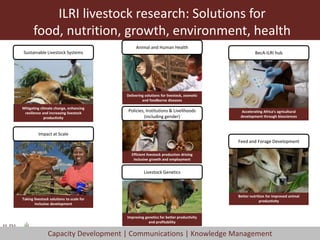
ILRI livestock research: Solutions for
food, nutrition, growth, environment, health
Mitigating climate change, enhancing
resilience and increasing livestock
productivity
Sustainable Livestock Systems
Taking livestock solutions to scale for
inclusive development
Impact at Scale
Delivering solutions for livestock, zoonotic
and foodborne diseases
Animal and Human Health
Efficient livestock production driving
inclusive growth and employment
Policies, Institutions & Livelihoods
(including gender)
Improving genetics for better productivity
and profitability
Livestock Genetics
Accelerating Africa’s agricultural
development through biosciences
BecA-ILRI hub
Better nutrition for improved animal
productivity
Feed and Forage Development
Capacity Development | Communications | Knowledge Management
ILRI Offices
Main campuses: Nairobi,
Kenya and Addis Ababa,
Ethiopia
Offices in 14 other
countries
ILRI offices
ILRI resources 2018
• Staff: 630+
• Budget: about US$82 million
• Senior scientists from over 30 countries
• One third of ILRI staff are women
• Main campuses in Kenya and Ethiopia,
and offices in 14 other countries
around the world
Developing capacity to undertake research
 Fellowships
 Internships
 Training courses
 Institutional development
 Alumni-led communities of practice
In a typical year:
• 70 research fellows
• 150 graduate (MSc., PhD) fellows
• 50 interns
• 1200 short course trainees
• >50 journal papers by fellows
Partners are essential for
research, impacts, going to scale
Sphere of interest
Multiple benefits at scale
Livestock contribute to SDGs
(in country/region/global)
Sphere of influence
Outcomes [changes in
knowledge, skills, attitudes]
resulting from uptake of
solutions by identified
stakeholders
Sphere of control
Application of
livestock-based
solutions (technical,
policy, institutional,
etc)
Private sector
Development
agencies
Advanced
research
National
research
Governments
NEW
Multi-
laterals

Livestock headwinds:Help or hindrance to sustainable development?

  • 1.
    Livestock headwinds: Help orhindrance to sustainable development? Jimmy Smith, Director General International Livestock Research Institute (ILRI) Borlaug Summer Institute at thePurdue Center for Global Food Security 5 June 2018
  • 2.
    Key messages Globally, livestockis the fastest growing, most valuable and most controversial agricultural subsector. Meeting the rising demand for milk, meat and eggs in lower income countries is both a challenge and an opportunity—a big opportunity—for sustainable development. Livestock enterprises worldwide contribute to every one of the 17 of the UN’s Sustainable Development Goals—and directly to 8 of them.
  • 3.
  • 4.
    On average, animal-sourcefoods make up 5 of the top 10 global commodity values 0 50,000 100,000 150,000 200,000 250,000 300,000 Rice, paddy Milk, whole fresh cow Meat, pig Maize Wheat Meat, chicken Meat, cattle Potatoes Eggs, hen, in shell Sugar cane Current million USD (average values 2005–2014; animal-source foods: USD825 billion)
  • 5.
    0 50 100 150 200 250 E.AsiaPacific China SouthAsia SSA Highincome Demand for livestockproducts in lower income regions is growing rapidly to 2000–2030 (%) 0 50 100 150 200 250 E.AsiaPacific China SouthAsia SSA Highincome 0 50 100 150 200 250 300 350 400 E.AsiaPacific China SouthAsia SSA Highincome 0 50 100 150 200 250 E.AsiaPacific China SouthAsia SSA Highincome Estimates of the % growth in demand for animal-source foods in different world regions, 2005 vs 2030. Source: Estimates were developed using the IMPACT model, courtesy Dolapo Enahoro, ILRI. Beef Pork Poultry Milk
  • 6.
    Meat consumption gainsin developing countries are greatly outpacing those of developed 0 50 100 150 200 250 300 350 1980 1990 2002 2015 2030 2050 Millionmetrictonnes developing developed These increases are not due to overconsumption by the poor. E.g., in 2016, average meat consumption was 8 times more in the EU than in Africa: EU = 69 kg per person | SSA = 8 kg per person
  • 7.
    8% 57% 10% 10% 15% Africa Asia N.AmericaEurope RoW On any given day, the world has more than 29 billion head of poultry, pigs, cattle, buffalo, sheep and goats poultry birds pigs cattle and buffalo sheep and goats 4% 58%9% 19% 10% Africa Asia N.America Europe RoW 20% 40%6% 7% 27% Africa Asia N.America Europe RoW 34% 49% 0% 7% 10% Africa Asia N.America Europe RoW
  • 8.
    There is greatpotential for increasing efficiencies where demand for livestock is growing fastest 0 100 200 300 400 500 600 700 0 5 10 15 20 25 Africa Asia Europe Northern America RoW No.animals(millions) Production(milliontonnes) Beef and buffalo meat (all animals included, even those raised solely for dairy) production (million tonnes) no. animals (million)
  • 9.
    Diverging production levelsof animal-source foods in high- versus low- and middle-income countriesProduction(millionsoftonnes) LMICs Year HICs
  • 10.
    Livestock build bothglobal and national economies • The global livestock sector on average makes up 40% of agricultural gross domestic product (GDP). • In developing countries, livestock contributions to agricultural GDP varies greatly, from 15–80%— and is growing. • It’s estimated that the market value of Africa’s animal- source foods will grow to some USD151 billion by 2050. • Varied activities all along the world’s numerous livestock value chains provide uncommonly large numbers of jobs. Source: Herrero et al. 2014
  • 11.
    The persistent livestockfunding challenge: ODA disbursements to developing countries (USD million) 0 20000 40000 60000 80000 100000 120000 140000 160000 180000 200000 2006 2007 2008 2009 2010 2011 2012 2013 2014 2015 2016 ODA Agric Livestock
  • 12.
    The percentage ofODA disbursements to livestock (green) vs agriculture (red) is negligible 0 0.5 1 1.5 2 2.5 3 3.5 4 4.5 5 2002 2003 2004 2005 2006 2007 2008 2009 2010 2011 2012 2013 2014 2015 2016 agric % ODA Livestock % ODA
  • 13.
  • 14.
    Agenda 2030’s SustainableDevelopment Goals Livestock contribute to all 17 of the SDGs.
  • 15.
    Agenda 2030’s SustainableDevelopment Goals Livestock contribute directly to 8 of the goals.
  • 16.
    FOOD AND NUTRITIONAL SECURITY LIVELIHOODS AND ECONOMICGROWTH HUMAN AND ANIMAL HEALTH 4 major livestock pathways exist for achieving the Sustainable Development Goals CLIMATE AND NATURALRESOURCES
  • 17.
    PATHWAY 1: Food andNutritional Security
  • 18.
    Animal products provide40% of global daily protein supply (18% of total kcal) 0 20 40 60 80 100 120 1961 2013 1961 2013 1961 2013 1961 2013 1961 2013 Daily protein (g/capita/day) protein animal products Africa Americas Asia Europe Oceania
  • 19.
    Nutritional divides among7 billion people today Hungry people stunted children insufficient nutrients overweight/obese balanced diets Healthcare for obesity economic cost: $2 trillion 11% of GNP lost annually in Africa and Asia from poor nutrition Less than one third well fed and nourished Meat consumption average 2016 EU = 69 kg/capita SSA = 8 kg/capita
  • 20.
    Animal-source foods arecritical for both physical and cognitive growth • Globally, 156 million young children are stunted. • Milk, meat and eggs provide key nutrients (vitamins A, B12, choline, iron, zinc) in highly bioavailable forms for humans. • Eggs and animal milk—among ‘nature’s first foods’—are especially critical for addressing nutrient deficiencies in undernourished people • New evidence from Ecuador shows that eating just one egg a day can reduce stunting among in 6–9 month-old babies. Animal-source foods are critical for human health, especially for new mothers and young children
  • 21.
    Nutrition in thefirst 1000 days of life Nutritionists are generating growing evidence that it is impossible for babies to achieve adequate nutrition in the first 1000 days of life without access to animal-source foods. Nutrition in the first 1000 days of life
  • 22.
    ILRI livestock researchon food and nutritional security • ILRI works to increase the productivity of livestock in low-income countries—e.g., through better feeds, breeds and health—to greatly augment food supplies. • ILRI works to better nourish as well as feed poor people through livestock-derived foods. • ILRI promotes ‘nutrition- sensitive livestock interventions’ to increase the availability, affordability, access and use of animal- source foods. • A new ILRI study recommends ring-fencing access to milk, meat and eggs for new mothers and children in their first 1000 days of life.
  • 23.
  • 24.
    Livestock livelihoods • 70%of the world’s rural poor rely greatly on livestock for their livelihoods. • Of the >600M poor livestock keepers in the world, two-thirds are rural women. • >100M landless people keep livestock. • For the poor, up to 40% of benefits from livestock keeping are non-market and intangible—mostly insurance and financing. • Most livestock products in developing countries are sold ‘informally’ and locally, with their production, processing and sale creating many jobs all along the value chain. Livestock provide livelihoods
  • 25.
    Various sources: BMGF,FAO, ILRI Smallholders still dominate livestock production in many countries Region (definition of ‘smallholder’) % production by smallholder livestock farms Beef Chicken meat Sheep/goat meat Milk Pork Eggs East Africa 60-90 (≤ 6 milking animals) Bangladesh (< 3ha land) 65 77 78 65 96 77 India (< 2ha land) 75 92 92 69 most 71 Vietnam (small scale) 90 65 80 70 Philippines (backyard) 85 41 99 44 64 25
  • 26.
    Demand for livestockcommodities in developing economies will be met—the question is how Scenario #1 Meeting livestock demand by importing livestock products Scenario #2 Meeting livestock demand by importing livestock industrial production know-how Scenario #3 Meeting livestock demand by transforming smallholder livestock systems Demand for livestock commodities in developing economies will be met—the question is how
  • 27.
    ILRI livestock researchon livelihoods and economic growth • ILRI produces evidence to guide livestock investment and related policy decisions in and for developing countries. • ILRI uses integrated strategies to improve the performance of smallholder livestock value chains. • ILRI generates gender- equitable livestock options for better lives of women and men alike. • ILRI evidence for an Ethiopian Livestock Master Plan has informed USD150M new livestock investments. • 25 ILRI-supported dairy enterprises in India’s Uttarakhand benefit >5,000 women farmers, increasing their milk supplies by 300%. • Women in 4 African countries have access to superior chick- en breeds developed by ILRI.
  • 28.
    PATHWAY 3: Human andAnimal Health
  • 29.
    Big opportunities existfor livestock-health to address antimicrobial resistance (AMR) By following a 3R approach to rational drug use: • Reduce overuse of antimicrobials via policy, regulatory and market incentives. • Replace antimicrobials with livestock vaccines and disease-resistant livestock breeds wherever possible. • Refine practices in animal husbandry and biosecurity. By ensuring essential partnerships and investments • Collaboration among both countries and the health, livestock and environment sectors. • WHO-OIE-FAO Global Action Plan on AMR. • An annual investment of USD9 billion will generate USD10–27 trillion in global benefits (2017–2050).
  • 30.
    13 zoonoses sicken2.4 billion people, kill 2.2 million people and affect more than 1 in 7 livestock each year Controlling (zoonotic) livestock diseases stops their transmission to humans
  • 31.
    Big opportunities existto reduce the threat of pandemic disease events via livestock interventions • Better animal disease surveillance, ‘One-Health’ and ‘herd health’ could save billions of dollars by stopping disease outbreaks in animals rather than people. • It’s estimated that a global investment of USD25 billion over 10 years in One Health work would generate benefits worth at least USD125 billion.
  • 32.
    • Animal-source foods arean important part of the diets of the poor. • The most nutritious animal-source foods are also the riskiest. • Enhancing traditional food processing is an overlooked opportunity for providing better nutrition, health, income and gender equity for poor people. Food safety
  • 33.
    ILRI livestock researchon human and animal health • ILRI models are improving herd health & livestock productivity. • ILRI products are improving food safety in the informal markets of developing countries. • ILRI tools are helping disease control agents stop zoonotic diseases and their human pandemics. • 1.8M African cattle have been protected against lethal East Coast fever by an ILRI-supported vaccine, which is greatly raising milk yields and disposable incomes. • ILRI training of milk processors and sellers in India’s Assam state has made dairy products much safer for one million people. • An ILRI decision-support tool for Rift Valley fever protects 50 million people in East Africa from infection.
  • 34.
    PATHWAY 4: Climate andNatural Resources
  • 35.
    Intensity of currentgreenhouse gas emissions generated in livestock production (Herrero et al., 2014)
  • 36.
    Production of thegreenhouse gas methane falls as animal productivity rises
  • 37.
    Meeting the risinglivestock demand through improved livestock production and efficiency • Create productivity-efficiency win-wins  The US reduced its carbon footprint per unit of milk by 63% over 60 years by improving cow productivity.  South Asia’s dairy sector has similar potential to reduce its greenhouse gas emissions—by 38%. • Obtain accurate livestock greenhouse gas emission figures  Support developing-country-led solutions to climate change as specified in their nationally appropriate mitigation actions. • Make more use of ‘new science’  Develop ‘low carbon’ cows, e.g. by modifying their rumen. • Support livestock’s essential role in a robust bio-economy  Make optimal and balanced use of biomass.
  • 38.
    Competition for landand grains? Maybe not! Inedible by humans 86% Could be eaten by humans 14% 6 billion tonnes dry feed Feed production 10% Grassland that could be converted for crops 14% Pastures/rangelands - not suitable for crops 27% Crop agriculture 49% 5 billion ha global agricultural area Latest for 1 kg boneless meat: 2.8kg human-edible food for ruminants 3.2kg human-edible food for monogastrics
  • 39.
    ILRI livestock researchon climate and natural resources • ILRI enhances people’s adaptation to climate change in ways that also mitigate climate change. • ILRI-generated tools and options help people to intensify their small-scale livestock production in sustainable ways. • Work across ILRI helps people and communities to use livestock assets to build their resilience to shocks. • ILRI research on livestock greenhouse gas emissions in Kenya is helping developing- world governments to refine their climate change mitigation strategies. • 170,000 farmers in Zimbabwe benefitted from an ILRI project improving livestock feed, crop- livestock integration & markets. • ILRI’s index-based livestock insurance in Kenya and Ethiopia is helping >10,000 pastoralists better cope with drought.
  • 40.
    Key messages Globally, livestockis the fastest growing, most valuable and most controversial agricultural subsector. Meeting the rising demand for milk, meat and eggs in lower income countries is both a challenge and an opportunity—a big opportunity—for sustainable development. Livestock enterprises worldwide contribute to every one of the 17 of the UN’s Sustainable Development Goals—and directly to 8 of them.
  • 41.
  • 42.
    Welcome to ILRI! Ihope my talk has helped to address some of the myths about livestock. I hope that you consider a career in livestock research. Like Norman Borlaug, you can make a big difference by joining CGIAR. And you will always be welcome by ILRI staff throughout the world. Karibuni!
  • 43.
    The presentation hasa Creative Commons licence. You are free to re-use or distribute this work, provided credit is given to ILRI. better lives through livestock ilri.org Thank you for your attention!
  • 45.
    Great potential existsfor making efficiency gains where demand for livestock foods is increasing most 0 500 1,000 0 20 40 Africa Asia Europe Northern America RoW Beef and buffalo meat (all animals included, even for dairy) production (million tonnes) no. animals (million) - 500 1,000 - 50 100 Africa Asia Europe Northern America RoW Pig meat production (million tonnes) no. animals (million) - 10,000 20,000 - 50 Africa Asia Europe Northern America RoW Poultry meat (all poultry birds included, even for eggs) production (million tonnes) no. animals (million) - 500 1,000 1,500 - 5 10 Africa Asia Europe Northern America RoW Sheep and goat meat production (million tonnes) no. animals (million)
  • 46.
    Provides food andnutritional security BUT overconsumption can cause obesity Powers economic development BUT equitable development can be a challenge Improves human health BUT animal-human/emerging diseases and unsafe foods need to be addressed Enhances the environment BUT pollution, land/water degradation, GHG emissions and biodiversity losses must be greatly reduced Opportunities and challenges in the livestock sector
  • 47.
    Improved food and nutritionsecurity for health Improved natural resource systems and ecosystem services Reduced poverty ILRI’s mandate ILRI’s mission is to improve food and nutritional security and to reduce poverty in developing countries through research for efficient, safe and sustainable use of livestock — ensuring better lives through livestock.
  • 48.
    CGIAR on theground: 15 research centres | more than 70 countries
  • 49.
    ILRI in CGIARresearch programs (‘CRPs’) *PIM = Policies, Institutions and Markets **WLE = Water, Land and Ecosystems ILRI is also a member of the cross-cutting gender platform 4 Global Integrating programs Excellence in Breeding * ** Grain legumes and dryland cereals
  • 50.
    ILRI livestock research:Solutions for food, nutrition, growth, environment, health Mitigating climate change, enhancing resilience and increasing livestock productivity Sustainable Livestock Systems Taking livestock solutions to scale for inclusive development Impact at Scale Delivering solutions for livestock, zoonotic and foodborne diseases Animal and Human Health Efficient livestock production driving inclusive growth and employment Policies, Institutions & Livelihoods (including gender) Improving genetics for better productivity and profitability Livestock Genetics Accelerating Africa’s agricultural development through biosciences BecA-ILRI hub Better nutrition for improved animal productivity Feed and Forage Development Capacity Development | Communications | Knowledge Management
  • 51.
    ILRI Offices Main campuses:Nairobi, Kenya and Addis Ababa, Ethiopia Offices in 14 other countries ILRI offices
  • 52.
    ILRI resources 2018 •Staff: 630+ • Budget: about US$82 million • Senior scientists from over 30 countries • One third of ILRI staff are women • Main campuses in Kenya and Ethiopia, and offices in 14 other countries around the world
  • 53.
    Developing capacity toundertake research  Fellowships  Internships  Training courses  Institutional development  Alumni-led communities of practice In a typical year: • 70 research fellows • 150 graduate (MSc., PhD) fellows • 50 interns • 1200 short course trainees • >50 journal papers by fellows
  • 54.
    Partners are essentialfor research, impacts, going to scale Sphere of interest Multiple benefits at scale Livestock contribute to SDGs (in country/region/global) Sphere of influence Outcomes [changes in knowledge, skills, attitudes] resulting from uptake of solutions by identified stakeholders Sphere of control Application of livestock-based solutions (technical, policy, institutional, etc) Private sector Development agencies Advanced research National research Governments NEW Multi- laterals