What is astronomy?
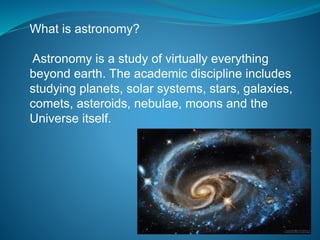
Astronomy is a study of virtually everything
beyond earth. The academic discipline includes
studying planets, solar systems, stars, galaxies,
comets, asteroids, nebulae, moons and the
Universe itself.
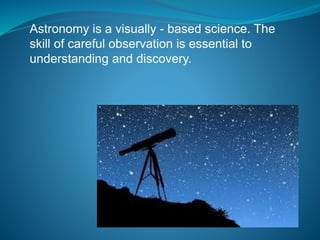
Astronomy is a visually - based science. The
skill of careful observation is essential to
understanding and discovery.
When did Astronomy began?
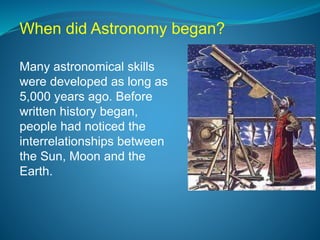
Many astronomical skills
were developed as long as
5,000 years ago. Before
written history began,
people had noticed the
interrelationships between
the Sun, Moon and the
Earth.
When did Astronomy began?
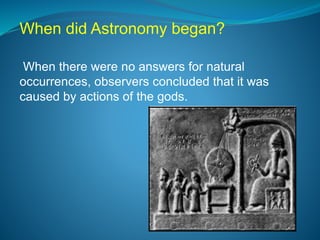
When there were no answers for natural
occurrences, observers concluded that it was
caused by actions of the gods.
Astrology
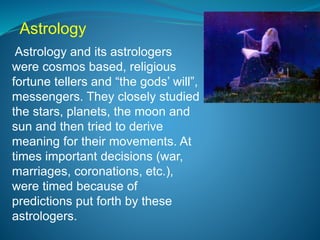
Astrology and its astrologers
were cosmos based, religious
fortune tellers and “the gods’ will”,
messengers. They closely studied
the stars, planets, the moon and
sun and then tried to derive
meaning for their movements. At
times important decisions (war,
marriages, coronations, etc.),
were timed because of
predictions put forth by these
astrologers.
Astrology
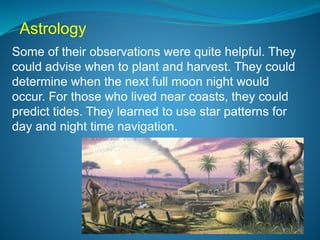
Some of their observations were quite helpful. They
could advise when to plant and harvest. They could
determine when the next full moon night would
occur. For those who lived near coasts, they could
predict tides. They learned to use star patterns for
day and night time navigation.
Importance of Astrology/Astronomy
1. Developed skills of predicting weather patterns
and seasons allowed man to time harvests. From
this, each man no longer had to just hunt, gather
and maintain flocks. Agriculture was developed,
creating greater food supplies this led to larger
populations, spare time to build, invent and
develop communities.
Importance of Astrology/Astronomy
2. Star observation and mapping allowed for the
navigation of new land and sea routes.
3. Trade and exchanges of ideas developed
between cultures. Over time, ancient civilizations
gained wealth, power and improved technology
based on the increased amounts of food and
trade, that was inspired by studying the cosmos.
Importance of Astrology/Astronomy
4. Mathematics was integral to the advancement of
astronomical studies. The ancient people of
Egypt and Greece developed algebra and
geometry. Through these math skills and little
else, a Greek citizen named Aristarchus, in 270
BC first figured out how far the moon was from
the earth.
Importance of Astrology/Astronomy
5. This brings us to another important component:
philosophy. Greek philosophers developed this
rational process of thought called SCIENTIFIC
METHOD.
Scientific Method- a method of procedure that has
characterized natural science since the 17th century,
consisting in systematic observation, measurement,
and experiment, and the formulation, testing, and
modification of hypotheses.
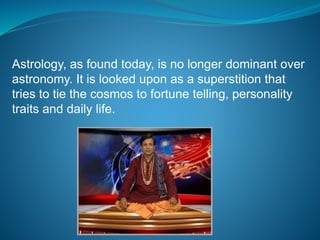
Astrology, as found today, is no longer dominant over
astronomy. It is looked upon as a superstition that
tries to tie the cosmos to fortune telling, personality
traits and daily life.
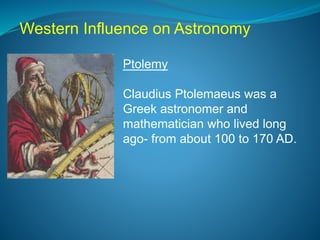
Ptolemy
Claudius Ptolemaeus was a
Greek astronomer and
mathematician who lived long
ago- from about 100 to 170 AD.
Western Influence on Astronomy
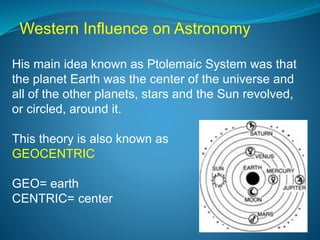
His main idea known as Ptolemaic System was that
the planet Earth was the center of the universe and
all of the other planets, stars and the Sun revolved,
or circled, around it.
This theory is also known as
GEOCENTRIC
GEO= earth
CENTRIC= center
Western Influence on Astronomy
Ptolemy’s theory was supported
by the Catholic Church
However, Ptolemy’s theory was
challenged by two men and one
instrument
Western Influence on Astronomy
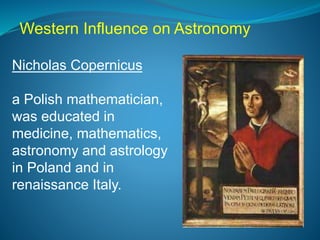
Nicholas Copernicus
a Polish mathematician,
was educated in
medicine, mathematics,
astronomy and astrology
in Poland and in
renaissance Italy.
Western Influence on Astronomy
Copernicus proved through math and
observations the earth rotates on an axis
and that the earth circles the sun, not
visa versa.
Western Influence on Astronomy
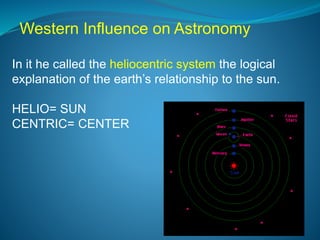
In it he called the heliocentric system the logical
explanation of the earth’s relationship to the sun.
HELIO= SUN
CENTRIC= CENTER
Western Influence on Astronomy
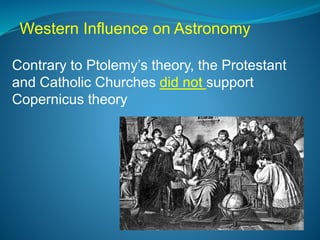
Contrary to Ptolemy’s theory, the Protestant
and Catholic Churches did not support
Copernicus theory
Western Influence on Astronomy
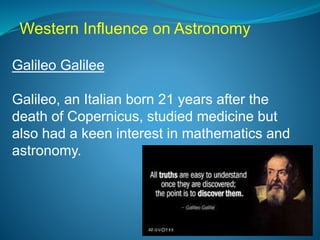
Galileo Galilee
Galileo, an Italian born 21 years after the
death of Copernicus, studied medicine but
also had a keen interest in mathematics and
astronomy.
Western Influence on Astronomy
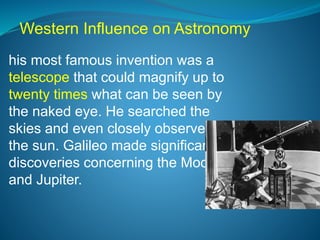
his most famous invention was a
telescope that could magnify up to
twenty times what can be seen by
the naked eye. He searched the
skies and even closely observed
the sun. Galileo made significant
discoveries concerning the Moon
and Jupiter.
Western Influence on Astronomy
Galileo’s discovery during his time:
 Galileo thought he saw oceans or seas on the
surface of the Moon. These areas he named:
“mare” (sea in Latin.) which still called by the
same names today, even though there are no
seas on the Moon.
 He found spots on the sun.
Western Influence on Astronomy
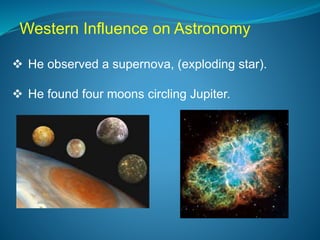
 He observed a supernova, (exploding star).
 He found four moons circling Jupiter.
Western Influence on Astronomy
Galileo published his works concerning the
verification of the heliocentric system and
ended up in the Inquisition, a court held by the
Catholic Church to try people accused of
religious heresies* that run counter to church
doctrine.
Heresy- belief or opinion contrary to orthodox
religious (especially Christian) doctrine.
Western Influence on Astronomy
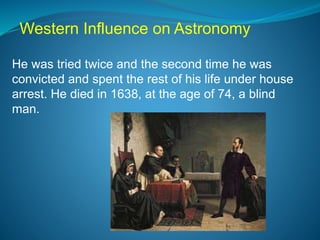
He was tried twice and the second time he was
convicted and spent the rest of his life under house
arrest. He died in 1638, at the age of 74, a blind
man.
Western Influence on Astronomy
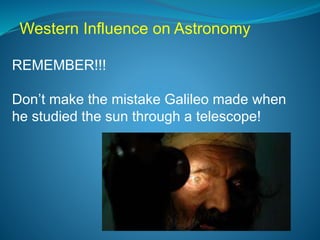
REMEMBER!!!
Don’t make the mistake Galileo made when
he studied the sun through a telescope!
Western Influence on Astronomy
As time went on, the Catholic and
Protestant churches accepted the new
discoveries and loosened religious
control over scientific research and their
findings.
Western Influence on Astronomy
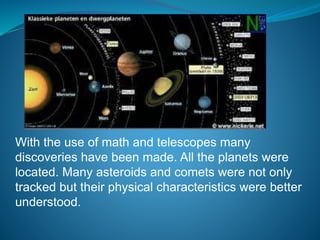
With the use of math and telescopes many
discoveries have been made. All the planets were
located. Many asteroids and comets were not only
tracked but their physical characteristics were better
understood.

INTRODUCTION TO ASTRONOMY.pptx

  • 2.
    What is astronomy? Astronomyis a study of virtually everything beyond earth. The academic discipline includes studying planets, solar systems, stars, galaxies, comets, asteroids, nebulae, moons and the Universe itself.
  • 3.
    Astronomy is avisually - based science. The skill of careful observation is essential to understanding and discovery.
  • 4.
    When did Astronomybegan? Many astronomical skills were developed as long as 5,000 years ago. Before written history began, people had noticed the interrelationships between the Sun, Moon and the Earth.
  • 5.
    When did Astronomybegan? When there were no answers for natural occurrences, observers concluded that it was caused by actions of the gods.
  • 6.
    Astrology Astrology and itsastrologers were cosmos based, religious fortune tellers and “the gods’ will”, messengers. They closely studied the stars, planets, the moon and sun and then tried to derive meaning for their movements. At times important decisions (war, marriages, coronations, etc.), were timed because of predictions put forth by these astrologers.
  • 7.
    Astrology Some of theirobservations were quite helpful. They could advise when to plant and harvest. They could determine when the next full moon night would occur. For those who lived near coasts, they could predict tides. They learned to use star patterns for day and night time navigation.
  • 8.
    Importance of Astrology/Astronomy 1.Developed skills of predicting weather patterns and seasons allowed man to time harvests. From this, each man no longer had to just hunt, gather and maintain flocks. Agriculture was developed, creating greater food supplies this led to larger populations, spare time to build, invent and develop communities.
  • 9.
    Importance of Astrology/Astronomy 2.Star observation and mapping allowed for the navigation of new land and sea routes. 3. Trade and exchanges of ideas developed between cultures. Over time, ancient civilizations gained wealth, power and improved technology based on the increased amounts of food and trade, that was inspired by studying the cosmos.
  • 10.
    Importance of Astrology/Astronomy 4.Mathematics was integral to the advancement of astronomical studies. The ancient people of Egypt and Greece developed algebra and geometry. Through these math skills and little else, a Greek citizen named Aristarchus, in 270 BC first figured out how far the moon was from the earth.
  • 11.
    Importance of Astrology/Astronomy 5.This brings us to another important component: philosophy. Greek philosophers developed this rational process of thought called SCIENTIFIC METHOD. Scientific Method- a method of procedure that has characterized natural science since the 17th century, consisting in systematic observation, measurement, and experiment, and the formulation, testing, and modification of hypotheses.
  • 12.
    Astrology, as foundtoday, is no longer dominant over astronomy. It is looked upon as a superstition that tries to tie the cosmos to fortune telling, personality traits and daily life.
  • 13.
    Ptolemy Claudius Ptolemaeus wasa Greek astronomer and mathematician who lived long ago- from about 100 to 170 AD. Western Influence on Astronomy
  • 14.
    His main ideaknown as Ptolemaic System was that the planet Earth was the center of the universe and all of the other planets, stars and the Sun revolved, or circled, around it. This theory is also known as GEOCENTRIC GEO= earth CENTRIC= center Western Influence on Astronomy
  • 15.
    Ptolemy’s theory wassupported by the Catholic Church However, Ptolemy’s theory was challenged by two men and one instrument Western Influence on Astronomy
  • 16.
    Nicholas Copernicus a Polishmathematician, was educated in medicine, mathematics, astronomy and astrology in Poland and in renaissance Italy. Western Influence on Astronomy
  • 17.
    Copernicus proved throughmath and observations the earth rotates on an axis and that the earth circles the sun, not visa versa. Western Influence on Astronomy
  • 18.
    In it hecalled the heliocentric system the logical explanation of the earth’s relationship to the sun. HELIO= SUN CENTRIC= CENTER Western Influence on Astronomy
  • 19.
    Contrary to Ptolemy’stheory, the Protestant and Catholic Churches did not support Copernicus theory Western Influence on Astronomy
  • 20.
    Galileo Galilee Galileo, anItalian born 21 years after the death of Copernicus, studied medicine but also had a keen interest in mathematics and astronomy. Western Influence on Astronomy
  • 21.
    his most famousinvention was a telescope that could magnify up to twenty times what can be seen by the naked eye. He searched the skies and even closely observed the sun. Galileo made significant discoveries concerning the Moon and Jupiter. Western Influence on Astronomy
  • 22.
    Galileo’s discovery duringhis time:  Galileo thought he saw oceans or seas on the surface of the Moon. These areas he named: “mare” (sea in Latin.) which still called by the same names today, even though there are no seas on the Moon.  He found spots on the sun. Western Influence on Astronomy
  • 23.
     He observeda supernova, (exploding star).  He found four moons circling Jupiter. Western Influence on Astronomy
  • 24.
    Galileo published hisworks concerning the verification of the heliocentric system and ended up in the Inquisition, a court held by the Catholic Church to try people accused of religious heresies* that run counter to church doctrine. Heresy- belief or opinion contrary to orthodox religious (especially Christian) doctrine. Western Influence on Astronomy
  • 25.
    He was triedtwice and the second time he was convicted and spent the rest of his life under house arrest. He died in 1638, at the age of 74, a blind man. Western Influence on Astronomy
  • 26.
    REMEMBER!!! Don’t make themistake Galileo made when he studied the sun through a telescope! Western Influence on Astronomy
  • 27.
    As time wenton, the Catholic and Protestant churches accepted the new discoveries and loosened religious control over scientific research and their findings. Western Influence on Astronomy
  • 28.
    With the useof math and telescopes many discoveries have been made. All the planets were located. Many asteroids and comets were not only tracked but their physical characteristics were better understood.