Fossils
Chapter 16 Lesson 1
Pages 564 - 572
Vocabulary
• Fossil – the preserved remains or evidence of ancient living things
• Catastrophism – the idea that conditions and organisms on Earth
change in quick, violent events
• Uniformitarianism – a principle that states that geologic processes
that occur today are similar to those that have occurred in the past
• Carbon Film – the fossilized carbon outline of an organism or part
of an organism
• Mold – the impression in a rock left by an ancient organism
• Cast – a fossil copy of an organism made when a mold of the
organism is filled with sediment of mineral deposits
• Trace Fossil – the preserved evidence of the activity of an organism
• Paleontologist – scientists who study fossils
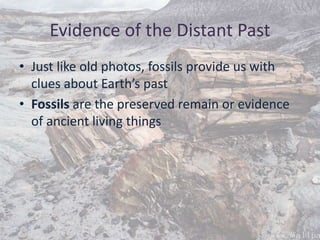
Evidence of the Distant Past
• Just like old photos, fossils provide us with
clues about Earth’s past
• Fossils are the preserved remain or evidence
of ancient living things
Catastrophism
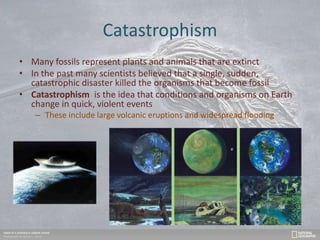
• Many fossils represent plants and animals that are extinct
• In the past many scientists believed that a single, sudden,
catastrophic disaster killed the organisms that become fossil
• Catastrophism is the idea that conditions and organisms on Earth
change in quick, violent events
– These include large volcanic eruptions and widespread flooding
Catastrophism
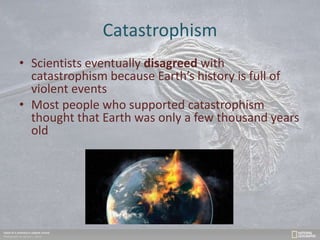
• Scientists eventually disagreed with
catastrophism because Earth’s history is full of
violent events
• Most people who supported catastrophism
thought that Earth was only a few thousand years
old
Uniformitarianism
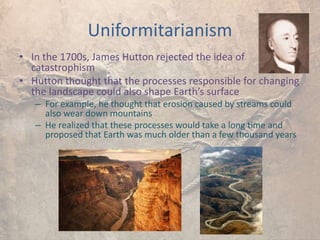
• In the 1700s, James Hutton rejected the idea of
catastrophism
• Hutton thought that the processes responsible for changing
the landscape could also shape Earth’s surface
– For example, he thought that erosion caused by streams could
also wear down mountains
– He realized that these processes would take a long time and
proposed that Earth was much older than a few thousand years
Uniformitarianism
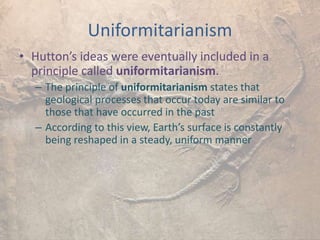
• Hutton’s ideas were eventually included in a
principle called uniformitarianism.
– The principle of uniformitarianism states that
geological processes that occur today are similar to
those that have occurred in the past
– According to this view, Earth’s surface is constantly
being reshaped in a steady, uniform manner
Uniformitarianism
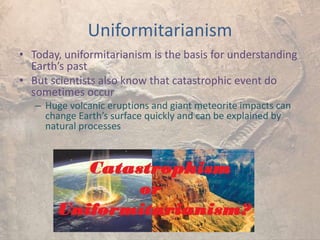
• Today, uniformitarianism is the basis for understanding
Earth’s past
• But scientists also know that catastrophic event do
sometimes occur
– Huge volcanic eruptions and giant meteorite impacts can
change Earth’s surface quickly and can be explained by
natural processes
Fossil Formation
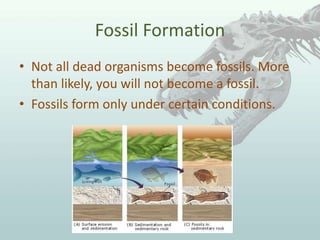
• Not all dead organisms become fossils. More
than likely, you will not become a fossil.
• Fossils form only under certain conditions.
Conditions for Fossil Formation
• Most plants and animals are eaten or decay when they die, leaving
no trace that they ever lived
– Consider an apple. More than likely an apple will decay into a soft
lump and be decomposed by bacteria and insects
• Some conditions increase the chances that a fossil will form.
1. If the organism has hard parts, such as shells, teeth, or bones
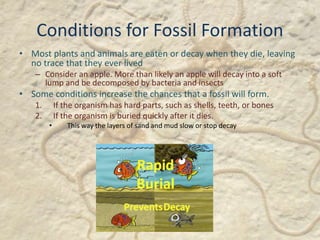
2. If the organism is buried quickly after it dies.
• This way the layers of sand and mud slow or stop decay
Fossils Come in All Sizes
• Many of the fossils we think of are large dinosaur fossils.
• However, not all fossils are large.
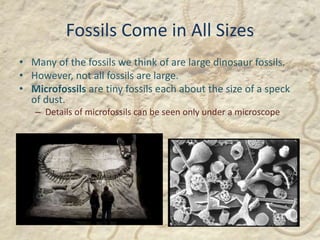
• Microfossils are tiny fossils each about the size of a speck
of dust.
– Details of microfossils can be seen only under a microscope
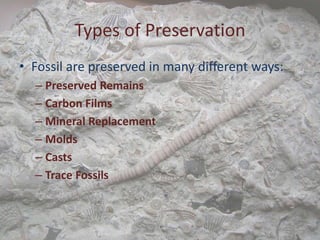
Types of Preservation
• Fossil are preserved in many different ways:
– Preserved Remains
– Carbon Films
– Mineral Replacement
– Molds
– Casts
– Trace Fossils
Preserved Remains
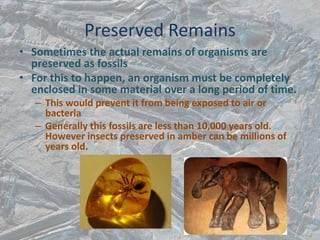
• Sometimes the actual remains of organisms are
preserved as fossils
• For this to happen, an organism must be completely
enclosed in some material over a long period of time.
– This would prevent it from being exposed to air or
bacteria
– Generally this fossils are less than 10,000 years old.
However insects preserved in amber can be millions of
years old.
Carbon Films
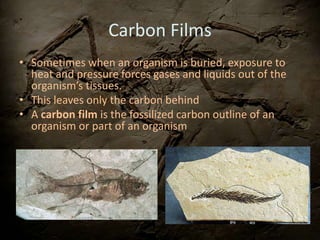
• Sometimes when an organism is buried, exposure to
heat and pressure forces gases and liquids out of the
organism’s tissues.
• This leaves only the carbon behind
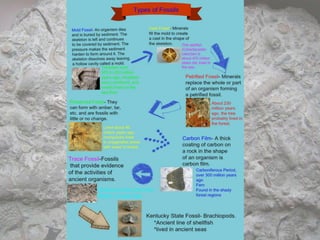
• A carbon film is the fossilized carbon outline of an
organism or part of an organism
Mineral Replacement
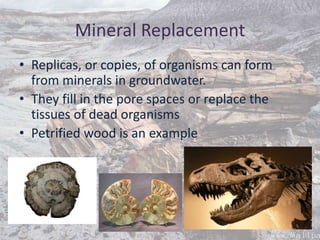
• Replicas, or copies, of organisms can form
from minerals in groundwater.
• They fill in the pore spaces or replace the
tissues of dead organisms
• Petrified wood is an example
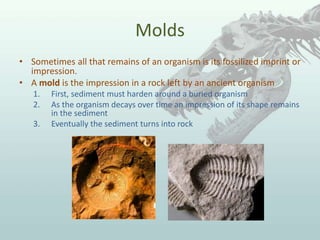
Molds
• Sometimes all that remains of an organism is its fossilized imprint or
impression.
• A mold is the impression in a rock left by an ancient organism
1. First, sediment must harden around a buried organism
2. As the organism decays over time an impression of its shape remains
in the sediment
3. Eventually the sediment turns into rock
Casts
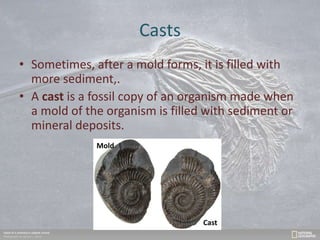
• Sometimes, after a mold forms, it is filled with
more sediment,.
• A cast is a fossil copy of an organism made when
a mold of the organism is filled with sediment or
mineral deposits.
Mold
Cast
Trace Fossils
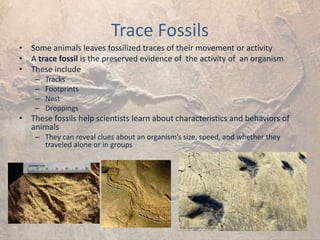
• Some animals leaves fossilized traces of their movement or activity
• A trace fossil is the preserved evidence of the activity of an organism
• These include
– Tracks
– Footprints
– Nest
– Droppings
• These fossils help scientists learn about characteristics and behaviors of
animals
– They can reveal clues about an organism’s size, speed, and whether they
traveled alone or in groups
Ancient Environments
• Scientists who study fossils are called paleontologists
• Paleontologists use the principle of uniformitarianism to
learn about ancient organisms and their environment
• They often compare fossils of ancient organisms to
organisms living today
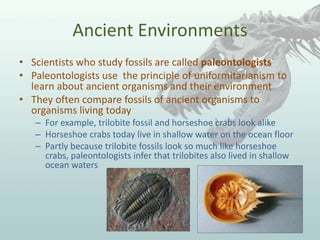
– For example, trilobite fossil and horseshoe crabs look alike
– Horseshoe crabs today live in shallow water on the ocean floor
– Partly because trilobite fossils look so much like horseshoe
crabs, paleontologists infer that trilobites also lived in shallow
ocean waters
Shallow Seas
• Today, Earth’s continents are mostly above sea level.
• But, sea level has risen, flooding Earth’s continents, many times in
the past
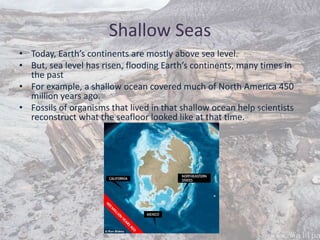
• For example, a shallow ocean covered much of North America 450
million years ago.
• Fossils of organisms that lived in that shallow ocean help scientists
reconstruct what the seafloor looked like at that time.
Past Climates
• Evidence indicates that Earth's present-day climate is
warming.
• Fossils show that Earth's climate has warmed and
cooled many times in the past
• Plant fossils are especially good indicators of climate
change
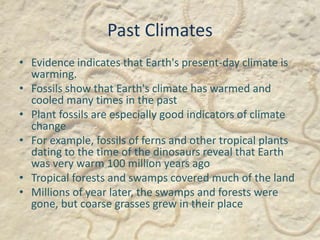
• For example, fossils of ferns and other tropical plants
dating to the time of the dinosaurs reveal that Earth
was very warm 100 million years ago
• Tropical forests and swamps covered much of the land
• Millions of year later, the swamps and forests were
gone, but coarse grasses grew in their place
Past Climates
• Huge sheets of ice called glaciers spread over
parts of N. America, Europe, and Asia.
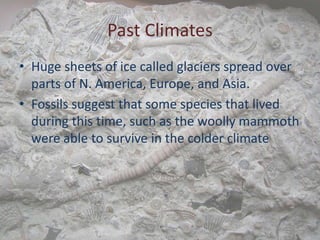
• Fossils suggest that some species that lived
during this time, such as the woolly mammoth
were able to survive in the colder climate

Chapter 16.1: Fossils

  • 1.
    Fossils Chapter 16 Lesson1 Pages 564 - 572
  • 2.
    Vocabulary • Fossil –the preserved remains or evidence of ancient living things • Catastrophism – the idea that conditions and organisms on Earth change in quick, violent events • Uniformitarianism – a principle that states that geologic processes that occur today are similar to those that have occurred in the past • Carbon Film – the fossilized carbon outline of an organism or part of an organism • Mold – the impression in a rock left by an ancient organism • Cast – a fossil copy of an organism made when a mold of the organism is filled with sediment of mineral deposits • Trace Fossil – the preserved evidence of the activity of an organism • Paleontologist – scientists who study fossils
  • 3.
    Evidence of theDistant Past • Just like old photos, fossils provide us with clues about Earth’s past • Fossils are the preserved remain or evidence of ancient living things
  • 4.
    Catastrophism • Many fossilsrepresent plants and animals that are extinct • In the past many scientists believed that a single, sudden, catastrophic disaster killed the organisms that become fossil • Catastrophism is the idea that conditions and organisms on Earth change in quick, violent events – These include large volcanic eruptions and widespread flooding
  • 5.
    Catastrophism • Scientists eventuallydisagreed with catastrophism because Earth’s history is full of violent events • Most people who supported catastrophism thought that Earth was only a few thousand years old
  • 6.
    Uniformitarianism • In the1700s, James Hutton rejected the idea of catastrophism • Hutton thought that the processes responsible for changing the landscape could also shape Earth’s surface – For example, he thought that erosion caused by streams could also wear down mountains – He realized that these processes would take a long time and proposed that Earth was much older than a few thousand years
  • 7.
    Uniformitarianism • Hutton’s ideaswere eventually included in a principle called uniformitarianism. – The principle of uniformitarianism states that geological processes that occur today are similar to those that have occurred in the past – According to this view, Earth’s surface is constantly being reshaped in a steady, uniform manner
  • 8.
    Uniformitarianism • Today, uniformitarianismis the basis for understanding Earth’s past • But scientists also know that catastrophic event do sometimes occur – Huge volcanic eruptions and giant meteorite impacts can change Earth’s surface quickly and can be explained by natural processes
  • 9.
    Fossil Formation • Notall dead organisms become fossils. More than likely, you will not become a fossil. • Fossils form only under certain conditions.
  • 10.
    Conditions for FossilFormation • Most plants and animals are eaten or decay when they die, leaving no trace that they ever lived – Consider an apple. More than likely an apple will decay into a soft lump and be decomposed by bacteria and insects • Some conditions increase the chances that a fossil will form. 1. If the organism has hard parts, such as shells, teeth, or bones 2. If the organism is buried quickly after it dies. • This way the layers of sand and mud slow or stop decay
  • 11.
    Fossils Come inAll Sizes • Many of the fossils we think of are large dinosaur fossils. • However, not all fossils are large. • Microfossils are tiny fossils each about the size of a speck of dust. – Details of microfossils can be seen only under a microscope
  • 12.
    Types of Preservation •Fossil are preserved in many different ways: – Preserved Remains – Carbon Films – Mineral Replacement – Molds – Casts – Trace Fossils
  • 14.
    Preserved Remains • Sometimesthe actual remains of organisms are preserved as fossils • For this to happen, an organism must be completely enclosed in some material over a long period of time. – This would prevent it from being exposed to air or bacteria – Generally this fossils are less than 10,000 years old. However insects preserved in amber can be millions of years old.
  • 15.
    Carbon Films • Sometimeswhen an organism is buried, exposure to heat and pressure forces gases and liquids out of the organism’s tissues. • This leaves only the carbon behind • A carbon film is the fossilized carbon outline of an organism or part of an organism
  • 16.
    Mineral Replacement • Replicas,or copies, of organisms can form from minerals in groundwater. • They fill in the pore spaces or replace the tissues of dead organisms • Petrified wood is an example
  • 17.
    Molds • Sometimes allthat remains of an organism is its fossilized imprint or impression. • A mold is the impression in a rock left by an ancient organism 1. First, sediment must harden around a buried organism 2. As the organism decays over time an impression of its shape remains in the sediment 3. Eventually the sediment turns into rock
  • 18.
    Casts • Sometimes, aftera mold forms, it is filled with more sediment,. • A cast is a fossil copy of an organism made when a mold of the organism is filled with sediment or mineral deposits. Mold Cast
  • 19.
    Trace Fossils • Someanimals leaves fossilized traces of their movement or activity • A trace fossil is the preserved evidence of the activity of an organism • These include – Tracks – Footprints – Nest – Droppings • These fossils help scientists learn about characteristics and behaviors of animals – They can reveal clues about an organism’s size, speed, and whether they traveled alone or in groups
  • 20.
    Ancient Environments • Scientistswho study fossils are called paleontologists • Paleontologists use the principle of uniformitarianism to learn about ancient organisms and their environment • They often compare fossils of ancient organisms to organisms living today – For example, trilobite fossil and horseshoe crabs look alike – Horseshoe crabs today live in shallow water on the ocean floor – Partly because trilobite fossils look so much like horseshoe crabs, paleontologists infer that trilobites also lived in shallow ocean waters
  • 21.
    Shallow Seas • Today,Earth’s continents are mostly above sea level. • But, sea level has risen, flooding Earth’s continents, many times in the past • For example, a shallow ocean covered much of North America 450 million years ago. • Fossils of organisms that lived in that shallow ocean help scientists reconstruct what the seafloor looked like at that time.
  • 22.
    Past Climates • Evidenceindicates that Earth's present-day climate is warming. • Fossils show that Earth's climate has warmed and cooled many times in the past • Plant fossils are especially good indicators of climate change • For example, fossils of ferns and other tropical plants dating to the time of the dinosaurs reveal that Earth was very warm 100 million years ago • Tropical forests and swamps covered much of the land • Millions of year later, the swamps and forests were gone, but coarse grasses grew in their place
  • 23.
    Past Climates • Hugesheets of ice called glaciers spread over parts of N. America, Europe, and Asia. • Fossils suggest that some species that lived during this time, such as the woolly mammoth were able to survive in the colder climate