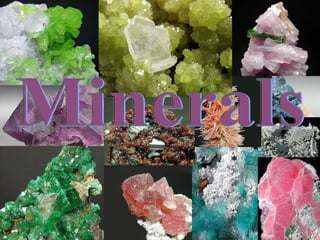
Minerals
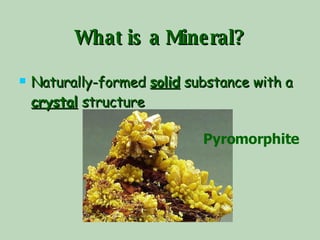
What is a Mineral? Naturally-formed  solid  substance with a  crystal  structure Pyromorphite
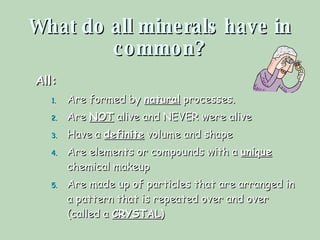
What do all minerals have in common? All: Are formed by  natural  processes. Are  NOT  alive and NEVER were alive Have a  definite  volume and shape Are elements or compounds with a  unique  chemical makeup Are made up of particles that are arranged in a pattern that is repeated over and over (called a  CRYSTAL )
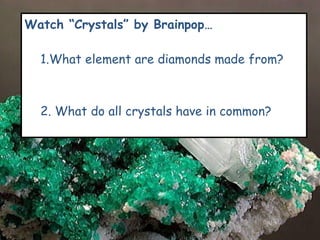
Watch “Crystals” by Brainpop… .What element are diamonds made from? . What do all crystals have in common?
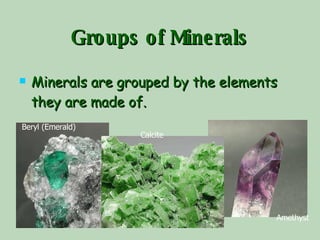
Groups of Minerals Minerals are grouped by the elements they are made of. Amethyst Beryl (Emerald) Calcite
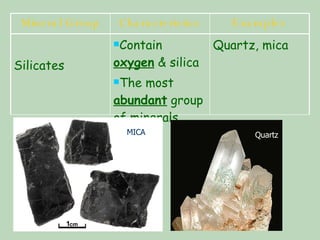
MICA Quartz Quartz, mica Contain  oxygen  & silica The most  abundant  group of minerals   Silicates Examples Characteristics Mineral Group
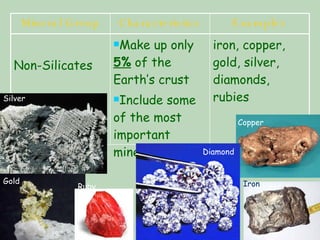
Silver Gold Ruby Iron Copper Diamond iron, copper, gold, silver, diamonds, rubies   Make up only  5%  of the Earth’s crust Include some of the most important minerals   Non-Silicates Examples Characteristics Mineral Group
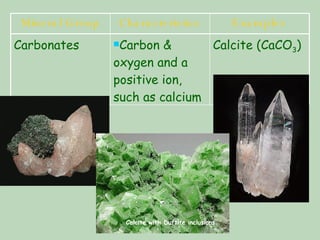
Calcite with Duftite inclusions Calcite (CaCO 3 ) Carbon & oxygen and a positive ion, such as calcium   Carbonates Examples Characteristics Mineral Group
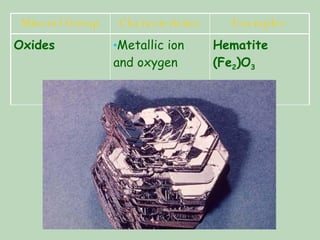
Hematite (Fe 2 )O 3 Metallic ion and oxygen Oxides Examples Characteristics Mineral Group
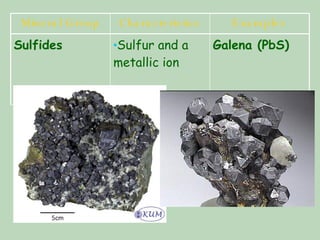
Galena (PbS) Sulfur and a metallic ion Sulfides Examples Characteristics Mineral Group
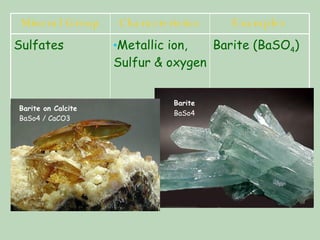
Barite on Calcite   BaSo4 / CaCO3 Barite BaSo4   Barite (BaSO 4 ) Metallic ion, Sulfur & oxygen Sulfates Examples Characteristics Mineral Group
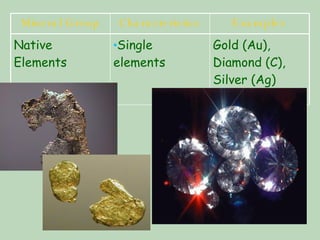
Gold (Au), Diamond (C), Silver (Ag)   Single elements Native Elements Examples Characteristics Mineral Group
How do minerals form? 1) Cooling of  magma  (hot,  liquid rock  and minerals inside the earth (from the mantle)) Fast Cooling = No Crystals (mineraloids) Medium Cooling = small crystals Slow Cooling = large crystals
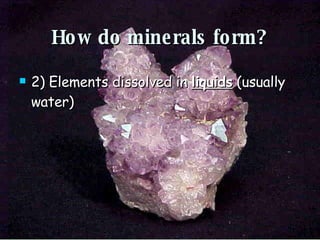
How do minerals form? 2) Elements dissolved in  liquids  (usually water)
Physical Properties of Minerals   (can be used to identify the mineral) Color Can be  misleading Can vary with the type of impurities
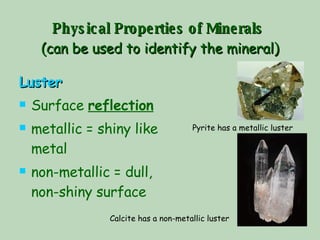
Physical Properties of Minerals   (can be used to identify the mineral) Luster Surface  reflection   metallic = shiny like metal non-metallic = dull, non-shiny surface Pyrite has a metallic luster Calcite has a non-metallic luster
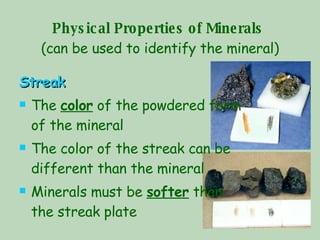
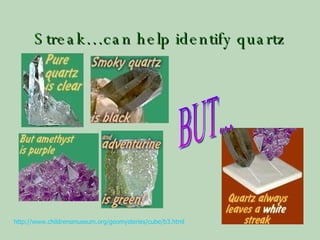
Physical Properties of Minerals   (can be used to identify the mineral) Streak The  color  of the powdered form of the mineral The color of the streak can be different than the mineral Minerals must be  softer  than the streak plate
Streak…can help identify quartz BUT... http://www.childrensmuseum.org/geomysteries/cube/b3.html
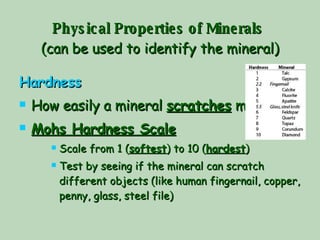
Physical Properties of Minerals   (can be used to identify the mineral) Hardness How easily a mineral  scratches  materials Mohs Hardness Scale Scale from 1 ( softest ) to 10 ( hardest ) Test by seeing if the mineral can scratch different objects (like human fingernail, copper, penny, glass, steel file)
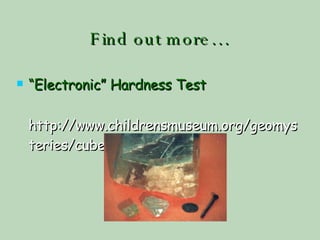
Find out more… “ Electronic” Hardness Test http://www.childrensmuseum.org/geomysteries/cube/b2.html
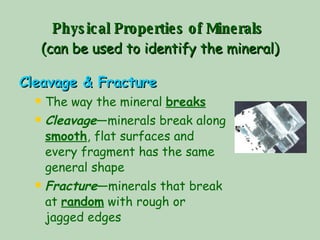
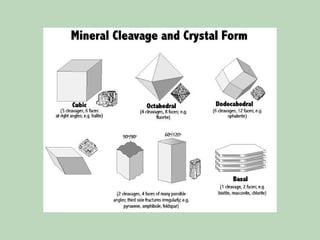
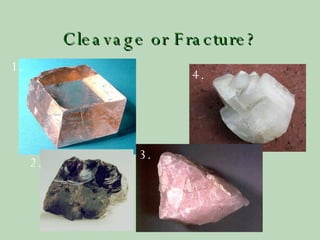
Physical Properties of Minerals   (can be used to identify the mineral) Cleavage & Fracture The way the mineral  breaks Cleavage —minerals break along  smooth , flat surfaces and every fragment has the same general shape Fracture —minerals that break at  random  with rough or jagged edges
 
Cleavage or Fracture? 1. 4. 3. 2.
Physical Properties of Minerals   (can be used to identify the mineral) Other Properties Specific gravity (*excellent clue to mineral’s identity) Attraction to  magnets Bending of light Reaction with hydrochloric acid Smell & taste http://www.childrensmuseum.org/geomysteries/cube/b4.html
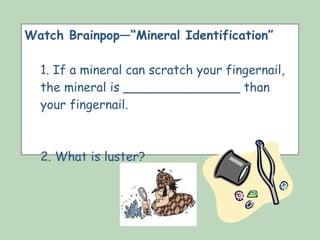
Watch Brainpop—“Mineral Identification” . If a mineral can scratch your fingernail, the mineral is _______________ than your fingernail. 2. What is luster?
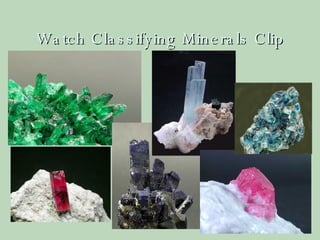
Watch Classifying Minerals Clip
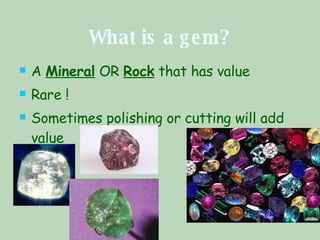
What is a gem? A  Mineral  OR  Rock  that has value Rare ! Sometimes polishing or cutting will add value

Minerals

  • 1.
  • 2.
    What is aMineral? Naturally-formed solid substance with a crystal structure Pyromorphite
  • 3.
    What do allminerals have in common? All: Are formed by natural processes. Are NOT alive and NEVER were alive Have a definite volume and shape Are elements or compounds with a unique chemical makeup Are made up of particles that are arranged in a pattern that is repeated over and over (called a CRYSTAL )
  • 4.
    Watch “Crystals” byBrainpop… .What element are diamonds made from? . What do all crystals have in common?
  • 5.
    Groups of MineralsMinerals are grouped by the elements they are made of. Amethyst Beryl (Emerald) Calcite
  • 6.
    MICA Quartz Quartz,mica Contain oxygen & silica The most abundant group of minerals Silicates Examples Characteristics Mineral Group
  • 7.
    Silver Gold RubyIron Copper Diamond iron, copper, gold, silver, diamonds, rubies Make up only 5% of the Earth’s crust Include some of the most important minerals Non-Silicates Examples Characteristics Mineral Group
  • 8.
    Calcite with Duftite inclusionsCalcite (CaCO 3 ) Carbon & oxygen and a positive ion, such as calcium Carbonates Examples Characteristics Mineral Group
  • 9.
    Hematite (Fe 2)O 3 Metallic ion and oxygen Oxides Examples Characteristics Mineral Group
  • 10.
    Galena (PbS) Sulfurand a metallic ion Sulfides Examples Characteristics Mineral Group
  • 11.
    Barite on Calcite BaSo4 / CaCO3 Barite BaSo4 Barite (BaSO 4 ) Metallic ion, Sulfur & oxygen Sulfates Examples Characteristics Mineral Group
  • 12.
    Gold (Au), Diamond(C), Silver (Ag) Single elements Native Elements Examples Characteristics Mineral Group
  • 13.
    How do mineralsform? 1) Cooling of magma (hot, liquid rock and minerals inside the earth (from the mantle)) Fast Cooling = No Crystals (mineraloids) Medium Cooling = small crystals Slow Cooling = large crystals
  • 14.
    How do mineralsform? 2) Elements dissolved in liquids (usually water)
  • 15.
    Physical Properties ofMinerals (can be used to identify the mineral) Color Can be misleading Can vary with the type of impurities
  • 16.
    Physical Properties ofMinerals (can be used to identify the mineral) Luster Surface reflection metallic = shiny like metal non-metallic = dull, non-shiny surface Pyrite has a metallic luster Calcite has a non-metallic luster
  • 17.
    Physical Properties ofMinerals (can be used to identify the mineral) Streak The color of the powdered form of the mineral The color of the streak can be different than the mineral Minerals must be softer than the streak plate
  • 18.
    Streak…can help identifyquartz BUT... http://www.childrensmuseum.org/geomysteries/cube/b3.html
  • 19.
    Physical Properties ofMinerals (can be used to identify the mineral) Hardness How easily a mineral scratches materials Mohs Hardness Scale Scale from 1 ( softest ) to 10 ( hardest ) Test by seeing if the mineral can scratch different objects (like human fingernail, copper, penny, glass, steel file)
  • 20.
    Find out more…“ Electronic” Hardness Test http://www.childrensmuseum.org/geomysteries/cube/b2.html
  • 21.
    Physical Properties ofMinerals (can be used to identify the mineral) Cleavage & Fracture The way the mineral breaks Cleavage —minerals break along smooth , flat surfaces and every fragment has the same general shape Fracture —minerals that break at random with rough or jagged edges
  • 22.
  • 23.
  • 24.
    Physical Properties ofMinerals (can be used to identify the mineral) Other Properties Specific gravity (*excellent clue to mineral’s identity) Attraction to magnets Bending of light Reaction with hydrochloric acid Smell & taste http://www.childrensmuseum.org/geomysteries/cube/b4.html
  • 25.
    Watch Brainpop—“Mineral Identification”. If a mineral can scratch your fingernail, the mineral is _______________ than your fingernail. 2. What is luster?
  • 26.
  • 27.
    What is agem? A Mineral OR Rock that has value Rare ! Sometimes polishing or cutting will add value