UNIT 4.6 CONGRUENCE IN RIGHTUNIT 4.6 CONGRUENCE IN RIGHT
TRIANGLESTRIANGLES
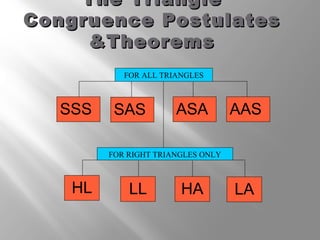
The TriangleThe Triangle
Congruence PostulatesCongruence Postulates
&Theorems&Theorems
LAHALLHL
FOR RIGHT TRIANGLES ONLY
AASASASASSSS
FOR ALL TRIANGLES
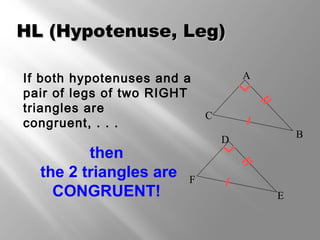
HL (Hypotenuse, Leg)HL (Hypotenuse, Leg)
If both hypotenuses and a
pair of legs of two RIGHT
triangles are
congruent, . . .
A
C
B
F
E
D
then
the 2 triangles are
CONGRUENT!
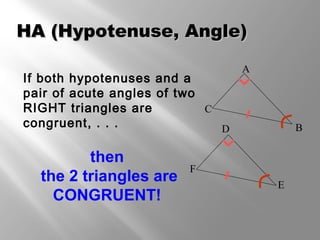
HA (Hypotenuse, Angle)HA (Hypotenuse, Angle)
If both hypotenuses and a
pair of acute angles of two
RIGHT triangles are
congruent, . . .
then
the 2 triangles are
CONGRUENT!
F
E
D
A
C
B
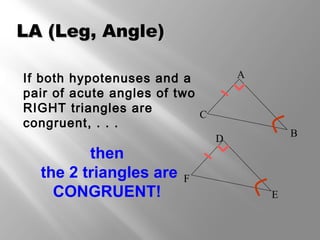
LA (Leg, Angle)LA (Leg, Angle)
If both hypotenuses and a
pair of acute angles of two
RIGHT triangles are
congruent, . . .
then
the 2 triangles are
CONGRUENT!
A
C
B
F
E
D
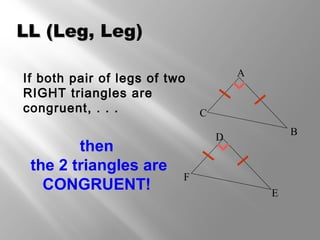
LL (Leg, Leg)LL (Leg, Leg)
If both pair of legs of two
RIGHT triangles are
congruent, . . .
then
the 2 triangles are
CONGRUENT!
A
C
B
F
E
D
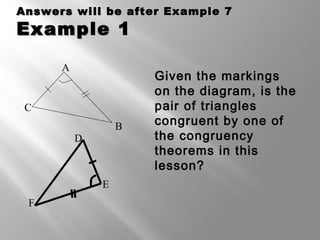
Answers will be after Example 7Answers will be after Example 7
Example 1Example 1
Given the markings
on the diagram, is the
pair of triangles
congruent by one of
the congruency
theorems in this
lesson?
F
E
D
A
C
B
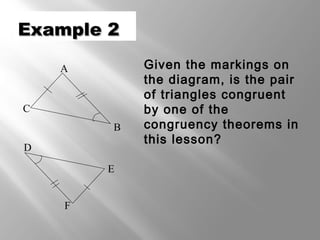
Example 2Example 2
Given the markings on
the diagram, is the pair
of triangles congruent
by one of the
congruency theorems in
this lesson?
A
C
B
F
E
D
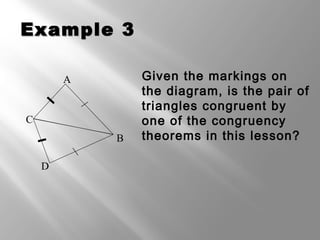
Example 3Example 3
Given the markings on
the diagram, is the pair of
triangles congruent by
one of the congruency
theorems in this lesson?
D
A
C
B
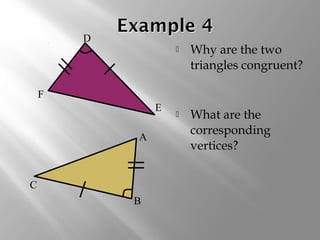
 Why are the two
triangles congruent?
 What are the
corresponding
vertices?
A
B
C
D
E
F
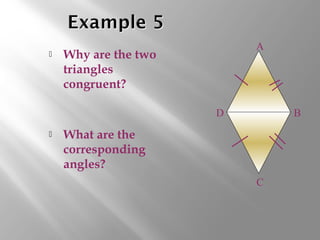
 Why are the two
triangles
congruent?
 What are the
corresponding
angles?
A
B
C
D
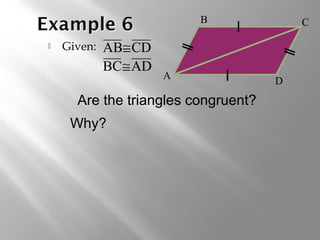
 Given:
B C
D
A
CDAB≅
ADBC≅
Are the triangles congruent?
Why?
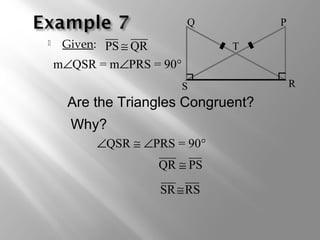
 Given: QRPS ≅
RSSR≅
Are the Triangles Congruent?
∠QSR ≅ ∠PRS = 90°
Q
RS
P
T
m∠QSR = m∠PRS = 90°
PSQR ≅
Why?
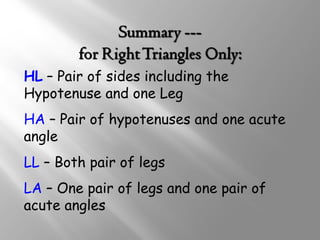
HL – Pair of sides including the
Hypotenuse and one Leg
HA – Pair of hypotenuses and one acute
angle
LL – Both pair of legs
LA – One pair of legs and one pair of
acute angles
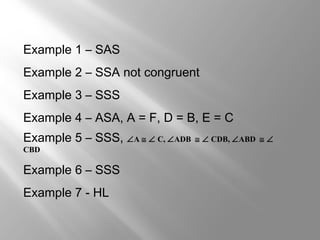
Example 1 – SAS
Example 2 – SSA not congruent
Example 3 – SSS
Example 4 – ASA, A = F, D = B, E = C
Example 5 – SSS, ∠A ≅ ∠ C, ∠ADB ≅ ∠ CDB, ∠ABD ≅ ∠
CBD
Example 6 – SSS
Example 7 - HL
(a)
(b)
(c)
(d)
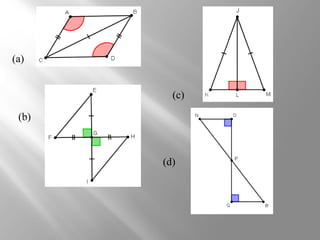
Let's take a closer look at all of the diagrams to determine which of them show a pair of congruent
triangles by the HL Theorem.
In (a), it appears as though we might be able to use the HL Theorem. However, upon careful examination, we
note that the angles at vertices A and D are not right angles. Because a square is not used to indicate that the
angles are right angles, we cannot use the HL Theorem. Recall that the only type of triangle for which this
theorem holds is a right triangle, so we cannot APPLY it in this situation.
Figure (b) does show two triangles that are congruent, but not by the HL Theorem. We are given that
segment FG is congruent to segment HG and that segment EG is congruent to segment IG. We also have
right angles that form at G. Because we have two sides and the included angle of one triangle congruent to
the corresponding parts of the other triangle, we know that the triangles are congruent by the SAS Postulate.
However, we are not given any information regarding the hypotenuses of ?EGF and ?IHG, so we cannot
APPLY the HL Theorem to prove that the triangles are congruent.
Now, let's look at (c). Notice that we have two right angles in the figure: ?JLK and ?JLM. Also, we have
been given the fact that segment JK is congruent to segment JM. These segments are actually the hypotenuses
of the triangles because they lie on the side opposite of the right angle. Moreover, the two triangles in the
figure share segment JL. By transitivity, we know that the segment is congruent to itself. Thus, we can apply
the HL Theorem to prove that ?JKL??JML, since we know that the triangles are right triangles, their
hypotenuses are congruent, and they have a pair of legs that are congruent.
Finally, we have the figure for (d). We have been given that there are right angles at vertices O and Q. We
can also imply that ?NPO and ?RPQ are congruent because they are vertical angles. This will not help us try
to prove that the triangles are congruent by the HL Theorem, however. What we are looking for is
information about the legs or hypotenuses of the triangles. Since we cannot deduce any more facts from the
diagram that will help us, we cannot apply the HL Theorem in this situation.
Therefore, we can only apply the HL Theorem in (c) to show that the triangles are congruent.
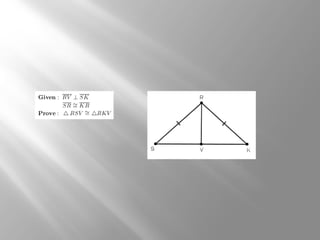
We want to examine the information that has been given to us in the problem. We know that
segment RV is perpendicular to segment SK, and that segments SR and KR are congruent.
Let's try to deduce more information from the given statements that may help us prove that
Since we were given that RV and SK are perpendicular, we know that there exist right angles
at RVS and RVK. This fact is a key component of our proof because we know that triangle
RSV and triangle RKV are right triangles. Thus, we can try to use the HL Theorem to prove
that they are congruent to each other.
We have already been given that the hypotenuses are congruent, so all that is left to show is
that a pair of legs of the triangles is congruent. Since they both share segment RV, we can use
the Transitive Property to say that the segment is congruent to itself.
In all, we have found right angles, congruent hypotenuses, and congruent legs between the
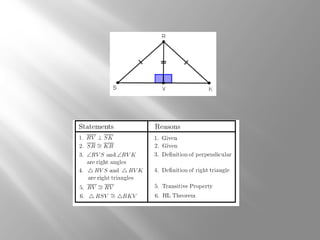
triangles, so we APPLY the HL Theorem to say that . Our new diagram and
the two-column geometric proof are shown below.
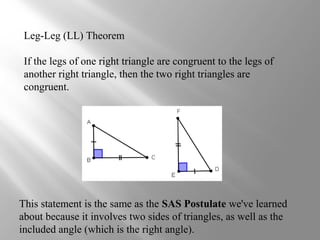
Leg-Leg (LL) Theorem
If the legs of one right triangle are congruent to the legs of
another right triangle, then the two right triangles are
congruent.
This statement is the same as the SAS Postulate we've learned
about because it involves two sides of triangles, as well as the
included angle (which is the right angle).
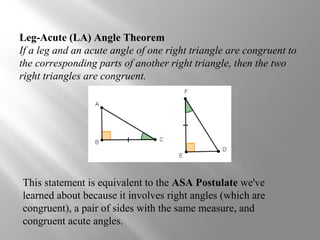
Leg-Acute (LA) Angle Theorem
If a leg and an acute angle of one right triangle are congruent to
the corresponding parts of another right triangle, then the two
right triangles are congruent.
This statement is equivalent to the ASA Postulate we've
learned about because it involves right angles (which are
congruent), a pair of sides with the same measure, and
congruent acute angles.
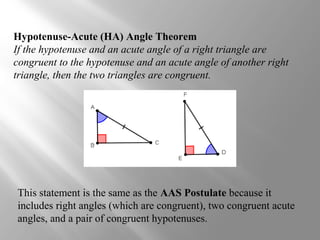
Hypotenuse-Acute (HA) Angle Theorem
If the hypotenuse and an acute angle of a right triangle are
congruent to the hypotenuse and an acute angle of another right
triangle, then the two triangles are congruent.
This statement is the same as the AAS Postulate because it
includes right angles (which are congruent), two congruent acute
angles, and a pair of congruent hypotenuses.
All rights belong to their respective
owners.
Copyright Disclaimer Under
Section 107 of the Copyright Act
1976, allowance is made for "fair
use" for purposes such as criticism,
comment, news
reporting, TEACHING,
scholarship, and research.
Fair use is a use permitted by
copyright statute that might
otherwise be infringing.
Non-profit, EDUCATIONAL or
personal use tips the balance in
favor of fair use.

Geometry unit 4.6

  • 1.
    UNIT 4.6 CONGRUENCEIN RIGHTUNIT 4.6 CONGRUENCE IN RIGHT TRIANGLESTRIANGLES
  • 2.
    The TriangleThe Triangle CongruencePostulatesCongruence Postulates &Theorems&Theorems LAHALLHL FOR RIGHT TRIANGLES ONLY AASASASASSSS FOR ALL TRIANGLES
  • 3.
    HL (Hypotenuse, Leg)HL(Hypotenuse, Leg) If both hypotenuses and a pair of legs of two RIGHT triangles are congruent, . . . A C B F E D then the 2 triangles are CONGRUENT!
  • 4.
    HA (Hypotenuse, Angle)HA(Hypotenuse, Angle) If both hypotenuses and a pair of acute angles of two RIGHT triangles are congruent, . . . then the 2 triangles are CONGRUENT! F E D A C B
  • 5.
    LA (Leg, Angle)LA(Leg, Angle) If both hypotenuses and a pair of acute angles of two RIGHT triangles are congruent, . . . then the 2 triangles are CONGRUENT! A C B F E D
  • 6.
    LL (Leg, Leg)LL(Leg, Leg) If both pair of legs of two RIGHT triangles are congruent, . . . then the 2 triangles are CONGRUENT! A C B F E D
  • 7.
    Answers will beafter Example 7Answers will be after Example 7 Example 1Example 1 Given the markings on the diagram, is the pair of triangles congruent by one of the congruency theorems in this lesson? F E D A C B
  • 8.
    Example 2Example 2 Giventhe markings on the diagram, is the pair of triangles congruent by one of the congruency theorems in this lesson? A C B F E D
  • 9.
    Example 3Example 3 Giventhe markings on the diagram, is the pair of triangles congruent by one of the congruency theorems in this lesson? D A C B
  • 10.
     Why arethe two triangles congruent?  What are the corresponding vertices? A B C D E F
  • 11.
     Why arethe two triangles congruent?  What are the corresponding angles? A B C D
  • 12.
     Given: B C D A CDAB≅ ADBC≅ Arethe triangles congruent? Why?
  • 13.
     Given: QRPS≅ RSSR≅ Are the Triangles Congruent? ∠QSR ≅ ∠PRS = 90° Q RS P T m∠QSR = m∠PRS = 90° PSQR ≅ Why?
  • 14.
    HL – Pairof sides including the Hypotenuse and one Leg HA – Pair of hypotenuses and one acute angle LL – Both pair of legs LA – One pair of legs and one pair of acute angles
  • 15.
    Example 1 –SAS Example 2 – SSA not congruent Example 3 – SSS Example 4 – ASA, A = F, D = B, E = C Example 5 – SSS, ∠A ≅ ∠ C, ∠ADB ≅ ∠ CDB, ∠ABD ≅ ∠ CBD Example 6 – SSS Example 7 - HL
  • 16.
  • 17.
    Let's take acloser look at all of the diagrams to determine which of them show a pair of congruent triangles by the HL Theorem. In (a), it appears as though we might be able to use the HL Theorem. However, upon careful examination, we note that the angles at vertices A and D are not right angles. Because a square is not used to indicate that the angles are right angles, we cannot use the HL Theorem. Recall that the only type of triangle for which this theorem holds is a right triangle, so we cannot APPLY it in this situation. Figure (b) does show two triangles that are congruent, but not by the HL Theorem. We are given that segment FG is congruent to segment HG and that segment EG is congruent to segment IG. We also have right angles that form at G. Because we have two sides and the included angle of one triangle congruent to the corresponding parts of the other triangle, we know that the triangles are congruent by the SAS Postulate. However, we are not given any information regarding the hypotenuses of ?EGF and ?IHG, so we cannot APPLY the HL Theorem to prove that the triangles are congruent. Now, let's look at (c). Notice that we have two right angles in the figure: ?JLK and ?JLM. Also, we have been given the fact that segment JK is congruent to segment JM. These segments are actually the hypotenuses of the triangles because they lie on the side opposite of the right angle. Moreover, the two triangles in the figure share segment JL. By transitivity, we know that the segment is congruent to itself. Thus, we can apply the HL Theorem to prove that ?JKL??JML, since we know that the triangles are right triangles, their hypotenuses are congruent, and they have a pair of legs that are congruent. Finally, we have the figure for (d). We have been given that there are right angles at vertices O and Q. We can also imply that ?NPO and ?RPQ are congruent because they are vertical angles. This will not help us try to prove that the triangles are congruent by the HL Theorem, however. What we are looking for is information about the legs or hypotenuses of the triangles. Since we cannot deduce any more facts from the diagram that will help us, we cannot apply the HL Theorem in this situation. Therefore, we can only apply the HL Theorem in (c) to show that the triangles are congruent.
  • 19.
    We want toexamine the information that has been given to us in the problem. We know that segment RV is perpendicular to segment SK, and that segments SR and KR are congruent. Let's try to deduce more information from the given statements that may help us prove that Since we were given that RV and SK are perpendicular, we know that there exist right angles at RVS and RVK. This fact is a key component of our proof because we know that triangle RSV and triangle RKV are right triangles. Thus, we can try to use the HL Theorem to prove that they are congruent to each other. We have already been given that the hypotenuses are congruent, so all that is left to show is that a pair of legs of the triangles is congruent. Since they both share segment RV, we can use the Transitive Property to say that the segment is congruent to itself. In all, we have found right angles, congruent hypotenuses, and congruent legs between the triangles, so we APPLY the HL Theorem to say that . Our new diagram and the two-column geometric proof are shown below.
  • 21.
    Leg-Leg (LL) Theorem Ifthe legs of one right triangle are congruent to the legs of another right triangle, then the two right triangles are congruent. This statement is the same as the SAS Postulate we've learned about because it involves two sides of triangles, as well as the included angle (which is the right angle).
  • 22.
    Leg-Acute (LA) AngleTheorem If a leg and an acute angle of one right triangle are congruent to the corresponding parts of another right triangle, then the two right triangles are congruent. This statement is equivalent to the ASA Postulate we've learned about because it involves right angles (which are congruent), a pair of sides with the same measure, and congruent acute angles.
  • 23.
    Hypotenuse-Acute (HA) AngleTheorem If the hypotenuse and an acute angle of a right triangle are congruent to the hypotenuse and an acute angle of another right triangle, then the two triangles are congruent. This statement is the same as the AAS Postulate because it includes right angles (which are congruent), two congruent acute angles, and a pair of congruent hypotenuses.
  • 24.
    All rights belongto their respective owners. Copyright Disclaimer Under Section 107 of the Copyright Act 1976, allowance is made for "fair use" for purposes such as criticism, comment, news reporting, TEACHING, scholarship, and research. Fair use is a use permitted by copyright statute that might otherwise be infringing. Non-profit, EDUCATIONAL or personal use tips the balance in favor of fair use.