09/27/07 Warm-up Which of the following four statements  can’t  you conclude from the diagram? A, B, and C are collinear. B is the midpoint of AC.  DBC is a right angle. E is in the interior of   DBA D C B A E
Postulate vs. Theorem Postulate (axiom): A statement that is accepted as true without proof. Theorem: An important statement that must be proved before it can be accepted.
Reading postulates and theorems Read carefully. Reread each phrase, one at a time. Look up any words you do not understand. Try to identify conditions. Look for key words,  if ,  if and only if ,  exactly one ,  exists ,  unique ,  etc . Visualize, draw diagrams, or model the situation Imagine if it wasn’t true.  What would that look like?
Postulates A line contains at least two points;  space contains at least four points not all in one plane. A plane contains at least three points not all in one line;
More Postulates Through any two points there is exactly one line.
More Postulates and through any three noncollinear points there is exactly one plane. Through any three points there is at least one plane,
More Postulates If two points are in a plane, then the line that contains the points is in that plane.
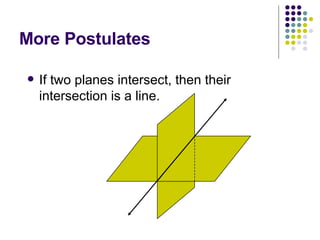
More Postulates If two planes intersect, then their intersection is a line.
p. 24:  State a postulate, or part of a postulate, that justifies your answer to each exercise. Name two points that determine line  l. Name three points that determine plane M. Name the intersection of planes M and N. Does AD lie in plane M? Does plane N contain any points not on AB? M N B A l C
Assignment A14 p. 25 #5-11
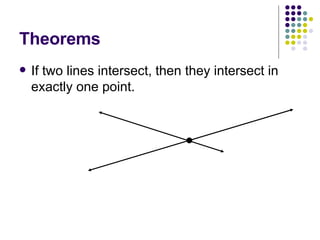
Theorems If two lines intersect, then they intersect in exactly one point.
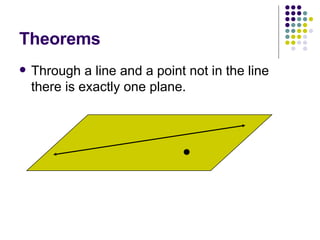
Theorems Through a line and a point not in the line there is exactly one plane.
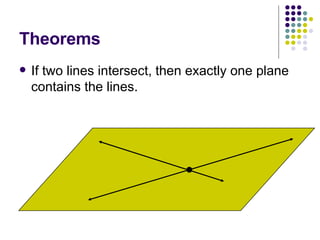
Theorems If two lines intersect, then exactly one plane contains the lines.