Trapezoid
Trapezoid
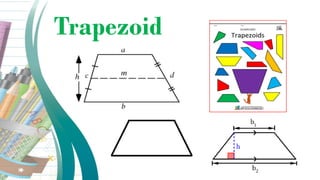
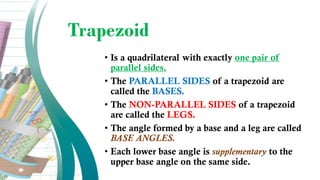
• Is a quadrilateral with exactly one pair of
parallel sides.
• The PARALLEL SIDES of a trapezoid are
called the BASES.
• The NON-PARALLEL SIDES of a trapezoid
are called the LEGS.
• The angle formed by a base and a leg are called
BASE ANGLES.
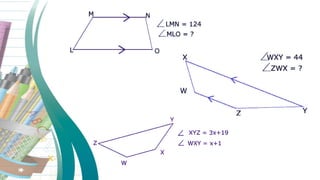
• Each lower base angle is supplementary to the
upper base angle on the same side.
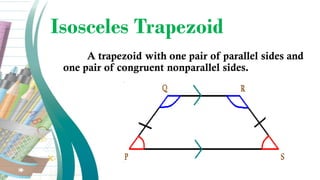
Isosceles Trapezoid
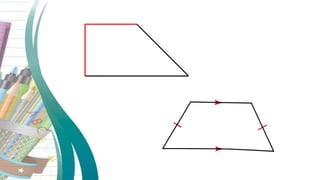
A trapezoid with one pair of parallel sides and
one pair of congruent nonparallel sides.
Three theorems related to
Isosceles Trapezoid
The base angles (upper and lower) of an
isosceles trapezoid are congruent.
Opposite angles of an isosceles trapezoid are
supplementary.
The diagonals of an isosceles trapezoid are
congruent.
Parallel and Perpendicular
Postulate
Parallel Postulate – if there is
a line and a point not on the
line, then there is exactly one
line through the point parallel
to the given line. (In a plane,
two lines are parallel if and
only if they are everywhere
equidistant).
Perpendicular Postulate – if
there is a line and a point
not on the line, then there
is exactly one line through
the point perpendicular to
the given line.
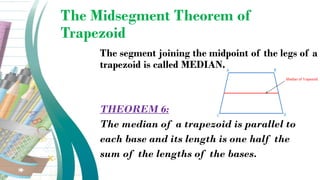
The Midsegment Theorem of
Trapezoid
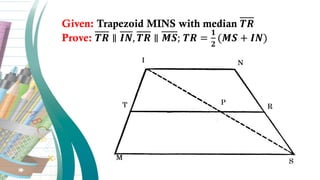
The segment joining the midpoint of the legs of a
trapezoid is called MEDIAN.
THEOREM 6:
The median of a trapezoid is parallel to
each base and its length is one half the
sum of the lengths of the bases.
Given: Trapezoid MINS with median 𝑻𝑹
Prove: 𝑻𝑹 ∥ 𝑰𝑵, 𝑻𝑹 ∥ 𝑴𝑺; 𝑻𝑹 =
𝟏
𝟐
(𝑴𝑺 + 𝑰𝑵)
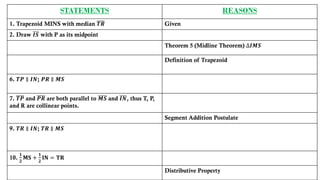
STATEMENTS REASONS
1. Trapezoid MINS with median 𝑻𝑹 Given
2. Draw 𝑰𝑺 with P as its midpoint
Theorem 5 (Midline Theorem) ∆𝑰𝑴𝑺
Definition of Trapezoid
6. 𝑻𝑷 ∥ 𝑰𝑵; 𝑷𝑹 ∥ 𝑴𝑺
7. 𝑻𝑷 and 𝑷𝑹 are both parallel to 𝑴𝑺 and 𝑰𝑵, thus T, P,
and R are collinear points.
Segment Addition Postulate
9. 𝑻𝑹 ∥ 𝑰𝑵; 𝑻𝑹 ∥ 𝑴𝑺
10.
𝟏
𝟐
𝐌𝐒 +
𝟏
𝟐
𝐈𝐍 = 𝐓𝐑
Distributive Property
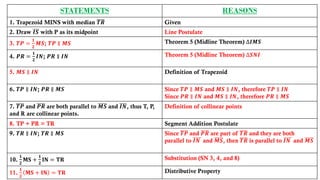
STATEMENTS REASONS
1. Trapezoid MINS with median 𝑻𝑹 Given
2. Draw 𝑰𝑺 with P as its midpoint Line Postulate
3. 𝑻𝑷 =
𝟏
𝟐
𝑴𝑺; 𝑻𝑷 ∥ 𝑴𝑺 Theorem 5 (Midline Theorem) ∆𝑰𝑴𝑺
4. 𝑷𝑹 =
𝟏
𝟐
𝑰𝑵; 𝑷𝑹 ∥ 𝑰𝑵 Theorem 5 (Midline Theorem) ∆𝑺𝑵𝑰
5. 𝑴𝑺 ∥ 𝑰𝑵 Definition of Trapezoid
6. 𝑻𝑷 ∥ 𝑰𝑵; 𝑷𝑹 ∥ 𝑴𝑺 Since 𝑻𝑷 ∥ 𝑴𝑺 and 𝑴𝑺 ∥ 𝑰𝑵, therefore 𝑻𝑷 ∥ 𝑰𝑵
Since 𝑷𝑹 ∥ 𝑰𝑵 and 𝑴𝑺 ∥ 𝑰𝑵, therefore 𝑷𝑹 ∥ 𝑴𝑺
7. 𝑻𝑷 and 𝑷𝑹 are both parallel to 𝑴𝑺 and 𝑰𝑵, thus T, P,
and R are collinear points.
Definition of collinear points
8. TP + PR = TR Segment Addition Postulate
9. 𝑻𝑹 ∥ 𝑰𝑵; 𝑻𝑹 ∥ 𝑴𝑺 Since 𝑻𝑷 and 𝑷𝑹 are part of 𝑻𝑹 and they are both
parallel to 𝑰𝑵 and 𝑴𝑺, then 𝑻𝑹 is parallel to 𝑰𝑵 and 𝑴𝑺
10.
𝟏
𝟐
𝐌𝐒 +
𝟏
𝟐
𝐈𝐍 = 𝐓𝐑 Substitution (SN 3, 4, and 8)
11.
𝟏
𝟐
𝐌𝐒 + 𝐈𝐍 = 𝐓𝐑 Distributive Property
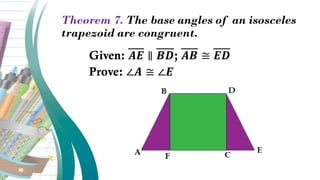
Theorem 7. The base angles of an isosceles
trapezoid are congruent.
Given: 𝑨𝑬 ∥ 𝑩𝑫; 𝑨𝑩 ≅ 𝑬𝑫
Prove: ∠𝑨 ≅ ∠𝑬
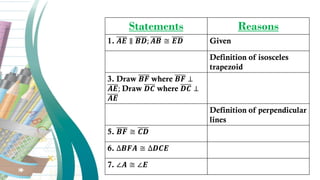
Statements Reasons
1. 𝑨𝑬 ∥ 𝑩𝑫; 𝑨𝑩 ≅ 𝑬𝑫 Given
Definition of isosceles
trapezoid
3. Draw 𝑩𝑭 where 𝑩𝑭 ⊥
𝑨𝑬; Draw 𝑫𝑪 where 𝑫𝑪 ⊥
𝑨𝑬
Definition of perpendicular
lines
5. 𝑩𝑭 ≅ 𝑪𝑫
6. ∆𝑩𝑭𝑨 ≅ ∆𝑫𝑪𝑬
7. ∠𝑨 ≅ ∠𝑬
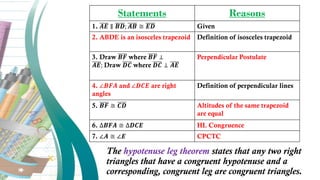
Statements Reasons
1. 𝑨𝑬 ∥ 𝑩𝑫; 𝑨𝑩 ≅ 𝑬𝑫 Given
2. ABDE is an isosceles trapezoid Definition of isosceles trapezoid
3. Draw 𝑩𝑭 where 𝑩𝑭 ⊥
𝑨𝑬; Draw 𝑫𝑪 where 𝑫𝑪 ⊥ 𝑨𝑬
Perpendicular Postulate
4. ∠𝑩𝑭𝑨 and ∠𝑫𝑪𝑬 are right
angles
Definition of perpendicular lines
5. 𝑩𝑭 ≅ 𝑪𝑫 Altitudes of the same trapezoid
are equal
6. ∆𝑩𝑭𝑨 ≅ ∆𝑫𝑪𝑬 HL Congruence
7. ∠𝑨 ≅ ∠𝑬 CPCTC
The hypotenuse leg theorem states that any two right
triangles that have a congruent hypotenuse and a
corresponding, congruent leg are congruent triangles.
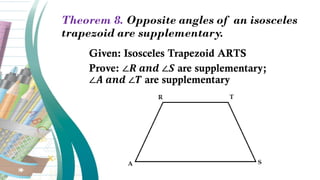
Theorem 8. Opposite angles of an isosceles
trapezoid are supplementary.
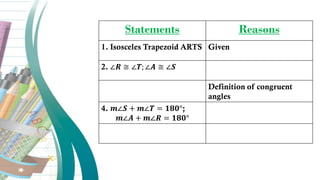
Given: Isosceles Trapezoid ARTS
Prove: ∠𝑹 𝒂𝒏𝒅 ∠𝑺 are supplementary;
∠𝑨 𝒂𝒏𝒅 ∠𝑻 are supplementary
Statements Reasons
1. Isosceles Trapezoid ARTS Given
2. ∠𝑹 ≅ ∠𝑻; ∠𝑨 ≅ ∠𝑺
Definition of congruent
angles
4. 𝒎∠𝑺 + 𝒎∠𝑻 = 𝟏𝟖𝟎°;
𝒎∠𝑨 + 𝒎∠𝑹 = 𝟏𝟖𝟎°
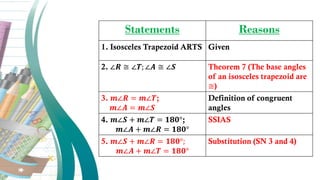
Statements Reasons
1. Isosceles Trapezoid ARTS Given
2. ∠𝑹 ≅ ∠𝑻; ∠𝑨 ≅ ∠𝑺 Theorem 7 (The base angles
of an isosceles trapezoid are
≅)
3. 𝒎∠𝑹 = 𝒎∠𝑻;
𝒎∠𝑨 = 𝒎∠𝑺
Definition of congruent
angles
4. 𝒎∠𝑺 + 𝒎∠𝑻 = 𝟏𝟖𝟎°;
𝒎∠𝑨 + 𝒎∠𝑹 = 𝟏𝟖𝟎°
SSIAS
5. 𝒎∠𝑺 + 𝒎∠𝑹 = 𝟏𝟖𝟎°;
𝒎∠𝑨 + 𝒎∠𝑻 = 𝟏𝟖𝟎°
Substitution (SN 3 and 4)
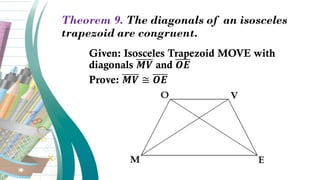
Theorem 9. The diagonals of an isosceles
trapezoid are congruent.
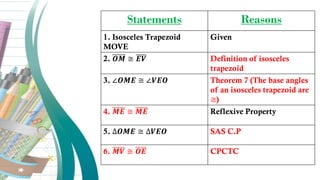
Given: Isosceles Trapezoid MOVE with
diagonals 𝑴𝑽 and 𝑶𝑬
Prove: 𝑴𝑽 ≅ 𝑶𝑬
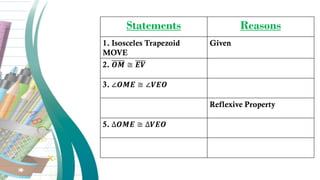
Statements Reasons
1. Isosceles Trapezoid
MOVE
Given
2. 𝑶𝑴 ≅ 𝑬𝑽
3. ∠𝑶𝑴𝑬 ≅ ∠𝑽𝑬𝑶
Reflexive Property
5. ∆𝑶𝑴𝑬 ≅ ∆𝑽𝑬𝑶
Statements Reasons
1. Isosceles Trapezoid
MOVE
Given
2. 𝑶𝑴 ≅ 𝑬𝑽 Definition of isosceles
trapezoid
3. ∠𝑶𝑴𝑬 ≅ ∠𝑽𝑬𝑶 Theorem 7 (The base angles
of an isosceles trapezoid are
≅)
4. 𝑴𝑬 ≅ 𝑴𝑬 Reflexive Property
5. ∆𝑶𝑴𝑬 ≅ ∆𝑽𝑬𝑶 SAS C.P
6. 𝑴𝑽 ≅ 𝑶𝑬 CPCTC

Trapezoid-and-Isosceles-Trapezoid-Theorems-6-9-1 (1).pdf

  • 3.
  • 4.
    Trapezoid • Is aquadrilateral with exactly one pair of parallel sides. • The PARALLEL SIDES of a trapezoid are called the BASES. • The NON-PARALLEL SIDES of a trapezoid are called the LEGS. • The angle formed by a base and a leg are called BASE ANGLES. • Each lower base angle is supplementary to the upper base angle on the same side.
  • 7.
    Isosceles Trapezoid A trapezoidwith one pair of parallel sides and one pair of congruent nonparallel sides.
  • 8.
    Three theorems relatedto Isosceles Trapezoid The base angles (upper and lower) of an isosceles trapezoid are congruent. Opposite angles of an isosceles trapezoid are supplementary. The diagonals of an isosceles trapezoid are congruent.
  • 9.
    Parallel and Perpendicular Postulate ParallelPostulate – if there is a line and a point not on the line, then there is exactly one line through the point parallel to the given line. (In a plane, two lines are parallel if and only if they are everywhere equidistant). Perpendicular Postulate – if there is a line and a point not on the line, then there is exactly one line through the point perpendicular to the given line.
  • 10.
    The Midsegment Theoremof Trapezoid The segment joining the midpoint of the legs of a trapezoid is called MEDIAN. THEOREM 6: The median of a trapezoid is parallel to each base and its length is one half the sum of the lengths of the bases.
  • 11.
    Given: Trapezoid MINSwith median 𝑻𝑹 Prove: 𝑻𝑹 ∥ 𝑰𝑵, 𝑻𝑹 ∥ 𝑴𝑺; 𝑻𝑹 = 𝟏 𝟐 (𝑴𝑺 + 𝑰𝑵)
  • 12.
    STATEMENTS REASONS 1. TrapezoidMINS with median 𝑻𝑹 Given 2. Draw 𝑰𝑺 with P as its midpoint Theorem 5 (Midline Theorem) ∆𝑰𝑴𝑺 Definition of Trapezoid 6. 𝑻𝑷 ∥ 𝑰𝑵; 𝑷𝑹 ∥ 𝑴𝑺 7. 𝑻𝑷 and 𝑷𝑹 are both parallel to 𝑴𝑺 and 𝑰𝑵, thus T, P, and R are collinear points. Segment Addition Postulate 9. 𝑻𝑹 ∥ 𝑰𝑵; 𝑻𝑹 ∥ 𝑴𝑺 10. 𝟏 𝟐 𝐌𝐒 + 𝟏 𝟐 𝐈𝐍 = 𝐓𝐑 Distributive Property
  • 13.
    STATEMENTS REASONS 1. TrapezoidMINS with median 𝑻𝑹 Given 2. Draw 𝑰𝑺 with P as its midpoint Line Postulate 3. 𝑻𝑷 = 𝟏 𝟐 𝑴𝑺; 𝑻𝑷 ∥ 𝑴𝑺 Theorem 5 (Midline Theorem) ∆𝑰𝑴𝑺 4. 𝑷𝑹 = 𝟏 𝟐 𝑰𝑵; 𝑷𝑹 ∥ 𝑰𝑵 Theorem 5 (Midline Theorem) ∆𝑺𝑵𝑰 5. 𝑴𝑺 ∥ 𝑰𝑵 Definition of Trapezoid 6. 𝑻𝑷 ∥ 𝑰𝑵; 𝑷𝑹 ∥ 𝑴𝑺 Since 𝑻𝑷 ∥ 𝑴𝑺 and 𝑴𝑺 ∥ 𝑰𝑵, therefore 𝑻𝑷 ∥ 𝑰𝑵 Since 𝑷𝑹 ∥ 𝑰𝑵 and 𝑴𝑺 ∥ 𝑰𝑵, therefore 𝑷𝑹 ∥ 𝑴𝑺 7. 𝑻𝑷 and 𝑷𝑹 are both parallel to 𝑴𝑺 and 𝑰𝑵, thus T, P, and R are collinear points. Definition of collinear points 8. TP + PR = TR Segment Addition Postulate 9. 𝑻𝑹 ∥ 𝑰𝑵; 𝑻𝑹 ∥ 𝑴𝑺 Since 𝑻𝑷 and 𝑷𝑹 are part of 𝑻𝑹 and they are both parallel to 𝑰𝑵 and 𝑴𝑺, then 𝑻𝑹 is parallel to 𝑰𝑵 and 𝑴𝑺 10. 𝟏 𝟐 𝐌𝐒 + 𝟏 𝟐 𝐈𝐍 = 𝐓𝐑 Substitution (SN 3, 4, and 8) 11. 𝟏 𝟐 𝐌𝐒 + 𝐈𝐍 = 𝐓𝐑 Distributive Property
  • 15.
    Theorem 7. Thebase angles of an isosceles trapezoid are congruent. Given: 𝑨𝑬 ∥ 𝑩𝑫; 𝑨𝑩 ≅ 𝑬𝑫 Prove: ∠𝑨 ≅ ∠𝑬
  • 16.
    Statements Reasons 1. 𝑨𝑬∥ 𝑩𝑫; 𝑨𝑩 ≅ 𝑬𝑫 Given Definition of isosceles trapezoid 3. Draw 𝑩𝑭 where 𝑩𝑭 ⊥ 𝑨𝑬; Draw 𝑫𝑪 where 𝑫𝑪 ⊥ 𝑨𝑬 Definition of perpendicular lines 5. 𝑩𝑭 ≅ 𝑪𝑫 6. ∆𝑩𝑭𝑨 ≅ ∆𝑫𝑪𝑬 7. ∠𝑨 ≅ ∠𝑬
  • 17.
    Statements Reasons 1. 𝑨𝑬∥ 𝑩𝑫; 𝑨𝑩 ≅ 𝑬𝑫 Given 2. ABDE is an isosceles trapezoid Definition of isosceles trapezoid 3. Draw 𝑩𝑭 where 𝑩𝑭 ⊥ 𝑨𝑬; Draw 𝑫𝑪 where 𝑫𝑪 ⊥ 𝑨𝑬 Perpendicular Postulate 4. ∠𝑩𝑭𝑨 and ∠𝑫𝑪𝑬 are right angles Definition of perpendicular lines 5. 𝑩𝑭 ≅ 𝑪𝑫 Altitudes of the same trapezoid are equal 6. ∆𝑩𝑭𝑨 ≅ ∆𝑫𝑪𝑬 HL Congruence 7. ∠𝑨 ≅ ∠𝑬 CPCTC The hypotenuse leg theorem states that any two right triangles that have a congruent hypotenuse and a corresponding, congruent leg are congruent triangles.
  • 18.
    Theorem 8. Oppositeangles of an isosceles trapezoid are supplementary. Given: Isosceles Trapezoid ARTS Prove: ∠𝑹 𝒂𝒏𝒅 ∠𝑺 are supplementary; ∠𝑨 𝒂𝒏𝒅 ∠𝑻 are supplementary
  • 19.
    Statements Reasons 1. IsoscelesTrapezoid ARTS Given 2. ∠𝑹 ≅ ∠𝑻; ∠𝑨 ≅ ∠𝑺 Definition of congruent angles 4. 𝒎∠𝑺 + 𝒎∠𝑻 = 𝟏𝟖𝟎°; 𝒎∠𝑨 + 𝒎∠𝑹 = 𝟏𝟖𝟎°
  • 20.
    Statements Reasons 1. IsoscelesTrapezoid ARTS Given 2. ∠𝑹 ≅ ∠𝑻; ∠𝑨 ≅ ∠𝑺 Theorem 7 (The base angles of an isosceles trapezoid are ≅) 3. 𝒎∠𝑹 = 𝒎∠𝑻; 𝒎∠𝑨 = 𝒎∠𝑺 Definition of congruent angles 4. 𝒎∠𝑺 + 𝒎∠𝑻 = 𝟏𝟖𝟎°; 𝒎∠𝑨 + 𝒎∠𝑹 = 𝟏𝟖𝟎° SSIAS 5. 𝒎∠𝑺 + 𝒎∠𝑹 = 𝟏𝟖𝟎°; 𝒎∠𝑨 + 𝒎∠𝑻 = 𝟏𝟖𝟎° Substitution (SN 3 and 4)
  • 21.
    Theorem 9. Thediagonals of an isosceles trapezoid are congruent. Given: Isosceles Trapezoid MOVE with diagonals 𝑴𝑽 and 𝑶𝑬 Prove: 𝑴𝑽 ≅ 𝑶𝑬
  • 22.
    Statements Reasons 1. IsoscelesTrapezoid MOVE Given 2. 𝑶𝑴 ≅ 𝑬𝑽 3. ∠𝑶𝑴𝑬 ≅ ∠𝑽𝑬𝑶 Reflexive Property 5. ∆𝑶𝑴𝑬 ≅ ∆𝑽𝑬𝑶
  • 23.
    Statements Reasons 1. IsoscelesTrapezoid MOVE Given 2. 𝑶𝑴 ≅ 𝑬𝑽 Definition of isosceles trapezoid 3. ∠𝑶𝑴𝑬 ≅ ∠𝑽𝑬𝑶 Theorem 7 (The base angles of an isosceles trapezoid are ≅) 4. 𝑴𝑬 ≅ 𝑴𝑬 Reflexive Property 5. ∆𝑶𝑴𝑬 ≅ ∆𝑽𝑬𝑶 SAS C.P 6. 𝑴𝑽 ≅ 𝑶𝑬 CPCTC