MATHEMATICS 
Standard -8 
By 
Shelin Elizabeth Varghese 
B.Ed Mathematics 
Reg No:13304013
CONTENTS 
 CONGRUENT TRIANGLES 
 CONGRUENCE OF TRIANGLES 
 SSS CONGRUENCE 
 SAS CONGRUENCE 
 ASA CONGRUENCE 
 AAS CONGRUENCE 
 RHS CONGRUENCE 
 ISOSCELES TRIANGLE 
 BISECTORS 
 APPLICATION AND EXAMPLES
 CONGRUENT TRIANGLES 
1.1 CONCEPT OF CONGRUENCE 
In our daily life you observe various figures and objects. These 
figures or objects can be categorised in terms of their shapes and sizes 
in the following manner. 
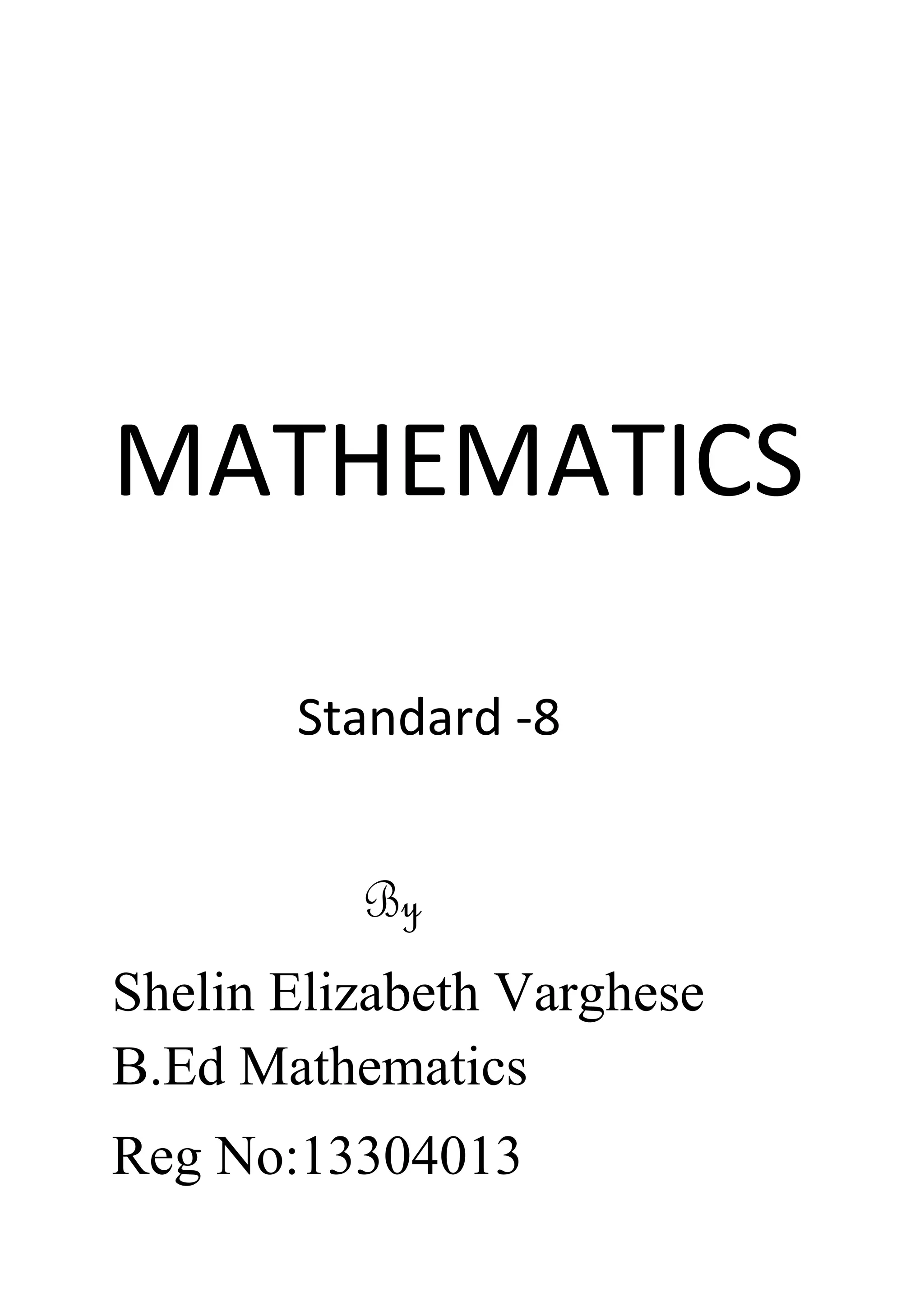
(i) Figures, which have different shapes and sizes as shown in Fig. 
11.1 
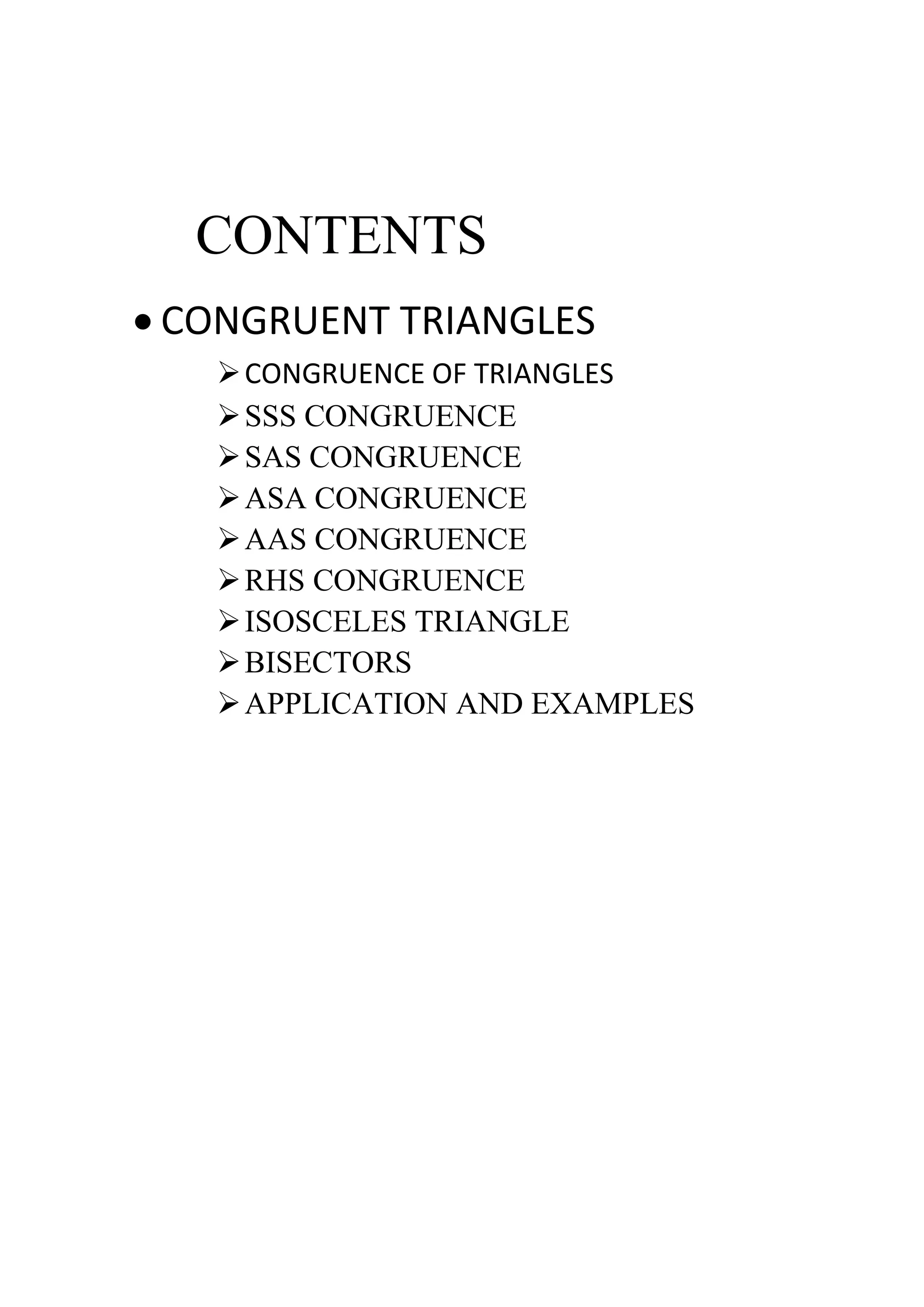
(ii) Objects, which have same shapes but different sizes as shown in 
Fig. 11.2
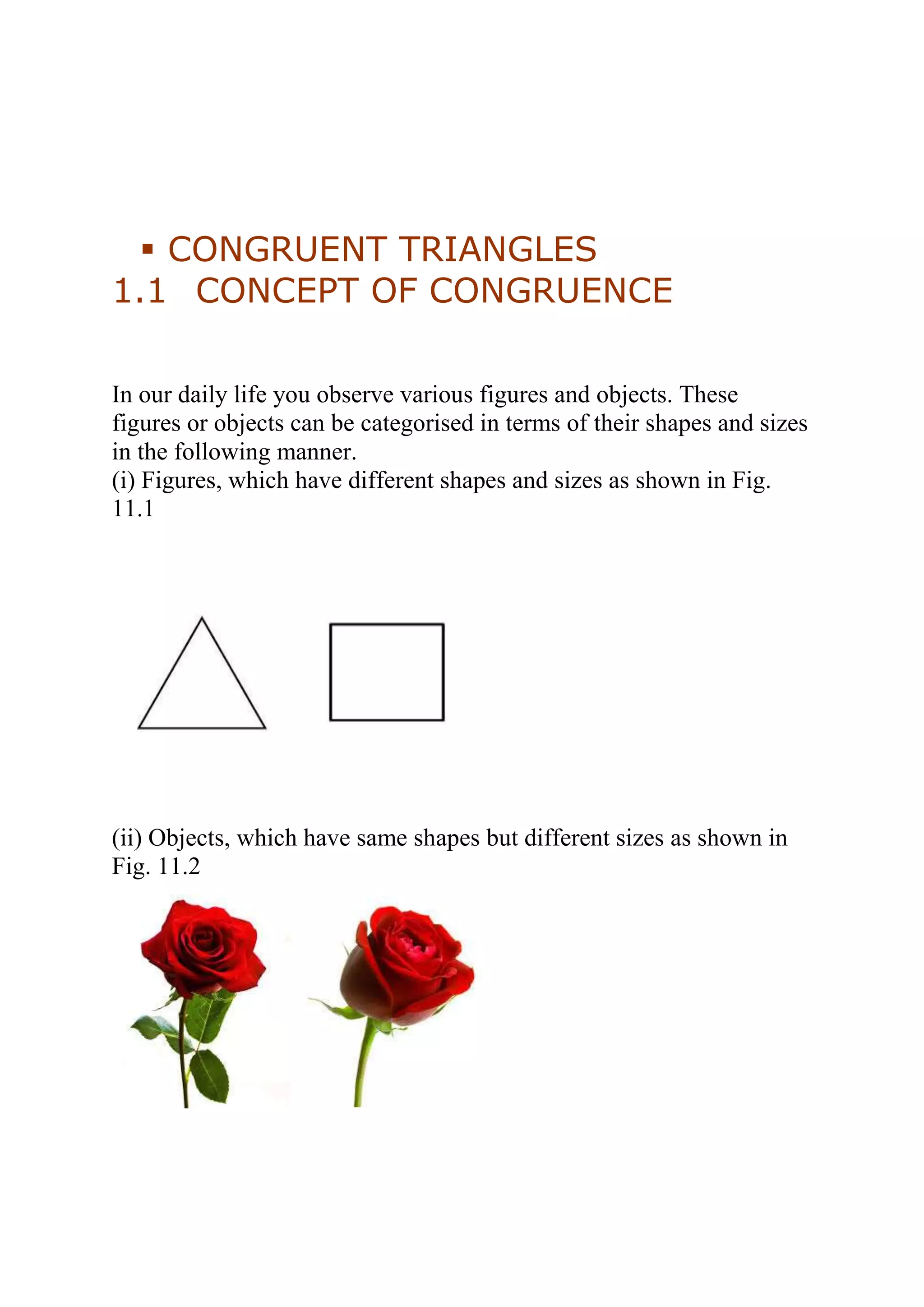
(iii) Two one-rupee coins. 
. 
Two figures, which have the same shape and same size are called 
congruent figures and this property is called congruence. 
What is "Congruent" ... ? 
Equal in size and shape. Two objects are congruent if they 
have the same dimensions and shape. 
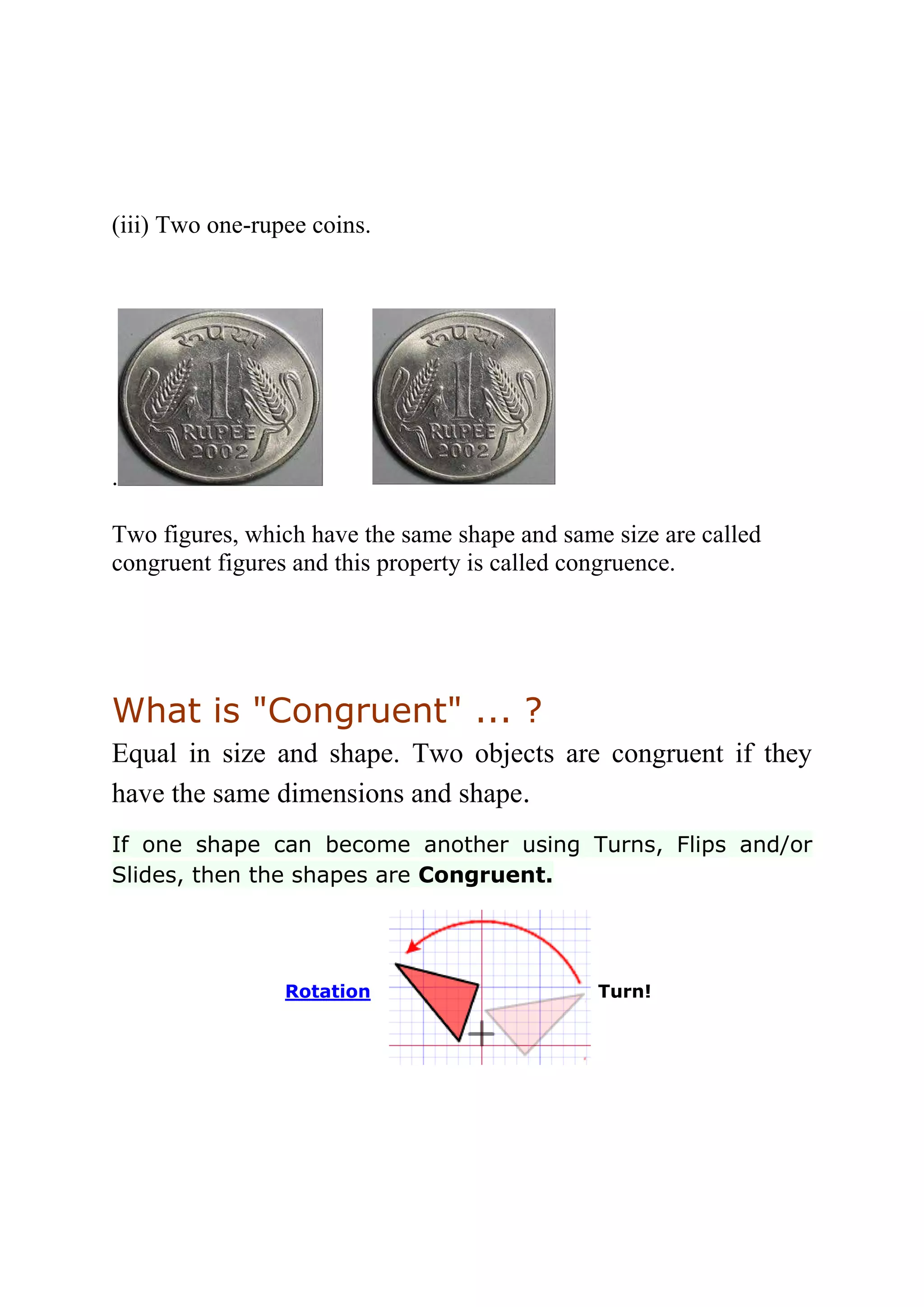
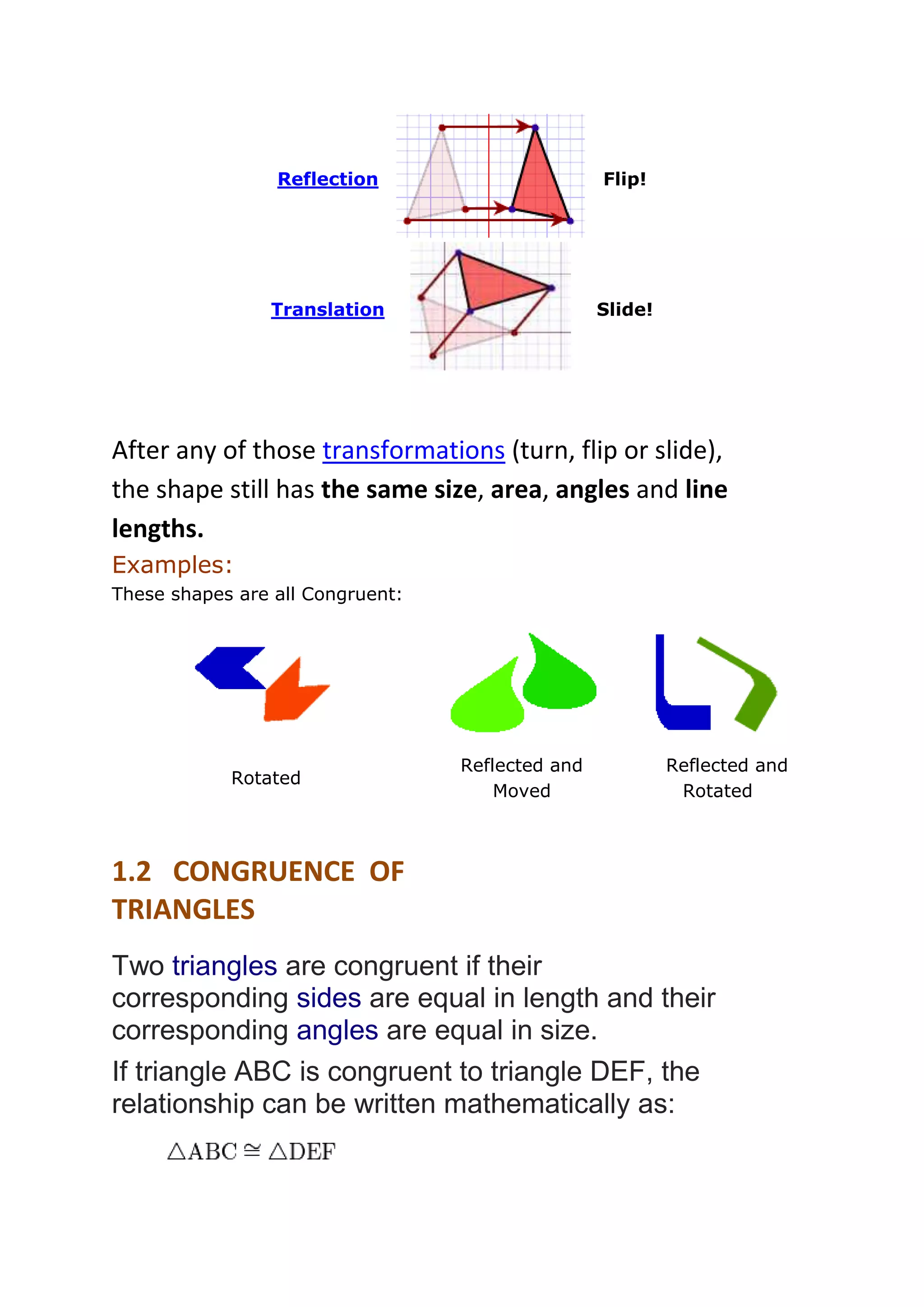
If one shape can become another using Turns, Flips and/or 
Slides, then the shapes are Congruent. 
Rotation 
Turn!
Reflection 
Flip! 
Translation 
Slide! 
After any of those transformations (turn, flip or slide), 
the shape still has the same size, area, angles and line 
lengths. 
Examples: 
These shapes are all Congruent: 
Rotated 
Reflected and 
Moved 
Reflected and 
Rotated 
1.2 CONGRUENCE OF 
TRIANGLES 
Two triangles are congruent if their 
corresponding sides are equal in length and their 
corresponding angles are equal in size. 
If triangle ABC is congruent to triangle DEF, the 
relationship can be written mathematically as:
Refresh your mind 
CONGRUENT TRIANGLES - ENGLISH - Simple paper folding proof..avi 
1.3 SSS CONGRUENCE 
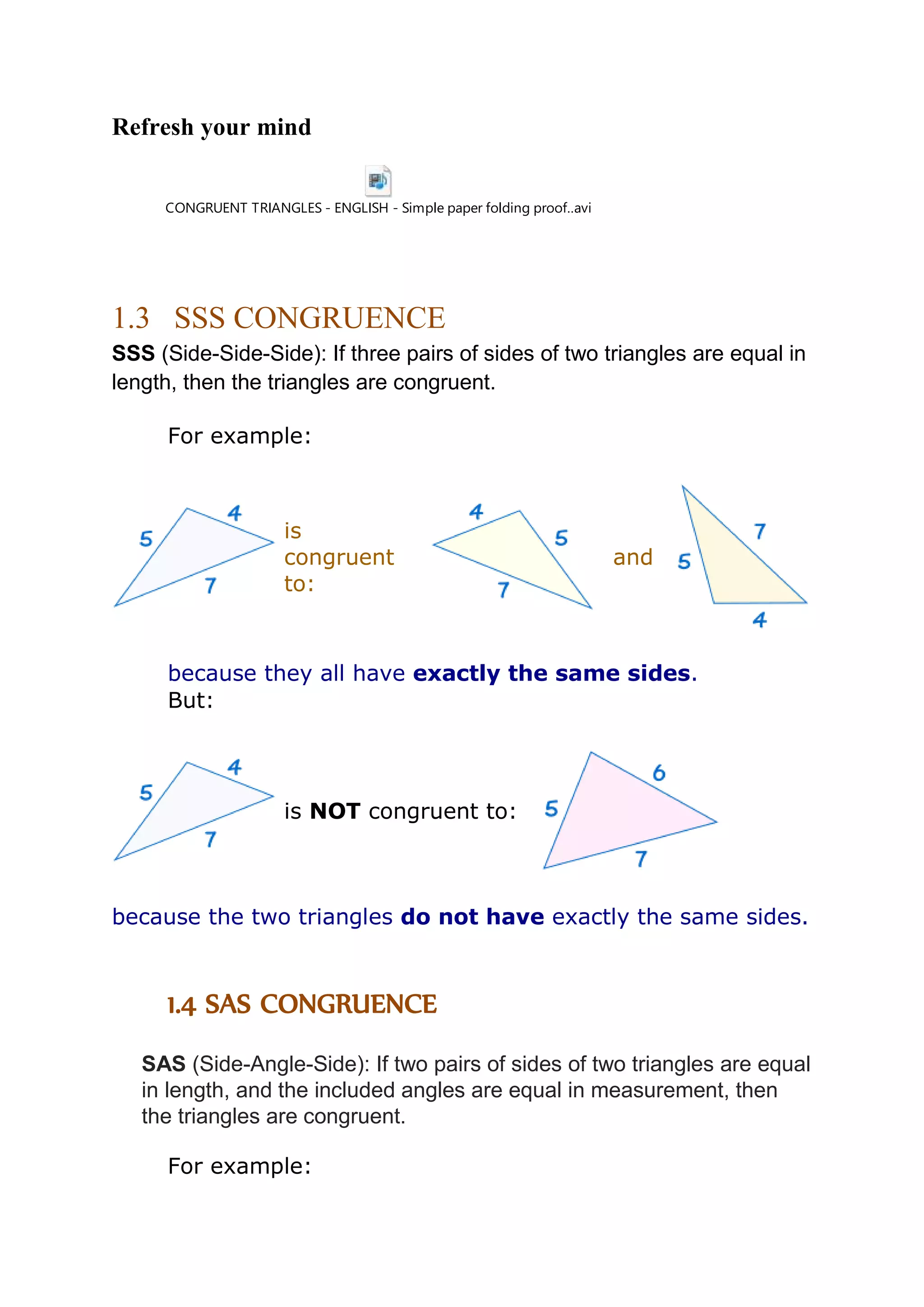
SSS (Side-Side-Side): If three pairs of sides of two triangles are equal in 
length, then the triangles are congruent. 
For example: 
is 
congruent 
to: 
and 
because they all have exactly the same sides. 
But: 
is NOT congruent to: 
because the two triangles do not have exactly the same sides. 
1.4 SAS CONGRUENCE 
SAS (Side-Angle-Side): If two pairs of sides of two triangles are equal 
in length, and the included angles are equal in measurement, then 
the triangles are congruent. 
For example:
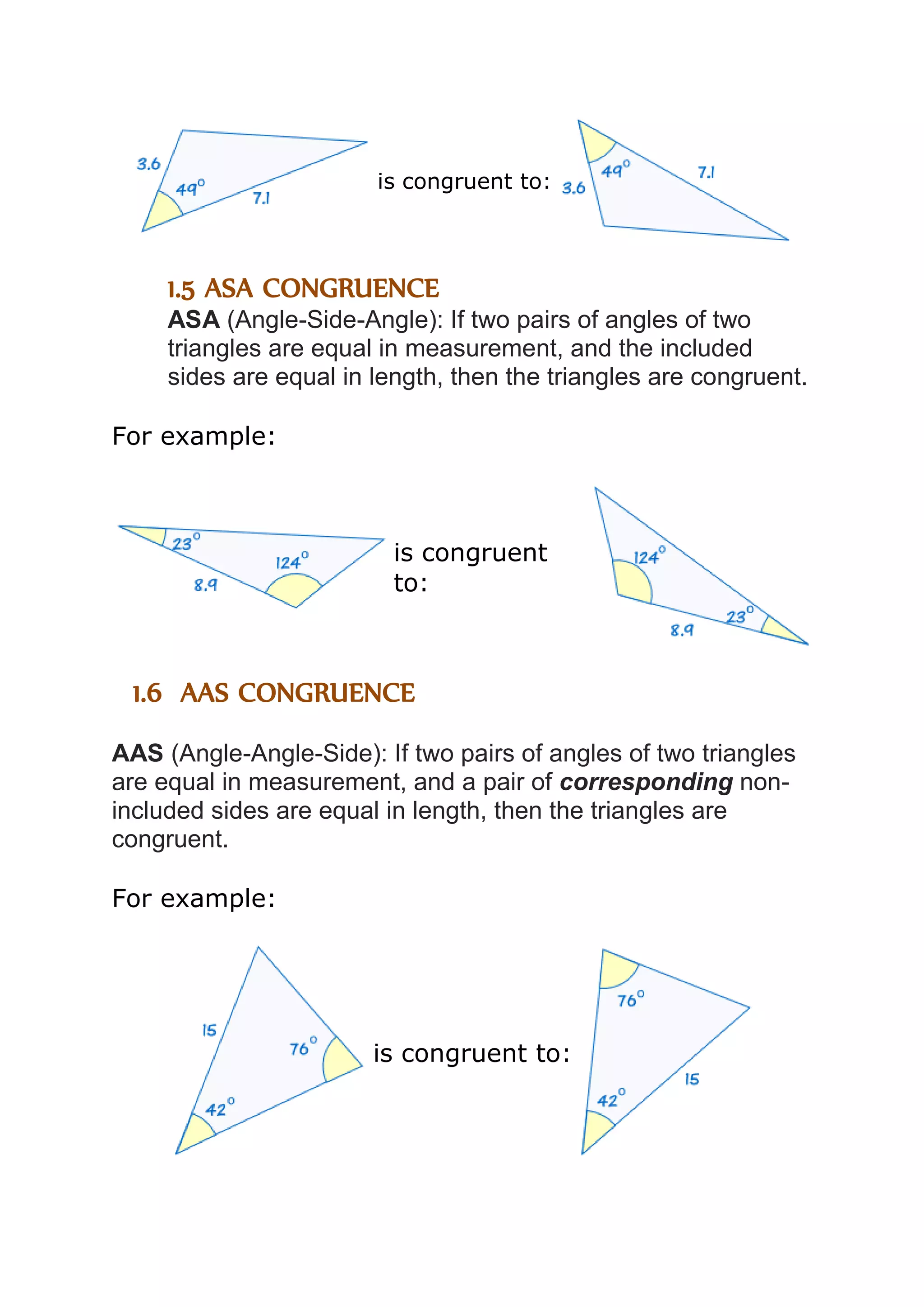
is congruent to: 
1.5 ASA CONGRUENCE 
ASA (Angle-Side-Angle): If two pairs of angles of two 
triangles are equal in measurement, and the included 
sides are equal in length, then the triangles are congruent. 
For example: 
is congruent 
to: 
1.6 AAS CONGRUENCE 
AAS (Angle-Angle-Side): If two pairs of angles of two triangles 
are equal in measurement, and a pair of corresponding non-included 
sides are equal in length, then the triangles are 
congruent. 
For example: 
is congruent to:
1.7 RHS CONGRUENCE 
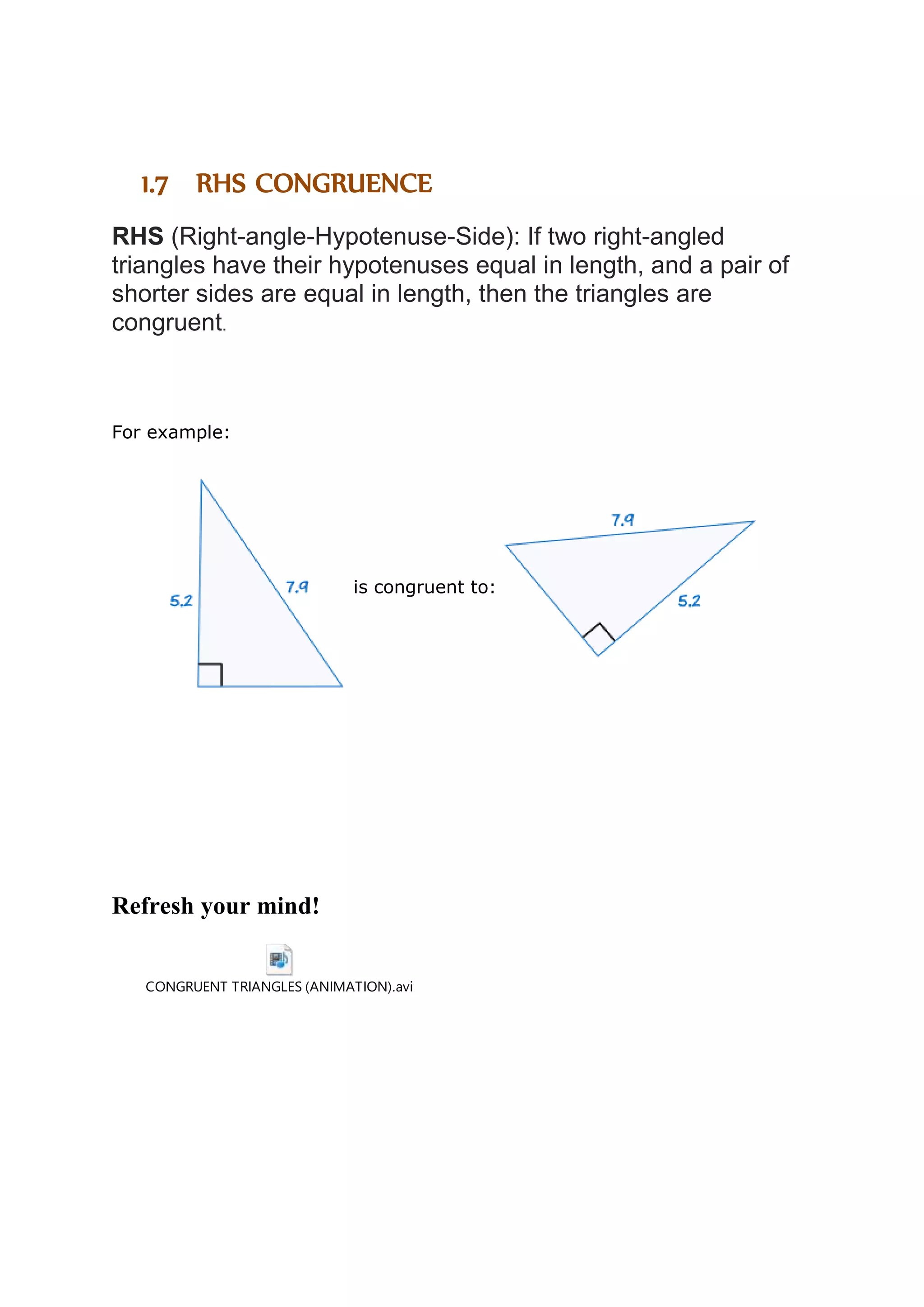
RHS (Right-angle-Hypotenuse-Side): If two right-angled 
triangles have their hypotenuses equal in length, and a pair of 
shorter sides are equal in length, then the triangles are 
congruent. 
For example: 
is congruent to: 
Refresh your mind! 
CONGRUENT TRIANGLES (ANIMATION).avi
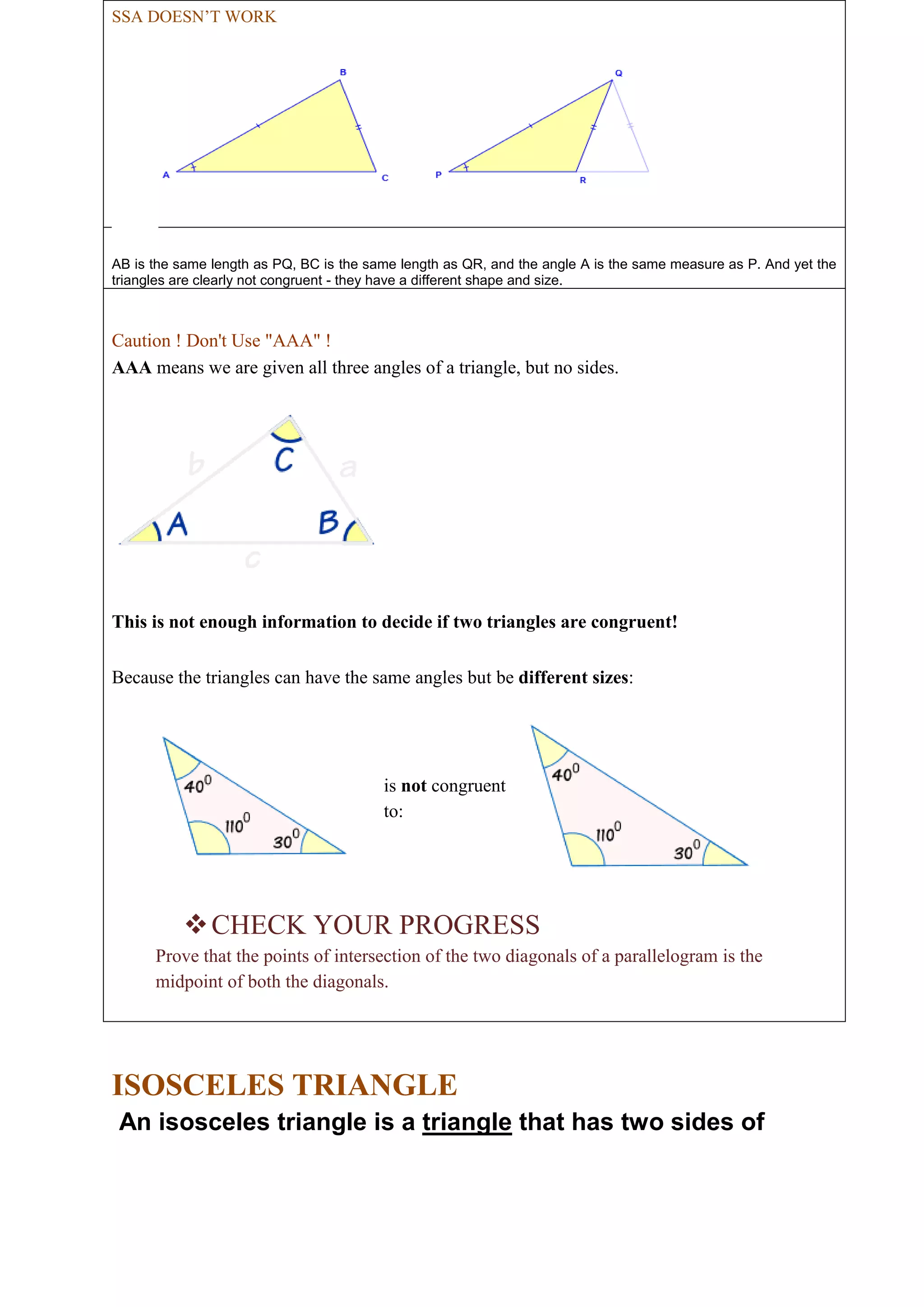
SSA DOESN’T WORK 
AB is the same length as PQ, BC is the same length as QR, and the angle A is the same measure as P. And yet the 
triangles are clearly not congruent - they have a different shape and size. 
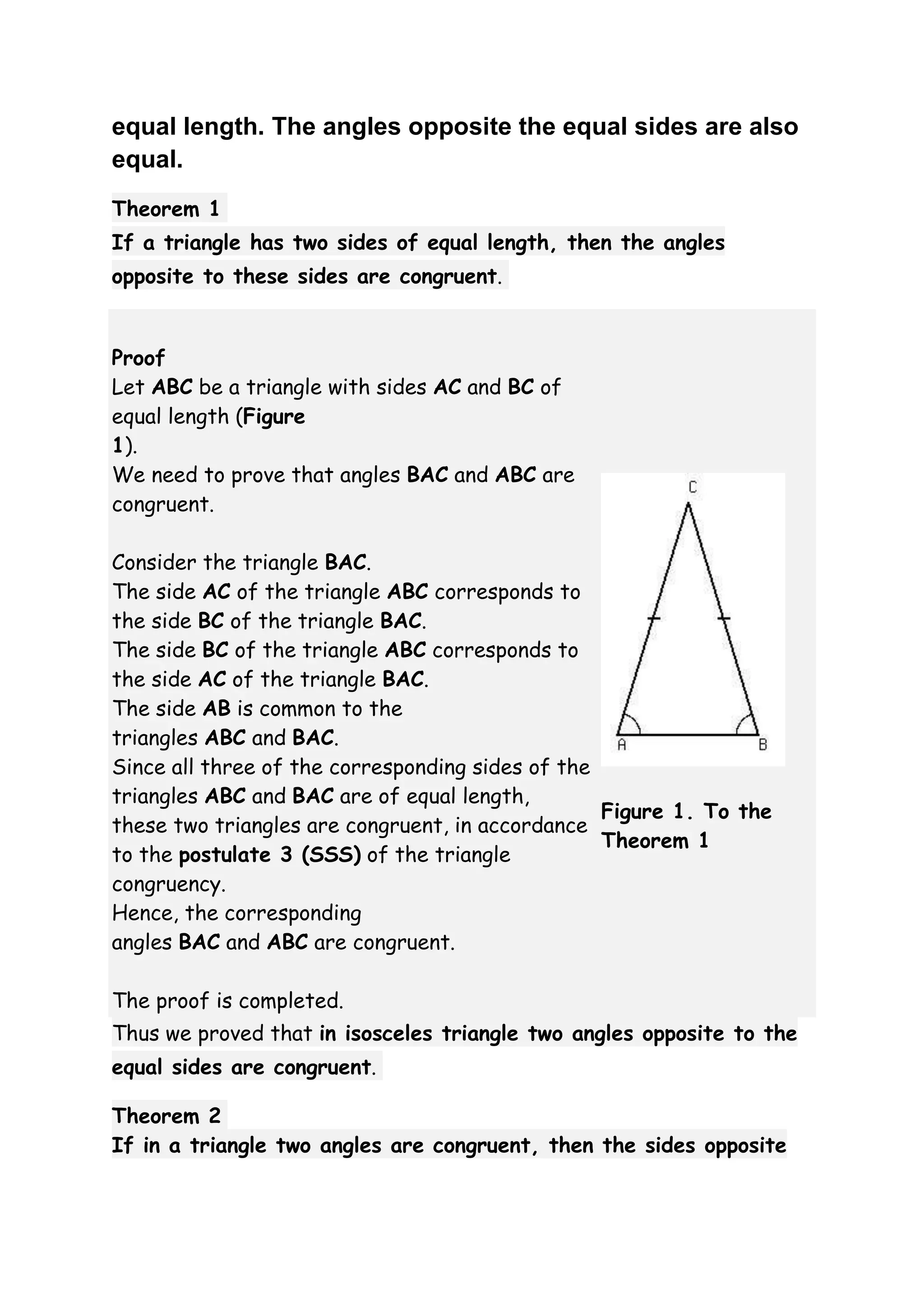
Caution ! Don't Use "AAA" ! 
AAA means we are given all three angles of a triangle, but no sides. 
This is not enough information to decide if two triangles are congruent! 
Because the triangles can have the same angles but be different sizes: 
is not congruent 
to: 
 CHECK YOUR PROGRESS 
Prove that the points of intersection of the two diagonals of a parallelogram is the 
midpoint of both the diagonals. 
ISOSCELES TRIANGLE 
An isosceles triangle is a triangle that has two sides of
equal length. The angles opposite the equal sides are also 
equal. 
Theorem 1 
If a triangle has two sides of equal length, then the angles 
opposite to these sides are congruent. 
Proof 
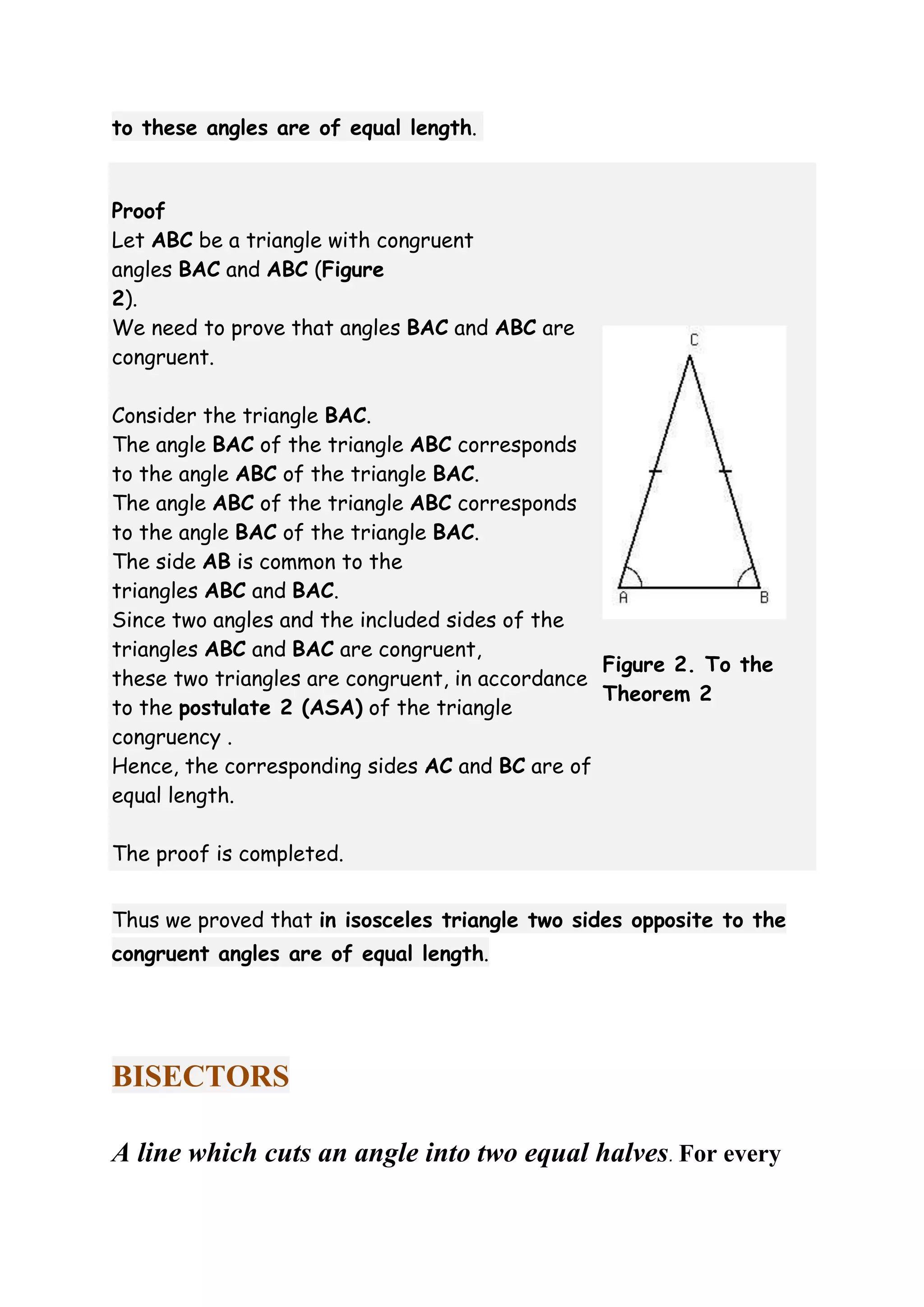
Let ABC be a triangle with sides AC and BC of 
equal length (Figure 
1). 
We need to prove that angles BAC and ABC are 
congruent. 
Consider the triangle BAC. 
The side AC of the triangle ABC corresponds to 
the side BC of the triangle BAC. 
The side BC of the triangle ABC corresponds to 
the side AC of the triangle BAC. 
The side AB is common to the 
triangles ABC and BAC. 
Since all three of the corresponding sides of the 
triangles ABC and BAC are of equal length, 
these two triangles are congruent, in accordance 
to the postulate 3 (SSS) of the triangle 
congruency. 
Hence, the corresponding 
angles BAC and ABC are congruent. 
The proof is completed. 
Figure 1. To the 
Theorem 1 
Thus we proved that in isosceles triangle two angles opposite to the 
equal sides are congruent. 
Theorem 2 
If in a triangle two angles are congruent, then the sides opposite
to these angles are of equal length. 
Proof 
Let ABC be a triangle with congruent 
angles BAC and ABC (Figure 
2). 
We need to prove that angles BAC and ABC are 
congruent. 
Consider the triangle BAC. 
The angle BAC of the triangle ABC corresponds 
to the angle ABC of the triangle BAC. 
The angle ABC of the triangle ABC corresponds 
to the angle BAC of the triangle BAC. 
The side AB is common to the 
triangles ABC and BAC. 
Since two angles and the included sides of the 
triangles ABC and BAC are congruent, 
these two triangles are congruent, in accordance 
to the postulate 2 (ASA) of the triangle 
congruency . 
Hence, the corresponding sides AC and BC are of 
equal length. 
The proof is completed. 
Figure 2. To the 
Theorem 2 
Thus we proved that in isosceles triangle two sides opposite to the 
congruent angles are of equal length. 
BISECTORS 
A line which cuts an angle into two equal halves. For every
angle, there exists a line that divides the angle into two equal 
parts. This line is known as the angle bisector. In a triangle, there 
are three such lines. Three angle bisectors of a triangle meet at a 
point called the incenter of the triangle. 
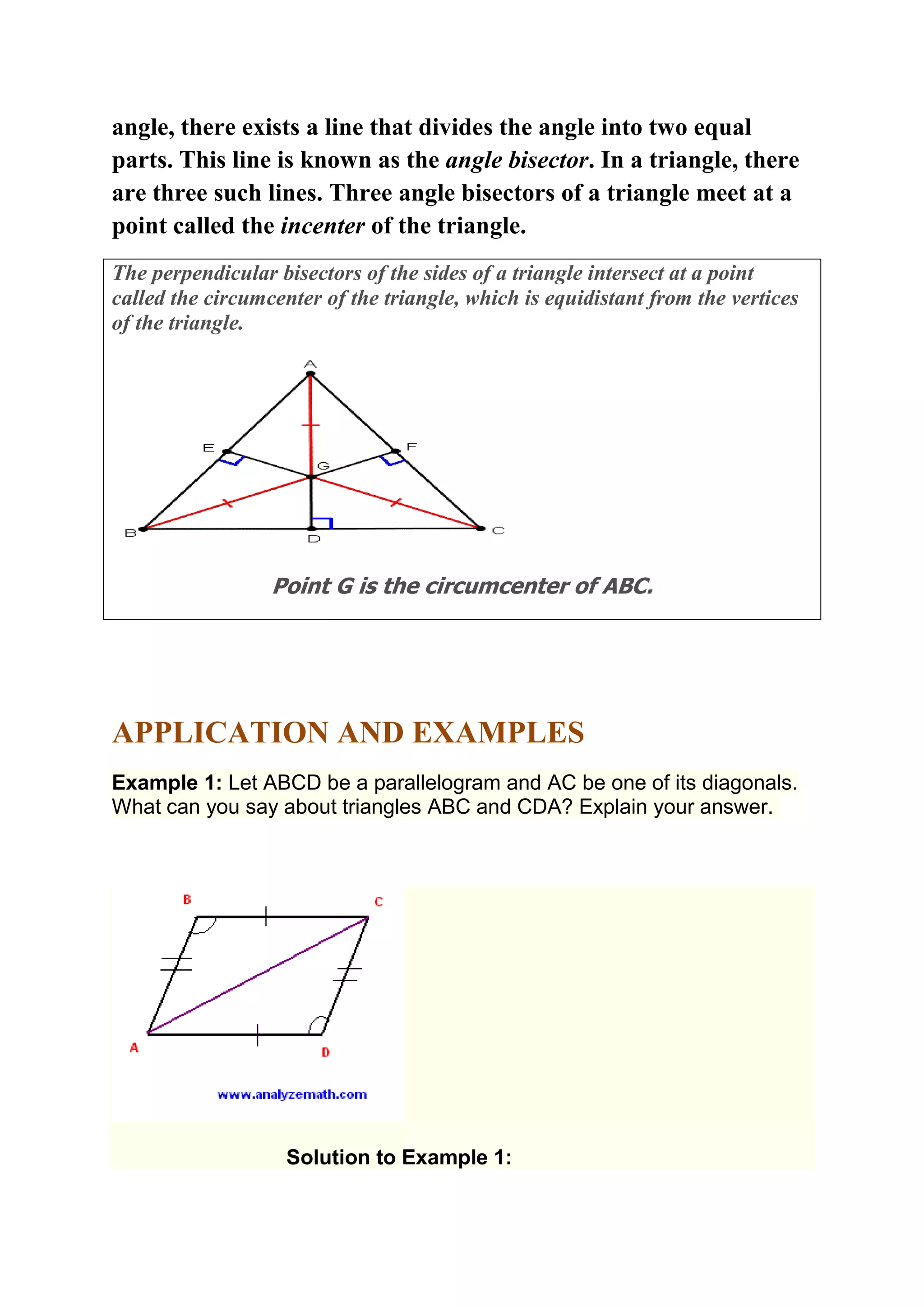
The perpendicular bisectors of the sides of a triangle intersect at a point 
called the circumcenter of the triangle, which is equidistant from the vertices 
of the triangle. 
Point G is the circumcenter of ABC. 
APPLICATION AND EXAMPLES 
Example 1: Let ABCD be a parallelogram and AC be one of its diagonals. 
What can you say about triangles ABC and CDA? Explain your answer. 
Solution to Example 1:
 In a parallelogram, opposite sides are congruent. Hence sides 
BC and AD are congruent, and also sides AB and CD are congruent. 
 In a parallelogram opposite angles are congruent. Hence angles 
ABC and CDA are congruent. 
 Two sides and an included angle of triangle ABC are congruent to 
two corresponding sides and an included angle in triangle CDA. 
According to the above postulate the two triangles ABC and CDA are 
congruent. 
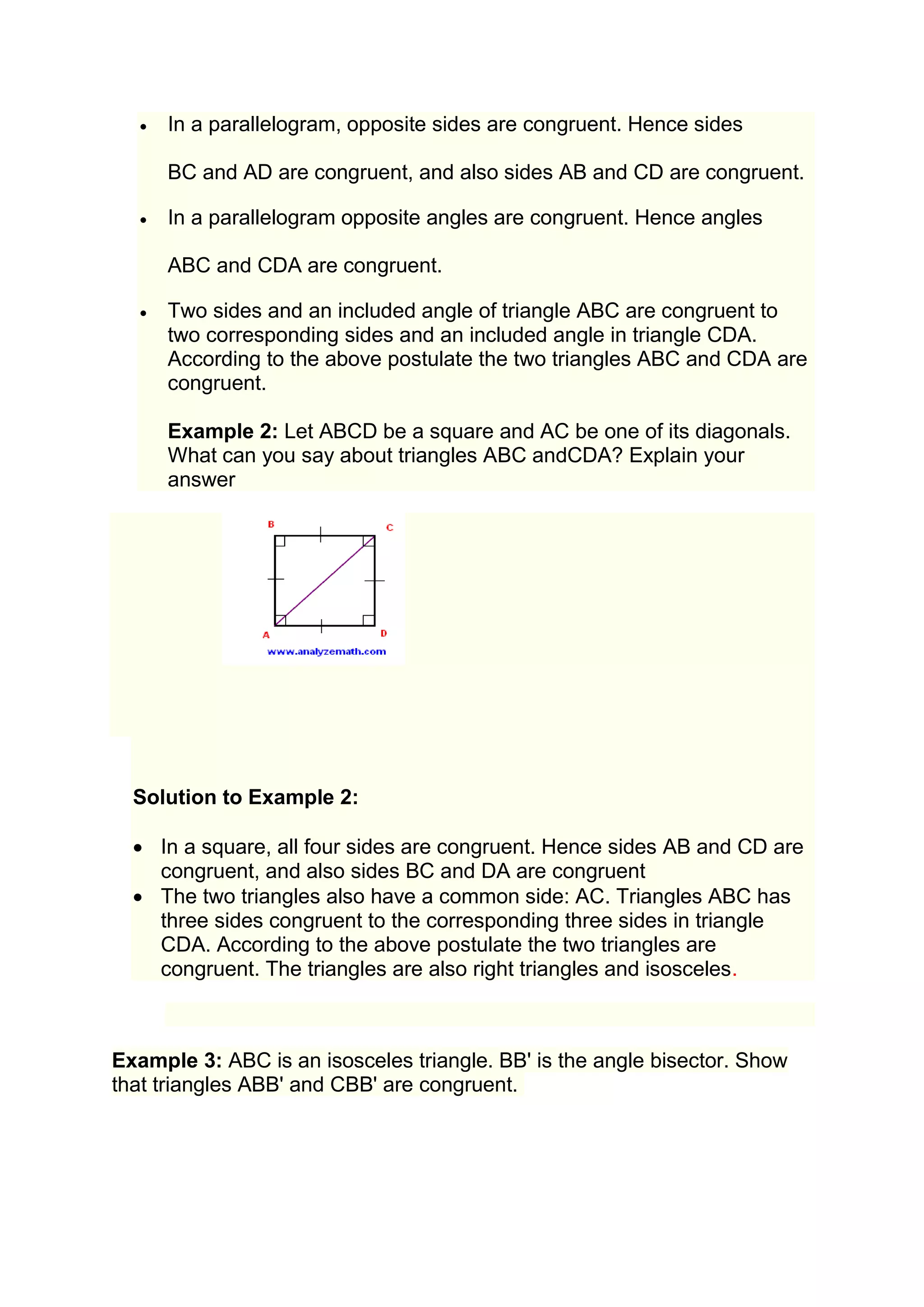
Example 2: Let ABCD be a square and AC be one of its diagonals. 
What can you say about triangles ABC andCDA? Explain your 
answer 
Solution to Example 2: 
 In a square, all four sides are congruent. Hence sides AB and CD are 
congruent, and also sides BC and DA are congruent 
 The two triangles also have a common side: AC. Triangles ABC has 
three sides congruent to the corresponding three sides in triangle 
CDA. According to the above postulate the two triangles are 
congruent. The triangles are also right triangles and isosceles. 
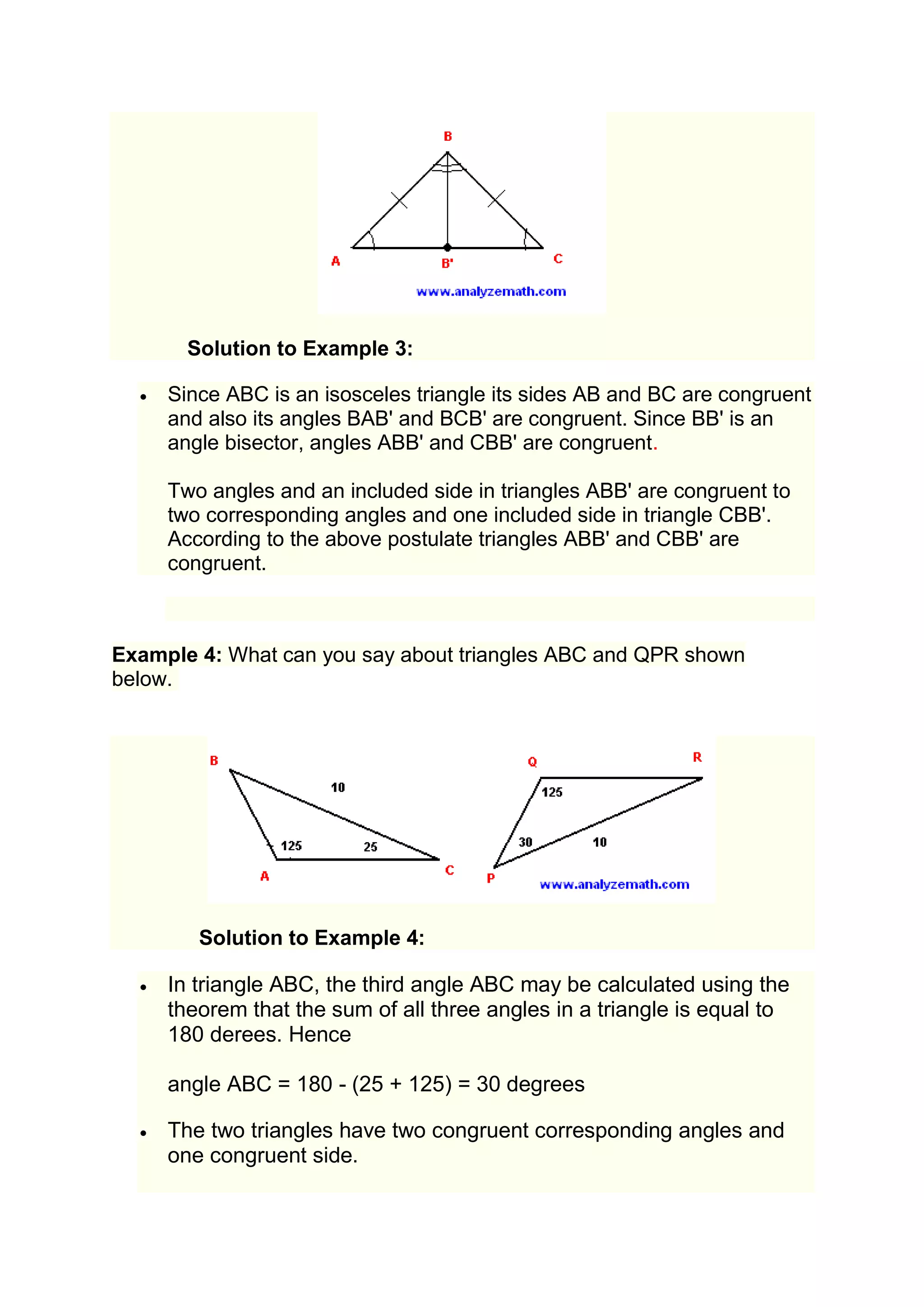
Example 3: ABC is an isosceles triangle. BB' is the angle bisector. Show 
that triangles ABB' and CBB' are congruent.
Solution to Example 3: 
 Since ABC is an isosceles triangle its sides AB and BC are congruent 
and also its angles BAB' and BCB' are congruent. Since BB' is an 
angle bisector, angles ABB' and CBB' are congruent. 
Two angles and an included side in triangles ABB' are congruent to 
two corresponding angles and one included side in triangle CBB'. 
According to the above postulate triangles ABB' and CBB' are 
congruent. 
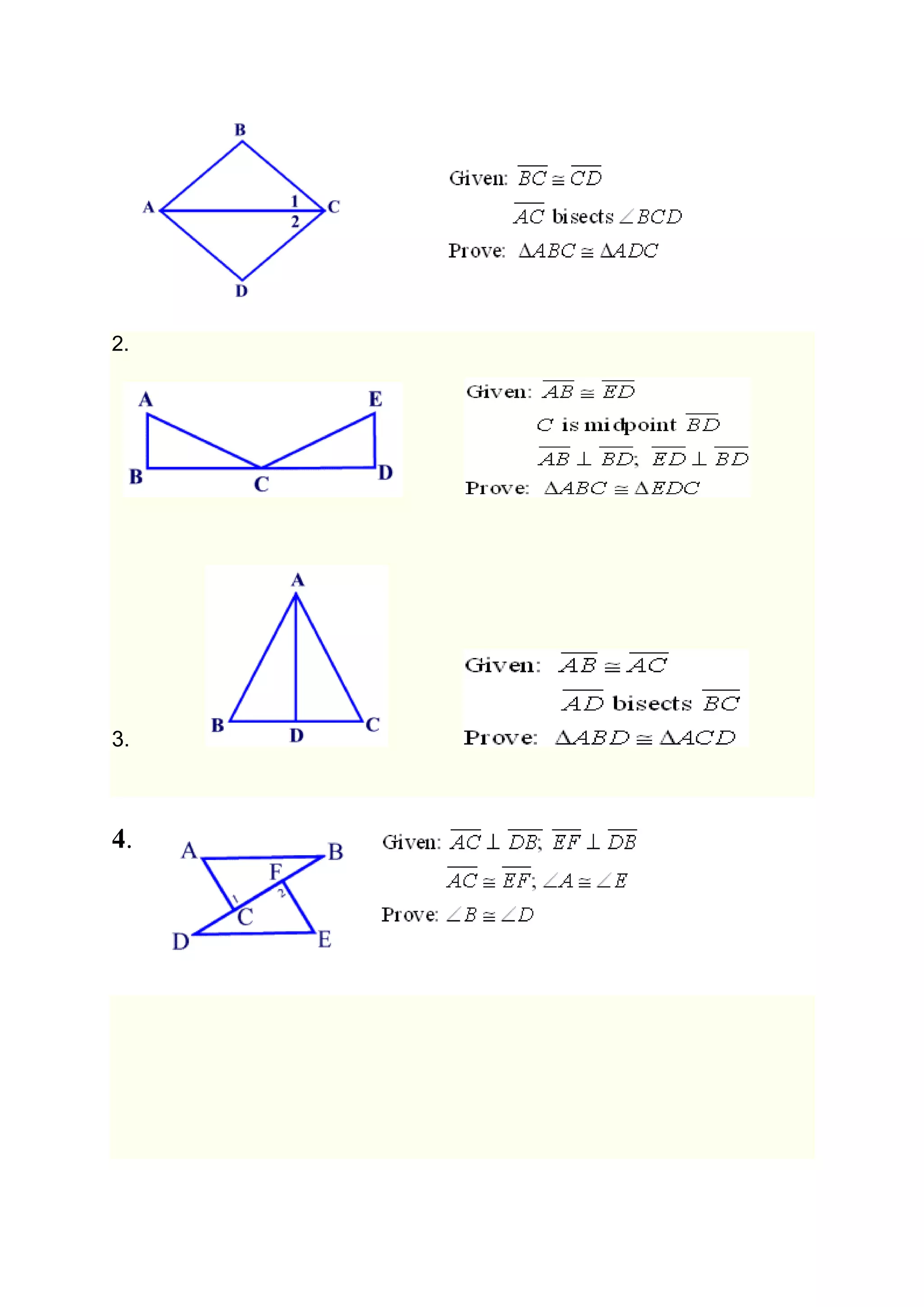
Example 4: What can you say about triangles ABC and QPR shown 
below. 
Solution to Example 4: 
 In triangle ABC, the third angle ABC may be calculated using the 
theorem that the sum of all three angles in a triangle is equal to 
180 derees. Hence 
angle ABC = 180 - (25 + 125) = 30 degrees 
 The two triangles have two congruent corresponding angles and 
one congruent side.
angles ABC and QPR are congruent. Also angles BAC and PQR 
are congruent. Sides BC and PR are congruent. 
 Two angles and one side in triangle ABC are congruent to two 
corresponding angles and one side in triangle PQR. According to 
the above theorem they are congruent. 
Example 5: Show that the two right triangles shown below are congruent. 
Solution to Example 5: 
 We first use Pythagora's theorem to find the length of side AB in 
triangle ABC. 
length of AB = sqrt [5 2 - 3 2] = 4 
 One side and the hypotenuse in triangle ABC are congruent to a 
corresponding side and hypotenuse in the right triangle A'B'C'. 
According to the above theorem, triangles ABC and B'A'C' are 
congruent. 
TERMINAL EXERCISE 
1.
2. 
3. 
4.
Digit l textbook 131

Digit l textbook 131

  • 1.
    MATHEMATICS Standard -8 By Shelin Elizabeth Varghese B.Ed Mathematics Reg No:13304013
  • 2.
    CONTENTS  CONGRUENTTRIANGLES  CONGRUENCE OF TRIANGLES  SSS CONGRUENCE  SAS CONGRUENCE  ASA CONGRUENCE  AAS CONGRUENCE  RHS CONGRUENCE  ISOSCELES TRIANGLE  BISECTORS  APPLICATION AND EXAMPLES
  • 3.
     CONGRUENT TRIANGLES 1.1 CONCEPT OF CONGRUENCE In our daily life you observe various figures and objects. These figures or objects can be categorised in terms of their shapes and sizes in the following manner. (i) Figures, which have different shapes and sizes as shown in Fig. 11.1 (ii) Objects, which have same shapes but different sizes as shown in Fig. 11.2
  • 4.
    (iii) Two one-rupeecoins. . Two figures, which have the same shape and same size are called congruent figures and this property is called congruence. What is "Congruent" ... ? Equal in size and shape. Two objects are congruent if they have the same dimensions and shape. If one shape can become another using Turns, Flips and/or Slides, then the shapes are Congruent. Rotation Turn!
  • 5.
    Reflection Flip! Translation Slide! After any of those transformations (turn, flip or slide), the shape still has the same size, area, angles and line lengths. Examples: These shapes are all Congruent: Rotated Reflected and Moved Reflected and Rotated 1.2 CONGRUENCE OF TRIANGLES Two triangles are congruent if their corresponding sides are equal in length and their corresponding angles are equal in size. If triangle ABC is congruent to triangle DEF, the relationship can be written mathematically as:
  • 6.
    Refresh your mind CONGRUENT TRIANGLES - ENGLISH - Simple paper folding proof..avi 1.3 SSS CONGRUENCE SSS (Side-Side-Side): If three pairs of sides of two triangles are equal in length, then the triangles are congruent. For example: is congruent to: and because they all have exactly the same sides. But: is NOT congruent to: because the two triangles do not have exactly the same sides. 1.4 SAS CONGRUENCE SAS (Side-Angle-Side): If two pairs of sides of two triangles are equal in length, and the included angles are equal in measurement, then the triangles are congruent. For example:
  • 7.
    is congruent to: 1.5 ASA CONGRUENCE ASA (Angle-Side-Angle): If two pairs of angles of two triangles are equal in measurement, and the included sides are equal in length, then the triangles are congruent. For example: is congruent to: 1.6 AAS CONGRUENCE AAS (Angle-Angle-Side): If two pairs of angles of two triangles are equal in measurement, and a pair of corresponding non-included sides are equal in length, then the triangles are congruent. For example: is congruent to:
  • 8.
    1.7 RHS CONGRUENCE RHS (Right-angle-Hypotenuse-Side): If two right-angled triangles have their hypotenuses equal in length, and a pair of shorter sides are equal in length, then the triangles are congruent. For example: is congruent to: Refresh your mind! CONGRUENT TRIANGLES (ANIMATION).avi
  • 9.
    SSA DOESN’T WORK AB is the same length as PQ, BC is the same length as QR, and the angle A is the same measure as P. And yet the triangles are clearly not congruent - they have a different shape and size. Caution ! Don't Use "AAA" ! AAA means we are given all three angles of a triangle, but no sides. This is not enough information to decide if two triangles are congruent! Because the triangles can have the same angles but be different sizes: is not congruent to:  CHECK YOUR PROGRESS Prove that the points of intersection of the two diagonals of a parallelogram is the midpoint of both the diagonals. ISOSCELES TRIANGLE An isosceles triangle is a triangle that has two sides of
  • 10.
    equal length. Theangles opposite the equal sides are also equal. Theorem 1 If a triangle has two sides of equal length, then the angles opposite to these sides are congruent. Proof Let ABC be a triangle with sides AC and BC of equal length (Figure 1). We need to prove that angles BAC and ABC are congruent. Consider the triangle BAC. The side AC of the triangle ABC corresponds to the side BC of the triangle BAC. The side BC of the triangle ABC corresponds to the side AC of the triangle BAC. The side AB is common to the triangles ABC and BAC. Since all three of the corresponding sides of the triangles ABC and BAC are of equal length, these two triangles are congruent, in accordance to the postulate 3 (SSS) of the triangle congruency. Hence, the corresponding angles BAC and ABC are congruent. The proof is completed. Figure 1. To the Theorem 1 Thus we proved that in isosceles triangle two angles opposite to the equal sides are congruent. Theorem 2 If in a triangle two angles are congruent, then the sides opposite
  • 11.
    to these anglesare of equal length. Proof Let ABC be a triangle with congruent angles BAC and ABC (Figure 2). We need to prove that angles BAC and ABC are congruent. Consider the triangle BAC. The angle BAC of the triangle ABC corresponds to the angle ABC of the triangle BAC. The angle ABC of the triangle ABC corresponds to the angle BAC of the triangle BAC. The side AB is common to the triangles ABC and BAC. Since two angles and the included sides of the triangles ABC and BAC are congruent, these two triangles are congruent, in accordance to the postulate 2 (ASA) of the triangle congruency . Hence, the corresponding sides AC and BC are of equal length. The proof is completed. Figure 2. To the Theorem 2 Thus we proved that in isosceles triangle two sides opposite to the congruent angles are of equal length. BISECTORS A line which cuts an angle into two equal halves. For every
  • 12.
    angle, there existsa line that divides the angle into two equal parts. This line is known as the angle bisector. In a triangle, there are three such lines. Three angle bisectors of a triangle meet at a point called the incenter of the triangle. The perpendicular bisectors of the sides of a triangle intersect at a point called the circumcenter of the triangle, which is equidistant from the vertices of the triangle. Point G is the circumcenter of ABC. APPLICATION AND EXAMPLES Example 1: Let ABCD be a parallelogram and AC be one of its diagonals. What can you say about triangles ABC and CDA? Explain your answer. Solution to Example 1:
  • 13.
     In aparallelogram, opposite sides are congruent. Hence sides BC and AD are congruent, and also sides AB and CD are congruent.  In a parallelogram opposite angles are congruent. Hence angles ABC and CDA are congruent.  Two sides and an included angle of triangle ABC are congruent to two corresponding sides and an included angle in triangle CDA. According to the above postulate the two triangles ABC and CDA are congruent. Example 2: Let ABCD be a square and AC be one of its diagonals. What can you say about triangles ABC andCDA? Explain your answer Solution to Example 2:  In a square, all four sides are congruent. Hence sides AB and CD are congruent, and also sides BC and DA are congruent  The two triangles also have a common side: AC. Triangles ABC has three sides congruent to the corresponding three sides in triangle CDA. According to the above postulate the two triangles are congruent. The triangles are also right triangles and isosceles. Example 3: ABC is an isosceles triangle. BB' is the angle bisector. Show that triangles ABB' and CBB' are congruent.
  • 14.
    Solution to Example3:  Since ABC is an isosceles triangle its sides AB and BC are congruent and also its angles BAB' and BCB' are congruent. Since BB' is an angle bisector, angles ABB' and CBB' are congruent. Two angles and an included side in triangles ABB' are congruent to two corresponding angles and one included side in triangle CBB'. According to the above postulate triangles ABB' and CBB' are congruent. Example 4: What can you say about triangles ABC and QPR shown below. Solution to Example 4:  In triangle ABC, the third angle ABC may be calculated using the theorem that the sum of all three angles in a triangle is equal to 180 derees. Hence angle ABC = 180 - (25 + 125) = 30 degrees  The two triangles have two congruent corresponding angles and one congruent side.
  • 15.
    angles ABC andQPR are congruent. Also angles BAC and PQR are congruent. Sides BC and PR are congruent.  Two angles and one side in triangle ABC are congruent to two corresponding angles and one side in triangle PQR. According to the above theorem they are congruent. Example 5: Show that the two right triangles shown below are congruent. Solution to Example 5:  We first use Pythagora's theorem to find the length of side AB in triangle ABC. length of AB = sqrt [5 2 - 3 2] = 4  One side and the hypotenuse in triangle ABC are congruent to a corresponding side and hypotenuse in the right triangle A'B'C'. According to the above theorem, triangles ABC and B'A'C' are congruent. TERMINAL EXERCISE 1.
  • 16.