𝐏𝐓𝐒 𝟑
Bridge to Calculus Workshop
Summer 2020
Lesson 9
Linear Relations and
Lines
“Mathematics is the language in
which the gods speak to people.“
- Plato -
Lehman College, Department of Mathematics
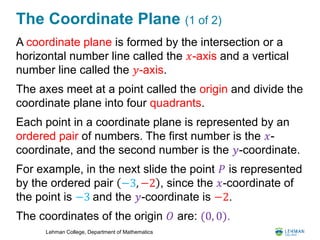
The Coordinate Plane (1 of 2)
A coordinate plane is formed by the intersection or a
horizontal number line called the 𝑥-axis and a vertical
number line called the 𝑦-axis.
The axes meet at a point called the origin and divide the
coordinate plane into four quadrants.
Each point in a coordinate plane is represented by an
ordered pair of numbers. The first number is the 𝑥-
coordinate, and the second number is the 𝑦-coordinate.
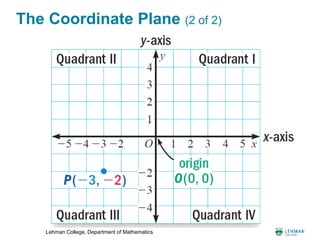
For example, in the next slide the point 𝑃 is represented
by the ordered pair −3, −2 , since the 𝑥-coordinate of
the point is −3 and the 𝑦-coordinate is −2.
The coordinates of the origin 𝑂 are: (0, 0).
Lehman College, Department of Mathematics
The Coordinate Plane (2 of 2)
Lehman College, Department of Mathematics
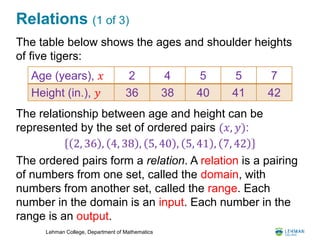
Relations (1 of 3)
The table below shows the ages and shoulder heights
of five tigers:
The relationship between age and height can be
represented by the set of ordered pairs (𝑥, 𝑦):
The ordered pairs form a relation. A relation is a pairing
of numbers from one set, called the domain, with
numbers from another set, called the range. Each
number in the domain is an input. Each number in the
range is an output.
Age (years), 𝑥 2 4 5 5 7
Height (in.), 𝑦 36 38 40 41 42
2, 36 , 4, 38 , 5, 40 , 5, 41 , 7, 42
Lehman College, Department of Mathematics
Tigers (1 of 1)
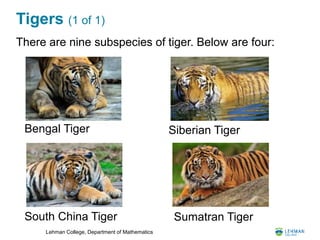
There are nine subspecies of tiger. Below are four:
Siberian TigerBengal Tiger
South China Tiger Sumatran Tiger
Lehman College, Department of Mathematics
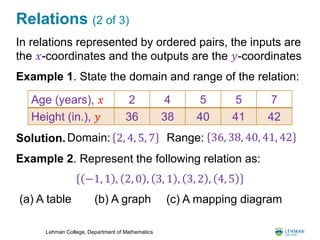
Relations (2 of 3)
In relations represented by ordered pairs, the inputs are
the 𝑥-coordinates and the outputs are the 𝑦-coordinates
Example 1. State the domain and range of the relation:
Solution.
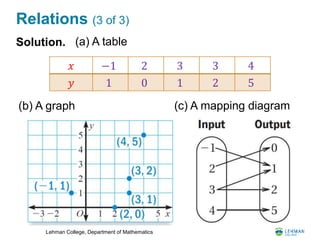
Example 2. Represent the following relation as:
Age (years), 𝑥 2 4 5 5 7
Height (in.), 𝑦 36 38 40 41 42
2, 4, 5, 7Domain: Range: 36, 38, 40, 41, 42
−1, 1 , 2, 0 , 3, 1 , 3, 2 , 4, 5
(a) A table (b) A graph (c) A mapping diagram
Lehman College, Department of Mathematics
Relations (3 of 3)
Solution.
𝑥 −1 2 3 3 4
𝑦 1 0 1 2 5
(a) A table
(b) A graph (c) A mapping diagram
Lehman College, Department of Mathematics
Functions (1 of 1)
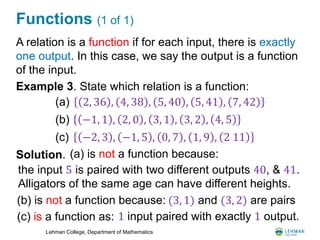
A relation is a function if for each input, there is exactly
one output. In this case, we say the output is a function
of the input.
Example 3. State which relation is a function:
Solution.
2, 36 , 4, 38 , 5, 40 , 5, 41 , 7, 42
−1, 1 , 2, 0 , 3, 1 , 3, 2 , 4, 5
(a)
(b)
(c) −2, 3 , −1, 5 , 0, 7 , 1, 9 , 2 11
(a) is not a function because:
the input 5 is paired with two different outputs 40, & 41.
Alligators of the same age can have different heights.
(b) is not a function because: (3, 1) and (3, 2) are pairs
(c) is a function as: 1 input paired with exactly 1 output.
Lehman College, Department of Mathematics
Vertical Line Test (1 of 1)
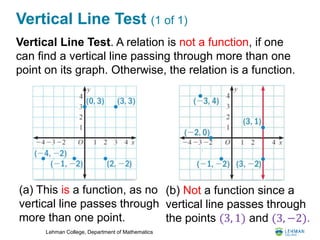
Vertical Line Test. A relation is not a function, if one
can find a vertical line passing through more than one
point on its graph. Otherwise, the relation is a function.
(a) This is a function, as no
vertical line passes through
more than one point.
(b) Not a function since a
vertical line passes through
the points (3, 1) and (3, −2).
Lehman College, Department of Mathematics
Linear Relations (1 of 2)
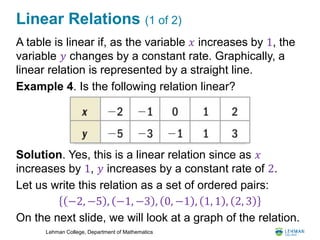
A table is linear if, as the variable 𝑥 increases by 1, the
variable 𝑦 changes by a constant rate. Graphically, a
linear relation is represented by a straight line.
Example 4. Is the following relation linear?
Solution. Yes, this is a linear relation since as 𝑥
increases by 1, 𝑦 increases by a constant rate of 2.
Let us write this relation as a set of ordered pairs:
On the next slide, we will look at a graph of the relation.
−2, −5 , −1, −3 , 0, −1 , 1, 1 , 2, 3
Lehman College, Department of Mathematics
Linear Relations (2 of 2)
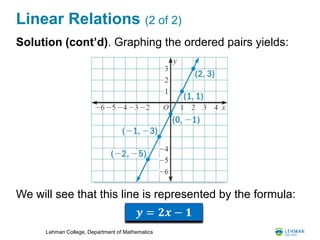
Solution (cont’d). Graphing the ordered pairs yields:
We will see that this line is represented by the formula:
𝒚 = 𝟐𝒙 − 𝟏
Lehman College, Department of Mathematics
Horizontal and Vertical Lines (1 of 1)
The graph of the equation 𝑦 = 𝑏 is the horizontal line
through the point (0, 𝑏). The graph of the equation 𝑥 = 𝑎
is the vertical line through the point (𝑎, 0).
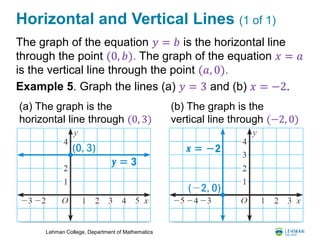
Example 5. Graph the lines (a) 𝑦 = 3 and (b) 𝑥 = −2.
(a) The graph is the
horizontal line through (0, 3)
(b) The graph is the
vertical line through (−2, 0)
Lehman College, Department of Mathematics
Intercepts (1 of 4)
The 𝑥-coordinate of a point where a graph crosses the
𝑥-axis is an 𝑥-intercept. The 𝑦-coordinate of a point
where a graph crosses the 𝑦-axis is an 𝑦-intercept.
To find the 𝑥-intercept of a line, substitute 0 for 𝑦 in the
equation of the line and solve for 𝑥.
To find the 𝑦-intercept of a line, substitute 0 for 𝑥 in the
equation of the line and solve for 𝑦.
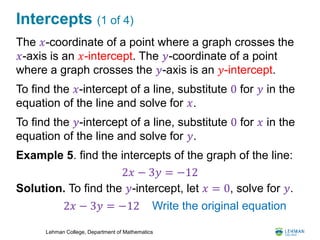
Example 5. find the intercepts of the graph of the line:
Solution. To find the 𝑦-intercept, let 𝑥 = 0, solve for 𝑦.
2𝑥 − 3𝑦 = −12
2𝑥 − 3𝑦 = −12 Write the original equation
Lehman College, Department of Mathematics
Intercepts (2 of 4)
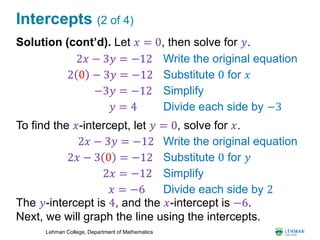
Solution (cont’d). Let 𝑥 = 0, then solve for 𝑦.
To find the 𝑥-intercept, let 𝑦 = 0, solve for 𝑥.
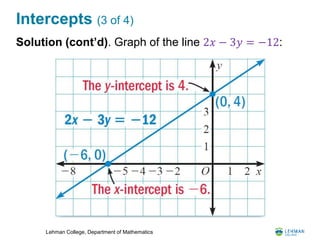
The 𝑦-intercept is 4, and the 𝑥-intercept is −6.
Next, we will graph the line using the intercepts.
2𝑥 − 3𝑦 = −12 Write the original equation
2 0 − 3𝑦 = −12 Substitute 0 for 𝑥
−3𝑦 = −12 Simplify
𝑦 = 4 Divide each side by −3
2𝑥 − 3𝑦 = −12 Write the original equation
2𝑥 − 3 0 = −12 Substitute 0 for 𝑦
2𝑥 = −12 Simplify
𝑥 = −6 Divide each side by 2
Lehman College, Department of Mathematics
Intercepts (3 of 4)
Solution (cont’d). Graph of the line 2𝑥 − 3𝑦 = −12:
Lehman College, Department of Mathematics
Intercepts (4 of 4)
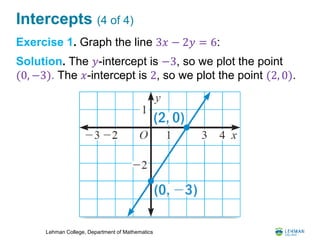
Exercise 1. Graph the line 3𝑥 − 2𝑦 = 6:
Solution. The 𝑦-intercept is −3, so we plot the point
(0, −3). The 𝑥-intercept is 2, so we plot the point (2, 0).
Lehman College, Department of Mathematics
Slope of a Line (1 of 2)
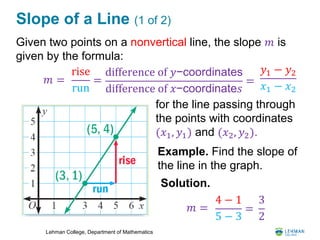
Given two points on a nonvertical line, the slope 𝑚 is
given by the formula:
𝑚 =
difference of 𝑦−coordinates
difference of 𝑥−coordinate𝑠
=
Example. Find the slope of
the line in the graph.
Solution.
𝑚 =
4 − 1
5 − 3
=
3
2
rise
run
=
𝑦1 − 𝑦2
𝑥1 − 𝑥2
for the line passing through
the points with coordinates
(𝑥1, 𝑦1) and (𝑥2, 𝑦2).
Lehman College, Department of Mathematics
Slope of a Line (2 of 2)
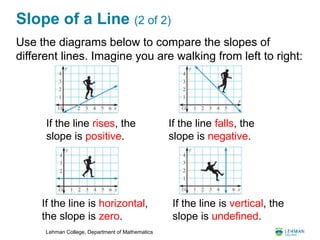
Use the diagrams below to compare the slopes of
different lines. Imagine you are walking from left to right:
If the line rises, the
slope is positive.
If the line falls, the
slope is negative.
If the line is horizontal,
the slope is zero.
If the line is vertical, the
slope is undefined.
Lehman College, Department of Mathematics
Velcro under a Microscope (1 of 1)
Lehman College, Department of Mathematics
Equation a Line (1 of 1)
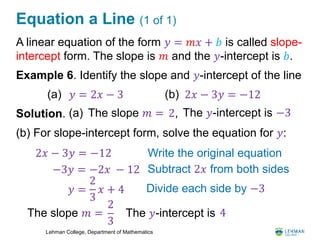
A linear equation of the form 𝑦 = 𝑚𝑥 + 𝑏 is called slope-
intercept form. The slope is 𝑚 and the 𝑦-intercept is 𝑏.
Example 6. Identify the slope and 𝑦-intercept of the line
Solution.
(b) For slope-intercept form, solve the equation for 𝑦:
(a) 𝑦 = 2𝑥 − 3 (b) 2𝑥 − 3𝑦 = −12
(a) The slope 𝑚 = 2, The 𝑦-intercept is −3
2𝑥 − 3𝑦 = −12 Write the original equation
−3𝑦 = −2𝑥 − 12 Subtract 2𝑥 from both sides
𝑦 =
2
3
𝑥 + 4 Divide each side by −3
The slope 𝑚 =
2
3
The 𝑦-intercept is 4
Lehman College, Department of Mathematics
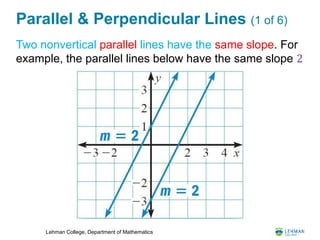
Parallel & Perpendicular Lines (1 of 6)
Two nonvertical parallel lines have the same slope. For
example, the parallel lines below have the same slope 2
Lehman College, Department of Mathematics
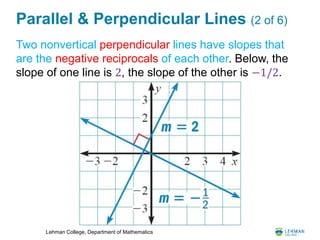
Parallel & Perpendicular Lines (2 of 6)
Two nonvertical perpendicular lines have slopes that
are the negative reciprocals of each other. Below, the
slope of one line is 2, the slope of the other is −1/2.
Lehman College, Department of Mathematics
Parallel & Perpendicular Lines (3 of 6)
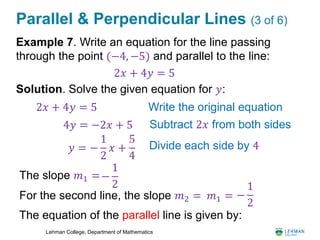
Example 7. Write an equation for the line passing
through the point (−4, −5) and parallel to the line:
Solution. Solve the given equation for 𝑦:
2𝑥 + 4𝑦 = 5
2𝑥 + 4𝑦 = 5 Write the original equation
4𝑦 = −2𝑥 + 5 Subtract 2𝑥 from both sides
𝑦 = −
1
2
𝑥 +
5
4
Divide each side by 4
The slope 𝑚1 =−
1
2
For the second line, the slope 𝑚2 = −
1
2
The equation of the parallel line is given by:
𝑚1 =
Lehman College, Department of Mathematics
Parallel & Perpendicular Lines (4 of 6)
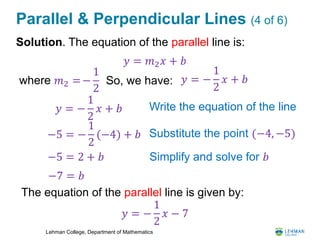
Solution. The equation of the parallel line is:
𝑦 = 𝑚2 𝑥 + 𝑏
Write the equation of the line
−5 = −
1
2
(−4) + 𝑏 Substitute the point (−4, −5)
−5 = 2 + 𝑏 Simplify and solve for 𝑏
So, we have:where 𝑚2 =−
1
2
The equation of the parallel line is given by:
𝑦 = −
1
2
𝑥 + 𝑏
𝑦 = −
1
2
𝑥 + 𝑏
−7 = 𝑏
𝑦 = −
1
2
𝑥 − 7
Lehman College, Department of Mathematics
Parallel & Perpendicular Lines (3 of 6)
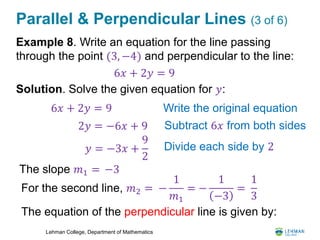
Example 8. Write an equation for the line passing
through the point (3, −4) and perpendicular to the line:
Solution. Solve the given equation for 𝑦:
6𝑥 + 2𝑦 = 9
6𝑥 + 2𝑦 = 9 Write the original equation
2𝑦 = −6𝑥 + 9 Subtract 6𝑥 from both sides
𝑦 = −3𝑥 +
9
2
Divide each side by 2
The slope 𝑚1 = −3
For the second line, 𝑚2 = −
1
−3
=
1
3
The equation of the perpendicular line is given by:
−
1
𝑚1
=
Lehman College, Department of Mathematics
Parallel & Perpendicular Lines (4 of 6)
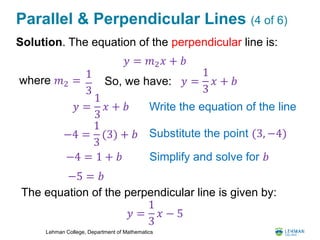
Solution. The equation of the perpendicular line is:
𝑦 = 𝑚2 𝑥 + 𝑏
Write the equation of the line
−4 =
1
3
(3) + 𝑏 Substitute the point (3, −4)
−4 = 1 + 𝑏 Simplify and solve for 𝑏
So, we have:where 𝑚2 =
1
3
The equation of the perpendicular line is given by:
𝑦 =
1
3
𝑥 + 𝑏
𝑦 =
1
3
𝑥 + 𝑏
−5 = 𝑏
𝑦 =
1
3
𝑥 − 5
Lehman College, Department of Mathematics
Parallel & Perpendicular Lines (3 of 6)
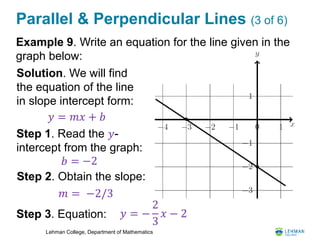
Example 9. Write an equation for the line given in the
graph below:
𝑦 = 𝑚𝑥 + 𝑏
Solution. We will find
the equation of the line
in slope intercept form:
Step 1. Read the 𝑦-
intercept from the graph:
𝑏 =
Step 2. Obtain the slope:
𝑚 =
Step 3. Equation: 𝑦 = −
2
3
𝑥 − 2
−2
−2/3
Lehman College, Department of Mathematics
Parallel & Perpendicular Lines (3 of 6)
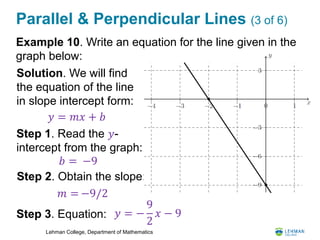
Example 10. Write an equation for the line given in the
graph below:
𝑦 = 𝑚𝑥 + 𝑏
Solution. We will find
the equation of the line
in slope intercept form:
Step 1. Read the 𝑦-
intercept from the graph:
𝑏 =
Step 2. Obtain the slope:
𝑚 =
Step 3. Equation: 𝑦 = −
9
2
𝑥 − 9
−9
−9/2
Lehman College, Department of Mathematics
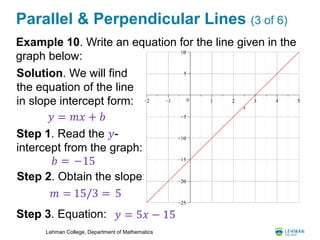
Parallel & Perpendicular Lines (3 of 6)
Example 10. Write an equation for the line given in the
graph below:
𝑦 = 𝑚𝑥 + 𝑏
Solution. We will find
the equation of the line
in slope intercept form:
Step 1. Read the 𝑦-
intercept from the graph:
𝑏 =
Step 2. Obtain the slope:
𝑚 =
Step 3. Equation: 𝑦 = 5𝑥 − 15
5
−15
15/3 =

Lesson 9: Linear Relations and Lines

  • 1.
    𝐏𝐓𝐒 𝟑 Bridge toCalculus Workshop Summer 2020 Lesson 9 Linear Relations and Lines “Mathematics is the language in which the gods speak to people.“ - Plato -
  • 2.
    Lehman College, Departmentof Mathematics The Coordinate Plane (1 of 2) A coordinate plane is formed by the intersection or a horizontal number line called the 𝑥-axis and a vertical number line called the 𝑦-axis. The axes meet at a point called the origin and divide the coordinate plane into four quadrants. Each point in a coordinate plane is represented by an ordered pair of numbers. The first number is the 𝑥- coordinate, and the second number is the 𝑦-coordinate. For example, in the next slide the point 𝑃 is represented by the ordered pair −3, −2 , since the 𝑥-coordinate of the point is −3 and the 𝑦-coordinate is −2. The coordinates of the origin 𝑂 are: (0, 0).
  • 3.
    Lehman College, Departmentof Mathematics The Coordinate Plane (2 of 2)
  • 4.
    Lehman College, Departmentof Mathematics Relations (1 of 3) The table below shows the ages and shoulder heights of five tigers: The relationship between age and height can be represented by the set of ordered pairs (𝑥, 𝑦): The ordered pairs form a relation. A relation is a pairing of numbers from one set, called the domain, with numbers from another set, called the range. Each number in the domain is an input. Each number in the range is an output. Age (years), 𝑥 2 4 5 5 7 Height (in.), 𝑦 36 38 40 41 42 2, 36 , 4, 38 , 5, 40 , 5, 41 , 7, 42
  • 5.
    Lehman College, Departmentof Mathematics Tigers (1 of 1) There are nine subspecies of tiger. Below are four: Siberian TigerBengal Tiger South China Tiger Sumatran Tiger
  • 6.
    Lehman College, Departmentof Mathematics Relations (2 of 3) In relations represented by ordered pairs, the inputs are the 𝑥-coordinates and the outputs are the 𝑦-coordinates Example 1. State the domain and range of the relation: Solution. Example 2. Represent the following relation as: Age (years), 𝑥 2 4 5 5 7 Height (in.), 𝑦 36 38 40 41 42 2, 4, 5, 7Domain: Range: 36, 38, 40, 41, 42 −1, 1 , 2, 0 , 3, 1 , 3, 2 , 4, 5 (a) A table (b) A graph (c) A mapping diagram
  • 7.
    Lehman College, Departmentof Mathematics Relations (3 of 3) Solution. 𝑥 −1 2 3 3 4 𝑦 1 0 1 2 5 (a) A table (b) A graph (c) A mapping diagram
  • 8.
    Lehman College, Departmentof Mathematics Functions (1 of 1) A relation is a function if for each input, there is exactly one output. In this case, we say the output is a function of the input. Example 3. State which relation is a function: Solution. 2, 36 , 4, 38 , 5, 40 , 5, 41 , 7, 42 −1, 1 , 2, 0 , 3, 1 , 3, 2 , 4, 5 (a) (b) (c) −2, 3 , −1, 5 , 0, 7 , 1, 9 , 2 11 (a) is not a function because: the input 5 is paired with two different outputs 40, & 41. Alligators of the same age can have different heights. (b) is not a function because: (3, 1) and (3, 2) are pairs (c) is a function as: 1 input paired with exactly 1 output.
  • 9.
    Lehman College, Departmentof Mathematics Vertical Line Test (1 of 1) Vertical Line Test. A relation is not a function, if one can find a vertical line passing through more than one point on its graph. Otherwise, the relation is a function. (a) This is a function, as no vertical line passes through more than one point. (b) Not a function since a vertical line passes through the points (3, 1) and (3, −2).
  • 10.
    Lehman College, Departmentof Mathematics Linear Relations (1 of 2) A table is linear if, as the variable 𝑥 increases by 1, the variable 𝑦 changes by a constant rate. Graphically, a linear relation is represented by a straight line. Example 4. Is the following relation linear? Solution. Yes, this is a linear relation since as 𝑥 increases by 1, 𝑦 increases by a constant rate of 2. Let us write this relation as a set of ordered pairs: On the next slide, we will look at a graph of the relation. −2, −5 , −1, −3 , 0, −1 , 1, 1 , 2, 3
  • 11.
    Lehman College, Departmentof Mathematics Linear Relations (2 of 2) Solution (cont’d). Graphing the ordered pairs yields: We will see that this line is represented by the formula: 𝒚 = 𝟐𝒙 − 𝟏
  • 12.
    Lehman College, Departmentof Mathematics Horizontal and Vertical Lines (1 of 1) The graph of the equation 𝑦 = 𝑏 is the horizontal line through the point (0, 𝑏). The graph of the equation 𝑥 = 𝑎 is the vertical line through the point (𝑎, 0). Example 5. Graph the lines (a) 𝑦 = 3 and (b) 𝑥 = −2. (a) The graph is the horizontal line through (0, 3) (b) The graph is the vertical line through (−2, 0)
  • 13.
    Lehman College, Departmentof Mathematics Intercepts (1 of 4) The 𝑥-coordinate of a point where a graph crosses the 𝑥-axis is an 𝑥-intercept. The 𝑦-coordinate of a point where a graph crosses the 𝑦-axis is an 𝑦-intercept. To find the 𝑥-intercept of a line, substitute 0 for 𝑦 in the equation of the line and solve for 𝑥. To find the 𝑦-intercept of a line, substitute 0 for 𝑥 in the equation of the line and solve for 𝑦. Example 5. find the intercepts of the graph of the line: Solution. To find the 𝑦-intercept, let 𝑥 = 0, solve for 𝑦. 2𝑥 − 3𝑦 = −12 2𝑥 − 3𝑦 = −12 Write the original equation
  • 14.
    Lehman College, Departmentof Mathematics Intercepts (2 of 4) Solution (cont’d). Let 𝑥 = 0, then solve for 𝑦. To find the 𝑥-intercept, let 𝑦 = 0, solve for 𝑥. The 𝑦-intercept is 4, and the 𝑥-intercept is −6. Next, we will graph the line using the intercepts. 2𝑥 − 3𝑦 = −12 Write the original equation 2 0 − 3𝑦 = −12 Substitute 0 for 𝑥 −3𝑦 = −12 Simplify 𝑦 = 4 Divide each side by −3 2𝑥 − 3𝑦 = −12 Write the original equation 2𝑥 − 3 0 = −12 Substitute 0 for 𝑦 2𝑥 = −12 Simplify 𝑥 = −6 Divide each side by 2
  • 15.
    Lehman College, Departmentof Mathematics Intercepts (3 of 4) Solution (cont’d). Graph of the line 2𝑥 − 3𝑦 = −12:
  • 16.
    Lehman College, Departmentof Mathematics Intercepts (4 of 4) Exercise 1. Graph the line 3𝑥 − 2𝑦 = 6: Solution. The 𝑦-intercept is −3, so we plot the point (0, −3). The 𝑥-intercept is 2, so we plot the point (2, 0).
  • 17.
    Lehman College, Departmentof Mathematics Slope of a Line (1 of 2) Given two points on a nonvertical line, the slope 𝑚 is given by the formula: 𝑚 = difference of 𝑦−coordinates difference of 𝑥−coordinate𝑠 = Example. Find the slope of the line in the graph. Solution. 𝑚 = 4 − 1 5 − 3 = 3 2 rise run = 𝑦1 − 𝑦2 𝑥1 − 𝑥2 for the line passing through the points with coordinates (𝑥1, 𝑦1) and (𝑥2, 𝑦2).
  • 18.
    Lehman College, Departmentof Mathematics Slope of a Line (2 of 2) Use the diagrams below to compare the slopes of different lines. Imagine you are walking from left to right: If the line rises, the slope is positive. If the line falls, the slope is negative. If the line is horizontal, the slope is zero. If the line is vertical, the slope is undefined.
  • 19.
    Lehman College, Departmentof Mathematics Velcro under a Microscope (1 of 1)
  • 20.
    Lehman College, Departmentof Mathematics Equation a Line (1 of 1) A linear equation of the form 𝑦 = 𝑚𝑥 + 𝑏 is called slope- intercept form. The slope is 𝑚 and the 𝑦-intercept is 𝑏. Example 6. Identify the slope and 𝑦-intercept of the line Solution. (b) For slope-intercept form, solve the equation for 𝑦: (a) 𝑦 = 2𝑥 − 3 (b) 2𝑥 − 3𝑦 = −12 (a) The slope 𝑚 = 2, The 𝑦-intercept is −3 2𝑥 − 3𝑦 = −12 Write the original equation −3𝑦 = −2𝑥 − 12 Subtract 2𝑥 from both sides 𝑦 = 2 3 𝑥 + 4 Divide each side by −3 The slope 𝑚 = 2 3 The 𝑦-intercept is 4
  • 21.
    Lehman College, Departmentof Mathematics Parallel & Perpendicular Lines (1 of 6) Two nonvertical parallel lines have the same slope. For example, the parallel lines below have the same slope 2
  • 22.
    Lehman College, Departmentof Mathematics Parallel & Perpendicular Lines (2 of 6) Two nonvertical perpendicular lines have slopes that are the negative reciprocals of each other. Below, the slope of one line is 2, the slope of the other is −1/2.
  • 23.
    Lehman College, Departmentof Mathematics Parallel & Perpendicular Lines (3 of 6) Example 7. Write an equation for the line passing through the point (−4, −5) and parallel to the line: Solution. Solve the given equation for 𝑦: 2𝑥 + 4𝑦 = 5 2𝑥 + 4𝑦 = 5 Write the original equation 4𝑦 = −2𝑥 + 5 Subtract 2𝑥 from both sides 𝑦 = − 1 2 𝑥 + 5 4 Divide each side by 4 The slope 𝑚1 =− 1 2 For the second line, the slope 𝑚2 = − 1 2 The equation of the parallel line is given by: 𝑚1 =
  • 24.
    Lehman College, Departmentof Mathematics Parallel & Perpendicular Lines (4 of 6) Solution. The equation of the parallel line is: 𝑦 = 𝑚2 𝑥 + 𝑏 Write the equation of the line −5 = − 1 2 (−4) + 𝑏 Substitute the point (−4, −5) −5 = 2 + 𝑏 Simplify and solve for 𝑏 So, we have:where 𝑚2 =− 1 2 The equation of the parallel line is given by: 𝑦 = − 1 2 𝑥 + 𝑏 𝑦 = − 1 2 𝑥 + 𝑏 −7 = 𝑏 𝑦 = − 1 2 𝑥 − 7
  • 25.
    Lehman College, Departmentof Mathematics Parallel & Perpendicular Lines (3 of 6) Example 8. Write an equation for the line passing through the point (3, −4) and perpendicular to the line: Solution. Solve the given equation for 𝑦: 6𝑥 + 2𝑦 = 9 6𝑥 + 2𝑦 = 9 Write the original equation 2𝑦 = −6𝑥 + 9 Subtract 6𝑥 from both sides 𝑦 = −3𝑥 + 9 2 Divide each side by 2 The slope 𝑚1 = −3 For the second line, 𝑚2 = − 1 −3 = 1 3 The equation of the perpendicular line is given by: − 1 𝑚1 =
  • 26.
    Lehman College, Departmentof Mathematics Parallel & Perpendicular Lines (4 of 6) Solution. The equation of the perpendicular line is: 𝑦 = 𝑚2 𝑥 + 𝑏 Write the equation of the line −4 = 1 3 (3) + 𝑏 Substitute the point (3, −4) −4 = 1 + 𝑏 Simplify and solve for 𝑏 So, we have:where 𝑚2 = 1 3 The equation of the perpendicular line is given by: 𝑦 = 1 3 𝑥 + 𝑏 𝑦 = 1 3 𝑥 + 𝑏 −5 = 𝑏 𝑦 = 1 3 𝑥 − 5
  • 27.
    Lehman College, Departmentof Mathematics Parallel & Perpendicular Lines (3 of 6) Example 9. Write an equation for the line given in the graph below: 𝑦 = 𝑚𝑥 + 𝑏 Solution. We will find the equation of the line in slope intercept form: Step 1. Read the 𝑦- intercept from the graph: 𝑏 = Step 2. Obtain the slope: 𝑚 = Step 3. Equation: 𝑦 = − 2 3 𝑥 − 2 −2 −2/3
  • 28.
    Lehman College, Departmentof Mathematics Parallel & Perpendicular Lines (3 of 6) Example 10. Write an equation for the line given in the graph below: 𝑦 = 𝑚𝑥 + 𝑏 Solution. We will find the equation of the line in slope intercept form: Step 1. Read the 𝑦- intercept from the graph: 𝑏 = Step 2. Obtain the slope: 𝑚 = Step 3. Equation: 𝑦 = − 9 2 𝑥 − 9 −9 −9/2
  • 29.
    Lehman College, Departmentof Mathematics Parallel & Perpendicular Lines (3 of 6) Example 10. Write an equation for the line given in the graph below: 𝑦 = 𝑚𝑥 + 𝑏 Solution. We will find the equation of the line in slope intercept form: Step 1. Read the 𝑦- intercept from the graph: 𝑏 = Step 2. Obtain the slope: 𝑚 = Step 3. Equation: 𝑦 = 5𝑥 − 15 5 −15 15/3 =