Find a Basis and Dimension of a Subspace
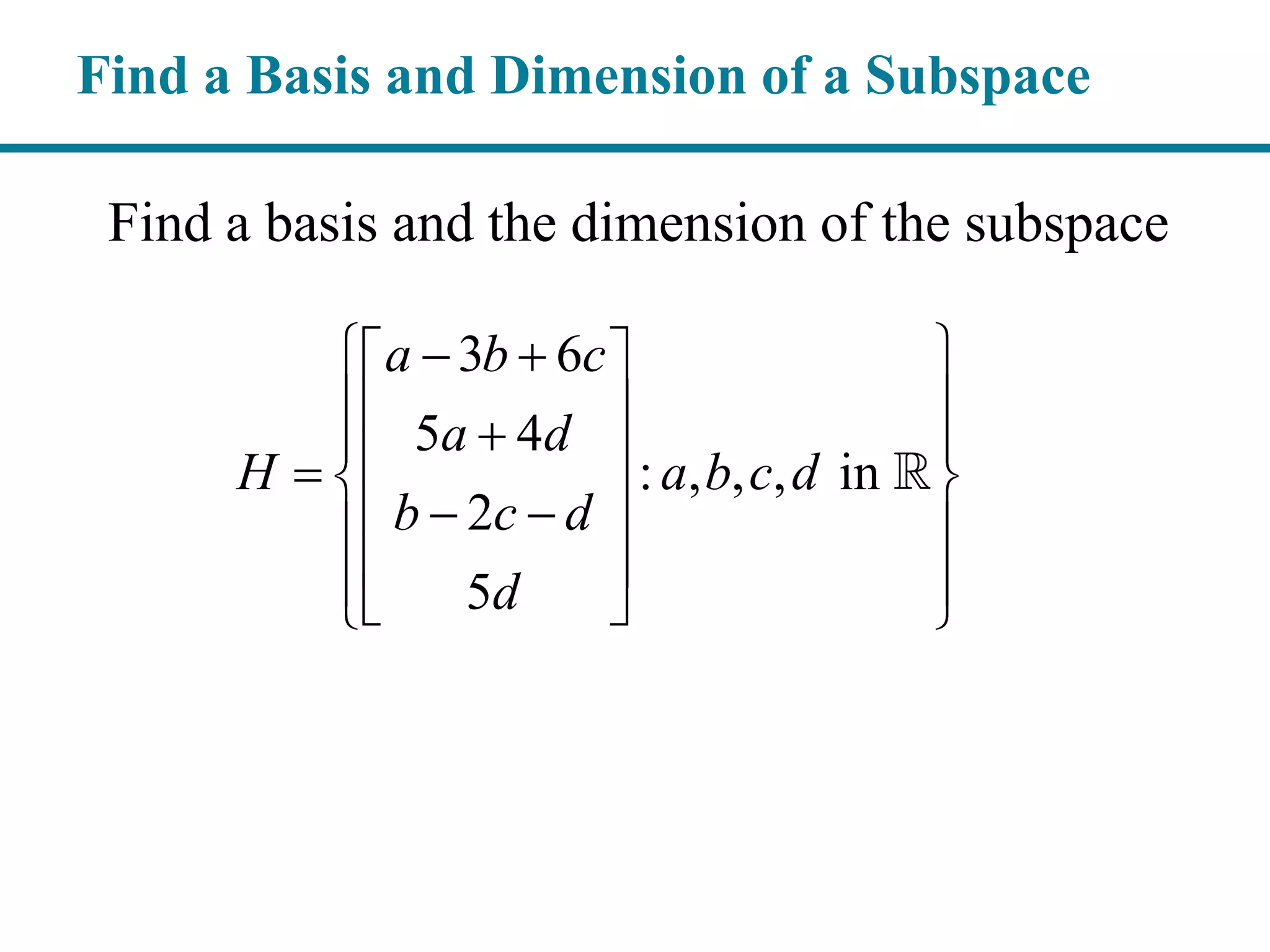
Find a basis and the dimension of the subspace
3 6
5 4
: , , , in
2
5
a b c
a d
H a b c d
b c d
d
   
      
   
    
Find a Basis and Dimension of a Subspace
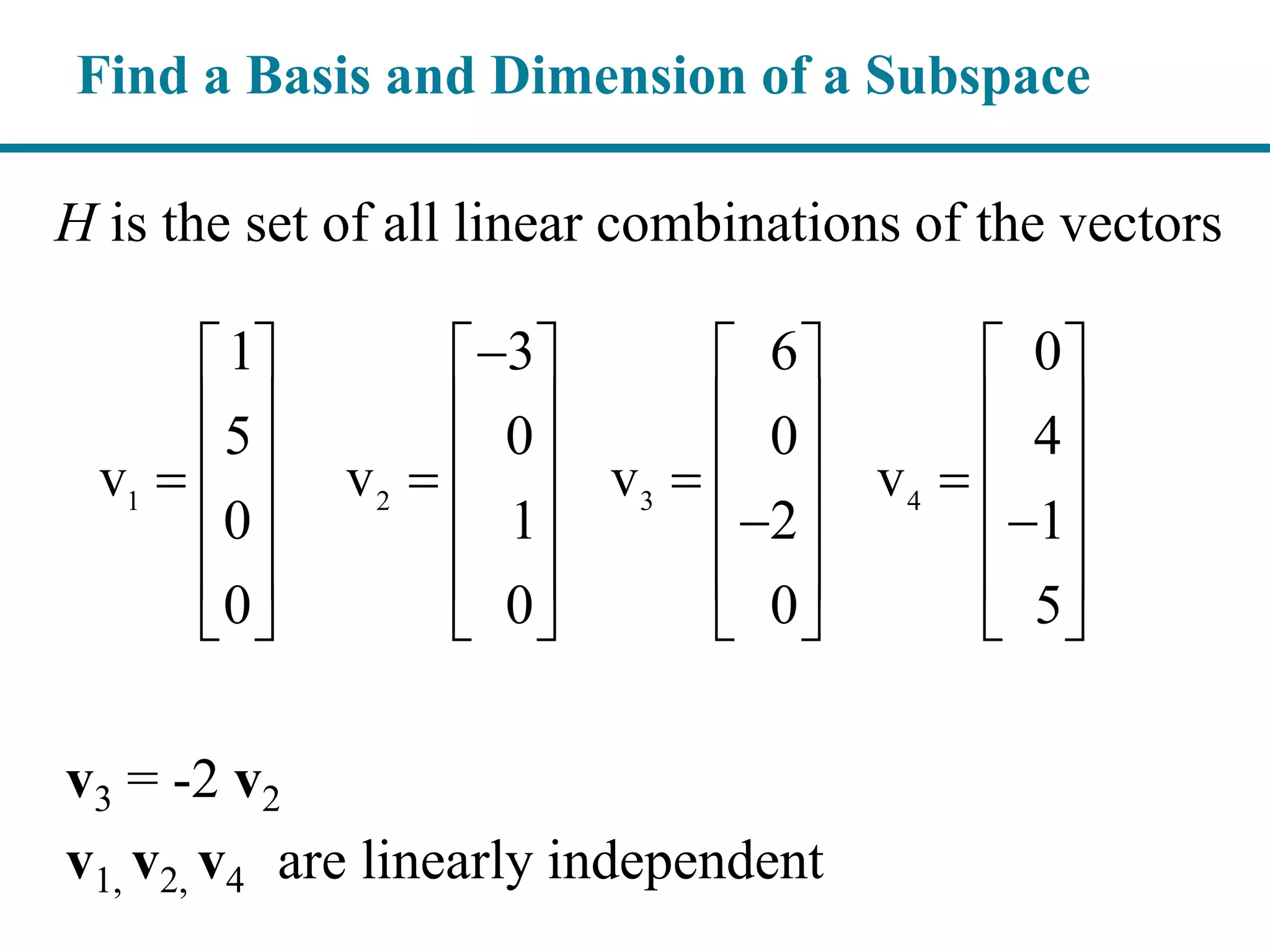
H is the set of all linear combinations of the vectors
1
1
5
v
0
0
 
 
 
 
 
 
2
3
0
v
1
0
 
 
 
 
 
 
3
6
0
v
2
0
 
 
 
 
 
 
4
0
4
v
1
5
 
 
 
 
 
 
v3 = -2 v2
v1, v2, v4 are linearly independent
Find a Basis and Dimension of a Subspace
Therefore, {v1, v2, v4} is a set of linearly
independent vectors.
Also, H = span {v1, v2, v4}.
Hence {v1, v2, v4} is a basis for H.
Thus dim H =3.
4. Vector Spaces
ROW and COLUMN
SPACES of a MATRIX
and
RANK of a MATRIX
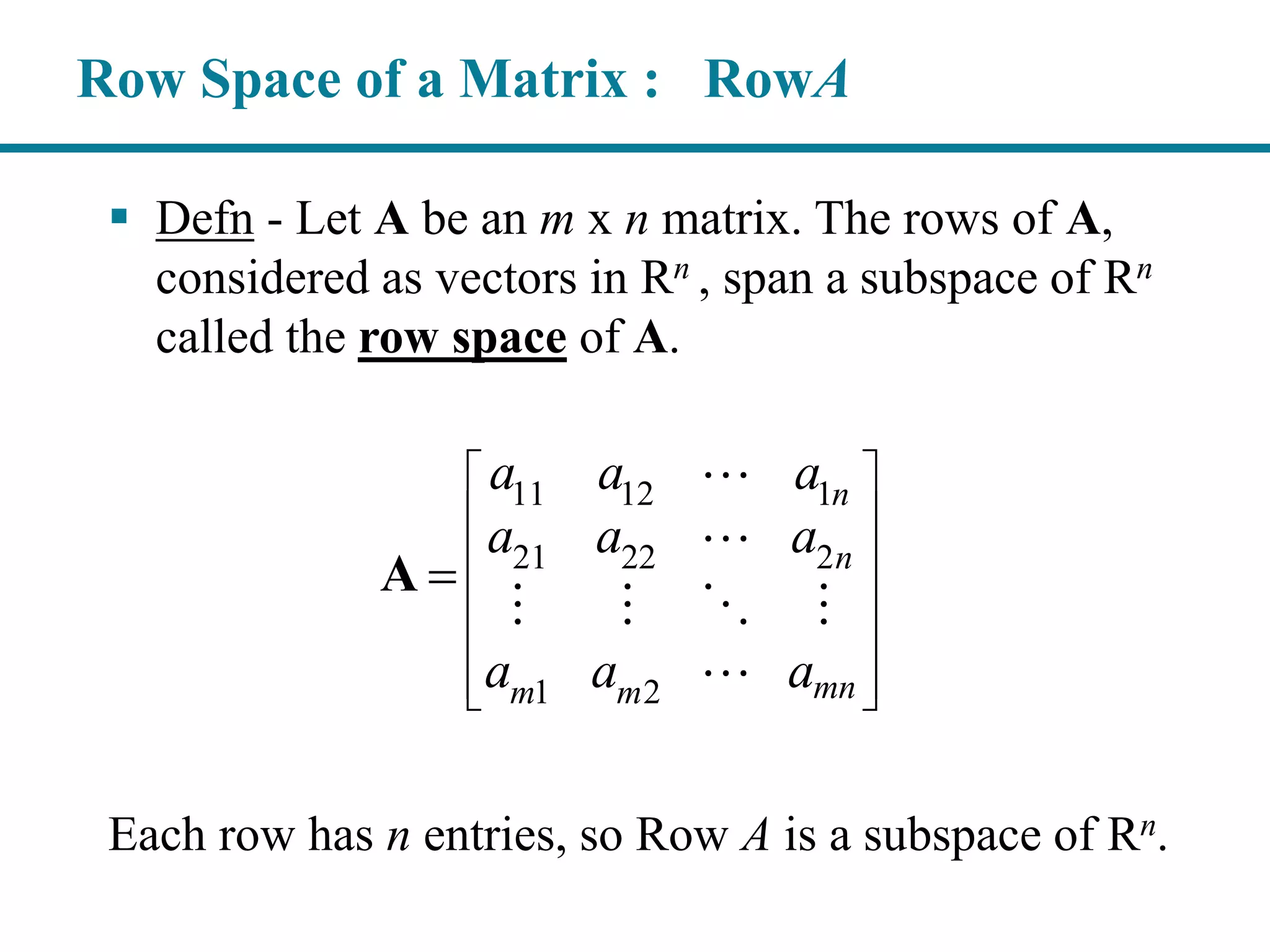
 Defn - Let A be an m x n matrix. The rows of A,
considered as vectors in Rn , span a subspace of Rn
called the row space of A.
Each row has n entries, so Row A is a subspace of Rn.
11 12 1
21 22 2
1 2
n
n
mnm m
a a a
a a a
a a a
 
 
 
 
 
  
A
Row Space of a Matrix : RowA
 Defn - Let A be an m x n matrix. The columns of
A, considered as vectors in Rm, span a subspace of
Rm called the column space of A
 The system Ax = b has a solution if and only if b
is in the column space of A.
 Each column has m entries, so Col A is a subspace
of Rm.
11 12 1
21 22 2
1 2
n
n
mnm m
a a a
a a a
a a a
 
 
 
 
 
  
A
Column Space of a Matrix : Col A
 Theorem - If A and B are mxn row (column)
equivalent matrices, then the row (column) spaces
of A and B are equal (the same).
 Recall: If A and B are row equivalent when the
rows of B are obtained from the rows of A by a
finite number of the three elementary row
operations.
Equality of Spaces
 Defn - The dimension of the row space of a matrix
A is called the row rank of A
 Defn - The dimension of the column space of a
matrix A is called the column rank of A
 Theorem - The row rank and the column rank of
an mxn matrix A = [ aij ] are equal.
Rank of A
 The rank of A corresponds to the number of linearly
independent rows (columns) of A.
 If A is an n x n matrix, then rank A = n if and only if A is
row equivalent to In
 Let A be an n x n matrix. A is nonsingular if and only if
rank A = n
 If A is an n x n matrix, then rank A = n if and only if
det(A) ≠ 0.
 The homogeneous system Ax = 0 where A is an n x n
matrix has a nontrivial solution if and only if rank A < n
 Let A be an n x n matrix. The linear system Ax = b has a
unique solution if and only if rank A = n.
Rank of A
Equivalent statements for nxn matrix A
 A is nonsingular
 AX  0 has the trivial solution only
 A is row equivalent to In
 The system AX  b has a unique solution
 A has rank n
 The rows (columns) of A form a linearly independent
set of vectors in Rn
Rank of A
Let A be an mxn matrix.
Then
rank A + nullity A = n.
Nullity A = dim Null(A)
Rank + Nullity Theorem
 Example:
a. If A is a matrix with a two-dimensional
null space, what is the rank of A?
b. Could a matrix have a two-dimensional
null space?
 Solution:
a. Since A has 9 columns, , and
hence rank .
b. No. If a matrix, call it B, has a two-
dimensional null space, it would have to have
rank 7, by the Rank Theorem.
7 9
6 9
(rank ) 2 9A  
7A 
6 9
Rank + Nullity Theorem
To identify the basis for Row A and Col A
1. Reduce A to echelon form E
2. The nonzero rows of E form a basis for Row A
3. The columns of A that correspond to the columns of E
containing the leading entries form a basis for Col A
Note: The same is true if the matrix E is in reduced
echelon form.
For a matrix A, the number of linearly independent rows
is equal to the number of linearly independent columns.
Bases for Row A and Col A
has m = n = 2 and rank r = 1
Column space contains all multiples of
Row space consists of all multiples of [ 1 2 ]
Null space consists of all multiples of
1 2
3 6
 
 
 
A
1
3
 
 
 
1
2
 
 
 
Example
Example - Find a basis for the subspace V of R3
spanned by the rows of the matrix A
Row Space of a Matrix : RowA
1 2 1
1 1 1
1 3 3
3 5 1
1 4 5
 
 
 
 
 
 
 
 


 


A
 Example (continued) - Apply elementary row
operations to A to reduce it to B, in echelon form
1 0 3
0 1 2
0 0 0
0 0 0
0 0 0
 
 
 
 
 
 
 
 


B
A basis for the row space of B
consists of the vectors
w1 = [ 1 0 3 ] and w2 = [ 0 1 2 ].
So { w1, w2 } is a basis for V
v1 = w1  2w2, v2 = w1 + w2,
v3 = w1  3w2, v4 = 3w1  5w2,
v5 = w1  4w2
Row Space of a Matrix : RowA
Example (continued) - Since a matrix A is row
equivalent to a matrix B that is in row echelon form,
then
the nonzero rows of B form a basis for the row space
of A and the row space of B.
Row Space of a Matrix : RowA
w1 = [ 1 0 3 ] and w2 = [ 0 1 2 ].
DIMENSIONS OF NUL A AND COL A
 Let A be an matrix, and suppose the equation
has k free variables.
 A spanning set for Nul A will produce exactly k
linearly independent vectors—say, —one for
each free variable.
 So is a basis for Nul A, and the number of
free variables determines the size of the basis.
m n
x 0A 
1
u ,...,uk
1
{u ,...,u }k
DIMENSIONS OF NUL A AND COL A
 The dimension of Nul A is the number of free
variables in the equation , and the dimension
of Col A is the number of pivot columns in A.
 Example: Find the dimensions of the null space and
the column space of
x 0A 
3 6 1 1 7
1 2 2 3 1
2 4 5 8 4
A
   
   
 
   
DIMENSIONS OF NUL A AND COL A
 Solution: Row reduce the matrix to echelon form:
 There are three free variable—x2, x4 and x5.
 Hence the dimension of Nul A is 3.
 Also dim Col A = 2 because A has two pivot
columns (column 1 of A and column 3 of A).
1 2 2 3 1
0 0 1 2 2
0 0 0 0 0
  
 
 
  
Find bases for the row space, the column space, and the
null space of the matrix
2 5 8 0 17
1 3 5 1 5
3 11 19 7 1
1 7 13 5 3
   
 
 
 
   
Example
To find bases for the row space and the column space,
row reduce A to an echelon form:
 The first three rows of B form a basis for the row
space of A (as well as for the row space of B).
 Basis for Row A:
Example (cont) : Row space
1 3 5 1 5
0 1 2 2 7
0 0 0 4 20
0 0 0 0 0
A B
 
  
 
 
 
 
{(1,3, 5,1,5),(0,1, 2,2, 7),(0,0,0, 4,20)}   
 For the column space, observe from B that the pivots
are in columns 1, 2, and 4.
 Hence columns 1, 2, and 4 of A (not B) form a basis
for Col A:
Basis for Col
 Notice that any echelon form of A provides (in its
nonzero rows) a basis for Row A and also identifies
the pivot columns of A for Col A.
Example (cont) : Column space
2 5 0
1 3 1
: , ,
3 11 7
1 7 5
A
       
      
       
      
            
 However, for Nul A, we need the reduced echelon
form.
 Further row operations on B yield
Example (cont) : Null space
1 0 1 0 1
0 1 2 0 3
0 0 0 1 5
0 0 0 0 0
A B C
 
 
 
 
 
 
 The equation is equivalent to , that is,
 So , , , with x3
and x5 free variables.
x 0A  x 0C 
1 3 5
2 3 5
4 5
0
2 3 0
5 0
x x x
x x x
x x
  
  
 
1 3 5
x x x   2 3 5
2 3x x x  4 5
5x x
Example (cont) : Null space
 The calculations show that
Basis for Nul A
 Observe that, unlike the basis for Col A, the bases for
Row A and Nul A have no simple connection with the
entries in A itself.
Example (cont) : Null space
1 1
2 3
: ,1 0
0 5
0 1
     
         
    
    
    
        
Section 4.5
p.268, p.269
1 to 16
Problems

Chapter 4: Vector Spaces - Part 4/Slides By Pearson

  • 1.
    Find a Basisand Dimension of a Subspace Find a basis and the dimension of the subspace 3 6 5 4 : , , , in 2 5 a b c a d H a b c d b c d d                    
  • 2.
    Find a Basisand Dimension of a Subspace H is the set of all linear combinations of the vectors 1 1 5 v 0 0             2 3 0 v 1 0             3 6 0 v 2 0             4 0 4 v 1 5             v3 = -2 v2 v1, v2, v4 are linearly independent
  • 3.
    Find a Basisand Dimension of a Subspace Therefore, {v1, v2, v4} is a set of linearly independent vectors. Also, H = span {v1, v2, v4}. Hence {v1, v2, v4} is a basis for H. Thus dim H =3.
  • 4.
    4. Vector Spaces ROWand COLUMN SPACES of a MATRIX and RANK of a MATRIX
  • 5.
     Defn -Let A be an m x n matrix. The rows of A, considered as vectors in Rn , span a subspace of Rn called the row space of A. Each row has n entries, so Row A is a subspace of Rn. 11 12 1 21 22 2 1 2 n n mnm m a a a a a a a a a              A Row Space of a Matrix : RowA
  • 6.
     Defn -Let A be an m x n matrix. The columns of A, considered as vectors in Rm, span a subspace of Rm called the column space of A  The system Ax = b has a solution if and only if b is in the column space of A.  Each column has m entries, so Col A is a subspace of Rm. 11 12 1 21 22 2 1 2 n n mnm m a a a a a a a a a              A Column Space of a Matrix : Col A
  • 7.
     Theorem -If A and B are mxn row (column) equivalent matrices, then the row (column) spaces of A and B are equal (the same).  Recall: If A and B are row equivalent when the rows of B are obtained from the rows of A by a finite number of the three elementary row operations. Equality of Spaces
  • 8.
     Defn -The dimension of the row space of a matrix A is called the row rank of A  Defn - The dimension of the column space of a matrix A is called the column rank of A  Theorem - The row rank and the column rank of an mxn matrix A = [ aij ] are equal. Rank of A
  • 9.
     The rankof A corresponds to the number of linearly independent rows (columns) of A.  If A is an n x n matrix, then rank A = n if and only if A is row equivalent to In  Let A be an n x n matrix. A is nonsingular if and only if rank A = n  If A is an n x n matrix, then rank A = n if and only if det(A) ≠ 0.  The homogeneous system Ax = 0 where A is an n x n matrix has a nontrivial solution if and only if rank A < n  Let A be an n x n matrix. The linear system Ax = b has a unique solution if and only if rank A = n. Rank of A
  • 10.
    Equivalent statements fornxn matrix A  A is nonsingular  AX  0 has the trivial solution only  A is row equivalent to In  The system AX  b has a unique solution  A has rank n  The rows (columns) of A form a linearly independent set of vectors in Rn Rank of A
  • 11.
    Let A bean mxn matrix. Then rank A + nullity A = n. Nullity A = dim Null(A) Rank + Nullity Theorem
  • 12.
     Example: a. IfA is a matrix with a two-dimensional null space, what is the rank of A? b. Could a matrix have a two-dimensional null space?  Solution: a. Since A has 9 columns, , and hence rank . b. No. If a matrix, call it B, has a two- dimensional null space, it would have to have rank 7, by the Rank Theorem. 7 9 6 9 (rank ) 2 9A   7A  6 9 Rank + Nullity Theorem
  • 13.
    To identify thebasis for Row A and Col A 1. Reduce A to echelon form E 2. The nonzero rows of E form a basis for Row A 3. The columns of A that correspond to the columns of E containing the leading entries form a basis for Col A Note: The same is true if the matrix E is in reduced echelon form. For a matrix A, the number of linearly independent rows is equal to the number of linearly independent columns. Bases for Row A and Col A
  • 14.
    has m =n = 2 and rank r = 1 Column space contains all multiples of Row space consists of all multiples of [ 1 2 ] Null space consists of all multiples of 1 2 3 6       A 1 3       1 2       Example
  • 15.
    Example - Finda basis for the subspace V of R3 spanned by the rows of the matrix A Row Space of a Matrix : RowA 1 2 1 1 1 1 1 3 3 3 5 1 1 4 5                       A
  • 16.
     Example (continued)- Apply elementary row operations to A to reduce it to B, in echelon form 1 0 3 0 1 2 0 0 0 0 0 0 0 0 0                   B A basis for the row space of B consists of the vectors w1 = [ 1 0 3 ] and w2 = [ 0 1 2 ]. So { w1, w2 } is a basis for V v1 = w1  2w2, v2 = w1 + w2, v3 = w1  3w2, v4 = 3w1  5w2, v5 = w1  4w2 Row Space of a Matrix : RowA
  • 17.
    Example (continued) -Since a matrix A is row equivalent to a matrix B that is in row echelon form, then the nonzero rows of B form a basis for the row space of A and the row space of B. Row Space of a Matrix : RowA w1 = [ 1 0 3 ] and w2 = [ 0 1 2 ].
  • 18.
    DIMENSIONS OF NULA AND COL A  Let A be an matrix, and suppose the equation has k free variables.  A spanning set for Nul A will produce exactly k linearly independent vectors—say, —one for each free variable.  So is a basis for Nul A, and the number of free variables determines the size of the basis. m n x 0A  1 u ,...,uk 1 {u ,...,u }k
  • 19.
    DIMENSIONS OF NULA AND COL A  The dimension of Nul A is the number of free variables in the equation , and the dimension of Col A is the number of pivot columns in A.  Example: Find the dimensions of the null space and the column space of x 0A  3 6 1 1 7 1 2 2 3 1 2 4 5 8 4 A              
  • 20.
    DIMENSIONS OF NULA AND COL A  Solution: Row reduce the matrix to echelon form:  There are three free variable—x2, x4 and x5.  Hence the dimension of Nul A is 3.  Also dim Col A = 2 because A has two pivot columns (column 1 of A and column 3 of A). 1 2 2 3 1 0 0 1 2 2 0 0 0 0 0          
  • 21.
    Find bases forthe row space, the column space, and the null space of the matrix 2 5 8 0 17 1 3 5 1 5 3 11 19 7 1 1 7 13 5 3               Example
  • 22.
    To find basesfor the row space and the column space, row reduce A to an echelon form:  The first three rows of B form a basis for the row space of A (as well as for the row space of B).  Basis for Row A: Example (cont) : Row space 1 3 5 1 5 0 1 2 2 7 0 0 0 4 20 0 0 0 0 0 A B              {(1,3, 5,1,5),(0,1, 2,2, 7),(0,0,0, 4,20)}   
  • 23.
     For thecolumn space, observe from B that the pivots are in columns 1, 2, and 4.  Hence columns 1, 2, and 4 of A (not B) form a basis for Col A: Basis for Col  Notice that any echelon form of A provides (in its nonzero rows) a basis for Row A and also identifies the pivot columns of A for Col A. Example (cont) : Column space 2 5 0 1 3 1 : , , 3 11 7 1 7 5 A                                           
  • 24.
     However, forNul A, we need the reduced echelon form.  Further row operations on B yield Example (cont) : Null space 1 0 1 0 1 0 1 2 0 3 0 0 0 1 5 0 0 0 0 0 A B C            
  • 25.
     The equationis equivalent to , that is,  So , , , with x3 and x5 free variables. x 0A  x 0C  1 3 5 2 3 5 4 5 0 2 3 0 5 0 x x x x x x x x         1 3 5 x x x   2 3 5 2 3x x x  4 5 5x x Example (cont) : Null space
  • 26.
     The calculationsshow that Basis for Nul A  Observe that, unlike the basis for Col A, the bases for Row A and Nul A have no simple connection with the entries in A itself. Example (cont) : Null space 1 1 2 3 : ,1 0 0 5 0 1                                        
  • 27.