INTRODUCTORY MATHEMATICALINTRODUCTORY MATHEMATICAL
ANALYSISANALYSISFor Business, Economics, and the Life and Social Sciences
©2007 Pearson Education Asia
Chapter 16Chapter 16
Continuous Random VariablesContinuous Random Variables
©2007 Pearson Education Asia
INTRODUCTORY MATHEMATICAL
ANALYSIS
0. Review of Algebra
1. Applications and More Algebra
2. Functions and Graphs
3. Lines, Parabolas, and Systems
4. Exponential and Logarithmic Functions
5. Mathematics of Finance
6. Matrix Algebra
7. Linear Programming
8. Introduction to Probability and Statistics
©2007 Pearson Education Asia
9. Additional Topics in Probability
10. Limits and Continuity
11. Differentiation
12. Additional Differentiation Topics
13. Curve Sketching
14. Integration
15. Methods and Applications of Integration
16. Continuous Random Variables
17. Multivariable Calculus
INTRODUCTORY MATHEMATICAL
ANALYSIS
©2007 Pearson Education Asia
• To introduce continuous random variables and
discuss density functions.
• To discuss the normal distribution, standard
units, and the table of areas under the standard
normal curve.
• To show the technique of estimating the
binomial distribution by using normal
distribution.
Chapter 16: Continuous Random Variables
Chapter ObjectivesChapter Objectives
©2007 Pearson Education Asia
Continuous Random Variables
The Normal Distribution
The Normal Approximation to the Binomial Distributi
16.1)
16.2)
16.3)
Chapter 16: Continuous Random Variables
Chapter OutlineChapter Outline
©2007 Pearson Education Asia
Chapter 16: Continuous Random Variables
16.1 Continuous Random Variables16.1 Continuous Random Variables
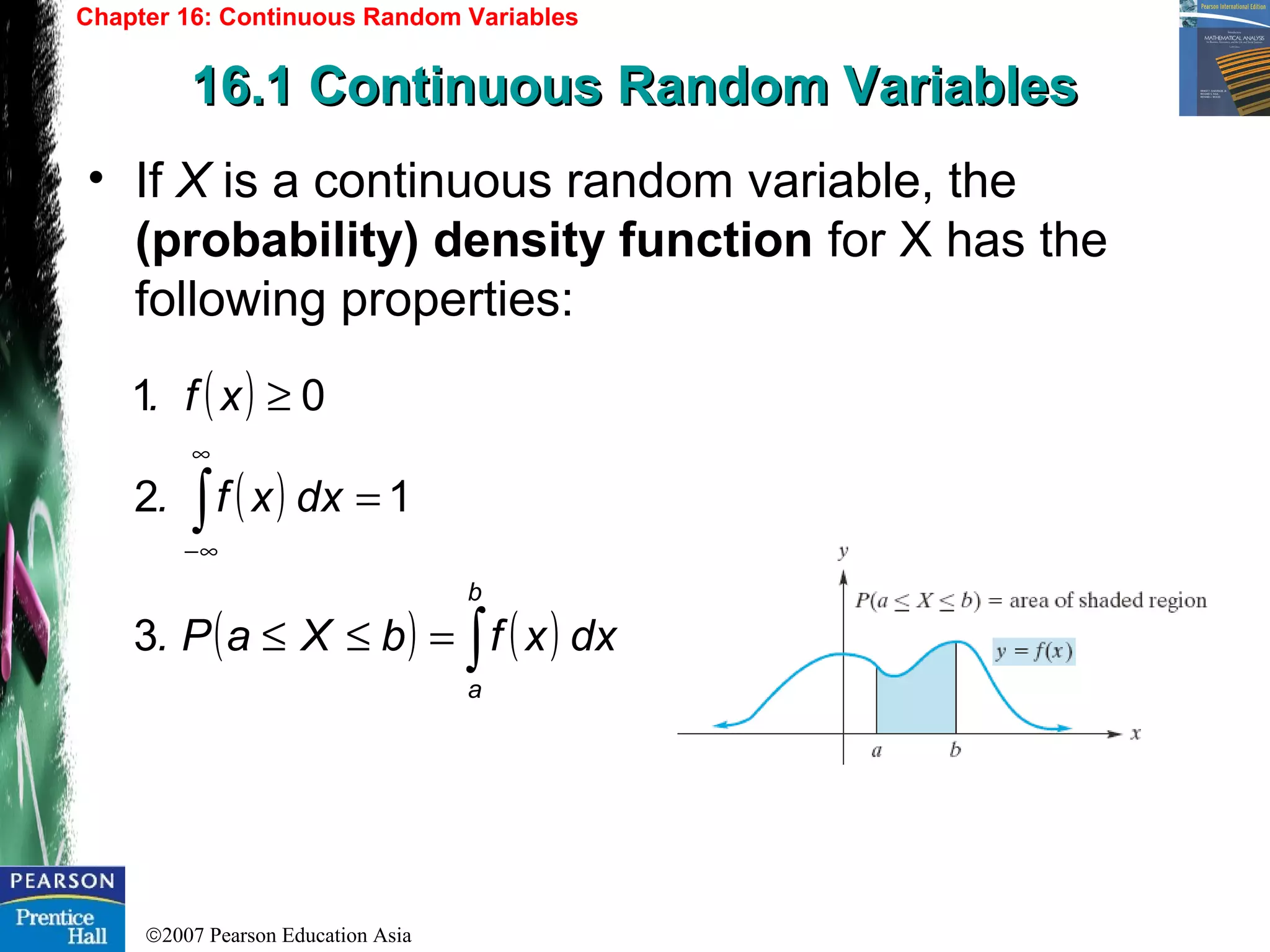
• If X is a continuous random variable, the
(probability) density function for X has the
following properties:
( )
( )
( ) ( )∫
∫
=≤≤
=
≥
∞
∞−
b
a
dxxfbXa. P
dxxf.
x. f
3
12
01
©2007 Pearson Education Asia
Chapter 16: Continuous Random Variables
16.1 Continuous Random Variables
Example 1 – Uniform Density Function
The uniform density function over [a, b] for the
random variable X is given by
Find P(2 < X < 3).
Solution: If [c, d] is any interval within [a, b] then
For a = 1, b = 4, c = 2, and d = 3,
( )




≤≤
−=
otherwise0
baif
1
x
abxf
( ) ( )
ab
cd
ab
x
dx
ab
dxxfdXcP
d
c
d
c
d
c
−
−
=
−
=
−
==≤≤ ∫∫
1
( )
3
1
14
23
32 =
−
−
=<< XP
©2007 Pearson Education Asia
Chapter 16: Continuous Random Variables
16.1 Continuous Random Variables
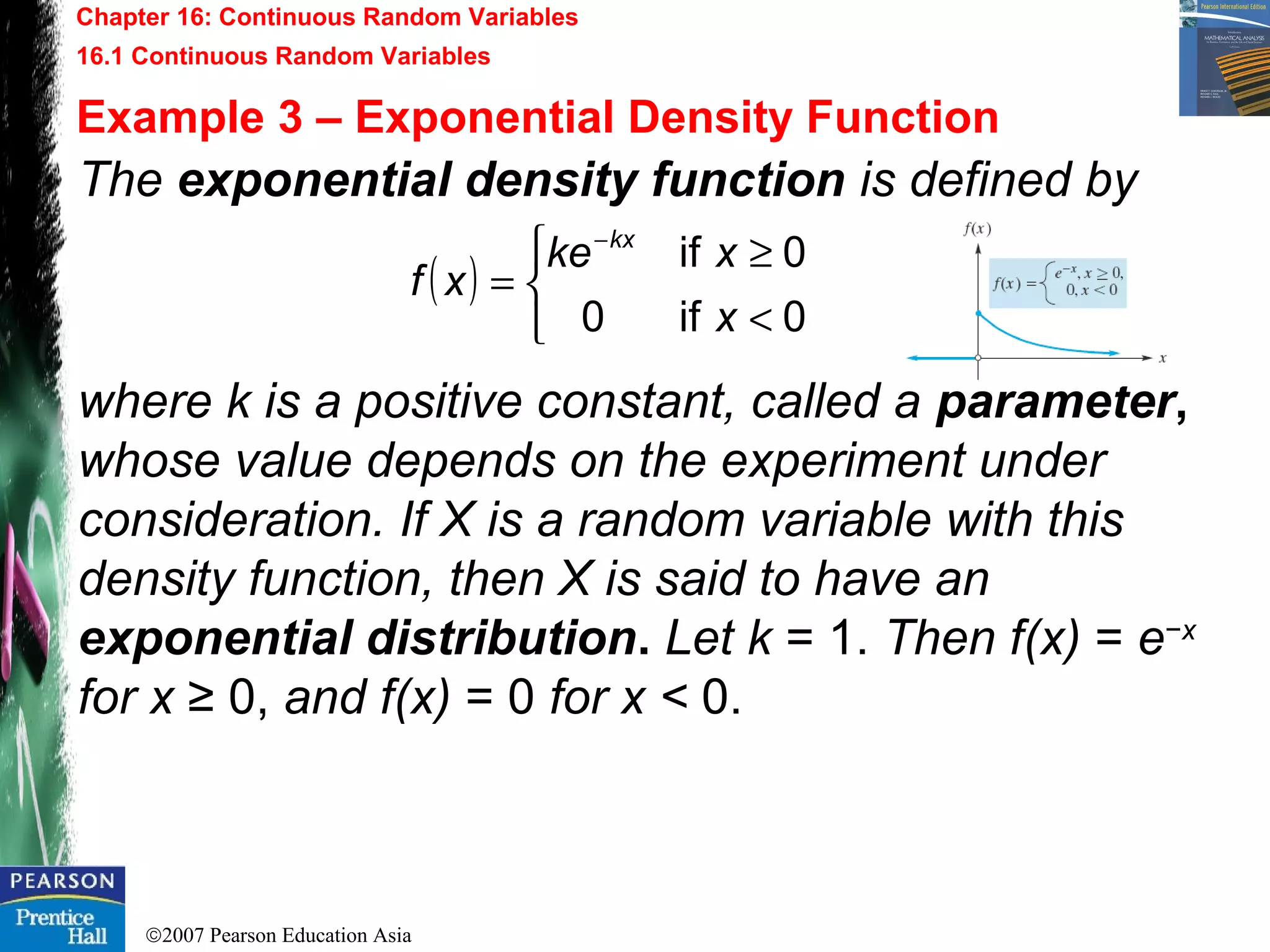
Example 3 – Exponential Density Function
The exponential density function is defined by
where k is a positive constant, called a parameter,
whose value depends on the experiment under
consideration. If X is a random variable with this
density function, then X is said to have an
exponential distribution. Let k = 1. Then f(x) = e−x
for x ≥ 0, and f(x) = 0 for x < 0.
( )



<
≥
=
−
0if0
0if
x
xke
xf
kx
©2007 Pearson Education Asia
Chapter 16: Continuous Random Variables
16.1 Continuous Random Variables
Example 3 – Exponential Density Function
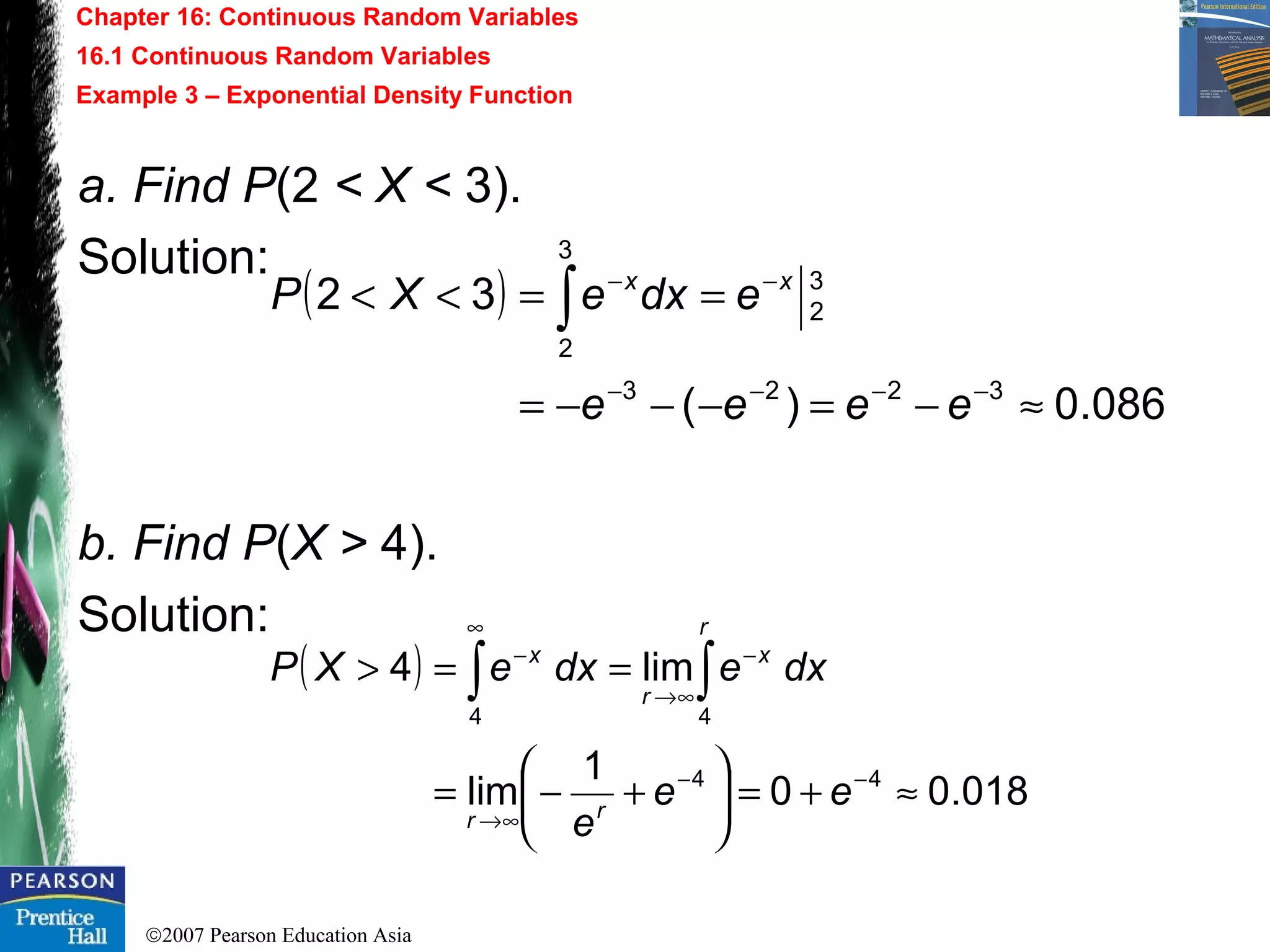
a. Find P(2 < X < 3).
Solution:
b. Find P(X > 4).
Solution:
( )
086.0)(
32
3223
3
2
3
2
≈−=−−−=
==<<
−−−−
−−
∫
eeee
edxeXP xx
( )
018.00
1
lim
lim4
44
44
≈+=





+−=
==>
−−
∞→
−
∞
∞→
−
∫∫
ee
e
dxedxeXP
rr
r
x
r
x
©2007 Pearson Education Asia
Chapter 16: Continuous Random Variables
16.1 Continuous Random Variables
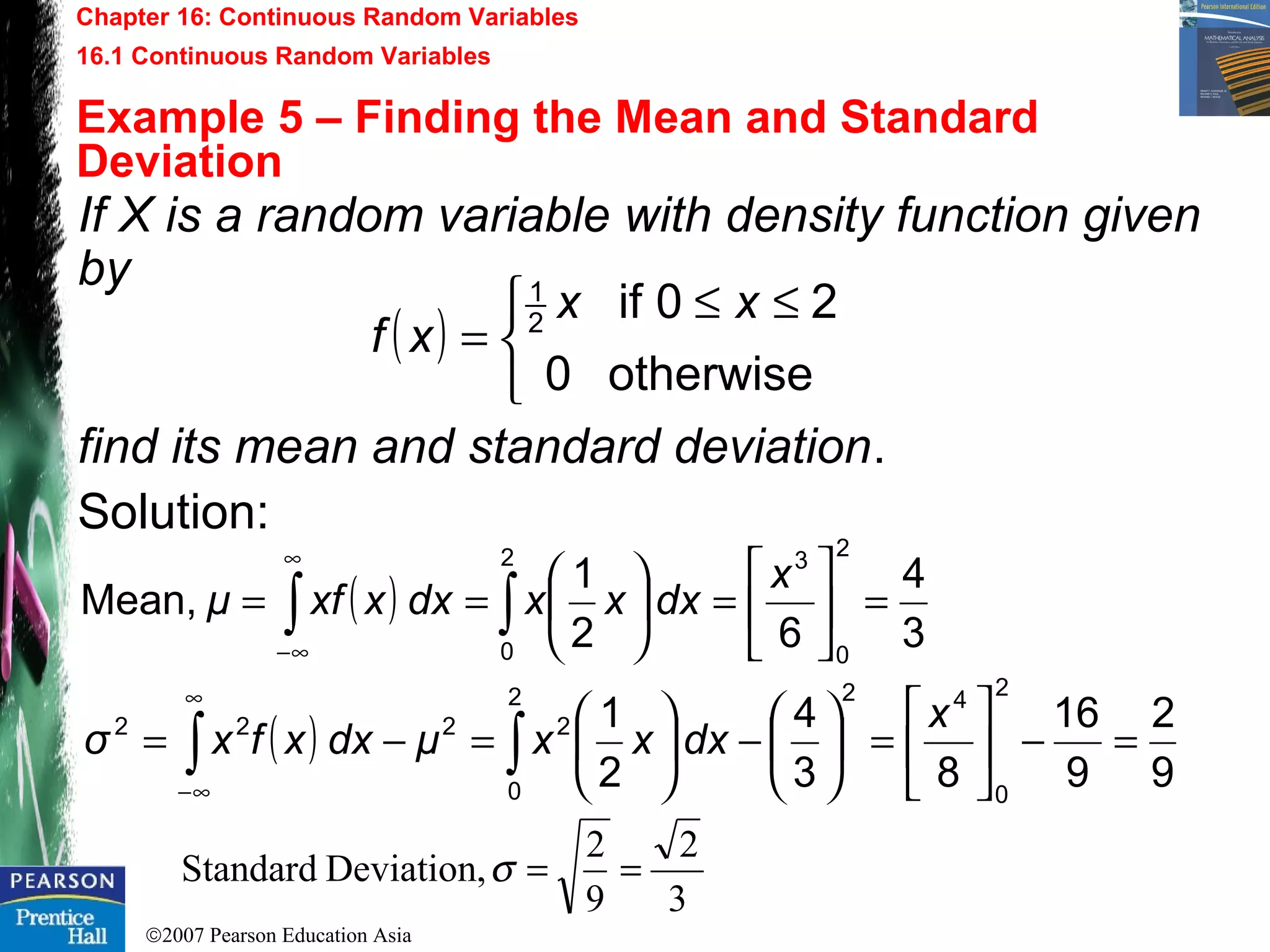
Example 5 – Finding the Mean and Standard
Deviation
If X is a random variable with density function given
by
find its mean and standard deviation.
Solution:
( )


 ≤≤
=
otherwise0
20if2
1
xx
xf
( )
3
4
62
1
Mean,
2
0
32
0
=





=





== ∫∫
∞
∞−
x
dxxxdxxxfμ
( )
9
2
9
16
83
4
2
1
2
0
422
0
2222
=−





=





−





=−= ∫∫
∞
∞−
x
dxxxμdxxfxσ
3
2
9
2
Deviation,Standard ==σ
©2007 Pearson Education Asia
Chapter 16: Continuous Random Variables
16.2 The Normal Distribution16.2 The Normal Distribution
• Continuous random variable X has a normal distribution if
its density function is given by
called the normal density function.
• Continuous random variable Z has a standard normal
distribution if its density function is given by
called the standard normal density function.
( ) ( ) ( )[ ]
∞<<∞−= −−
xe
πσ
xf σμx
2
1 2
/2/1
( ) 2/2
2
1 z
e
πσ
zf −
=
©2007 Pearson Education Asia
Chapter 16: Continuous Random Variables
16.2 The Normal Distribution
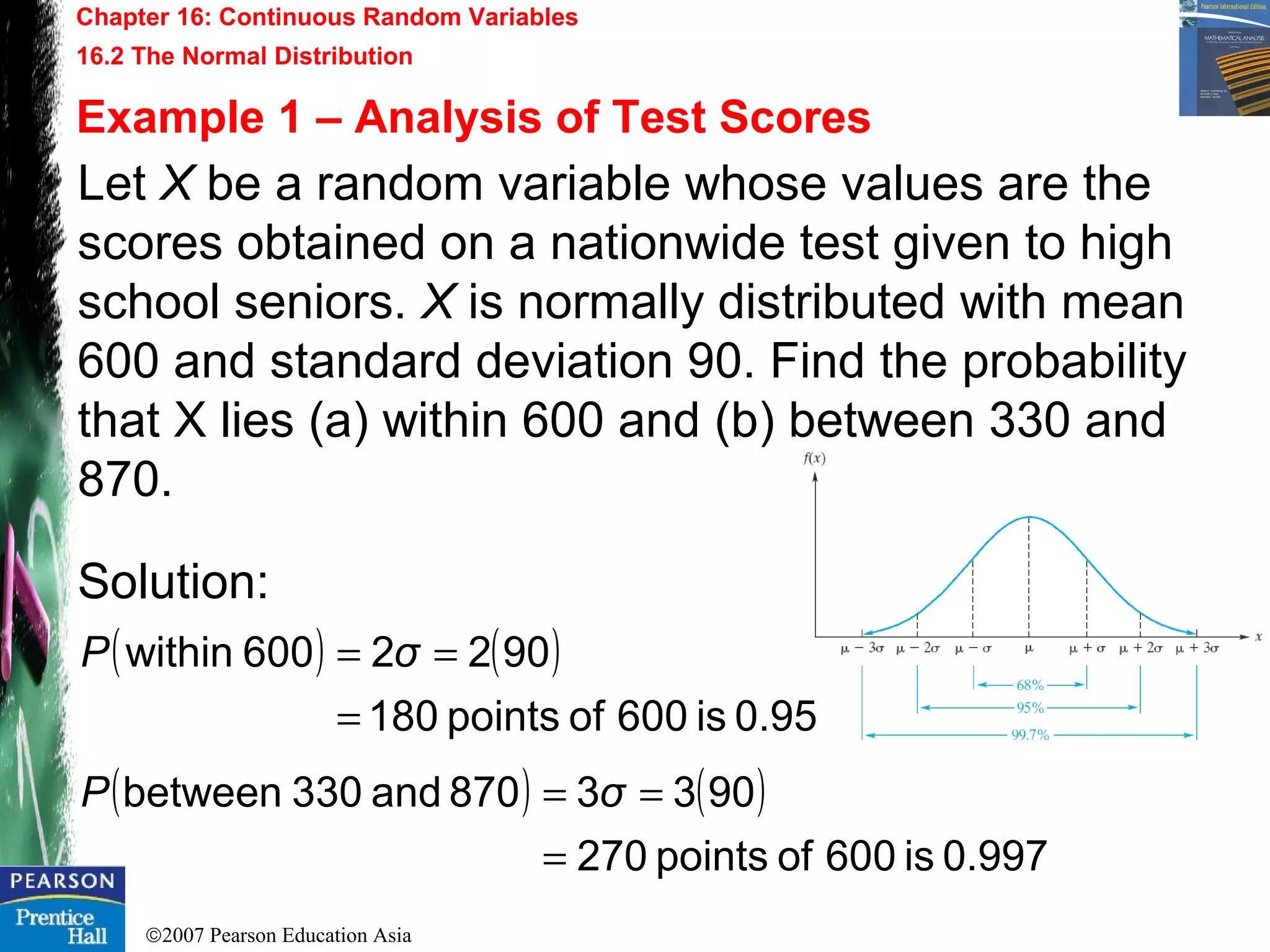
Example 1 – Analysis of Test Scores
Let X be a random variable whose values are the
scores obtained on a nationwide test given to high
school seniors. X is normally distributed with mean
600 and standard deviation 90. Find the probability
that X lies (a) within 600 and (b) between 330 and
870.
Solution:
( ) ( )
0.95is600ofpoints180
9022600within
=
== σP
( ) ( )
0.997is600ofpoints270
9033870and330between
=
== σP
©2007 Pearson Education Asia
Chapter 16: Continuous Random Variables
16.2 The Normal Distribution
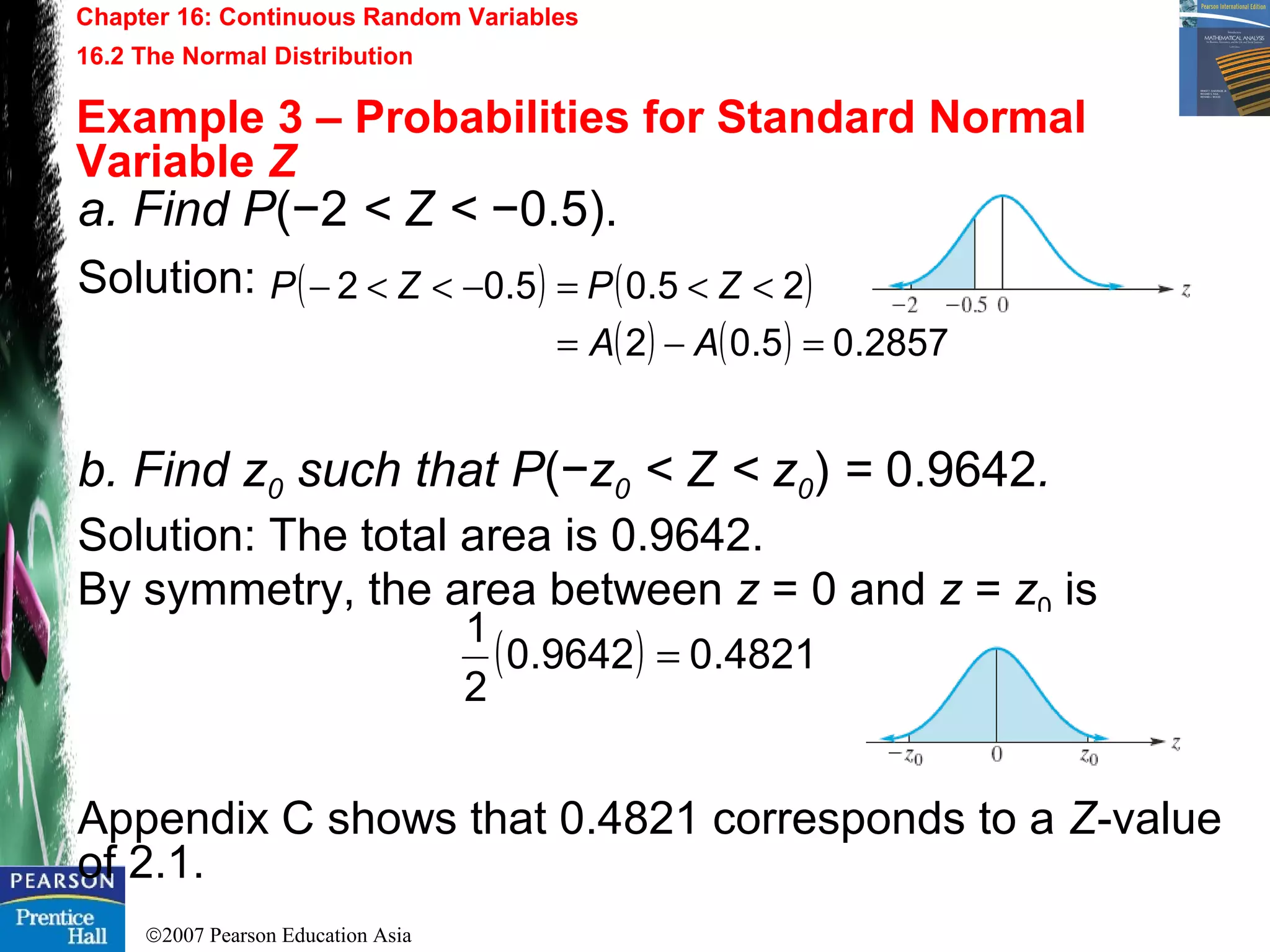
Example 3 – Probabilities for Standard Normal
Variable Z
a. Find P(−2 < Z < −0.5).
Solution:
b. Find z0 such that P(−z0 < Z < z0) = 0.9642.
Solution: The total area is 0.9642.
By symmetry, the area between z = 0 and z = z0 is
Appendix C shows that 0.4821 corresponds to a Z-value
of 2.1.
( ) ( )
( ) ( ) 2857.05.02
25.05.02
=−=
<<=−<<−
AA
ZPZP
( ) 4821.09642.0
2
1
=
©2007 Pearson Education Asia
Chapter 16: Continuous Random Variables
16.3 The Normal Approximation to the16.3 The Normal Approximation to the
Binomial DistributionBinomial Distribution
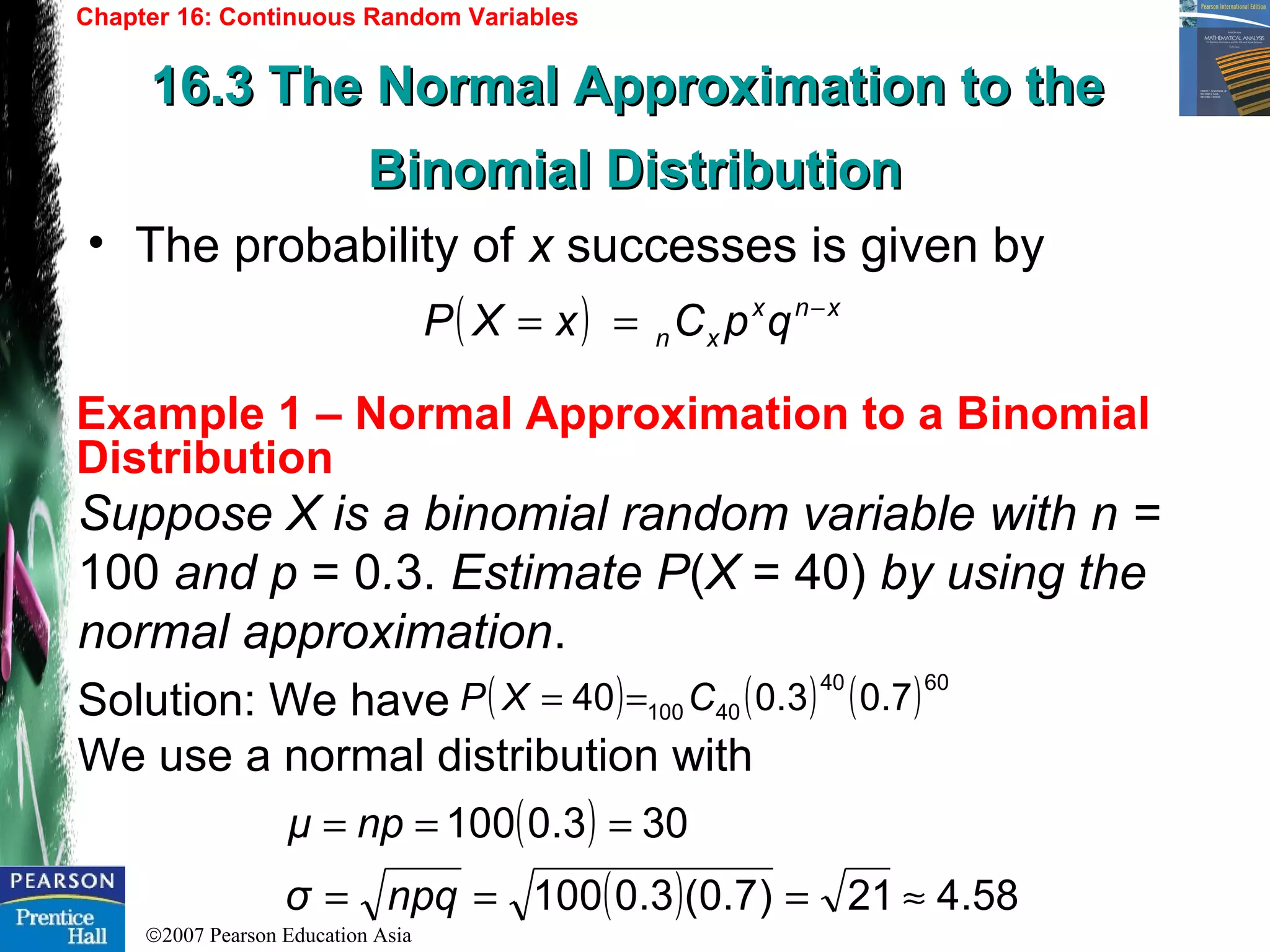
Example 1 – Normal Approximation to a Binomial
Distribution
• The probability of x successes is given by
( ) xnx
xn qpCxXP −
==
Suppose X is a binomial random variable with n =
100 and p = 0.3. Estimate P(X = 40) by using the
normal approximation.
Solution: We have
We use a normal distribution with
( ) ( ) ( )6040
40100 7.03.040 CXP ==
( )
( ) 58.421)7.0(3.0100
303.0100
≈===
===
npqσ
npμ
©2007 Pearson Education Asia
Chapter 16: Continuous Random Variables
16.3 The Normal Approximation to the Binomial Distribution
Example 1 – Normal Approximation to a Binomial Distribution
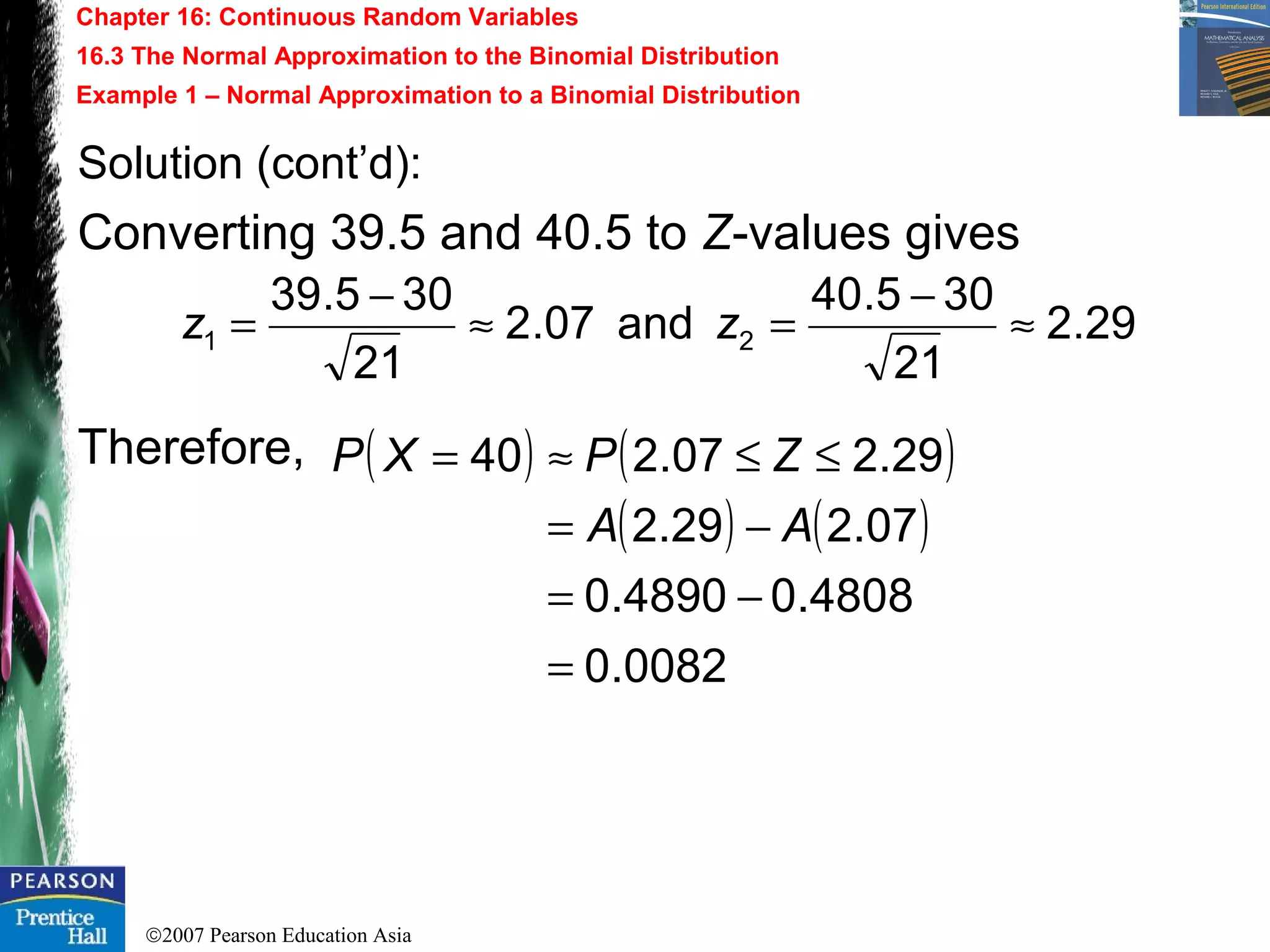
Solution (cont’d):
Converting 39.5 and 40.5 to Z-values gives
Therefore, ( ) ( )
( ) ( )
0082.0
4808.04890.0
07.229.2
29.207.240
=
−=
−=
≤≤≈=
AA
ZPXP
29.2
21
305.40
and07.2
21
305.39
21 ≈
−
=≈
−
= zz

Introductory maths analysis chapter 16 official

  • 1.
    INTRODUCTORY MATHEMATICALINTRODUCTORY MATHEMATICAL ANALYSISANALYSISForBusiness, Economics, and the Life and Social Sciences ©2007 Pearson Education Asia Chapter 16Chapter 16 Continuous Random VariablesContinuous Random Variables
  • 2.
    ©2007 Pearson EducationAsia INTRODUCTORY MATHEMATICAL ANALYSIS 0. Review of Algebra 1. Applications and More Algebra 2. Functions and Graphs 3. Lines, Parabolas, and Systems 4. Exponential and Logarithmic Functions 5. Mathematics of Finance 6. Matrix Algebra 7. Linear Programming 8. Introduction to Probability and Statistics
  • 3.
    ©2007 Pearson EducationAsia 9. Additional Topics in Probability 10. Limits and Continuity 11. Differentiation 12. Additional Differentiation Topics 13. Curve Sketching 14. Integration 15. Methods and Applications of Integration 16. Continuous Random Variables 17. Multivariable Calculus INTRODUCTORY MATHEMATICAL ANALYSIS
  • 4.
    ©2007 Pearson EducationAsia • To introduce continuous random variables and discuss density functions. • To discuss the normal distribution, standard units, and the table of areas under the standard normal curve. • To show the technique of estimating the binomial distribution by using normal distribution. Chapter 16: Continuous Random Variables Chapter ObjectivesChapter Objectives
  • 5.
    ©2007 Pearson EducationAsia Continuous Random Variables The Normal Distribution The Normal Approximation to the Binomial Distributi 16.1) 16.2) 16.3) Chapter 16: Continuous Random Variables Chapter OutlineChapter Outline
  • 6.
    ©2007 Pearson EducationAsia Chapter 16: Continuous Random Variables 16.1 Continuous Random Variables16.1 Continuous Random Variables • If X is a continuous random variable, the (probability) density function for X has the following properties: ( ) ( ) ( ) ( )∫ ∫ =≤≤ = ≥ ∞ ∞− b a dxxfbXa. P dxxf. x. f 3 12 01
  • 7.
    ©2007 Pearson EducationAsia Chapter 16: Continuous Random Variables 16.1 Continuous Random Variables Example 1 – Uniform Density Function The uniform density function over [a, b] for the random variable X is given by Find P(2 < X < 3). Solution: If [c, d] is any interval within [a, b] then For a = 1, b = 4, c = 2, and d = 3, ( )     ≤≤ −= otherwise0 baif 1 x abxf ( ) ( ) ab cd ab x dx ab dxxfdXcP d c d c d c − − = − = − ==≤≤ ∫∫ 1 ( ) 3 1 14 23 32 = − − =<< XP
  • 8.
    ©2007 Pearson EducationAsia Chapter 16: Continuous Random Variables 16.1 Continuous Random Variables Example 3 – Exponential Density Function The exponential density function is defined by where k is a positive constant, called a parameter, whose value depends on the experiment under consideration. If X is a random variable with this density function, then X is said to have an exponential distribution. Let k = 1. Then f(x) = e−x for x ≥ 0, and f(x) = 0 for x < 0. ( )    < ≥ = − 0if0 0if x xke xf kx
  • 9.
    ©2007 Pearson EducationAsia Chapter 16: Continuous Random Variables 16.1 Continuous Random Variables Example 3 – Exponential Density Function a. Find P(2 < X < 3). Solution: b. Find P(X > 4). Solution: ( ) 086.0)( 32 3223 3 2 3 2 ≈−=−−−= ==<< −−−− −− ∫ eeee edxeXP xx ( ) 018.00 1 lim lim4 44 44 ≈+=      +−= ==> −− ∞→ − ∞ ∞→ − ∫∫ ee e dxedxeXP rr r x r x
  • 10.
    ©2007 Pearson EducationAsia Chapter 16: Continuous Random Variables 16.1 Continuous Random Variables Example 5 – Finding the Mean and Standard Deviation If X is a random variable with density function given by find its mean and standard deviation. Solution: ( )    ≤≤ = otherwise0 20if2 1 xx xf ( ) 3 4 62 1 Mean, 2 0 32 0 =      =      == ∫∫ ∞ ∞− x dxxxdxxxfμ ( ) 9 2 9 16 83 4 2 1 2 0 422 0 2222 =−      =      −      =−= ∫∫ ∞ ∞− x dxxxμdxxfxσ 3 2 9 2 Deviation,Standard ==σ
  • 11.
    ©2007 Pearson EducationAsia Chapter 16: Continuous Random Variables 16.2 The Normal Distribution16.2 The Normal Distribution • Continuous random variable X has a normal distribution if its density function is given by called the normal density function. • Continuous random variable Z has a standard normal distribution if its density function is given by called the standard normal density function. ( ) ( ) ( )[ ] ∞<<∞−= −− xe πσ xf σμx 2 1 2 /2/1 ( ) 2/2 2 1 z e πσ zf − =
  • 12.
    ©2007 Pearson EducationAsia Chapter 16: Continuous Random Variables 16.2 The Normal Distribution Example 1 – Analysis of Test Scores Let X be a random variable whose values are the scores obtained on a nationwide test given to high school seniors. X is normally distributed with mean 600 and standard deviation 90. Find the probability that X lies (a) within 600 and (b) between 330 and 870. Solution: ( ) ( ) 0.95is600ofpoints180 9022600within = == σP ( ) ( ) 0.997is600ofpoints270 9033870and330between = == σP
  • 13.
    ©2007 Pearson EducationAsia Chapter 16: Continuous Random Variables 16.2 The Normal Distribution Example 3 – Probabilities for Standard Normal Variable Z a. Find P(−2 < Z < −0.5). Solution: b. Find z0 such that P(−z0 < Z < z0) = 0.9642. Solution: The total area is 0.9642. By symmetry, the area between z = 0 and z = z0 is Appendix C shows that 0.4821 corresponds to a Z-value of 2.1. ( ) ( ) ( ) ( ) 2857.05.02 25.05.02 =−= <<=−<<− AA ZPZP ( ) 4821.09642.0 2 1 =
  • 14.
    ©2007 Pearson EducationAsia Chapter 16: Continuous Random Variables 16.3 The Normal Approximation to the16.3 The Normal Approximation to the Binomial DistributionBinomial Distribution Example 1 – Normal Approximation to a Binomial Distribution • The probability of x successes is given by ( ) xnx xn qpCxXP − == Suppose X is a binomial random variable with n = 100 and p = 0.3. Estimate P(X = 40) by using the normal approximation. Solution: We have We use a normal distribution with ( ) ( ) ( )6040 40100 7.03.040 CXP == ( ) ( ) 58.421)7.0(3.0100 303.0100 ≈=== === npqσ npμ
  • 15.
    ©2007 Pearson EducationAsia Chapter 16: Continuous Random Variables 16.3 The Normal Approximation to the Binomial Distribution Example 1 – Normal Approximation to a Binomial Distribution Solution (cont’d): Converting 39.5 and 40.5 to Z-values gives Therefore, ( ) ( ) ( ) ( ) 0082.0 4808.04890.0 07.229.2 29.207.240 = −= −= ≤≤≈= AA ZPXP 29.2 21 305.40 and07.2 21 305.39 21 ≈ − =≈ − = zz