Gene knockout 
A gene knockout (abbreviation: KO) is a genetic technique in which an organism is 
engineered to carry genes that have been made inoperative (have been "knocked out" of 
the organism). Also known as knockout organisms or simply knockouts, they are used 
in learning about a gene that has been sequenced, but which has an unknown or 
incompletely known function. Researchers draw inferences from the difference between 
the knockout organism and normal individuals. 
The term also refers to the process of creating such an organism, as in "knocking 
out" a gene. The technique is essentially the opposite of a Gene Knock-in. 
Knockout is often abbreviated as KO. Knocking out two genes simultaneously 
in an organism is known as a double knockout (DKO). Similarly the terms triple 
knockout (TKO) and quadruple knockouts (QKO) are used to describe 3 or 4 
knocked out genes, respectively. 
Method 
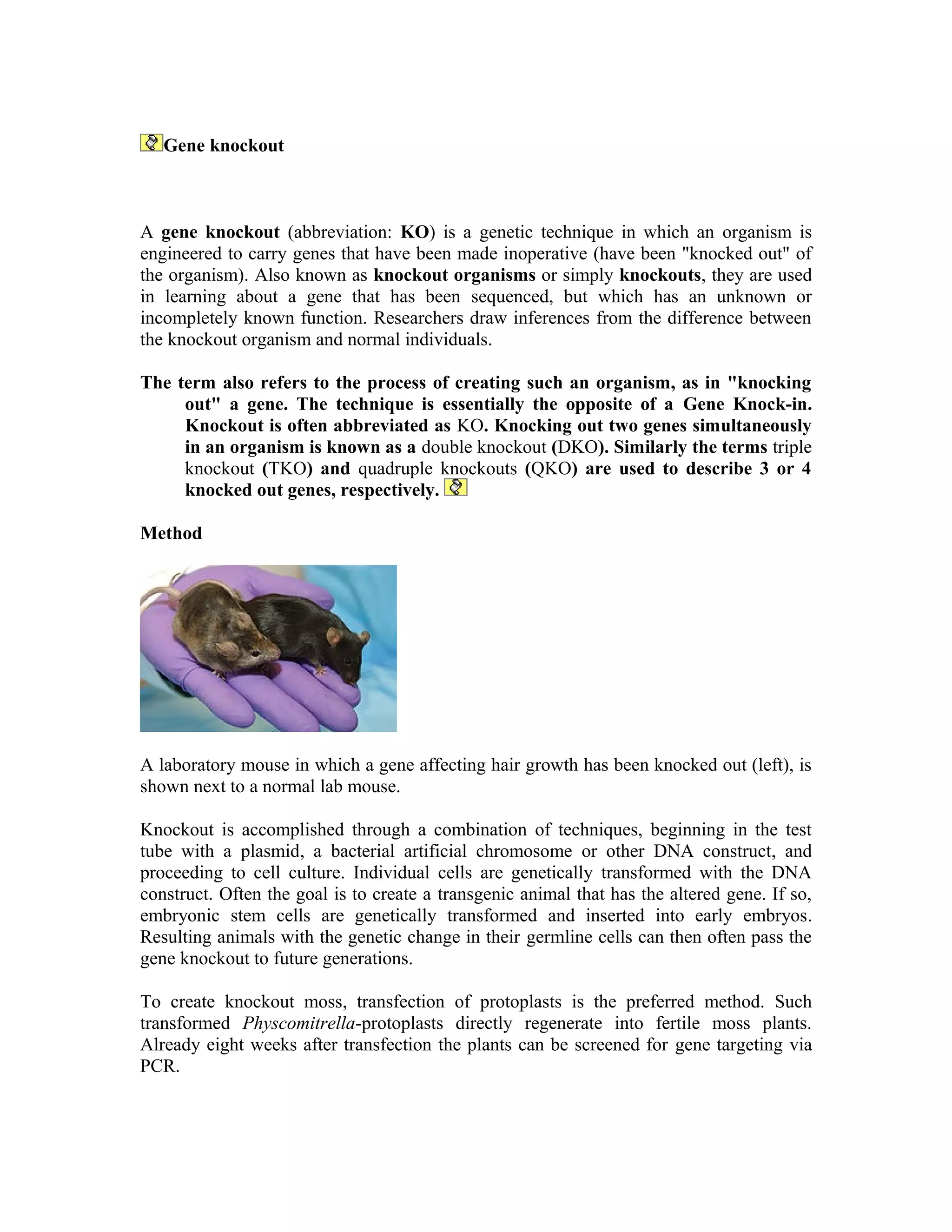
A laboratory mouse in which a gene affecting hair growth has been knocked out (left), is 
shown next to a normal lab mouse. 
Knockout is accomplished through a combination of techniques, beginning in the test 
tube with a plasmid, a bacterial artificial chromosome or other DNA construct, and 
proceeding to cell culture. Individual cells are genetically transformed with the DNA 
construct. Often the goal is to create a transgenic animal that has the altered gene. If so, 
embryonic stem cells are genetically transformed and inserted into early embryos. 
Resulting animals with the genetic change in their germline cells can then often pass the 
gene knockout to future generations. 
To create knockout moss, transfection of protoplasts is the preferred method. Such 
transformed Physcomitrella-protoplasts directly regenerate into fertile moss plants. 
Already eight weeks after transfection the plants can be screened for gene targeting via 
PCR.
Wild-type Physcomitrella and knockout-mosses: Deviating phenotypes induced in gene-disruption 
library transformants. Physcomitrella wild-type and transformed plants were 
grown on minimal Knop medium to induce differentiation and development of 
gametophores. For each plant, an overview (upper row, scale bar corresponds to 1 mm) 
and a close-up (bottom row, scale bar equals 0.5 mm) is shown. A, Haploid wild-type 
moss plant completely covered with leafy gametophores and close-up of wild-type leaf. 
B-D, Different Mutants.[2] 
The construct is engineered to recombine with the target gene, which is accomplished by 
incorporating sequences from the gene itself into the construct. Recombination then 
occurs in the region of that sequence within the gene, resulting in the insertion of a 
foreign sequence to disrupt the gene. With its sequence interrupted, the altered gene in 
most cases will be translated into a nonfunctional protein, if it is translated at all. 
A knockout mouse (left) that is a model of obesity, compared with a normal mouse. 
A conditional knockout allows gene deletion in a tissue or time specific manner. This is 
done by introducing short sequences called loxP sites around the gene. These sequences 
will be introduced into the germ-line via the same mechanism as a knock-in. This germ-line 
can then be crossed to another germline containing Cre-recombinase which is a 
bacterial enzyme that can recognize these sequences, recombines them and deletes the 
gene flanked by these sites. 
Because the desired type of DNA recombination is a rare event in the case of most cells 
and most constructs, the foreign sequence chosen for insertion usually includes a reporter. 
This enables easy selection of cells or individuals in which knockout was successful. 
Sometimes the DNA construct inserts into a chromosome without the desired 
homologous recombination with the target gene. To eliminate such cells, the DNA 
construct often contains a second region of DNA that allows such cells to be identified 
and discarded. 
In diploid organisms, which contain two alleles for most genes, and may as well contain 
several related genes that collaborate in the same role, additional rounds of 
transformation and selection are performed until every targeted gene is knocked out. 
Selective breeding may be required to produce homozygous knockout animals.
Knock-in is similar to knock-out, but instead it replaces a gene with another instead of 
deleting it.

Gene knockout

  • 1.
    Gene knockout Agene knockout (abbreviation: KO) is a genetic technique in which an organism is engineered to carry genes that have been made inoperative (have been "knocked out" of the organism). Also known as knockout organisms or simply knockouts, they are used in learning about a gene that has been sequenced, but which has an unknown or incompletely known function. Researchers draw inferences from the difference between the knockout organism and normal individuals. The term also refers to the process of creating such an organism, as in "knocking out" a gene. The technique is essentially the opposite of a Gene Knock-in. Knockout is often abbreviated as KO. Knocking out two genes simultaneously in an organism is known as a double knockout (DKO). Similarly the terms triple knockout (TKO) and quadruple knockouts (QKO) are used to describe 3 or 4 knocked out genes, respectively. Method A laboratory mouse in which a gene affecting hair growth has been knocked out (left), is shown next to a normal lab mouse. Knockout is accomplished through a combination of techniques, beginning in the test tube with a plasmid, a bacterial artificial chromosome or other DNA construct, and proceeding to cell culture. Individual cells are genetically transformed with the DNA construct. Often the goal is to create a transgenic animal that has the altered gene. If so, embryonic stem cells are genetically transformed and inserted into early embryos. Resulting animals with the genetic change in their germline cells can then often pass the gene knockout to future generations. To create knockout moss, transfection of protoplasts is the preferred method. Such transformed Physcomitrella-protoplasts directly regenerate into fertile moss plants. Already eight weeks after transfection the plants can be screened for gene targeting via PCR.
  • 2.
    Wild-type Physcomitrella andknockout-mosses: Deviating phenotypes induced in gene-disruption library transformants. Physcomitrella wild-type and transformed plants were grown on minimal Knop medium to induce differentiation and development of gametophores. For each plant, an overview (upper row, scale bar corresponds to 1 mm) and a close-up (bottom row, scale bar equals 0.5 mm) is shown. A, Haploid wild-type moss plant completely covered with leafy gametophores and close-up of wild-type leaf. B-D, Different Mutants.[2] The construct is engineered to recombine with the target gene, which is accomplished by incorporating sequences from the gene itself into the construct. Recombination then occurs in the region of that sequence within the gene, resulting in the insertion of a foreign sequence to disrupt the gene. With its sequence interrupted, the altered gene in most cases will be translated into a nonfunctional protein, if it is translated at all. A knockout mouse (left) that is a model of obesity, compared with a normal mouse. A conditional knockout allows gene deletion in a tissue or time specific manner. This is done by introducing short sequences called loxP sites around the gene. These sequences will be introduced into the germ-line via the same mechanism as a knock-in. This germ-line can then be crossed to another germline containing Cre-recombinase which is a bacterial enzyme that can recognize these sequences, recombines them and deletes the gene flanked by these sites. Because the desired type of DNA recombination is a rare event in the case of most cells and most constructs, the foreign sequence chosen for insertion usually includes a reporter. This enables easy selection of cells or individuals in which knockout was successful. Sometimes the DNA construct inserts into a chromosome without the desired homologous recombination with the target gene. To eliminate such cells, the DNA construct often contains a second region of DNA that allows such cells to be identified and discarded. In diploid organisms, which contain two alleles for most genes, and may as well contain several related genes that collaborate in the same role, additional rounds of transformation and selection are performed until every targeted gene is knocked out. Selective breeding may be required to produce homozygous knockout animals.
  • 3.
    Knock-in is similarto knock-out, but instead it replaces a gene with another instead of deleting it.