ISOLATION OF mRNA
MADE BY- SARAH HAMID
M.Sc BIOTECHNOLOGY
PG Y-1
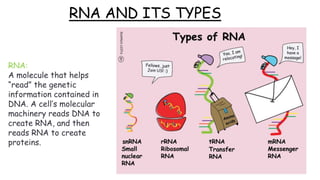
RNA AND ITS TYPES
RNA:
A molecule that helps
“read” the genetic
information contained in
DNA. A cell’s molecular
machinery reads DNA to
create RNA, and then
reads RNA to create
proteins.
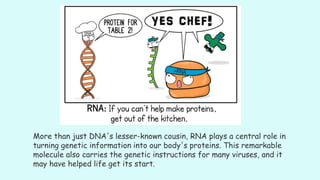
More than just DNA's lesser-known cousin, RNA plays a central role in
turning genetic information into our body's proteins. This remarkable
molecule also carries the genetic instructions for many viruses, and it
may have helped life get its start.
WHAT IS mRNA?
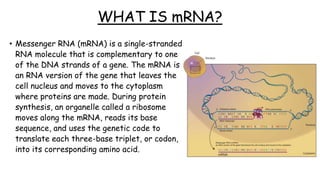
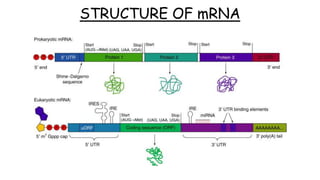
• Messenger RNA (mRNA) is a single-stranded
RNA molecule that is complementary to one
of the DNA strands of a gene. The mRNA is
an RNA version of the gene that leaves the
cell nucleus and moves to the cytoplasm
where proteins are made. During protein
synthesis, an organelle called a ribosome
moves along the mRNA, reads its base
sequence, and uses the genetic code to
translate each three-base triplet, or codon,
into its corresponding amino acid.
STRUCTURE OF mRNA
WHAT IS RNA ISOLATION?
RNA isolation is the extraction of RNA from biological samples. This
procedure is complicated by the ubiquitous presence of ribonuclease
enzymes in cells and tissues, which can rapidly degrade RNA.
PRINCIPLE OF mRNA ISOLATION
Total RNA is isolated and separated from DNA and protein after
extraction with a solution called as Trizol. Trizol is an acidic solution
containing guanidinium thiocyanate (GITC), phenol and chloroform.
GITC irreversibly denatures proteins and RNases. This is followed by
centrifugation. Under acidic conditions, total RNA remains in the
upper aqueous phase, while most of DNA and proteins remain either in
the interphase or in the lower organic phase. Total RNA is then
recovered by precipitation with isopropanol. RNase enzymes can be
inactivated by including diethyl pyrrocarbonate (DEPC).
METHOD OF RNA ISOLATION
1. Take 800 μL of bacterial culture in a fresh eppendorf.
2.To this add 160 μL of Trizol (1/5th of culture volume).
3.The solution was mixed well by pipetting several times.
4.To this add 32 μl of chloroform (1/5th volume of trizol).
5.Incubate for 2 to 5 minutes and centrifuge at 12000 rpm for 15 minutes at 4° C
6.Transfer the aqueous phase into a new tube and add equal volume of isopropanol. Mix well.
7.Centrifuge at 10000 rpm for 10 minutes at 4° C.
8.Discard the supernatant and resuspend the pellet in 70% ethanol. • Again centrifuge at 10000
rpm for 10 minutes at 4° C.
9.Discard the supernatant.
10.Air dry the pellet at 37° C for 10-15 minutes.
11.Resuspend the pellet in 50 μL of TE buffer.
12.Analyse the RNA sample quantitatively and qualitatively.
WHY DO mRNA ISOLATION?
1) In scientific research and industry there are several scenarios
in which mRNA extraction is needed.
2) The amount of mRNA in the cell provides crucial information
about what information (genes) is being processed and at what
amounts.
3) This translates understanding what genes are being turned into
which proteins to what process is occurring in the body that is
causing this mRNA to be present. Understanding mRNA also
provides insight into what splicing events are taking place.
4) To detect or quantify very rare mRNAs, make probes for
microarrays or construct libraries of complementary DNA
molecules, mRNA must be isolated.
mRNA ISOLATION PROTOCOL
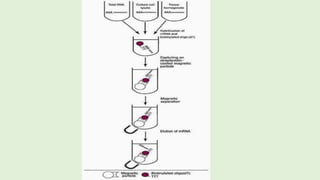
• OPTION 1
1.You incubate your total RNA sample with biotin linked oligo-dT chains first.
2.Your magnetic beads are pre-conjugated (or pre-coated) with streptavidin.
3.Incubate your RNA bound to oligo-dT-biotin with your magnetic beads.
4.Put your sample on a magnetic separator, and remove all RNA in solution not
bound to magnetic beads.
• OPTION 2
1.Magnetic beads are pre-conjugated with oligo-dT.
2.RNA sample is mixed with magnetic beads, mRNA binds specifically to oligo-
dT.
3.Sample is put on a magnetic separator to hold magnetic beads in place bound
to mRNA, the rest of the solution with unwanted RNA is washed away.
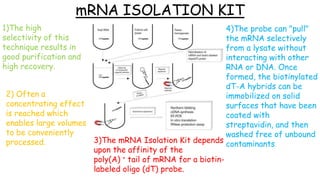
mRNA ISOLATION KIT
1)The high
selectivity of this
technique results in
good purification and
high recovery.
4)The probe can "pull"
the mRNA selectively
from a lysate without
interacting with other
RNA or DNA. Once
formed, the biotinylated
dT-A hybrids can be
immobilized on solid
surfaces that have been
coated with
streptavidin, and then
washed free of unbound
contaminants.
3)The mRNA Isolation Kit depends
upon the affinity of the
poly(A) + tail of mRNA for a biotin-
labeled oligo (dT) probe.
2) Often a
concentrating effect
is reached which
enables large volumes
to be conveniently
processed.
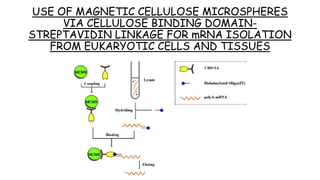
USE OF MAGNETIC CELLULOSE MICROSPHERES
VIA CELLULOSE BINDING DOMAIN-
STREPTAVIDIN LINKAGE FOR mRNA ISOLATION
FROM EUKARYOTIC CELLS AND TISSUES
APPLICATIONS
The mRNA Isolation Kit prepares highly purified poly (A) + RNA which may be
used directly in many molecular biology applications:
• RT-PCR
• cDNA synthesis
• Northern blotting
• Northern ELISA
• RNase protection assay
• In vitro translation
CONCLUSION
• mRNA extraction is important to research and industry
settings.
• In research, mRNA offers important insight into what
proteins are being translated or how much transcript is
being produced by the cell.
• Synthetic mRNA production requires a purification step to
get the final mRNA product out of the solution in which it
was transcribed.
REFERENCES
• https://www.sepmag.eu/blog/mrna-extraction
• https://www.amoebasisters.com/parameciumparlorcomics
• https://www.sigmaaldrich.com
• http://www.cyto.purdue.edu/cdroms/cyto6/content/primer/molegen
.htm
• https://microbenotes.com/rna-isolation-protocol/
• https://www.researchgate.net/
mRNA Isolation

mRNA Isolation

  • 1.
    ISOLATION OF mRNA MADEBY- SARAH HAMID M.Sc BIOTECHNOLOGY PG Y-1
  • 2.
    RNA AND ITSTYPES RNA: A molecule that helps “read” the genetic information contained in DNA. A cell’s molecular machinery reads DNA to create RNA, and then reads RNA to create proteins.
  • 3.
    More than justDNA's lesser-known cousin, RNA plays a central role in turning genetic information into our body's proteins. This remarkable molecule also carries the genetic instructions for many viruses, and it may have helped life get its start.
  • 4.
    WHAT IS mRNA? •Messenger RNA (mRNA) is a single-stranded RNA molecule that is complementary to one of the DNA strands of a gene. The mRNA is an RNA version of the gene that leaves the cell nucleus and moves to the cytoplasm where proteins are made. During protein synthesis, an organelle called a ribosome moves along the mRNA, reads its base sequence, and uses the genetic code to translate each three-base triplet, or codon, into its corresponding amino acid.
  • 5.
  • 6.
    WHAT IS RNAISOLATION? RNA isolation is the extraction of RNA from biological samples. This procedure is complicated by the ubiquitous presence of ribonuclease enzymes in cells and tissues, which can rapidly degrade RNA. PRINCIPLE OF mRNA ISOLATION Total RNA is isolated and separated from DNA and protein after extraction with a solution called as Trizol. Trizol is an acidic solution containing guanidinium thiocyanate (GITC), phenol and chloroform. GITC irreversibly denatures proteins and RNases. This is followed by centrifugation. Under acidic conditions, total RNA remains in the upper aqueous phase, while most of DNA and proteins remain either in the interphase or in the lower organic phase. Total RNA is then recovered by precipitation with isopropanol. RNase enzymes can be inactivated by including diethyl pyrrocarbonate (DEPC).
  • 7.
    METHOD OF RNAISOLATION 1. Take 800 μL of bacterial culture in a fresh eppendorf. 2.To this add 160 μL of Trizol (1/5th of culture volume). 3.The solution was mixed well by pipetting several times. 4.To this add 32 μl of chloroform (1/5th volume of trizol). 5.Incubate for 2 to 5 minutes and centrifuge at 12000 rpm for 15 minutes at 4° C 6.Transfer the aqueous phase into a new tube and add equal volume of isopropanol. Mix well. 7.Centrifuge at 10000 rpm for 10 minutes at 4° C. 8.Discard the supernatant and resuspend the pellet in 70% ethanol. • Again centrifuge at 10000 rpm for 10 minutes at 4° C. 9.Discard the supernatant. 10.Air dry the pellet at 37° C for 10-15 minutes. 11.Resuspend the pellet in 50 μL of TE buffer. 12.Analyse the RNA sample quantitatively and qualitatively.
  • 8.
    WHY DO mRNAISOLATION? 1) In scientific research and industry there are several scenarios in which mRNA extraction is needed. 2) The amount of mRNA in the cell provides crucial information about what information (genes) is being processed and at what amounts. 3) This translates understanding what genes are being turned into which proteins to what process is occurring in the body that is causing this mRNA to be present. Understanding mRNA also provides insight into what splicing events are taking place. 4) To detect or quantify very rare mRNAs, make probes for microarrays or construct libraries of complementary DNA molecules, mRNA must be isolated.
  • 9.
    mRNA ISOLATION PROTOCOL •OPTION 1 1.You incubate your total RNA sample with biotin linked oligo-dT chains first. 2.Your magnetic beads are pre-conjugated (or pre-coated) with streptavidin. 3.Incubate your RNA bound to oligo-dT-biotin with your magnetic beads. 4.Put your sample on a magnetic separator, and remove all RNA in solution not bound to magnetic beads. • OPTION 2 1.Magnetic beads are pre-conjugated with oligo-dT. 2.RNA sample is mixed with magnetic beads, mRNA binds specifically to oligo- dT. 3.Sample is put on a magnetic separator to hold magnetic beads in place bound to mRNA, the rest of the solution with unwanted RNA is washed away.
  • 11.
    mRNA ISOLATION KIT 1)Thehigh selectivity of this technique results in good purification and high recovery. 4)The probe can "pull" the mRNA selectively from a lysate without interacting with other RNA or DNA. Once formed, the biotinylated dT-A hybrids can be immobilized on solid surfaces that have been coated with streptavidin, and then washed free of unbound contaminants. 3)The mRNA Isolation Kit depends upon the affinity of the poly(A) + tail of mRNA for a biotin- labeled oligo (dT) probe. 2) Often a concentrating effect is reached which enables large volumes to be conveniently processed.
  • 12.
    USE OF MAGNETICCELLULOSE MICROSPHERES VIA CELLULOSE BINDING DOMAIN- STREPTAVIDIN LINKAGE FOR mRNA ISOLATION FROM EUKARYOTIC CELLS AND TISSUES
  • 13.
    APPLICATIONS The mRNA IsolationKit prepares highly purified poly (A) + RNA which may be used directly in many molecular biology applications: • RT-PCR • cDNA synthesis • Northern blotting • Northern ELISA • RNase protection assay • In vitro translation
  • 14.
    CONCLUSION • mRNA extractionis important to research and industry settings. • In research, mRNA offers important insight into what proteins are being translated or how much transcript is being produced by the cell. • Synthetic mRNA production requires a purification step to get the final mRNA product out of the solution in which it was transcribed.
  • 15.
    REFERENCES • https://www.sepmag.eu/blog/mrna-extraction • https://www.amoebasisters.com/parameciumparlorcomics •https://www.sigmaaldrich.com • http://www.cyto.purdue.edu/cdroms/cyto6/content/primer/molegen .htm • https://microbenotes.com/rna-isolation-protocol/ • https://www.researchgate.net/