DONE BY:
SHRUTHI K (18308019)
1st M.Sc MICROBIOLOGY
PONDICHERRY UNIVERSITY
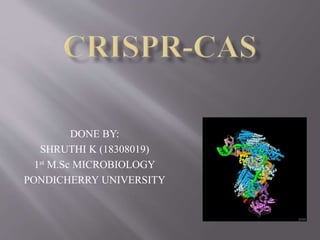
WHAT IS CRISPR CAS ?
 Clustered Regularly Insterspaced Short Palindromic Repeats
(CRISPR) are short segments of prokaryotic DNA that contain
repititive base sequences. Spacer- DNA of viral proteins
 The protein Cas9 (or "CRISPR-associated") is an enzyme that
acts like a pair of molecular scissors, capable of cutting strands
of DNA. They help in gene modification.
 They are the natural defense modification in bacteria and archaea
to foil attacks by viruses and other foreign bodies.
KEY COMPONENTS OF CRISPR CAS
 crRNA : contains DNA that locates the correct section of host
DNA along with region that binds to tracrRNA as hairpin loop
forming an active complex. TracrRNA binds to crRNA forms an
active complex. (stem loop) – need to stimulate cas9.
 sgRNA: chimera of crRNA and tracrRNA (modification of
crRNA )
 Cas9 protein: protein whose active form is abvle to modify DNA.
Many variants exist with differing function. (nicks, double strand
breaks, DNA binding)
CRISPR-Cas IN BACTERIA
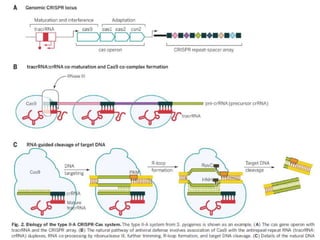
 After insertion of exogenous DNA from viruses or plasmids, a Cas
complex recognizes foreign DNA and integrates a novel repeat-spacer
unit at the leader end of the CRISPR locus.
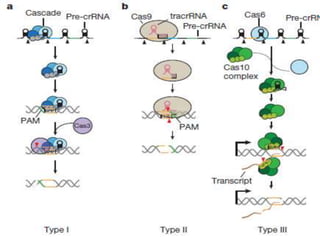
 Type I systems. A Cas protein cleaves at the base of the stem–loop short
crRNA guides. The Cascade– crRNA complex scans the target DNA for a
matching sequence (known as protospacer), which is flanked by a
protospacer-adjacent motif (PAM, in green). Annealing of the crRNA to
the target strand forms an R-loop; the Cas3 nuclease is recruited and
cleaves the target downstream of the PAM (red arrowhead) and also
degrades the opposite strand.
 Type II systems. These systems encode another small RNA
known as trans-encoded crRNA which has regions
complementary to crRNA. The tracrRNA dsRNA is cleaved by
RNase III and cleaves both strands of the protospacer/crRNA R-
loop. A PAM is located downstream of the target sequence.
GENOME EDITING WITH CRISPR
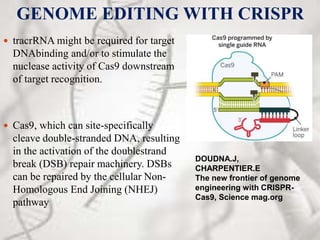
 tracrRNA might be required for target
DNAbinding and/or to stimulate the
nuclease activity of Cas9 downstream
of target recognition.
 Cas9, which can site-specifically
cleave double-stranded DNA, resulting
in the activation of the doublestrand
break (DSB) repair machinery. DSBs
can be repaired by the cellular Non-
Homologous End Joining (NHEJ)
pathway
DOUDNA.J,
CHARPENTIER.E
The new frontier of genome
engineering with CRISPR-
Cas9, Science mag.org
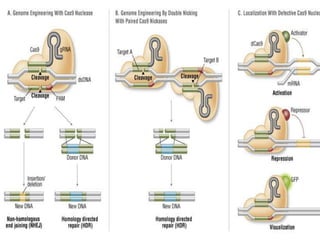
 Cas9, which can site-specifically cleave double-stranded DNA, resulting
in the activation of the doublestrand break (DSB) repair machinery. DSBs
can be repaired by the cellular Non-Homologous End Joining (NHEJ)
pathway.
 Alternatively, if a donor template with homology to the targeted locus is
supplied, the DSB may be repaired by the homology-directed repair
(HDR) pathway allowing for precise replacement mutations to be made.
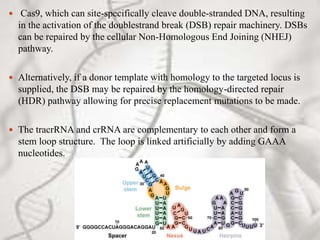
 The tracrRNA and crRNA are complementary to each other and form a
stem loop structure. The loop is linked artificially by adding GAAA
nucleotides.
 If we want to cut a specific part of DNA and insert certain
nucleotides, we create a guide RNA containing
corresponding bit of RNA.
 Once the DNA to be cut is in place in the cas 9 complex to
form a DNA-RNA hybrid, the rev and hnh endonucleases
snip the dsDNA at the specific place.
 The third component apart from guideRNA and cas9 is host
RNA which contains the set of nucleotides that we want to
insert in the break to repair it.
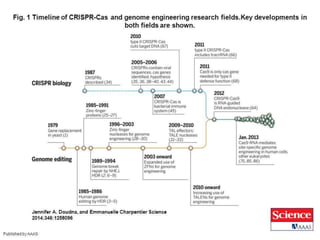
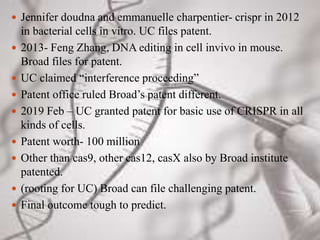
 Jennifer doudna and emmanuelle charpentier- crispr in 2012
in bacterial cells in vitro. UC files patent.
 2013- Feng Zhang, DNA editing in cell invivo in mouse.
Broad files for patent.
 UC claimed “interference proceeding”
 Patent office ruled Broad’s patent different.
 2019 Feb – UC granted patent for basic use of CRISPR in all
kinds of cells.
 Patent worth- 100 million
 Other than cas9, other cas12, casX also by Broad institute
patented.
 (rooting for UC) Broad can file challenging patent.
 Final outcome tough to predict.
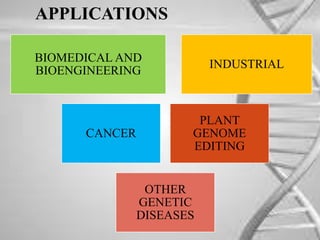
BIOMEDICAL AND
BIOENGINEERING
INDUSTRIAL
CANCER
PLANT
GENOME
EDITING
OTHER
GENETIC
DISEASES
APPLICATIONS
APPLICATIONS
 GENOME EDITING OF IMPORTANT MODEL ORGANISMS AND
CELL TYPES:
 Groundbreaking research was begun by Jinek et al. [2012] when they
investigated the mature crRNA that forms a pair with the transactivating
crRNA (tracrRNA)
 Reengineered dual-RNA:Cas9 specificity by changing the nucleotides of the
crRNAs to make single and multiple nucleotide changes. They used two
crRNAs to simultaneously create the desired mutations in Streptococcus
pneumoniae.
 Hwang et al. [2013] used a CRISPR-Cas9 system in vivo for targeted
genome editing in zebrafish embryos.
 Mali et al. [2013] engineered a (sgRNAs) and a human codon-optimized
Cas9 for targeted genome editing.
 CRISPR-Cas9 AS SMART ANTIMICROBIALAGENTS AGAINST
MDR PATHOGENS:
 In order to test the multiplexity of CRISPR-Cas9, they designed two
sgRNAs to target the superantigen enterotoxin sek gene and a region of the
mecA gene.
 They observed that target strains had been killed with comparable efficiency
 CRISPR-Cas9 FOR THE ERADICATION OF HUMAN
VIRUSES:
 The hepatitis viruses include hepatitis A, hepatitis B, and hepatitis C, three
distinct viruses that cause acute and chronic infections in human [Zhang et
al., 2014; Zeng, 2014]. CRISPR-Cas9 has been developed to eliminate HBV
through the targeting of P1 and XCp sites.
 Used to eliminate HPV, HSV, HIV
 CRISPR-cas9 IN THE NEUROSCIENCES:
 Recently CRISPR‐Cas9 technology has been used for creating a new in vitro
and in vivo animal model for testing and characterizing the nervous system
and neurological diseases.
 CRISPR‐Cas9 interruptions in and around the DISC1 gene - knocked‐down
levels of the protein expression. Further study is required to see whether or
not DISC1 can be corrected in vivo to overcome the schizophrenia.
[Srikanth et al.,2015]
 CRISPR‐Cas9 have been applied in iPSC‐based disease models to explore
the mechanism of epilepsy caused by SCN1A loss‐of‐function mutations
[Liu et al., 2016]
 Wang et al. [2015] have made mutations in CHD8 gene, replicating autism
spectrum disorders (ASDs).
 CRISPR-cas9 IN HUMAN DISEASE THERAPY:
 CRISPR‐Cas9 has been revolutionized for combating the cardiovascular
diseases. Mutation in the PCSK9 gene results in a reduction in (LDL‐C),
which can improve the heart health and reduce the cardiovascular disease.
 Ding et al. [2014] have used CRISPR‐Cas9 for in vivo mutation of
the PCSK9 gene in mouse liver.
 Yang et al. [2016] have developed an adeno‐associated virus delivery system
for CRISPR‐Cas9 toward the correction of OTC gene in newborn mice –
hyperammonemia.
 CRISPR‐Cas9 has been used to correct the mutated dmd (Duche nne
muscular dystrophy) gene in the mdx mice germ line and found 2–100%
corrections efficiency Long et al., 2014; Nelson et al., 2016].
 CRISPR-cas9 IN CANCER IMMUNOTHERAPY:
 The generation of CAR-T (chimeric antigen receptor) cells is one of the most
eye-catching applications of CRISPR-Cas9 technology in cancer
immunotherapy.
 Ren et al used the CRISPR/Cas9 system to disrupt multiple genomic sites for
constructing CAR-T cells with defective TCR and HLA class I expression,
which shows potent antitumour activity.
 CRISPR-Cas9-mediated genome editing can also be applied to eliminate
genes that encode inhibitory T cell surface receptors, such as programmed
cell death protein 1 (PD-1)
 Zhang et al successfully generated lymphocyte activating gene-3 (LAG-3)
knockout CAR-T cells using CRISPR-Cas9.
 Off target effects
 Unwanted deletions and insertions
 Production of gRNA – posttranslational modicfication processes
 Efficient delivery system – adeno and lentivirus.
REFERENCES
 Jennifer A. Doudna Emmanuelle Charpentier, The new frontier of
genome engineering with CRISPR-Cas9, Science 28 Nov 2014:
Vol. 346, Issue 6213, DOI: 10.1126/science.1258096
 Philippe Horvath and Rodolphe Barrangou, CRISPR/Cas, the
Immune System of Bacteria and Archaea, Science 327 (5962), 167-
170. DOI: 10.1126/science.1179555
 Chun-Hao Huang, Ko-Chuan Lee, and Jennifer A. Doudna ,
Applications of CRISPR-Cas Enzymes in Cancer Therapeutics and
Detection , Cell Press Reviews.
 Martin Jinek, Krzysztof Chylinski, Ines Fonfara, Michael Hauer,
Jennifer A. Doudna and Emmanuelle Charpentier, A
Programmable Dual-RNA-Guided DNA Endonuclease in
Adaptive Bacterial Immunity, Science 337 (6096), 816-821.
DOI: 10.1126/science.1225829originally published online June 28,
2012

Crispr cas

  • 1.
    DONE BY: SHRUTHI K(18308019) 1st M.Sc MICROBIOLOGY PONDICHERRY UNIVERSITY
  • 2.
    WHAT IS CRISPRCAS ?  Clustered Regularly Insterspaced Short Palindromic Repeats (CRISPR) are short segments of prokaryotic DNA that contain repititive base sequences. Spacer- DNA of viral proteins  The protein Cas9 (or "CRISPR-associated") is an enzyme that acts like a pair of molecular scissors, capable of cutting strands of DNA. They help in gene modification.  They are the natural defense modification in bacteria and archaea to foil attacks by viruses and other foreign bodies.
  • 4.
    KEY COMPONENTS OFCRISPR CAS  crRNA : contains DNA that locates the correct section of host DNA along with region that binds to tracrRNA as hairpin loop forming an active complex. TracrRNA binds to crRNA forms an active complex. (stem loop) – need to stimulate cas9.  sgRNA: chimera of crRNA and tracrRNA (modification of crRNA )  Cas9 protein: protein whose active form is abvle to modify DNA. Many variants exist with differing function. (nicks, double strand breaks, DNA binding)
  • 5.
    CRISPR-Cas IN BACTERIA After insertion of exogenous DNA from viruses or plasmids, a Cas complex recognizes foreign DNA and integrates a novel repeat-spacer unit at the leader end of the CRISPR locus.  Type I systems. A Cas protein cleaves at the base of the stem–loop short crRNA guides. The Cascade– crRNA complex scans the target DNA for a matching sequence (known as protospacer), which is flanked by a protospacer-adjacent motif (PAM, in green). Annealing of the crRNA to the target strand forms an R-loop; the Cas3 nuclease is recruited and cleaves the target downstream of the PAM (red arrowhead) and also degrades the opposite strand.
  • 6.
     Type IIsystems. These systems encode another small RNA known as trans-encoded crRNA which has regions complementary to crRNA. The tracrRNA dsRNA is cleaved by RNase III and cleaves both strands of the protospacer/crRNA R- loop. A PAM is located downstream of the target sequence.
  • 8.
    GENOME EDITING WITHCRISPR  tracrRNA might be required for target DNAbinding and/or to stimulate the nuclease activity of Cas9 downstream of target recognition.  Cas9, which can site-specifically cleave double-stranded DNA, resulting in the activation of the doublestrand break (DSB) repair machinery. DSBs can be repaired by the cellular Non- Homologous End Joining (NHEJ) pathway DOUDNA.J, CHARPENTIER.E The new frontier of genome engineering with CRISPR- Cas9, Science mag.org
  • 9.
     Cas9, whichcan site-specifically cleave double-stranded DNA, resulting in the activation of the doublestrand break (DSB) repair machinery. DSBs can be repaired by the cellular Non-Homologous End Joining (NHEJ) pathway.  Alternatively, if a donor template with homology to the targeted locus is supplied, the DSB may be repaired by the homology-directed repair (HDR) pathway allowing for precise replacement mutations to be made.  The tracrRNA and crRNA are complementary to each other and form a stem loop structure. The loop is linked artificially by adding GAAA nucleotides.
  • 10.
     If wewant to cut a specific part of DNA and insert certain nucleotides, we create a guide RNA containing corresponding bit of RNA.  Once the DNA to be cut is in place in the cas 9 complex to form a DNA-RNA hybrid, the rev and hnh endonucleases snip the dsDNA at the specific place.  The third component apart from guideRNA and cas9 is host RNA which contains the set of nucleotides that we want to insert in the break to repair it.
  • 13.
     Jennifer doudnaand emmanuelle charpentier- crispr in 2012 in bacterial cells in vitro. UC files patent.  2013- Feng Zhang, DNA editing in cell invivo in mouse. Broad files for patent.  UC claimed “interference proceeding”  Patent office ruled Broad’s patent different.  2019 Feb – UC granted patent for basic use of CRISPR in all kinds of cells.  Patent worth- 100 million  Other than cas9, other cas12, casX also by Broad institute patented.  (rooting for UC) Broad can file challenging patent.  Final outcome tough to predict.
  • 14.
  • 15.
    APPLICATIONS  GENOME EDITINGOF IMPORTANT MODEL ORGANISMS AND CELL TYPES:  Groundbreaking research was begun by Jinek et al. [2012] when they investigated the mature crRNA that forms a pair with the transactivating crRNA (tracrRNA)  Reengineered dual-RNA:Cas9 specificity by changing the nucleotides of the crRNAs to make single and multiple nucleotide changes. They used two crRNAs to simultaneously create the desired mutations in Streptococcus pneumoniae.  Hwang et al. [2013] used a CRISPR-Cas9 system in vivo for targeted genome editing in zebrafish embryos.  Mali et al. [2013] engineered a (sgRNAs) and a human codon-optimized Cas9 for targeted genome editing.
  • 16.
     CRISPR-Cas9 ASSMART ANTIMICROBIALAGENTS AGAINST MDR PATHOGENS:  In order to test the multiplexity of CRISPR-Cas9, they designed two sgRNAs to target the superantigen enterotoxin sek gene and a region of the mecA gene.  They observed that target strains had been killed with comparable efficiency  CRISPR-Cas9 FOR THE ERADICATION OF HUMAN VIRUSES:  The hepatitis viruses include hepatitis A, hepatitis B, and hepatitis C, three distinct viruses that cause acute and chronic infections in human [Zhang et al., 2014; Zeng, 2014]. CRISPR-Cas9 has been developed to eliminate HBV through the targeting of P1 and XCp sites.  Used to eliminate HPV, HSV, HIV
  • 17.
     CRISPR-cas9 INTHE NEUROSCIENCES:  Recently CRISPR‐Cas9 technology has been used for creating a new in vitro and in vivo animal model for testing and characterizing the nervous system and neurological diseases.  CRISPR‐Cas9 interruptions in and around the DISC1 gene - knocked‐down levels of the protein expression. Further study is required to see whether or not DISC1 can be corrected in vivo to overcome the schizophrenia. [Srikanth et al.,2015]  CRISPR‐Cas9 have been applied in iPSC‐based disease models to explore the mechanism of epilepsy caused by SCN1A loss‐of‐function mutations [Liu et al., 2016]  Wang et al. [2015] have made mutations in CHD8 gene, replicating autism spectrum disorders (ASDs).
  • 18.
     CRISPR-cas9 INHUMAN DISEASE THERAPY:  CRISPR‐Cas9 has been revolutionized for combating the cardiovascular diseases. Mutation in the PCSK9 gene results in a reduction in (LDL‐C), which can improve the heart health and reduce the cardiovascular disease.  Ding et al. [2014] have used CRISPR‐Cas9 for in vivo mutation of the PCSK9 gene in mouse liver.  Yang et al. [2016] have developed an adeno‐associated virus delivery system for CRISPR‐Cas9 toward the correction of OTC gene in newborn mice – hyperammonemia.  CRISPR‐Cas9 has been used to correct the mutated dmd (Duche nne muscular dystrophy) gene in the mdx mice germ line and found 2–100% corrections efficiency Long et al., 2014; Nelson et al., 2016].
  • 19.
     CRISPR-cas9 INCANCER IMMUNOTHERAPY:  The generation of CAR-T (chimeric antigen receptor) cells is one of the most eye-catching applications of CRISPR-Cas9 technology in cancer immunotherapy.  Ren et al used the CRISPR/Cas9 system to disrupt multiple genomic sites for constructing CAR-T cells with defective TCR and HLA class I expression, which shows potent antitumour activity.  CRISPR-Cas9-mediated genome editing can also be applied to eliminate genes that encode inhibitory T cell surface receptors, such as programmed cell death protein 1 (PD-1)  Zhang et al successfully generated lymphocyte activating gene-3 (LAG-3) knockout CAR-T cells using CRISPR-Cas9.
  • 20.
     Off targeteffects  Unwanted deletions and insertions  Production of gRNA – posttranslational modicfication processes  Efficient delivery system – adeno and lentivirus.
  • 21.
    REFERENCES  Jennifer A.Doudna Emmanuelle Charpentier, The new frontier of genome engineering with CRISPR-Cas9, Science 28 Nov 2014: Vol. 346, Issue 6213, DOI: 10.1126/science.1258096  Philippe Horvath and Rodolphe Barrangou, CRISPR/Cas, the Immune System of Bacteria and Archaea, Science 327 (5962), 167- 170. DOI: 10.1126/science.1179555  Chun-Hao Huang, Ko-Chuan Lee, and Jennifer A. Doudna , Applications of CRISPR-Cas Enzymes in Cancer Therapeutics and Detection , Cell Press Reviews.  Martin Jinek, Krzysztof Chylinski, Ines Fonfara, Michael Hauer, Jennifer A. Doudna and Emmanuelle Charpentier, A Programmable Dual-RNA-Guided DNA Endonuclease in Adaptive Bacterial Immunity, Science 337 (6096), 816-821. DOI: 10.1126/science.1225829originally published online June 28, 2012

Editor's Notes

  • #2 Genome editing, types of nucleases, why
  • #5 The predicted tracrRNA:crRNA secondary structure includes base pairing between the 22 nucleotides at the 3′ terminus of the crRNA and a segment near the 5′ end of the mature tracrRNA
  • #6 Unknown viral dna- broken by cas1 and genes stored in spacers
  • #7 Homing rna- where the pam sequence is in grna for editing
  • #16 https://onlinelibrary.wiley.com/doi/full/10.1002/jcb.26165 ref
  • #17 The NHEJ repair mechanism is error prone and is harnessed by the provirus to generate variability in the targeted sequence making this event possible
  • #20 Car-t cells- t cells attacking cancer cells