GENE KNOCK OUT TECHNOLOGY
• Knocked out an existing gene by
replacing it or disrupting it with an
artificial piece of DNA.
• Knockouts are used to study the function of
specific genes.
• The first recorded knockout mouse was
created by Mario R. Capecchi, Martin
Evans and Oliver Smithies in 1989
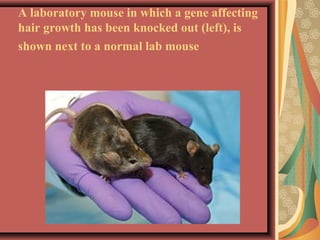
A laboratory mouse in which a gene affecting
hair growth has been knocked out (left), is
shown next to a normal lab mouse
ANIMAL MODELS
• Knockout mice are a common tool for
studying genes in the laboratory.
• Microorganisms are also used for
studying gene function.
• The knockout can be lethal.
HOW IT WORKS?
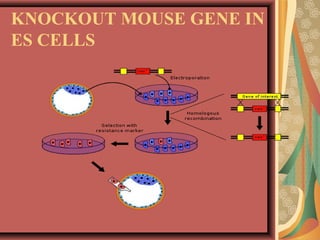
With the use of recombinant DNA technology
cloned genes are modified in such a way, that
they are no longer functional, cloned genes
modified in this way are known as ‘Knock out
construct’, when homologous recombination
occurs with a knock out construct.The non-
functional knockout allele replace the
endogenous mild type allele.
PROCEDURE
• The gene to be knocked out is isolated from a
mouse gene library
• Then a new DNA sequence is engineered
• The new sequence is also given a marker
gene.
• Stem cells are isolated from a
mouse blastocyst.
,
• The new sequence is introduced into the stem
cells by electroporation.
The stem cells that incorporated the knocked-out
gene are isolated.
The knocked-out stem cells are inserted into a
mouse blastocyst.
These blastocysts are then implanted into
the uterus of female mice
• The newborn mice will therefore
be chimeras.
These chimera mice are crossbred with
others of the wild type.
The mice produced are not chimeras, but
they are still heterozygous.
When these heterozygous offspring are
interbred, some of their offspring will inherit
the knocked-out gene from both parents;
KNOCKOUT MOUSE GENE IN
ES CELLS
APPLICATIONS
To determine the function of gene
products.
To create mouse modal of human genetic
diseases.
To characterize genetic regulatory
regions.
CYSTIC FIBROSIS
Cystic fibrosis is a genetic disorder that
perticularly affects the lungs and diagestive
system.
CF is inherited disease.
The inherited CF gene directs the body’s
epithelial cells to produce a defective form of
a protein called CFTR(cystic fibrosis
transmembrane conductance regulator) found
in cell line of lungs,digestive tracts,sweat
gland,and genitourinary system.
CF is inherited disease.
The inherited CF gene directs the body’s
epithelial cells to produce a defective form of a
protein called CFTR(cystic fibrosis
transmembrane conductance regulator) found in
cell line of lungs,digestive tracts,sweat
gland,and genitourinary system.
When the CFTR protein is defective,epithelial
cells can’t regulate the way chloride (part of salt
called sodium chloride) passes across cell
membrane.
• This disrupts the essential balance of salt and water
needed to maintain a normal thin coating of fluid and
mucus insight the lungs, pancreas and passege ways in
other organs.The mucus become thick, sticky and hard
to move.
Normally, mucus in lungs traps germs,which are then
cleared out of the lung. But, in CF, the thick,sticky
mucus and germs it has trapped remain in lungs, which
become infected.
• The human Cystic Fibrosis gene is identified and cloned
in a phage vector.
ES cells are recoverd from mouse blastocyst.
Transfection of ES cells with CFTR knockout construct.
Animals homozygous for the CFTR knock out allele
display a mutant phenotype that is very similar to that
expressed by humans suffering from Cystic Fibrosis.
Thus ,in developing drugs to alleviate CF system in
human,pharmaceutical researches can first test new
products in mice to determine their efficiency.
LIMITATIONS
Genetically altered embryos cannot grow
into adult mice.
The lack of adult mice limits studies
to embryonic development.
The gene may serve a different function
in adults than in developing embryos.

Gene knockout

  • 1.
    GENE KNOCK OUTTECHNOLOGY • Knocked out an existing gene by replacing it or disrupting it with an artificial piece of DNA. • Knockouts are used to study the function of specific genes. • The first recorded knockout mouse was created by Mario R. Capecchi, Martin Evans and Oliver Smithies in 1989
  • 2.
    A laboratory mousein which a gene affecting hair growth has been knocked out (left), is shown next to a normal lab mouse
  • 3.
    ANIMAL MODELS • Knockoutmice are a common tool for studying genes in the laboratory. • Microorganisms are also used for studying gene function. • The knockout can be lethal.
  • 4.
    HOW IT WORKS? Withthe use of recombinant DNA technology cloned genes are modified in such a way, that they are no longer functional, cloned genes modified in this way are known as ‘Knock out construct’, when homologous recombination occurs with a knock out construct.The non- functional knockout allele replace the endogenous mild type allele.
  • 5.
    PROCEDURE • The geneto be knocked out is isolated from a mouse gene library • Then a new DNA sequence is engineered • The new sequence is also given a marker gene. • Stem cells are isolated from a mouse blastocyst. ,
  • 6.
    • The newsequence is introduced into the stem cells by electroporation. The stem cells that incorporated the knocked-out gene are isolated. The knocked-out stem cells are inserted into a mouse blastocyst. These blastocysts are then implanted into the uterus of female mice
  • 7.
    • The newbornmice will therefore be chimeras. These chimera mice are crossbred with others of the wild type. The mice produced are not chimeras, but they are still heterozygous. When these heterozygous offspring are interbred, some of their offspring will inherit the knocked-out gene from both parents;
  • 8.
  • 9.
    APPLICATIONS To determine thefunction of gene products. To create mouse modal of human genetic diseases. To characterize genetic regulatory regions.
  • 10.
    CYSTIC FIBROSIS Cystic fibrosisis a genetic disorder that perticularly affects the lungs and diagestive system. CF is inherited disease. The inherited CF gene directs the body’s epithelial cells to produce a defective form of a protein called CFTR(cystic fibrosis transmembrane conductance regulator) found in cell line of lungs,digestive tracts,sweat gland,and genitourinary system.
  • 11.
    CF is inheriteddisease. The inherited CF gene directs the body’s epithelial cells to produce a defective form of a protein called CFTR(cystic fibrosis transmembrane conductance regulator) found in cell line of lungs,digestive tracts,sweat gland,and genitourinary system. When the CFTR protein is defective,epithelial cells can’t regulate the way chloride (part of salt called sodium chloride) passes across cell membrane.
  • 12.
    • This disruptsthe essential balance of salt and water needed to maintain a normal thin coating of fluid and mucus insight the lungs, pancreas and passege ways in other organs.The mucus become thick, sticky and hard to move. Normally, mucus in lungs traps germs,which are then cleared out of the lung. But, in CF, the thick,sticky mucus and germs it has trapped remain in lungs, which become infected.
  • 13.
    • The humanCystic Fibrosis gene is identified and cloned in a phage vector. ES cells are recoverd from mouse blastocyst. Transfection of ES cells with CFTR knockout construct. Animals homozygous for the CFTR knock out allele display a mutant phenotype that is very similar to that expressed by humans suffering from Cystic Fibrosis. Thus ,in developing drugs to alleviate CF system in human,pharmaceutical researches can first test new products in mice to determine their efficiency.
  • 14.
    LIMITATIONS Genetically altered embryoscannot grow into adult mice. The lack of adult mice limits studies to embryonic development. The gene may serve a different function in adults than in developing embryos.