TRANSGENIC AND KNOCKOUT MICE
1
INTRODUCTION:
• Transgenesis refers to the phenomenon of introduction of
exogenous DNA into the genome to create and maintain a stable
heritable character.
• The foreign DNA that is introduced is called transgene. And the
animal whose genome is altered by adding one or more transgenes
is said to be transgenic.
• The transgenes behave like other genes present in the animal’s
genome and are passed on to the offsprings.
• Thus, transgenic animals are genetically engineered or genetically
modified organisms (GMOs) with a new heritable character.
2
TRANSGENIC MICE:
• The first animal used for transgenesis was a mouse. Mouse
continues to be an animal of choice for most transgenic
experiments.
• Being a small animal, it can be easily handled, and mouse is
regarded as researcher- friendly by biotechnologists.
• It produces more eggs unlike the large domestic animals.
• Transgenic mice have significantly contributed to the understanding
of molecular biology, genetics, immunology and cancer, besides
creating animal models for several human genetic diseases.
3
GENERAL PROCEDURE FOR PRODUCING TRANSGENIC
MICE:
• There are three methods for introducing a transgene into mice:
i. Retroviral vector method - Transfer of small pieces (8 kb) of
DNA can be effectively carried out by retroviruses.
ii. Microinjection method - Using a microinjection needle and a
holding pipette, the DNA is introduced into the male pronucleus
of the fertilized egg.
iii. Embryonic stem cell method - Cells from inner cell mass
(ICM) of the blastocyst stage of a developing mouse embryo can
proliferate in cell culture. These cells are capable of
differentiating into other types of cells when transferred to
another blastocyst embryo.
4
TRANSFECTION:
• Transfection is the process of inserting genetic material, such as
DNA and double stranded RNA, into mammalian cells.
• By transfecting genes involved with the immune response into
cells that lack those genes, the product of specific gene can be
studied apart from interacting proteins encoded by other genes.
• For example, transfection of MHC genes, under the control of
appropriate promoters, into a mouse fibroblast cell line has enabled
immunologists to study the role of MHC molecules in antigen
presentation to T cells.
• Transfection of the gene that encodes the T-cell receptor has
provided information about the antigen-MHC specificity of the T-
cell receptors.
5
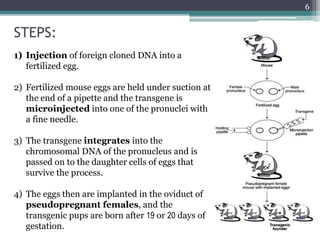
STEPS:
1) Injection of foreign cloned DNA into a
fertilized egg.
2) Fertilized mouse eggs are held under suction at
the end of a pipette and the transgene is
microinjected into one of the pronuclei with
a fine needle.
3) The transgene integrates into the
chromosomal DNA of the pronucleus and is
passed on to the daughter cells of eggs that
survive the process.
4) The eggs then are implanted in the oviduct of
pseudopregnant females, and the
transgenic pups are born after 19 or 20 days of
gestation.
6
TRANSGENIC MICE IN IN VIVO ANALYSIS OF GENE
FUNCTION:
• Development of transgene into mouse embryos has permitted
immunologists to study the effects of immune system genes in
vivo.
• Immunologists have been able to study the expression of a given
gene in a living animal.
• By constructing transgene with the particular promoter,
researchers can control the expression of the transgene.
• For example, the metallothionein promoter is activated by zinc.
Transgenic mice carrying a transgene linked to a metallothionein
promoter express the transgene only if zinc is added to their water
supply.
7
• The transgenic mice can transmit the transgene to their offspring
as a Mendalian trait.
• It has been possible to produce lines of transgenic mice in which
every number of line contains the same transgene.
• A variety of such transgenic lines are currently available and are
widely used in immunologic research.
• Included among these are lines carrying transgenes that encode
immunoglobulin, T-cell receptors, class I and class II MHC
molecules, various foreign antigens, and a number of cytokines.
• Several lines carrying oncogenes as transgenes have also been
produced.
8
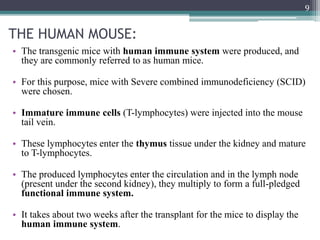
THE HUMAN MOUSE:
• The transgenic mice with human immune system were produced, and
they are commonly referred to as human mice.
• For this purpose, mice with Severe combined immunodeficiency (SCID)
were chosen.
• Immature immune cells (T-lymphocytes) were injected into the mouse
tail vein.
• These lymphocytes enter the thymus tissue under the kidney and mature
to T-lymphocytes.
• The produced lymphocytes enter the circulation and in the lymph node
(present under the second kidney), they multiply to form a full-pledged
functional immune system.
• It takes about two weeks after the transplant for the mice to display the
human immune system.
9
THE ONCOMOUSE: THE PROSTATE MOUSE:
• The animal model for cancer is
the oncomouse.
• First developed for breast cancer.
• The oncogene c-myc in
association with mouse
mammary tumor (MMT) virus
was found to be responsible for
breast cancer.
• Transgenic mice where produced
by introducing chimeric DNA
consisting of c-myc gene and
sections MMT virus fertilized
mouse egg cells.
• In the older men, particularly
above 60 years of age, prostate
gland gets enlarged and may
become cancerous.
• The oncogene for prostate
cancer was identified (int-2).
• A chimeric DNA by joining
int-2 with viral promoter was
prepared and introduced into
fertilized mouse eggs.
• In the transgenic mice so
developed, enlargement of
prostate gland was observed.
10
GENE KNOCKOUT:
• By inserting a transgene into a chromosome, a new function is
introduced while producing transgenic animals.
• On the other hand, in a process referred to as gene knockout an
existing function can be blocked by destroying a specific gene.
• In gene knockout, the loss-of-function occurs in transgenic
animals. This is in contrast to gain-of-function that takes place
by introducing a foreign gene.
• Gene knockout is important for understanding the development
and physiological consequences in an organism.
11
KNOCKOUT MICE:
• A knockout mouse is a genetically engineered mouse in which
one or more genes have been turned off through a gene knockout.
• Several knockout mice have been developed.
i. SCID mouse
ii. knockout mouse for allergy
iii. knockout mouse for transplantation
iv. knockout mouse with memory loss
v. knockout mouse with retinitis pigmentosa
• Important animal models for studying the role of genes which
have been sequenced, but have unknown functions.
12
SCID MOUSE:
• Severe conbined immunodeficiency (SCID) is a condition with a
total lack of immune system.
• SCID mouse were developed by eliminating a single gene & the
resultant mice lost the ability to produce B-lymphocytes & T-
lymphocytes.
• The SCID mouse was shown to have early B- and T- lineage cells
but a virtual absence of lymphoid cells in the thymus, spleen,
lymph nodes, and gut tissues.
• The precursor T and B cells in the SCID mouse appeared to be
unable to differentiate into mature functional B and T lymphocytes.
• Cells other than lymphoctes develop normally in the SCID mouse;
RBC, monocytes, and granulocytes are present and functional.
13
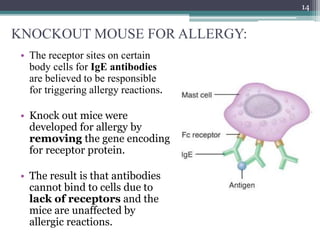
KNOCKOUT MOUSE FOR ALLERGY:
• The receptor sites on certain
body cells for IgE antibodies
are believed to be responsible
for triggering allergy reactions.
• Knock out mice were
developed for allergy by
removing the gene encoding
for receptor protein.
• The result is that antibodies
cannot bind to cells due to
lack of receptors and the
mice are unaffected by
allergic reactions.
14
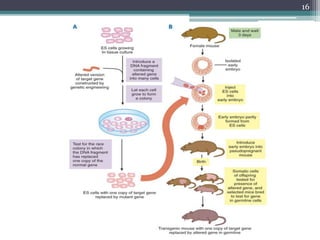
STEPS:
1) Isolation and culture of embryonic stem (ES) cells from the
inner cell mass of a mouse blastocyst.
2) Introduction of mutant or disrupted gene into the cultured ES
cells and selection of homologous recombinant cells in which
the gene of interest has been knocked out.
3) Injection of homologous recombinant ES cells into a recipient
mouse blastocyst and surgical implantation of the blastocyst into
a pseudopregnant mouse.
4) Mating of chimeric offspring heterozygous for the distrupted
gene to produce knockout mice.
15
16
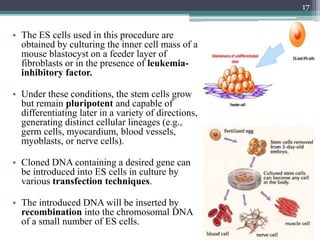
• The ES cells used in this procedure are
obtained by culturing the inner cell mass of a
mouse blastocyst on a feeder layer of
fibroblasts or in the presence of leukemia-
inhibitory factor.
• Under these conditions, the stem cells grow
but remain pluripotent and capable of
differentiating later in a variety of directions,
generating distinct cellular lineages (e.g.,
germ cells, myocardium, blood vessels,
myoblasts, or nerve cells).
• Cloned DNA containing a desired gene can
be introduced into ES cells in culture by
various transfection techniques.
• The introduced DNA will be inserted by
recombination into the chromosomal DNA
of a small number of ES cells.
17
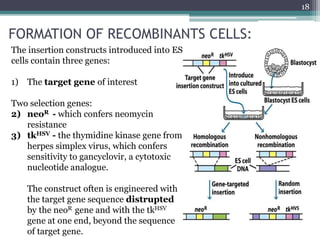
FORMATION OF RECOMBINANTS CELLS:
18
The insertion constructs introduced into ES
cells contain three genes:
1) The target gene of interest
Two selection genes:
2) neoR - which confers neomycin
resistance
3) tkHSV - the thymidine kinase gene from
herpes simplex virus, which confers
sensitivity to gancyclovir, a cytotoxic
nucleotide analogue.
The construct often is engineered with
the target gene sequence distrupted
by the neoR gene and with the tkHSV
gene at one end, beyond the sequence
of target gene.
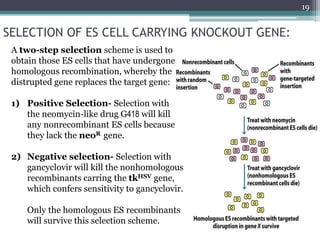
SELECTION OF ES CELL CARRYING KNOCKOUT GENE:
19
A two-step selection scheme is used to
obtain those ES cells that have undergone
homologous recombination, whereby the
distrupted gene replaces the target gene:
1) Positive Selection- Selection with
the neomycin-like drug G418 will kill
any nonrecombinant ES cells because
they lack the neoR gene.
2) Negative selection- Selection with
gancyclovir will kill the nonhomologous
recombinants carring the tkHSV gene,
which confers sensitivity to gancyclovir.
Only the homologous ES recombinants
will survive this selection scheme.
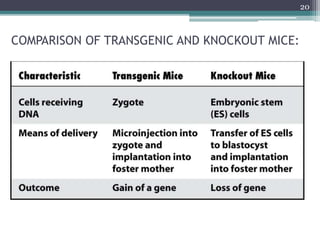
COMPARISON OF TRANSGENIC AND KNOCKOUT MICE:
20
KNOCK-IN TECHNOLOGY:
• Knock-in is similar to knock-out, but instead it replaces a gene with
another instead of deleting it.
• A common use of knock-in technology is for the creation of disease
models.
• In addition to disrupting a gene of choice, it is possible to replace the
endogenous gene with a mutated form of that gene or completely replace
the endogenous gene with a DNA sequence of choice.
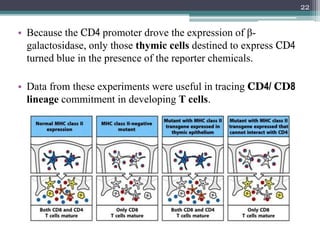
• For example, the CD4 gene was replaced with the gene for β-
galactosidase.
• In these experiments, the CD4 promoter was left intact to drive the
expression of β-galactosidase, which catalyzes the colour change of
certain reporter chemicals to blue.
21
• Because the CD4 promoter drove the expression of β-
galactosidase, only those thymic cells destined to express CD4
turned blue in the presence of the reporter chemicals.
• Data from these experiments were useful in tracing CD4/ CD8
lineage commitment in developing T cells.
22
INDUCIBLE KNOCKOUT MICE:
23
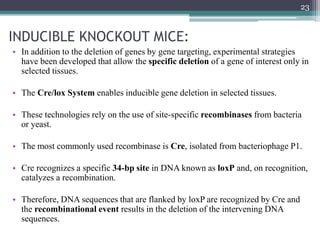
• In addition to the deletion of genes by gene targeting, experimental strategies
have been developed that allow the specific deletion of a gene of interest only in
selected tissues.
• The Cre/lox System enables inducible gene deletion in selected tissues.
• These technologies rely on the use of site-specific recombinases from bacteria
or yeast.
• The most commonly used recombinase is Cre, isolated from bacteriophage P1.
• Cre recognizes a specific 34-bp site in DNA known as loxP and, on recognition,
catalyzes a recombination.
• Therefore, DNA sequences that are flanked by loxP are recognized by Cre and
the recombinational event results in the deletion of the intervening DNA
sequences.
CONDITIONAL DELETION BY CRE RECOMBINASE:
24
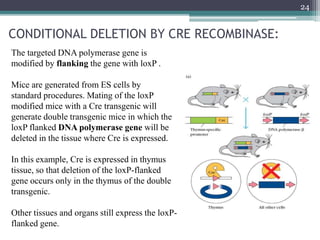
The targeted DNA polymerase gene is
modified by flanking the gene with loxP .
Mice are generated from ES cells by
standard procedures. Mating of the loxP
modified mice with a Cre transgenic will
generate double transgenic mice in which the
loxP flanked DNA polymerase gene will be
deleted in the tissue where Cre is expressed.
In this example, Cre is expressed in thymus
tissue, so that deletion of the loxP-flanked
gene occurs only in the thymus of the double
transgenic.
Other tissues and organs still express the loxP-
flanked gene.
ACTIVATION OF GENE EXPRESSION USING CRE/LOX:
25
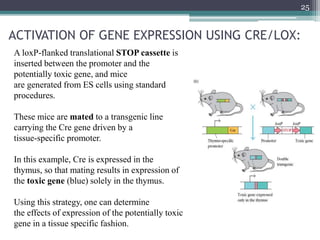
A loxP-flanked translational STOP cassette is
inserted between the promoter and the
potentially toxic gene, and mice
are generated from ES cells using standard
procedures.
These mice are mated to a transgenic line
carrying the Cre gene driven by a
tissue-specific promoter.
In this example, Cre is expressed in the
thymus, so that mating results in expression of
the toxic gene (blue) solely in the thymus.
Using this strategy, one can determine
the effects of expression of the potentially toxic
gene in a tissue specific fashion.
LIMITATIONS OF KNOCK OUT MICE:
• About 15 percent of gene knockouts are developmentally lethal,
which means that the genetically altered embryos cannot grow into
adult mice.
• The lack of adult mice limits studies to embryonic development
and often makes it more difficult to determine a gene's function in
relation to human health.
• In some instances, the gene may serve a different function in
adults than in developing embryos.
• Knocking out a gene also may fail to produce an observable change
in a mouse or may even produce different characteristics from those
observed in humans in which the same gene is inactivated.
26
BIBLIOGRAPHY:
• http://www.biotec.uniba.it/area_docenti/documenti_docen
te/materiali_didattici/43_knockout.PDF
• https://en.wikipedia.org/wiki/Knockout_mouse
• https://en.wikipedia.org/wiki/Gene_knockin
• Book : Kuby Immunology
Author: Barbara A. Osborne, Kindt and Goldsby
Edition: Sixth Edition
Chapter: 22
27
28

Transgenic and knockout mice

  • 1.
  • 2.
    INTRODUCTION: • Transgenesis refersto the phenomenon of introduction of exogenous DNA into the genome to create and maintain a stable heritable character. • The foreign DNA that is introduced is called transgene. And the animal whose genome is altered by adding one or more transgenes is said to be transgenic. • The transgenes behave like other genes present in the animal’s genome and are passed on to the offsprings. • Thus, transgenic animals are genetically engineered or genetically modified organisms (GMOs) with a new heritable character. 2
  • 3.
    TRANSGENIC MICE: • Thefirst animal used for transgenesis was a mouse. Mouse continues to be an animal of choice for most transgenic experiments. • Being a small animal, it can be easily handled, and mouse is regarded as researcher- friendly by biotechnologists. • It produces more eggs unlike the large domestic animals. • Transgenic mice have significantly contributed to the understanding of molecular biology, genetics, immunology and cancer, besides creating animal models for several human genetic diseases. 3
  • 4.
    GENERAL PROCEDURE FORPRODUCING TRANSGENIC MICE: • There are three methods for introducing a transgene into mice: i. Retroviral vector method - Transfer of small pieces (8 kb) of DNA can be effectively carried out by retroviruses. ii. Microinjection method - Using a microinjection needle and a holding pipette, the DNA is introduced into the male pronucleus of the fertilized egg. iii. Embryonic stem cell method - Cells from inner cell mass (ICM) of the blastocyst stage of a developing mouse embryo can proliferate in cell culture. These cells are capable of differentiating into other types of cells when transferred to another blastocyst embryo. 4
  • 5.
    TRANSFECTION: • Transfection isthe process of inserting genetic material, such as DNA and double stranded RNA, into mammalian cells. • By transfecting genes involved with the immune response into cells that lack those genes, the product of specific gene can be studied apart from interacting proteins encoded by other genes. • For example, transfection of MHC genes, under the control of appropriate promoters, into a mouse fibroblast cell line has enabled immunologists to study the role of MHC molecules in antigen presentation to T cells. • Transfection of the gene that encodes the T-cell receptor has provided information about the antigen-MHC specificity of the T- cell receptors. 5
  • 6.
    STEPS: 1) Injection offoreign cloned DNA into a fertilized egg. 2) Fertilized mouse eggs are held under suction at the end of a pipette and the transgene is microinjected into one of the pronuclei with a fine needle. 3) The transgene integrates into the chromosomal DNA of the pronucleus and is passed on to the daughter cells of eggs that survive the process. 4) The eggs then are implanted in the oviduct of pseudopregnant females, and the transgenic pups are born after 19 or 20 days of gestation. 6
  • 7.
    TRANSGENIC MICE ININ VIVO ANALYSIS OF GENE FUNCTION: • Development of transgene into mouse embryos has permitted immunologists to study the effects of immune system genes in vivo. • Immunologists have been able to study the expression of a given gene in a living animal. • By constructing transgene with the particular promoter, researchers can control the expression of the transgene. • For example, the metallothionein promoter is activated by zinc. Transgenic mice carrying a transgene linked to a metallothionein promoter express the transgene only if zinc is added to their water supply. 7
  • 8.
    • The transgenicmice can transmit the transgene to their offspring as a Mendalian trait. • It has been possible to produce lines of transgenic mice in which every number of line contains the same transgene. • A variety of such transgenic lines are currently available and are widely used in immunologic research. • Included among these are lines carrying transgenes that encode immunoglobulin, T-cell receptors, class I and class II MHC molecules, various foreign antigens, and a number of cytokines. • Several lines carrying oncogenes as transgenes have also been produced. 8
  • 9.
    THE HUMAN MOUSE: •The transgenic mice with human immune system were produced, and they are commonly referred to as human mice. • For this purpose, mice with Severe combined immunodeficiency (SCID) were chosen. • Immature immune cells (T-lymphocytes) were injected into the mouse tail vein. • These lymphocytes enter the thymus tissue under the kidney and mature to T-lymphocytes. • The produced lymphocytes enter the circulation and in the lymph node (present under the second kidney), they multiply to form a full-pledged functional immune system. • It takes about two weeks after the transplant for the mice to display the human immune system. 9
  • 10.
    THE ONCOMOUSE: THEPROSTATE MOUSE: • The animal model for cancer is the oncomouse. • First developed for breast cancer. • The oncogene c-myc in association with mouse mammary tumor (MMT) virus was found to be responsible for breast cancer. • Transgenic mice where produced by introducing chimeric DNA consisting of c-myc gene and sections MMT virus fertilized mouse egg cells. • In the older men, particularly above 60 years of age, prostate gland gets enlarged and may become cancerous. • The oncogene for prostate cancer was identified (int-2). • A chimeric DNA by joining int-2 with viral promoter was prepared and introduced into fertilized mouse eggs. • In the transgenic mice so developed, enlargement of prostate gland was observed. 10
  • 11.
    GENE KNOCKOUT: • Byinserting a transgene into a chromosome, a new function is introduced while producing transgenic animals. • On the other hand, in a process referred to as gene knockout an existing function can be blocked by destroying a specific gene. • In gene knockout, the loss-of-function occurs in transgenic animals. This is in contrast to gain-of-function that takes place by introducing a foreign gene. • Gene knockout is important for understanding the development and physiological consequences in an organism. 11
  • 12.
    KNOCKOUT MICE: • Aknockout mouse is a genetically engineered mouse in which one or more genes have been turned off through a gene knockout. • Several knockout mice have been developed. i. SCID mouse ii. knockout mouse for allergy iii. knockout mouse for transplantation iv. knockout mouse with memory loss v. knockout mouse with retinitis pigmentosa • Important animal models for studying the role of genes which have been sequenced, but have unknown functions. 12
  • 13.
    SCID MOUSE: • Severeconbined immunodeficiency (SCID) is a condition with a total lack of immune system. • SCID mouse were developed by eliminating a single gene & the resultant mice lost the ability to produce B-lymphocytes & T- lymphocytes. • The SCID mouse was shown to have early B- and T- lineage cells but a virtual absence of lymphoid cells in the thymus, spleen, lymph nodes, and gut tissues. • The precursor T and B cells in the SCID mouse appeared to be unable to differentiate into mature functional B and T lymphocytes. • Cells other than lymphoctes develop normally in the SCID mouse; RBC, monocytes, and granulocytes are present and functional. 13
  • 14.
    KNOCKOUT MOUSE FORALLERGY: • The receptor sites on certain body cells for IgE antibodies are believed to be responsible for triggering allergy reactions. • Knock out mice were developed for allergy by removing the gene encoding for receptor protein. • The result is that antibodies cannot bind to cells due to lack of receptors and the mice are unaffected by allergic reactions. 14
  • 15.
    STEPS: 1) Isolation andculture of embryonic stem (ES) cells from the inner cell mass of a mouse blastocyst. 2) Introduction of mutant or disrupted gene into the cultured ES cells and selection of homologous recombinant cells in which the gene of interest has been knocked out. 3) Injection of homologous recombinant ES cells into a recipient mouse blastocyst and surgical implantation of the blastocyst into a pseudopregnant mouse. 4) Mating of chimeric offspring heterozygous for the distrupted gene to produce knockout mice. 15
  • 16.
  • 17.
    • The EScells used in this procedure are obtained by culturing the inner cell mass of a mouse blastocyst on a feeder layer of fibroblasts or in the presence of leukemia- inhibitory factor. • Under these conditions, the stem cells grow but remain pluripotent and capable of differentiating later in a variety of directions, generating distinct cellular lineages (e.g., germ cells, myocardium, blood vessels, myoblasts, or nerve cells). • Cloned DNA containing a desired gene can be introduced into ES cells in culture by various transfection techniques. • The introduced DNA will be inserted by recombination into the chromosomal DNA of a small number of ES cells. 17
  • 18.
    FORMATION OF RECOMBINANTSCELLS: 18 The insertion constructs introduced into ES cells contain three genes: 1) The target gene of interest Two selection genes: 2) neoR - which confers neomycin resistance 3) tkHSV - the thymidine kinase gene from herpes simplex virus, which confers sensitivity to gancyclovir, a cytotoxic nucleotide analogue. The construct often is engineered with the target gene sequence distrupted by the neoR gene and with the tkHSV gene at one end, beyond the sequence of target gene.
  • 19.
    SELECTION OF ESCELL CARRYING KNOCKOUT GENE: 19 A two-step selection scheme is used to obtain those ES cells that have undergone homologous recombination, whereby the distrupted gene replaces the target gene: 1) Positive Selection- Selection with the neomycin-like drug G418 will kill any nonrecombinant ES cells because they lack the neoR gene. 2) Negative selection- Selection with gancyclovir will kill the nonhomologous recombinants carring the tkHSV gene, which confers sensitivity to gancyclovir. Only the homologous ES recombinants will survive this selection scheme.
  • 20.
    COMPARISON OF TRANSGENICAND KNOCKOUT MICE: 20
  • 21.
    KNOCK-IN TECHNOLOGY: • Knock-inis similar to knock-out, but instead it replaces a gene with another instead of deleting it. • A common use of knock-in technology is for the creation of disease models. • In addition to disrupting a gene of choice, it is possible to replace the endogenous gene with a mutated form of that gene or completely replace the endogenous gene with a DNA sequence of choice. • For example, the CD4 gene was replaced with the gene for β- galactosidase. • In these experiments, the CD4 promoter was left intact to drive the expression of β-galactosidase, which catalyzes the colour change of certain reporter chemicals to blue. 21
  • 22.
    • Because theCD4 promoter drove the expression of β- galactosidase, only those thymic cells destined to express CD4 turned blue in the presence of the reporter chemicals. • Data from these experiments were useful in tracing CD4/ CD8 lineage commitment in developing T cells. 22
  • 23.
    INDUCIBLE KNOCKOUT MICE: 23 •In addition to the deletion of genes by gene targeting, experimental strategies have been developed that allow the specific deletion of a gene of interest only in selected tissues. • The Cre/lox System enables inducible gene deletion in selected tissues. • These technologies rely on the use of site-specific recombinases from bacteria or yeast. • The most commonly used recombinase is Cre, isolated from bacteriophage P1. • Cre recognizes a specific 34-bp site in DNA known as loxP and, on recognition, catalyzes a recombination. • Therefore, DNA sequences that are flanked by loxP are recognized by Cre and the recombinational event results in the deletion of the intervening DNA sequences.
  • 24.
    CONDITIONAL DELETION BYCRE RECOMBINASE: 24 The targeted DNA polymerase gene is modified by flanking the gene with loxP . Mice are generated from ES cells by standard procedures. Mating of the loxP modified mice with a Cre transgenic will generate double transgenic mice in which the loxP flanked DNA polymerase gene will be deleted in the tissue where Cre is expressed. In this example, Cre is expressed in thymus tissue, so that deletion of the loxP-flanked gene occurs only in the thymus of the double transgenic. Other tissues and organs still express the loxP- flanked gene.
  • 25.
    ACTIVATION OF GENEEXPRESSION USING CRE/LOX: 25 A loxP-flanked translational STOP cassette is inserted between the promoter and the potentially toxic gene, and mice are generated from ES cells using standard procedures. These mice are mated to a transgenic line carrying the Cre gene driven by a tissue-specific promoter. In this example, Cre is expressed in the thymus, so that mating results in expression of the toxic gene (blue) solely in the thymus. Using this strategy, one can determine the effects of expression of the potentially toxic gene in a tissue specific fashion.
  • 26.
    LIMITATIONS OF KNOCKOUT MICE: • About 15 percent of gene knockouts are developmentally lethal, which means that the genetically altered embryos cannot grow into adult mice. • The lack of adult mice limits studies to embryonic development and often makes it more difficult to determine a gene's function in relation to human health. • In some instances, the gene may serve a different function in adults than in developing embryos. • Knocking out a gene also may fail to produce an observable change in a mouse or may even produce different characteristics from those observed in humans in which the same gene is inactivated. 26
  • 27.
    BIBLIOGRAPHY: • http://www.biotec.uniba.it/area_docenti/documenti_docen te/materiali_didattici/43_knockout.PDF • https://en.wikipedia.org/wiki/Knockout_mouse •https://en.wikipedia.org/wiki/Gene_knockin • Book : Kuby Immunology Author: Barbara A. Osborne, Kindt and Goldsby Edition: Sixth Edition Chapter: 22 27
  • 28.