S.Y.B.Sc. - PRACTICAL
SESSION-3
(12th Aug.2021)
EXPERIMENT-2
EXPRESSION OF LAC EXPRESSION – BLUE WHITE
SCREENING
EXPERIMENT
-2 – STUDY of
LAC
EXPRESSION –
BLUE WHITE
SCREENING
BLUE-WHITE SCREENING & PROTOCOLS FOR
COLONY SELECTION
IDENTIFICATION OF
RECOMBINANT BACTERIA
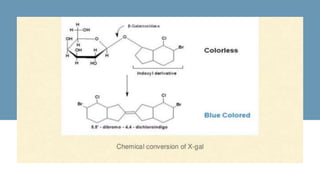
Blue-white screening is a rapid
and efficient technique for the
identification of recombinant
bacteria. It relies on the activity
of β-galactosidase, an enzyme
occurring in E. coli, which cleaves
lactose into glucose and
galactose.
The method is based on the principle of α-complementation of
the β-galactosidase gene. This phenomenon of α-complementation
was first demonstrated in work done by Agnes Ullmann in the
laboratory of François Jacob and Jacques Monod, where the function
of an inactive mutant β-galactosidase with deleted sequence was
shown to be rescued by a fragment of β-galactosidase in which that
same sequence, the α-donor peptide, is still intact.[
Langley et al. showed that the mutant non-functional β-
galactosidase was lacking in part of its N-terminus with its residues
11—41 deleted, but it may be complemented by a peptide formed of
residues 3—90 of β-galactosidase.
BLUE-WHITE SCREENING & PROTOCOLS FOR
COLONY SELECTION
DISRUPTING
THE LACZ
GENE
The presence of lactose in the
surrounding environment triggers
the lacZ operon in E. coli. The
operon activity results in the
production of β-galactosidase
enzyme that metabolizes the lactose.
Most plasmid vectors carry a short
segment of lacZ gene that contains
coding information for the first 146
amino acids of β-galactosidase. The
host E. coli strains used are
competent cells containing
lacZΔM15 deletion mutation. When
the plasmid vector is taken up by
such cells, due to α-
complementation process, a
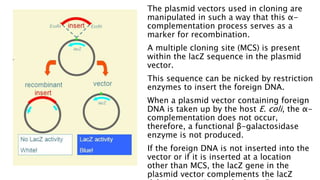
The plasmid vectors used in cloning are
manipulated in such a way that this α-
complementation process serves as a
marker for recombination.
A multiple cloning site (MCS) is present
within the lacZ sequence in the plasmid
vector.
This sequence can be nicked by restriction
enzymes to insert the foreign DNA.
When a plasmid vector containing foreign
DNA is taken up by the host E. coli, the α-
complementation does not occur,
therefore, a functional β-galactosidase
enzyme is not produced.
If the foreign DNA is not inserted into the
vector or if it is inserted at a location
other than MCS, the lacZ gene in the
plasmid vector complements the lacZ
VIDEO LINKS
https://www.youtube.com/watch?v=Y7gxELssMRw
https://www.youtube.com/watch?v=4fnS2xKjIbg

Blue white screening

  • 1.
    S.Y.B.Sc. - PRACTICAL SESSION-3 (12thAug.2021) EXPERIMENT-2 EXPRESSION OF LAC EXPRESSION – BLUE WHITE SCREENING
  • 2.
    EXPERIMENT -2 – STUDYof LAC EXPRESSION – BLUE WHITE SCREENING
  • 3.
    BLUE-WHITE SCREENING &PROTOCOLS FOR COLONY SELECTION IDENTIFICATION OF RECOMBINANT BACTERIA Blue-white screening is a rapid and efficient technique for the identification of recombinant bacteria. It relies on the activity of β-galactosidase, an enzyme occurring in E. coli, which cleaves lactose into glucose and galactose.
  • 4.
    The method isbased on the principle of α-complementation of the β-galactosidase gene. This phenomenon of α-complementation was first demonstrated in work done by Agnes Ullmann in the laboratory of François Jacob and Jacques Monod, where the function of an inactive mutant β-galactosidase with deleted sequence was shown to be rescued by a fragment of β-galactosidase in which that same sequence, the α-donor peptide, is still intact.[ Langley et al. showed that the mutant non-functional β- galactosidase was lacking in part of its N-terminus with its residues 11—41 deleted, but it may be complemented by a peptide formed of residues 3—90 of β-galactosidase. BLUE-WHITE SCREENING & PROTOCOLS FOR COLONY SELECTION
  • 8.
    DISRUPTING THE LACZ GENE The presenceof lactose in the surrounding environment triggers the lacZ operon in E. coli. The operon activity results in the production of β-galactosidase enzyme that metabolizes the lactose. Most plasmid vectors carry a short segment of lacZ gene that contains coding information for the first 146 amino acids of β-galactosidase. The host E. coli strains used are competent cells containing lacZΔM15 deletion mutation. When the plasmid vector is taken up by such cells, due to α- complementation process, a
  • 10.
    The plasmid vectorsused in cloning are manipulated in such a way that this α- complementation process serves as a marker for recombination. A multiple cloning site (MCS) is present within the lacZ sequence in the plasmid vector. This sequence can be nicked by restriction enzymes to insert the foreign DNA. When a plasmid vector containing foreign DNA is taken up by the host E. coli, the α- complementation does not occur, therefore, a functional β-galactosidase enzyme is not produced. If the foreign DNA is not inserted into the vector or if it is inserted at a location other than MCS, the lacZ gene in the plasmid vector complements the lacZ
  • 11.