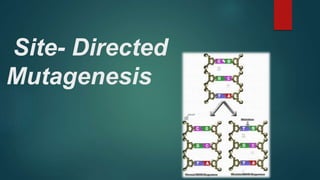
Site- Directed
Mutagenesis
Assigned by:
Dr. Sajjad Ali
Presented by:
Zain Ahsan
Maira Akram
Mubeen Shahzadi
Contents
 Mutation vs Mutagenesis
 History
 Site Directed Mutagenesis
 Types of Site Directed Mutagenesis
 Oligonucleotide site directed Mutagenesis
 Cassette Mutagenesis
 PCR site directed mutagenesis
 Applications
 Future Aspects
 Conclusion
Mutation vs Mutagenesis
Mutation
Mutation is defined as random and permanent change in a DNA
sequence which caused by some mutagens that can be a viruses ,mutagenic
chemicals,transpsonse and radiations as well as errors that occur during
meiosis or DNA replication.
Chemicals-
1. Ethyl methane sulfonate
2. Methyl methane sulfonate
Mutagenesis
Genesis means to synthesize something
Mutagenesis is defined as” to generate mutation” in a DNA for a particular
cause. Mutagenesis gives us the capability of testing the role of any amino
acid in a protein by replacing it with any of the other naturally occurring amino
acids
Types Of Mutagenesis
 Random mutagenesis:
In this type the mutation can be generated , at any region of DNA
sequence, randomly.
 Sited-directed Mutagenesis:
It is the process of creating specific, targeted changes in DNA.
Like change in specific gene or of specific nucleotide.
History
 Early attempts at mutagenesis using radiation or chemical mutagens were
non-site-specific they generate random mutations.
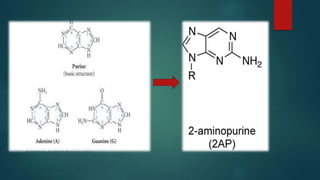
 Analogs of nucleotides and other chemicals were later used to generate
localized point mutations.
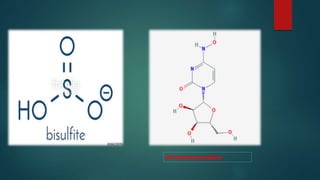
examples of such chemicals are aminopurine and bisulfite.
 Site-directed mutagenesis was achieved in 1974 in the laboratory of
Charles Weissmann using a nucleotide analogue N4-hydroxycytidine,
which induces transition of A-T to G-C.
 Michael Smith in 1978 a more flexible approach to site-directed
mutagenesis by using oligonucleotides in a primer extension method with
DNA polymerase.
N4-hydroxycytidine
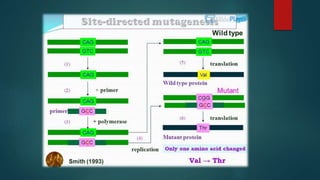
Site- directed mutagenesis
Site – Directed mutagenesis is also known as Site specific Mutagenesis.
SDM is a molecular biology technique in which a mutation is created at a
defined site in a DNA molecule known as Plasmid.
OR
Site – Directed mutagenesis is a powerful technique where site specific
changes in DNA sequences are produced in vitro for instance to change an
amino acid residue into another by changing the codon sequence within the
gene sequence.
Purpose of Site Directed
Mutagenesis?
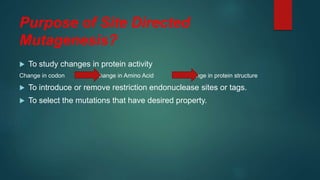
 To study changes in protein activity
Change in codon change in Amino Acid Change in protein structure
 To introduce or remove restriction endonuclease sites or tags.
 To select the mutations that have desired property.
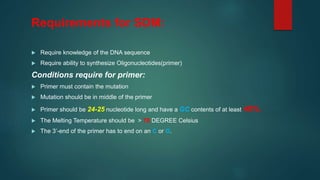
Requirements for SDM:
 Require knowledge of the DNA sequence
 Require ability to synthesize Oligonucleotides(primer)
Conditions require for primer:
 Primer must contain the mutation
 Mutation should be in middle of the primer
 Primer should be 24-25 nucleotide long and have a GC contents of at least 40%.
 The Melting Temperature should be > 78 DEGREE Celsius
 The 3’-end of the primer has to end on an C or G.
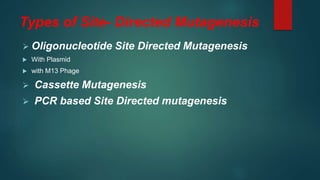
Types of Site- Directed Mutagenesis
 Oligonucleotide Site Directed Mutagenesis
 With Plasmid
 with M13 Phage
 Cassette Mutagenesis
 PCR based Site Directed mutagenesis
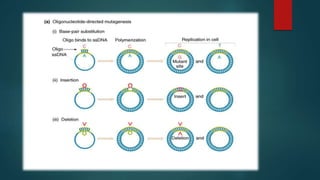
Oligonucleotide site directed mutagenesis
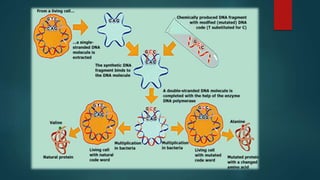
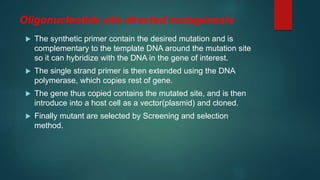
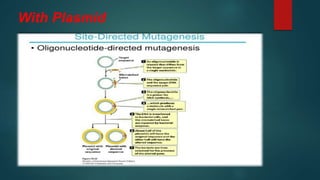
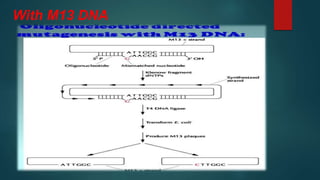
 The synthetic primer contain the desired mutation and is
complementary to the template DNA around the mutation site
so it can hybridize with the DNA in the gene of interest.
 The single strand primer is then extended using the DNA
polymerase, which copies rest of gene.
 The gene thus copied contains the mutated site, and is then
introduce into a host cell as a vector(plasmid) and cloned.
 Finally mutant are selected by Screening and selection
method.
With Plasmid
With M13 DNA
Basic Methods
 Oligonucleotide site directed mutagenesis occurs in 3
ways
1. Insertion of neucleotides
2. Deletion of neucleotides
3. Base pair substitution
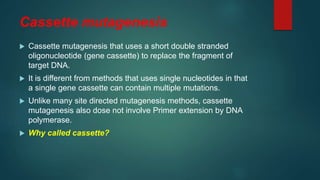
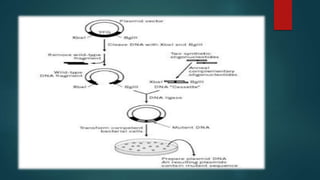
Cassette mutagenesis
 Cassette mutagenesis that uses a short double stranded
oligonucleotide (gene cassette) to replace the fragment of
target DNA.
 It is different from methods that uses single nucleotides in that
a single gene cassette can contain multiple mutations.
 Unlike many site directed mutagenesis methods, cassette
mutagenesis also dose not involve Primer extension by DNA
polymerase.
 Why called cassette?
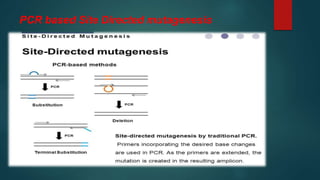
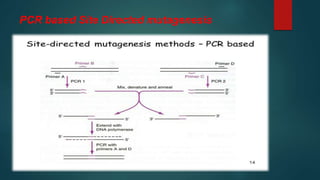
PCR based Site Directed mutagenesis
Applications
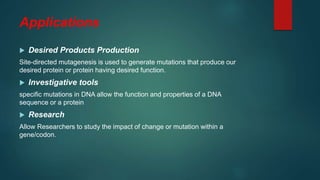
 Desired Products Production
Site-directed mutagenesis is used to generate mutations that produce our
desired protein or protein having desired function.
 Investigative tools
specific mutations in DNA allow the function and properties of a DNA
sequence or a protein
 Research
Allow Researchers to study the impact of change or mutation within a
gene/codon.
Commercial applications
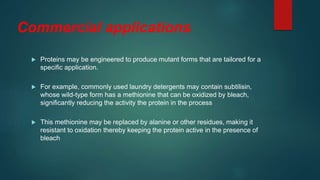
 Proteins may be engineered to produce mutant forms that are tailored for a
specific application.
 For example, commonly used laundry detergents may contain subtilisin,
whose wild-type form has a methionine that can be oxidized by bleach,
significantly reducing the activity the protein in the process
 This methionine may be replaced by alanine or other residues, making it
resistant to oxidation thereby keeping the protein active in the presence of
bleach
Future Aspects
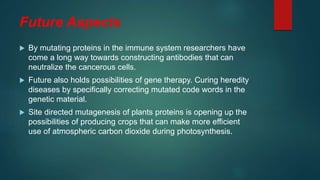
 By mutating proteins in the immune system researchers have
come a long way towards constructing antibodies that can
neutralize the cancerous cells.
 Future also holds possibilities of gene therapy. Curing heredity
diseases by specifically correcting mutated code words in the
genetic material.
 Site directed mutagenesis of plants proteins is opening up the
possibilities of producing crops that can make more efficient
use of atmospheric carbon dioxide during photosynthesis.
Conclusion
 Any amino acid in a protein can be selectively
replaced with another amino acid
 The replacement are made at the genetic level by
modifying the codon to incorporate the new amino
acid
 Characterizing the mutant enzyme that is obtained
will provide information on the role of amino acid that
has been replaced.
Site  directed mutagenesis

Site directed mutagenesis

  • 1.
  • 2.
    Assigned by: Dr. SajjadAli Presented by: Zain Ahsan Maira Akram Mubeen Shahzadi
  • 3.
    Contents  Mutation vsMutagenesis  History  Site Directed Mutagenesis  Types of Site Directed Mutagenesis  Oligonucleotide site directed Mutagenesis  Cassette Mutagenesis  PCR site directed mutagenesis  Applications  Future Aspects  Conclusion
  • 4.
    Mutation vs Mutagenesis Mutation Mutationis defined as random and permanent change in a DNA sequence which caused by some mutagens that can be a viruses ,mutagenic chemicals,transpsonse and radiations as well as errors that occur during meiosis or DNA replication. Chemicals- 1. Ethyl methane sulfonate 2. Methyl methane sulfonate Mutagenesis Genesis means to synthesize something Mutagenesis is defined as” to generate mutation” in a DNA for a particular cause. Mutagenesis gives us the capability of testing the role of any amino acid in a protein by replacing it with any of the other naturally occurring amino acids
  • 5.
    Types Of Mutagenesis Random mutagenesis: In this type the mutation can be generated , at any region of DNA sequence, randomly.  Sited-directed Mutagenesis: It is the process of creating specific, targeted changes in DNA. Like change in specific gene or of specific nucleotide.
  • 6.
    History  Early attemptsat mutagenesis using radiation or chemical mutagens were non-site-specific they generate random mutations.  Analogs of nucleotides and other chemicals were later used to generate localized point mutations. examples of such chemicals are aminopurine and bisulfite.  Site-directed mutagenesis was achieved in 1974 in the laboratory of Charles Weissmann using a nucleotide analogue N4-hydroxycytidine, which induces transition of A-T to G-C.  Michael Smith in 1978 a more flexible approach to site-directed mutagenesis by using oligonucleotides in a primer extension method with DNA polymerase.
  • 8.
  • 9.
    Site- directed mutagenesis Site– Directed mutagenesis is also known as Site specific Mutagenesis. SDM is a molecular biology technique in which a mutation is created at a defined site in a DNA molecule known as Plasmid. OR Site – Directed mutagenesis is a powerful technique where site specific changes in DNA sequences are produced in vitro for instance to change an amino acid residue into another by changing the codon sequence within the gene sequence.
  • 10.
    Purpose of SiteDirected Mutagenesis?  To study changes in protein activity Change in codon change in Amino Acid Change in protein structure  To introduce or remove restriction endonuclease sites or tags.  To select the mutations that have desired property.
  • 11.
    Requirements for SDM: Require knowledge of the DNA sequence  Require ability to synthesize Oligonucleotides(primer) Conditions require for primer:  Primer must contain the mutation  Mutation should be in middle of the primer  Primer should be 24-25 nucleotide long and have a GC contents of at least 40%.  The Melting Temperature should be > 78 DEGREE Celsius  The 3’-end of the primer has to end on an C or G.
  • 14.
    Types of Site-Directed Mutagenesis  Oligonucleotide Site Directed Mutagenesis  With Plasmid  with M13 Phage  Cassette Mutagenesis  PCR based Site Directed mutagenesis
  • 15.
    Oligonucleotide site directedmutagenesis  The synthetic primer contain the desired mutation and is complementary to the template DNA around the mutation site so it can hybridize with the DNA in the gene of interest.  The single strand primer is then extended using the DNA polymerase, which copies rest of gene.  The gene thus copied contains the mutated site, and is then introduce into a host cell as a vector(plasmid) and cloned.  Finally mutant are selected by Screening and selection method.
  • 16.
  • 17.
  • 18.
    Basic Methods  Oligonucleotidesite directed mutagenesis occurs in 3 ways 1. Insertion of neucleotides 2. Deletion of neucleotides 3. Base pair substitution
  • 20.
    Cassette mutagenesis  Cassettemutagenesis that uses a short double stranded oligonucleotide (gene cassette) to replace the fragment of target DNA.  It is different from methods that uses single nucleotides in that a single gene cassette can contain multiple mutations.  Unlike many site directed mutagenesis methods, cassette mutagenesis also dose not involve Primer extension by DNA polymerase.  Why called cassette?
  • 22.
    PCR based SiteDirected mutagenesis
  • 23.
    PCR based SiteDirected mutagenesis
  • 24.
    Applications  Desired ProductsProduction Site-directed mutagenesis is used to generate mutations that produce our desired protein or protein having desired function.  Investigative tools specific mutations in DNA allow the function and properties of a DNA sequence or a protein  Research Allow Researchers to study the impact of change or mutation within a gene/codon.
  • 25.
    Commercial applications  Proteinsmay be engineered to produce mutant forms that are tailored for a specific application.  For example, commonly used laundry detergents may contain subtilisin, whose wild-type form has a methionine that can be oxidized by bleach, significantly reducing the activity the protein in the process  This methionine may be replaced by alanine or other residues, making it resistant to oxidation thereby keeping the protein active in the presence of bleach
  • 26.
    Future Aspects  Bymutating proteins in the immune system researchers have come a long way towards constructing antibodies that can neutralize the cancerous cells.  Future also holds possibilities of gene therapy. Curing heredity diseases by specifically correcting mutated code words in the genetic material.  Site directed mutagenesis of plants proteins is opening up the possibilities of producing crops that can make more efficient use of atmospheric carbon dioxide during photosynthesis.
  • 27.
    Conclusion  Any aminoacid in a protein can be selectively replaced with another amino acid  The replacement are made at the genetic level by modifying the codon to incorporate the new amino acid  Characterizing the mutant enzyme that is obtained will provide information on the role of amino acid that has been replaced.