KNOCK OUT MICE
DR. KHUSHBOO BHOJWANI
BDS, MSC PHARMACEUTICAL MEDICINE
KNOCKOUT MICE
• A knockout mouse is a genetically engineered mouse in
which one or more genes have been turned off through a
gene knockout
• Important animal models for studying the role of genes
which have been sequenced, but have unknown functions
• By causing a specific gene to be inactive in the mouse,
and observing any differences from normal behaviour or
condition, researchers can infer its probable function.
TRANSGENICS
 This technique permits the introduction of foreign genes or
altered forms of an endogenous gene into an organism
 Mostly, this technique does not result in replacement of
the endogenous gene, but rather the integration of
additional copies of it
 The introduced gene is called transgene and the organism
carrying it is referred to as transgenic
KNOCKOUT VS. TRANSGENIC
MOUSE?
Knockout:
-gene inactivated
-homologous recombination
Transgenic:
- gene(s) added can be:
- a foreign gene
- extra copies of endogenous gene
- mutated endogenous gene
TRANSFERRING DNA INTO
EUKARYOTIC CELLS
• Production of both knockout and transgenic animals
requires the transfer of DNA into eukaryotic cells.
• Calcium precipitation
• Liposome delivery
• Microinjection
• Electroporation
•
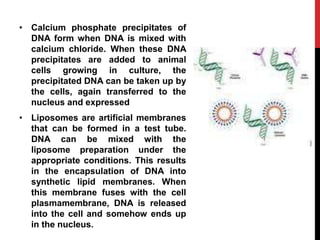
• Calcium phosphate precipitates of
DNA form when DNA is mixed with
calcium chloride. When these DNA
precipitates are added to animal
cells growing in culture, the
precipitated DNA can be taken up by
the cells, again transferred to the
nucleus and expressed
• Liposomes are artificial membranes
that can be formed in a test tube.
DNA can be mixed with the
liposome preparation under the
appropriate conditions. This results
in the encapsulation of DNA into
synthetic lipid membranes. When
this membrane fuses with the cell
plasmamembrane, DNA is released
into the cell and somehow ends up
in the nucleus.
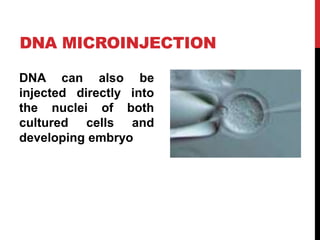
DNA MICROINJECTION
DNA can also be
injected directly into
the nuclei of both
cultured cells and
developing embryo
ELECTROPORATION
• Cells are subjected to a brief electric
shock of several thousand volts and
become transiently permeable to DNA.
Presumably the shock briefly opens holes
in the cell membrane allowing the DNA to
enter the cells before the holes reseal
DNA INCORPORATION IN THE
CELL
 Once the foreign DNA is inside the host cell, enzymes that
function normally in DNA repair and recombination join the
fragments of foreign DNA into the host cells chromosome
 The new fragment can either replace an endogenous gene-
homologous recombination or it can remain as an
independent extrachromosomal DNA molecule referred to
as an episome
IDENTIFICATION OF
TRANSGENIC CELLS
• Since only a relatively small fraction of cells take up DNA,
a selective technique must be available to identify the
transgenic cells
• In most cases the exogenous DNA includes two additional
genes
• The small fraction of cells in which homologous
recombination takes place can be identified by a
combination of positive and negative selection
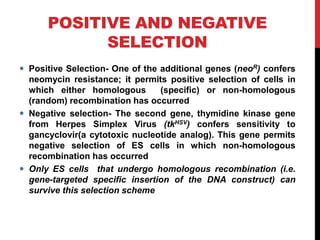
POSITIVE AND NEGATIVE
SELECTION
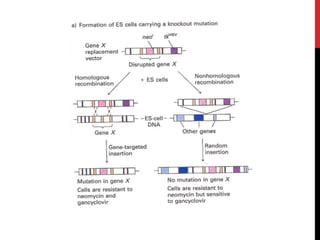
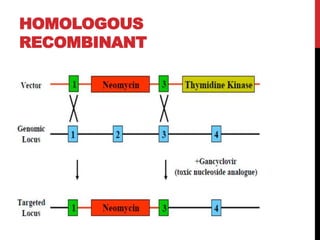
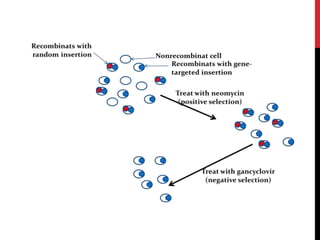
 Positive Selection- One of the additional genes (neoR) confers
neomycin resistance; it permits positive selection of cells in
which either homologous (specific) or non-homologous
(random) recombination has occurred
 Negative selection- The second gene, thymidine kinase gene
from Herpes Simplex Virus (tkHSV) confers sensitivity to
gancyclovir(a cytotoxic nucleotide analog). This gene permits
negative selection of ES cells in which non-homologous
recombination has occurred
 Only ES cells that undergo homologous recombination (i.e.
gene-targeted specific insertion of the DNA construct) can
survive this selection scheme
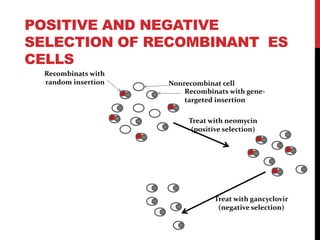
POSITIVE AND NEGATIVE
SELECTION OF RECOMBINANT ES
CELLS
Recombinats with
random insertion Nonrecombinat cell
Recombinats with gene-
targeted insertion
Treat with neomycin
(positive selection)
Treat with gancyclovir
(negative selection)
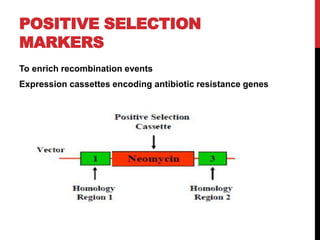
POSITIVE SELECTION
MARKERS
To enrich recombination events
Expression cassettes encoding antibiotic resistance genes
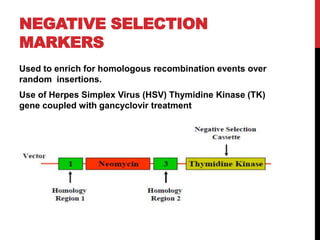
NEGATIVE SELECTION
MARKERS
Used to enrich for homologous recombination events over
random insertions.
Use of Herpes Simplex Virus (HSV) Thymidine Kinase (TK)
gene coupled with gancyclovir treatment
HOMOLOGOUS
RECOMBINANT
KNOCKOUT MICE
Gene knockout is a technique for selectively inactivating a
gene by replacing it with a mutant allele in an otherwise
normal organism (mice)
Knockout mice are a useful model system for studying
certain human genetic diseases.
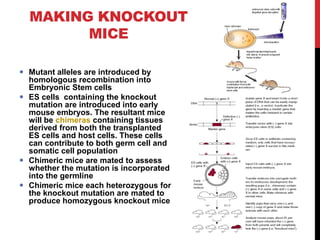
MAKING KNOCKOUT
MICE
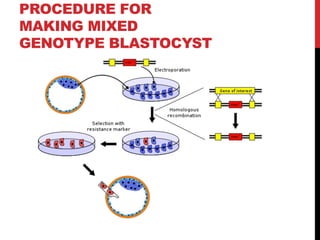
 Mutant alleles are introduced by
homologous recombination into
Embryonic Stem cells
 ES cells containing the knockout
mutation are introduced into early
mouse embryos. The resultant mice
will be chimeras containing tissues
derived from both the transplanted
ES cells and host cells. These cells
can contribute to both germ cell and
somatic cell population
 Chimeric mice are mated to assess
whether the mutation is incorporated
into the germline
 Chimeric mice each heterozygous for
the knockout mutation are mated to
produce homozygous knockout mice
PROCEDURE FOR
MAKING MIXED
GENOTYPE BLASTOCYST
DRAWBACKS OF KNOCKOUT
MICE
• About 15% of gene knockouts are developmentally lethal
and therefore cannot grow into adult mice. Thus it
becomes difficult to determine the gene function in
adults.
• Many genes that participate in interesting gene pathways
are essential for either mouse development, viability or
fertility. Therefore , a traditional knock out of the gene can
never lead to the establishment of knockout mouse strain
for analysis
MICE - MODELS OF
HUMAN DISEASES
 Although the human is the mammal we are generally most
interested in learning more about, it is also the one animal
we cannot use for genetic experiments for obvious ethical
reasons
 Mice naturally develop conditions that mimic human
disease, such as cardiovascular disease, cancer and
diabetes
 Mouse are a favorite model for human disease because it
has a relatively low cost of maintenance and a generation
time that measures only nine weeks
 Developments in molecular biology and stem cell biology
have allowed researchers to create custom-made mice
through gene targeting in mouse embryonic stem (ES)
cells
 Certain diseases that afflict only humans, such as cystic
fibrosis and Alzheimer's can also be induced by
manipulating the mouse genome and environment
KNOCKOUT MICE TO STUDY
GENETIC DISEASES
Knockout mice make good model systems for investigating
the nature of genetic diseases and the efficacy of different
types of treatment and for developing effective gene
therapies to cure these often devastating diseases
For instance, the knockout mice for CFTR gene show
symptoms similar to those of humans with cystic fibrosis
RESEARCH USING KNOCKOUT
MICE
Examples of research in which knockout mice have been useful
include studying and modelling different kinds of
-obesity
-heart disease
-diabetes
-arthritis
-Parkinson’s disease
Knockout mice also offer a biological and scientific context in
which drugs and other therapies can be developed and tested.
TRANSGENIC ANIMALS
• Transgenic animals carry cloned genes that have integrated
randomly into the host genome
• Transgenic technology has numerous experimental application
and potential therapeutic value
• The frequency of random integration of exogenous DNA into
mouse genome at non-homologous sites is very high, therefore,
the production of transgenic mice is a highly efficient and
straightforward process
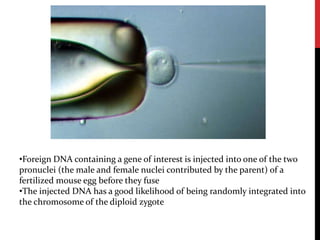
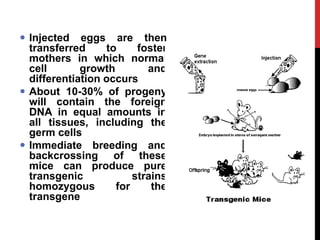
•Foreign DNA containing a gene of interest is injected into one of the two
pronuclei (the male and female nuclei contributed by the parent) of a
fertilized mouse egg before they fuse
•The injected DNA has a good likelihood of being randomly integrated into
the chromosome of the diploid zygote
 Injected eggs are then
transferred to foster
mothers in which normal
cell growth and
differentiation occurs
 About 10-30% of progeny
will contain the foreign
DNA in equal amounts in
all tissues, including the
germ cells
 Immediate breeding and
backcrossing of these
mice can produce pure
transgenic strains
homozygous for the
transgene
TRANSGENICS AND GENE
THERAPY
 Once a gene mutation is identified to be the cause of a
disease, the next step is to cure the disease by introducing
normal genes( transgene) into affected individual
 In experimental animals, some genetic disorders have
been cured by gene therapy, but in humans, numerous
technical issues need to be resolved before it can be
widely used
a) how to reliably and safely introduce various genes
into human cells
b) tissue/ cell specific introduction of genes
c) large size of genes
d)how to address the ethical issues

Knock out mice

  • 1.
    KNOCK OUT MICE DR.KHUSHBOO BHOJWANI BDS, MSC PHARMACEUTICAL MEDICINE
  • 2.
    KNOCKOUT MICE • Aknockout mouse is a genetically engineered mouse in which one or more genes have been turned off through a gene knockout • Important animal models for studying the role of genes which have been sequenced, but have unknown functions • By causing a specific gene to be inactive in the mouse, and observing any differences from normal behaviour or condition, researchers can infer its probable function.
  • 3.
    TRANSGENICS  This techniquepermits the introduction of foreign genes or altered forms of an endogenous gene into an organism  Mostly, this technique does not result in replacement of the endogenous gene, but rather the integration of additional copies of it  The introduced gene is called transgene and the organism carrying it is referred to as transgenic
  • 4.
    KNOCKOUT VS. TRANSGENIC MOUSE? Knockout: -geneinactivated -homologous recombination Transgenic: - gene(s) added can be: - a foreign gene - extra copies of endogenous gene - mutated endogenous gene
  • 5.
    TRANSFERRING DNA INTO EUKARYOTICCELLS • Production of both knockout and transgenic animals requires the transfer of DNA into eukaryotic cells. • Calcium precipitation • Liposome delivery • Microinjection • Electroporation •
  • 6.
    • Calcium phosphateprecipitates of DNA form when DNA is mixed with calcium chloride. When these DNA precipitates are added to animal cells growing in culture, the precipitated DNA can be taken up by the cells, again transferred to the nucleus and expressed • Liposomes are artificial membranes that can be formed in a test tube. DNA can be mixed with the liposome preparation under the appropriate conditions. This results in the encapsulation of DNA into synthetic lipid membranes. When this membrane fuses with the cell plasmamembrane, DNA is released into the cell and somehow ends up in the nucleus.
  • 7.
    DNA MICROINJECTION DNA canalso be injected directly into the nuclei of both cultured cells and developing embryo
  • 8.
    ELECTROPORATION • Cells aresubjected to a brief electric shock of several thousand volts and become transiently permeable to DNA. Presumably the shock briefly opens holes in the cell membrane allowing the DNA to enter the cells before the holes reseal
  • 9.
    DNA INCORPORATION INTHE CELL  Once the foreign DNA is inside the host cell, enzymes that function normally in DNA repair and recombination join the fragments of foreign DNA into the host cells chromosome  The new fragment can either replace an endogenous gene- homologous recombination or it can remain as an independent extrachromosomal DNA molecule referred to as an episome
  • 10.
    IDENTIFICATION OF TRANSGENIC CELLS •Since only a relatively small fraction of cells take up DNA, a selective technique must be available to identify the transgenic cells • In most cases the exogenous DNA includes two additional genes • The small fraction of cells in which homologous recombination takes place can be identified by a combination of positive and negative selection
  • 11.
    POSITIVE AND NEGATIVE SELECTION Positive Selection- One of the additional genes (neoR) confers neomycin resistance; it permits positive selection of cells in which either homologous (specific) or non-homologous (random) recombination has occurred  Negative selection- The second gene, thymidine kinase gene from Herpes Simplex Virus (tkHSV) confers sensitivity to gancyclovir(a cytotoxic nucleotide analog). This gene permits negative selection of ES cells in which non-homologous recombination has occurred  Only ES cells that undergo homologous recombination (i.e. gene-targeted specific insertion of the DNA construct) can survive this selection scheme
  • 13.
    POSITIVE AND NEGATIVE SELECTIONOF RECOMBINANT ES CELLS Recombinats with random insertion Nonrecombinat cell Recombinats with gene- targeted insertion Treat with neomycin (positive selection) Treat with gancyclovir (negative selection)
  • 14.
    POSITIVE SELECTION MARKERS To enrichrecombination events Expression cassettes encoding antibiotic resistance genes
  • 15.
    NEGATIVE SELECTION MARKERS Used toenrich for homologous recombination events over random insertions. Use of Herpes Simplex Virus (HSV) Thymidine Kinase (TK) gene coupled with gancyclovir treatment
  • 16.
  • 18.
    KNOCKOUT MICE Gene knockoutis a technique for selectively inactivating a gene by replacing it with a mutant allele in an otherwise normal organism (mice) Knockout mice are a useful model system for studying certain human genetic diseases.
  • 19.
    MAKING KNOCKOUT MICE  Mutantalleles are introduced by homologous recombination into Embryonic Stem cells  ES cells containing the knockout mutation are introduced into early mouse embryos. The resultant mice will be chimeras containing tissues derived from both the transplanted ES cells and host cells. These cells can contribute to both germ cell and somatic cell population  Chimeric mice are mated to assess whether the mutation is incorporated into the germline  Chimeric mice each heterozygous for the knockout mutation are mated to produce homozygous knockout mice
  • 20.
  • 21.
    DRAWBACKS OF KNOCKOUT MICE •About 15% of gene knockouts are developmentally lethal and therefore cannot grow into adult mice. Thus it becomes difficult to determine the gene function in adults. • Many genes that participate in interesting gene pathways are essential for either mouse development, viability or fertility. Therefore , a traditional knock out of the gene can never lead to the establishment of knockout mouse strain for analysis
  • 22.
    MICE - MODELSOF HUMAN DISEASES  Although the human is the mammal we are generally most interested in learning more about, it is also the one animal we cannot use for genetic experiments for obvious ethical reasons  Mice naturally develop conditions that mimic human disease, such as cardiovascular disease, cancer and diabetes  Mouse are a favorite model for human disease because it has a relatively low cost of maintenance and a generation time that measures only nine weeks
  • 23.
     Developments inmolecular biology and stem cell biology have allowed researchers to create custom-made mice through gene targeting in mouse embryonic stem (ES) cells  Certain diseases that afflict only humans, such as cystic fibrosis and Alzheimer's can also be induced by manipulating the mouse genome and environment
  • 24.
    KNOCKOUT MICE TOSTUDY GENETIC DISEASES Knockout mice make good model systems for investigating the nature of genetic diseases and the efficacy of different types of treatment and for developing effective gene therapies to cure these often devastating diseases For instance, the knockout mice for CFTR gene show symptoms similar to those of humans with cystic fibrosis
  • 25.
    RESEARCH USING KNOCKOUT MICE Examplesof research in which knockout mice have been useful include studying and modelling different kinds of -obesity -heart disease -diabetes -arthritis -Parkinson’s disease Knockout mice also offer a biological and scientific context in which drugs and other therapies can be developed and tested.
  • 26.
    TRANSGENIC ANIMALS • Transgenicanimals carry cloned genes that have integrated randomly into the host genome • Transgenic technology has numerous experimental application and potential therapeutic value • The frequency of random integration of exogenous DNA into mouse genome at non-homologous sites is very high, therefore, the production of transgenic mice is a highly efficient and straightforward process
  • 27.
    •Foreign DNA containinga gene of interest is injected into one of the two pronuclei (the male and female nuclei contributed by the parent) of a fertilized mouse egg before they fuse •The injected DNA has a good likelihood of being randomly integrated into the chromosome of the diploid zygote
  • 28.
     Injected eggsare then transferred to foster mothers in which normal cell growth and differentiation occurs  About 10-30% of progeny will contain the foreign DNA in equal amounts in all tissues, including the germ cells  Immediate breeding and backcrossing of these mice can produce pure transgenic strains homozygous for the transgene
  • 29.
    TRANSGENICS AND GENE THERAPY Once a gene mutation is identified to be the cause of a disease, the next step is to cure the disease by introducing normal genes( transgene) into affected individual  In experimental animals, some genetic disorders have been cured by gene therapy, but in humans, numerous technical issues need to be resolved before it can be widely used a) how to reliably and safely introduce various genes into human cells b) tissue/ cell specific introduction of genes c) large size of genes d)how to address the ethical issues