CELL
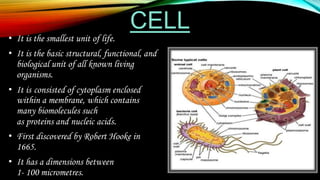
• It is the smallest unit of life.
• It is the basic structural, functional, and
biological unit of all known living
organisms.
• It is consisted of cytoplasm enclosed
within a membrane, which contains
many biomolecules such
as proteins and nucleic acids.
• First discovered by Robert Hooke in
1665.
• It has a dimensions between
1- 100 micrometres.
CELL LINE
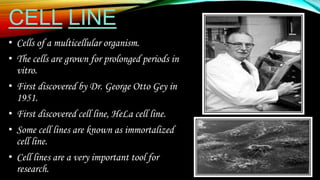
• Cells of a multicellular organism.
• The cells are grown for prolonged periods in
vitro.
• First discovered by Dr. George Otto Gey in
1951.
• First discovered cell line, HeLa cell line.
• Some cell lines are known as immortalized
cell line.
• Cell lines are a very important tool for
research.
CLASSIFICATION
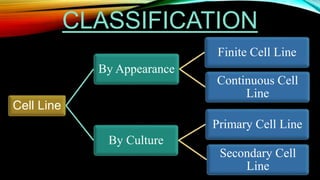
Cell Line
By Appearance
Finite Cell Line
Continuous Cell
Line
By Culture
Primary Cell Line
Secondary Cell
Line
BY APPEARANCE
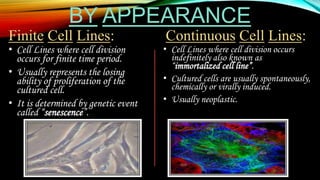
Finite Cell Lines:
• Cell Lines where cell division
occurs for finite time period.
• Usually represents the losing
ability of proliferation of the
cultured cell.
• It is determined by genetic event
called “senescence”.
Continuous Cell Lines:
• Cell Lines where cell division occurs
indefinitely also known as
“immortalized cell line”.
• Cultured cells are usually spontaneously,
chemically or virally induced.
• Usually neoplastic.
BY CULTURE
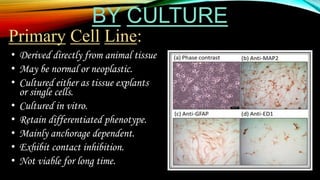
Primary Cell Line:
• Derived directly from animal tissue
• May be normal or neoplastic.
• Cultured either as tissue explants
or single cells.
• Cultured in vitro.
• Retain differentiated phenotype.
• Mainly anchorage dependent.
• Exhibit contact inhibition.
• Not viable for long time.
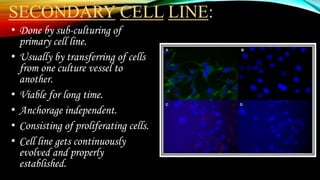
SECONDARY CELL LINE:
• Done by sub-culturing of
primary cell line.
• Usually by transferring of cells
from one culture vessel to
another.
• Viable for long time.
• Anchorage independent.
• Consisting of proliferating cells.
• Cell line gets continuously
evolved and properly
established.
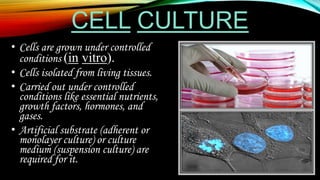
CELL CULTURE
• Cells are grown under controlled
conditions (in vitro).
• Cells isolated from living tissues.
• Carried out under controlled
conditions like essential nutrients,
growth factors, hormones, and
gases.
• Artificial substrate (adherent or
monolayer culture) or culture
medium (suspension culture) are
required for it.
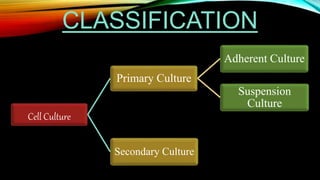
CLASSIFICATION
Cell Culture
Primary Culture
Adherent Culture
Suspension
Culture
Secondary Culture
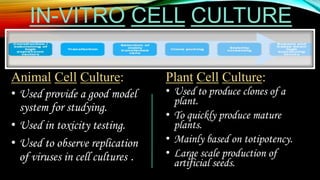
IN-VITRO CELL CULTURE
Animal Cell Culture:
• Used provide a good model
system for studying.
• Used in toxicity testing.
• Used to observe replication
of viruses in cell cultures .
Plant Cell Culture:
• Used to produce clones of a
plant.
• To quickly produce mature
plants.
• Mainly based on totipotency.
• Large scale production of
artificial seeds.
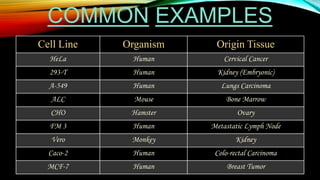
COMMON EXAMPLES
Cell Line Organism Origin Tissue
HeLa Human Cervical Cancer
293-T Human Kidney (Embryonic)
A-549 Human Lungs Carcinoma
ALC Mouse Bone Marrow
CHO Hamster Ovary
FM 3 Human Metastatic Lymph Node
Vero Monkey Kidney
Caco-2 Human Colo-rectal Carcinoma
MCF-7 Human Breast Tumor
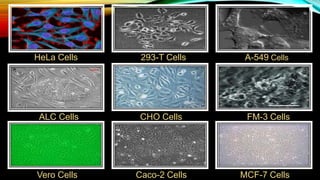
HeLa Cells 293-T Cells A-549 Cells
ALC Cells CHO Cells
Vero Cells Caco-2 Cells MCF-7 Cells
FM-3 Cells
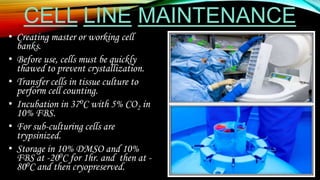
CELL LINE MAINTENANCE
• Creating master or working cell
banks.
• Before use, cells must be quickly
thawed to prevent crystallization.
• Transfer cells in tissue culture to
perform cell counting.
• Incubation in 370C with 5% CO2 in
10% FBS.
• For sub-culturing cells are
trypsinized.
• Storage in 10% DMSO and 10%
FBS at -200C for 1hr. and then at -
800C and then cryopreserved.
Primary and Secondary Cell Line

Primary and Secondary Cell Line

  • 2.
    CELL • It isthe smallest unit of life. • It is the basic structural, functional, and biological unit of all known living organisms. • It is consisted of cytoplasm enclosed within a membrane, which contains many biomolecules such as proteins and nucleic acids. • First discovered by Robert Hooke in 1665. • It has a dimensions between 1- 100 micrometres.
  • 3.
    CELL LINE • Cellsof a multicellular organism. • The cells are grown for prolonged periods in vitro. • First discovered by Dr. George Otto Gey in 1951. • First discovered cell line, HeLa cell line. • Some cell lines are known as immortalized cell line. • Cell lines are a very important tool for research.
  • 4.
    CLASSIFICATION Cell Line By Appearance FiniteCell Line Continuous Cell Line By Culture Primary Cell Line Secondary Cell Line
  • 5.
    BY APPEARANCE Finite CellLines: • Cell Lines where cell division occurs for finite time period. • Usually represents the losing ability of proliferation of the cultured cell. • It is determined by genetic event called “senescence”. Continuous Cell Lines: • Cell Lines where cell division occurs indefinitely also known as “immortalized cell line”. • Cultured cells are usually spontaneously, chemically or virally induced. • Usually neoplastic.
  • 6.
    BY CULTURE Primary CellLine: • Derived directly from animal tissue • May be normal or neoplastic. • Cultured either as tissue explants or single cells. • Cultured in vitro. • Retain differentiated phenotype. • Mainly anchorage dependent. • Exhibit contact inhibition. • Not viable for long time.
  • 7.
    SECONDARY CELL LINE: •Done by sub-culturing of primary cell line. • Usually by transferring of cells from one culture vessel to another. • Viable for long time. • Anchorage independent. • Consisting of proliferating cells. • Cell line gets continuously evolved and properly established.
  • 8.
    CELL CULTURE • Cellsare grown under controlled conditions (in vitro). • Cells isolated from living tissues. • Carried out under controlled conditions like essential nutrients, growth factors, hormones, and gases. • Artificial substrate (adherent or monolayer culture) or culture medium (suspension culture) are required for it.
  • 9.
    CLASSIFICATION Cell Culture Primary Culture AdherentCulture Suspension Culture Secondary Culture
  • 10.
    IN-VITRO CELL CULTURE AnimalCell Culture: • Used provide a good model system for studying. • Used in toxicity testing. • Used to observe replication of viruses in cell cultures . Plant Cell Culture: • Used to produce clones of a plant. • To quickly produce mature plants. • Mainly based on totipotency. • Large scale production of artificial seeds.
  • 11.
    COMMON EXAMPLES Cell LineOrganism Origin Tissue HeLa Human Cervical Cancer 293-T Human Kidney (Embryonic) A-549 Human Lungs Carcinoma ALC Mouse Bone Marrow CHO Hamster Ovary FM 3 Human Metastatic Lymph Node Vero Monkey Kidney Caco-2 Human Colo-rectal Carcinoma MCF-7 Human Breast Tumor
  • 12.
    HeLa Cells 293-TCells A-549 Cells ALC Cells CHO Cells Vero Cells Caco-2 Cells MCF-7 Cells FM-3 Cells
  • 13.
    CELL LINE MAINTENANCE •Creating master or working cell banks. • Before use, cells must be quickly thawed to prevent crystallization. • Transfer cells in tissue culture to perform cell counting. • Incubation in 370C with 5% CO2 in 10% FBS. • For sub-culturing cells are trypsinized. • Storage in 10% DMSO and 10% FBS at -200C for 1hr. and then at - 800C and then cryopreserved.