14/03/2013
1
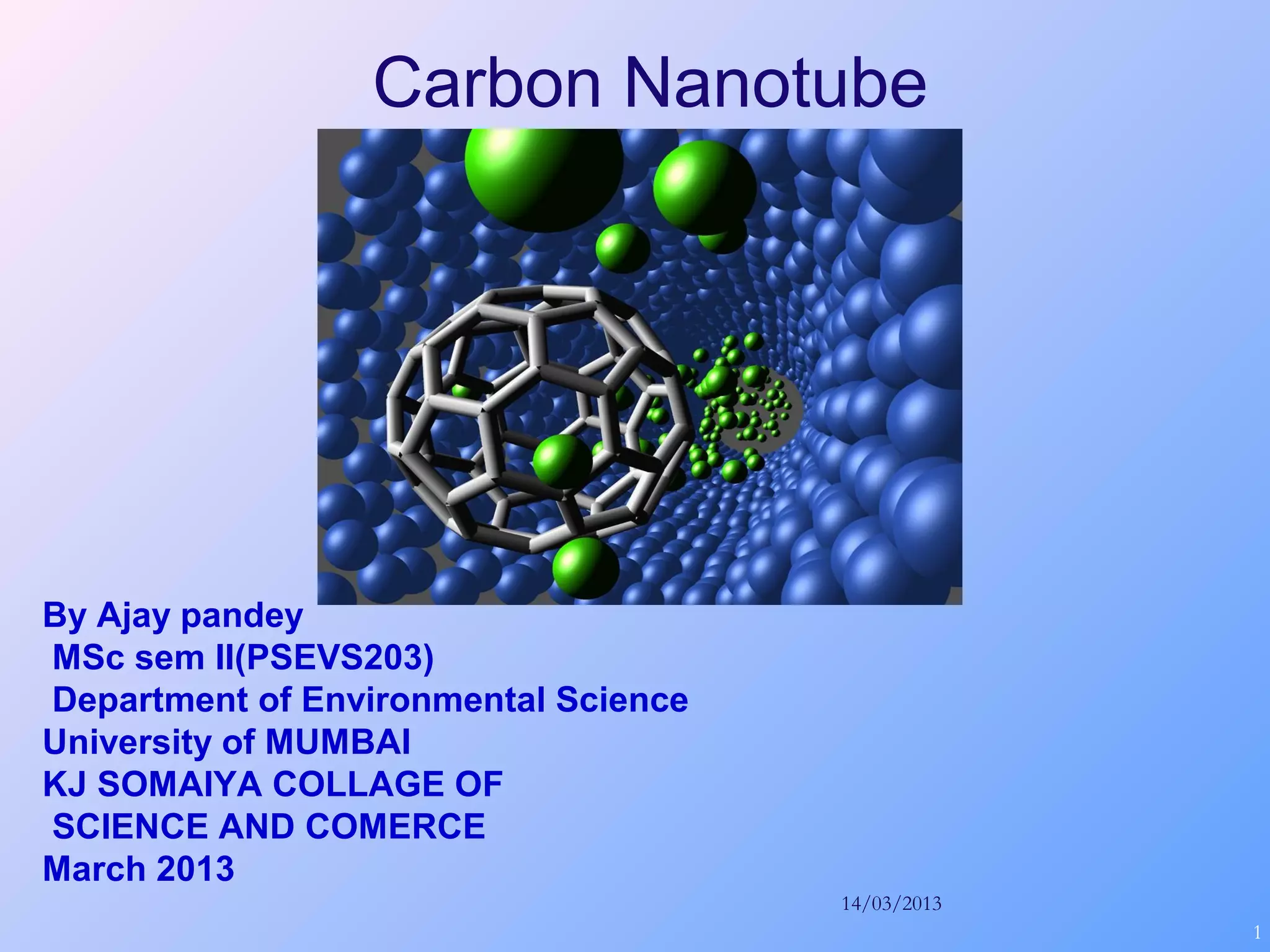
Carbon Nanotube
By Ajay pandey
MSc sem II(PSEVS203)
Department of Environmental Science
University of MUMBAI
KJ SOMAIYA COLLAGE OF
SCIENCE AND COMERCE
March 2013
14/03/2013 2
 Introduction
 Structure Formation Mechanism
 Synthesis
 Properties
 Applications
 Scope
 Conclusions
Outline
14/03/2013
3
Introduction
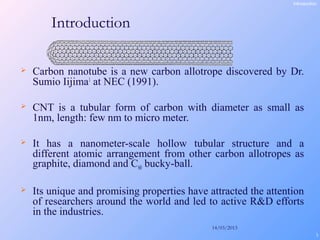
 Carbon nanotube is a new carbon allotrope discovered by Dr.
Sumio Iijima1
at NEC (1991).
 CNT is a tubular form of carbon with diameter as small as
1nm, length: few nm to micro meter.
 It has a nanometer-scale hollow tubular structure and a
different atomic arrangement from other carbon allotropes as
graphite, diamond and C60 bucky-ball.
 Its unique and promising properties have attracted the attention
of researchers around the world and led to active R&D efforts
in the industries.
Introduction
14/03/2013
4
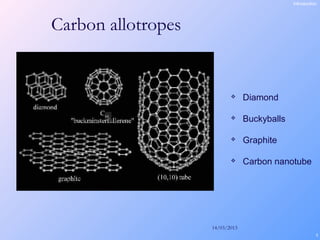
Carbon allotropes
Introduction
 Diamond
 Buckyballs
 Graphite
 Carbon nanotube
14/03/2013
5
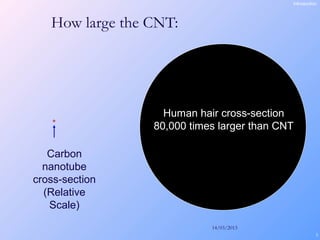
How large the CNT:
°
Carbon
nanotube
cross-section
(Relative
Scale)
Human hair cross-section
80,000 times larger than CNT
Introduction
14/03/2013
6
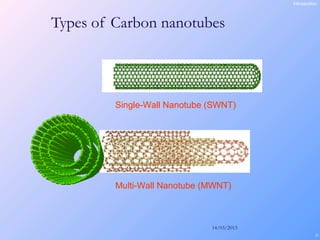
Types of Carbon nanotubes
Single-Wall Nanotube (SWNT)
Multi-Wall Nanotube (MWNT)
Introduction
14/03/2013
7
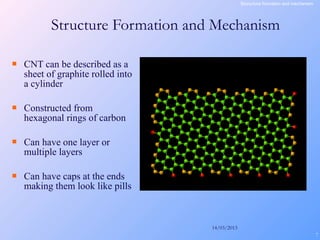
Structure Formation and Mechanism
Sturucture fromation and mechanism
 CNT can be described as a
sheet of graphite rolled into
a cylinder
 Constructed from
hexagonal rings of carbon
 Can have one layer or
multiple layers
 Can have caps at the ends
making them look like pills
14/03/2013
8
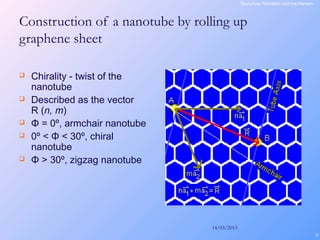
Construction of a nanotube by rolling up
graphene sheet
 Chirality - twist of the
nanotube
 Described as the vector
R (n, m)
 Φ = 0º, armchair nanotube
 0º < Φ < 30º, chiral
nanotube
 Φ > 30º, zigzag nanotube
Sturucture fromation and mechanism
14/03/2013
9
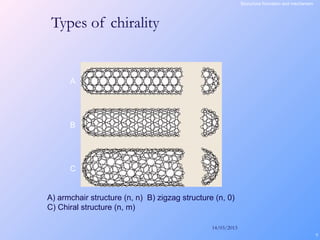
Types of chirality
A) armchair structure (n, n) B) zigzag structure (n, 0)
C) Chiral structure (n, m)
A
B
C
Sturucture fromation and mechanism
14/03/2013
10
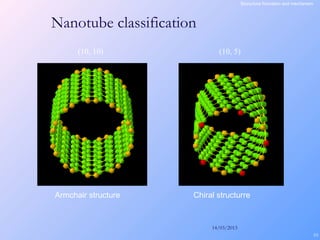
Nanotube classification
Sturucture fromation and mechanism
(10, 10) (10, 5)
Chiral structurreArmchair structure
14/03/2013
11
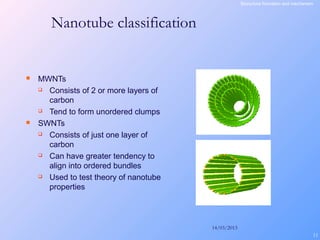
 MWNTs
 Consists of 2 or more layers of
carbon
 Tend to form unordered clumps
 SWNTs
 Consists of just one layer of
carbon
 Can have greater tendency to
align into ordered bundles
 Used to test theory of nanotube
properties
Nanotube classification
Sturucture fromation and mechanism
14/03/2013
12
Synthesis Methods of CNT
 Arc Discharge method
- Nanotubes found in soot produced in arc-discharge with catalytic metals such as Fe,
Ni and Co (S. Iijima, 1991).
 Laser Ablation Method
- Nanotubes produced by pulsed YAG laser ablation of graphite target in a furnace at
1200 °C. (R. Smalley, 1996).
 Chemical Vapor diposition (CVD)
- Nanotubes are grown from nucleation sites of a catalyst in carbon based gas
environments (Ethylene, Methane, etc.) at elevated temperatures (600 - 1000 °C).
Synthesis
14/03/2013
13
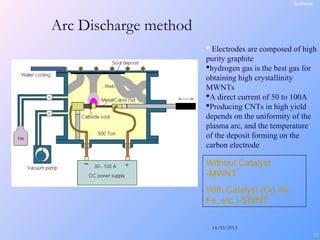
Arc Discharge method
Synthesis
Without Catalyst
-MWNT
With Catalyst (Co, Ni,
Fe, etc.)-SWNT
 Electrodes are composed of high
purity graphite
hydrogen gas is the best gas for
obtaining high crystallinity
MWNTs
A direct current of 50 to 100A
Producing CNTs in high yield
depends on the uniformity of the
plasma arc, and the temperature
of the deposit forming on the
carbon electrode
14/03/2013
14
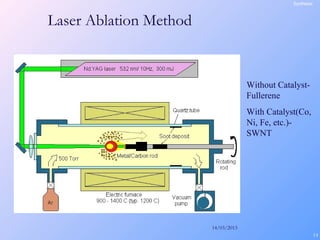
Laser Ablation Method
Synthesis
Without Catalyst-
Fullerene
With Catalyst(Co,
Ni, Fe, etc.)-
SWNT
15
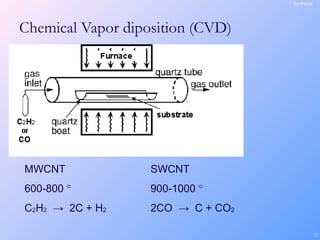
Chemical Vapor diposition (CVD)
Synthesis
SWCNT
900-1000 °
2CO → C + CO2
MWCNT
600-800 °
C2H2 → 2C + H2
14/03/2013 16
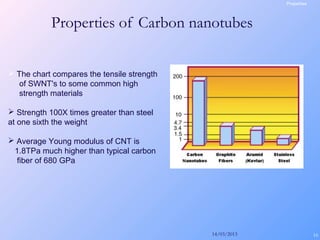
 The chart compares the tensile strength
of SWNT's to some common high
strength materials
 Strength 100X times greater than steel
at one sixth the weight
 Average Young modulus of CNT is
1.8TPa much higher than typical carbon
fiber of 680 GPa
Properties
Properties of Carbon nanotubes
17
Potential applications of CNT
Application Area
 Energy storage
- Hydrogen storage
- Lithium intercalation
- Electrochemical supercapcitors
 Molecular electronics
- Field emitting devices
- Transistors
 Nanoprobes and sensors
 Composite materials
Application
18
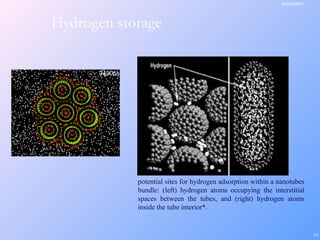
Hydrogen storage
potential sites for hydrogen adsorption within a nanotubes
bundle: (left) hydrogen atoms occupying the interstitial
spaces between the tubes, and (right) hydrogen atoms
inside the tube interior*.
Application
19
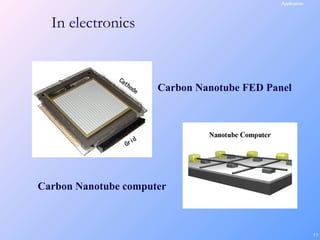
In electronics
Carbon Nanotube FED Panel
Carbon Nanotube computer
Application
14/03/2013
20
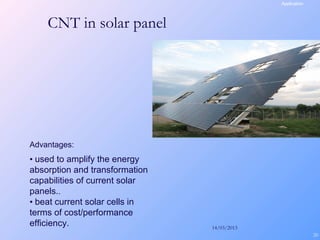
CNT in solar panel
Application
Advantages:
• used to amplify the energy
absorption and transformation
capabilities of current solar
panels..
• beat current solar cells in
terms of cost/performance
efficiency.
21
Application
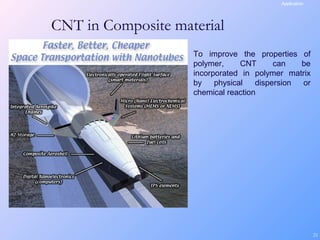
CNT in Composite material
To improve the properties of
polymer, CNT can be
incorporated in polymer matrix
by physical dispersion or
chemical reaction
14/03/2013
22
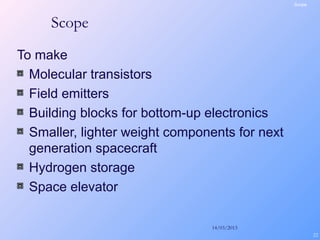
Scope
To make
Molecular transistors
Field emitters
Building blocks for bottom-up electronics
Smaller, lighter weight components for next
generation spacecraft
Hydrogen storage
Space elevator
Scope
23
Issues
 The controlled functionalization of CNT has
not yet been fully achieved
 Solubility continues to be an issue
 New purification and characterization
techniques are still needed
 Effect on living cells has been still not studied
well
Scope
24
Conclusion
 Application of CNT in various field due to its robust
structure and metallic/ semiconducting properties makes
it one of the promising material in nanotechnology.
 There is saying that good things come in small packages
nanotechnology has certainly materializing this saying
 It has potential of making almost every manufacture
product faster, lighter, stronger, smarter, safer and
cleaner
 Although it is a very important material, effect on living
cell has to be studied in detail
Conclusion
references
 Books
 Sulabha k.kulkarni (2007) Nanotechnology principle and practices. New Delhi: capital
publishing company
 Chattopadhyay (2009) introduction to nanoscience and technology. New Delhi: PHL
learning private limited
 Website
 Marty Mulvihill (2013) advancing green chemistry
 http://advancinggreenchemistry.org/tag/green-design/ (accessed 20/2/2013)
 Carbon nanotube synthesis
 http://www.northeastern.edu/nsrg/?page_id=141 (accessed 20/2/2013)
 3. Increasing importance of carbon nanotube
http://www.ncbi.nlm.nih.gov/pubmed/20706831(accessed 20/2/2013)
 4. carbon nanotube http://en.wikipedia.org/wiki/Carbon_nanotube (accessed
20/2/2013)
26/09/2008Carbon nanotube : a leading material – Panjab Waghmare 25
14/03/2013
26
THANK YOU
FOR
ATTENTION

carbon nanotube

  • 1.
    14/03/2013 1 Carbon Nanotube By Ajaypandey MSc sem II(PSEVS203) Department of Environmental Science University of MUMBAI KJ SOMAIYA COLLAGE OF SCIENCE AND COMERCE March 2013
  • 2.
    14/03/2013 2  Introduction Structure Formation Mechanism  Synthesis  Properties  Applications  Scope  Conclusions Outline
  • 3.
    14/03/2013 3 Introduction  Carbon nanotubeis a new carbon allotrope discovered by Dr. Sumio Iijima1 at NEC (1991).  CNT is a tubular form of carbon with diameter as small as 1nm, length: few nm to micro meter.  It has a nanometer-scale hollow tubular structure and a different atomic arrangement from other carbon allotropes as graphite, diamond and C60 bucky-ball.  Its unique and promising properties have attracted the attention of researchers around the world and led to active R&D efforts in the industries. Introduction
  • 4.
    14/03/2013 4 Carbon allotropes Introduction  Diamond Buckyballs  Graphite  Carbon nanotube
  • 5.
    14/03/2013 5 How large theCNT: ° Carbon nanotube cross-section (Relative Scale) Human hair cross-section 80,000 times larger than CNT Introduction
  • 6.
    14/03/2013 6 Types of Carbonnanotubes Single-Wall Nanotube (SWNT) Multi-Wall Nanotube (MWNT) Introduction
  • 7.
    14/03/2013 7 Structure Formation andMechanism Sturucture fromation and mechanism  CNT can be described as a sheet of graphite rolled into a cylinder  Constructed from hexagonal rings of carbon  Can have one layer or multiple layers  Can have caps at the ends making them look like pills
  • 8.
    14/03/2013 8 Construction of ananotube by rolling up graphene sheet  Chirality - twist of the nanotube  Described as the vector R (n, m)  Φ = 0º, armchair nanotube  0º < Φ < 30º, chiral nanotube  Φ > 30º, zigzag nanotube Sturucture fromation and mechanism
  • 9.
    14/03/2013 9 Types of chirality A)armchair structure (n, n) B) zigzag structure (n, 0) C) Chiral structure (n, m) A B C Sturucture fromation and mechanism
  • 10.
    14/03/2013 10 Nanotube classification Sturucture fromationand mechanism (10, 10) (10, 5) Chiral structurreArmchair structure
  • 11.
    14/03/2013 11  MWNTs  Consistsof 2 or more layers of carbon  Tend to form unordered clumps  SWNTs  Consists of just one layer of carbon  Can have greater tendency to align into ordered bundles  Used to test theory of nanotube properties Nanotube classification Sturucture fromation and mechanism
  • 12.
    14/03/2013 12 Synthesis Methods ofCNT  Arc Discharge method - Nanotubes found in soot produced in arc-discharge with catalytic metals such as Fe, Ni and Co (S. Iijima, 1991).  Laser Ablation Method - Nanotubes produced by pulsed YAG laser ablation of graphite target in a furnace at 1200 °C. (R. Smalley, 1996).  Chemical Vapor diposition (CVD) - Nanotubes are grown from nucleation sites of a catalyst in carbon based gas environments (Ethylene, Methane, etc.) at elevated temperatures (600 - 1000 °C). Synthesis
  • 13.
    14/03/2013 13 Arc Discharge method Synthesis WithoutCatalyst -MWNT With Catalyst (Co, Ni, Fe, etc.)-SWNT  Electrodes are composed of high purity graphite hydrogen gas is the best gas for obtaining high crystallinity MWNTs A direct current of 50 to 100A Producing CNTs in high yield depends on the uniformity of the plasma arc, and the temperature of the deposit forming on the carbon electrode
  • 14.
    14/03/2013 14 Laser Ablation Method Synthesis WithoutCatalyst- Fullerene With Catalyst(Co, Ni, Fe, etc.)- SWNT
  • 15.
    15 Chemical Vapor diposition(CVD) Synthesis SWCNT 900-1000 ° 2CO → C + CO2 MWCNT 600-800 ° C2H2 → 2C + H2
  • 16.
    14/03/2013 16  Thechart compares the tensile strength of SWNT's to some common high strength materials  Strength 100X times greater than steel at one sixth the weight  Average Young modulus of CNT is 1.8TPa much higher than typical carbon fiber of 680 GPa Properties Properties of Carbon nanotubes
  • 17.
    17 Potential applications ofCNT Application Area  Energy storage - Hydrogen storage - Lithium intercalation - Electrochemical supercapcitors  Molecular electronics - Field emitting devices - Transistors  Nanoprobes and sensors  Composite materials Application
  • 18.
    18 Hydrogen storage potential sitesfor hydrogen adsorption within a nanotubes bundle: (left) hydrogen atoms occupying the interstitial spaces between the tubes, and (right) hydrogen atoms inside the tube interior*. Application
  • 19.
    19 In electronics Carbon NanotubeFED Panel Carbon Nanotube computer Application
  • 20.
    14/03/2013 20 CNT in solarpanel Application Advantages: • used to amplify the energy absorption and transformation capabilities of current solar panels.. • beat current solar cells in terms of cost/performance efficiency.
  • 21.
    21 Application CNT in Compositematerial To improve the properties of polymer, CNT can be incorporated in polymer matrix by physical dispersion or chemical reaction
  • 22.
    14/03/2013 22 Scope To make Molecular transistors Fieldemitters Building blocks for bottom-up electronics Smaller, lighter weight components for next generation spacecraft Hydrogen storage Space elevator Scope
  • 23.
    23 Issues  The controlledfunctionalization of CNT has not yet been fully achieved  Solubility continues to be an issue  New purification and characterization techniques are still needed  Effect on living cells has been still not studied well Scope
  • 24.
    24 Conclusion  Application ofCNT in various field due to its robust structure and metallic/ semiconducting properties makes it one of the promising material in nanotechnology.  There is saying that good things come in small packages nanotechnology has certainly materializing this saying  It has potential of making almost every manufacture product faster, lighter, stronger, smarter, safer and cleaner  Although it is a very important material, effect on living cell has to be studied in detail Conclusion
  • 25.
    references  Books  Sulabhak.kulkarni (2007) Nanotechnology principle and practices. New Delhi: capital publishing company  Chattopadhyay (2009) introduction to nanoscience and technology. New Delhi: PHL learning private limited  Website  Marty Mulvihill (2013) advancing green chemistry  http://advancinggreenchemistry.org/tag/green-design/ (accessed 20/2/2013)  Carbon nanotube synthesis  http://www.northeastern.edu/nsrg/?page_id=141 (accessed 20/2/2013)  3. Increasing importance of carbon nanotube http://www.ncbi.nlm.nih.gov/pubmed/20706831(accessed 20/2/2013)  4. carbon nanotube http://en.wikipedia.org/wiki/Carbon_nanotube (accessed 20/2/2013) 26/09/2008Carbon nanotube : a leading material – Panjab Waghmare 25
  • 26.

Editor's Notes

  • #15 Ablation - Removing a surface material by vaporization
  • #16 Pyrolysis - decomposition of organic material through the application of heat and the absence of oxygen Typical Organic/Catalyst Mixtures Xylene/ferrocene (Andrews et al.) Toluene, benzene, xylene, mesitylene, and n-hexane/ferrocene (Vivekchand et al.) Ethylene and ethanol/Fe, Co, and Mo alloys (K. Mizuno et al.) Typical Carrier Gases Argon Hydrogen
  • #20 Field emission diode (FED)