Dr. Jivraj Mehta Institute Of Technology,
Mogar, Anand
Graphene
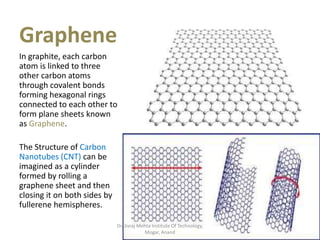
In graphite, each carbon
atom is linked to three
other carbon atoms
through covalent bonds
forming hexagonal rings
connected to each other to
form plane sheets known
as Graphene.
The Structure of Carbon
Nanotubes (CNT) can be
imagined as a cylinder
formed by rolling a
graphene sheet and then
closing it on both sides by
fullerene hemispheres.
Dr. Jivraj Mehta Institute Of Technology,
Mogar, Anand
Types of CNT
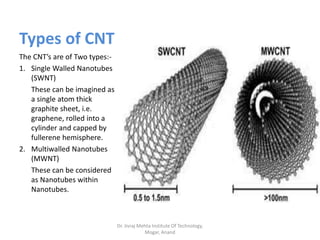
The CNT’s are of Two types:-
1. Single Walled Nanotubes
(SWNT)
These can be imagined as
a single atom thick
graphite sheet, i.e.
graphene, rolled into a
cylinder and capped by
fullerene hemisphere.
2. Multiwalled Nanotubes
(MWNT)
These can be considered
as Nanotubes within
Nanotubes.
Dr. Jivraj Mehta Institute Of Technology,
Mogar, Anand
Structure
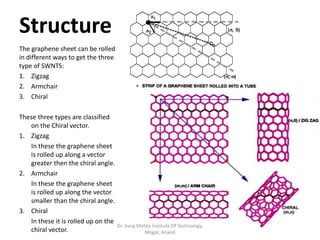
The graphene sheet can be rolled
in different ways to get the three
type of SWNTS:
1. Zigzag
2. Armchair
3. Chiral
These three types are classified
on the Chiral vector.
1. Zigzag
In these the graphene sheet
is rolled up along a vector
greater then the chiral angle.
2. Armchair
In these the graphene sheet
is rolled up along the vector
smaller than the chiral angle.
3. Chiral
In these it is rolled up on the
chiral vector.
Dr. Jivraj Mehta Institute Of Technology,
Mogar, Anand
Fabrication
• CNT’s can be fabricated by 3 method
Electric Arc Method
Laser Deposition
Chemical Vapor Deposition
Dr. Jivraj Mehta Institute Of Technology,
Mogar, Anand
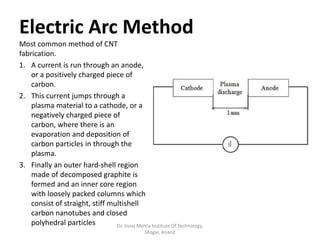
Electric Arc Method
Most common method of CNT
fabrication.
1. A current is run through an anode,
or a positively charged piece of
carbon.
2. This current jumps through a
plasma material to a cathode, or a
negatively charged piece of
carbon, where there is an
evaporation and deposition of
carbon particles in through the
plasma.
3. Finally an outer hard-shell region
made of decomposed graphite is
formed and an inner core region
with loosely packed columns which
consist of straight, stiff multishell
carbon nanotubes and closed
polyhedral particles Dr. Jivraj Mehta Institute Of Technology,
Mogar, Anand
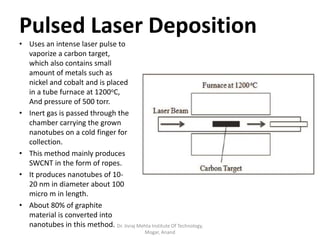
Pulsed Laser Deposition
• Uses an intense laser pulse to
vaporize a carbon target,
which also contains small
amount of metals such as
nickel and cobalt and is placed
in a tube furnace at 1200oC,
And pressure of 500 torr.
• Inert gas is passed through the
chamber carrying the grown
nanotubes on a cold finger for
collection.
• This method mainly produces
SWCNT in the form of ropes.
• It produces nanotubes of 10-
20 nm in diameter about 100
micro m in length.
• About 80% of graphite
material is converted into
nanotubes in this method. Dr. Jivraj Mehta Institute Of Technology,
Mogar, Anand
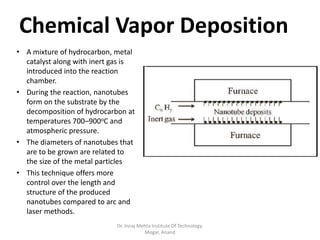
Chemical Vapor Deposition
• A mixture of hydrocarbon, metal
catalyst along with inert gas is
introduced into the reaction
chamber.
• During the reaction, nanotubes
form on the substrate by the
decomposition of hydrocarbon at
temperatures 700–900oC and
atmospheric pressure.
• The diameters of nanotubes that
are to be grown are related to
the size of the metal particles
• This technique offers more
control over the length and
structure of the produced
nanotubes compared to arc and
laser methods.
Dr. Jivraj Mehta Institute Of Technology,
Mogar, Anand
Carbon Nanotubes
Advantages
• Extremely small and
lightweight, making them
excellent replacements for
metallic wires
• Resources required to produce
them are plentiful, and many
can be made with only a small
amount of material
• Are resistant to temperature
changes, meaning they
function almost just as well in
extreme cold as they do in
extreme heat
Disadvantages
• Despite all the research, scientists
still don't understand exactly how
they work
• Extremely small, so are difficult to
work with.
• Currently, the process is relatively
expensive to produce the
nanotubes
• Would be expensive to
implement this new technology in
and replace the older technology
in all the places that we could
• At the rate our technology has
been becoming obsolete, it may
be a gamble to bet on this
technology
Dr. Jivraj Mehta Institute Of Technology,
Mogar, Anand
Applications
• Carbon nanotubes can store lithium due to which they can be used in
batteries. CNT’s can also store hydrogen and hence find potential
applications in fuel cells.
• They are used in the tips for atomic force microscope probes.
• They are being used to develop flat panel displays for television and
computer monitors.
• They are being used to develop light weight shield for electromagnetic
radiation.
• Field effect transistors are being developed using semi conducting CNT’s
which can be used to build faster processors for computers. It is estimated
that these processors will ne 104 times faster than the present processors.
• CNT’s are being used to produce light weight materials with higher
strength than steel. These can be used in Auto mobile, Aircraft and rocket
parts.
• They are used in chemical sensors to detect gases.
Dr. Jivraj Mehta Institute Of Technology,
Mogar, Anand
Properties
1. Mechanical:
The carbon nanotubes are highly elastic. The Young’s
Modulus is a measure of the elasticity. The Young’ Modulus
for carbon nanotubes is about 1800 Gpa whereas it is about
210 Gpa for steel.
Carbon Nanotubes exhibit large strength in tension. They are
about twenty times stronger than steel. The yield stress is a
measure of the strength.
Carbon Nanotubes can withstand larger strains than steel.
They can be bent without breaking.
Dr. Jivraj Mehta Institute Of Technology,
Mogar, Anand
Properties
2. Electrical:
The electrical properties of carbon nanotubes depends
upon their diameter and chirality. They show electrical
properties ranging from semiconductors to those of good
conductors. The energy gap decreases as the diameter of
the CNT is increased.
Due to very low resistivity, the heat dissipation in the CNT
is very small and hence they can carry much larger
currents than the metals.
The conductivity of a CNT is maximum along its axis and
very low in a perpendicular direction. Hence they are
equivalent to one dimensional conductors.
At low temperatures, the resistance decreases with
increasing magnetic field applied across the CNT. This
effect is known as magneto resistance.
Dr. Jivraj Mehta Institute Of Technology,
Mogar, Anand
Properties
3. Thermal:
Carbon nanotubes are very good conductors of heat.
Their thermal conductivity is more than twice that of
diamond. The thermal conductivity also varies with
direction. The conductivity is very good along the axis
of the tube and very low in a perpendicular direction.
4. Physical:
CNT’s have very high strength to weight ratio. They
have low density.
5. Chemical:
CNT’s are chemically more inert compared to other
forms of carbon.
Dr. Jivraj Mehta Institute Of Technology,
Mogar, Anand
Dr. Jivraj Mehta Institute Of Technology,
Mogar, Anand

Carbon nanotube

  • 1.
    Dr. Jivraj MehtaInstitute Of Technology, Mogar, Anand
  • 2.
    Graphene In graphite, eachcarbon atom is linked to three other carbon atoms through covalent bonds forming hexagonal rings connected to each other to form plane sheets known as Graphene. The Structure of Carbon Nanotubes (CNT) can be imagined as a cylinder formed by rolling a graphene sheet and then closing it on both sides by fullerene hemispheres. Dr. Jivraj Mehta Institute Of Technology, Mogar, Anand
  • 3.
    Types of CNT TheCNT’s are of Two types:- 1. Single Walled Nanotubes (SWNT) These can be imagined as a single atom thick graphite sheet, i.e. graphene, rolled into a cylinder and capped by fullerene hemisphere. 2. Multiwalled Nanotubes (MWNT) These can be considered as Nanotubes within Nanotubes. Dr. Jivraj Mehta Institute Of Technology, Mogar, Anand
  • 4.
    Structure The graphene sheetcan be rolled in different ways to get the three type of SWNTS: 1. Zigzag 2. Armchair 3. Chiral These three types are classified on the Chiral vector. 1. Zigzag In these the graphene sheet is rolled up along a vector greater then the chiral angle. 2. Armchair In these the graphene sheet is rolled up along the vector smaller than the chiral angle. 3. Chiral In these it is rolled up on the chiral vector. Dr. Jivraj Mehta Institute Of Technology, Mogar, Anand
  • 5.
    Fabrication • CNT’s canbe fabricated by 3 method Electric Arc Method Laser Deposition Chemical Vapor Deposition Dr. Jivraj Mehta Institute Of Technology, Mogar, Anand
  • 6.
    Electric Arc Method Mostcommon method of CNT fabrication. 1. A current is run through an anode, or a positively charged piece of carbon. 2. This current jumps through a plasma material to a cathode, or a negatively charged piece of carbon, where there is an evaporation and deposition of carbon particles in through the plasma. 3. Finally an outer hard-shell region made of decomposed graphite is formed and an inner core region with loosely packed columns which consist of straight, stiff multishell carbon nanotubes and closed polyhedral particles Dr. Jivraj Mehta Institute Of Technology, Mogar, Anand
  • 7.
    Pulsed Laser Deposition •Uses an intense laser pulse to vaporize a carbon target, which also contains small amount of metals such as nickel and cobalt and is placed in a tube furnace at 1200oC, And pressure of 500 torr. • Inert gas is passed through the chamber carrying the grown nanotubes on a cold finger for collection. • This method mainly produces SWCNT in the form of ropes. • It produces nanotubes of 10- 20 nm in diameter about 100 micro m in length. • About 80% of graphite material is converted into nanotubes in this method. Dr. Jivraj Mehta Institute Of Technology, Mogar, Anand
  • 8.
    Chemical Vapor Deposition •A mixture of hydrocarbon, metal catalyst along with inert gas is introduced into the reaction chamber. • During the reaction, nanotubes form on the substrate by the decomposition of hydrocarbon at temperatures 700–900oC and atmospheric pressure. • The diameters of nanotubes that are to be grown are related to the size of the metal particles • This technique offers more control over the length and structure of the produced nanotubes compared to arc and laser methods. Dr. Jivraj Mehta Institute Of Technology, Mogar, Anand
  • 9.
    Carbon Nanotubes Advantages • Extremelysmall and lightweight, making them excellent replacements for metallic wires • Resources required to produce them are plentiful, and many can be made with only a small amount of material • Are resistant to temperature changes, meaning they function almost just as well in extreme cold as they do in extreme heat Disadvantages • Despite all the research, scientists still don't understand exactly how they work • Extremely small, so are difficult to work with. • Currently, the process is relatively expensive to produce the nanotubes • Would be expensive to implement this new technology in and replace the older technology in all the places that we could • At the rate our technology has been becoming obsolete, it may be a gamble to bet on this technology Dr. Jivraj Mehta Institute Of Technology, Mogar, Anand
  • 10.
    Applications • Carbon nanotubescan store lithium due to which they can be used in batteries. CNT’s can also store hydrogen and hence find potential applications in fuel cells. • They are used in the tips for atomic force microscope probes. • They are being used to develop flat panel displays for television and computer monitors. • They are being used to develop light weight shield for electromagnetic radiation. • Field effect transistors are being developed using semi conducting CNT’s which can be used to build faster processors for computers. It is estimated that these processors will ne 104 times faster than the present processors. • CNT’s are being used to produce light weight materials with higher strength than steel. These can be used in Auto mobile, Aircraft and rocket parts. • They are used in chemical sensors to detect gases. Dr. Jivraj Mehta Institute Of Technology, Mogar, Anand
  • 11.
    Properties 1. Mechanical: The carbonnanotubes are highly elastic. The Young’s Modulus is a measure of the elasticity. The Young’ Modulus for carbon nanotubes is about 1800 Gpa whereas it is about 210 Gpa for steel. Carbon Nanotubes exhibit large strength in tension. They are about twenty times stronger than steel. The yield stress is a measure of the strength. Carbon Nanotubes can withstand larger strains than steel. They can be bent without breaking. Dr. Jivraj Mehta Institute Of Technology, Mogar, Anand
  • 12.
    Properties 2. Electrical: The electricalproperties of carbon nanotubes depends upon their diameter and chirality. They show electrical properties ranging from semiconductors to those of good conductors. The energy gap decreases as the diameter of the CNT is increased. Due to very low resistivity, the heat dissipation in the CNT is very small and hence they can carry much larger currents than the metals. The conductivity of a CNT is maximum along its axis and very low in a perpendicular direction. Hence they are equivalent to one dimensional conductors. At low temperatures, the resistance decreases with increasing magnetic field applied across the CNT. This effect is known as magneto resistance. Dr. Jivraj Mehta Institute Of Technology, Mogar, Anand
  • 13.
    Properties 3. Thermal: Carbon nanotubesare very good conductors of heat. Their thermal conductivity is more than twice that of diamond. The thermal conductivity also varies with direction. The conductivity is very good along the axis of the tube and very low in a perpendicular direction. 4. Physical: CNT’s have very high strength to weight ratio. They have low density. 5. Chemical: CNT’s are chemically more inert compared to other forms of carbon. Dr. Jivraj Mehta Institute Of Technology, Mogar, Anand
  • 14.
    Dr. Jivraj MehtaInstitute Of Technology, Mogar, Anand