Bonding and Structure
Discovery and Applications of fullerenes
Meaning of fullerenes
 Fullerenes are a family of carbon allotropes.
 They are molecules composed entirely of
carbon.
 They are in the form of a hollow sphere,
ellipsoid, or tube.
Discovery of the first fullerene: C60
 In 1985, Prof. Harold W. Kroto of the University of
Sussex joined Robert F. Curl and Prof. Richard E.
Smalley at Rice University to study the products of
carbon vaporization.
 They carried out molecular beam experiments.
 From the result, discrete peaks were observed
corresponding to molecules with the exact mass of sixty
or seventy or more carbon atoms.
 C60 was then discovered, and it was named
buckminsterfullerene which is named after Richard
Buckminster Fuller who designed geodesic domes which
is the same structure as C60.
 Shortly after discovery of C60, it came to discover the
fullerenes.
Harold Kroto
Richard Errett Smalley
Robert Floyd Curl
Construction of the model of C60
 Cut out 12 pieces of regular pentagon
paper and 20 pieces of regular hexagons
paper, keeping the length of their sides
as the same.
 Use transparent tape to attach the
shapes together.
 Each pentagon should be surrounded by
5 hexagons. Hexagons should be
surrounded by three hexagons and three
pentagons placed next to each other
alternately.
 Fold up the large piece of paper to form a
ball just as shown in the picture at the left.
A model is finished!
Structures of some fullerenes
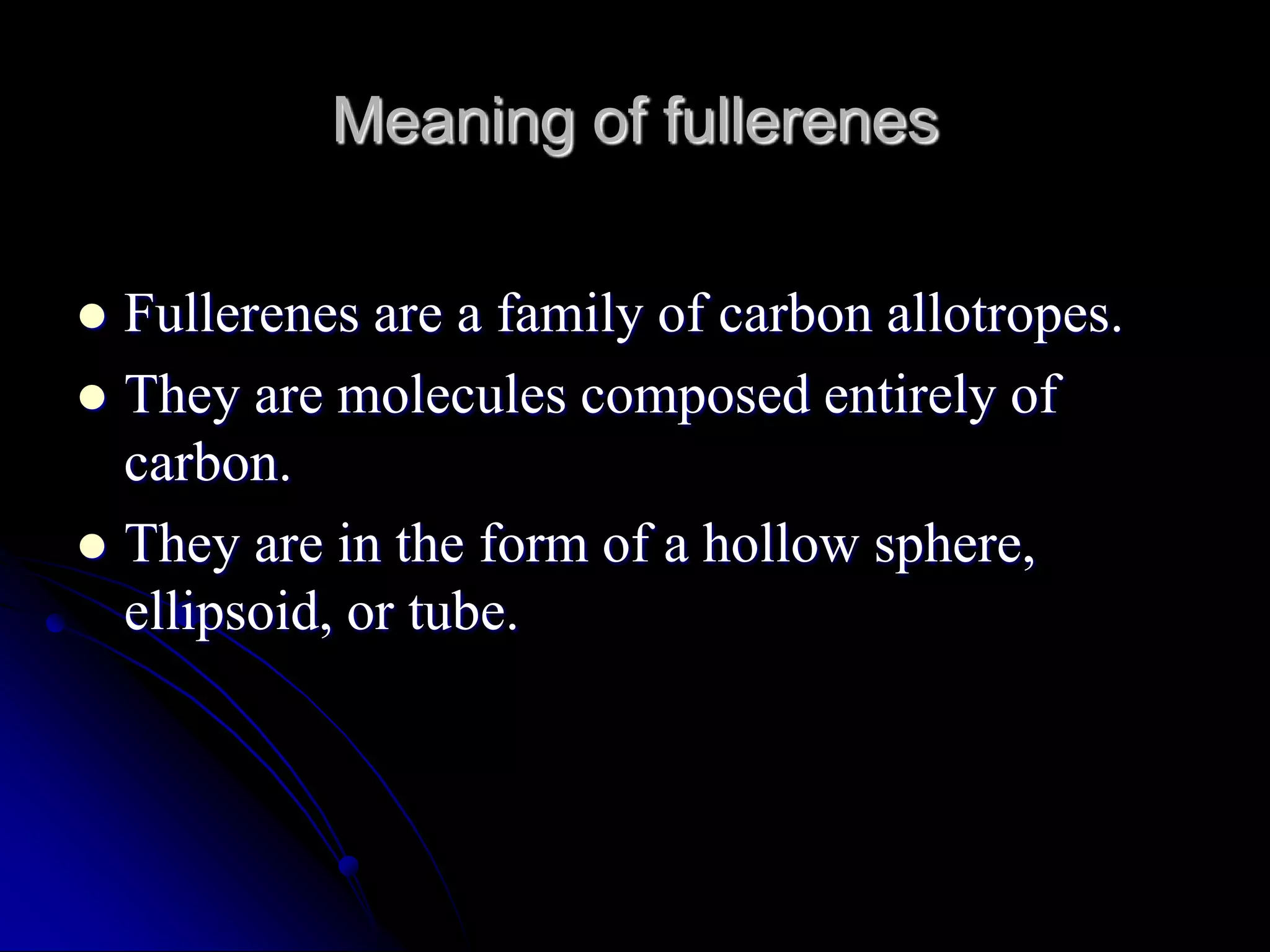
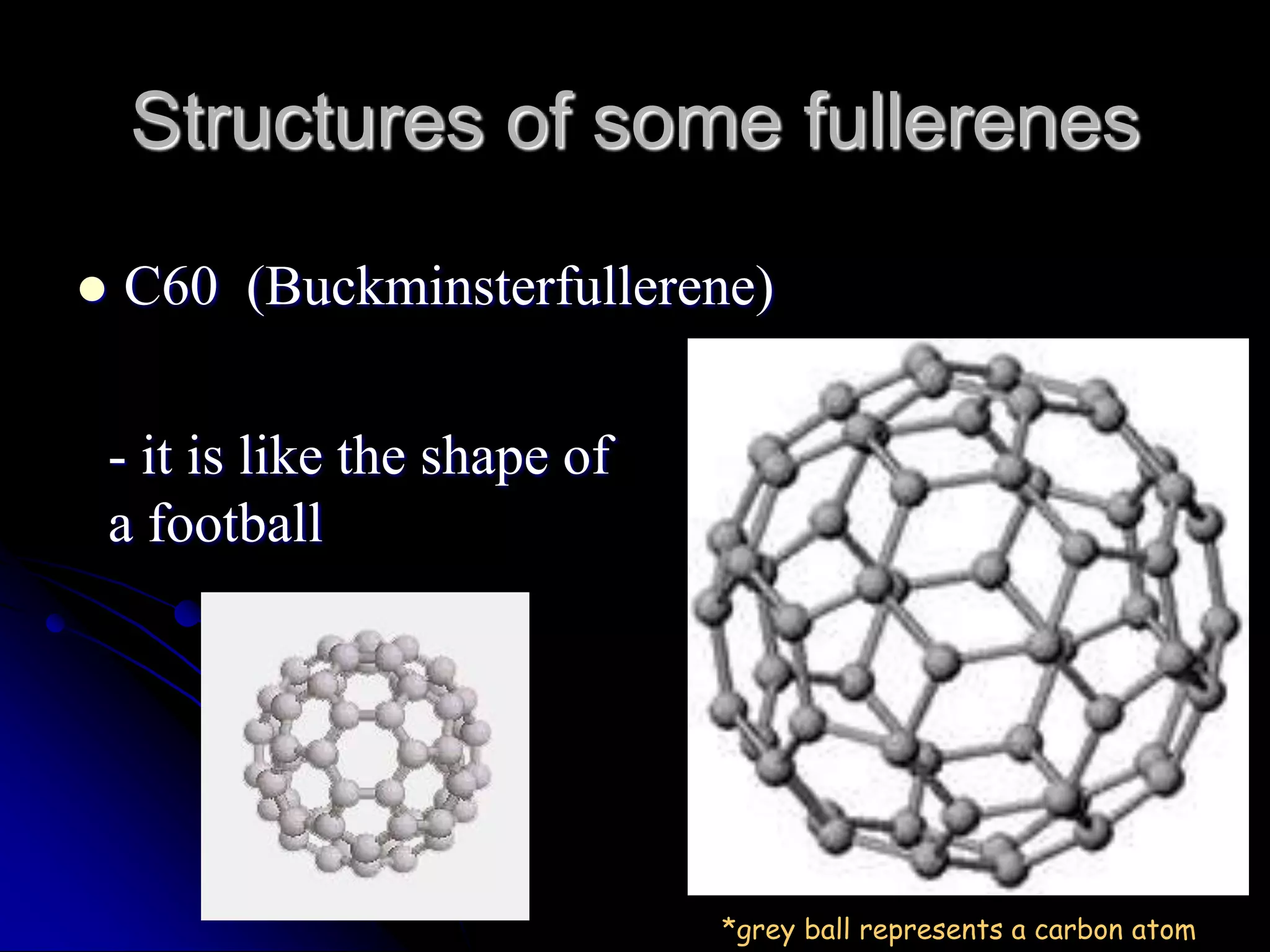
 C60 (Buckminsterfullerene)
- it is like the shape of
a football
*grey ball represents a carbon atom
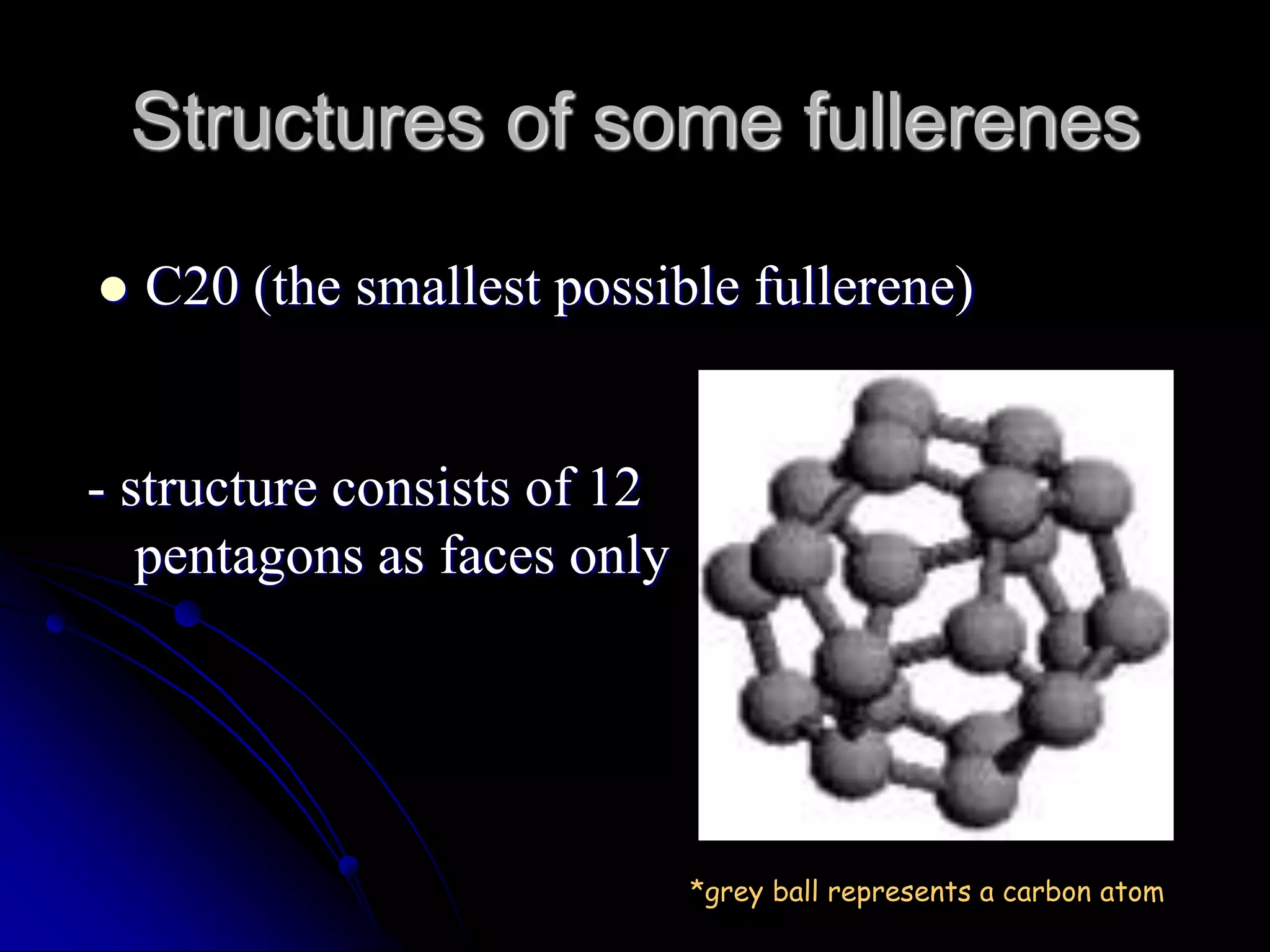
Structures of some fullerenes
- structure consists of 12
pentagons as faces only
*grey ball represents a carbon atom
 C20 (the smallest possible fullerene)
Applications of fullerenes
 Polymer Additives - fullerenes and fullerenic black
are chemically reactive and can be added to polymer
structures to create new copolymers with specific
physical and mechanical properties.
 Carbon Nanotubes - nanotubes are cylindrical
fullerenes. These tubes of carbon are usually only a
few nanometers wide, but they have high tensile
strength, high electrical conductivity, high resistance
to heat, and relative chemical inactivity.
These tubes can help to make useful substances.
For examples:
- tennis racket
- superconductor
- composite used in aircraft
 Combination of nano tubes and fullerenes are used in
molecular pumps and pistons.
 To produce nanowires of gold and zinc oxide .
 These are used for economical electrical motor
brushes. In light bulb filament-as an alternative to
tungsten filament in incandescent lamps.
 As artificial muscles to increase strength and halt
crack propagation of concrete.

Fullerene

  • 1.
    Bonding and Structure Discoveryand Applications of fullerenes
  • 2.
    Meaning of fullerenes Fullerenes are a family of carbon allotropes.  They are molecules composed entirely of carbon.  They are in the form of a hollow sphere, ellipsoid, or tube.
  • 3.
    Discovery of thefirst fullerene: C60  In 1985, Prof. Harold W. Kroto of the University of Sussex joined Robert F. Curl and Prof. Richard E. Smalley at Rice University to study the products of carbon vaporization.  They carried out molecular beam experiments.  From the result, discrete peaks were observed corresponding to molecules with the exact mass of sixty or seventy or more carbon atoms.  C60 was then discovered, and it was named buckminsterfullerene which is named after Richard Buckminster Fuller who designed geodesic domes which is the same structure as C60.  Shortly after discovery of C60, it came to discover the fullerenes. Harold Kroto Richard Errett Smalley Robert Floyd Curl
  • 4.
    Construction of themodel of C60  Cut out 12 pieces of regular pentagon paper and 20 pieces of regular hexagons paper, keeping the length of their sides as the same.  Use transparent tape to attach the shapes together.  Each pentagon should be surrounded by 5 hexagons. Hexagons should be surrounded by three hexagons and three pentagons placed next to each other alternately.  Fold up the large piece of paper to form a ball just as shown in the picture at the left. A model is finished!
  • 5.
    Structures of somefullerenes  C60 (Buckminsterfullerene) - it is like the shape of a football *grey ball represents a carbon atom
  • 6.
    Structures of somefullerenes - structure consists of 12 pentagons as faces only *grey ball represents a carbon atom  C20 (the smallest possible fullerene)
  • 7.
    Applications of fullerenes Polymer Additives - fullerenes and fullerenic black are chemically reactive and can be added to polymer structures to create new copolymers with specific physical and mechanical properties.  Carbon Nanotubes - nanotubes are cylindrical fullerenes. These tubes of carbon are usually only a few nanometers wide, but they have high tensile strength, high electrical conductivity, high resistance to heat, and relative chemical inactivity.
  • 8.
    These tubes canhelp to make useful substances. For examples: - tennis racket - superconductor - composite used in aircraft
  • 9.
     Combination ofnano tubes and fullerenes are used in molecular pumps and pistons.  To produce nanowires of gold and zinc oxide .  These are used for economical electrical motor brushes. In light bulb filament-as an alternative to tungsten filament in incandescent lamps.  As artificial muscles to increase strength and halt crack propagation of concrete.