Downloaded 16 times
![Bucky Ball
Buckminsterfullerene (IUPAC name (C60-
Ih)[5,6]fullerene) is the smallest fullerene in
which no two pentagons share an edge. It is
also the most common in terms of natural
occurrence, as it can often be found in soot.
The structure of C60 is a truncated T=3
icosahedron, which resembles a soccer ball
of the type made of hexagons and
pentagons, with a carbon atom at the
corners of each hexagon and a bond along
each edge.
The diameter of a C60 molecule is about 1
nanometer (nm).
From AIDS medicines to superconductors to
flat-screen TVs, a wide range of medical
and industrial uses are envisioned for the
buckminsterfullerene, an incredibly strong
soccer-ball-shaped molecule that is the third
form of carbon after diamond and graphite.
http://en.wikipedia.org/wiki/Buckyball
•http://www.godunov.com/Bucky/fullerene.htm
l](https://image.slidesharecdn.com/aquinobucky-140925013101-phpapp01/85/BUCKY-BALL-1-320.jpg)
![Bucky Ball
Buckminsterfullerene (IUPAC name (C60-
Ih)[5,6]fullerene) is the smallest fullerene in
which no two pentagons share an edge. It is
also the most common in terms of natural
occurrence, as it can often be found in soot.
The structure of C60 is a truncated T=3
icosahedron, which resembles a soccer ball
of the type made of hexagons and
pentagons, with a carbon atom at the
corners of each hexagon and a bond along
each edge.
The diameter of a C60 molecule is about 1
nanometer (nm).
From AIDS medicines to superconductors to
flat-screen TVs, a wide range of medical
and industrial uses are envisioned for the
buckminsterfullerene, an incredibly strong
soccer-ball-shaped molecule that is the third
form of carbon after diamond and graphite.
http://en.wikipedia.org/wiki/Buckyball
•http://www.godunov.com/Bucky/fullerene.htm
l](https://image.slidesharecdn.com/aquinobucky-140925013101-phpapp01/75/BUCKY-BALL-1-2048.jpg)
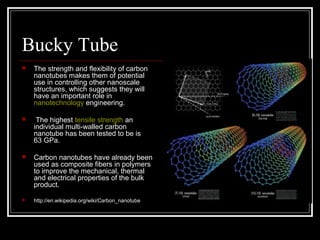
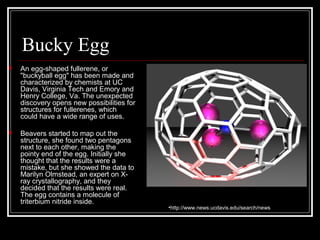

Buckminsterfullerene (C60) is the smallest fullerene molecule that resembles a soccer ball, with carbon atoms at the corners of hexagons and bonds along the edges. It is about 1 nanometer in diameter and is the most common fullerene found in soot. C60 has potential medical and industrial applications. Carbon nanotubes are incredibly strong and flexible cylindrical molecules that could be used in nanotechnology. An egg-shaped fullerene molecule has also been discovered that contains a molecule of triterbium nitride inside.


