Frequency Distributions
BY UNSA SHAKIR
Example
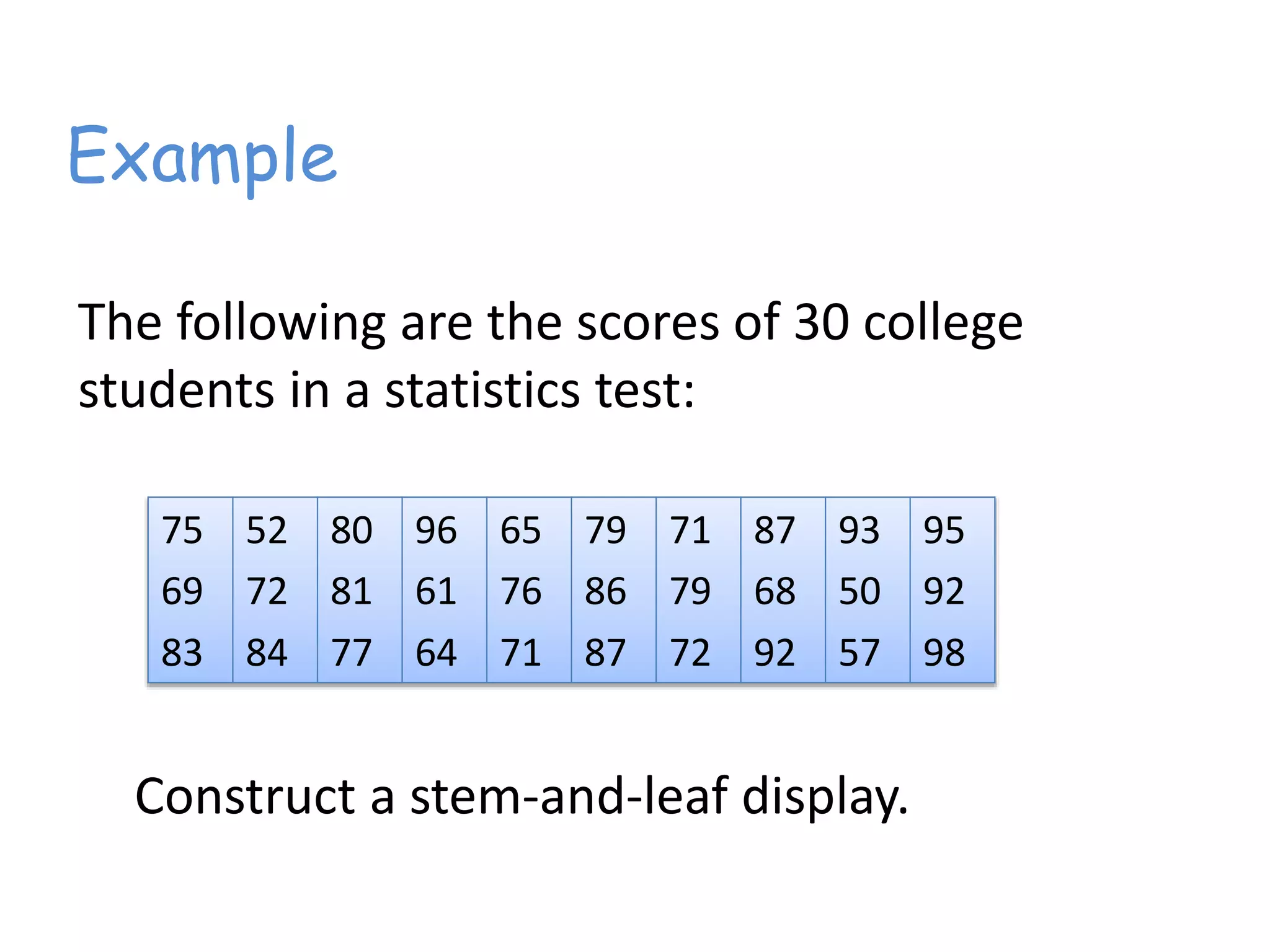
The following are the scores of 30 college
students in a statistics test:
Construct a stem-and-leaf display.
75
69
83
52
72
84
80
81
77
96
61
64
65
76
71
79
86
87
71
79
72
87
68
92
93
50
57
95
92
98
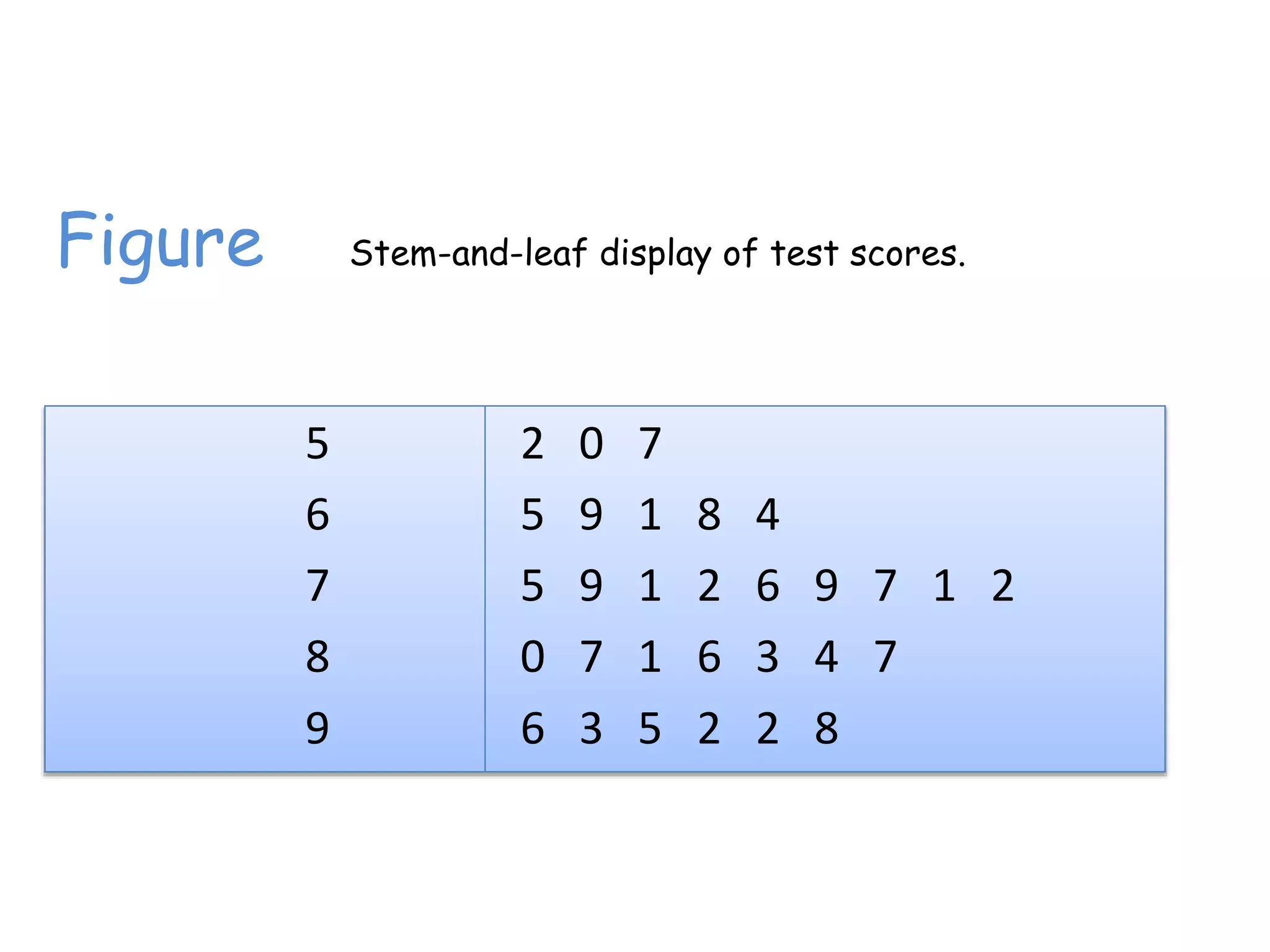
Figure Stem-and-leaf display of test scores.
5
6
7
8
9
2 0 7
5 9 1 8 4
5 9 1 2 6 9 7 1 2
0 7 1 6 3 4 7
6 3 5 2 2 8
Example
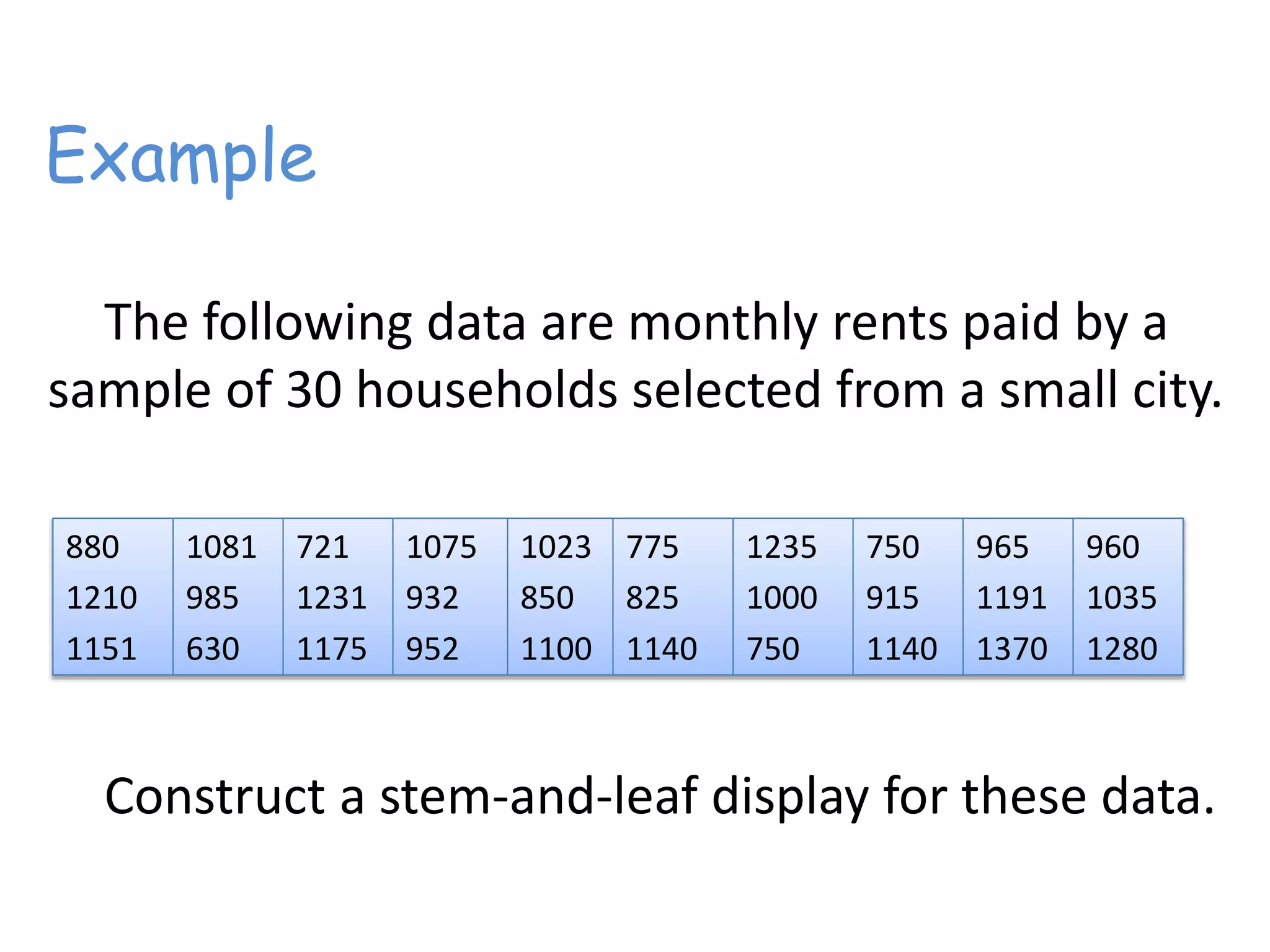
The following data are monthly rents paid by a
sample of 30 households selected from a small city.
Construct a stem-and-leaf display for these data.
880
1210
1151
1081
985
630
721
1231
1175
1075
932
952
1023
850
1100
775
825
1140
1235
1000
750
750
915
1140
965
1191
1370
960
1035
1280
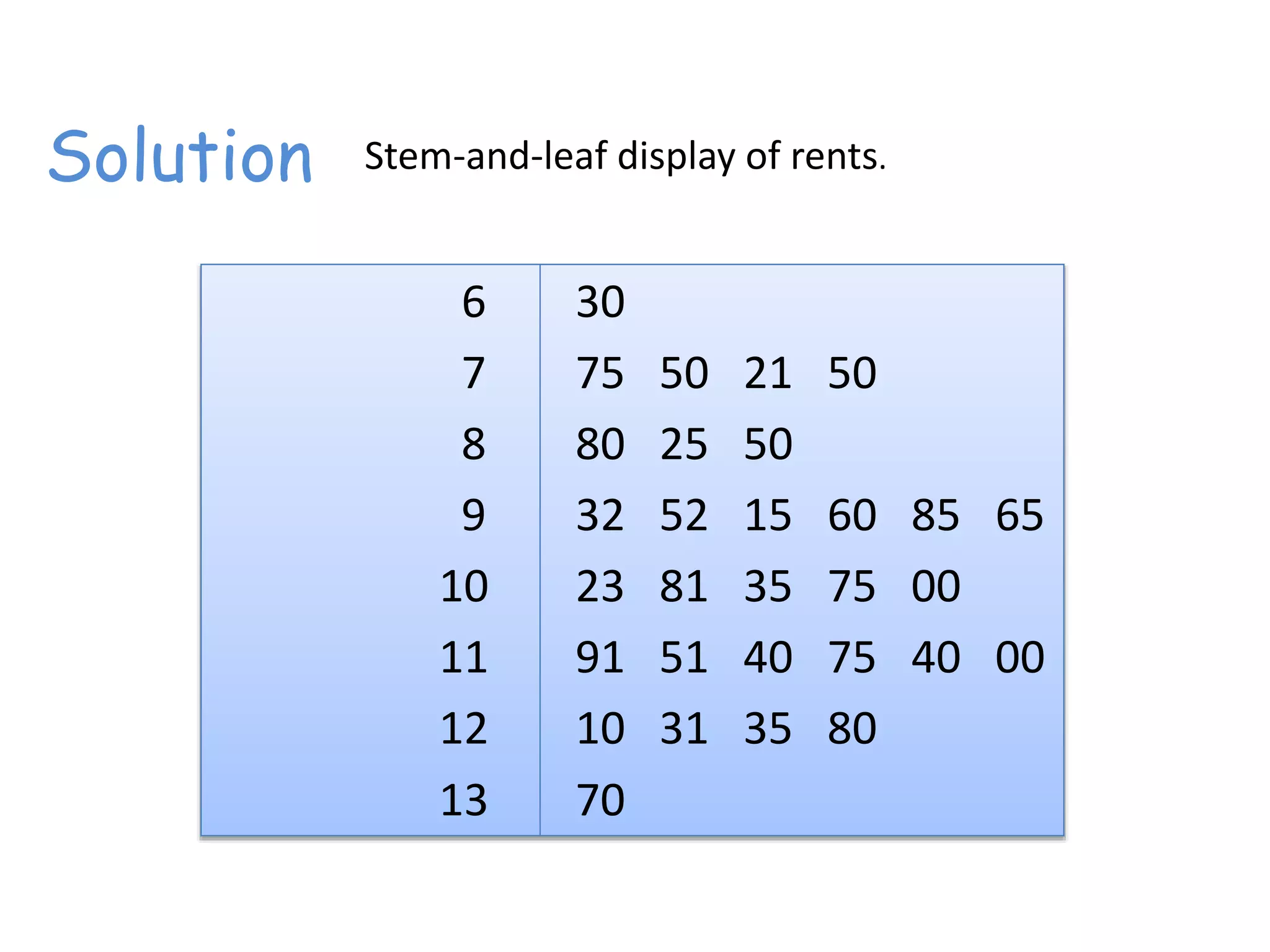
Solution
6
7
8
9
10
11
12
13
30
75 50 21 50
80 25 50
32 52 15 60 85 65
23 81 35 75 00
91 51 40 75 40 00
10 31 35 80
70
Stem-and-leaf display of rents.
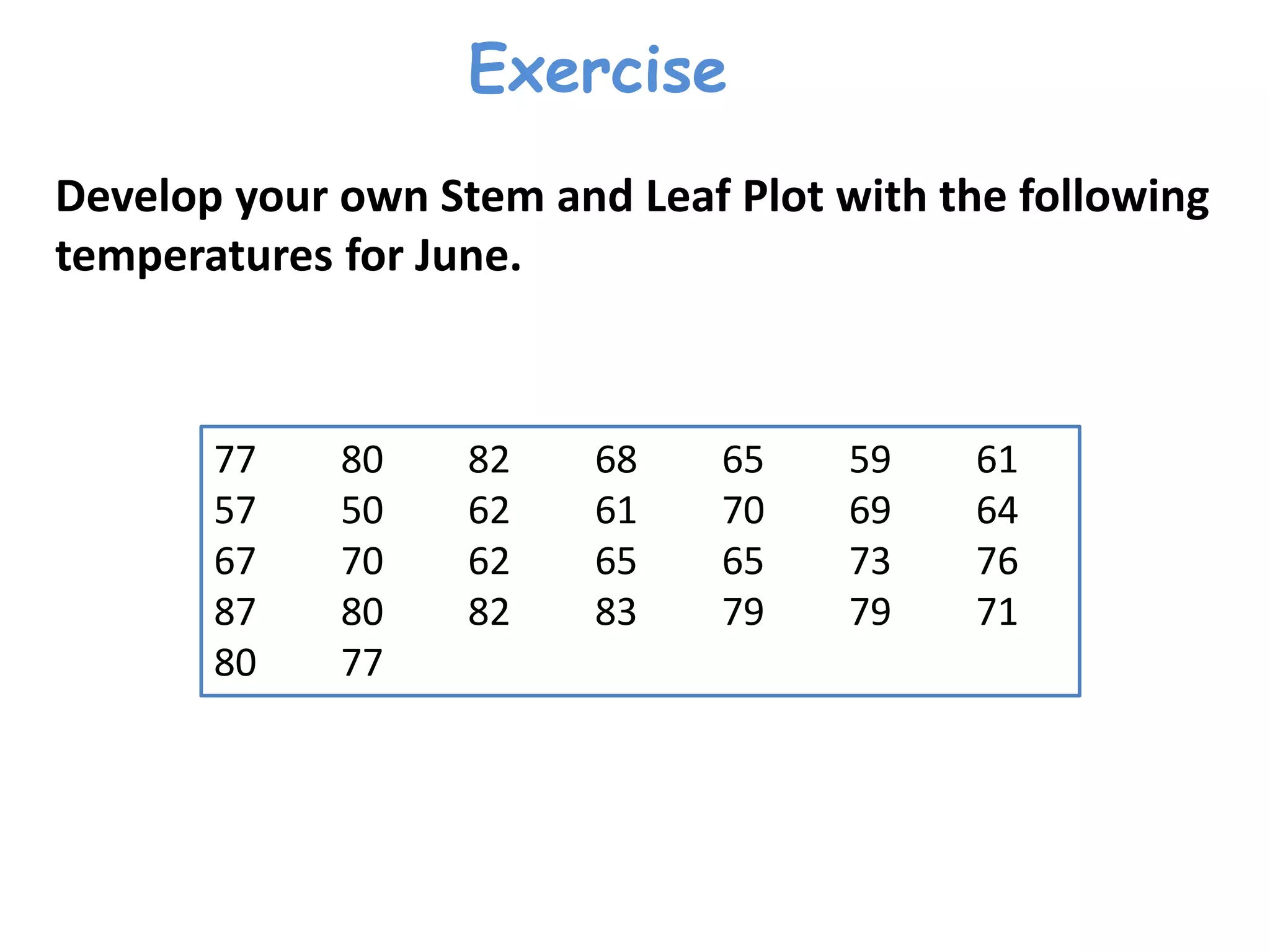
Exercise
Develop your own Stem and Leaf Plot with the following
temperatures for June.
77 80 82 68 65 59 61
57 50 62 61 70 69 64
67 70 62 65 65 73 76
87 80 82 83 79 79 71
80 77
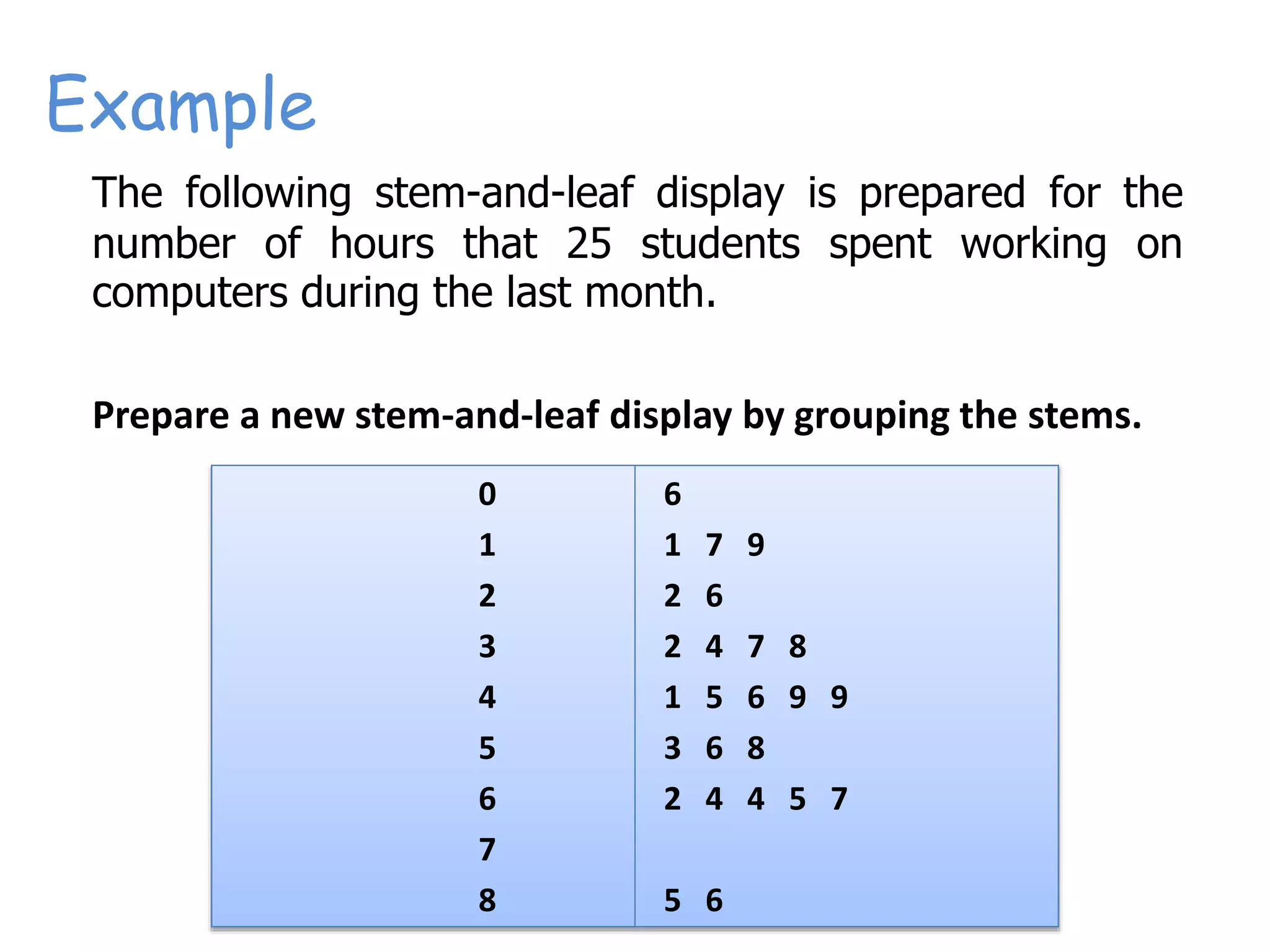
Example
0
1
2
3
4
5
6
7
8
6
1 7 9
2 6
2 4 7 8
1 5 6 9 9
3 6 8
2 4 4 5 7
5 6
The following stem-and-leaf display is prepared for the
number of hours that 25 students spent working on
computers during the last month.
Prepare a new stem-and-leaf display by grouping the stems.
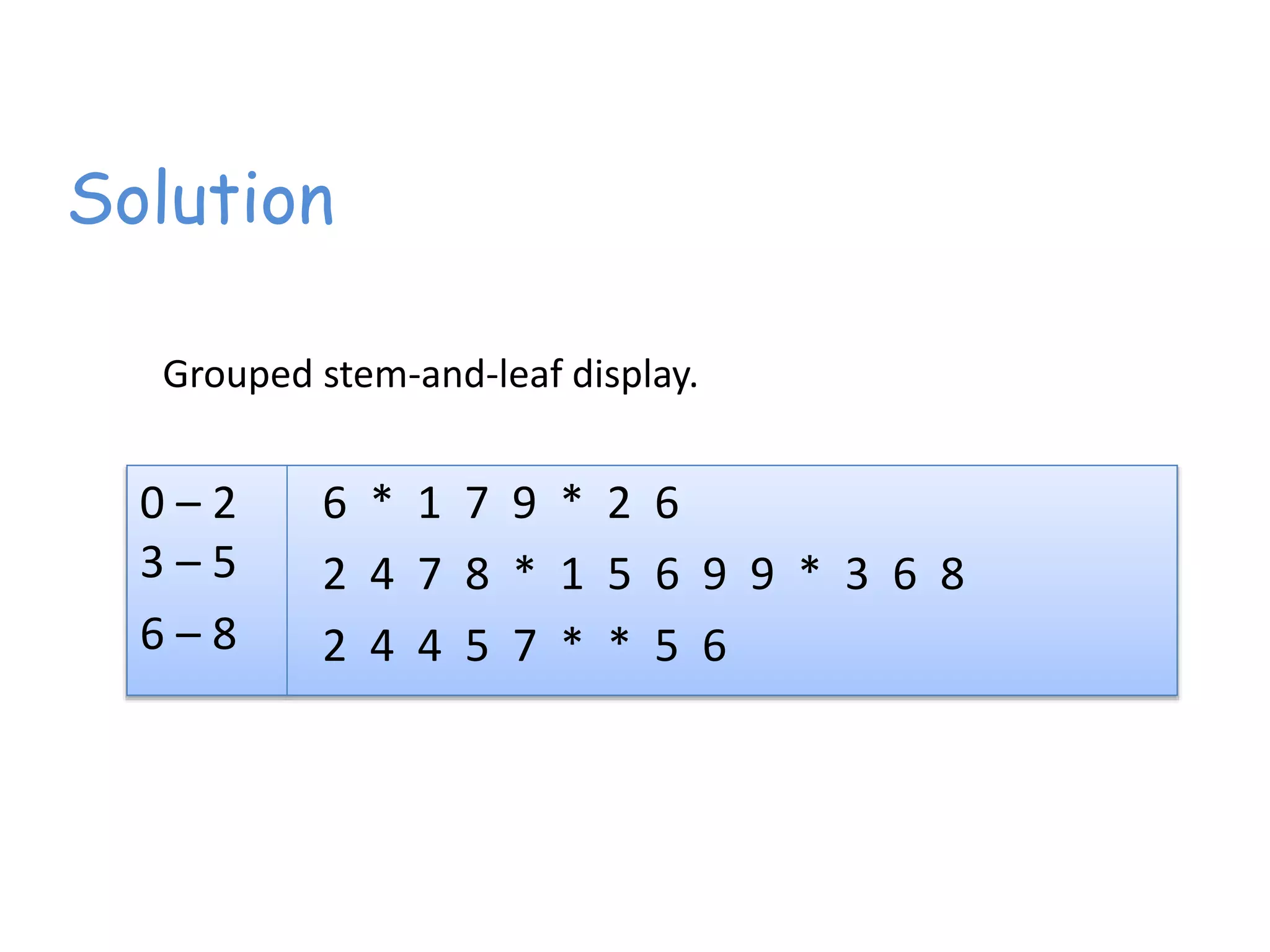
Solution
0 – 2
3 – 5
6 – 8
6 * 1 7 9 * 2 6
2 4 7 8 * 1 5 6 9 9 * 3 6 8
2 4 4 5 7 * * 5 6
Grouped stem-and-leaf display.
Grouped DataVs Ungrouped Data
Ungrouped data – Data
that has not been
organized into groups.
Also called as raw data.
Grouped data - Data
that has been organized
into groups (into a
frequency distribution).
Data Frequency
2 – 4 5
5 – 7 6
8 – 10 10
11 – 13 8
14 – 16 4
17 – 19 3
Data Frequency
2 8
3 4
5 6
7 7
8 2
9 5
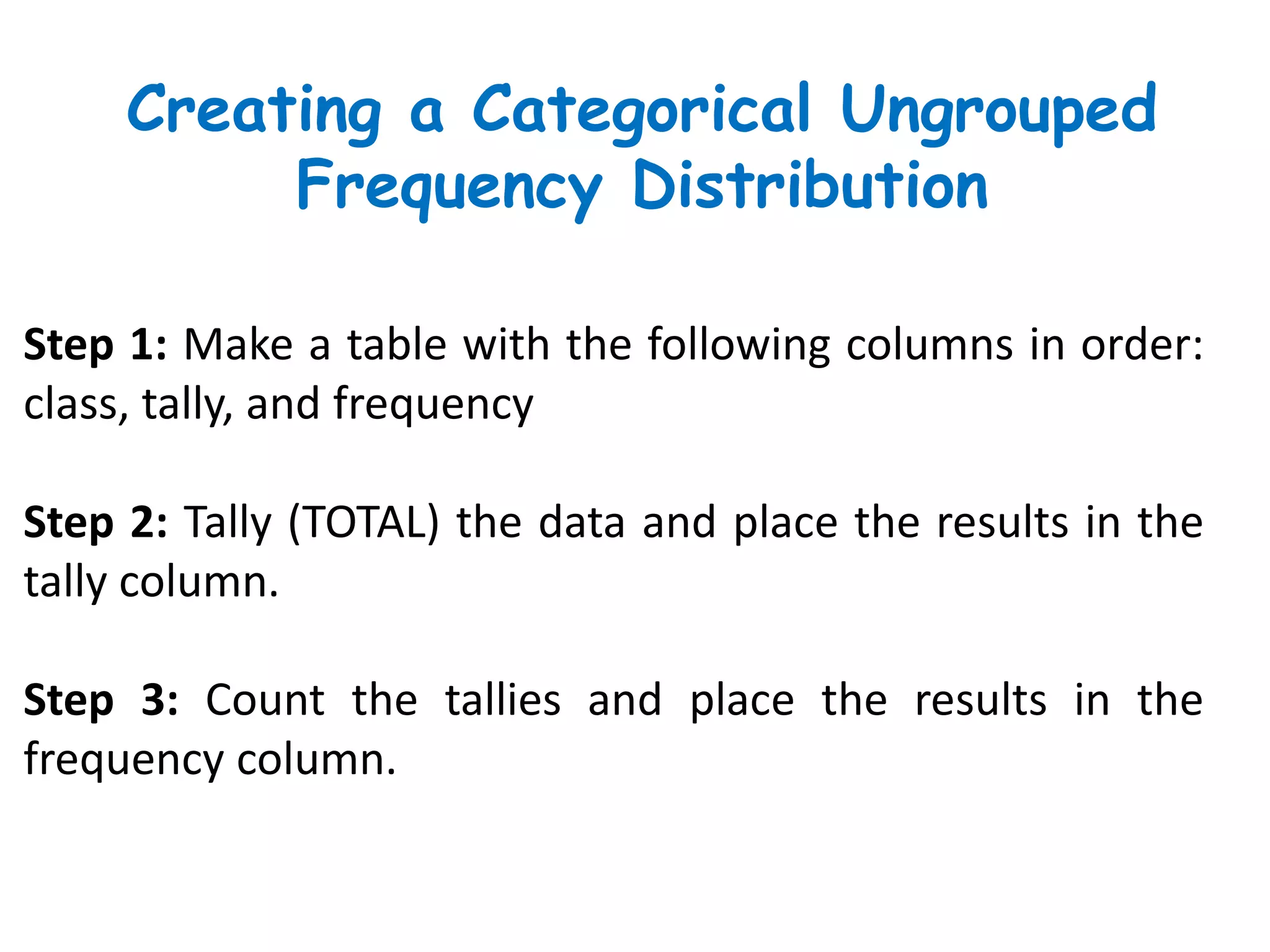
Step 1: Make a table with the following columns in order:
class, tally, and frequency
Step 2: Tally (TOTAL) the data and place the results in the
tally column.
Step 3: Count the tallies and place the results in the
frequency column.
Creating a Categorical Ungrouped
Frequency Distribution
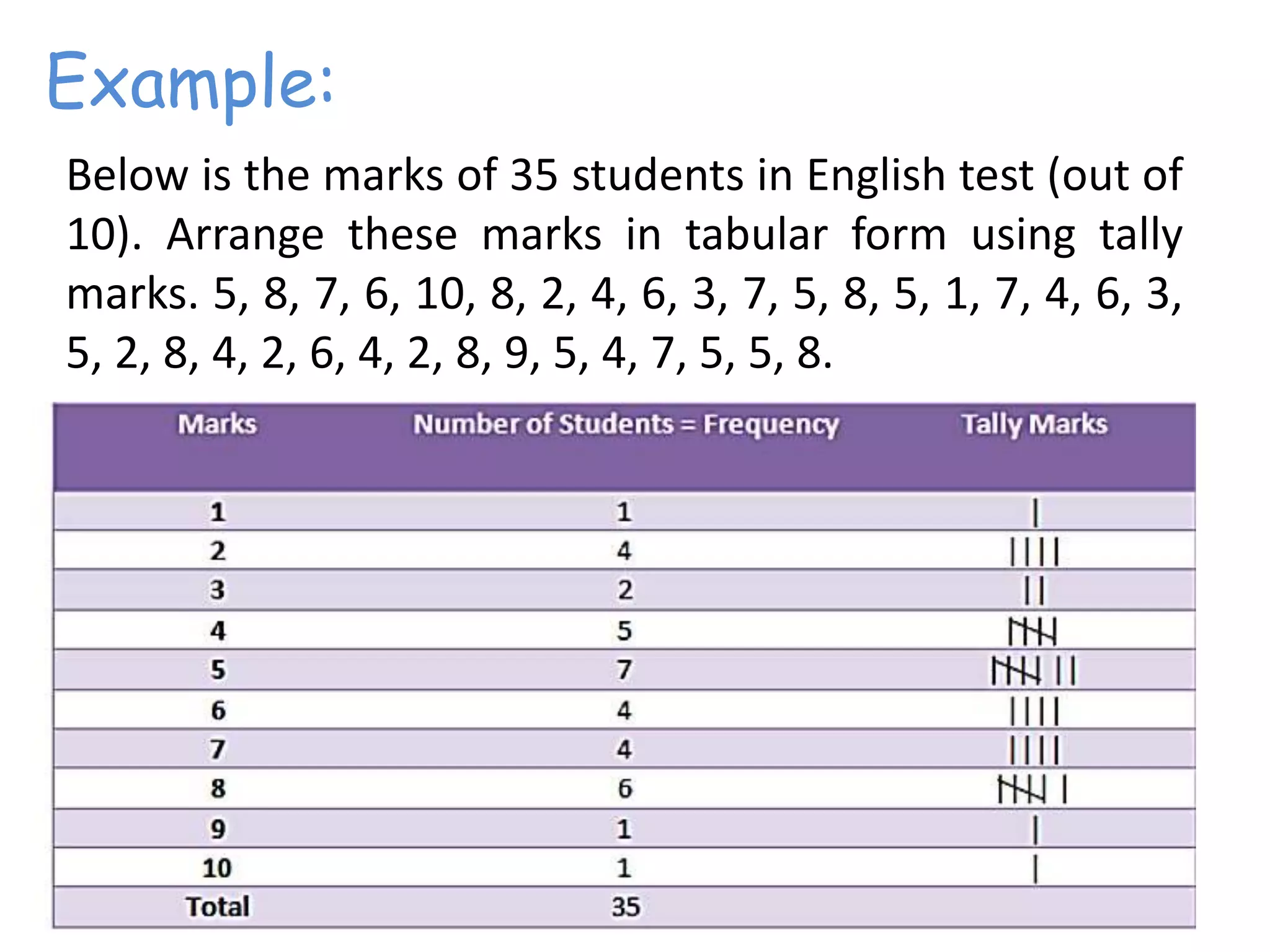
Example:
Below is the marks of 35 students in English test (out of
10). Arrange these marks in tabular form using tally
marks. 5, 8, 7, 6, 10, 8, 2, 4, 6, 3, 7, 5, 8, 5, 1, 7, 4, 6, 3,
5, 2, 8, 4, 2, 6, 4, 2, 8, 9, 5, 4, 7, 5, 5, 8.
Example:
Let us consider the following data:
2, 3, 3, 5, 7, 9, 7, 8, 9, 9, 2, 5, 3, 9, 3, 2, 5, 9, 8,
7, 3, 5, 7, 9, 8, 5, 2, 3
Design frequency table for above data.
Class Tally Frequency
Total=
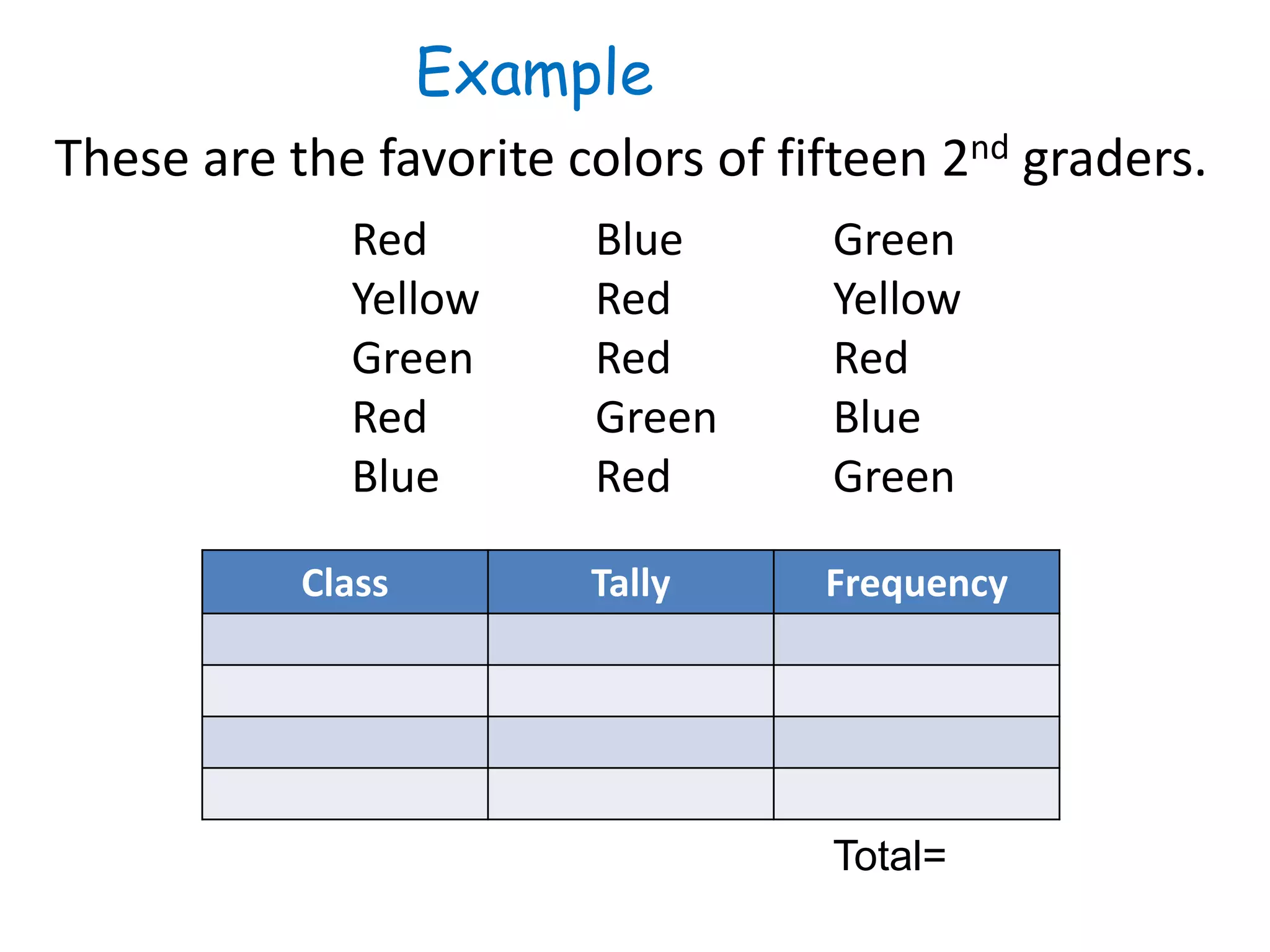
Example
These are the favorite colors of fifteen 2nd graders.
Red
Yellow
Green
Red
Blue
Blue
Red
Red
Green
Red
Green
Yellow
Red
Blue
Green
• When the range of the data is large, the data must be grouped
into classes
Grouped Frequency Distribution
41 104 112 118 87 95
105 57 107 67 78 125
109 99 105 99 101 92
Key Concept
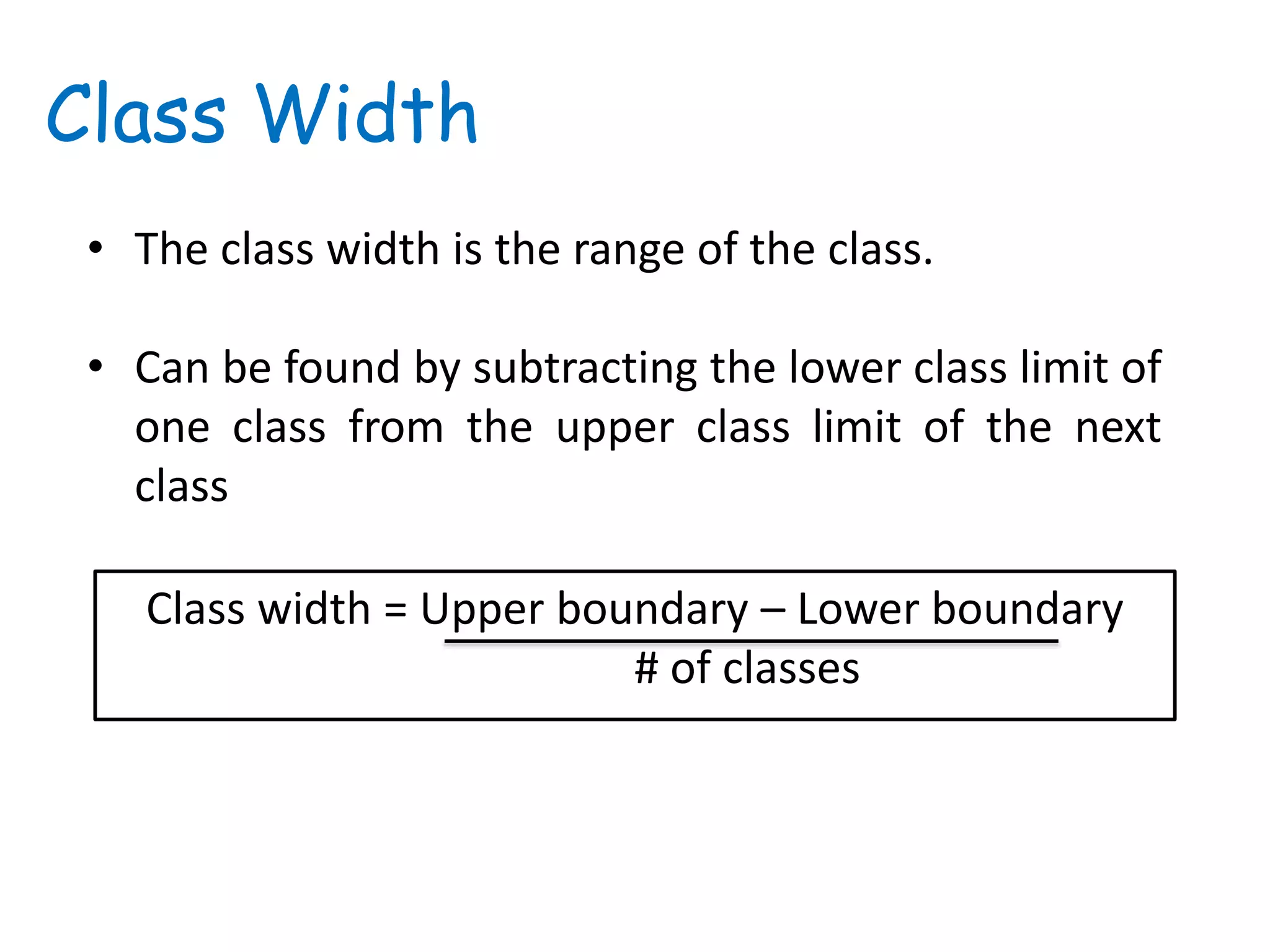
• The class width is the range of the class.
• Can be found by subtracting the lower class limit of
one class from the upper class limit of the next
class
Class Width
Class width = Upper boundary – Lower boundary
# of classes
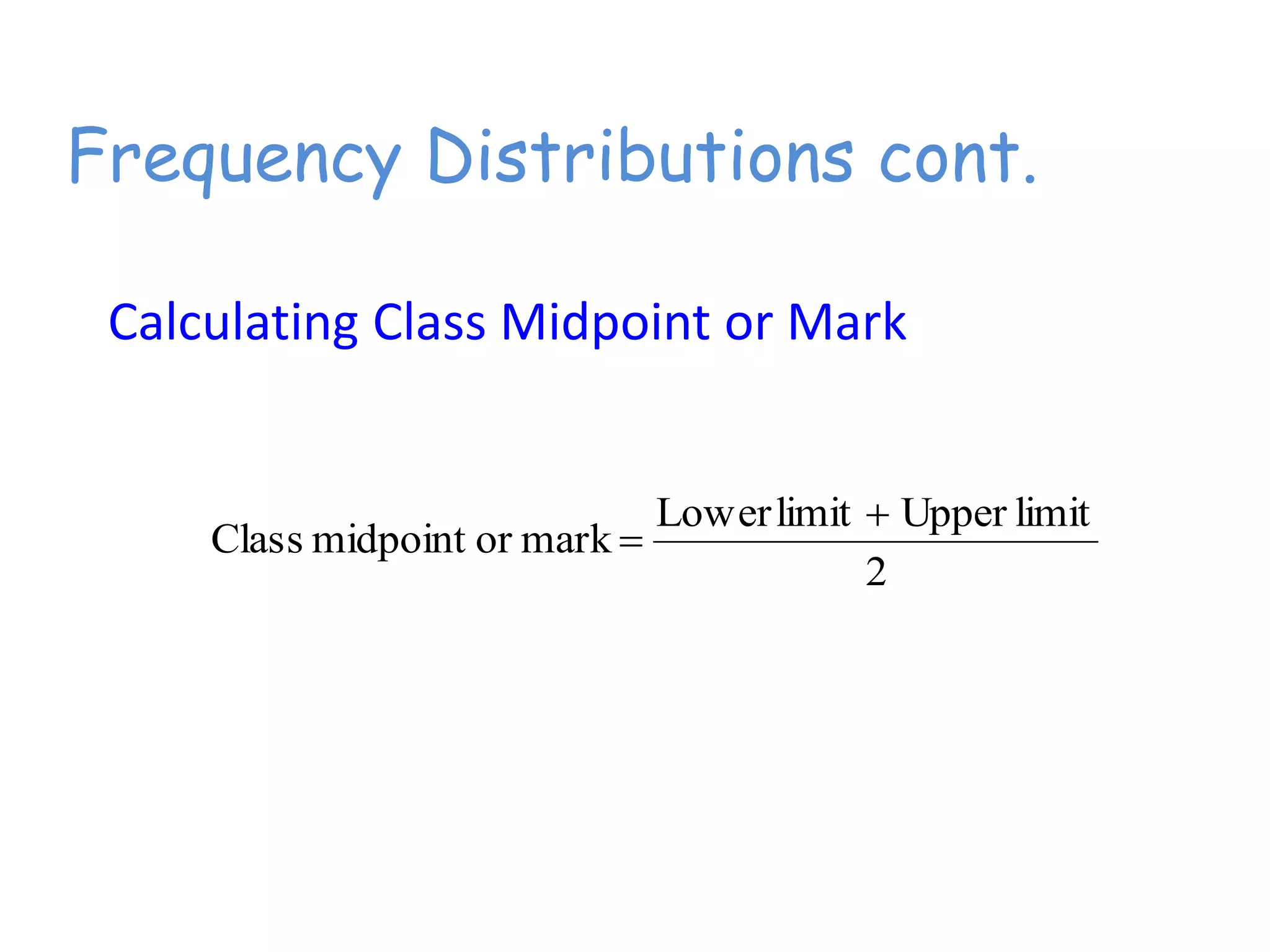
Frequency Distributions cont.
Calculating Class Midpoint or Mark
2
limitUpperlimitLower
markormidpointClass


Rule #1: Choose the classes
You will normally be told how many classes you need
Rule #2: Choose Class Width
ALWAYS round up to the next whole number
Rule #3: Mutually Exclusive
This means the class limits cannot overlap or be
contained in more than one class.
Rules For Grouped Data
Rule #4: Continuous
Even if there are no values in a class the class must be
included in the frequency distribution. There should be
no gaps in a frequency distribution.
(with the exception of a class with zero frequency)
Rule #5: Exhaustive
There should be enough classes to accommodate all of
the data
Rule #6: Equal Width
This avoids a distorted view of the data.
Rules For Grouped Data
Table Class Widths, and Class Midpoints
Class Limits Class Width Class Midpoint
400 to 600
601 to 800
801 to 1000
1001 to 1200
1201 to 1400
1401 to 1600
200
200
200
200
200
200
500
700.5
900.5
1100.5
1300.5
1500.5
Frequency Distributions
102 124 108 86 103 82
71 104 112 118 87 95
103 116 85 122 87 100
105 97 107 67 78 125
109 99 105 99 101 92
Make a frequency distribution table with five classes.
Minutes Spent on the Phone
Minimum value =
Maximum value =
67
125
Total=30
78
90
102
114
126
3
5
8
9
5
67
79
91
103
115
Class Limits Tally f
Construct a Frequency Distribution Table
Minimum = 67, Maximum = 125
Number of classes = 5
Class width = 11.6 = 12
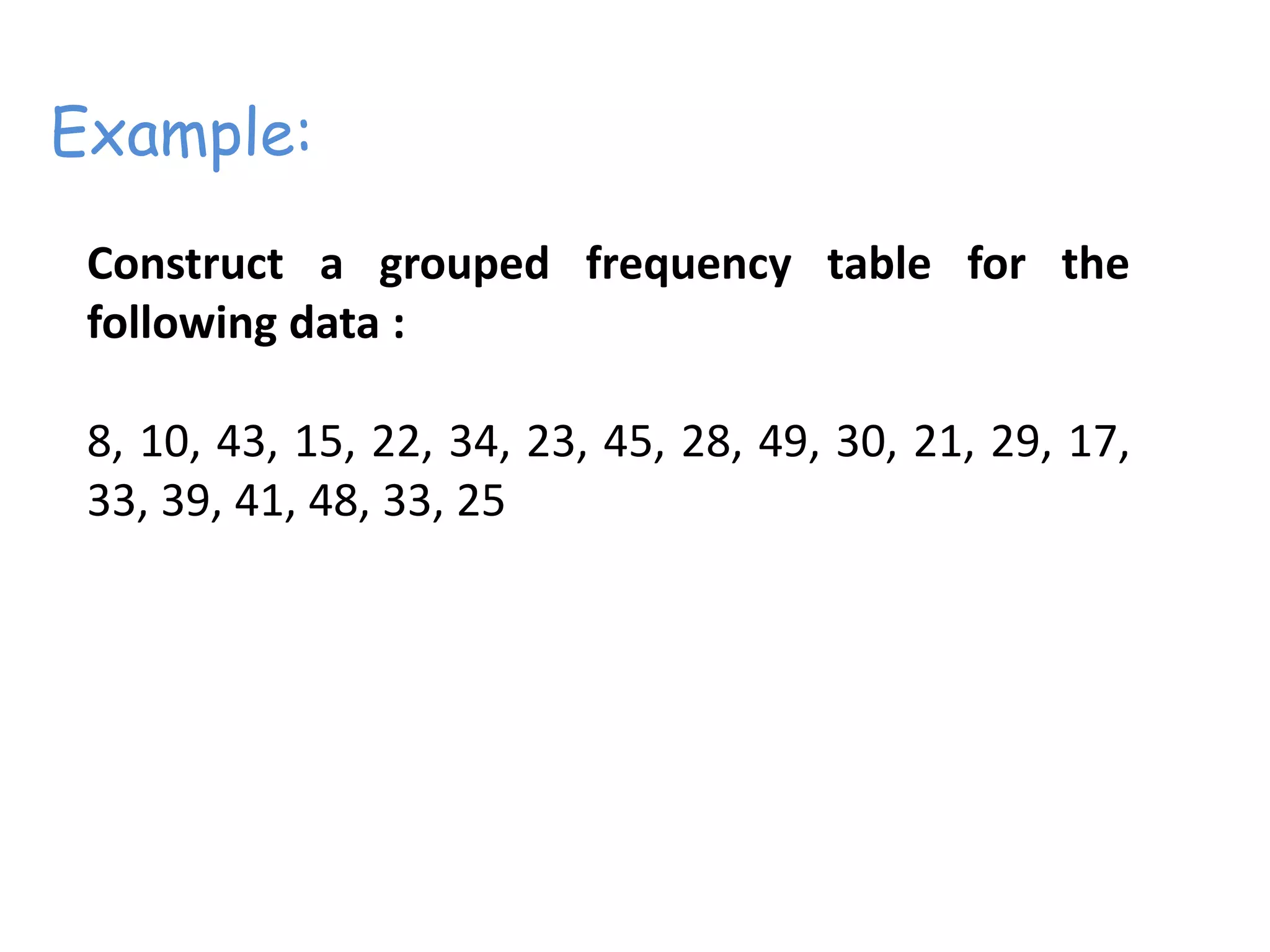
Construct a grouped frequency table for the
following data :
8, 10, 43, 15, 22, 34, 23, 45, 28, 49, 30, 21, 29, 17,
33, 39, 41, 48, 33, 25
Example:
Example
• The total home runs hit by all players of each
of the 30 Major League Baseball teams during
the 2002 season. Construct a frequency
distribution table.
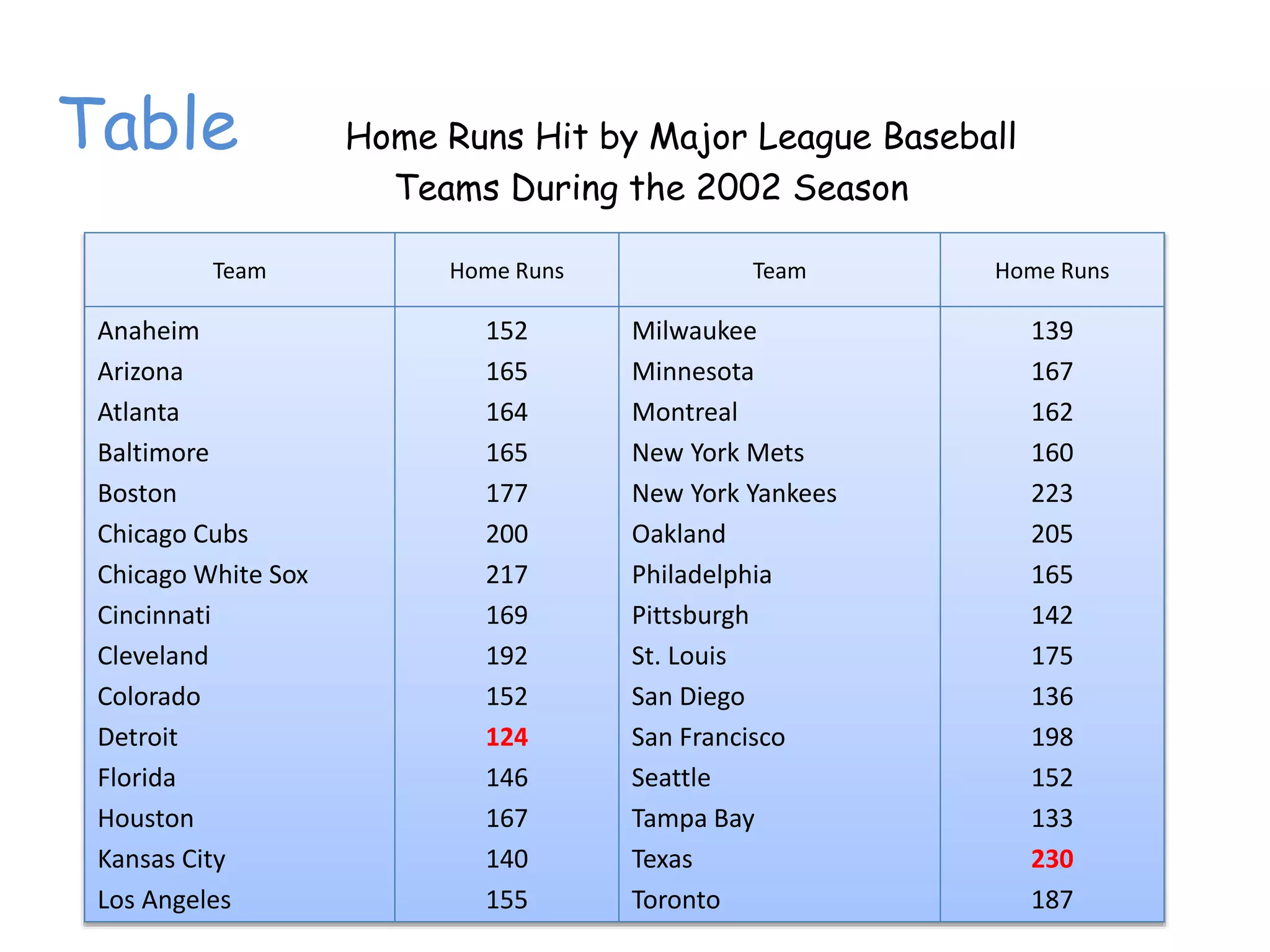
Table Home Runs Hit by Major League Baseball
Teams During the 2002 Season
Team Home Runs Team Home Runs
Anaheim
Arizona
Atlanta
Baltimore
Boston
Chicago Cubs
Chicago White Sox
Cincinnati
Cleveland
Colorado
Detroit
Florida
Houston
Kansas City
Los Angeles
152
165
164
165
177
200
217
169
192
152
124
146
167
140
155
Milwaukee
Minnesota
Montreal
New York Mets
New York Yankees
Oakland
Philadelphia
Pittsburgh
St. Louis
San Diego
San Francisco
Seattle
Tampa Bay
Texas
Toronto
139
167
162
160
223
205
165
142
175
136
198
152
133
230
187
Solution
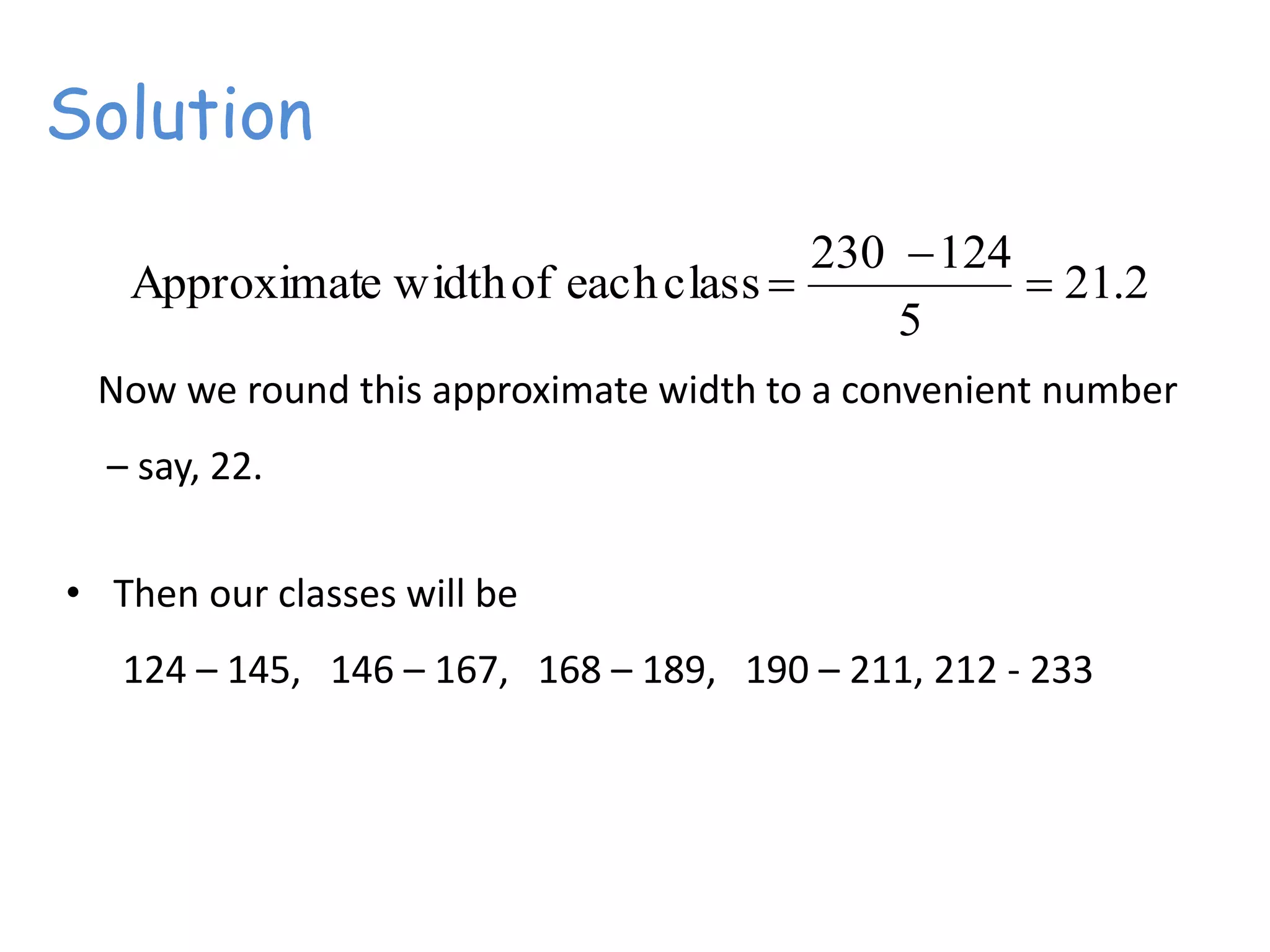
2.21
5
124230
classeachofwidtheApproximat 


Now we round this approximate width to a convenient number
– say, 22.
• Then our classes will be
124 – 145, 146 – 167, 168 – 189, 190 – 211, 212 - 233
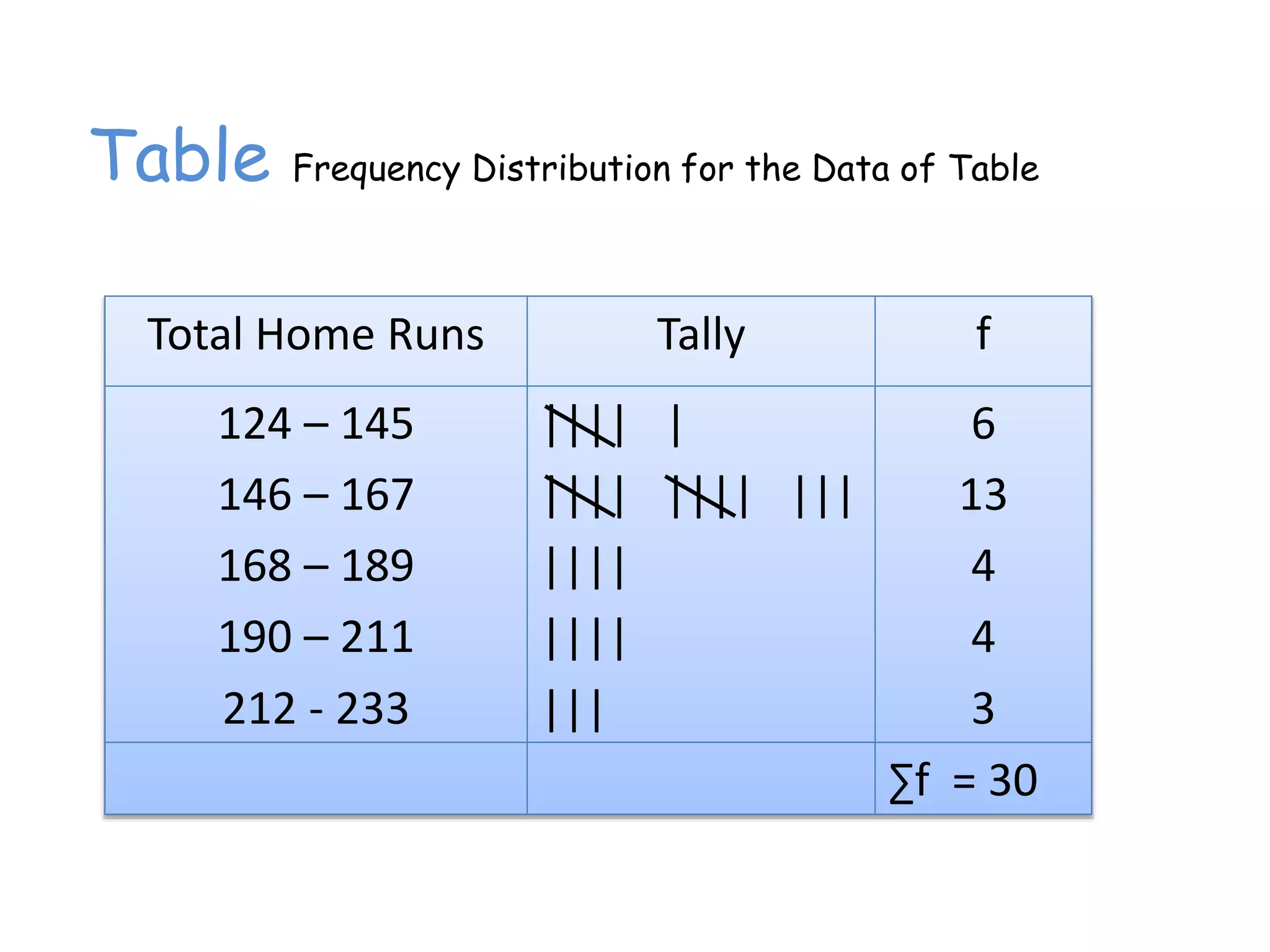
Table Frequency Distribution for the Data of Table
Total Home Runs Tally f
124 – 145
146 – 167
168 – 189
190 – 211
212 - 233
|||| |
|||| |||| |||
||||
||||
|||
6
13
4
4
3
∑f = 30
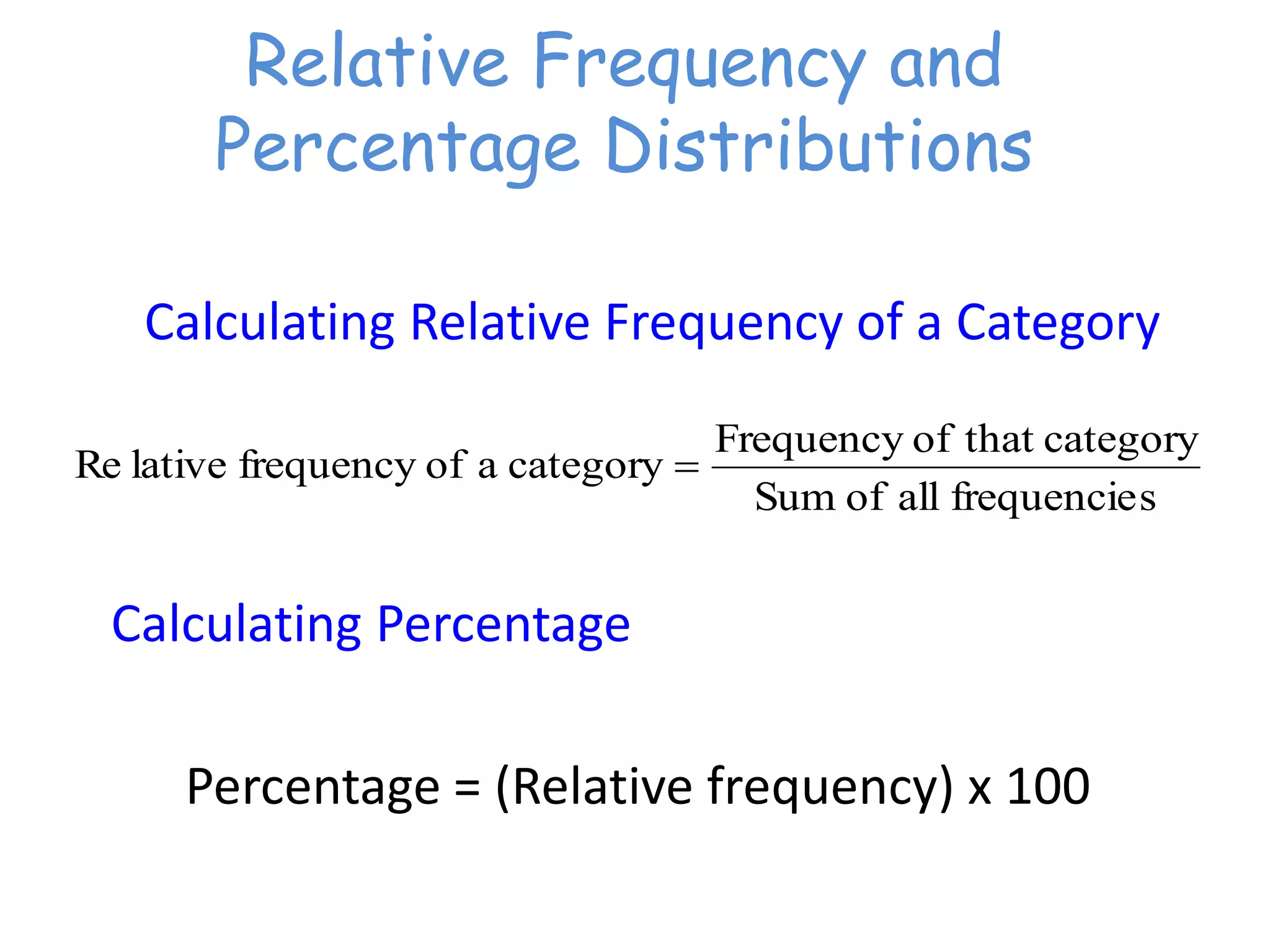
Relative Frequency and
Percentage Distributions
Calculating Relative Frequency of a Category
sfrequencieallofSum
categorythatofFrequency
categoryaoffrequencylativeRe 
Calculating Percentage
Percentage = (Relative frequency) x 100
Solution
Total Home
Runs
f Relative
Frequency
Percentage
124 – 145
146 – 167
168 – 189
190 – 211
212 - 233
6
13
4
4
3
.200
.433
.133
.133
.100
20.0
43.3
13.3
13.3
10.0
∑f = 30 Sum = .999 Sum = 99.9%
Table Relative Frequency and Percentage Distributions for Table
After conducting a survey of 30 of your classmates, you
are left with the following set of data on how many days
off each employee has taken this year:
Construct a Frequency Table. Assume you want to divide the
data into 5 different classes.
Example
7, 8, 9, 4, 10, 36, 19, 9, 26, 5, 11, 6, 2, 9, 10,
8, 16, 29, 7, 9, 8, 25, 4, 27, 8, 7, 6, 10, 34, 8
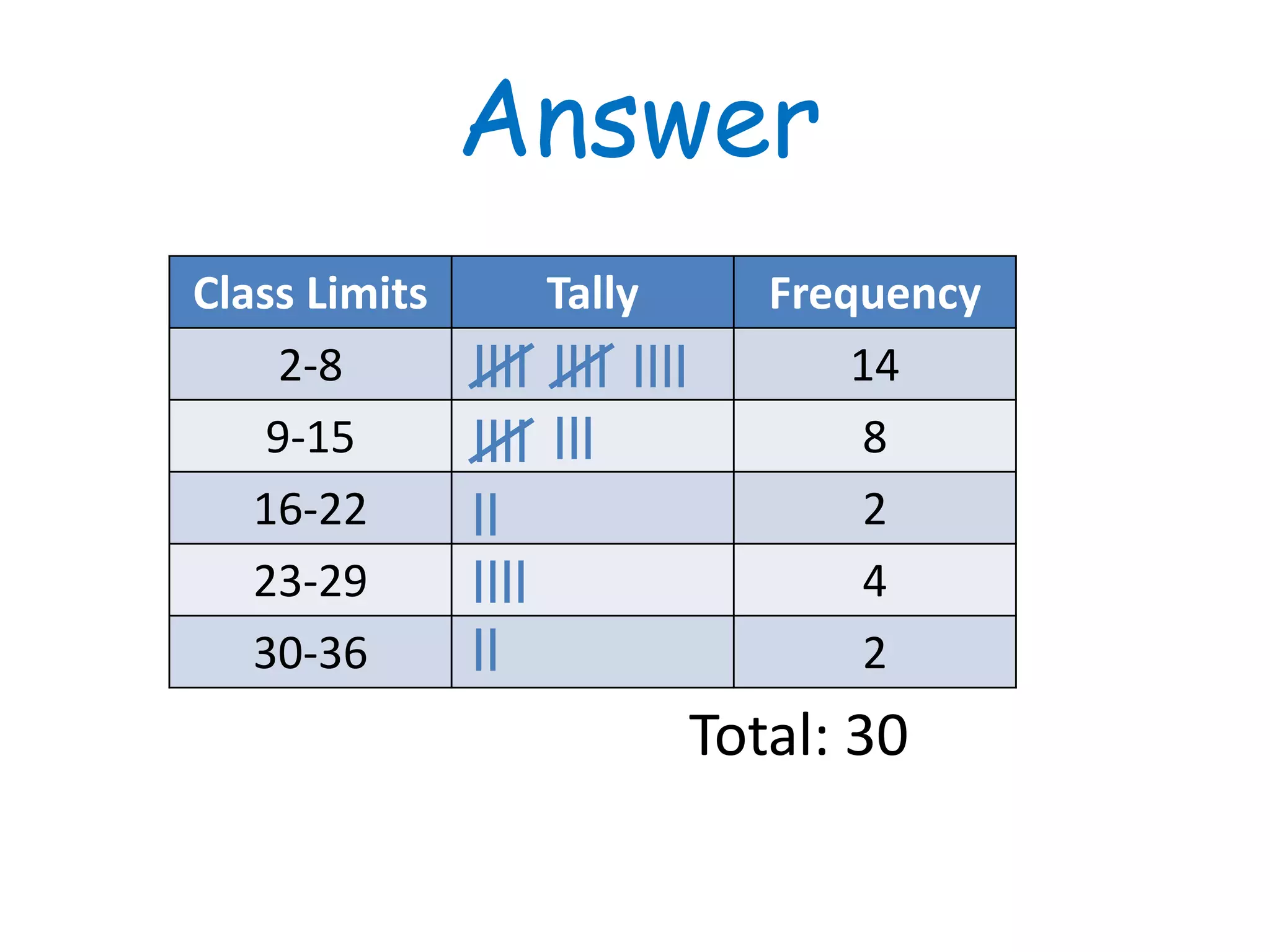
Answer
Class Limits Tally Frequency
2-8 14
9-15 8
16-22 2
23-29 4
30-36 2
Total: 30
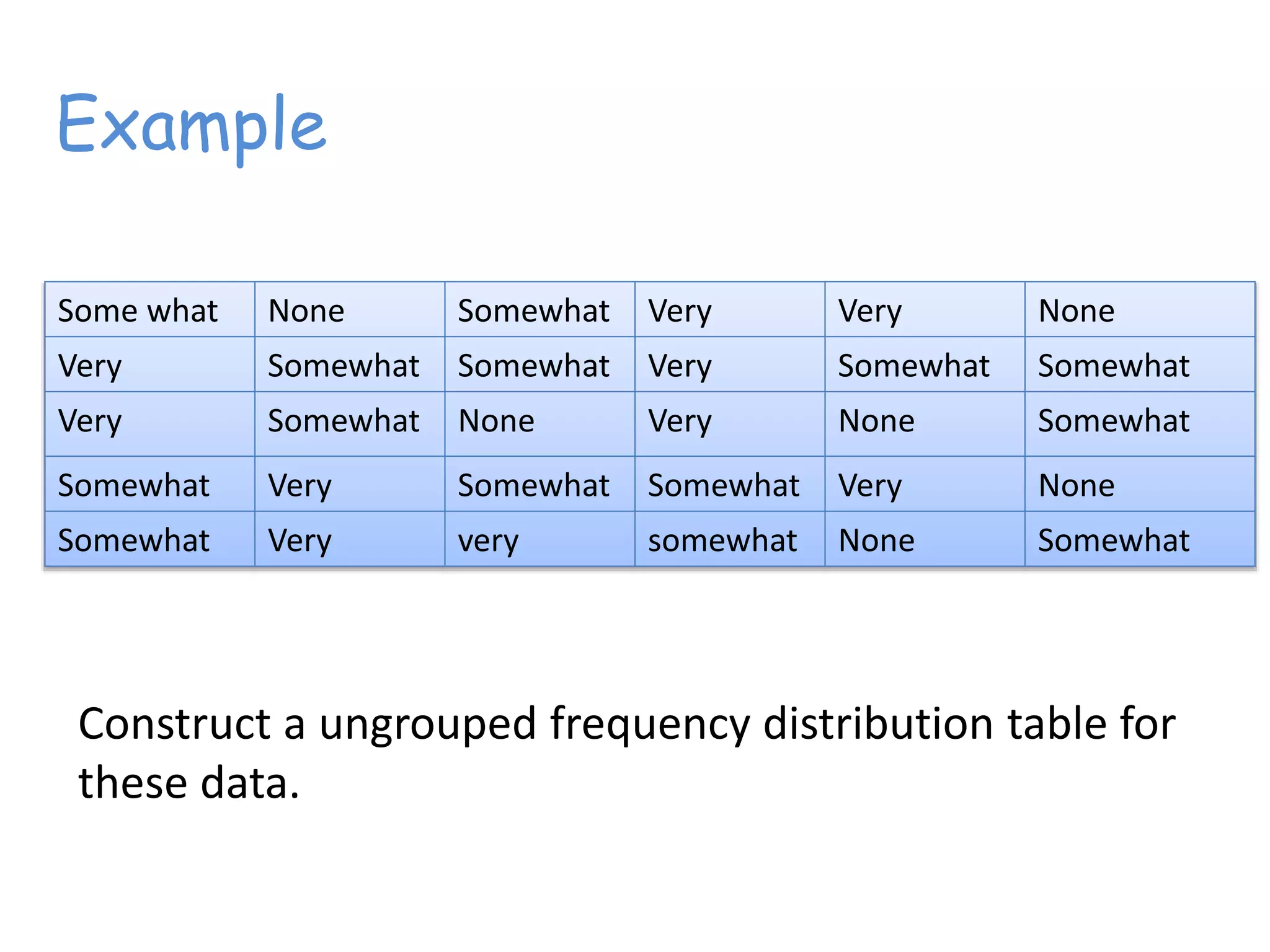
Example
Some what None Somewhat Very Very None
Very Somewhat Somewhat Very Somewhat Somewhat
Very Somewhat None Very None Somewhat
Somewhat Very Somewhat Somewhat Very None
Somewhat Very very somewhat None Somewhat
Construct a ungrouped frequency distribution table for
these data.
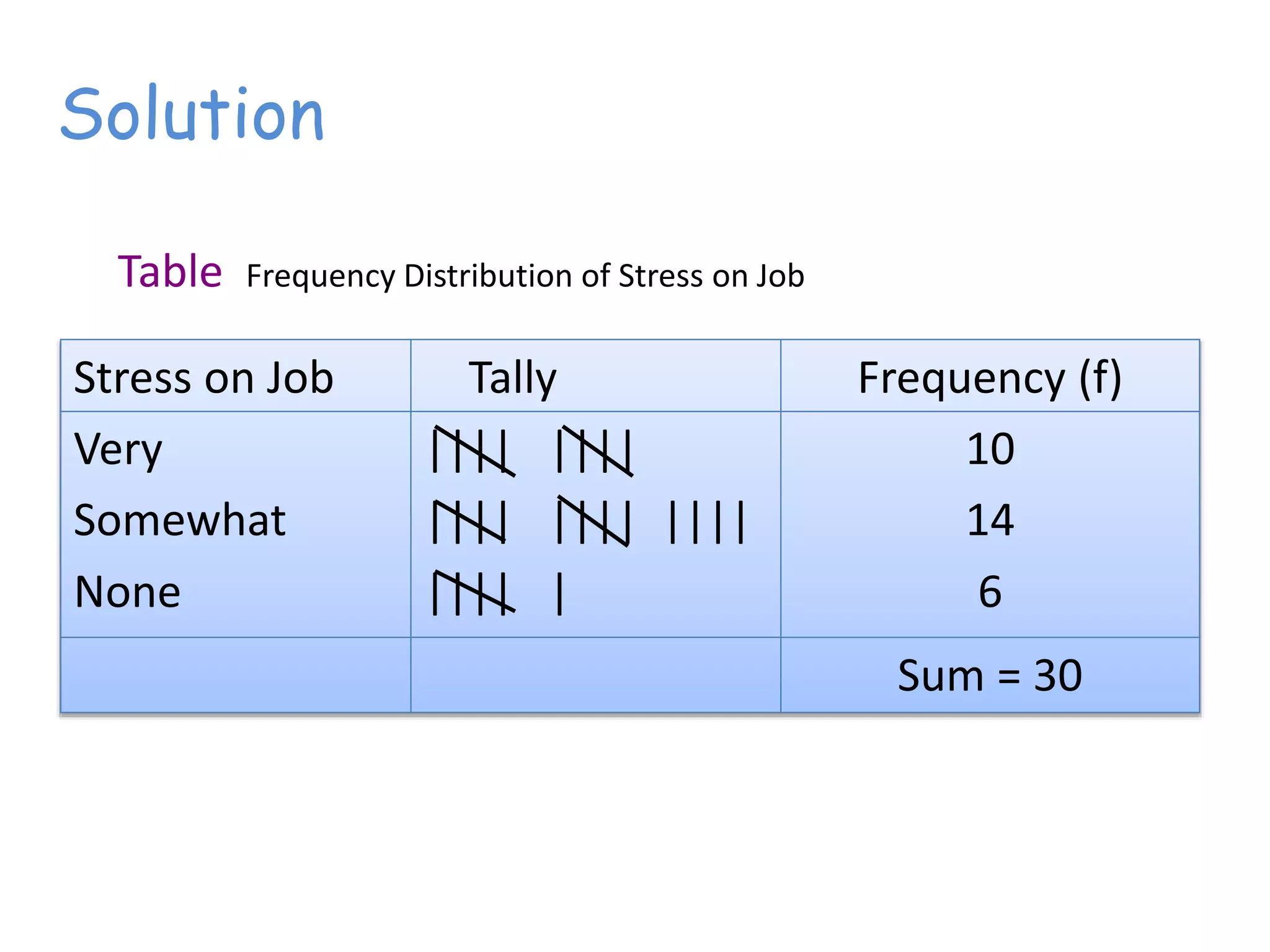
Solution
Stress on Job Tally Frequency (f)
Very
Somewhat
None
|||| ||||
|||| |||| ||||
|||| |
10
14
6
Sum = 30
Table Frequency Distribution of Stress on Job
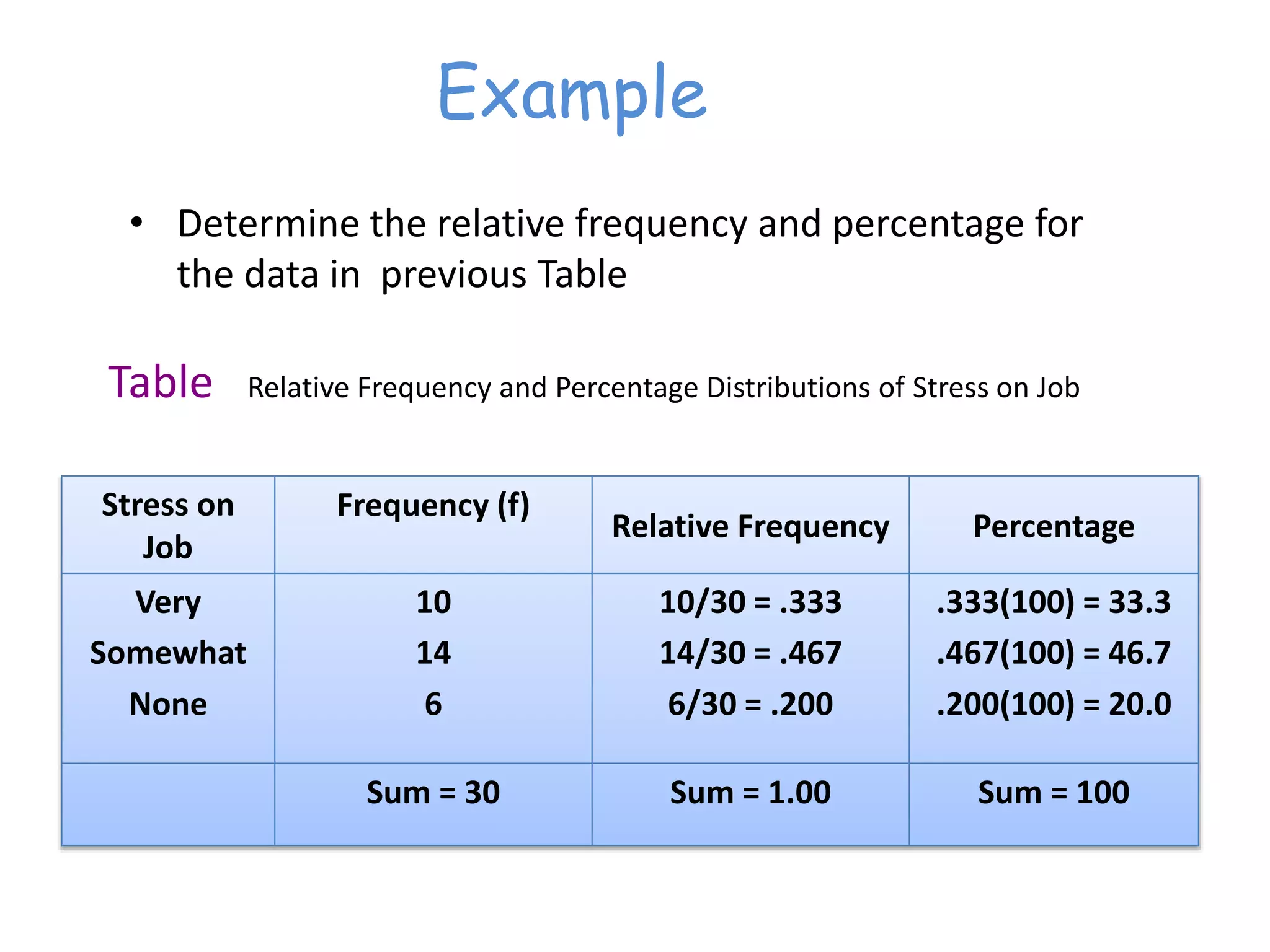
Example
Stress on
Job
Frequency (f)
Relative Frequency Percentage
Very
Somewhat
None
10
14
6
10/30 = .333
14/30 = .467
6/30 = .200
.333(100) = 33.3
.467(100) = 46.7
.200(100) = 20.0
Sum = 30 Sum = 1.00 Sum = 100
Table Relative Frequency and Percentage Distributions of Stress on Job
• Determine the relative frequency and percentage for
the data in previous Table
Example
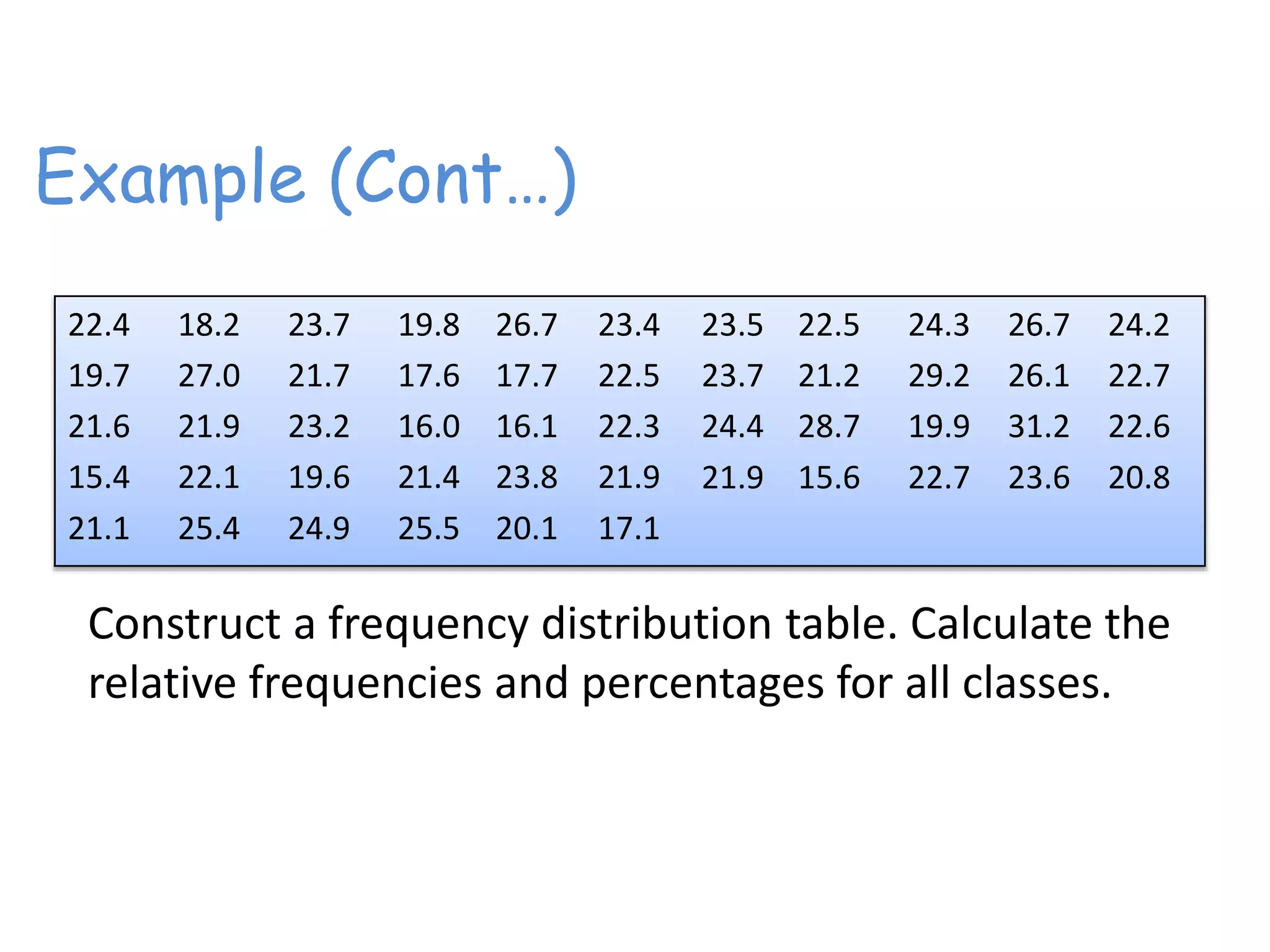
The following data give the average travel time
from home to work (in minutes) for 50 states. The
data are based on a sample survey of 700,000
households conducted by the Census Bureau (USA
TODAY, August 6, 2001).
Example (Cont…)
22.4
19.7
21.6
15.4
21.1
18.2
27.0
21.9
22.1
25.4
23.7
21.7
23.2
19.6
24.9
19.8
17.6
16.0
21.4
25.5
26.7
17.7
16.1
23.8
20.1
23.4
22.5
22.3
21.9
17.1
23.5
23.7
24.4
21.9
22.5
21.2
28.7
15.6
24.3
29.2
19.9
22.7
26.7
26.1
31.2
23.6
24.2
22.7
22.6
20.8
Construct a frequency distribution table. Calculate the
relative frequencies and percentages for all classes.
Solution
63.2
6
4.152.31
classeachofwidtheApproximat 


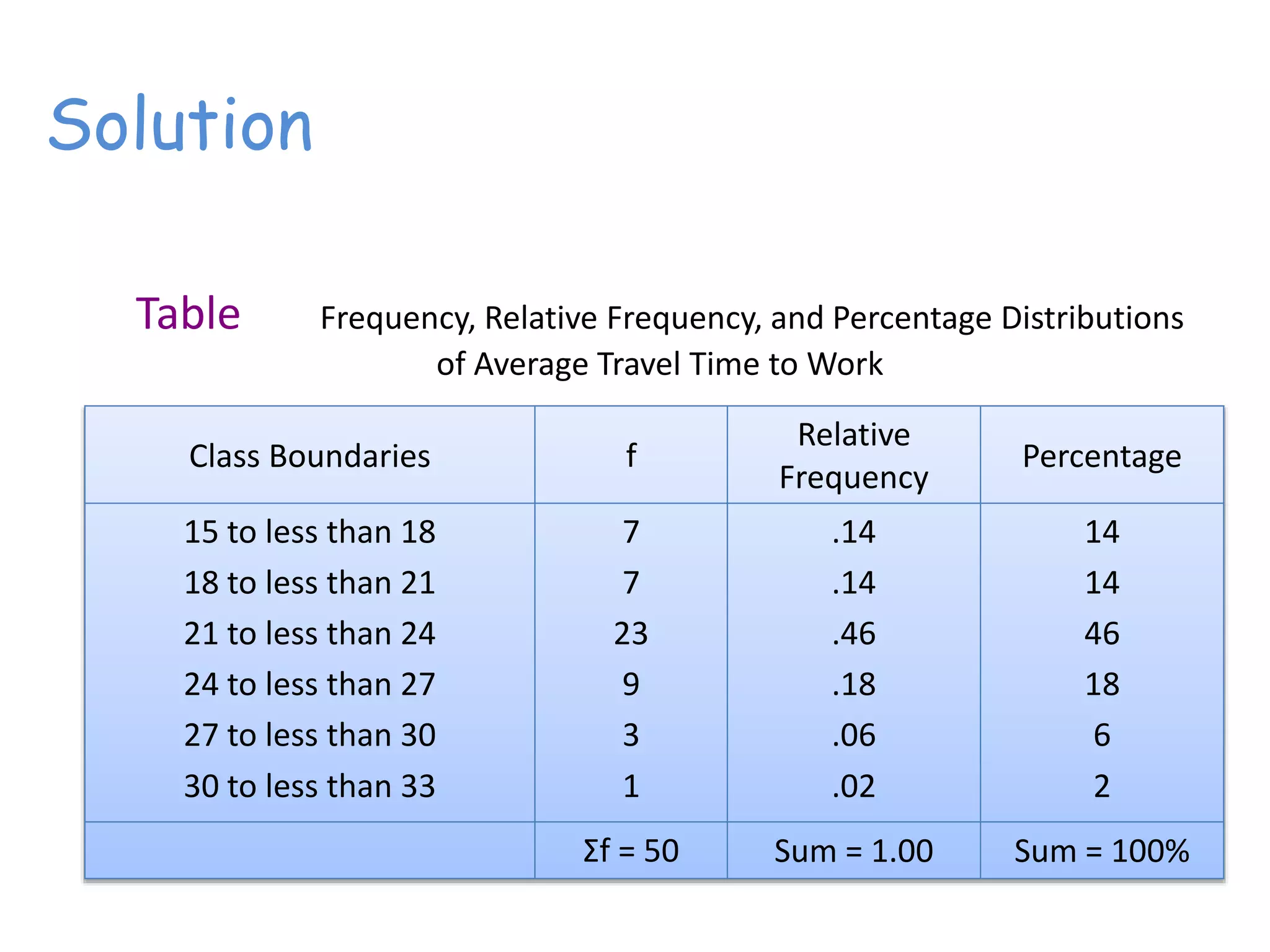
Solution
Class Boundaries f
Relative
Frequency
Percentage
15 to less than 18
18 to less than 21
21 to less than 24
24 to less than 27
27 to less than 30
30 to less than 33
7
7
23
9
3
1
.14
.14
.46
.18
.06
.02
14
14
46
18
6
2
Σf = 50 Sum = 1.00 Sum = 100%
Table Frequency, Relative Frequency, and Percentage Distributions
of Average Travel Time to Work
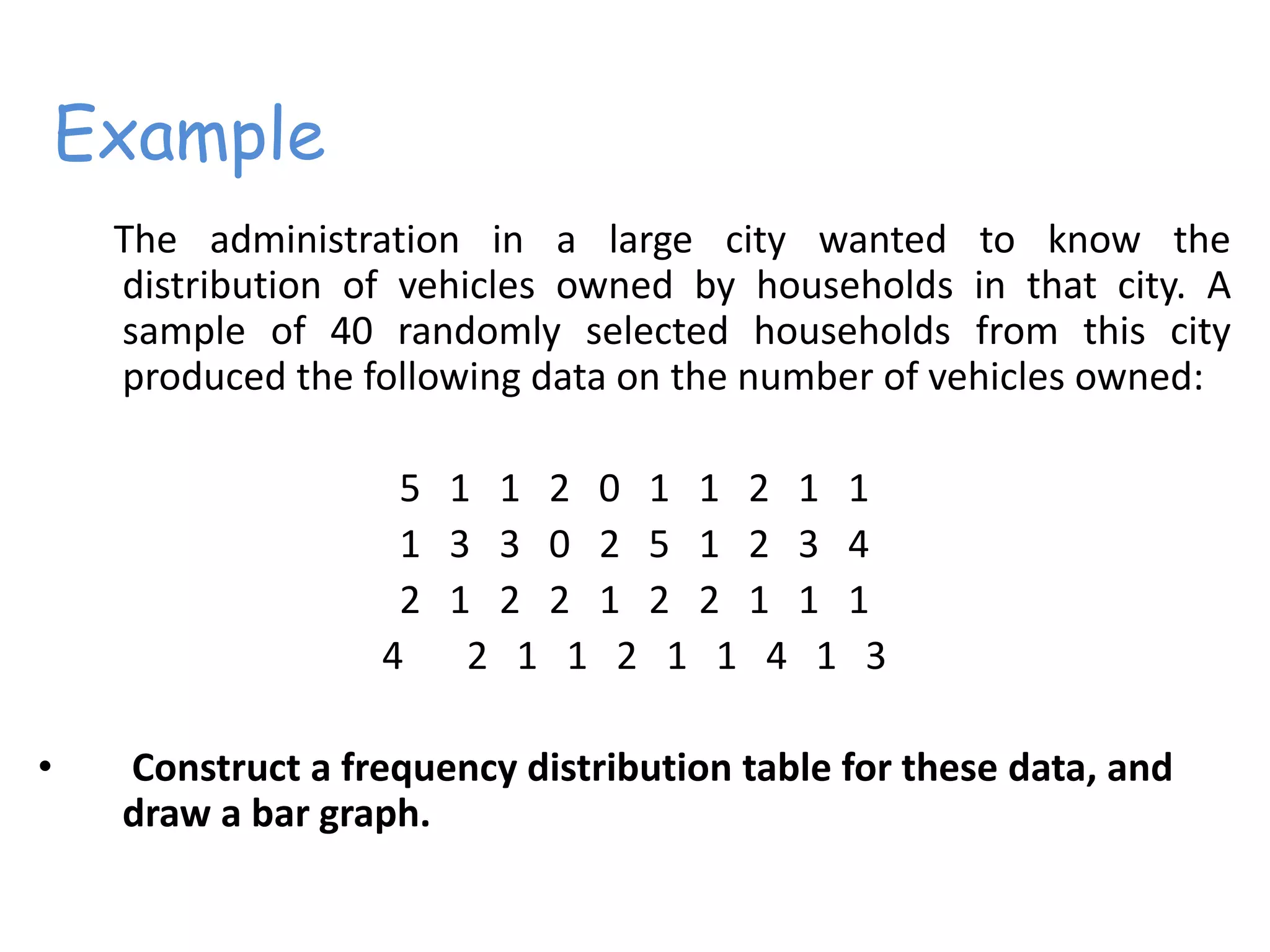
Example
The administration in a large city wanted to know the
distribution of vehicles owned by households in that city. A
sample of 40 randomly selected households from this city
produced the following data on the number of vehicles owned:
5 1 1 2 0 1 1 2 1 1
1 3 3 0 2 5 1 2 3 4
2 1 2 2 1 2 2 1 1 1
4 2 1 1 2 1 1 4 1 3
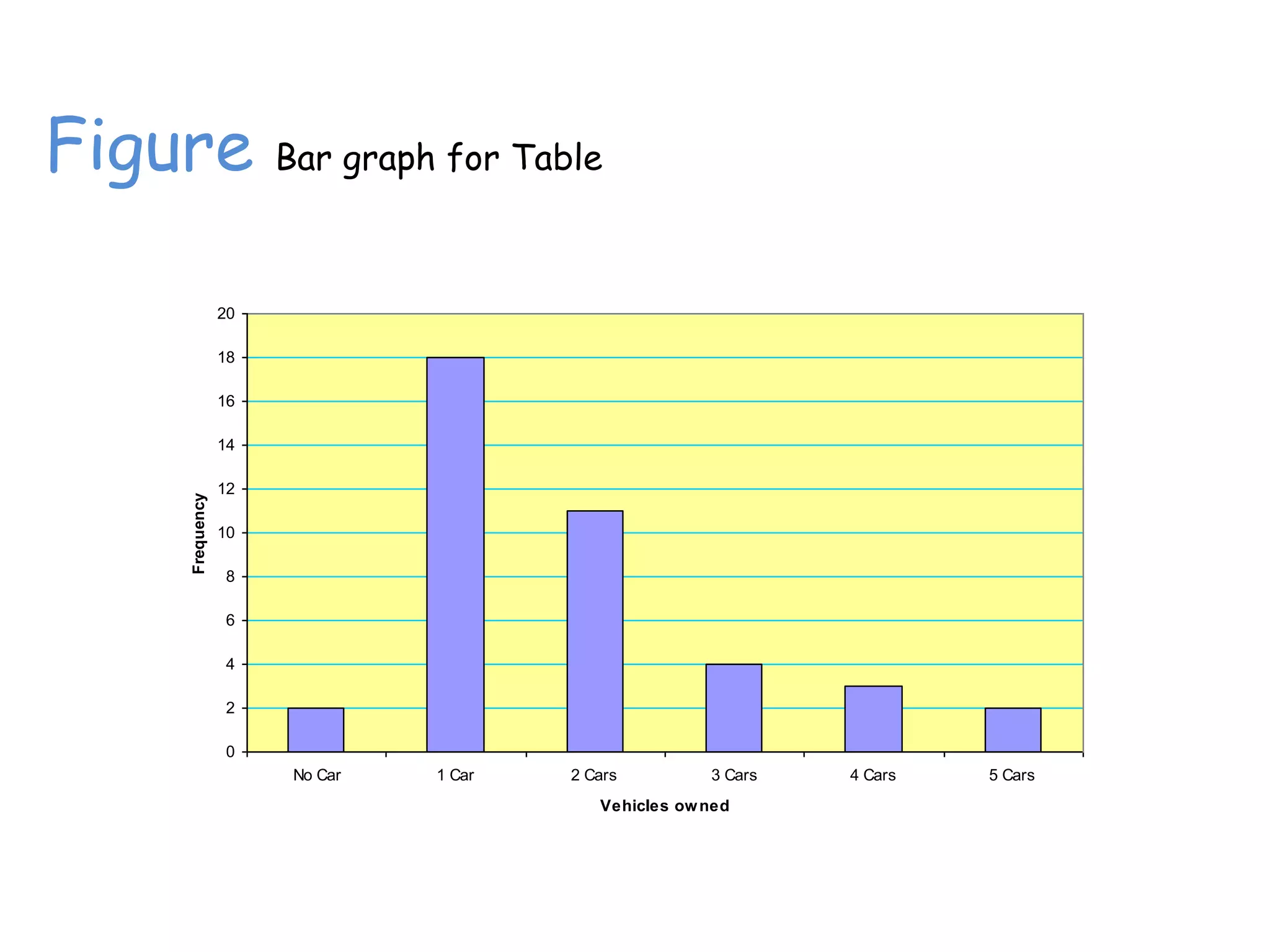
• Construct a frequency distribution table for these data, and
draw a bar graph.
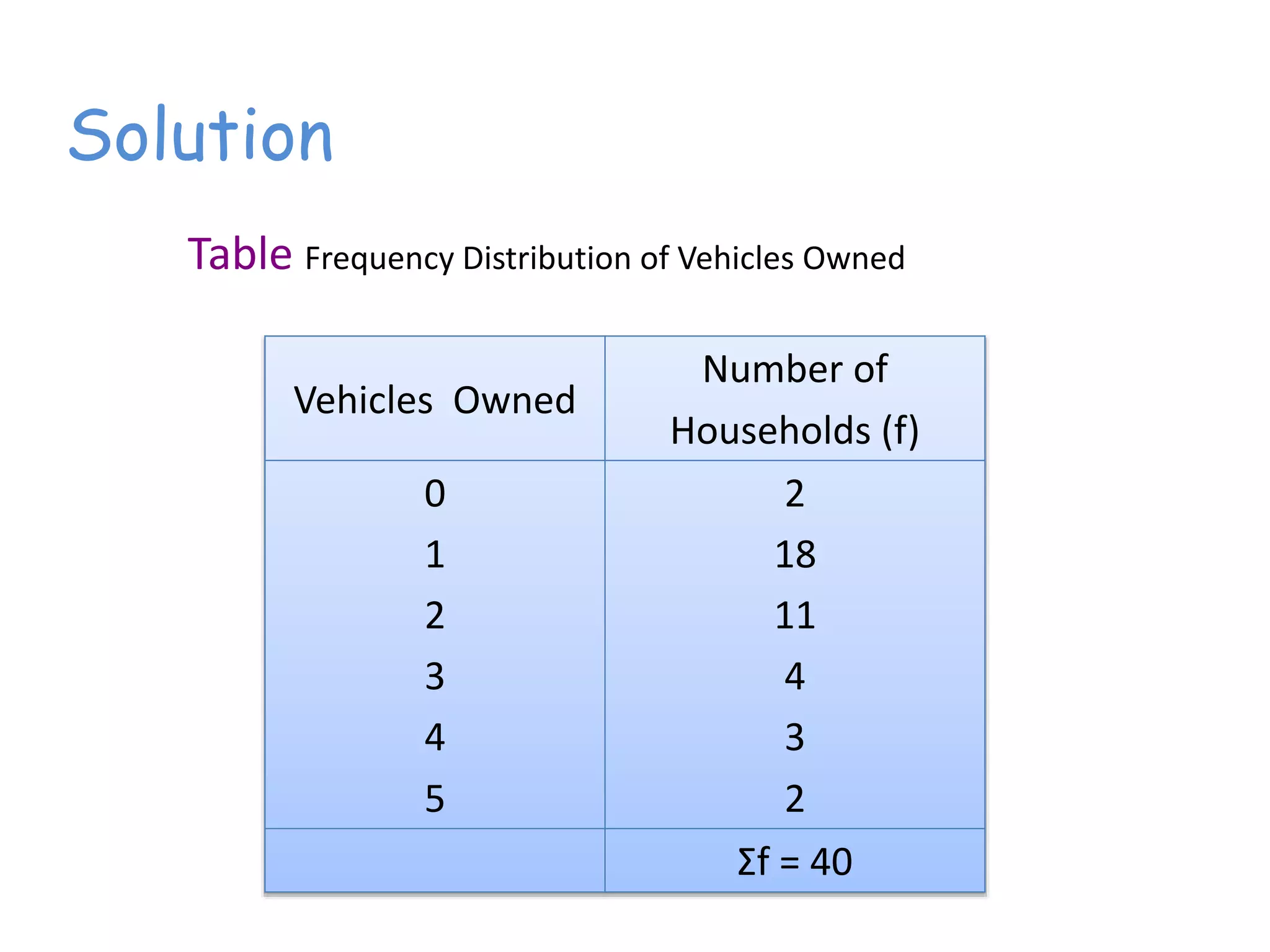
Solution
Vehicles Owned
Number of
Households (f)
0
1
2
3
4
5
2
18
11
4
3
2
Σf = 40
Table Frequency Distribution of Vehicles Owned
Figure Bar graph for Table
0
2
4
6
8
10
12
14
16
18
20
No Car 1 Car 2 Cars 3 Cars 4 Cars 5 Cars
Vehicles owned
Frequency
CUMULATIVE FREQUENCY
DISTRIBUTIONS
Definition
A cumulative frequency distribution gives the
total number of values that fall below the upper
boundary of each class.
Example
Using the frequency distribution of Table in
ptrvious example, reproduced in the next slide,
prepare a cumulative frequency distribution for t
he home runs hit by Major League Baseball
teams during the 2002 season.
Example
Total Home Runs f
124 – 145
146 – 167
168 – 189
190 – 211
212 - 233
6
13
4
4
3
Solution
Class Limits f Cumulative Frequency
124 – 145
124 – 167
124 – 189
124 – 211
124 – 233
6
13
4
4
3
6
6 + 13 = 19
6 + 13 + 4 = 23
6 + 13 + 4 + 4 = 27
6 + 13 + 4 + 4 + 3 = 30
Table Cumulative Frequency Distribution of Home Runs by Baseball Teams
CUMULATIVE FREQUENCY
DISTRIBUTIONS cont.
Calculating Cumulative Relative Frequency and
Cumulative Percentage
100frequency)relativee(CumulativpercentageCumulative
setdatain thensobservatioTotal
classaoffrequencyCumulative
frequencyrelativeCumulative


Table Cumulative Relative Frequency and
Cumulative Percentage Distributions for
Home Runs Hit by baseball Teams
Class Limits
Cumulative
Relative Frequency
Cumulative Percentage
124 – 145
124 – 167
124 – 189
124 – 211
124 - 233
6/30 = .200
19/30 = .633
23/30 = .767
27/30 = .900
30/30 = 1.00
20.0
63.3
76.7
90.0
100.0
CUMULATIVE FREQUENCY
DISTRIBUTIONS cont.
Definition
An ogive is a curve drawn for the cumulative
frequency distribution by joining with straight lines
the dots marked above the upper boundaries of
classes at heights equal to the cumulative
frequencies of respective classes.
Figure Ogive for the cumulative frequency
distribution in Table
123.5 145.5 167.5 189.5 211.5 233.5
30
25
20
15
10
5
Total home runs
Cumulativefrequency
Shape
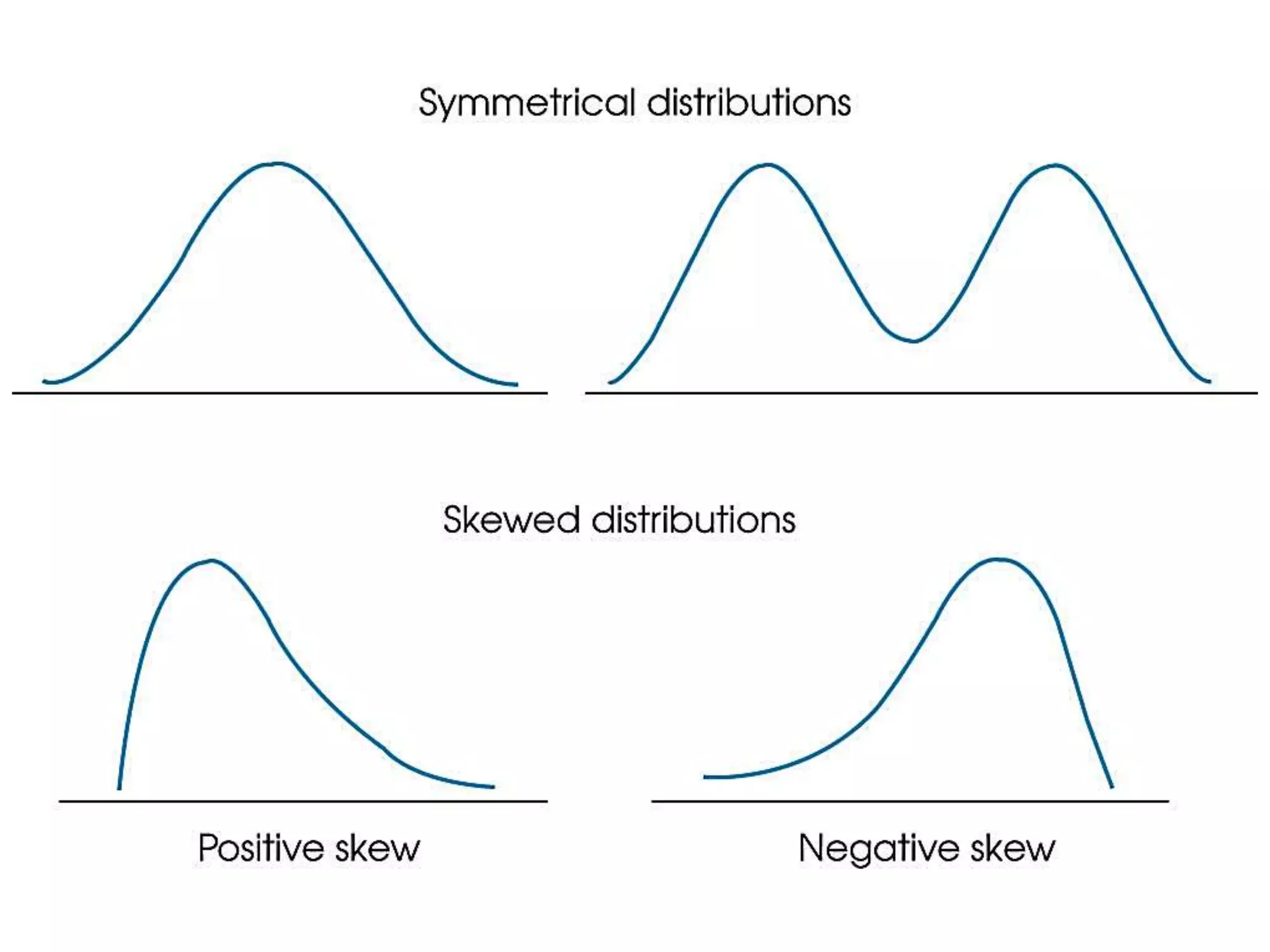
• A graph shows the shape of the distribution.
• A distribution is symmetrical if the left side of the
graph is (roughly) a mirror image of the right side.
• One example of a symmetrical distribution is the
bell-shaped normal distribution.
• On the other hand, distributions are skewed when
scores pile up on one side of the distribution,
leaving a "tail" of a few extreme values on the other
side.
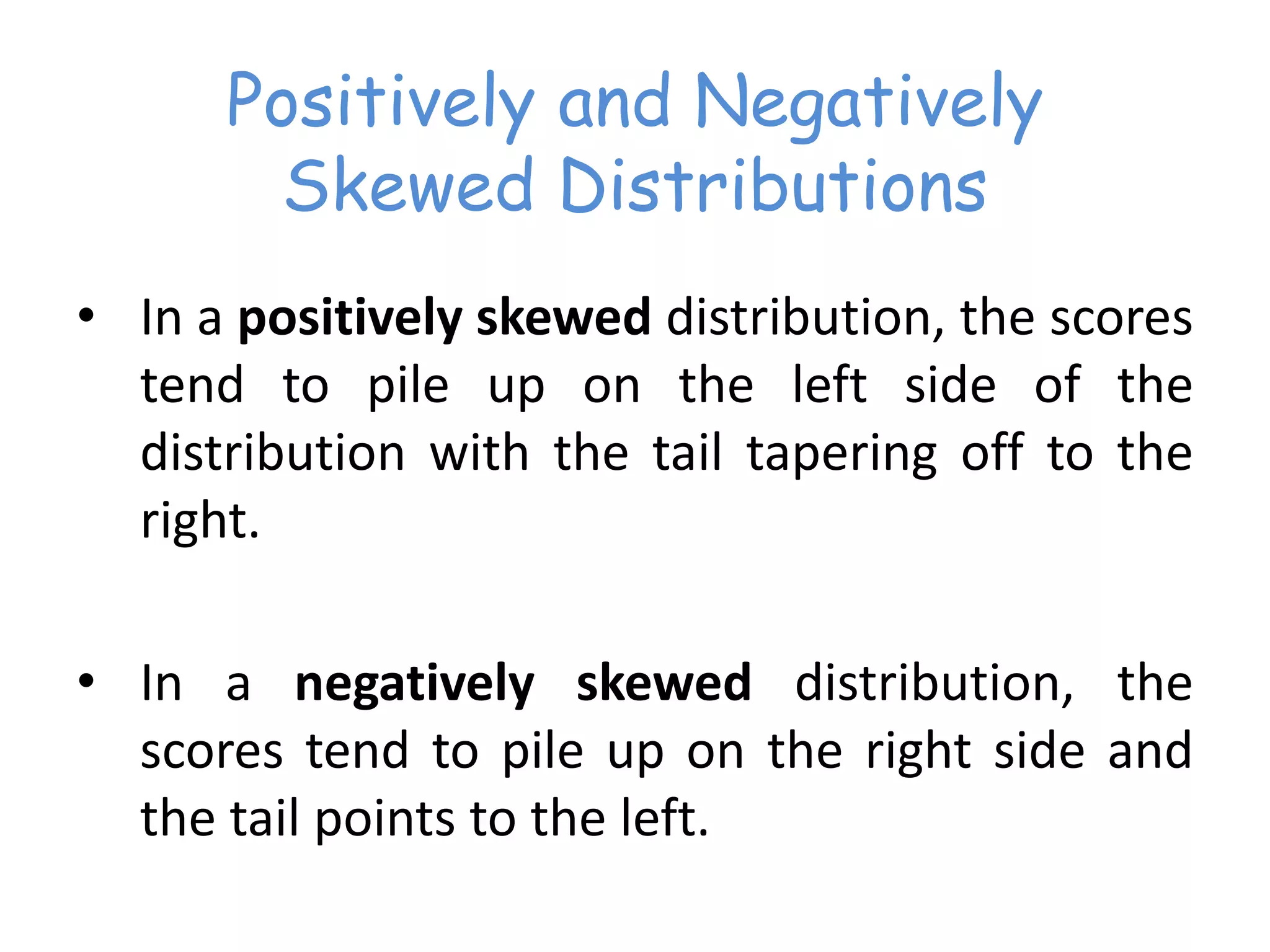
Positively and Negatively
Skewed Distributions
• In a positively skewed distribution, the scores
tend to pile up on the left side of the
distribution with the tail tapering off to the
right.
• In a negatively skewed distribution, the
scores tend to pile up on the right side and
the tail points to the left.
 frequency distribution

frequency distribution

  • 1.
  • 2.
    Example The following arethe scores of 30 college students in a statistics test: Construct a stem-and-leaf display. 75 69 83 52 72 84 80 81 77 96 61 64 65 76 71 79 86 87 71 79 72 87 68 92 93 50 57 95 92 98
  • 3.
    Figure Stem-and-leaf displayof test scores. 5 6 7 8 9 2 0 7 5 9 1 8 4 5 9 1 2 6 9 7 1 2 0 7 1 6 3 4 7 6 3 5 2 2 8
  • 4.
    Example The following dataare monthly rents paid by a sample of 30 households selected from a small city. Construct a stem-and-leaf display for these data. 880 1210 1151 1081 985 630 721 1231 1175 1075 932 952 1023 850 1100 775 825 1140 1235 1000 750 750 915 1140 965 1191 1370 960 1035 1280
  • 5.
    Solution 6 7 8 9 10 11 12 13 30 75 50 2150 80 25 50 32 52 15 60 85 65 23 81 35 75 00 91 51 40 75 40 00 10 31 35 80 70 Stem-and-leaf display of rents.
  • 6.
    Exercise Develop your ownStem and Leaf Plot with the following temperatures for June. 77 80 82 68 65 59 61 57 50 62 61 70 69 64 67 70 62 65 65 73 76 87 80 82 83 79 79 71 80 77
  • 7.
    Example 0 1 2 3 4 5 6 7 8 6 1 7 9 26 2 4 7 8 1 5 6 9 9 3 6 8 2 4 4 5 7 5 6 The following stem-and-leaf display is prepared for the number of hours that 25 students spent working on computers during the last month. Prepare a new stem-and-leaf display by grouping the stems.
  • 8.
    Solution 0 – 2 3– 5 6 – 8 6 * 1 7 9 * 2 6 2 4 7 8 * 1 5 6 9 9 * 3 6 8 2 4 4 5 7 * * 5 6 Grouped stem-and-leaf display.
  • 9.
    Grouped DataVs UngroupedData Ungrouped data – Data that has not been organized into groups. Also called as raw data. Grouped data - Data that has been organized into groups (into a frequency distribution). Data Frequency 2 – 4 5 5 – 7 6 8 – 10 10 11 – 13 8 14 – 16 4 17 – 19 3 Data Frequency 2 8 3 4 5 6 7 7 8 2 9 5
  • 10.
    Step 1: Makea table with the following columns in order: class, tally, and frequency Step 2: Tally (TOTAL) the data and place the results in the tally column. Step 3: Count the tallies and place the results in the frequency column. Creating a Categorical Ungrouped Frequency Distribution
  • 11.
    Example: Below is themarks of 35 students in English test (out of 10). Arrange these marks in tabular form using tally marks. 5, 8, 7, 6, 10, 8, 2, 4, 6, 3, 7, 5, 8, 5, 1, 7, 4, 6, 3, 5, 2, 8, 4, 2, 6, 4, 2, 8, 9, 5, 4, 7, 5, 5, 8.
  • 12.
    Example: Let us considerthe following data: 2, 3, 3, 5, 7, 9, 7, 8, 9, 9, 2, 5, 3, 9, 3, 2, 5, 9, 8, 7, 3, 5, 7, 9, 8, 5, 2, 3 Design frequency table for above data.
  • 13.
    Class Tally Frequency Total= Example Theseare the favorite colors of fifteen 2nd graders. Red Yellow Green Red Blue Blue Red Red Green Red Green Yellow Red Blue Green
  • 14.
    • When therange of the data is large, the data must be grouped into classes Grouped Frequency Distribution 41 104 112 118 87 95 105 57 107 67 78 125 109 99 105 99 101 92
  • 15.
  • 16.
    • The classwidth is the range of the class. • Can be found by subtracting the lower class limit of one class from the upper class limit of the next class Class Width Class width = Upper boundary – Lower boundary # of classes
  • 17.
    Frequency Distributions cont. CalculatingClass Midpoint or Mark 2 limitUpperlimitLower markormidpointClass  
  • 18.
    Rule #1: Choosethe classes You will normally be told how many classes you need Rule #2: Choose Class Width ALWAYS round up to the next whole number Rule #3: Mutually Exclusive This means the class limits cannot overlap or be contained in more than one class. Rules For Grouped Data
  • 19.
    Rule #4: Continuous Evenif there are no values in a class the class must be included in the frequency distribution. There should be no gaps in a frequency distribution. (with the exception of a class with zero frequency) Rule #5: Exhaustive There should be enough classes to accommodate all of the data Rule #6: Equal Width This avoids a distorted view of the data. Rules For Grouped Data
  • 20.
    Table Class Widths,and Class Midpoints Class Limits Class Width Class Midpoint 400 to 600 601 to 800 801 to 1000 1001 to 1200 1201 to 1400 1401 to 1600 200 200 200 200 200 200 500 700.5 900.5 1100.5 1300.5 1500.5
  • 21.
    Frequency Distributions 102 124108 86 103 82 71 104 112 118 87 95 103 116 85 122 87 100 105 97 107 67 78 125 109 99 105 99 101 92 Make a frequency distribution table with five classes. Minutes Spent on the Phone Minimum value = Maximum value = 67 125
  • 22.
    Total=30 78 90 102 114 126 3 5 8 9 5 67 79 91 103 115 Class Limits Tallyf Construct a Frequency Distribution Table Minimum = 67, Maximum = 125 Number of classes = 5 Class width = 11.6 = 12
  • 23.
    Construct a groupedfrequency table for the following data : 8, 10, 43, 15, 22, 34, 23, 45, 28, 49, 30, 21, 29, 17, 33, 39, 41, 48, 33, 25 Example:
  • 24.
    Example • The totalhome runs hit by all players of each of the 30 Major League Baseball teams during the 2002 season. Construct a frequency distribution table.
  • 25.
    Table Home RunsHit by Major League Baseball Teams During the 2002 Season Team Home Runs Team Home Runs Anaheim Arizona Atlanta Baltimore Boston Chicago Cubs Chicago White Sox Cincinnati Cleveland Colorado Detroit Florida Houston Kansas City Los Angeles 152 165 164 165 177 200 217 169 192 152 124 146 167 140 155 Milwaukee Minnesota Montreal New York Mets New York Yankees Oakland Philadelphia Pittsburgh St. Louis San Diego San Francisco Seattle Tampa Bay Texas Toronto 139 167 162 160 223 205 165 142 175 136 198 152 133 230 187
  • 26.
    Solution 2.21 5 124230 classeachofwidtheApproximat    Now weround this approximate width to a convenient number – say, 22. • Then our classes will be 124 – 145, 146 – 167, 168 – 189, 190 – 211, 212 - 233
  • 27.
    Table Frequency Distributionfor the Data of Table Total Home Runs Tally f 124 – 145 146 – 167 168 – 189 190 – 211 212 - 233 |||| | |||| |||| ||| |||| |||| ||| 6 13 4 4 3 ∑f = 30
  • 28.
    Relative Frequency and PercentageDistributions Calculating Relative Frequency of a Category sfrequencieallofSum categorythatofFrequency categoryaoffrequencylativeRe  Calculating Percentage Percentage = (Relative frequency) x 100
  • 29.
    Solution Total Home Runs f Relative Frequency Percentage 124– 145 146 – 167 168 – 189 190 – 211 212 - 233 6 13 4 4 3 .200 .433 .133 .133 .100 20.0 43.3 13.3 13.3 10.0 ∑f = 30 Sum = .999 Sum = 99.9% Table Relative Frequency and Percentage Distributions for Table
  • 30.
    After conducting asurvey of 30 of your classmates, you are left with the following set of data on how many days off each employee has taken this year: Construct a Frequency Table. Assume you want to divide the data into 5 different classes. Example 7, 8, 9, 4, 10, 36, 19, 9, 26, 5, 11, 6, 2, 9, 10, 8, 16, 29, 7, 9, 8, 25, 4, 27, 8, 7, 6, 10, 34, 8
  • 31.
    Answer Class Limits TallyFrequency 2-8 14 9-15 8 16-22 2 23-29 4 30-36 2 Total: 30
  • 32.
    Example Some what NoneSomewhat Very Very None Very Somewhat Somewhat Very Somewhat Somewhat Very Somewhat None Very None Somewhat Somewhat Very Somewhat Somewhat Very None Somewhat Very very somewhat None Somewhat Construct a ungrouped frequency distribution table for these data.
  • 33.
    Solution Stress on JobTally Frequency (f) Very Somewhat None |||| |||| |||| |||| |||| |||| | 10 14 6 Sum = 30 Table Frequency Distribution of Stress on Job
  • 34.
    Example Stress on Job Frequency (f) RelativeFrequency Percentage Very Somewhat None 10 14 6 10/30 = .333 14/30 = .467 6/30 = .200 .333(100) = 33.3 .467(100) = 46.7 .200(100) = 20.0 Sum = 30 Sum = 1.00 Sum = 100 Table Relative Frequency and Percentage Distributions of Stress on Job • Determine the relative frequency and percentage for the data in previous Table
  • 35.
    Example The following datagive the average travel time from home to work (in minutes) for 50 states. The data are based on a sample survey of 700,000 households conducted by the Census Bureau (USA TODAY, August 6, 2001).
  • 36.
  • 37.
  • 38.
    Solution Class Boundaries f Relative Frequency Percentage 15to less than 18 18 to less than 21 21 to less than 24 24 to less than 27 27 to less than 30 30 to less than 33 7 7 23 9 3 1 .14 .14 .46 .18 .06 .02 14 14 46 18 6 2 Σf = 50 Sum = 1.00 Sum = 100% Table Frequency, Relative Frequency, and Percentage Distributions of Average Travel Time to Work
  • 39.
    Example The administration ina large city wanted to know the distribution of vehicles owned by households in that city. A sample of 40 randomly selected households from this city produced the following data on the number of vehicles owned: 5 1 1 2 0 1 1 2 1 1 1 3 3 0 2 5 1 2 3 4 2 1 2 2 1 2 2 1 1 1 4 2 1 1 2 1 1 4 1 3 • Construct a frequency distribution table for these data, and draw a bar graph.
  • 40.
    Solution Vehicles Owned Number of Households(f) 0 1 2 3 4 5 2 18 11 4 3 2 Σf = 40 Table Frequency Distribution of Vehicles Owned
  • 41.
    Figure Bar graphfor Table 0 2 4 6 8 10 12 14 16 18 20 No Car 1 Car 2 Cars 3 Cars 4 Cars 5 Cars Vehicles owned Frequency
  • 42.
    CUMULATIVE FREQUENCY DISTRIBUTIONS Definition A cumulativefrequency distribution gives the total number of values that fall below the upper boundary of each class.
  • 43.
    Example Using the frequencydistribution of Table in ptrvious example, reproduced in the next slide, prepare a cumulative frequency distribution for t he home runs hit by Major League Baseball teams during the 2002 season.
  • 44.
    Example Total Home Runsf 124 – 145 146 – 167 168 – 189 190 – 211 212 - 233 6 13 4 4 3
  • 45.
    Solution Class Limits fCumulative Frequency 124 – 145 124 – 167 124 – 189 124 – 211 124 – 233 6 13 4 4 3 6 6 + 13 = 19 6 + 13 + 4 = 23 6 + 13 + 4 + 4 = 27 6 + 13 + 4 + 4 + 3 = 30 Table Cumulative Frequency Distribution of Home Runs by Baseball Teams
  • 46.
    CUMULATIVE FREQUENCY DISTRIBUTIONS cont. CalculatingCumulative Relative Frequency and Cumulative Percentage 100frequency)relativee(CumulativpercentageCumulative setdatain thensobservatioTotal classaoffrequencyCumulative frequencyrelativeCumulative  
  • 47.
    Table Cumulative RelativeFrequency and Cumulative Percentage Distributions for Home Runs Hit by baseball Teams Class Limits Cumulative Relative Frequency Cumulative Percentage 124 – 145 124 – 167 124 – 189 124 – 211 124 - 233 6/30 = .200 19/30 = .633 23/30 = .767 27/30 = .900 30/30 = 1.00 20.0 63.3 76.7 90.0 100.0
  • 48.
    CUMULATIVE FREQUENCY DISTRIBUTIONS cont. Definition Anogive is a curve drawn for the cumulative frequency distribution by joining with straight lines the dots marked above the upper boundaries of classes at heights equal to the cumulative frequencies of respective classes.
  • 49.
    Figure Ogive forthe cumulative frequency distribution in Table 123.5 145.5 167.5 189.5 211.5 233.5 30 25 20 15 10 5 Total home runs Cumulativefrequency
  • 50.
    Shape • A graphshows the shape of the distribution. • A distribution is symmetrical if the left side of the graph is (roughly) a mirror image of the right side. • One example of a symmetrical distribution is the bell-shaped normal distribution. • On the other hand, distributions are skewed when scores pile up on one side of the distribution, leaving a "tail" of a few extreme values on the other side.
  • 51.
    Positively and Negatively SkewedDistributions • In a positively skewed distribution, the scores tend to pile up on the left side of the distribution with the tail tapering off to the right. • In a negatively skewed distribution, the scores tend to pile up on the right side and the tail points to the left.