

BY UNSA SHAKIR
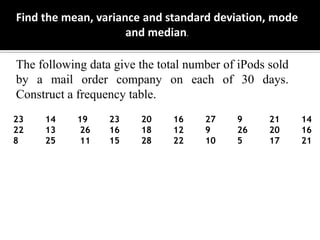
The following data give the total number of iPods sold
by a mail order company on each of 30 days.
Construct a frequency table.
Find the mean, variance and standard deviation, mode
and median.
23 14 19 23 20 16 27 9 21 14
22 13 26 16 18 12 9 26 20 16
8 25 11 15 28 22 10 5 17 21
FCP (fundamental counting priciple)
Factorial Notation
Permutation
Combination
Fundamental Counting Principle can be used
determine the number of possible outcomes
when there are two or more characteristics .
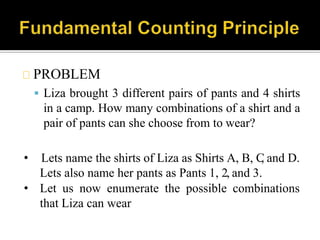
PROBLEM
 Liza brought 3 different pairs of pants and 4 shirts
in a camp. How many combinations of a shirt and a
pair of pants can she choose from to wear?
• Lets name the shirts of Liza as Shirts A, B, C, and D.
Lets also name her pants as Pants 1, 2, and 3.
• Let us now enumerate the possible combinations
that Liza can wear
The answer is there are 12 possible
combinations.
We found the answer by drawing a diagram.
But what if there are large numbers given in the
problem (say, 179 pairs of pants and 83 shirts)?
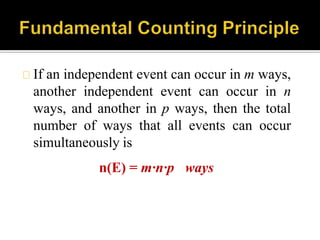
If an independent event can occur in m ways,
another independent event can occur in n
ways, and another in p ways, then the total
number of ways that all events can occur
simultaneously is
n(E) = m∙n∙p ways
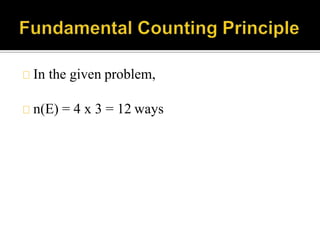
In the given problem,
n(E) = 4 x 3 = 12 ways
9
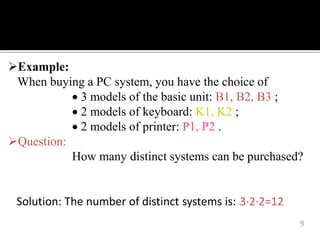
Example:
When buying a PC system, you have the choice of
 3 models of the basic unit: B1, B2, B3 ;
 2 models of keyboard: K1, K2 ;
 2 models of printer: P1, P2 .
Question:
How many distinct systems can be purchased?
Solution: The number of distinct systems is: 3∙2∙2=12
Fundamental Counting Principle
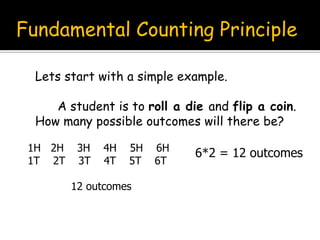
Lets start with a simple example.
A student is to roll a die and flip a coin.
How many possible outcomes will there be?
1H 2H 3H 4H 5H 6H
1T 2T 3T 4T 5T 6T
12 outcomes
6*2 = 12 outcomes
Fundamental Counting Principle
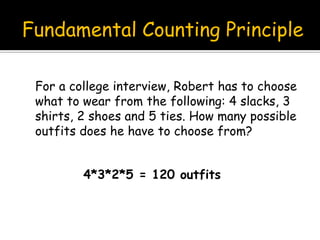
For a college interview, Robert has to choose
what to wear from the following: 4 slacks, 3
shirts, 2 shoes and 5 ties. How many possible
outfits does he have to choose from?
4*3*2*5 = 120 outfits
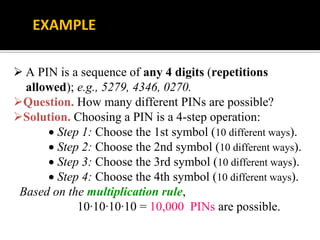
 A PIN is a sequence of any 4 digits (repetitions
allowed); e.g., 5279, 4346, 0270.
Question. How many different PINs are possible?
Solution. Choosing a PIN is a 4-step operation:
 Step 1: Choose the 1st symbol (10 different ways).
 Step 2: Choose the 2nd symbol (10 different ways).
 Step 3: Choose the 3rd symbol (10 different ways).
 Step 4: Choose the 4th symbol (10 different ways).
Based on the multiplication rule,
10∙10∙10∙10 = 10,000 PINs are possible.
EXAMPLE
13
Example
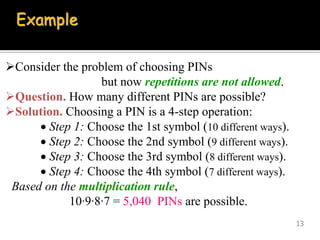
Consider the problem of choosing PINs
but now repetitions are not allowed.
Question. How many different PINs are possible?
Solution. Choosing a PIN is a 4-step operation:
 Step 1: Choose the 1st symbol (10 different ways).
 Step 2: Choose the 2nd symbol (9 different ways).
 Step 3: Choose the 3rd symbol (8 different ways).
 Step 4: Choose the 4th symbol (7 different ways).
Based on the multiplication rule,
10∙9∙8∙7 = 5,040 PINs are possible.
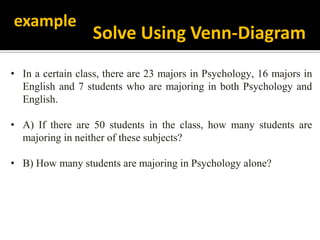
• In a certain class, there are 23 majors in Psychology, 16 majors in
English and 7 students who are majoring in both Psychology and
English.
• A) If there are 50 students in the class, how many students are
majoring in neither of these subjects?
• B) How many students are majoring in Psychology alone?
example
Solve Using Venn-Diagram
Solution:
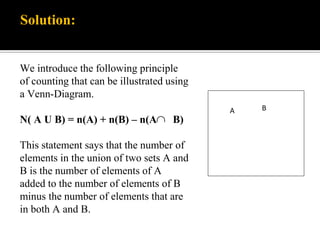
We introduce the following principle
of counting that can be illustrated using
a Venn-Diagram.
N( A U B) = n(A) + n(B) – n(A B)
This statement says that the number of
elements in the union of two sets A and
B is the number of elements of A
added to the number of elements of B
minus the number of elements that are
in both A and B.

A B
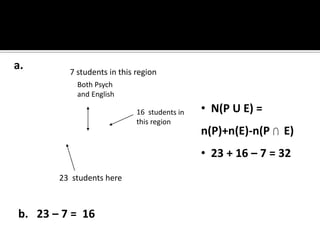
Both Psych
and English
7 students in this region
23 students here
• N(P U E) =
n(P)+n(E)-n(P E)
• 23 + 16 – 7 = 32
a.
b. 23 – 7 = 16
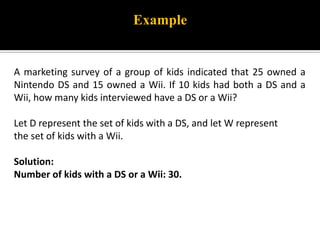
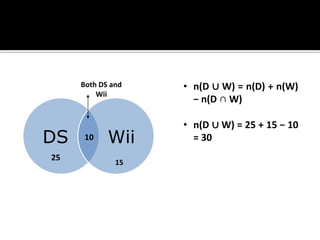
A marketing survey of a group of kids indicated that 25 owned a
Nintendo DS and 15 owned a Wii. If 10 kids had both a DS and a
Wii, how many kids interviewed have a DS or a Wii?
Let D represent the set of kids with a DS, and let W represent
the set of kids with a Wii.
Solution:
Number of kids with a DS or a Wii: 30.
Example
DS Wii
Both DS and
Wii
10
25
• n(D ∪ W) = n(D) + n(W)
− n(D ∩ W)
• n(D ∪ W) = 25 + 15 − 10
= 30
More problems…
• How many different ways can a team consisting of 28 players
select a captain and an assistant captain?
• Solution: Operation 1: select the captain. If all team members
are eligible to be a captain, there are 28 ways this can be done.
• Operation 2. Select the assistant captain. Assuming that a player
cannot be both a captain and assistant captain, there are 27 ways
this can be done, since there are 27 team members left who are
eligible to be the assistant captain.
• Then, using the multiplication principle there are (28)(27) ways
to select both a captain and an assistant captain. This number
turns out to be 756.
The factorial of an integer k is the product of
all integers from 1 to k.
This is usually denoted as k! read as “k
factorial”
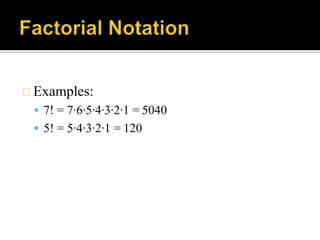
Examples:
 7! = 7∙6∙5∙4∙3∙2∙1 = 5040
 5! = 5∙4∙3∙2∙1 = 120
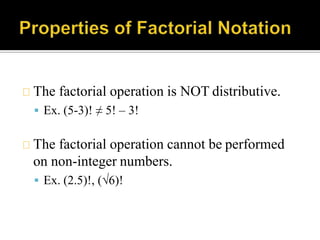
The factorial operation is NOT distributive.
 Ex. (5-3)! ≠ 5! – 3!
The factorial operation cannot be performed
on non-integer numbers.
 Ex. (2.5)!, (√6)!
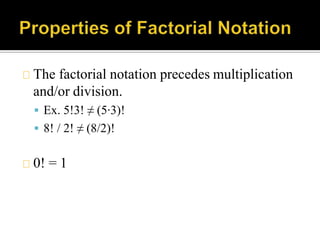
The factorial notation precedes multiplication
and/or division.
 Ex. 5!3! ≠ (5∙3)!
 8! / 2! ≠ (8/2)!
0! = 1
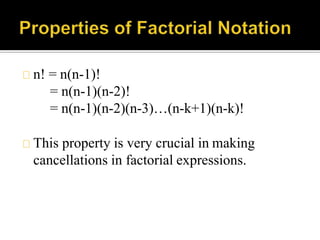
n! = n(n-1)!
= n(n-1)(n-2)!
= n(n-1)(n-2)(n-3)…(n-k+1)(n-k)!
This property is very crucial in making
cancellations in factorial expressions.
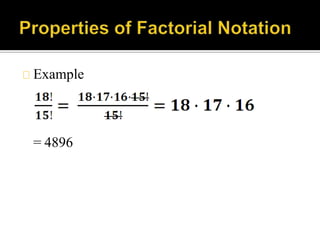
Example
= 4896
BOTH
PERMUTATIONS AND
COMBINATIONS
USE A COUNTING METHOD
CALLED FACTORIAL.
A permutation is an ordered arrangement
of objects.
It tells us how many possible orders there can
be given a number of objects.
In permutation, if all objects are distinct,
then they cannot be repeated.
Permutation is usually denoted by
nPr
read as “the permutation of n objects taken r at
a time”
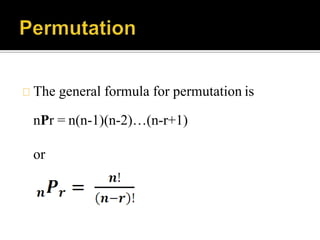
The general formula for permutation is
nPr = n(n-1)(n-2)…(n-r+1)
or
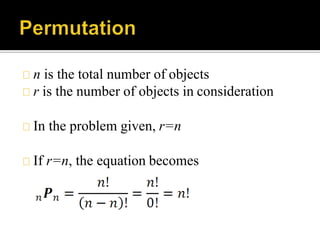
n is the total number of objects
r is the number of objects in consideration
In the problem given, r=n
If r=n, the equation becomes
Example: Permutations
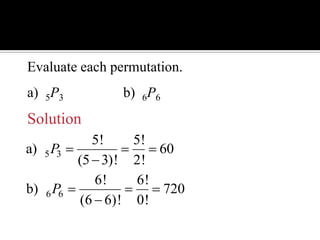
Evaluate each permutation.
a) 5P3 b) 6P6
5 3
5! 5!
a) 60
(5 3)! 2!
P   

6 6
6! 6!
b) 720
(6 6)! 0!
P   

Solution
Permutations
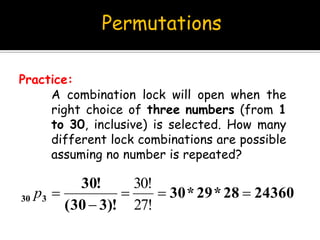
A combination lock will open when the
right choice of three numbers (from 1
to 30, inclusive) is selected. How many
different lock combinations are possible
assuming no number is repeated?
Practice:
2436028*29*30
)!330(
!30
330 


27!
30!
p
Permutations
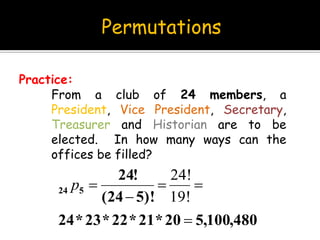
From a club of 24 members, a
President, Vice President, Secretary,
Treasurer and Historian are to be
elected. In how many ways can the
offices be filled?
Practice:
480,100,520*21*22*23*24
)!524(
!24
524




19!
24!
p
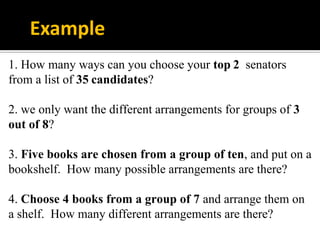
1. How many ways can you choose your top 2 senators
from a list of 35 candidates?
2. we only want the different arrangements for groups of 3
out of 8?
3. Five books are chosen from a group of ten, and put on a
bookshelf. How many possible arrangements are there?
4. Choose 4 books from a group of 7 and arrange them on
a shelf. How many different arrangements are there?
Example
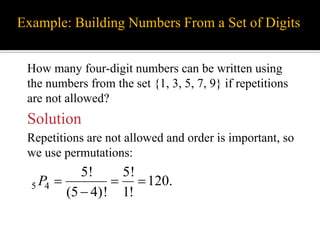
Example: Building Numbers From a Set of Digits
How many four-digit numbers can be written using
the numbers from the set {1, 3, 5, 7, 9} if repetitions
are not allowed?
5 4
5! 5!
120.
(5 4)! 1!
P   

Solution
Repetitions are not allowed and order is important, so
we use permutations:
Example
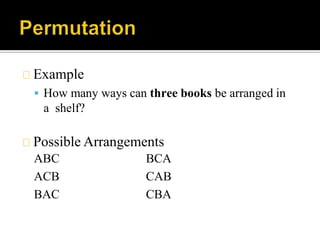
 How many ways can three books be arranged in
a shelf?
Possible Arrangements
ABC
ACB
BAC
BCA
CAB
CBA
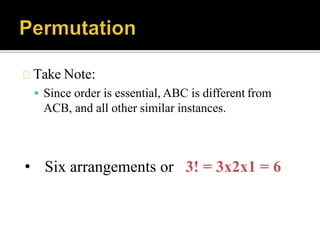
Take Note:
 Since order is essential, ABC is different from
ACB, and all other similar instances.
• Six arrangements or 3! = 3x2x1 = 6
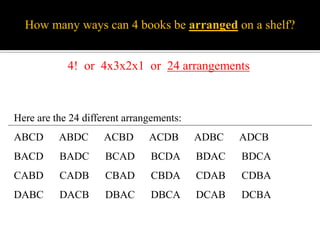
How many ways can 4 books be arranged on a shelf?
4! or 4x3x2x1 or 24 arrangements
Here are the 24 different arrangements:
ABCD ABDC ACBD ACDB ADBC ADCB
BACD BADC BCAD BCDA BDAC BDCA
CABD CADB CBAD CBDA CDAB CDBA
DABC DACB DBAC DBCA DCAB DCBA
If we were asked how many permutations we
can get if we rearrange the letters of the word
“cat”, we get 3!
What if we rearrange the letters of the word
“dad”?
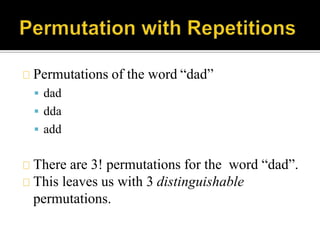
Permutations of the word “dad”
 dad
 dda
 add
There are 3! permutations for the word “dad”.
This leaves us with 3 distinguishable
permutations.
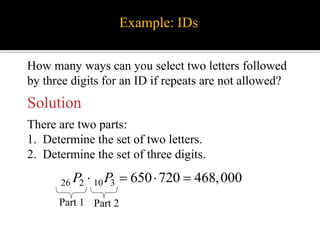
Example: IDs
How many ways can you select two letters followed
by three digits for an ID if repeats are not allowed?
Solution
26 2 10 3 650 720 468,000P P   
There are two parts:
1. Determine the set of two letters.
2. Determine the set of three digits.
Part 1 Part 2
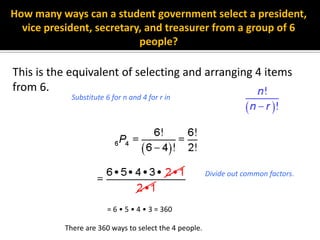
How many ways can a student government select a president,
vice president, secretary, and treasurer from a group of 6
people?
This is the equivalent of selecting and arranging 4 items
from 6.
= 6 • 5 • 4 • 3 = 360
Divide out common factors.
There are 360 ways to select the 4 people.
Substitute 6 for n and 4 for r in
• How many ways can a student government select a
president, vice president, secretary, and treasurer from
a group of 6 people?
• How many ways can a stylist arrange 5 of 8 vases from
left to right in a store display?
• How many ways can a 2-digit number be formed by
using only the digits 5–9 and by each digit being used
only once?
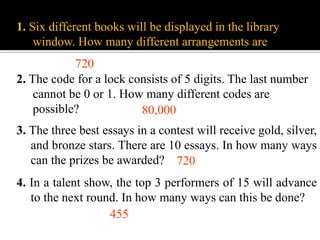
1. Six different books will be displayed in the library
window. How many different arrangements are there?
2. The code for a lock consists of 5 digits. The last number
cannot be 0 or 1. How many different codes are
possible? 80,000
720
3. The three best essays in a contest will receive gold, silver,
and bronze stars. There are 10 essays. In how many ways
can the prizes be awarded?
4. In a talent show, the top 3 performers of 15 will advance
to the next round. In how many ways can this be done?
455
720
A combination is an arrangement of objects with
no respect to order. Combinations are basically
“selections”.
Example.
 Find the possible permutations and combinations
of the word “cat”
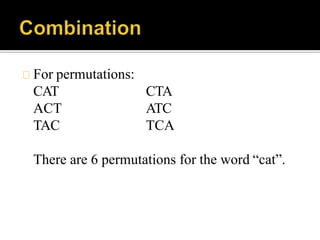
For permutations:
CAT
ACT
TAC
CTA
ATC
TCA
There are 6 permutations for the word “cat”.
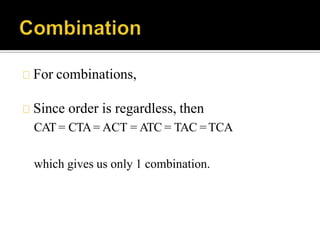
For combinations,
Since order is regardless, then
CAT = CTA= ACT = ATC = TAC =TCA
which gives us only 1 combination.
What if we take only two letters from the word
“cat”?
How many permutations and combinations
are there?
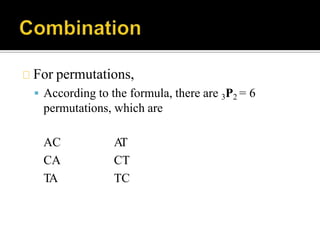
For permutations,
 According to the formula, there are 3P2 = 6
permutations, which are
AC
CA
TA
AT
CT
TC
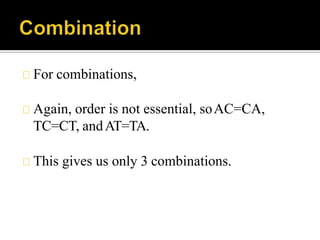
For combinations,
Again, order is not essential, soAC=CA,
TC=CT, andAT=TA.
This gives us only 3 combinations.
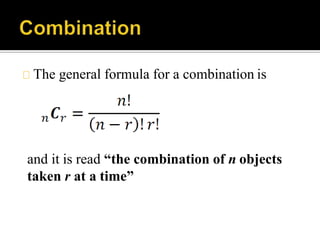
The general formula for a combination is
and it is read “the combination of n objects
taken r at a time”
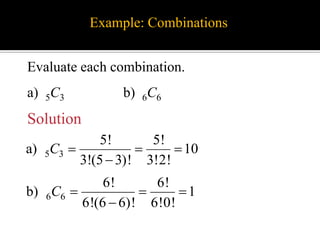
Example: Combinations
Evaluate each combination.
a) 5C3 b) 6C6
5 3
5! 5!
a) 10
3!(5 3)! 3!2!
C   

6 6
6! 6!
b) 1
6!(6 6)! 6!0!
C   

Solution
Combinations
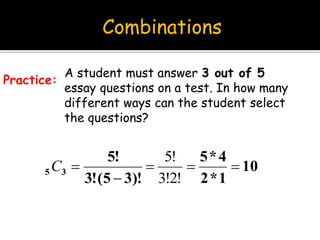
A student must answer 3 out of 5
essay questions on a test. In how many
different ways can the student select
the questions?
Practice:
10
1*2
4*5
)!35(!3
!5
35 


3!2!
5!
C
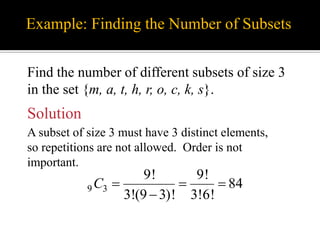
Example: Finding the Number of Subsets
Find the number of different subsets of size 3
in the set {m, a, t, h, r, o, c, k, s}.
Solution
A subset of size 3 must have 3 distinct elements,
so repetitions are not allowed. Order is not
important.
9 3
9! 9!
84
3!(9 3)! 3!6!
C   

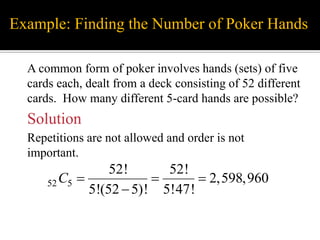
Example: Finding the Number of Poker Hands
A common form of poker involves hands (sets) of five
cards each, dealt from a deck consisting of 52 different
cards. How many different 5-card hands are possible?
Solution
Repetitions are not allowed and order is not
important.
52 5
52! 52!
2,598,960
5!(52 5)! 5!47!
C   

1. Find the number of ways of getting just a
pair when randomly getting three cards from a
standard deck.
2. A committee of 3 students must be selected
from a group of 5 people. How many possible
different committees could be formed?
Example:
1. Find the number of ways of getting at least a
pair when randomly getting three cards from a
standard deck.
2.How many possible committees of 2 people
can be selected from a group of 8?
Example:
1. In a party, there are 53 guests who shook
hands with one another exactly once. How many
handshakes took place?
2. How many committees of 4 students could be
formed from a group of 12 people?
Example:
• An amusement park has 27 different rides. If you
have 21 ride tickets, how many different combinations
of rides can you take? 296,010
Pop’s Pizza offers 4 types of meat and 3 types of
cheese. In how many ways could a pizza with two
meats, different or double of the same meat, and one
cheese be ordered? 30
Combinations
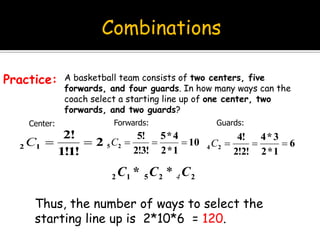
A basketball team consists of two centers, five
forwards, and four guards. In how many ways can the
coach select a starting line up of one center, two
forwards, and two guards?
Practice:
2
!1!1
!2
12 C
Center:
10
1*2
4*5
!3!2
!5
25 C
Forwards:
6
1*2
3*4
!2!2
!4
24 C
Guards:
Thus, the number of ways to select the
starting line up is 2*10*6 = 120.
22512 * CCC 4*
Guidelines on Which Method to Use
Permutations Combinations
Number of ways of selecting r items out of n items
Repetitions are not allowed
Order is important. Order is not important.
Arrangements of n items
taken r at a time
Subsets of n items taken r
at a time
nPr = n!/(n – r)! nCr = n!/[ r!(n – r)!]
Clue words: arrangement,
schedule, order
Clue words: group,
sample, selection

counting techniques

  • 1.
  • 2.
    The following datagive the total number of iPods sold by a mail order company on each of 30 days. Construct a frequency table. Find the mean, variance and standard deviation, mode and median. 23 14 19 23 20 16 27 9 21 14 22 13 26 16 18 12 9 26 20 16 8 25 11 15 28 22 10 5 17 21
  • 3.
    FCP (fundamental countingpriciple) Factorial Notation Permutation Combination
  • 4.
    Fundamental Counting Principlecan be used determine the number of possible outcomes when there are two or more characteristics .
  • 5.
    PROBLEM  Liza brought3 different pairs of pants and 4 shirts in a camp. How many combinations of a shirt and a pair of pants can she choose from to wear? • Lets name the shirts of Liza as Shirts A, B, C, and D. Lets also name her pants as Pants 1, 2, and 3. • Let us now enumerate the possible combinations that Liza can wear
  • 6.
    The answer isthere are 12 possible combinations. We found the answer by drawing a diagram. But what if there are large numbers given in the problem (say, 179 pairs of pants and 83 shirts)?
  • 7.
    If an independentevent can occur in m ways, another independent event can occur in n ways, and another in p ways, then the total number of ways that all events can occur simultaneously is n(E) = m∙n∙p ways
  • 8.
    In the givenproblem, n(E) = 4 x 3 = 12 ways
  • 9.
    9 Example: When buying aPC system, you have the choice of  3 models of the basic unit: B1, B2, B3 ;  2 models of keyboard: K1, K2 ;  2 models of printer: P1, P2 . Question: How many distinct systems can be purchased? Solution: The number of distinct systems is: 3∙2∙2=12
  • 10.
    Fundamental Counting Principle Letsstart with a simple example. A student is to roll a die and flip a coin. How many possible outcomes will there be? 1H 2H 3H 4H 5H 6H 1T 2T 3T 4T 5T 6T 12 outcomes 6*2 = 12 outcomes
  • 11.
    Fundamental Counting Principle Fora college interview, Robert has to choose what to wear from the following: 4 slacks, 3 shirts, 2 shoes and 5 ties. How many possible outfits does he have to choose from? 4*3*2*5 = 120 outfits
  • 12.
     A PINis a sequence of any 4 digits (repetitions allowed); e.g., 5279, 4346, 0270. Question. How many different PINs are possible? Solution. Choosing a PIN is a 4-step operation:  Step 1: Choose the 1st symbol (10 different ways).  Step 2: Choose the 2nd symbol (10 different ways).  Step 3: Choose the 3rd symbol (10 different ways).  Step 4: Choose the 4th symbol (10 different ways). Based on the multiplication rule, 10∙10∙10∙10 = 10,000 PINs are possible. EXAMPLE
  • 13.
    13 Example Consider the problemof choosing PINs but now repetitions are not allowed. Question. How many different PINs are possible? Solution. Choosing a PIN is a 4-step operation:  Step 1: Choose the 1st symbol (10 different ways).  Step 2: Choose the 2nd symbol (9 different ways).  Step 3: Choose the 3rd symbol (8 different ways).  Step 4: Choose the 4th symbol (7 different ways). Based on the multiplication rule, 10∙9∙8∙7 = 5,040 PINs are possible.
  • 14.
    • In acertain class, there are 23 majors in Psychology, 16 majors in English and 7 students who are majoring in both Psychology and English. • A) If there are 50 students in the class, how many students are majoring in neither of these subjects? • B) How many students are majoring in Psychology alone? example Solve Using Venn-Diagram
  • 15.
    Solution: We introduce thefollowing principle of counting that can be illustrated using a Venn-Diagram. N( A U B) = n(A) + n(B) – n(A B) This statement says that the number of elements in the union of two sets A and B is the number of elements of A added to the number of elements of B minus the number of elements that are in both A and B.  A B
  • 16.
    Both Psych and English 7students in this region 23 students here • N(P U E) = n(P)+n(E)-n(P E) • 23 + 16 – 7 = 32 a. b. 23 – 7 = 16
  • 17.
    A marketing surveyof a group of kids indicated that 25 owned a Nintendo DS and 15 owned a Wii. If 10 kids had both a DS and a Wii, how many kids interviewed have a DS or a Wii? Let D represent the set of kids with a DS, and let W represent the set of kids with a Wii. Solution: Number of kids with a DS or a Wii: 30. Example
  • 18.
    DS Wii Both DSand Wii 10 25 • n(D ∪ W) = n(D) + n(W) − n(D ∩ W) • n(D ∪ W) = 25 + 15 − 10 = 30
  • 19.
    More problems… • Howmany different ways can a team consisting of 28 players select a captain and an assistant captain? • Solution: Operation 1: select the captain. If all team members are eligible to be a captain, there are 28 ways this can be done. • Operation 2. Select the assistant captain. Assuming that a player cannot be both a captain and assistant captain, there are 27 ways this can be done, since there are 27 team members left who are eligible to be the assistant captain. • Then, using the multiplication principle there are (28)(27) ways to select both a captain and an assistant captain. This number turns out to be 756.
  • 20.
    The factorial ofan integer k is the product of all integers from 1 to k. This is usually denoted as k! read as “k factorial”
  • 21.
    Examples:  7! =7∙6∙5∙4∙3∙2∙1 = 5040  5! = 5∙4∙3∙2∙1 = 120
  • 22.
    The factorial operationis NOT distributive.  Ex. (5-3)! ≠ 5! – 3! The factorial operation cannot be performed on non-integer numbers.  Ex. (2.5)!, (√6)!
  • 23.
    The factorial notationprecedes multiplication and/or division.  Ex. 5!3! ≠ (5∙3)!  8! / 2! ≠ (8/2)! 0! = 1
  • 24.
    n! = n(n-1)! =n(n-1)(n-2)! = n(n-1)(n-2)(n-3)…(n-k+1)(n-k)! This property is very crucial in making cancellations in factorial expressions.
  • 25.
  • 26.
    BOTH PERMUTATIONS AND COMBINATIONS USE ACOUNTING METHOD CALLED FACTORIAL.
  • 27.
    A permutation isan ordered arrangement of objects. It tells us how many possible orders there can be given a number of objects. In permutation, if all objects are distinct, then they cannot be repeated.
  • 28.
    Permutation is usuallydenoted by nPr read as “the permutation of n objects taken r at a time”
  • 29.
    The general formulafor permutation is nPr = n(n-1)(n-2)…(n-r+1) or
  • 30.
    n is thetotal number of objects r is the number of objects in consideration In the problem given, r=n If r=n, the equation becomes
  • 31.
    Example: Permutations Evaluate eachpermutation. a) 5P3 b) 6P6 5 3 5! 5! a) 60 (5 3)! 2! P     6 6 6! 6! b) 720 (6 6)! 0! P     Solution
  • 32.
    Permutations A combination lockwill open when the right choice of three numbers (from 1 to 30, inclusive) is selected. How many different lock combinations are possible assuming no number is repeated? Practice: 2436028*29*30 )!330( !30 330    27! 30! p
  • 33.
    Permutations From a clubof 24 members, a President, Vice President, Secretary, Treasurer and Historian are to be elected. In how many ways can the offices be filled? Practice: 480,100,520*21*22*23*24 )!524( !24 524     19! 24! p
  • 34.
    1. How manyways can you choose your top 2 senators from a list of 35 candidates? 2. we only want the different arrangements for groups of 3 out of 8? 3. Five books are chosen from a group of ten, and put on a bookshelf. How many possible arrangements are there? 4. Choose 4 books from a group of 7 and arrange them on a shelf. How many different arrangements are there? Example
  • 35.
    Example: Building NumbersFrom a Set of Digits How many four-digit numbers can be written using the numbers from the set {1, 3, 5, 7, 9} if repetitions are not allowed? 5 4 5! 5! 120. (5 4)! 1! P     Solution Repetitions are not allowed and order is important, so we use permutations:
  • 36.
    Example  How manyways can three books be arranged in a shelf? Possible Arrangements ABC ACB BAC BCA CAB CBA
  • 37.
    Take Note:  Sinceorder is essential, ABC is different from ACB, and all other similar instances. • Six arrangements or 3! = 3x2x1 = 6
  • 38.
    How many wayscan 4 books be arranged on a shelf? 4! or 4x3x2x1 or 24 arrangements Here are the 24 different arrangements: ABCD ABDC ACBD ACDB ADBC ADCB BACD BADC BCAD BCDA BDAC BDCA CABD CADB CBAD CBDA CDAB CDBA DABC DACB DBAC DBCA DCAB DCBA
  • 39.
    If we wereasked how many permutations we can get if we rearrange the letters of the word “cat”, we get 3! What if we rearrange the letters of the word “dad”?
  • 40.
    Permutations of theword “dad”  dad  dda  add There are 3! permutations for the word “dad”. This leaves us with 3 distinguishable permutations.
  • 41.
    Example: IDs How manyways can you select two letters followed by three digits for an ID if repeats are not allowed? Solution 26 2 10 3 650 720 468,000P P    There are two parts: 1. Determine the set of two letters. 2. Determine the set of three digits. Part 1 Part 2
  • 42.
    How many wayscan a student government select a president, vice president, secretary, and treasurer from a group of 6 people? This is the equivalent of selecting and arranging 4 items from 6. = 6 • 5 • 4 • 3 = 360 Divide out common factors. There are 360 ways to select the 4 people. Substitute 6 for n and 4 for r in
  • 43.
    • How manyways can a student government select a president, vice president, secretary, and treasurer from a group of 6 people? • How many ways can a stylist arrange 5 of 8 vases from left to right in a store display? • How many ways can a 2-digit number be formed by using only the digits 5–9 and by each digit being used only once?
  • 44.
    1. Six differentbooks will be displayed in the library window. How many different arrangements are there? 2. The code for a lock consists of 5 digits. The last number cannot be 0 or 1. How many different codes are possible? 80,000 720 3. The three best essays in a contest will receive gold, silver, and bronze stars. There are 10 essays. In how many ways can the prizes be awarded? 4. In a talent show, the top 3 performers of 15 will advance to the next round. In how many ways can this be done? 455 720
  • 45.
    A combination isan arrangement of objects with no respect to order. Combinations are basically “selections”. Example.  Find the possible permutations and combinations of the word “cat”
  • 46.
    For permutations: CAT ACT TAC CTA ATC TCA There are6 permutations for the word “cat”.
  • 47.
    For combinations, Since orderis regardless, then CAT = CTA= ACT = ATC = TAC =TCA which gives us only 1 combination.
  • 48.
    What if wetake only two letters from the word “cat”? How many permutations and combinations are there?
  • 49.
    For permutations,  Accordingto the formula, there are 3P2 = 6 permutations, which are AC CA TA AT CT TC
  • 50.
    For combinations, Again, orderis not essential, soAC=CA, TC=CT, andAT=TA. This gives us only 3 combinations.
  • 51.
    The general formulafor a combination is and it is read “the combination of n objects taken r at a time”
  • 52.
    Example: Combinations Evaluate eachcombination. a) 5C3 b) 6C6 5 3 5! 5! a) 10 3!(5 3)! 3!2! C     6 6 6! 6! b) 1 6!(6 6)! 6!0! C     Solution
  • 53.
    Combinations A student mustanswer 3 out of 5 essay questions on a test. In how many different ways can the student select the questions? Practice: 10 1*2 4*5 )!35(!3 !5 35    3!2! 5! C
  • 54.
    Example: Finding theNumber of Subsets Find the number of different subsets of size 3 in the set {m, a, t, h, r, o, c, k, s}. Solution A subset of size 3 must have 3 distinct elements, so repetitions are not allowed. Order is not important. 9 3 9! 9! 84 3!(9 3)! 3!6! C    
  • 55.
    Example: Finding theNumber of Poker Hands A common form of poker involves hands (sets) of five cards each, dealt from a deck consisting of 52 different cards. How many different 5-card hands are possible? Solution Repetitions are not allowed and order is not important. 52 5 52! 52! 2,598,960 5!(52 5)! 5!47! C    
  • 56.
    1. Find thenumber of ways of getting just a pair when randomly getting three cards from a standard deck. 2. A committee of 3 students must be selected from a group of 5 people. How many possible different committees could be formed? Example:
  • 57.
    1. Find thenumber of ways of getting at least a pair when randomly getting three cards from a standard deck. 2.How many possible committees of 2 people can be selected from a group of 8? Example:
  • 58.
    1. In aparty, there are 53 guests who shook hands with one another exactly once. How many handshakes took place? 2. How many committees of 4 students could be formed from a group of 12 people? Example:
  • 59.
    • An amusementpark has 27 different rides. If you have 21 ride tickets, how many different combinations of rides can you take? 296,010 Pop’s Pizza offers 4 types of meat and 3 types of cheese. In how many ways could a pizza with two meats, different or double of the same meat, and one cheese be ordered? 30
  • 60.
    Combinations A basketball teamconsists of two centers, five forwards, and four guards. In how many ways can the coach select a starting line up of one center, two forwards, and two guards? Practice: 2 !1!1 !2 12 C Center: 10 1*2 4*5 !3!2 !5 25 C Forwards: 6 1*2 3*4 !2!2 !4 24 C Guards: Thus, the number of ways to select the starting line up is 2*10*6 = 120. 22512 * CCC 4*
  • 61.
    Guidelines on WhichMethod to Use Permutations Combinations Number of ways of selecting r items out of n items Repetitions are not allowed Order is important. Order is not important. Arrangements of n items taken r at a time Subsets of n items taken r at a time nPr = n!/(n – r)! nCr = n!/[ r!(n – r)!] Clue words: arrangement, schedule, order Clue words: group, sample, selection