Steps in Constructing a
Frequency Distribution Table
Educ 98 Statistics in Education
• Determine the use and types of Frequency
Distribution Table
• Appreciate the importance of constructing
Frequency Distribution Table.
By the end of this lesson...
• Understand the terms used in Constructing a
Frequency Distribution Table.
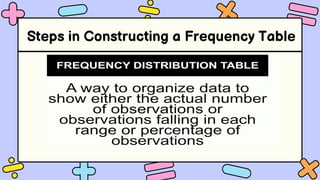
Steps in Constructing a Frequency Table
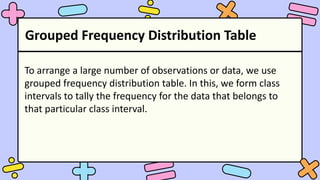
Grouped Frequency Distribution Table
To arrange a large number of observations or data, we use
grouped frequency distribution table. In this, we form class
intervals to tally the frequency for the data that belongs to
that particular class interval.
Steps in Constructing a Frequency Table
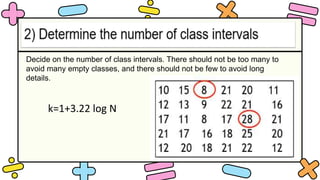
Decide on the number of class intervals. There should not be too many to
avoid many empty classes, and there should not be few to avoid long
details.
k=1+3.22 log N
k=(1+3.22 log N)
=[1+3.22(1.47712125]
=1+4. 87450014
k=5.874 or 6
N= NO. OF DATA
N=30
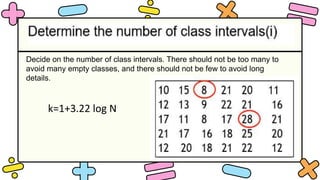
Decide on the number of class intervals. There should not be too many to
avoid many empty classes, and there should not be few to avoid long
details.
k=1+3.22 log N
k=(1+3.22 log N)
=[1+3.22(1.47712125]
=1+4.75633044
k=5.756 or 6
N= NO. OF DATA
N=30
K
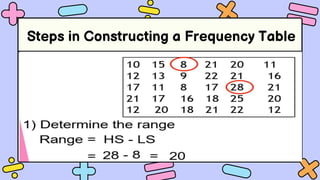
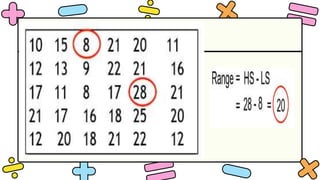
Step 1:
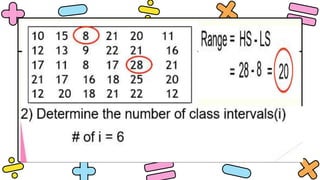
Range = 28-8= 20
Step 2
k=(1+3.22 log N)
=[1+3.22(1.47712125]
=1+4.75633044
k=5.756 or 6
Step 3:
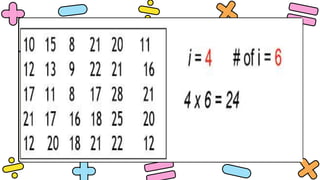
i = Range / k
= 20 / 6
= 3.33 or 4
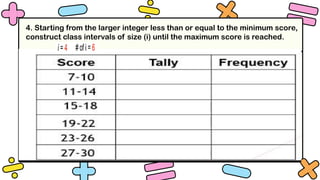
4. Starting from the larger integer less than or equal to the minimum score,
construct class intervals of size (i) until the maximum score is reached.
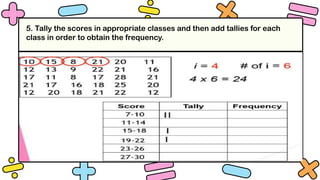
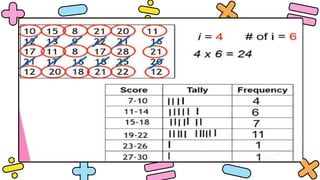
5. Tally the scores in appropriate classes and then add tallies for each
class in order to obtain the frequency.
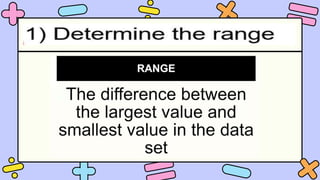
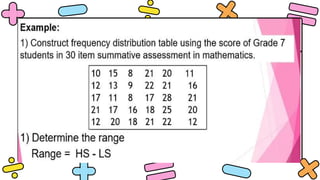
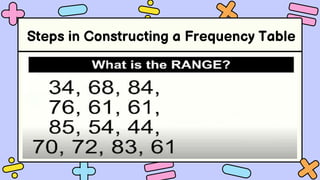
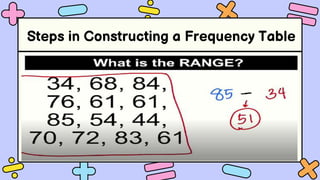
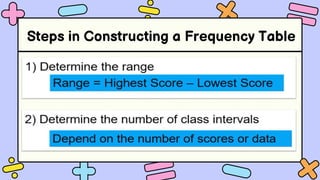
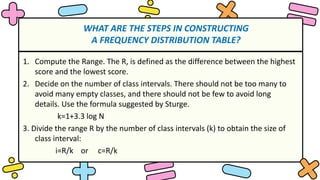
1. Compute the Range. The R, is defined as the difference between the highest
score and the lowest score.
2. Decide on the number of class intervals. There should not be too many to
avoid many empty classes, and there should not be few to avoid long
details. Use the formula suggested by Sturge.
k=1+3.3 log N
3. Divide the range R by the number of class intervals (k) to obtain the size of
class interval:
i=R/k or c=R/k
WHAT ARE THE STEPS IN CONSTRUCTING
A FREQUENCY DISTRIBUTION TABLE?
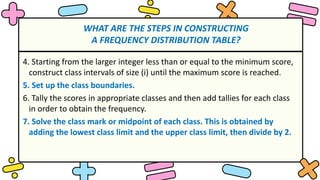
4. Starting from the larger integer less than or equal to the minimum score,
construct class intervals of size (i) until the maximum score is reached.
5. Set up the class boundaries.
6. Tally the scores in appropriate classes and then add tallies for each class
in order to obtain the frequency.
7. Solve the class mark or midpoint of each class. This is obtained by
adding the lowest class limit and the upper class limit, then divide by 2.
WHAT ARE THE STEPS IN CONSTRUCTING
A FREQUENCY DISTRIBUTION TABLE?
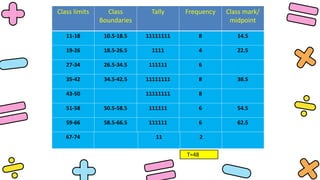
Class limits Class
Boundaries
Tally Frequency Class mark/
midpoint
11-18 10.5-18.5 11111111 8 14.5
19-26 18.5-26.5 1111 4 22.5
27-34 26.5-34.5 111111 6
35-42 34.5-42.5 11111111 8 38.5
43-50 11111111 8
51-58 50.5-58.5 111111 6 54.5
59-66 58.5-66.5 111111 6 62.5
67-74 11 2
T=48
Class limits Class
Boundaries
Tally Frequency Class mark/
midpoint
11-18 10.5-18.5 11111111 8 14.5
19-26 18.5-26.5 1111 4 22.5
27-34 26.5-34.5 111111 6 30.5
35-42 34.5-42.5 11111111 8 38.5
43-50 42.5-50.5 11111111 8 46.5
51-58 50.5-58.5 111111 6 54.5
59-66 58.5-66.5 111111 6 62.5
67-74 66.5-74.5 11 2 70.5
T=48
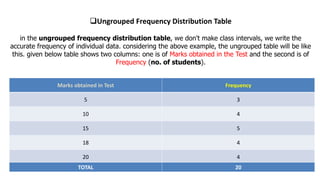
Ungrouped Frequency Distribution Table
in the ungrouped frequency distribution table, we don't make class intervals, we write the
accurate frequency of individual data. considering the above example, the ungrouped table will be like
this. given below table shows two columns: one is of Marks obtained in the Test and the second is of
Frequency (no. of students).
Marks obtained in Test Frequency
5 3
10 4
15 5
18 4
20 4
TOTAL 20
https://www.youtube.com/watch?v=lZwHtvqnADk
Reference:
https://www.youtube.com/watch?v=kKE_VnW-npQ
Thank You

Steps in Constructing a Frequency Distribution Table.pptx

  • 1.
    Steps in Constructinga Frequency Distribution Table Educ 98 Statistics in Education
  • 2.
    • Determine theuse and types of Frequency Distribution Table • Appreciate the importance of constructing Frequency Distribution Table. By the end of this lesson... • Understand the terms used in Constructing a Frequency Distribution Table.
  • 3.
    Steps in Constructinga Frequency Table
  • 4.
    Grouped Frequency DistributionTable To arrange a large number of observations or data, we use grouped frequency distribution table. In this, we form class intervals to tally the frequency for the data that belongs to that particular class interval.
  • 7.
    Steps in Constructinga Frequency Table
  • 8.
    Steps in Constructinga Frequency Table
  • 9.
    Steps in Constructinga Frequency Table
  • 10.
    Steps in Constructinga Frequency Table
  • 12.
    Decide on thenumber of class intervals. There should not be too many to avoid many empty classes, and there should not be few to avoid long details. k=1+3.22 log N
  • 13.
    k=(1+3.22 log N) =[1+3.22(1.47712125] =1+4.87450014 k=5.874 or 6 N= NO. OF DATA N=30
  • 17.
    Decide on thenumber of class intervals. There should not be too many to avoid many empty classes, and there should not be few to avoid long details. k=1+3.22 log N
  • 18.
  • 19.
  • 20.
    Step 1: Range =28-8= 20 Step 2 k=(1+3.22 log N) =[1+3.22(1.47712125] =1+4.75633044 k=5.756 or 6 Step 3: i = Range / k = 20 / 6 = 3.33 or 4
  • 22.
    4. Starting fromthe larger integer less than or equal to the minimum score, construct class intervals of size (i) until the maximum score is reached.
  • 23.
    5. Tally thescores in appropriate classes and then add tallies for each class in order to obtain the frequency.
  • 25.
    1. Compute theRange. The R, is defined as the difference between the highest score and the lowest score. 2. Decide on the number of class intervals. There should not be too many to avoid many empty classes, and there should not be few to avoid long details. Use the formula suggested by Sturge. k=1+3.3 log N 3. Divide the range R by the number of class intervals (k) to obtain the size of class interval: i=R/k or c=R/k WHAT ARE THE STEPS IN CONSTRUCTING A FREQUENCY DISTRIBUTION TABLE?
  • 26.
    4. Starting fromthe larger integer less than or equal to the minimum score, construct class intervals of size (i) until the maximum score is reached. 5. Set up the class boundaries. 6. Tally the scores in appropriate classes and then add tallies for each class in order to obtain the frequency. 7. Solve the class mark or midpoint of each class. This is obtained by adding the lowest class limit and the upper class limit, then divide by 2. WHAT ARE THE STEPS IN CONSTRUCTING A FREQUENCY DISTRIBUTION TABLE?
  • 27.
    Class limits Class Boundaries TallyFrequency Class mark/ midpoint 11-18 10.5-18.5 11111111 8 14.5 19-26 18.5-26.5 1111 4 22.5 27-34 26.5-34.5 111111 6 35-42 34.5-42.5 11111111 8 38.5 43-50 11111111 8 51-58 50.5-58.5 111111 6 54.5 59-66 58.5-66.5 111111 6 62.5 67-74 11 2 T=48
  • 28.
    Class limits Class Boundaries TallyFrequency Class mark/ midpoint 11-18 10.5-18.5 11111111 8 14.5 19-26 18.5-26.5 1111 4 22.5 27-34 26.5-34.5 111111 6 30.5 35-42 34.5-42.5 11111111 8 38.5 43-50 42.5-50.5 11111111 8 46.5 51-58 50.5-58.5 111111 6 54.5 59-66 58.5-66.5 111111 6 62.5 67-74 66.5-74.5 11 2 70.5 T=48
  • 29.
    Ungrouped Frequency DistributionTable in the ungrouped frequency distribution table, we don't make class intervals, we write the accurate frequency of individual data. considering the above example, the ungrouped table will be like this. given below table shows two columns: one is of Marks obtained in the Test and the second is of Frequency (no. of students). Marks obtained in Test Frequency 5 3 10 4 15 5 18 4 20 4 TOTAL 20
  • 30.
  • 31.