Probability and Statistics
Unit 02
Learning Outcomes
• Unit 2.1
• Construct a frequency distribution table with classes,
frequencies, class marks, relative frequencies, and cumulative
frequencies.

• Construct frequency histogram, frequency polygon, relative
frequency histogram and o-give.
Frequency Distributions
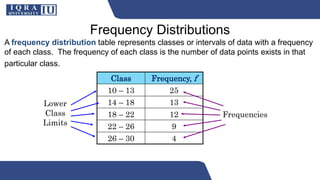
A frequency distribution table represents classes or intervals of data with a frequency
of each class. The frequency of each class is the number of data points exists in that
particular class.
Class Frequency, f
10 – 13 25
14 – 18 13
18 – 22 12
22 – 26 9
26 – 30 4
Frequencies
Lower
Class
Limits
Frequency Distributions
The class width is the difference between two consecutive lower limits or two con
secutive upper limits
The range is the difference between the maximum and minimum values
Class Width = 4
Range = 30 – 10 = 20
Class Frequency, f
10 – 13 25
14 – 18 13
18 – 22 12
22 – 26 9
26 – 30 4
14 – 10 = 4
18 – 14 = 4
22 – 18 = 4
26 – 22 = 4
Frequency Distribution
Example:
The following data represents the ages of 30 participants in a Workshop.
Construct a frequency distribution that has five classes.
34 19 32 19 30 19
29 18 21 27 20 20
33 30 32 44 39 46
21 54 18 51 49 21
38 24 18 37 29 22
The Example in this slide is adapted from Elementary Statistics: Picturing
the World – Larson and Farber – 3e
Frequency Distribution
Example Cont.
No of Classes: 5
Minimum Value = 18
Maximum Value = 54
Range = Max. Value – Min Value
Range = 54 – 18 = 36
Class Width =
34 19 32 19 30 19
29 18 21 27 20 20
33 30 32 44 39 46
21 54 18 51 49 21
38 24 18 37 29 22
Range
Number of Classes
36
5
= = 7.2 => Round up to 8
Frequency Distribution
Example Cont.
• The Class Width is calculated as 8
• The lower class limits are 18, 26, 34, 42, and 50
• The upper class limits are 25, 33, 41, 49, and 57
• Make a tally mark for each data entry in the appropriate class
• The number of tally marks for a class is the frequency for that class.
Frequency Distribution
Example Cont.
2
50 – 57
3
42 – 49
4
34 – 41
8
26 – 33
13
18 – 25
Tally Frequency, f
Class
30
f
 
Ages of Students
Frequency Distribution
53.5
45.5
37.5
29.5
21.5
50 – 57
42 – 49
34 – 41
26 – 33
2
3
4
8
13
18 – 25
Frequency, f
Class
30
f
 
Class Mark
43  2 = 21.5
18 + 25 = 43
The Class Mark of a class is the midpoint of the class and is obtained by
taking sum of the lower and upper limits of the class divided by two.
(Lower class limit) + (Upper class limit)
2
Class Mark = 18+25
2
Class Mark = 21.5
Frequency Distribution
Relative Frequency
The relative frequency of a class is the portion or percentage of the data
that falls in that class and can be obtained by;
Cumulative Frequency
The cumulative frequency of a class is the sum of the frequency for that
class and all the previous classes
Relative frequency =
Class frequency
Sample size
f
n

Relative Frequency
50 – 57 2
3
4
8
13
42 – 49
34 – 41
26 – 33
18 – 25
Frequency, f
Class
30
f
 
Relative
Frequency
0.067
0.1
0.133
0.267
0.433 f
n
13
30

0.433

1
f
n
 
Cumulative Frequency
30
28
25
21
13
+
+
+
+
50 – 57 2
3
4
8
13
42 – 49
34 – 41
26 – 33
18 – 25
Frequency, f
Class
30
f
 
Cumulative
Frequency
Total number
of students
Class Boundaries
49.5  57.5
41.5  49.5
33.5  41.5
25.5  33.5
17.5  25.5
Class
Boundaries
50 – 57 2
3
4
8
13
42 – 49
34 – 41
26 – 33
18 – 25
Frequency, f
Class
30
f
 
Unit 2.2
Graphical Representation
Frequency Histogram
2
3
4
8
13
Broken axis
Ages of Students
10
8
6
4
2
0
Age (in years)
f
12
14
17.5 25.5 33.5 41.5 49.5 57.5
• Class Boundary vs Frequency Graph
• Bar Graph
Frequency Polygon
• Class Marks vs
Frequency Graph
• A frequency polygon
is a line graph that
emphasizes the
continuous change in
frequencies
Broken axis
10
8
6
4
2
0
Age (in years)
f
12
14
13.5 21.5 29.5 37.5 45.5 53.5 61.5
Midpoints
Line is extended
to the x-axis.
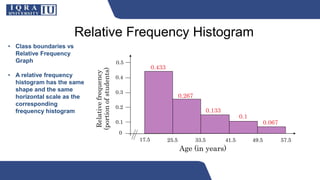
Relative Frequency Histogram
• Class boundaries vs
Relative Frequency
Graph
• A relative frequency
histogram has the same
shape and the same
horizontal scale as the
corresponding
frequency histogram
0.4
0.3
0.2
0.1
0.5
0
Age (in years)
Relative
frequency
(portion
of
students)
17.5 25.5 33.5 41.5 49.5 57.5
0.433
0.267
0.133
0.1
0.067
Cumulative Frequency Graph
• Upper Class boundaries
vs Cumulative
Frequency
• A cumulative frequency
graph or ogive, is a line
graph that displays the
cumulative frequency of
each class at its upper
class boundary
17.5
Age (in years)
Ages of Students
24
18
12
6
30
0
Cumulative
frequency
(portion
of
students)
25.5 33.5 41.5 49.5 57.5
The graph ends
at the upper
boundary of the
last class.
Review Questions
• Explain the following:
• Frequency distribution
• Class frequencies
• Class marks
• Relative frequencies
• Cumulative frequencies.
Review Question 2
Review Question 3
Unit 02.pptx

Unit 02.pptx

  • 2.
  • 3.
    Learning Outcomes • Unit2.1 • Construct a frequency distribution table with classes, frequencies, class marks, relative frequencies, and cumulative frequencies. • Construct frequency histogram, frequency polygon, relative frequency histogram and o-give.
  • 4.
    Frequency Distributions A frequencydistribution table represents classes or intervals of data with a frequency of each class. The frequency of each class is the number of data points exists in that particular class. Class Frequency, f 10 – 13 25 14 – 18 13 18 – 22 12 22 – 26 9 26 – 30 4 Frequencies Lower Class Limits
  • 5.
    Frequency Distributions The classwidth is the difference between two consecutive lower limits or two con secutive upper limits The range is the difference between the maximum and minimum values Class Width = 4 Range = 30 – 10 = 20 Class Frequency, f 10 – 13 25 14 – 18 13 18 – 22 12 22 – 26 9 26 – 30 4 14 – 10 = 4 18 – 14 = 4 22 – 18 = 4 26 – 22 = 4
  • 6.
    Frequency Distribution Example: The followingdata represents the ages of 30 participants in a Workshop. Construct a frequency distribution that has five classes. 34 19 32 19 30 19 29 18 21 27 20 20 33 30 32 44 39 46 21 54 18 51 49 21 38 24 18 37 29 22 The Example in this slide is adapted from Elementary Statistics: Picturing the World – Larson and Farber – 3e
  • 7.
    Frequency Distribution Example Cont. Noof Classes: 5 Minimum Value = 18 Maximum Value = 54 Range = Max. Value – Min Value Range = 54 – 18 = 36 Class Width = 34 19 32 19 30 19 29 18 21 27 20 20 33 30 32 44 39 46 21 54 18 51 49 21 38 24 18 37 29 22 Range Number of Classes 36 5 = = 7.2 => Round up to 8
  • 8.
    Frequency Distribution Example Cont. •The Class Width is calculated as 8 • The lower class limits are 18, 26, 34, 42, and 50 • The upper class limits are 25, 33, 41, 49, and 57 • Make a tally mark for each data entry in the appropriate class • The number of tally marks for a class is the frequency for that class.
  • 9.
    Frequency Distribution Example Cont. 2 50– 57 3 42 – 49 4 34 – 41 8 26 – 33 13 18 – 25 Tally Frequency, f Class 30 f   Ages of Students
  • 10.
    Frequency Distribution 53.5 45.5 37.5 29.5 21.5 50 –57 42 – 49 34 – 41 26 – 33 2 3 4 8 13 18 – 25 Frequency, f Class 30 f   Class Mark 43  2 = 21.5 18 + 25 = 43 The Class Mark of a class is the midpoint of the class and is obtained by taking sum of the lower and upper limits of the class divided by two. (Lower class limit) + (Upper class limit) 2 Class Mark = 18+25 2 Class Mark = 21.5
  • 11.
    Frequency Distribution Relative Frequency Therelative frequency of a class is the portion or percentage of the data that falls in that class and can be obtained by; Cumulative Frequency The cumulative frequency of a class is the sum of the frequency for that class and all the previous classes Relative frequency = Class frequency Sample size f n 
  • 12.
    Relative Frequency 50 –57 2 3 4 8 13 42 – 49 34 – 41 26 – 33 18 – 25 Frequency, f Class 30 f   Relative Frequency 0.067 0.1 0.133 0.267 0.433 f n 13 30  0.433  1 f n  
  • 13.
    Cumulative Frequency 30 28 25 21 13 + + + + 50 –57 2 3 4 8 13 42 – 49 34 – 41 26 – 33 18 – 25 Frequency, f Class 30 f   Cumulative Frequency Total number of students
  • 14.
    Class Boundaries 49.5 57.5 41.5  49.5 33.5  41.5 25.5  33.5 17.5  25.5 Class Boundaries 50 – 57 2 3 4 8 13 42 – 49 34 – 41 26 – 33 18 – 25 Frequency, f Class 30 f  
  • 15.
  • 16.
    Frequency Histogram 2 3 4 8 13 Broken axis Agesof Students 10 8 6 4 2 0 Age (in years) f 12 14 17.5 25.5 33.5 41.5 49.5 57.5 • Class Boundary vs Frequency Graph • Bar Graph
  • 17.
    Frequency Polygon • ClassMarks vs Frequency Graph • A frequency polygon is a line graph that emphasizes the continuous change in frequencies Broken axis 10 8 6 4 2 0 Age (in years) f 12 14 13.5 21.5 29.5 37.5 45.5 53.5 61.5 Midpoints Line is extended to the x-axis.
  • 18.
    Relative Frequency Histogram •Class boundaries vs Relative Frequency Graph • A relative frequency histogram has the same shape and the same horizontal scale as the corresponding frequency histogram 0.4 0.3 0.2 0.1 0.5 0 Age (in years) Relative frequency (portion of students) 17.5 25.5 33.5 41.5 49.5 57.5 0.433 0.267 0.133 0.1 0.067
  • 19.
    Cumulative Frequency Graph •Upper Class boundaries vs Cumulative Frequency • A cumulative frequency graph or ogive, is a line graph that displays the cumulative frequency of each class at its upper class boundary 17.5 Age (in years) Ages of Students 24 18 12 6 30 0 Cumulative frequency (portion of students) 25.5 33.5 41.5 49.5 57.5 The graph ends at the upper boundary of the last class.
  • 20.
    Review Questions • Explainthe following: • Frequency distribution • Class frequencies • Class marks • Relative frequencies • Cumulative frequencies.
  • 21.
  • 22.