RECTIFIER
By Unsa Shakir
Rectifiers
Rectifier: Rectifier is that circuit, that converts ac
to dc.
The following two types of rectifier circuit can be
used:
I. Half wave rectifier
II. Full wave rectifier
2
Half wave Rectifier
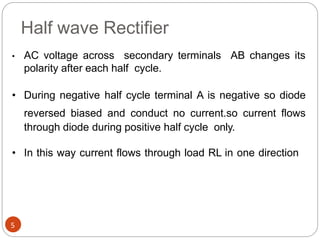
• The process of removing one-half the input signal to
establish a dc level is called half-wave rectification.
• In Half wave rectification, the rectifier conducts current
during positive half cycle of input ac signal only.
• Negative half cycle is suppressed or clipped.
3
Half wave Rectifier
• AC voltage across secondary terminals AB changes its
polarity after each half cycle.
• During negative half cycle terminal A is negative so diode
reversed biased and conduct no current.so current flows
through diode during positive half cycle only.
• In this way current flows through load RL in one direction
5
Half wave Rectifier
Disadvantage of Half wave rectifier:
• Since, power is delivered only during one half of the
cycle of the input alternating voltage, therefore, its
power output and rectification frequency is low.
• Transformer utilization factor is also low.
• The DC output power produced from the half wave
rectifier is not satisfactory to make a general power
supply.
5
Half wave Rectifier
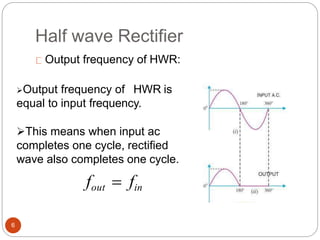
Output frequency of HWR:
Output frequency of HWR is
equal to input frequency.
This means when input ac
completes one cycle, rectified
wave also completes one cycle.
fout  fin
6
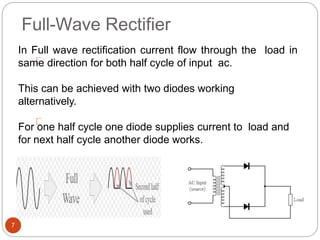
Full-Wave Rectifier
In Full wave rectification current flow through the load in
same direction for both half cycle of input ac.
This can be achieved with two diodes working
alternatively.
For one half cycle one diode supplies current to load and
for next half cycle another diode works.
7
Full wave Rectifier
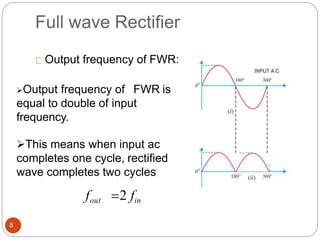
Output frequency of FWR:
Output frequency of FWR is
equal to double of input
frequency.
This means when input ac
completes one cycle, rectified
wave completes two cycles
8
fout 2 fin
Centre Tap Full Wave Rectifier
Circuit has two diodes D1 , D2 and a centre tap
transformer.
During positive half cycle Diode D1conducts and
during negative half cycle Diode D2 conducts.
It can be seen that current through load RL is in the
same direction for both cycle.
10
Full Wave Bridge Rectifier
• Consists of 4 diodes
instead of 2.
10
Full Wave Bridge Rectifier
During first half cycle D1 and D3
are conducting while D2 and D4
are in the “off” state.
11
Full Wave Bridge Rectifier
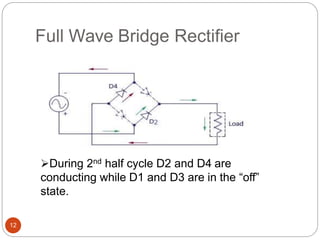
During 2nd half cycle D2 and D4 are
conducting while D1 and D3 are in the “off”
state.
12
Full Wave Bridge Rectifier
Advantage:
I. Need for centre tap trnsformer is eliminated.
II. Output is twice than that of centre tap circuit.
Disadvantage
I. Requires 4 diodes.
II. Internal resistance voltage drop is twice
than that of Centre Tap Circuit.
13

Rectifiers

  • 1.
  • 2.
    Rectifiers Rectifier: Rectifier isthat circuit, that converts ac to dc. The following two types of rectifier circuit can be used: I. Half wave rectifier II. Full wave rectifier 2
  • 3.
    Half wave Rectifier •The process of removing one-half the input signal to establish a dc level is called half-wave rectification. • In Half wave rectification, the rectifier conducts current during positive half cycle of input ac signal only. • Negative half cycle is suppressed or clipped. 3
  • 4.
    Half wave Rectifier •AC voltage across secondary terminals AB changes its polarity after each half cycle. • During negative half cycle terminal A is negative so diode reversed biased and conduct no current.so current flows through diode during positive half cycle only. • In this way current flows through load RL in one direction 5
  • 5.
    Half wave Rectifier Disadvantageof Half wave rectifier: • Since, power is delivered only during one half of the cycle of the input alternating voltage, therefore, its power output and rectification frequency is low. • Transformer utilization factor is also low. • The DC output power produced from the half wave rectifier is not satisfactory to make a general power supply. 5
  • 6.
    Half wave Rectifier Outputfrequency of HWR: Output frequency of HWR is equal to input frequency. This means when input ac completes one cycle, rectified wave also completes one cycle. fout  fin 6
  • 7.
    Full-Wave Rectifier In Fullwave rectification current flow through the load in same direction for both half cycle of input ac. This can be achieved with two diodes working alternatively. For one half cycle one diode supplies current to load and for next half cycle another diode works. 7
  • 8.
    Full wave Rectifier Outputfrequency of FWR: Output frequency of FWR is equal to double of input frequency. This means when input ac completes one cycle, rectified wave completes two cycles 8 fout 2 fin
  • 9.
    Centre Tap FullWave Rectifier Circuit has two diodes D1 , D2 and a centre tap transformer. During positive half cycle Diode D1conducts and during negative half cycle Diode D2 conducts. It can be seen that current through load RL is in the same direction for both cycle. 10
  • 10.
    Full Wave BridgeRectifier • Consists of 4 diodes instead of 2. 10
  • 11.
    Full Wave BridgeRectifier During first half cycle D1 and D3 are conducting while D2 and D4 are in the “off” state. 11
  • 12.
    Full Wave BridgeRectifier During 2nd half cycle D2 and D4 are conducting while D1 and D3 are in the “off” state. 12
  • 13.
    Full Wave BridgeRectifier Advantage: I. Need for centre tap trnsformer is eliminated. II. Output is twice than that of centre tap circuit. Disadvantage I. Requires 4 diodes. II. Internal resistance voltage drop is twice than that of Centre Tap Circuit. 13