The work of rivers
Fluvial Processes
 Three basic processes at work
 Erosion,
 Transportation
 Deposition
 Weathering does not play a significant role in rivers
 The effectiveness of these processes depends on the River’s
Energy level, it’s overall shape and it’s depth
 (Deep rivers more powerful than shallow, young rivers more
powerful than old age)
A River’s Course
The area drained by a
river = Drainage Basin
A drop of rain falling
anywhere in this area
will eventually find its
way into the river.
Drainage basins are
separated from each
other by watersheds
What is at X?
Definitions
 River Source __________________________________
 Drainage Basin ________________________________
 Confluence ___________________________________
 Tributary _____________________________________
 Watershed ____________________________________
 Estuary _______________________________________
 River Mouth ___________________________________
Long (real) and Graded (ideal)
Profile
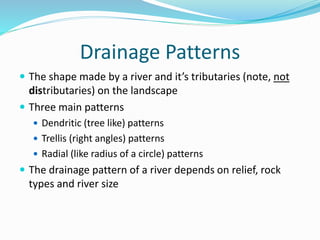
Drainage Patterns
 The shape made by a river and it’s tributaries (note, not
distributaries) on the landscape
 Three main patterns
 Dendritic (tree like) patterns
 Trellis (right angles) patterns
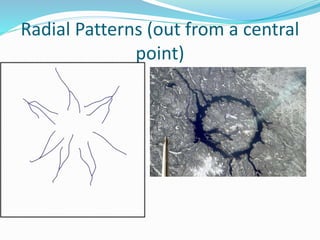
 Radial (like radius of a circle) patterns
 The drainage pattern of a river depends on relief, rock
types and river size
Dendritic (tree like) Patterns
Dendritic Patterns
Trellis (right angled) Patterns
Radial Patterns (out from a central
point)
2007 Leaving Cert Hons
Factors affecting fluvial (river)
processes – P107
 River Volume
 River Speed/Velocity
 Slope
 Width and Depth of a Channel
 Load (material carried by a river)
 Hydraulic Action
 The force of moving water, aided by the process of cavitation (popping of air bubbles in the river,
creating tiny explosions)
 Abrasion (a.k.a. Corrasion)
 The river’s load (stones and sand/grit carried by the water) wears away the bed and sides – river
“sandpaper”
 Attrition
 Rocks hitting each other and being worn away
 Solution
 Chemicals in the river water wearing away the bed and banks
Bank Caving
 Formed by hydraulic action eroding the river banks
 Leads to a small temporary “cave” in the bank – this usually
collapses after a short period
River transport
 Solution – material is dissolved in the water and is carried
along by it. Salt carried in solution is the reason why seawater
is salty. NOT VISIBLE
 Suspension – fine material is carried along by the river. If the
river slows down this material can be dropped on the bed of
the river – this is how rivers & canals “silt up”. VISIBLE
 Saltation – stones bouncing along the river bed – easily seen
(bedload)
 Traction – Heaviest stones dragged along river bed (bedload)
Deposition
 Rivers can drop (deposit) their material for a few reasons
1. Reduction in velocity – when entering a lake, sea, other slow
moving river, encountering an obstacle, a change to a gentler
slope or when drought causes the river to dry up
2. If the river’s load increases suddenly beyond it’s ability to carry
(e.g. a landslide into a river)
3. Evaporation of water
Deposition
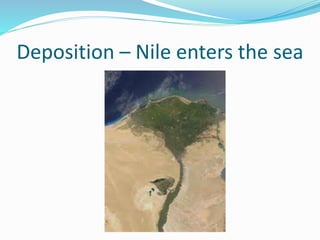
Deposition – Nile enters the sea
Stages of a river
Youthful Stage
Mature Stage
Old Age Stage
Drainage
 The area drained by a river is known as its Drainage Basin
 A drop of rain falling anywhere in this area will eventually
find its way into the river.
 Drainage basins are separated from each other by
watersheds– usually high ground between two drainage
basins.
 Sketch (Montpellier Hill)
River Landforms
 Each stage of a river (youth, mature, old age) creates
different landforms as different processes are at work.
 Youth – Vertical erosion dominant, almost no deposition
 Mature – Lateral (horizontal) erosion, some deposition
 Old age – deposition predominant, some lateral erosion
River landforms - youthful
Source of river
 Where the river starts, usually in a mountainous area
 River source often bears no resemblance to the river we know.
 River Shannon Source
Source of the Liffey
River Landforms - youthful
 As a river is eroding downward in this stage, it leads to
narrow rivers in steep sided valleys (V – Shaped). Eg. Fig
12 p 101
 Depth of V controlled by several factors
 V Shaped valleys appear distinctive on OS Maps –
contours “kink” at the river
V Shaped Valley
Interlocking Spurs
 Bands of harder rock which the river cannot erode
straight through and is forced to flow around
 As the river is forced to “swerve” around the spurs, lateral
(horizontal) erosion increases due to centrifugal force –
making the curves more developed
 On a map, interlocking spurs give a youthful river a
“squiggly” appearance
Interlocking Spurs
Waterfalls
 Formed when a band of hard rock lies across the river.
 Hard rock erodes more slowly, leading to a “bump” in the
river – this grows and develops into a waterfall.
 Example:
 http://www.youtube.com/watch?v=Nhi4cf9yCPs
Waterfalls
 As waterfall grows, the force of falling water (hydraulic
action) creates a pool at the base of the waterfall (plunge
pool).
 The splash back leads to the back of the waterfall being
eroded and the waterfall retreats upstream
 This is known as headward erosion
 On maps, waterfalls are straight flowing streams flowing
over tightly packed contours at right angles
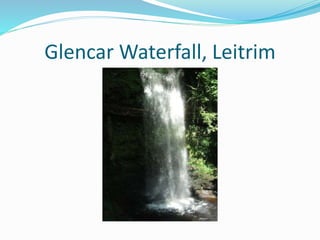
Glencar Waterfall, Leitrim
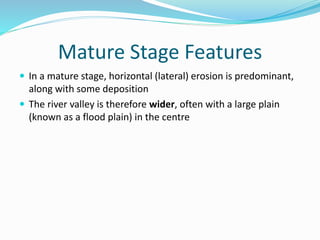
Mature Stage Features
 In a mature stage, horizontal (lateral) erosion is predominant,
along with some deposition
 The river valley is therefore wider, often with a large plain
(known as a flood plain) in the centre
Mature Stage Valley
Mature Stage Features - Meanders
 Meanders are features formed from both erosion AND
deposition
 As the river enters the mature stage, it begins to flow in a
winding manner (forming S bends)
 River water flows fastest on the outside of the bend (forming
erosion) and slowest on the inside (causing deposition)
 Easily spotted on a map as prominent curves in a river
Meanders
Meanders
Point bars & erosion
Point Bars
Erosion
2008 OL
2007 OL
Ox Bow Lakes
 Formed when a river erodes through the narrow “neck”
of a meander.
 Only happens when a meander is very developed
 Meander needs two processes to form – erosion and
deposition – ox bow lake needs a third – Flooding
 In times of flood, the river gains so much hydraulic energy
that it breaks through the narrow neck of the meander
 http://www.youtube.com/watch?v=8uV-
BuBpIFw&feature=related
Ox Bow lakes - formation
1. Meander becomes very
developed
2. In times of flood, the river
cuts through the meander
“neck”
3. Deposition seals off the old
meander, forming an ox bow
lake, which can eventually
dry out
Ox Bow Lakes
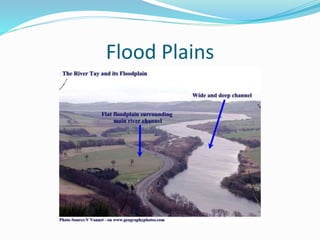
Flood Plains
 A flat area on either side of the river that is covered by
water in times of flooding
 Act as a safety valve for rivers – major problems have
been caused in the past decade by building on flood
plains - leaves river with no place to go (and worthless
“ghost” housing estates)
 Caused by a meandering river slowly eroding interlocking
spurs and other areas of high ground to form a wide flat
valley
Flood Plains
….and some obvious problems
Old Stage Landforms
 In this stage deposition is the main process and it creates
features such as Levees and Deltas
 The land over which the river flows is virtually flat – as a
result old age stage can also contain many meanders and
ox-bow lakes
 Levees are naturally occurring wide, low ridge of river
sediment (known as alluvium) that is deposited on river
banks
 Are often raised in height to act as a flood barrier (e.g.
New Orleans, USA)
Levees - formation
Levees
 Levees are useful as natural flood protection
 However can cause particular problems if people build
too close to the river and levee breaks.
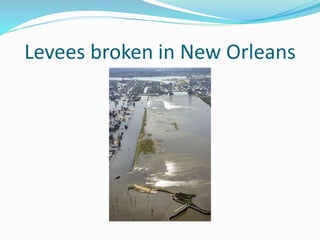
 Hurricane Katrina (2005) broke the levees protecting New
Orleans, resulting in widespread damage
Levees broken in New Orleans
Deltas
 Deltas are the final feature formed in the river’s course
 Formed from deposits of alluvium when a river enters the
sea (called marine deltas), a lake (called lacustrine
deltas), or another slow flowing river
 When a river loses speed suddenly, it drops it’s alluvium
load, which build up in layers known as beds
 First layers deposited – bottomset beds
 Second layer – foreset beds
 Last layer – topset beds
Deltas
 As the sediments build up, the river is forced to split into
a number of smaller channels called distributaries
 Not to be confused with tributaries, (small rivers joining a
larger one)
 Number of different types of delta
Bird’s foot deltas
 Birds’s foot delta (page 125)
 As the material is deposited, the river is forced to carve
out new channels to get to the sea
Estuarine Delta
 Formed when deposits are dropped in long narrow lines,
an example being the Mackenzie river below
Arcuate Delta (arc-shaped)
 An arc, fan or triangular shaped delta which has the apex
(tip) of the triangle pointing upstream
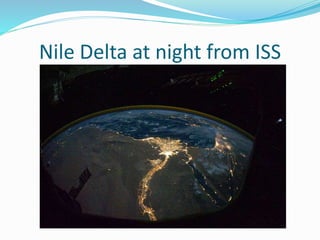
 Most famous example is the Nile Delta on page 113
 The alluvium in these deltas can often be very fertile
(Egypt’s delta produces most of the country’s agricultural
output, and half the country’s population live on it)
 These deltas contain many distributaries
Nile Delta at night from ISS
2009 Ordinary Level
Exam Question
 2008 HL Question 1(b):
Examine with the aid of a labelled diagram or diagrams the
processes that have led to the formation of any one Irish
landform of your choice
 Marking Scheme
 Identify landform – 2 marks
 Name one process – 2 marks
 Irish example – 2 marks
 Label Diagram – 4 marks
 Examination – 10 SRPs (10 x 2 marks = 20)
Human Interaction with rivers
 Humans have interacted with rivers by building Dams, raising
Levees (to reduce flooding) and attempting to change the
course of rivers
 These projects have led to successes and failures.
 Successes
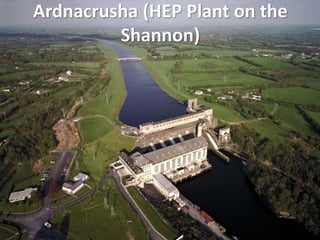
 Hydroelectric power generated (e.g. Ardnacrusha, Three Gorges)
 Improved economic use of rivers (Rhine)
 Flood management (Clonmel)
 Tourism potential (Blessington, Co. Wicklow)
 Irrigation (Central valley scheme in California)
Human interaction with rivers
 Failures
 Some hydroelectric (HEP) schemes (e.g. Three Gorges) have had
negative environmental impact
 Flood management often leads to overconfidence and
overdevelopment of flood plains
 Economic cost – drowned farmland, houses etc
 Irrigation can lead to salt build up in soil
 Straightening rivers can lead to erosion
The Rhine – Impact of Canalisation
 Canalisation is the construction of canals alongside a river to
improve accessibility for boats
 In Ireland, the River Barrow and the River Boyne were both
partly canalised in the 19th Century
 Advantage of Canalisation
 Ease of transport – saves time and money
 Able to manage small flooding incidents
 Disadvantage of Canalisation
 Greater flooding risk
 Environmental damage
Canalised Rhine
Canal
Natural River
Channel
Three Gorges Dam, China
Ardnacrusha (HEP Plant on the
Shannon)
3 Gorges - Impact of Dam Building
 Erosion affected (surges of water vs steady flow)
 Deposition of alluvium behind Dam
 Flooding of Land during building
 Floods managed after construction
 Seawater invasion of River Estuary (?)
 Deltas deprived of sediment
Flood Control - Clonmel
Clonmel – human and natural
factors leading to flooding
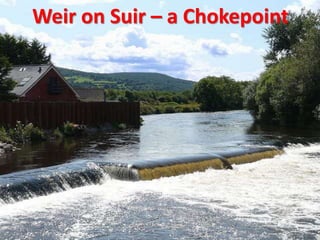
 Human factors (narrow bridge, weir preventing quick
river flow)
 Natural factors – (Confluence of rivers, flood plain, heavy
rainfall)
 Solutions:
 Remove blockage points on river
 Improve levees and flood defences
Old Bridge on Suir – a chokepoint
Weir on Suir – a Chokepoint
Aral Sea – a victim of irrigation
Aral Sea
 Rivers that used to flow into it have been diverted for
irrigation of farmland
 As a result the salt from dried up seabed has been blown
by wind over farmland – making it useless
 Weather patterns changed – leading to desertification
Aral Sea - today
2008 Ordinary Level LC
River rejuvenation
 Rejuvenate – to restore to a former state: to make new again
 River rejuvenation refers to the river flowing faster with more
energy to reach sea level (Known as the river’s base level)
 Can happen either because the sea level falls (e.g. during an ice age)
- this is known as eustatic changes
 ….or because land rises because of uplift (isostatic uplift)
 Ireland’s rivers show evidence of rejuvenation because the sea levels
fell (during the last ice age) and also because Ireland’s landmass has
risen over millions of years (much of Ireland was underwater at the
time of the dinosaurs)
 A rejuvenated river begins to erode vertically in the old age section
of the river
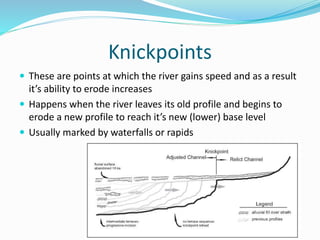
Knickpoints
 These are points at which the river gains speed and as a result
it’s ability to erode increases
 Happens when the river leaves its old profile and begins to
erode a new profile to reach it’s new (lower) base level
 Usually marked by waterfalls or rapids
Knickpoint – river increases speed
Incised meanders
 As the river gets a boost in velocity from rejuvenation and
from knickpoints, “old age” features such as meanders
are subject to vertical erosion
 This leads to the creation of very deep meanders where
the river has begun to vertically erode into the river bed.
 Irish example: River Nore, Kilkenny
Incised Meander, Nevada, USA
River Terrace
 These occur when a river flowing across a flood plain is
rejuvenated
 The faster flowing river cuts a deeper channel for itself –
this leads in time to a new flood plain “below” the old
plain
 Old flood plain is left high and dry as a River Terrace
River Terraces
Superimposed Rivers
 Superimposed rivers are rivers that don’t seem to follow the
course that they should – cutting through hills rather than
going around them
Superimposed Rivers
 For most rivers, the direction of flow is a result (a
consequence) of the landscape over which they flow.
 These rivers are thus known as consequent streams
 However if the area over which the river flows is subject to
erosion and/or uplift then the river can erode through the
landscape as it is being slowly exposed
 This ends up with the river seemingly able to flow through
hills, seemingly in violation of the laws of nature
 Irish Example: River Lee and Shournagh River, Cork
Superimposed Rivers
On the left, the subsequent river is flowing over layers of soft
rock. As these layers are slowly eroded away, the river cuts
through the exposed hard rock ridges and has superimposed
itself on the landscape
River Capture
 This can be caused by “headward erosion” as the river erodes
back from it’s source until it reaches another river and
“captures” it
River Capture
2011 LC Paper (Higher)
 Explain how isostatic changes have impacted on the Irish
landscape, using examples that you have studied [30m]
 Impact /Feature identified 2 + 2 marks
 Example 2 + 2 marks
 Explanation 11 x SRPs
 Accept features of emergence only
 Accept river features of rejuvenation
 Give credit for 1 SRP for a 3rd named feature
 All other features must be explained
 Give credit for 1 SRP for diagram without annotation
 Credit relevant diagrams with extra information
2010 LC Paper (Higher) – 30 Marks
 With reference to an example you have studied, describe and
account for one way in which humans attempt to influence or
control natural processes. In your answer, refer to one of the
following:
 Fluvial processes
 Marine processes
 Mass movement.
 Influence / Control identified: 2 marks
 Named Example / Location: 2 marks
 Reference to natural process: 2 marks
 Discussion: 12 x SRPs
 Max 6 SRPs for discussion without reference to influence or control
 Question not tied to Ireland
 Amalgamate all relevant discussion
Conflict over Rivers
 Not just a factor in landscape creation, rivers are
becoming vitally important to modern society for water
supply, power (hydroelectricity), irrigation of farmland,
access for shipping and as a waste management system
 In a Warming World, rivers will become an even more
vital to our well being
 Status of River Jordan is a sensitive issue in Israeli –
Palestinian peace process – both sides want access to the
river
River Jordan – a border
Conflict in Ireland over water
 http://www.rte.ie/news/2010/0713/water.html#video
 http://www.shannonprotectionalliance.ie/
Conflict over water
 In favour of the proposal or against?
 Positives?
 Negatives?
 For Dublin?
 For the Midlands?
 Solutions?

Fluvial/River Processes

  • 1.
  • 2.
    Fluvial Processes  Threebasic processes at work  Erosion,  Transportation  Deposition  Weathering does not play a significant role in rivers  The effectiveness of these processes depends on the River’s Energy level, it’s overall shape and it’s depth  (Deep rivers more powerful than shallow, young rivers more powerful than old age)
  • 3.
    A River’s Course Thearea drained by a river = Drainage Basin A drop of rain falling anywhere in this area will eventually find its way into the river. Drainage basins are separated from each other by watersheds What is at X?
  • 4.
    Definitions  River Source__________________________________  Drainage Basin ________________________________  Confluence ___________________________________  Tributary _____________________________________  Watershed ____________________________________  Estuary _______________________________________  River Mouth ___________________________________
  • 5.
    Long (real) andGraded (ideal) Profile
  • 6.
    Drainage Patterns  Theshape made by a river and it’s tributaries (note, not distributaries) on the landscape  Three main patterns  Dendritic (tree like) patterns  Trellis (right angles) patterns  Radial (like radius of a circle) patterns  The drainage pattern of a river depends on relief, rock types and river size
  • 7.
  • 8.
  • 9.
  • 10.
    Radial Patterns (outfrom a central point)
  • 11.
  • 13.
    Factors affecting fluvial(river) processes – P107  River Volume  River Speed/Velocity  Slope  Width and Depth of a Channel  Load (material carried by a river)
  • 14.
     Hydraulic Action The force of moving water, aided by the process of cavitation (popping of air bubbles in the river, creating tiny explosions)  Abrasion (a.k.a. Corrasion)  The river’s load (stones and sand/grit carried by the water) wears away the bed and sides – river “sandpaper”  Attrition  Rocks hitting each other and being worn away  Solution  Chemicals in the river water wearing away the bed and banks
  • 15.
    Bank Caving  Formedby hydraulic action eroding the river banks  Leads to a small temporary “cave” in the bank – this usually collapses after a short period
  • 16.
    River transport  Solution– material is dissolved in the water and is carried along by it. Salt carried in solution is the reason why seawater is salty. NOT VISIBLE  Suspension – fine material is carried along by the river. If the river slows down this material can be dropped on the bed of the river – this is how rivers & canals “silt up”. VISIBLE  Saltation – stones bouncing along the river bed – easily seen (bedload)  Traction – Heaviest stones dragged along river bed (bedload)
  • 18.
    Deposition  Rivers candrop (deposit) their material for a few reasons 1. Reduction in velocity – when entering a lake, sea, other slow moving river, encountering an obstacle, a change to a gentler slope or when drought causes the river to dry up 2. If the river’s load increases suddenly beyond it’s ability to carry (e.g. a landslide into a river) 3. Evaporation of water
  • 19.
  • 20.
    Deposition – Nileenters the sea
  • 21.
  • 22.
  • 23.
  • 24.
  • 25.
    Drainage  The areadrained by a river is known as its Drainage Basin  A drop of rain falling anywhere in this area will eventually find its way into the river.  Drainage basins are separated from each other by watersheds– usually high ground between two drainage basins.  Sketch (Montpellier Hill)
  • 26.
    River Landforms  Eachstage of a river (youth, mature, old age) creates different landforms as different processes are at work.  Youth – Vertical erosion dominant, almost no deposition  Mature – Lateral (horizontal) erosion, some deposition  Old age – deposition predominant, some lateral erosion
  • 27.
  • 29.
    Source of river Where the river starts, usually in a mountainous area  River source often bears no resemblance to the river we know.  River Shannon Source
  • 30.
  • 31.
    River Landforms -youthful  As a river is eroding downward in this stage, it leads to narrow rivers in steep sided valleys (V – Shaped). Eg. Fig 12 p 101  Depth of V controlled by several factors  V Shaped valleys appear distinctive on OS Maps – contours “kink” at the river
  • 32.
  • 33.
    Interlocking Spurs  Bandsof harder rock which the river cannot erode straight through and is forced to flow around  As the river is forced to “swerve” around the spurs, lateral (horizontal) erosion increases due to centrifugal force – making the curves more developed  On a map, interlocking spurs give a youthful river a “squiggly” appearance
  • 34.
  • 35.
    Waterfalls  Formed whena band of hard rock lies across the river.  Hard rock erodes more slowly, leading to a “bump” in the river – this grows and develops into a waterfall.  Example:  http://www.youtube.com/watch?v=Nhi4cf9yCPs
  • 36.
    Waterfalls  As waterfallgrows, the force of falling water (hydraulic action) creates a pool at the base of the waterfall (plunge pool).  The splash back leads to the back of the waterfall being eroded and the waterfall retreats upstream  This is known as headward erosion  On maps, waterfalls are straight flowing streams flowing over tightly packed contours at right angles
  • 37.
  • 38.
    Mature Stage Features In a mature stage, horizontal (lateral) erosion is predominant, along with some deposition  The river valley is therefore wider, often with a large plain (known as a flood plain) in the centre
  • 39.
  • 40.
    Mature Stage Features- Meanders  Meanders are features formed from both erosion AND deposition  As the river enters the mature stage, it begins to flow in a winding manner (forming S bends)  River water flows fastest on the outside of the bend (forming erosion) and slowest on the inside (causing deposition)  Easily spotted on a map as prominent curves in a river
  • 41.
  • 42.
  • 43.
    Point bars &erosion Point Bars Erosion
  • 44.
  • 45.
  • 46.
    Ox Bow Lakes Formed when a river erodes through the narrow “neck” of a meander.  Only happens when a meander is very developed  Meander needs two processes to form – erosion and deposition – ox bow lake needs a third – Flooding  In times of flood, the river gains so much hydraulic energy that it breaks through the narrow neck of the meander  http://www.youtube.com/watch?v=8uV- BuBpIFw&feature=related
  • 47.
    Ox Bow lakes- formation 1. Meander becomes very developed 2. In times of flood, the river cuts through the meander “neck” 3. Deposition seals off the old meander, forming an ox bow lake, which can eventually dry out
  • 48.
  • 49.
    Flood Plains  Aflat area on either side of the river that is covered by water in times of flooding  Act as a safety valve for rivers – major problems have been caused in the past decade by building on flood plains - leaves river with no place to go (and worthless “ghost” housing estates)  Caused by a meandering river slowly eroding interlocking spurs and other areas of high ground to form a wide flat valley
  • 50.
  • 51.
  • 52.
    Old Stage Landforms In this stage deposition is the main process and it creates features such as Levees and Deltas  The land over which the river flows is virtually flat – as a result old age stage can also contain many meanders and ox-bow lakes  Levees are naturally occurring wide, low ridge of river sediment (known as alluvium) that is deposited on river banks  Are often raised in height to act as a flood barrier (e.g. New Orleans, USA)
  • 53.
  • 54.
    Levees  Levees areuseful as natural flood protection  However can cause particular problems if people build too close to the river and levee breaks.  Hurricane Katrina (2005) broke the levees protecting New Orleans, resulting in widespread damage
  • 55.
    Levees broken inNew Orleans
  • 57.
    Deltas  Deltas arethe final feature formed in the river’s course  Formed from deposits of alluvium when a river enters the sea (called marine deltas), a lake (called lacustrine deltas), or another slow flowing river  When a river loses speed suddenly, it drops it’s alluvium load, which build up in layers known as beds  First layers deposited – bottomset beds  Second layer – foreset beds  Last layer – topset beds
  • 58.
    Deltas  As thesediments build up, the river is forced to split into a number of smaller channels called distributaries  Not to be confused with tributaries, (small rivers joining a larger one)  Number of different types of delta
  • 59.
    Bird’s foot deltas Birds’s foot delta (page 125)  As the material is deposited, the river is forced to carve out new channels to get to the sea
  • 60.
    Estuarine Delta  Formedwhen deposits are dropped in long narrow lines, an example being the Mackenzie river below
  • 61.
    Arcuate Delta (arc-shaped) An arc, fan or triangular shaped delta which has the apex (tip) of the triangle pointing upstream  Most famous example is the Nile Delta on page 113  The alluvium in these deltas can often be very fertile (Egypt’s delta produces most of the country’s agricultural output, and half the country’s population live on it)  These deltas contain many distributaries
  • 62.
    Nile Delta atnight from ISS
  • 64.
  • 65.
    Exam Question  2008HL Question 1(b): Examine with the aid of a labelled diagram or diagrams the processes that have led to the formation of any one Irish landform of your choice  Marking Scheme  Identify landform – 2 marks  Name one process – 2 marks  Irish example – 2 marks  Label Diagram – 4 marks  Examination – 10 SRPs (10 x 2 marks = 20)
  • 66.
    Human Interaction withrivers  Humans have interacted with rivers by building Dams, raising Levees (to reduce flooding) and attempting to change the course of rivers  These projects have led to successes and failures.  Successes  Hydroelectric power generated (e.g. Ardnacrusha, Three Gorges)  Improved economic use of rivers (Rhine)  Flood management (Clonmel)  Tourism potential (Blessington, Co. Wicklow)  Irrigation (Central valley scheme in California)
  • 67.
    Human interaction withrivers  Failures  Some hydroelectric (HEP) schemes (e.g. Three Gorges) have had negative environmental impact  Flood management often leads to overconfidence and overdevelopment of flood plains  Economic cost – drowned farmland, houses etc  Irrigation can lead to salt build up in soil  Straightening rivers can lead to erosion
  • 68.
    The Rhine –Impact of Canalisation  Canalisation is the construction of canals alongside a river to improve accessibility for boats  In Ireland, the River Barrow and the River Boyne were both partly canalised in the 19th Century  Advantage of Canalisation  Ease of transport – saves time and money  Able to manage small flooding incidents  Disadvantage of Canalisation  Greater flooding risk  Environmental damage
  • 69.
  • 70.
  • 71.
    Ardnacrusha (HEP Planton the Shannon)
  • 72.
    3 Gorges -Impact of Dam Building  Erosion affected (surges of water vs steady flow)  Deposition of alluvium behind Dam  Flooding of Land during building  Floods managed after construction  Seawater invasion of River Estuary (?)  Deltas deprived of sediment
  • 73.
  • 74.
    Clonmel – humanand natural factors leading to flooding  Human factors (narrow bridge, weir preventing quick river flow)  Natural factors – (Confluence of rivers, flood plain, heavy rainfall)  Solutions:  Remove blockage points on river  Improve levees and flood defences
  • 75.
    Old Bridge onSuir – a chokepoint
  • 76.
    Weir on Suir– a Chokepoint
  • 77.
    Aral Sea –a victim of irrigation
  • 78.
    Aral Sea  Riversthat used to flow into it have been diverted for irrigation of farmland  As a result the salt from dried up seabed has been blown by wind over farmland – making it useless  Weather patterns changed – leading to desertification
  • 79.
  • 80.
  • 81.
    River rejuvenation  Rejuvenate– to restore to a former state: to make new again  River rejuvenation refers to the river flowing faster with more energy to reach sea level (Known as the river’s base level)  Can happen either because the sea level falls (e.g. during an ice age) - this is known as eustatic changes  ….or because land rises because of uplift (isostatic uplift)  Ireland’s rivers show evidence of rejuvenation because the sea levels fell (during the last ice age) and also because Ireland’s landmass has risen over millions of years (much of Ireland was underwater at the time of the dinosaurs)  A rejuvenated river begins to erode vertically in the old age section of the river
  • 82.
    Knickpoints  These arepoints at which the river gains speed and as a result it’s ability to erode increases  Happens when the river leaves its old profile and begins to erode a new profile to reach it’s new (lower) base level  Usually marked by waterfalls or rapids
  • 83.
    Knickpoint – riverincreases speed
  • 84.
    Incised meanders  Asthe river gets a boost in velocity from rejuvenation and from knickpoints, “old age” features such as meanders are subject to vertical erosion  This leads to the creation of very deep meanders where the river has begun to vertically erode into the river bed.  Irish example: River Nore, Kilkenny
  • 85.
  • 86.
    River Terrace  Theseoccur when a river flowing across a flood plain is rejuvenated  The faster flowing river cuts a deeper channel for itself – this leads in time to a new flood plain “below” the old plain  Old flood plain is left high and dry as a River Terrace
  • 87.
  • 88.
    Superimposed Rivers  Superimposedrivers are rivers that don’t seem to follow the course that they should – cutting through hills rather than going around them
  • 89.
    Superimposed Rivers  Formost rivers, the direction of flow is a result (a consequence) of the landscape over which they flow.  These rivers are thus known as consequent streams  However if the area over which the river flows is subject to erosion and/or uplift then the river can erode through the landscape as it is being slowly exposed  This ends up with the river seemingly able to flow through hills, seemingly in violation of the laws of nature  Irish Example: River Lee and Shournagh River, Cork
  • 90.
    Superimposed Rivers On theleft, the subsequent river is flowing over layers of soft rock. As these layers are slowly eroded away, the river cuts through the exposed hard rock ridges and has superimposed itself on the landscape
  • 91.
    River Capture  Thiscan be caused by “headward erosion” as the river erodes back from it’s source until it reaches another river and “captures” it
  • 92.
  • 94.
    2011 LC Paper(Higher)  Explain how isostatic changes have impacted on the Irish landscape, using examples that you have studied [30m]  Impact /Feature identified 2 + 2 marks  Example 2 + 2 marks  Explanation 11 x SRPs  Accept features of emergence only  Accept river features of rejuvenation  Give credit for 1 SRP for a 3rd named feature  All other features must be explained  Give credit for 1 SRP for diagram without annotation  Credit relevant diagrams with extra information
  • 95.
    2010 LC Paper(Higher) – 30 Marks  With reference to an example you have studied, describe and account for one way in which humans attempt to influence or control natural processes. In your answer, refer to one of the following:  Fluvial processes  Marine processes  Mass movement.  Influence / Control identified: 2 marks  Named Example / Location: 2 marks  Reference to natural process: 2 marks  Discussion: 12 x SRPs  Max 6 SRPs for discussion without reference to influence or control  Question not tied to Ireland  Amalgamate all relevant discussion
  • 96.
    Conflict over Rivers Not just a factor in landscape creation, rivers are becoming vitally important to modern society for water supply, power (hydroelectricity), irrigation of farmland, access for shipping and as a waste management system  In a Warming World, rivers will become an even more vital to our well being  Status of River Jordan is a sensitive issue in Israeli – Palestinian peace process – both sides want access to the river
  • 97.
  • 98.
    Conflict in Irelandover water  http://www.rte.ie/news/2010/0713/water.html#video  http://www.shannonprotectionalliance.ie/
  • 99.
    Conflict over water In favour of the proposal or against?  Positives?  Negatives?  For Dublin?  For the Midlands?  Solutions?