River Rejuvenation All your knowledge of rivers should help you to understand this final process which forms a unique set of landforms. The big picture
Rejuvenate To restore to a former state; to make fresh or new again
Learning Outcomes To understand how changes in base level create different landforms. Explain the landforms produced by river rejuvenation (15 marks)
Base Level Listen to the explanation of base level and then produce a diagram to explain what it is and how it changes.
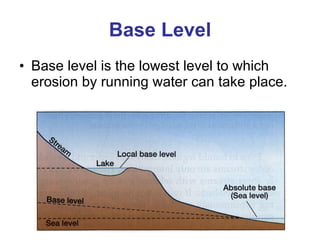
Base Level Base level is the lowest level to which erosion by running water can take place.
The River System River’s are always attempting to reach a state of dynamic equilibrium where there is  a balance between the rate of erosion and deposition.
Dynamic Rivers In reality a river is rarely, if ever, in a state of dynamic equilibrium. Changes in discharge and sediment load are constantly changing the profile of the river.
For example…. Waterfall Erosion near the waterfall Deposition lower downstream Lengthy period of heavy rain
Base Level changes Eustatic Change Changes to sea Level Isostatic change Glacial rebound
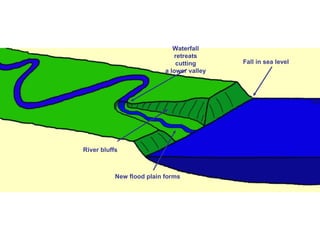
Changes Positive Sea levels rise in relation to the land. The river loses energy and as such deposition dominates and coastal areas flood. Negative Sea levels fall in relation to the sea. Land emerges from the sea, steepening the river gradient thus increasing the rivers erosional power. rejuvenation
Base Level Produce your diagram
Key Points Rivers begin to regrade from the point nearest the sea. It often happens again before a river has reached dynamic equilibrium giving it a partly graded profile. Knickpoints Incised meanders River terraces Waterfalls Changes to the cross profile of the river
River in grade Flood plain
Waterfall retreats cutting a lower valley Fall in sea level River bluffs New flood plain forms
New flood plain forms River bluffs Waterfall decreases in size to form rapids (knick point) River Terrace
Terraces
Knickpoints and waterfalls
 
 
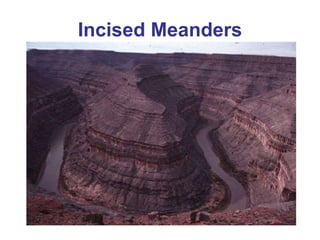
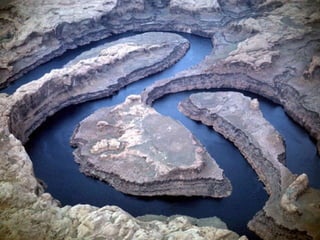
Incised Meanders


The likely story is that the streams once flowed across nearly flat lowlands.  Then, uplift of the rocks began, giving the streams a steeper slope to the sea and so speeding their flow and causing them to erode.  But, the uplift was gradual enough that the streams held their old courses.   The streams cut downward without a change in pattern, which is called incision. 
Write three level descriptors for this question Explain  the landforms produced by river rejuvenation (15 marks) Level 1 : BASIC Level 2 : CLEAR Level 3 : DETAILED
Review BASE LEVEL INCISION ISOSTATIC UPLIFT KNICK POINT

River Rejuvenation

  • 1.
    River Rejuvenation Allyour knowledge of rivers should help you to understand this final process which forms a unique set of landforms. The big picture
  • 2.
    Rejuvenate To restoreto a former state; to make fresh or new again
  • 3.
    Learning Outcomes Tounderstand how changes in base level create different landforms. Explain the landforms produced by river rejuvenation (15 marks)
  • 4.
    Base Level Listento the explanation of base level and then produce a diagram to explain what it is and how it changes.
  • 5.
    Base Level Baselevel is the lowest level to which erosion by running water can take place.
  • 6.
    The River SystemRiver’s are always attempting to reach a state of dynamic equilibrium where there is a balance between the rate of erosion and deposition.
  • 7.
    Dynamic Rivers Inreality a river is rarely, if ever, in a state of dynamic equilibrium. Changes in discharge and sediment load are constantly changing the profile of the river.
  • 8.
    For example…. WaterfallErosion near the waterfall Deposition lower downstream Lengthy period of heavy rain
  • 9.
    Base Level changesEustatic Change Changes to sea Level Isostatic change Glacial rebound
  • 10.
    Changes Positive Sealevels rise in relation to the land. The river loses energy and as such deposition dominates and coastal areas flood. Negative Sea levels fall in relation to the sea. Land emerges from the sea, steepening the river gradient thus increasing the rivers erosional power. rejuvenation
  • 11.
    Base Level Produceyour diagram
  • 12.
    Key Points Riversbegin to regrade from the point nearest the sea. It often happens again before a river has reached dynamic equilibrium giving it a partly graded profile. Knickpoints Incised meanders River terraces Waterfalls Changes to the cross profile of the river
  • 13.
    River in gradeFlood plain
  • 14.
    Waterfall retreats cuttinga lower valley Fall in sea level River bluffs New flood plain forms
  • 15.
    New flood plainforms River bluffs Waterfall decreases in size to form rapids (knick point) River Terrace
  • 16.
  • 17.
  • 18.
  • 19.
  • 20.
  • 21.
  • 22.
  • 23.
  • 24.
  • 25.
    The likely storyis that the streams once flowed across nearly flat lowlands. Then, uplift of the rocks began, giving the streams a steeper slope to the sea and so speeding their flow and causing them to erode. But, the uplift was gradual enough that the streams held their old courses.  The streams cut downward without a change in pattern, which is called incision. 
  • 26.
    Write three leveldescriptors for this question Explain the landforms produced by river rejuvenation (15 marks) Level 1 : BASIC Level 2 : CLEAR Level 3 : DETAILED
  • 27.
    Review BASE LEVELINCISION ISOSTATIC UPLIFT KNICK POINT