COASTAL
LANDFORMS
PRESENTED BY:
GROUP-C
S HRITHIK SINGHA
ROCKTIM GOGOI
QUEEN CHETIA
SONIA GHOSH
KUKI MONJORI BORUAH
ACKNOWLEDGEMENT
We would like to express our special thanks of gratitude to our professor Dr.
Ratan Das who gave us this golden opportunity to do this wonderful presentation
on “COASTAL LANDFORMS”.
We came to know about so many new things and we are really thankful to it.
Lastly but not the least we would like to thank all our group members for their
valuable advice and contributions in completion of this presentation.
CONTENTS
INTODUCTION
COASTAL ENVIRONMENT
WAVE
TIDE
CURRENT
COASTAL PROCESSES
DEGRADATIONAL PROCESSES
AGGRADATIONAL PROCESSES
EROSIONAL FEATURES
DEPOSITIONAL FEATURES
CONCLUSION
REFERENCES
INTRODUCTION
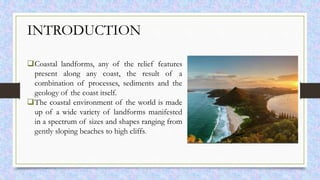
Coastal landforms, any of the relief features
present along any coast, the result of a
combination of processes, sediments and the
geology of the coast itself.
The coastal environment of the world is made
up of a wide variety of landforms manifested
in a spectrum of sizes and shapes ranging from
gently sloping beaches to high cliffs.
What is Coastal environment?
• Coasts are the areas where the land masses meet the seas.
• This results in a special set of environments where the marine and terrestrial areas
influence each other.
• There are mainly three processes active which modify the coast and the coastal
environments:
oWaves
oTides
oCurrents
WAVES
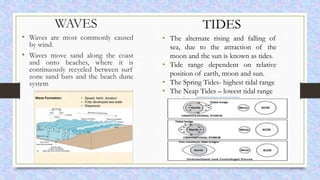
• Waves are most commonly caused
by wind.
• Waves move sand along the coast
and onto beaches, where it is
continuously recycled between surf
zone sand bars and the beach dune
system
TIDES
• The alternate rising and falling of
sea, due to the attraction of the
moon and the sun is known as tides.
• Tide range dependent on relative
position of earth, moon and sun.
• The Spring Tides- highest tidal range
• The Neap Tides – lowest tidal range
CURRENTS
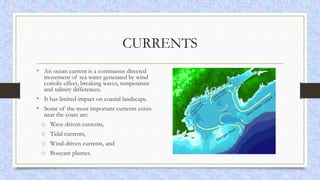
• An ocean current is a continuous directed
movement of sea water generated by wind
coriolis effect, breaking waves, temperature
and salinity differences.
• It has limited impact on coastal landscape.
• Some of the most important currents exists
near the coast are:
o Wave-driven currents,
o Tidal currents,
o Wind-driven currents, and
o Bouyant plumes.
COASTAL PROCESSES
• Coastal landforms are fashioned by weathering, by sediment erosion and
transport associated with wave action and tides, and by sediment deposition.
• It can be distinguished into two processes:
Degradational processes
Aggradational processes
.
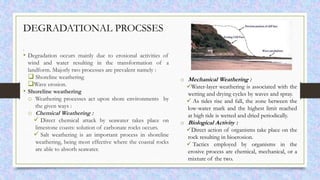
• Degradation occurs mainly due to erosional activities of
wind and water resulting in the transformation of a
landform. Majorly two processes are prevalent namely :
 Shoreline weathering
Wave erosion.
• Shoreline weathering
o Weathering processes act upon shore environments by
the given ways :
o Chemical Weathering :
 Direct chemical attack by seawater takes place on
limestone coasts: solution of carbonate rocks occurs.
 Salt weathering is an important process in shoreline
weathering, being most effective where the coastal rocks
are able to absorb seawater.
9
o Mechanical Weathering :
Water-layer weathering is associated with the
wetting and drying cycles by waves and spray.
 As tides rise and fall, the zone between the
low-water mark and the highest limit reached
at high tide is wetted and dried periodically.
o Biological Activity :
Direct action of organisms take place on the
rock resulting in bioerosion.
 Tactics employed by organisms in the
erosive process are chemical, mechanical, or a
mixture of the two.
DEGRADATIONAL PROCSSES
• Wave erosion
oWave and tidal activities make coastlines a dynamic entity as
they regularly modify the coastal features.
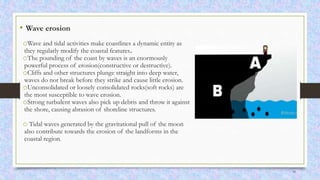
oThe pounding of the coast by waves is an enormously
powerful process of erosion(constructive or destructive).
oCliffs and other structures plunge straight into deep water,
waves do not break before they strike and cause little erosion.
oUnconsolidated or loosely consolidated rocks(soft rocks) are
the most susceptible to wave erosion.
oStrong turbulent waves also pick up debris and throw it against
the shore, causing abrasion of shoreline structures.
o Tidal waves generated by the gravitational pull of the moon
also contribute towards the erosion of the landforms in the
coastal region.
10
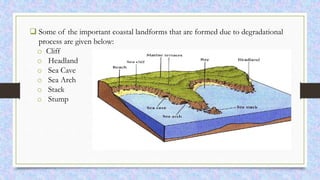
 Some of the important coastal landforms that are formed due to degradational
process are given below:
o Cliff
o Headland
o Sea Cave
o Sea Arch
o Stack
o Stump
AGGRADATIONAL PROCESSES
• Aggradation means adding the sediments and raising
the level of the land.
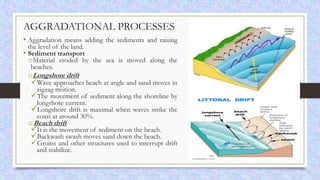
• Sediment transport
oMaterial eroded by the sea is moved along the
beaches.
oLongshore drift
Wave approaches beach at angle and sand moves in
zigzag motion.
The movement of sediment along the shoreline by
longshore current.
Longshore drift is maximal when waves strike the
coast at around 30%.
oBeach drift
It is the movement of sediment on the beach.
Backwash swash moves sand down the beach.
Groins and other structures used to interrupt drift
and stabilize.
.
.
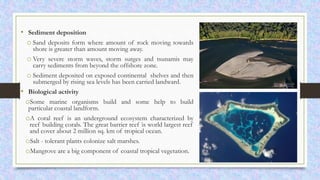
• Sediment deposition
o Sand deposits form where amount of rock moving towards
shore is greater than amount moving away.
o Very severe storm waves, storm surges and tsunamis may
carry sediments from beyond the offshore zone.
o Sediment deposited on exposed continental shelves and then
submerged by rising sea levels has been carried landward.
• Biological activity
oSome marine organisms build and some help to build
particular coastal landform.
oA coral reef is an underground ecosystem characterized by
reef building corals. The great barrier reef is world largest reef
and cover about 2 million sq. km of tropical ocean.
oSalt - tolerant plants colonize salt marshes.
oMangrove are a big component of coastal tropical vegetation.
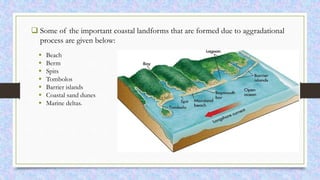
 Some of the important coastal landforms that are formed due to aggradational
process are given below:
 Beach
 Berm
 Spits
 Tombolos
 Barrier islands
 Coastal sand dunes
 Marine deltas.
FACTORS AFFECTING EROSIONAL
LANDFORMS
1. Abrasion - waves transport material which hit the cliff and gradually wear it away.
2. Hydraulic action - as waves approach the coast they trap air and force it into
gaps in the cliff. Eventually this weakens the rock.
3. Attrition - waves cause the rocks to crash against each other, breaking them down
into smaller and rounder pieces.
4. Corrosion (also known as solution) - salts and acids in seawater dissolve the
rock gradually over thousands of years. In addition, changes in landforms can be a
result of wind erosion, weathering and sub-aerial processes such as mass
movement.
Erosional landforms
The process of erosion can create different landforms
along the coastline :-
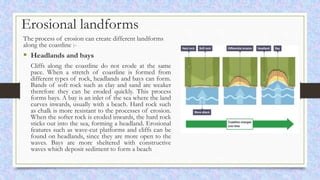
 Headlands and bays
Cliffs along the coastline do not erode at the same
pace. When a stretch of coastline is formed from
different types of rock, headlands and bays can form.
Bands of soft rock such as clay and sand are weaker
therefore they can be eroded quickly. This process
forms bays. A bay is an inlet of the sea where the land
curves inwards, usually with a beach. Hard rock such
as chalk is more resistant to the processes of erosion.
When the softer rock is eroded inwards, the hard rock
sticks out into the sea, forming a headland. Erosional
features such as wave-cut platforms and cliffs can be
found on headlands, since they are more open to the
waves. Bays are more sheltered with constructive
waves which deposit sediment to form a beach
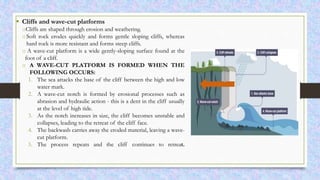
 Cliffs and wave-cut platforms
oCliffs are shaped through erosion and weathering.
oSoft rock erodes quickly and forms gentle sloping cliffs, whereas
hard rock is more resistant and forms steep cliffs.
o A wave-cut platform is a wide gently-sloping surface found at the
foot of a cliff.
o A WAVE-CUT PLATFORM IS FORMED WHEN THE
FOLLOWING OCCURS:
1. The sea attacks the base of the cliff between the high and low
water mark.
2. A wave-cut notch is formed by erosional processes such as
abrasion and hydraulic action - this is a dent in the cliff usually
at the level of high tide.
3. As the notch increases in size, the cliff becomes unstable and
collapses, leading to the retreat of the cliff face.
4. The backwash carries away the eroded material, leaving a wave-
cut platform.
5. The process repeats and the cliff continues to retreat.
 Caves, arches, stacks and stumps
o Caves, arches, stacks and stumps are erosional features
that are commonly found on a headland
1.Cracks are widened in the headland through the
erosional processes of hydraulic action and abrasion.
2.As the waves continue to grind away at the crack, it
begins to open up to form a cave.
3.The cave becomes larger and eventually breaks
through the headland to form an arch.
4.The base of the arch continually becomes wider
through further erosion, until its roof becomes too
heavy and collapses into the sea. This leaves a stack
(an isolated column of rock).
5.The stack is undercut at the base until it collapses to
form a stump
COASTAL DEPOSITIONAL LANDFORMS
 BEACHES
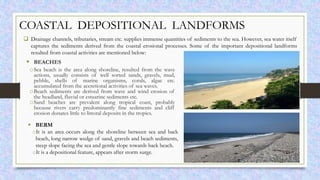
oSea beach is the area along shoreline, resulted from the wave
actions, usually consists of well sorted sands, gravels, mud,
pebble, shells of marine organisms, corals, algae etc.
accumulated from the accretional activities of sea waves.
oBeach sediments are derived from wave and wind erosion of
the headland, fluvial or estuarine sediments etc.
oSand beaches are prevalent along tropical coast, probably
because rivers carry predominantly fine sediments and cliff
erosion donates little to littoral deposits in the tropics.
 Drainage channels, tributaries, stream etc. supplies immense quantities of sediments to the sea. However, sea water itself
captures the sediments derived from the coastal erosional processes. Some of the important depositional landforms
resulted from coastal activities are mentioned below:
 BERM
oIt is an area occurs along the shoreline between sea and back
beach, long narrow wedge of sand, gravels and beach sediments,
steep slope facing the sea and gentle slope towards back beach.
oIt is a depositional feature, appears after storm surge.
 SPITS
oIt is an extended stretch of beach material that
sticks out to sea and joined to the mainland at
one end.
oLongshore drift moves material along a
coastline. Where the coastline changes direction
or the power of the waves reduced and the
transported material is deposited.
oLongshore drift moves material along the
coastline and gradually the spit grows and
sometimes develop a hook at tip portion.
oA spit is an unstable landform.
 TOMBOLO
oIt is a small gravels or sands mound or island
connected with narrow seaward extension
from coast or mainland.
oTombolos are formed from the refraction of
sea waves which causes longshore currents of
opposite direction to converge in a zone
where sediments are accumulated and creates
a tombolo.
oTwo or more tombolos connected in a series
called as tombolo cluster.
 COASTAL SAND DUNES
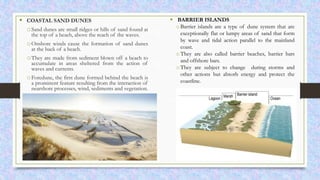
oSand dunes are small ridges or hills of sand found at
the top of a beach, above the reach of the waves.
oOnshore winds cause the formation of sand dunes
at the back of a beach.
oThey are made from sediment blown off a beach to
accumulate in areas sheltered from the action of
waves and currents.
oForedune, the first dune formed behind the beach is
a prominent feature resulting from the interaction of
nearshore processes, wind, sediments and vegetation.
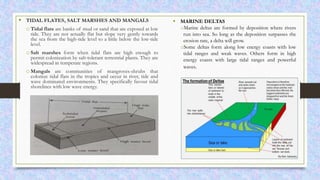
 BARRIER ISLANDS
oBarrier islands are a type of dune system that are
exceptionally flat or lumpy areas of sand that form
by wave and tidal action parallel to the mainland
coast.
o They are also called barrier beaches, barrier bars
and offshore bars.
oThey are subject to change during storms and
other actions but absorb energy and protect the
coastline.
 TIDAL FLATES, SALT MARSHES AND MANGALS
oTidal flats are banks of mud or sand that are exposed at low
tide. They are not actually flat but slope very gently towards
the sea from the high-tide level to a little below the low-tide
level.
oSalt marshes form when tidal flats are high enough to
permit colonization by salt-tolerant terrestrial plants. They are
widespread in temperate regions.
oMangals are communities of mangroves-shrubs that
colonize tidal flats in the tropics and occur in river, tide and
wave dominated environments. They specifically favour tidal
shorelines with low wave energy.
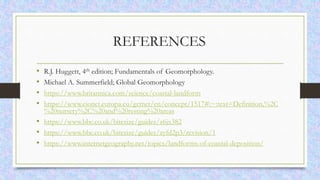
 MARINE DELTAS
oMarine deltas are formed by deposition where rivers
run into sea. So long as the deposition surpasses the
erosion rate, a delta will grow.
oSome deltas form along low energy coasts with low
tidal ranges and weak waves. Others form in high
energy coasts with large tidal ranges and powerful
waves.
CONCLUSION
• Coastal landforms, any of the relief features present along any coast, the result of a
combination of processes, sediments and the geology of the coast itself.
• The three processes mainly active which modify the coast and the coastal environments are
waves, tides and currents.
• Coastal processes can be divided into two as degradational processes and aggradational
processes.
• Some of the important coastal landforms that are formed due to degradational process are
cliff, headland, sea cave, sea arch, stack and stump.
• Some of the important coastal landforms that are formed due to aggradational process are
beach, berm, spits, tombolos, barrier islands, coastal sand dunes, marine deltas.
REFERENCES
• R.J. Huggett, 4th edition; Fundamentals of Geomorphology.
• Michael A. Summerfield; Global Geomorphology
• https://www.britannica.com/science/coastal-landform
• https://www.eionet.europa.eu/gemet/en/concept/1517#:~:text=Definition,%2C
%20nursery%2C%20and%20resting%20areas
• https://www.bbc.co.uk/bitesize/guides/z6jx382
• https://www.bbc.co.uk/bitesize/guides/zyfd2p3/revision/1
• https://www.internetgeography.net/topics/landforms-of-coastal-deposition/
COASTAL LANDFORMS.pptx

COASTAL LANDFORMS.pptx

  • 1.
    COASTAL LANDFORMS PRESENTED BY: GROUP-C S HRITHIKSINGHA ROCKTIM GOGOI QUEEN CHETIA SONIA GHOSH KUKI MONJORI BORUAH
  • 2.
    ACKNOWLEDGEMENT We would liketo express our special thanks of gratitude to our professor Dr. Ratan Das who gave us this golden opportunity to do this wonderful presentation on “COASTAL LANDFORMS”. We came to know about so many new things and we are really thankful to it. Lastly but not the least we would like to thank all our group members for their valuable advice and contributions in completion of this presentation.
  • 3.
    CONTENTS INTODUCTION COASTAL ENVIRONMENT WAVE TIDE CURRENT COASTAL PROCESSES DEGRADATIONALPROCESSES AGGRADATIONAL PROCESSES EROSIONAL FEATURES DEPOSITIONAL FEATURES CONCLUSION REFERENCES
  • 4.
    INTRODUCTION Coastal landforms, anyof the relief features present along any coast, the result of a combination of processes, sediments and the geology of the coast itself. The coastal environment of the world is made up of a wide variety of landforms manifested in a spectrum of sizes and shapes ranging from gently sloping beaches to high cliffs.
  • 5.
    What is Coastalenvironment? • Coasts are the areas where the land masses meet the seas. • This results in a special set of environments where the marine and terrestrial areas influence each other. • There are mainly three processes active which modify the coast and the coastal environments: oWaves oTides oCurrents
  • 6.
    WAVES • Waves aremost commonly caused by wind. • Waves move sand along the coast and onto beaches, where it is continuously recycled between surf zone sand bars and the beach dune system TIDES • The alternate rising and falling of sea, due to the attraction of the moon and the sun is known as tides. • Tide range dependent on relative position of earth, moon and sun. • The Spring Tides- highest tidal range • The Neap Tides – lowest tidal range
  • 7.
    CURRENTS • An oceancurrent is a continuous directed movement of sea water generated by wind coriolis effect, breaking waves, temperature and salinity differences. • It has limited impact on coastal landscape. • Some of the most important currents exists near the coast are: o Wave-driven currents, o Tidal currents, o Wind-driven currents, and o Bouyant plumes.
  • 8.
    COASTAL PROCESSES • Coastallandforms are fashioned by weathering, by sediment erosion and transport associated with wave action and tides, and by sediment deposition. • It can be distinguished into two processes: Degradational processes Aggradational processes
  • 9.
    . • Degradation occursmainly due to erosional activities of wind and water resulting in the transformation of a landform. Majorly two processes are prevalent namely :  Shoreline weathering Wave erosion. • Shoreline weathering o Weathering processes act upon shore environments by the given ways : o Chemical Weathering :  Direct chemical attack by seawater takes place on limestone coasts: solution of carbonate rocks occurs.  Salt weathering is an important process in shoreline weathering, being most effective where the coastal rocks are able to absorb seawater. 9 o Mechanical Weathering : Water-layer weathering is associated with the wetting and drying cycles by waves and spray.  As tides rise and fall, the zone between the low-water mark and the highest limit reached at high tide is wetted and dried periodically. o Biological Activity : Direct action of organisms take place on the rock resulting in bioerosion.  Tactics employed by organisms in the erosive process are chemical, mechanical, or a mixture of the two. DEGRADATIONAL PROCSSES
  • 10.
    • Wave erosion oWaveand tidal activities make coastlines a dynamic entity as they regularly modify the coastal features. oThe pounding of the coast by waves is an enormously powerful process of erosion(constructive or destructive). oCliffs and other structures plunge straight into deep water, waves do not break before they strike and cause little erosion. oUnconsolidated or loosely consolidated rocks(soft rocks) are the most susceptible to wave erosion. oStrong turbulent waves also pick up debris and throw it against the shore, causing abrasion of shoreline structures. o Tidal waves generated by the gravitational pull of the moon also contribute towards the erosion of the landforms in the coastal region. 10
  • 11.
     Some ofthe important coastal landforms that are formed due to degradational process are given below: o Cliff o Headland o Sea Cave o Sea Arch o Stack o Stump
  • 12.
    AGGRADATIONAL PROCESSES • Aggradationmeans adding the sediments and raising the level of the land. • Sediment transport oMaterial eroded by the sea is moved along the beaches. oLongshore drift Wave approaches beach at angle and sand moves in zigzag motion. The movement of sediment along the shoreline by longshore current. Longshore drift is maximal when waves strike the coast at around 30%. oBeach drift It is the movement of sediment on the beach. Backwash swash moves sand down the beach. Groins and other structures used to interrupt drift and stabilize.
  • 13.
    . . • Sediment deposition oSand deposits form where amount of rock moving towards shore is greater than amount moving away. o Very severe storm waves, storm surges and tsunamis may carry sediments from beyond the offshore zone. o Sediment deposited on exposed continental shelves and then submerged by rising sea levels has been carried landward. • Biological activity oSome marine organisms build and some help to build particular coastal landform. oA coral reef is an underground ecosystem characterized by reef building corals. The great barrier reef is world largest reef and cover about 2 million sq. km of tropical ocean. oSalt - tolerant plants colonize salt marshes. oMangrove are a big component of coastal tropical vegetation.
  • 14.
     Some ofthe important coastal landforms that are formed due to aggradational process are given below:  Beach  Berm  Spits  Tombolos  Barrier islands  Coastal sand dunes  Marine deltas.
  • 15.
    FACTORS AFFECTING EROSIONAL LANDFORMS 1.Abrasion - waves transport material which hit the cliff and gradually wear it away. 2. Hydraulic action - as waves approach the coast they trap air and force it into gaps in the cliff. Eventually this weakens the rock. 3. Attrition - waves cause the rocks to crash against each other, breaking them down into smaller and rounder pieces. 4. Corrosion (also known as solution) - salts and acids in seawater dissolve the rock gradually over thousands of years. In addition, changes in landforms can be a result of wind erosion, weathering and sub-aerial processes such as mass movement.
  • 16.
    Erosional landforms The processof erosion can create different landforms along the coastline :-  Headlands and bays Cliffs along the coastline do not erode at the same pace. When a stretch of coastline is formed from different types of rock, headlands and bays can form. Bands of soft rock such as clay and sand are weaker therefore they can be eroded quickly. This process forms bays. A bay is an inlet of the sea where the land curves inwards, usually with a beach. Hard rock such as chalk is more resistant to the processes of erosion. When the softer rock is eroded inwards, the hard rock sticks out into the sea, forming a headland. Erosional features such as wave-cut platforms and cliffs can be found on headlands, since they are more open to the waves. Bays are more sheltered with constructive waves which deposit sediment to form a beach
  • 17.
     Cliffs andwave-cut platforms oCliffs are shaped through erosion and weathering. oSoft rock erodes quickly and forms gentle sloping cliffs, whereas hard rock is more resistant and forms steep cliffs. o A wave-cut platform is a wide gently-sloping surface found at the foot of a cliff. o A WAVE-CUT PLATFORM IS FORMED WHEN THE FOLLOWING OCCURS: 1. The sea attacks the base of the cliff between the high and low water mark. 2. A wave-cut notch is formed by erosional processes such as abrasion and hydraulic action - this is a dent in the cliff usually at the level of high tide. 3. As the notch increases in size, the cliff becomes unstable and collapses, leading to the retreat of the cliff face. 4. The backwash carries away the eroded material, leaving a wave- cut platform. 5. The process repeats and the cliff continues to retreat.
  • 18.
     Caves, arches,stacks and stumps o Caves, arches, stacks and stumps are erosional features that are commonly found on a headland 1.Cracks are widened in the headland through the erosional processes of hydraulic action and abrasion. 2.As the waves continue to grind away at the crack, it begins to open up to form a cave. 3.The cave becomes larger and eventually breaks through the headland to form an arch. 4.The base of the arch continually becomes wider through further erosion, until its roof becomes too heavy and collapses into the sea. This leaves a stack (an isolated column of rock). 5.The stack is undercut at the base until it collapses to form a stump
  • 19.
    COASTAL DEPOSITIONAL LANDFORMS BEACHES oSea beach is the area along shoreline, resulted from the wave actions, usually consists of well sorted sands, gravels, mud, pebble, shells of marine organisms, corals, algae etc. accumulated from the accretional activities of sea waves. oBeach sediments are derived from wave and wind erosion of the headland, fluvial or estuarine sediments etc. oSand beaches are prevalent along tropical coast, probably because rivers carry predominantly fine sediments and cliff erosion donates little to littoral deposits in the tropics.  Drainage channels, tributaries, stream etc. supplies immense quantities of sediments to the sea. However, sea water itself captures the sediments derived from the coastal erosional processes. Some of the important depositional landforms resulted from coastal activities are mentioned below:  BERM oIt is an area occurs along the shoreline between sea and back beach, long narrow wedge of sand, gravels and beach sediments, steep slope facing the sea and gentle slope towards back beach. oIt is a depositional feature, appears after storm surge.
  • 20.
     SPITS oIt isan extended stretch of beach material that sticks out to sea and joined to the mainland at one end. oLongshore drift moves material along a coastline. Where the coastline changes direction or the power of the waves reduced and the transported material is deposited. oLongshore drift moves material along the coastline and gradually the spit grows and sometimes develop a hook at tip portion. oA spit is an unstable landform.  TOMBOLO oIt is a small gravels or sands mound or island connected with narrow seaward extension from coast or mainland. oTombolos are formed from the refraction of sea waves which causes longshore currents of opposite direction to converge in a zone where sediments are accumulated and creates a tombolo. oTwo or more tombolos connected in a series called as tombolo cluster.
  • 21.
     COASTAL SANDDUNES oSand dunes are small ridges or hills of sand found at the top of a beach, above the reach of the waves. oOnshore winds cause the formation of sand dunes at the back of a beach. oThey are made from sediment blown off a beach to accumulate in areas sheltered from the action of waves and currents. oForedune, the first dune formed behind the beach is a prominent feature resulting from the interaction of nearshore processes, wind, sediments and vegetation.  BARRIER ISLANDS oBarrier islands are a type of dune system that are exceptionally flat or lumpy areas of sand that form by wave and tidal action parallel to the mainland coast. o They are also called barrier beaches, barrier bars and offshore bars. oThey are subject to change during storms and other actions but absorb energy and protect the coastline.
  • 22.
     TIDAL FLATES,SALT MARSHES AND MANGALS oTidal flats are banks of mud or sand that are exposed at low tide. They are not actually flat but slope very gently towards the sea from the high-tide level to a little below the low-tide level. oSalt marshes form when tidal flats are high enough to permit colonization by salt-tolerant terrestrial plants. They are widespread in temperate regions. oMangals are communities of mangroves-shrubs that colonize tidal flats in the tropics and occur in river, tide and wave dominated environments. They specifically favour tidal shorelines with low wave energy.  MARINE DELTAS oMarine deltas are formed by deposition where rivers run into sea. So long as the deposition surpasses the erosion rate, a delta will grow. oSome deltas form along low energy coasts with low tidal ranges and weak waves. Others form in high energy coasts with large tidal ranges and powerful waves.
  • 23.
    CONCLUSION • Coastal landforms,any of the relief features present along any coast, the result of a combination of processes, sediments and the geology of the coast itself. • The three processes mainly active which modify the coast and the coastal environments are waves, tides and currents. • Coastal processes can be divided into two as degradational processes and aggradational processes. • Some of the important coastal landforms that are formed due to degradational process are cliff, headland, sea cave, sea arch, stack and stump. • Some of the important coastal landforms that are formed due to aggradational process are beach, berm, spits, tombolos, barrier islands, coastal sand dunes, marine deltas.
  • 24.
    REFERENCES • R.J. Huggett,4th edition; Fundamentals of Geomorphology. • Michael A. Summerfield; Global Geomorphology • https://www.britannica.com/science/coastal-landform • https://www.eionet.europa.eu/gemet/en/concept/1517#:~:text=Definition,%2C %20nursery%2C%20and%20resting%20areas • https://www.bbc.co.uk/bitesize/guides/z6jx382 • https://www.bbc.co.uk/bitesize/guides/zyfd2p3/revision/1 • https://www.internetgeography.net/topics/landforms-of-coastal-deposition/