Grade 12
Geomorphology guide 2022
Written by:
BRYAN SHINGANGE
Geomorphology
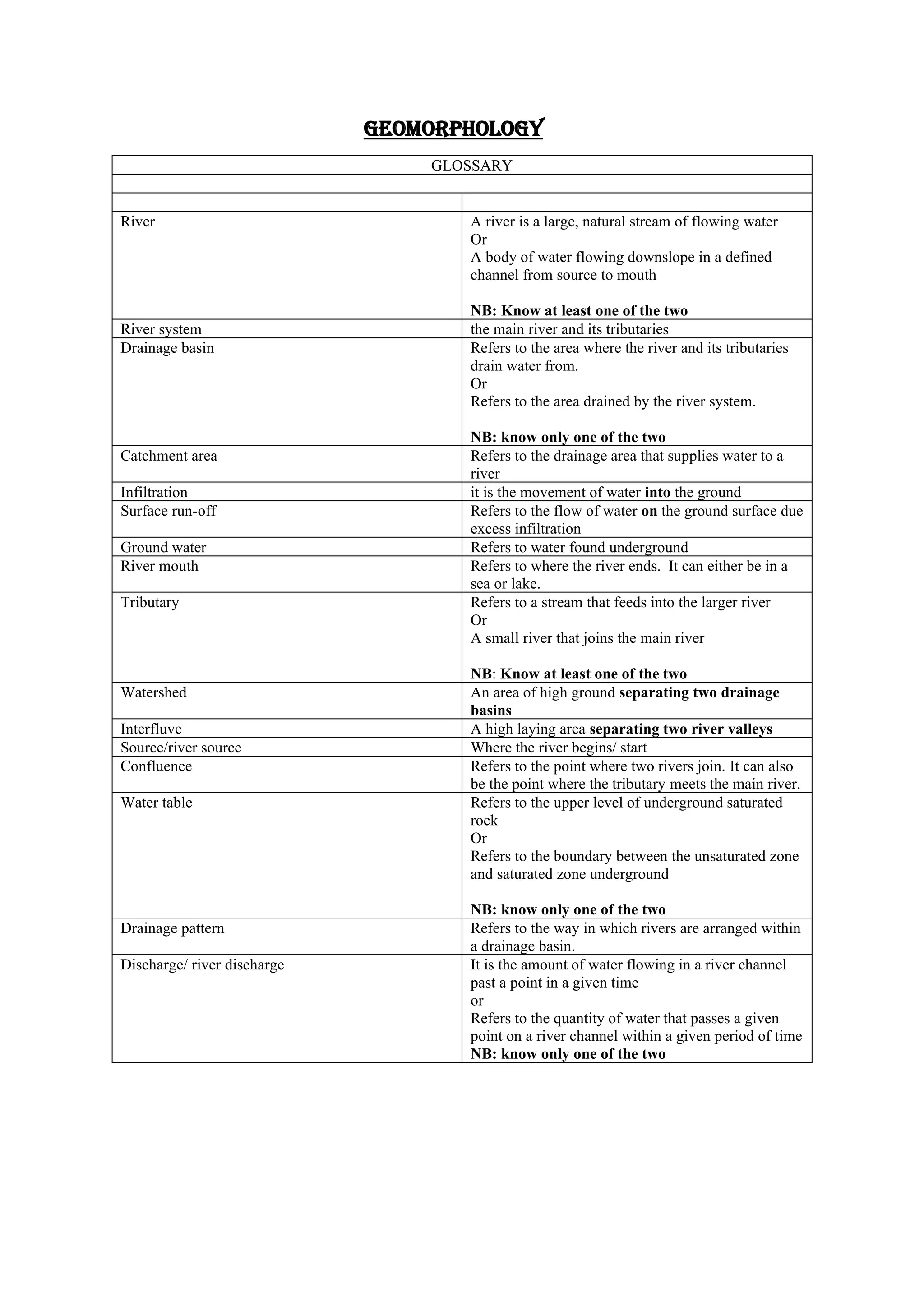
GLOSSARY
River A river is a large, natural stream of flowing water
Or
A body of water flowing downslope in a defined
channel from source to mouth
NB: Know at least one of the two
River system the main river and its tributaries
Drainage basin Refers to the area where the river and its tributaries
drain water from.
Or
Refers to the area drained by the river system.
NB: know only one of the two
Catchment area Refers to the drainage area that supplies water to a
river
Infiltration it is the movement of water into the ground
Surface run-off Refers to the flow of water on the ground surface due
excess infiltration
Ground water Refers to water found underground
River mouth Refers to where the river ends. It can either be in a
sea or lake.
Tributary Refers to a stream that feeds into the larger river
Or
A small river that joins the main river
NB: Know at least one of the two
Watershed An area of high ground separating two drainage
basins
Interfluve A high laying area separating two river valleys
Source/river source Where the river begins/ start
Confluence Refers to the point where two rivers join. It can also
be the point where the tributary meets the main river.
Water table Refers to the upper level of underground saturated
rock
Or
Refers to the boundary between the unsaturated zone
and saturated zone underground
NB: know only one of the two
Drainage pattern Refers to the way in which rivers are arranged within
a drainage basin.
Discharge/ river discharge It is the amount of water flowing in a river channel
past a point in a given time
or
Refers to the quantity of water that passes a given
point on a river channel within a given period of time
NB: know only one of the two
Geomorphology
➢ Geomorphology is the study of the physical processes and surface features of the
Earth
What happens to the precipitation that falls within a drainage basin?
➢ The drainage basin is an open system, of inputs, stores, flows and output
➢ The drainage basin collects precipitation and allows water to seep into the ground
through the process of infiltration to become underground water. water is stored in
lakes in drainage basins.
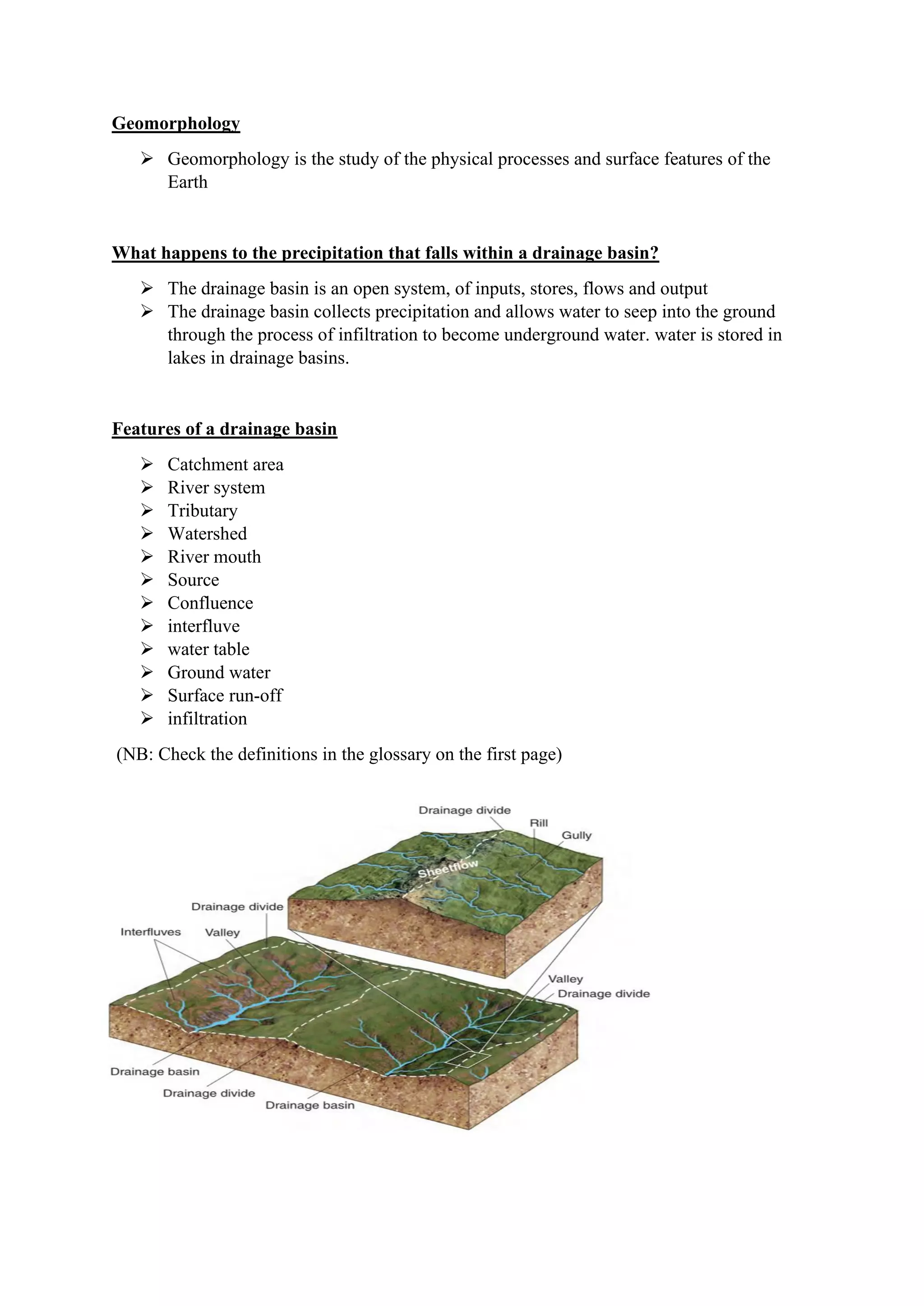
Features of a drainage basin
➢ Catchment area
➢ River system
➢ Tributary
➢ Watershed
➢ River mouth
➢ Source
➢ Confluence
➢ interfluve
➢ water table
➢ Ground water
➢ Surface run-off
➢ infiltration
(NB: Check the definitions in the glossary on the first page)
Important watersheds in South Africa
Drakensberg mountains—separates rivers that separates the rivers flowing to the eastern
plateau slopes and the orange river system
Witwatersrand—Separates the Limpopo River system and the Vaal River system
Types of Rivers
We have four river types namely:
➢ Permanent river
➢ Periodic river
➢ Episodic river
➢ Exotic river
Description of the rivers
- Permanent river—this river touches/intersects the water table, so it flows all year
round. For example, Tugela River
- Periodic river—these type of rivers flows only during the rainy season and the
sometimes run dry. For example, Vaal River and Palmiet River.
- Episodic river—kind of river that flow after heavy rain. This river type often flows
for hours to few days. E.g., Molopo river
- Exotic river—river that begins in a high rainfall regions and flow into dry regions/
area. Such as Orange River.
Drainage patterns
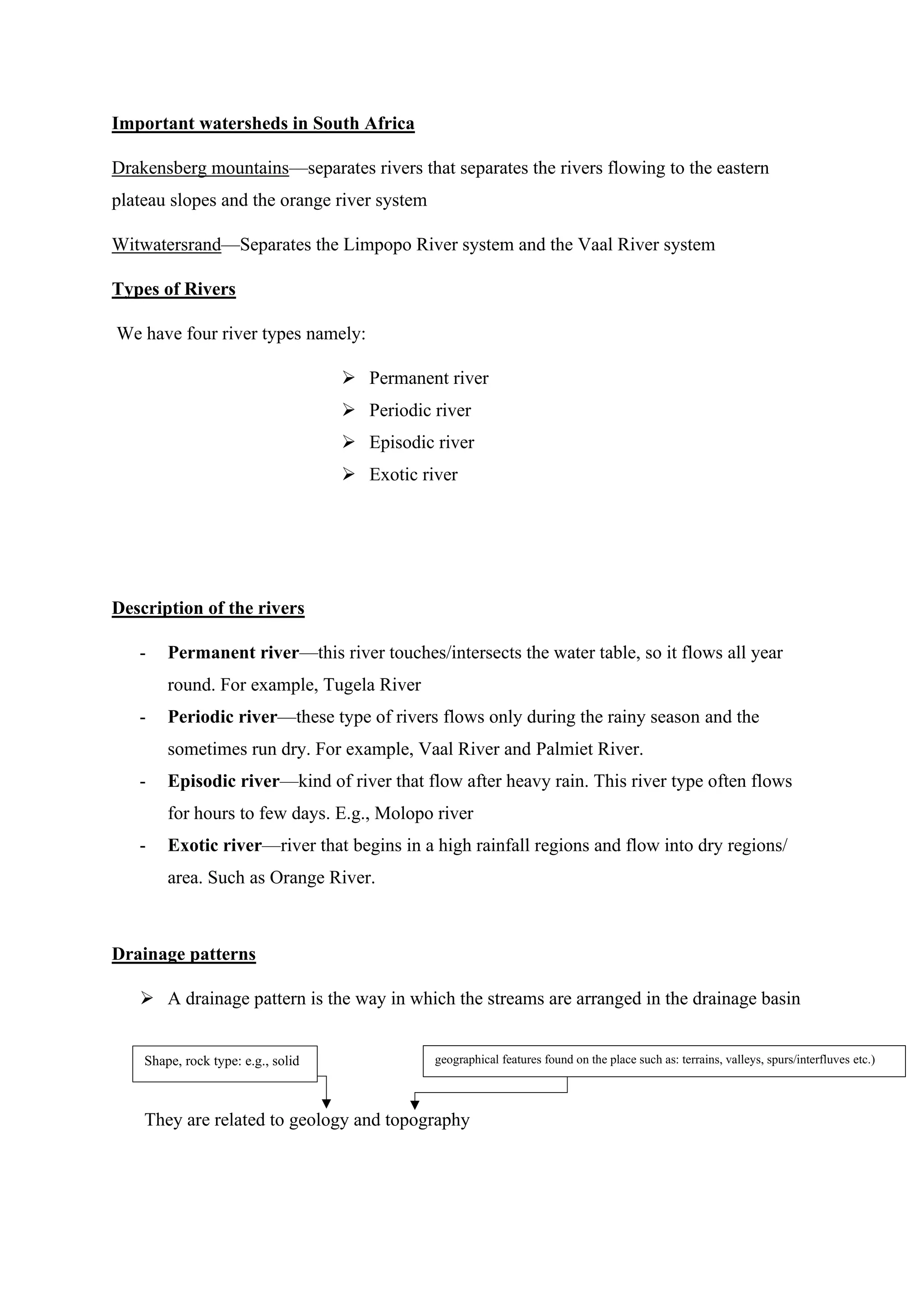
➢ A drainage pattern is the way in which the streams are arranged in the drainage basin
They are related to geology and topography
geographical features found on the place such as: terrains, valleys, spurs/interfluves etc.)
Shape, rock type: e.g., solid
roc
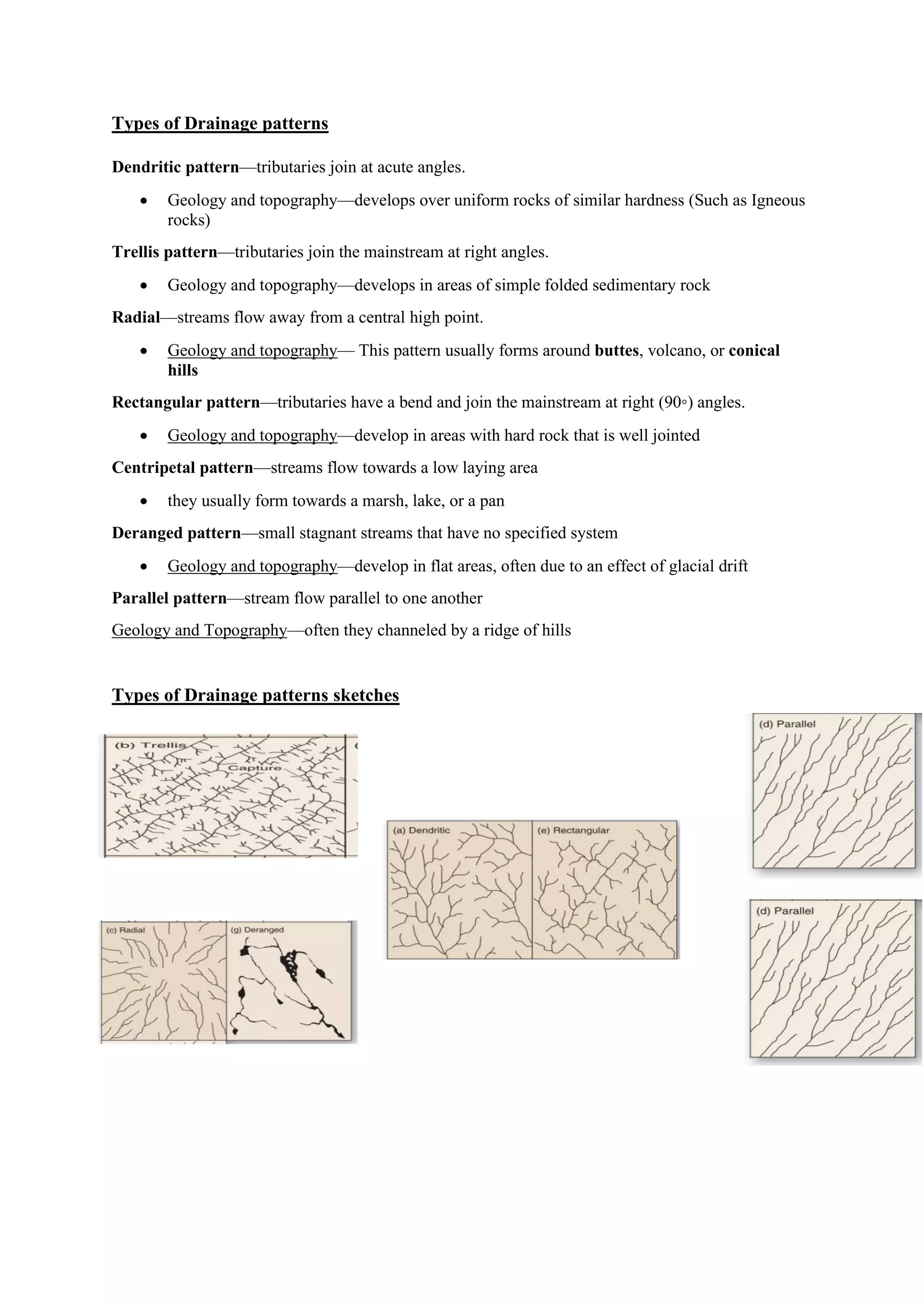
Types of Drainage patterns
Dendritic pattern—tributaries join at acute angles.
• Geology and topography—develops over uniform rocks of similar hardness (Such as Igneous
rocks)
Trellis pattern—tributaries join the mainstream at right angles.
• Geology and topography—develops in areas of simple folded sedimentary rock
Radial—streams flow away from a central high point.
• Geology and topography— This pattern usually forms around buttes, volcano, or conical
hills
Rectangular pattern—tributaries have a bend and join the mainstream at right (90⸰) angles.
• Geology and topography—develop in areas with hard rock that is well jointed
Centripetal pattern—streams flow towards a low laying area
• they usually form towards a marsh, lake, or a pan
Deranged pattern—small stagnant streams that have no specified system
• Geology and topography—develop in flat areas, often due to an effect of glacial drift
Parallel pattern—stream flow parallel to one another
Geology and Topography—often they channeled by a ridge of hills
Types of Drainage patterns sketches
Drainage density
➢ Drainage density is the total length of streams per unit area of a drainage basin
Factors that influence drainage density
- evaporation rates
- amount of rainfall
- amount of infiltration
- the hardness of the rock underneath the drainage basin area
- gradient
- soil type
- rock type
- vegetation
- human activities
Discharge of a river
factors that influence discharge
- gradient
- soil type
- rock type
- vegetation
- human activities
Two main Types of flow
laminar flow—flow of water in sheets without changing levels.
- usually occur when the riverbed is even/ smooth/ having a sandy riverbed.
turbulent flow—flow of water on bubbling motion.
- it usually occurs when the riverbed is uneven/ or having a change in levels/ riverbed having
rocks.
Fluvial processes
We have two River profiles namely: Longitudinal profile and Transverse profile
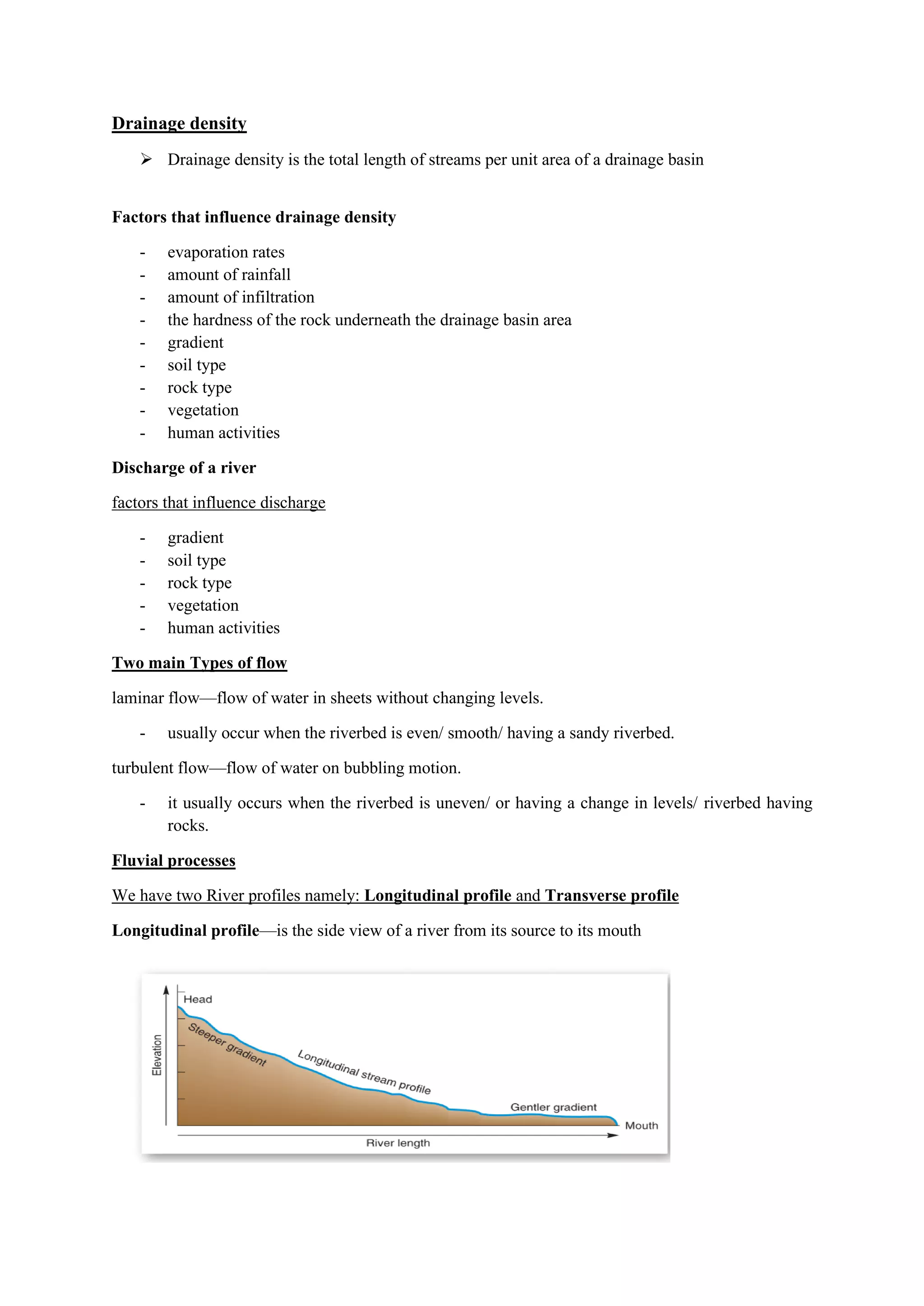
Longitudinal profile—is the side view of a river from its source to its mouth
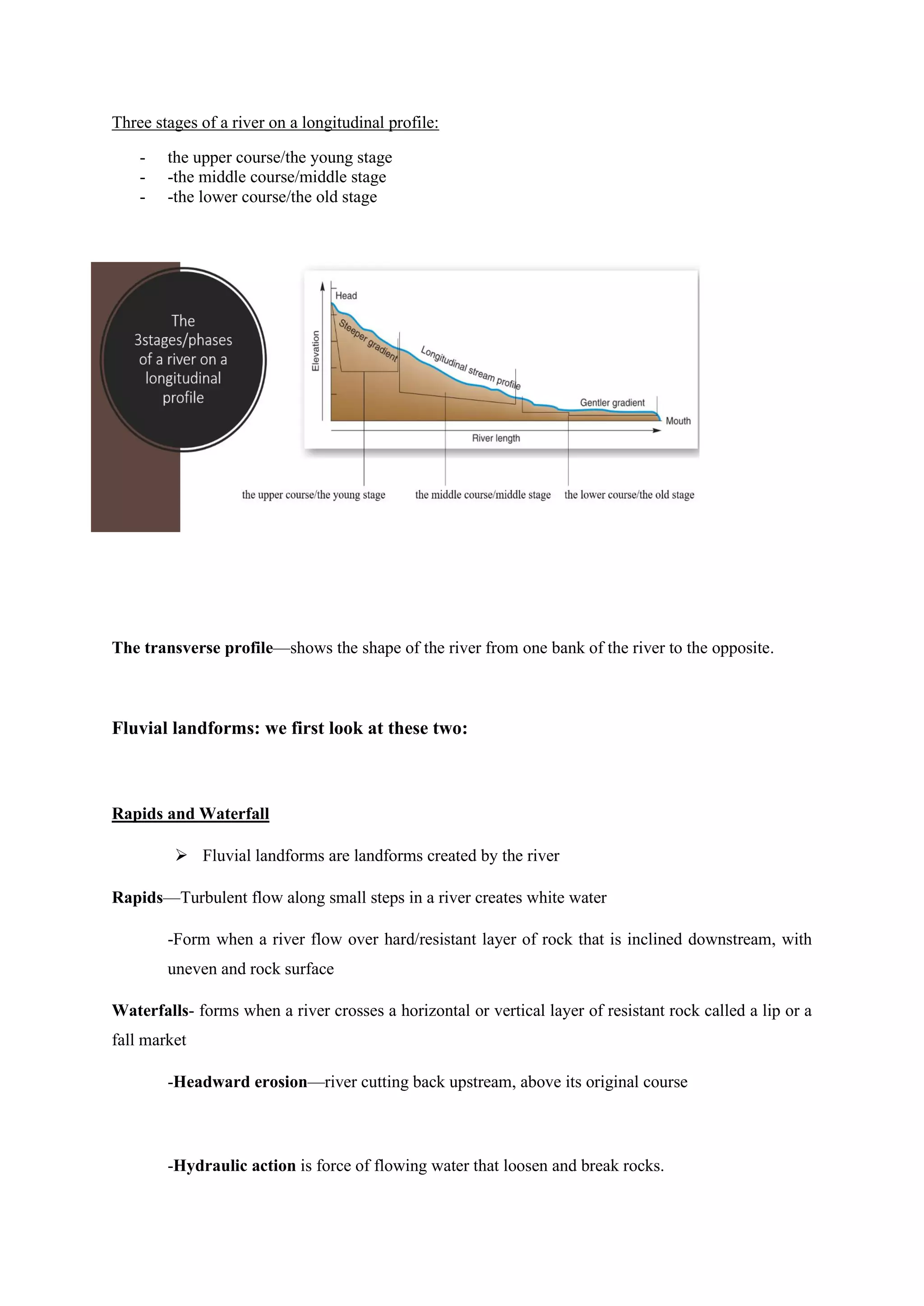
Three stages of a river on a longitudinal profile:
- the upper course/the young stage
- -the middle course/middle stage
- -the lower course/the old stage
The transverse profile—shows the shape of the river from one bank of the river to the opposite.
Fluvial landforms: we first look at these two:
Rapids and Waterfall
➢ Fluvial landforms are landforms created by the river
Rapids—Turbulent flow along small steps in a river creates white water
-Form when a river flow over hard/resistant layer of rock that is inclined downstream, with
uneven and rock surface
Waterfalls- forms when a river crosses a horizontal or vertical layer of resistant rock called a lip or a
fall market
-Headward erosion—river cutting back upstream, above its original course
-Hydraulic action is force of flowing water that loosen and break rocks.
- this is the chief erosion process. (Chief process in this case mean that it is the main
form of erosion that occurs in the fluvial processes)
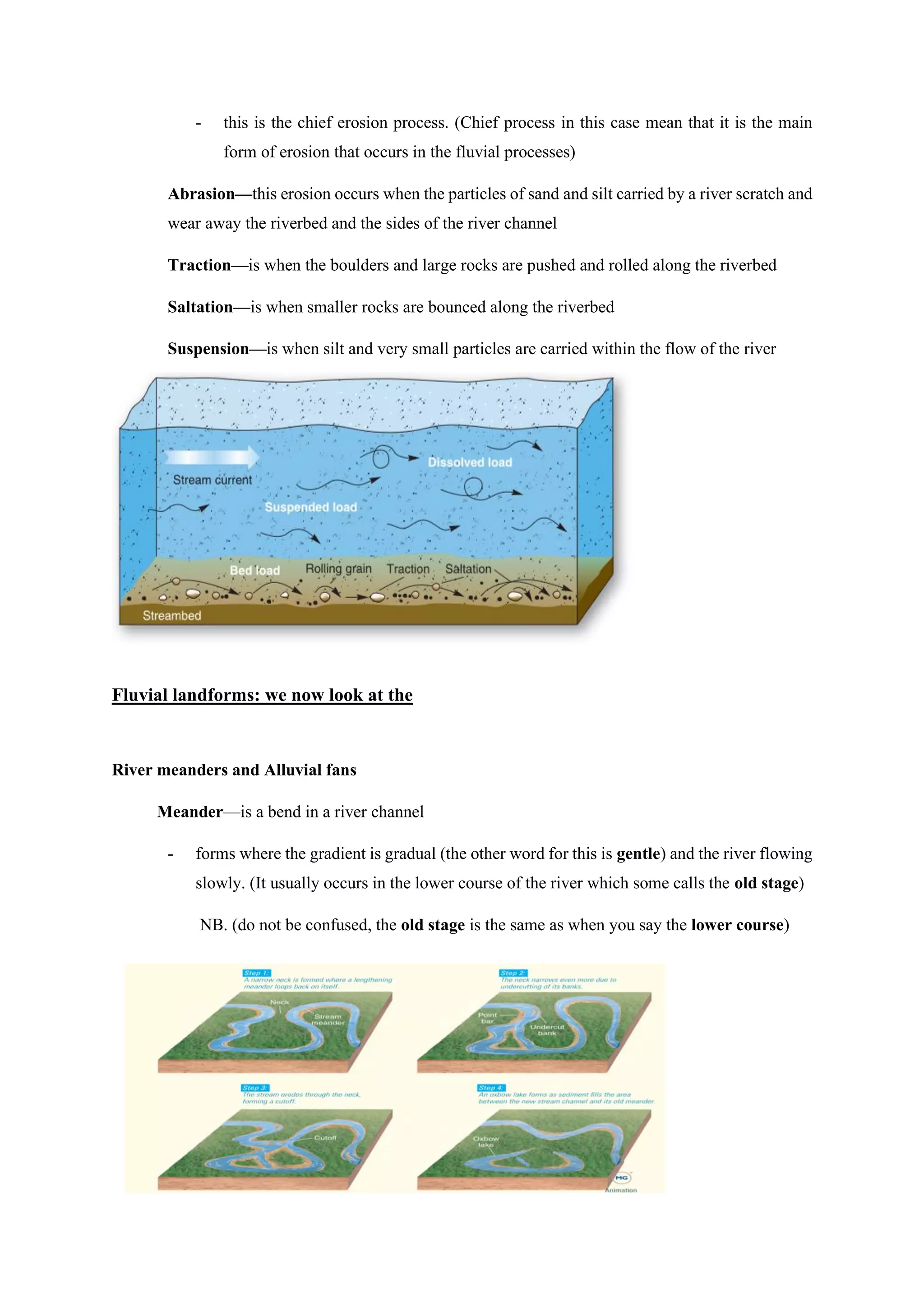
Abrasion—this erosion occurs when the particles of sand and silt carried by a river scratch and
wear away the riverbed and the sides of the river channel
Traction—is when the boulders and large rocks are pushed and rolled along the riverbed
Saltation—is when smaller rocks are bounced along the riverbed
Suspension—is when silt and very small particles are carried within the flow of the river
Fluvial landforms: we now look at the
River meanders and Alluvial fans
Meander—is a bend in a river channel
- forms where the gradient is gradual (the other word for this is gentle) and the river flowing
slowly. (It usually occurs in the lower course of the river which some calls the old stage)
NB. (do not be confused, the old stage is the same as when you say the lower course)
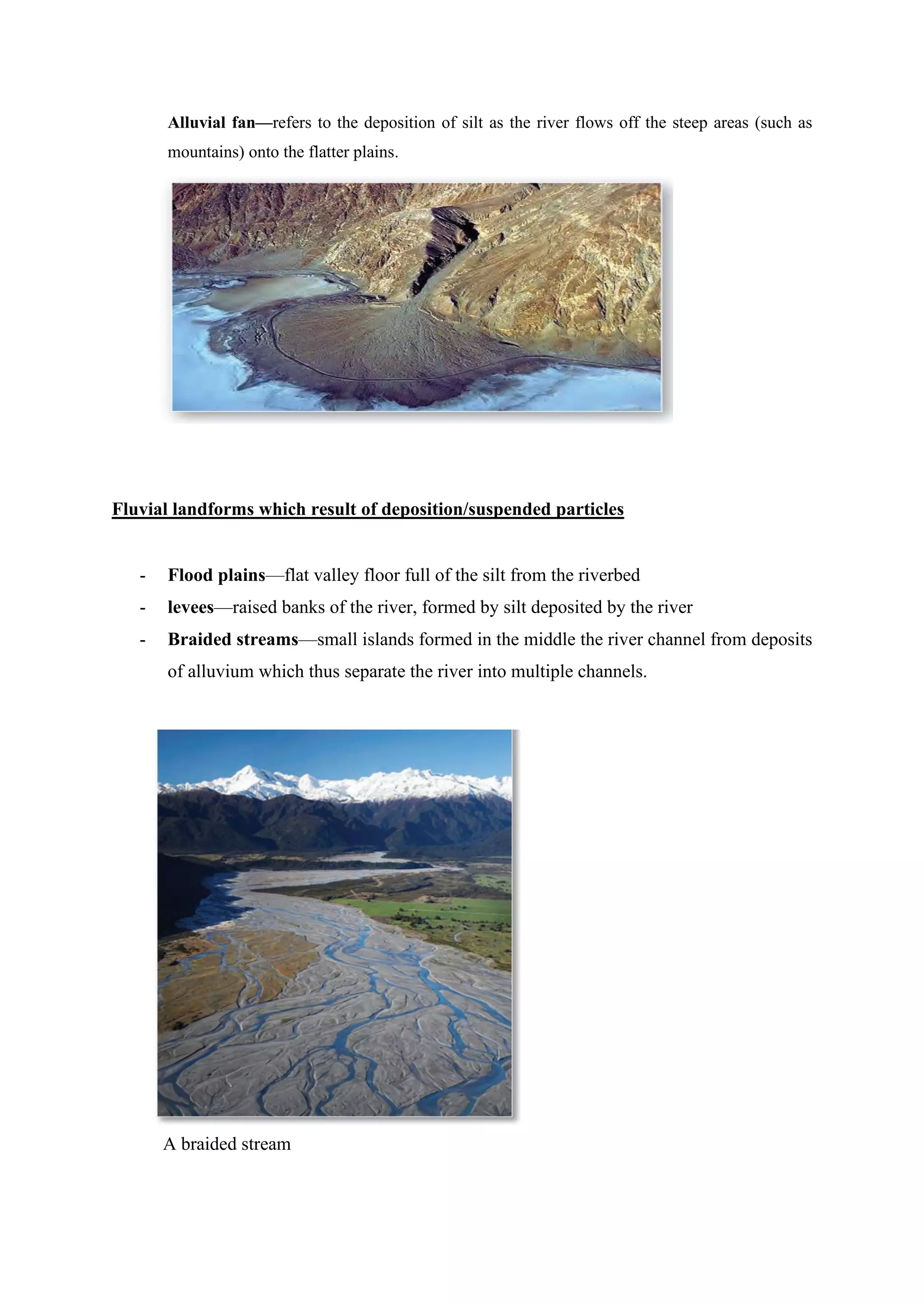
Alluvial fan—refers to the deposition of silt as the river flows off the steep areas (such as
mountains) onto the flatter plains.
Fluvial landforms which result of deposition/suspended particles
- Flood plains—flat valley floor full of the silt from the riverbed
- levees—raised banks of the river, formed by silt deposited by the river
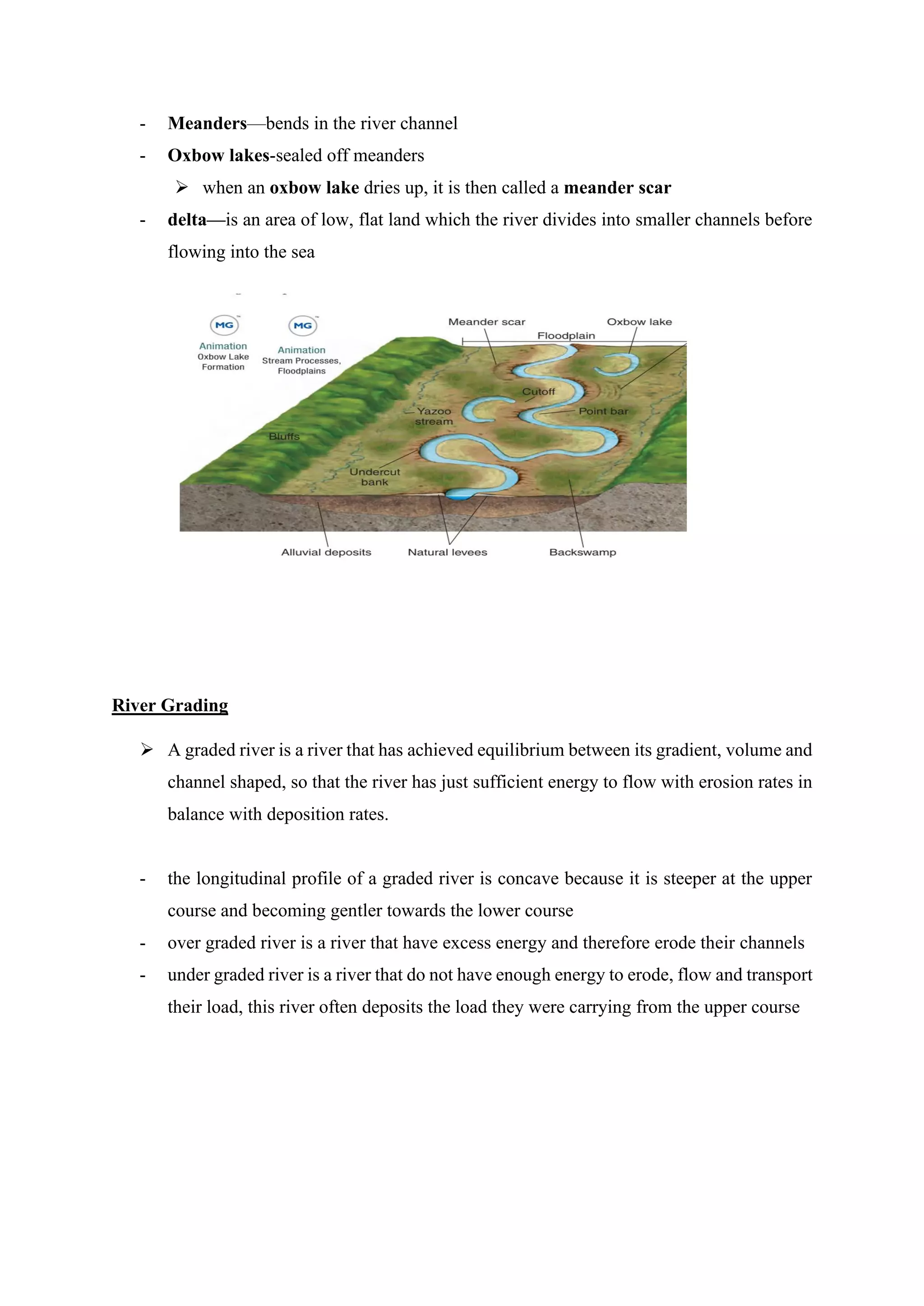
- Braided streams—small islands formed in the middle the river channel from deposits
of alluvium which thus separate the river into multiple channels.
A braided stream
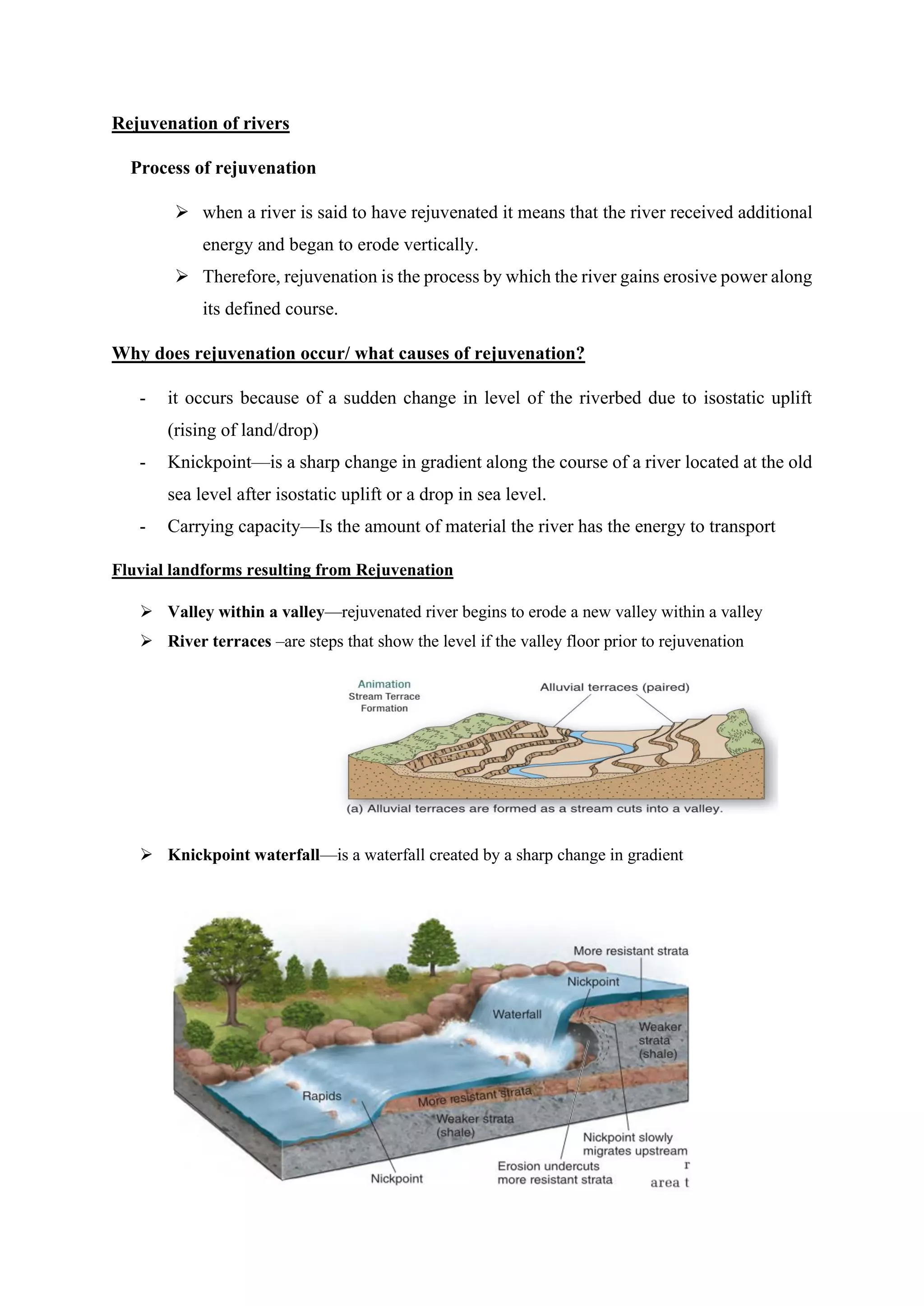
- Meanders—bends in the river channel
- Oxbow lakes-sealed off meanders
➢ when an oxbow lake dries up, it is then called a meander scar
- delta—is an area of low, flat land which the river divides into smaller channels before
flowing into the sea
River Grading
➢ A graded river is a river that has achieved equilibrium between its gradient, volume and
channel shaped, so that the river has just sufficient energy to flow with erosion rates in
balance with deposition rates.
- the longitudinal profile of a graded river is concave because it is steeper at the upper
course and becoming gentler towards the lower course
- over graded river is a river that have excess energy and therefore erode their channels
- under graded river is a river that do not have enough energy to erode, flow and transport
their load, this river often deposits the load they were carrying from the upper course
Rejuvenation of rivers
Process of rejuvenation
➢ when a river is said to have rejuvenated it means that the river received additional
energy and began to erode vertically.
➢ Therefore, rejuvenation is the process by which the river gains erosive power along
its defined course.
Why does rejuvenation occur/ what causes of rejuvenation?
- it occurs because of a sudden change in level of the riverbed due to isostatic uplift
(rising of land/drop)
- Knickpoint—is a sharp change in gradient along the course of a river located at the old
sea level after isostatic uplift or a drop in sea level.
- Carrying capacity—Is the amount of material the river has the energy to transport
Fluvial landforms resulting from Rejuvenation
➢ Valley within a valley—rejuvenated river begins to erode a new valley within a valley
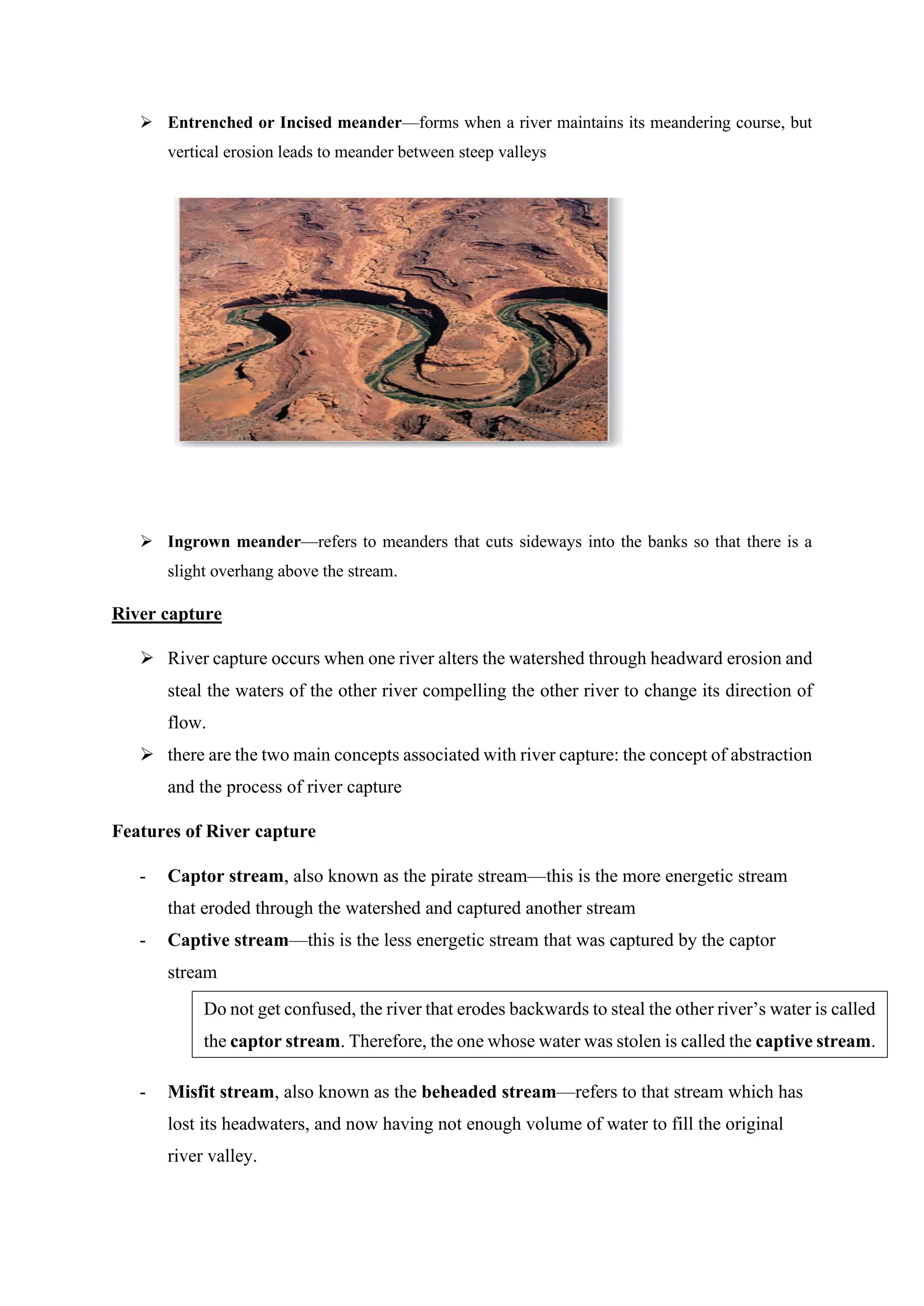
➢ River terraces –are steps that show the level if the valley floor prior to rejuvenation
➢ Knickpoint waterfall—is a waterfall created by a sharp change in gradient
➢ Entrenched or Incised meander—forms when a river maintains its meandering course, but
vertical erosion leads to meander between steep valleys
➢ Ingrown meander—refers to meanders that cuts sideways into the banks so that there is a
slight overhang above the stream.
River capture
➢ River capture occurs when one river alters the watershed through headward erosion and
steal the waters of the other river compelling the other river to change its direction of
flow.
➢ there are the two main concepts associated with river capture: the concept of abstraction
and the process of river capture
Features of River capture
- Captor stream, also known as the pirate stream—this is the more energetic stream
that eroded through the watershed and captured another stream
- Captive stream—this is the less energetic stream that was captured by the captor
stream
- Misfit stream, also known as the beheaded stream—refers to that stream which has
lost its headwaters, and now having not enough volume of water to fill the original
river valley.
Do not get confused, the river that erodes backwards to steal the other river’s water is called
the captor stream. Therefore, the one whose water was stolen is called the captive stream.
- Elbow of Capture –this is a point where the capture occurred, here the captive stream
changes direction and flow into the captor stream
- Wind gap—this refers to the part found between the elbow and the misfit stream that
is now dry and filled with rocks.
Abstraction
➢ Abstraction is the process whereby the watershed becomes lower and its position
shift. Normally happens due to the difference in gradient on each of the side of the
watershed
Results of capture (Kindly refer to your textbook.)
NB: This was part of the original river valley of the captive stream before capture.

Grade 12 notes (Geomorphology) .pdf

  • 1.
    Grade 12 Geomorphology guide2022 Written by: BRYAN SHINGANGE
  • 2.
    Geomorphology GLOSSARY River A riveris a large, natural stream of flowing water Or A body of water flowing downslope in a defined channel from source to mouth NB: Know at least one of the two River system the main river and its tributaries Drainage basin Refers to the area where the river and its tributaries drain water from. Or Refers to the area drained by the river system. NB: know only one of the two Catchment area Refers to the drainage area that supplies water to a river Infiltration it is the movement of water into the ground Surface run-off Refers to the flow of water on the ground surface due excess infiltration Ground water Refers to water found underground River mouth Refers to where the river ends. It can either be in a sea or lake. Tributary Refers to a stream that feeds into the larger river Or A small river that joins the main river NB: Know at least one of the two Watershed An area of high ground separating two drainage basins Interfluve A high laying area separating two river valleys Source/river source Where the river begins/ start Confluence Refers to the point where two rivers join. It can also be the point where the tributary meets the main river. Water table Refers to the upper level of underground saturated rock Or Refers to the boundary between the unsaturated zone and saturated zone underground NB: know only one of the two Drainage pattern Refers to the way in which rivers are arranged within a drainage basin. Discharge/ river discharge It is the amount of water flowing in a river channel past a point in a given time or Refers to the quantity of water that passes a given point on a river channel within a given period of time NB: know only one of the two
  • 3.
    Geomorphology ➢ Geomorphology isthe study of the physical processes and surface features of the Earth What happens to the precipitation that falls within a drainage basin? ➢ The drainage basin is an open system, of inputs, stores, flows and output ➢ The drainage basin collects precipitation and allows water to seep into the ground through the process of infiltration to become underground water. water is stored in lakes in drainage basins. Features of a drainage basin ➢ Catchment area ➢ River system ➢ Tributary ➢ Watershed ➢ River mouth ➢ Source ➢ Confluence ➢ interfluve ➢ water table ➢ Ground water ➢ Surface run-off ➢ infiltration (NB: Check the definitions in the glossary on the first page)
  • 4.
    Important watersheds inSouth Africa Drakensberg mountains—separates rivers that separates the rivers flowing to the eastern plateau slopes and the orange river system Witwatersrand—Separates the Limpopo River system and the Vaal River system Types of Rivers We have four river types namely: ➢ Permanent river ➢ Periodic river ➢ Episodic river ➢ Exotic river Description of the rivers - Permanent river—this river touches/intersects the water table, so it flows all year round. For example, Tugela River - Periodic river—these type of rivers flows only during the rainy season and the sometimes run dry. For example, Vaal River and Palmiet River. - Episodic river—kind of river that flow after heavy rain. This river type often flows for hours to few days. E.g., Molopo river - Exotic river—river that begins in a high rainfall regions and flow into dry regions/ area. Such as Orange River. Drainage patterns ➢ A drainage pattern is the way in which the streams are arranged in the drainage basin They are related to geology and topography geographical features found on the place such as: terrains, valleys, spurs/interfluves etc.) Shape, rock type: e.g., solid roc
  • 5.
    Types of Drainagepatterns Dendritic pattern—tributaries join at acute angles. • Geology and topography—develops over uniform rocks of similar hardness (Such as Igneous rocks) Trellis pattern—tributaries join the mainstream at right angles. • Geology and topography—develops in areas of simple folded sedimentary rock Radial—streams flow away from a central high point. • Geology and topography— This pattern usually forms around buttes, volcano, or conical hills Rectangular pattern—tributaries have a bend and join the mainstream at right (90⸰) angles. • Geology and topography—develop in areas with hard rock that is well jointed Centripetal pattern—streams flow towards a low laying area • they usually form towards a marsh, lake, or a pan Deranged pattern—small stagnant streams that have no specified system • Geology and topography—develop in flat areas, often due to an effect of glacial drift Parallel pattern—stream flow parallel to one another Geology and Topography—often they channeled by a ridge of hills Types of Drainage patterns sketches
  • 6.
    Drainage density ➢ Drainagedensity is the total length of streams per unit area of a drainage basin Factors that influence drainage density - evaporation rates - amount of rainfall - amount of infiltration - the hardness of the rock underneath the drainage basin area - gradient - soil type - rock type - vegetation - human activities Discharge of a river factors that influence discharge - gradient - soil type - rock type - vegetation - human activities Two main Types of flow laminar flow—flow of water in sheets without changing levels. - usually occur when the riverbed is even/ smooth/ having a sandy riverbed. turbulent flow—flow of water on bubbling motion. - it usually occurs when the riverbed is uneven/ or having a change in levels/ riverbed having rocks. Fluvial processes We have two River profiles namely: Longitudinal profile and Transverse profile Longitudinal profile—is the side view of a river from its source to its mouth
  • 7.
    Three stages ofa river on a longitudinal profile: - the upper course/the young stage - -the middle course/middle stage - -the lower course/the old stage The transverse profile—shows the shape of the river from one bank of the river to the opposite. Fluvial landforms: we first look at these two: Rapids and Waterfall ➢ Fluvial landforms are landforms created by the river Rapids—Turbulent flow along small steps in a river creates white water -Form when a river flow over hard/resistant layer of rock that is inclined downstream, with uneven and rock surface Waterfalls- forms when a river crosses a horizontal or vertical layer of resistant rock called a lip or a fall market -Headward erosion—river cutting back upstream, above its original course -Hydraulic action is force of flowing water that loosen and break rocks.
  • 8.
    - this isthe chief erosion process. (Chief process in this case mean that it is the main form of erosion that occurs in the fluvial processes) Abrasion—this erosion occurs when the particles of sand and silt carried by a river scratch and wear away the riverbed and the sides of the river channel Traction—is when the boulders and large rocks are pushed and rolled along the riverbed Saltation—is when smaller rocks are bounced along the riverbed Suspension—is when silt and very small particles are carried within the flow of the river Fluvial landforms: we now look at the River meanders and Alluvial fans Meander—is a bend in a river channel - forms where the gradient is gradual (the other word for this is gentle) and the river flowing slowly. (It usually occurs in the lower course of the river which some calls the old stage) NB. (do not be confused, the old stage is the same as when you say the lower course)
  • 9.
    Alluvial fan—refers tothe deposition of silt as the river flows off the steep areas (such as mountains) onto the flatter plains. Fluvial landforms which result of deposition/suspended particles - Flood plains—flat valley floor full of the silt from the riverbed - levees—raised banks of the river, formed by silt deposited by the river - Braided streams—small islands formed in the middle the river channel from deposits of alluvium which thus separate the river into multiple channels. A braided stream
  • 10.
    - Meanders—bends inthe river channel - Oxbow lakes-sealed off meanders ➢ when an oxbow lake dries up, it is then called a meander scar - delta—is an area of low, flat land which the river divides into smaller channels before flowing into the sea River Grading ➢ A graded river is a river that has achieved equilibrium between its gradient, volume and channel shaped, so that the river has just sufficient energy to flow with erosion rates in balance with deposition rates. - the longitudinal profile of a graded river is concave because it is steeper at the upper course and becoming gentler towards the lower course - over graded river is a river that have excess energy and therefore erode their channels - under graded river is a river that do not have enough energy to erode, flow and transport their load, this river often deposits the load they were carrying from the upper course
  • 11.
    Rejuvenation of rivers Processof rejuvenation ➢ when a river is said to have rejuvenated it means that the river received additional energy and began to erode vertically. ➢ Therefore, rejuvenation is the process by which the river gains erosive power along its defined course. Why does rejuvenation occur/ what causes of rejuvenation? - it occurs because of a sudden change in level of the riverbed due to isostatic uplift (rising of land/drop) - Knickpoint—is a sharp change in gradient along the course of a river located at the old sea level after isostatic uplift or a drop in sea level. - Carrying capacity—Is the amount of material the river has the energy to transport Fluvial landforms resulting from Rejuvenation ➢ Valley within a valley—rejuvenated river begins to erode a new valley within a valley ➢ River terraces –are steps that show the level if the valley floor prior to rejuvenation ➢ Knickpoint waterfall—is a waterfall created by a sharp change in gradient
  • 12.
    ➢ Entrenched orIncised meander—forms when a river maintains its meandering course, but vertical erosion leads to meander between steep valleys ➢ Ingrown meander—refers to meanders that cuts sideways into the banks so that there is a slight overhang above the stream. River capture ➢ River capture occurs when one river alters the watershed through headward erosion and steal the waters of the other river compelling the other river to change its direction of flow. ➢ there are the two main concepts associated with river capture: the concept of abstraction and the process of river capture Features of River capture - Captor stream, also known as the pirate stream—this is the more energetic stream that eroded through the watershed and captured another stream - Captive stream—this is the less energetic stream that was captured by the captor stream - Misfit stream, also known as the beheaded stream—refers to that stream which has lost its headwaters, and now having not enough volume of water to fill the original river valley. Do not get confused, the river that erodes backwards to steal the other river’s water is called the captor stream. Therefore, the one whose water was stolen is called the captive stream.
  • 13.
    - Elbow ofCapture –this is a point where the capture occurred, here the captive stream changes direction and flow into the captor stream - Wind gap—this refers to the part found between the elbow and the misfit stream that is now dry and filled with rocks. Abstraction ➢ Abstraction is the process whereby the watershed becomes lower and its position shift. Normally happens due to the difference in gradient on each of the side of the watershed Results of capture (Kindly refer to your textbook.) NB: This was part of the original river valley of the captive stream before capture.