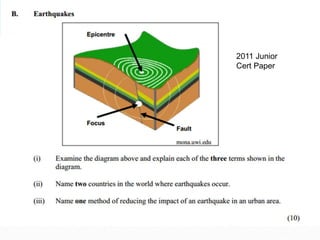

2011 Junior
Cert Paper
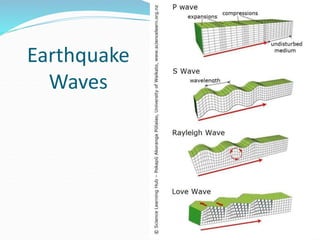
Earthquake
Waves
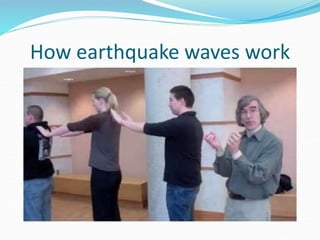
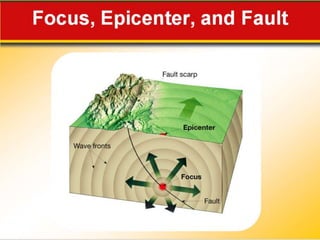
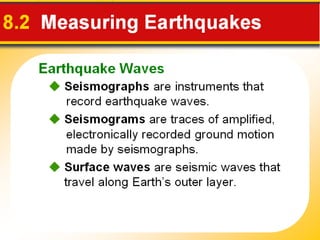
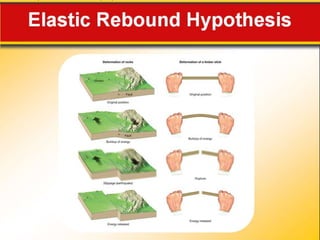
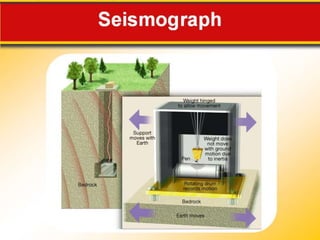
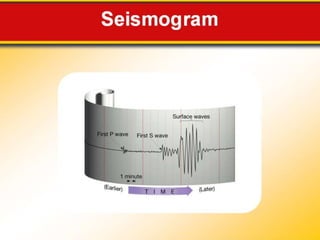
How earthquake waves work
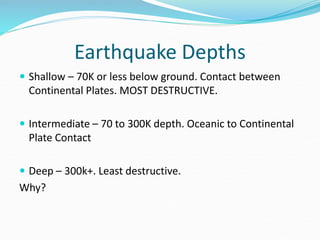
Earthquake Depths
 Shallow – 70K or less below ground. Contact between
Continental Plates. MOST DESTRUCTIVE.
 Intermediate – 70 to 300K depth. Oceanic to Continental
Plate Contact
 Deep – 300k+. Least destructive.
Why?
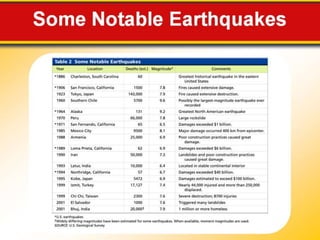
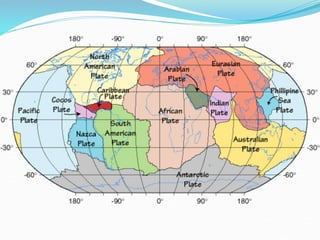
Earthquake Locations
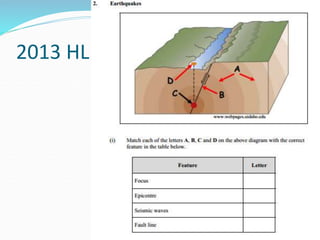
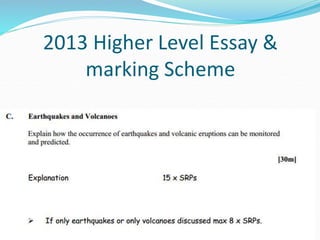
2013 HL
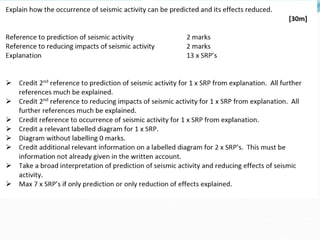
Leaving Cert 2012 – Question & Marking Scheme
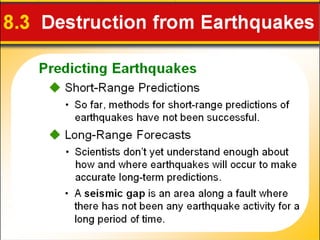
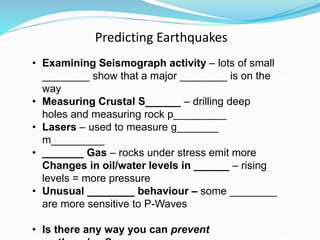
Predicting Earthquakes
• Examining Seismograph activity – lots of small
________ show that a major ________ is on the
way
• Measuring Crustal S______ – drilling deep
holes and measuring rock p_________
• Lasers – used to measure g_______
m_________
• _______ Gas – rocks under stress emit more
Changes in oil/water levels in ______ – rising
levels = more pressure
• Unusual ________ behaviour – some ________
are more sensitive to P-Waves
• Is there any way you can prevent
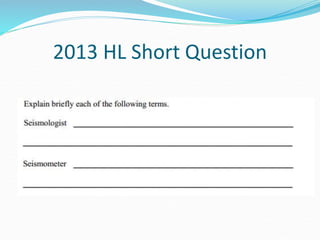
2013 HL Short Question
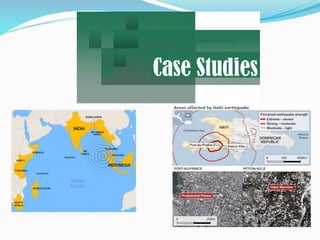
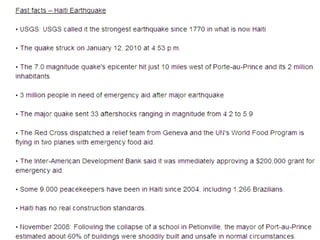
Haiti Earthquake
• Cities in Haiti had large Shanty towns, these were
badly damaged
• Cholera spread rapidly after the earthquake
• Haiti’s large debts meant that the country had no
money to deal with earthquake damage
• Earthquake hit just 25 KM from capital city – v little
warning
2008 Ordinary Level Question
2013 Higher Level Essay &
marking Scheme
Making buildings Earthquake Proof
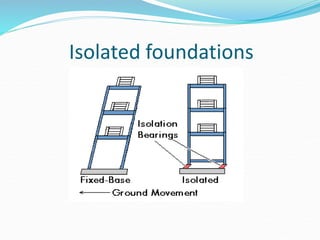
• Spring loaded foundations
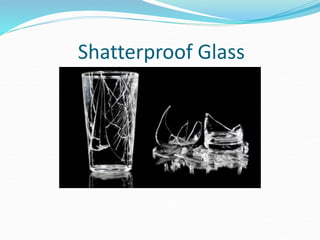
• Shatterproof Glass in windows
• Flexible joints in buildings – buildings can flex under
pressure
• More supports on each floor
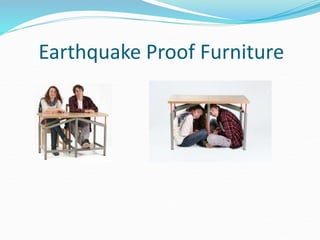
• Furniture and loose items to be secured
Isolated foundations
Shatterproof Glass
Earthquake Proof Furniture
Leaving Cert 2012 – Question & Marking Scheme
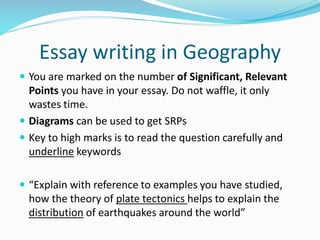
 You are marked on the number of Significant, Relevant
Points you have in your essay. Do not waffle, it only
wastes time.
 Diagrams can be used to get SRPs
 Key to high marks is to read the question carefully and
underline keywords
 “Explain with reference to examples you have studied,
how the theory of plate tectonics helps to explain the
distribution of earthquakes around the world”
Essay writing in Geography
 “Explain with reference to examples you have studied,
how the theory of plate tectonics helps to explain the
distribution of earthquakes around the world”
 Question asks about distribution
 In plain English, “Why do earthquakes happen where
they happen”
NOT
 “How do earthquakes happen”
Reading the Question
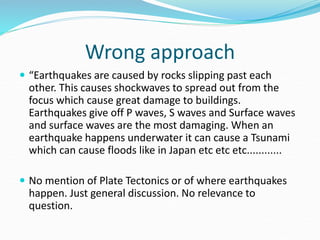
Wrong approach
 “Earthquakes are caused by rocks slipping past each
other. This causes shockwaves to spread out from the
focus which cause great damage to buildings.
Earthquakes give off P waves, S waves and Surface waves
and surface waves are the most damaging. When an
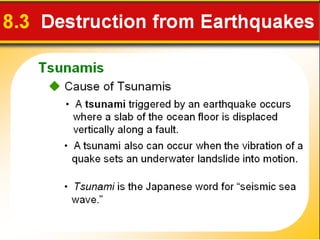
earthquake happens underwater it can cause a Tsunami
which can cause floods like in Japan etc etc etc............
 No mention of Plate Tectonics or of where earthquakes
happen. Just general discussion. No relevance to
question.
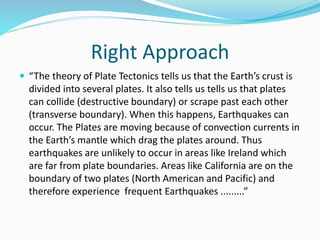
Right Approach
 “The theory of Plate Tectonics tells us that the Earth’s crust is
divided into several plates. It also tells us tells us that plates
can collide (destructive boundary) or scrape past each other
(transverse boundary). When this happens, Earthquakes can
occur. The Plates are moving because of convection currents in
the Earth’s mantle which drag the plates around. Thus
earthquakes are unlikely to occur in areas like Ireland which
are far from plate boundaries. Areas like California are on the
boundary of two plates (North American and Pacific) and
therefore experience frequent Earthquakes .........”

Earthquakes - Leaving Certificate Geography

  • 3.
  • 6.
  • 8.
  • 11.
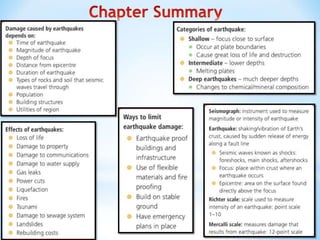
    Earthquake Depths  Shallow– 70K or less below ground. Contact between Continental Plates. MOST DESTRUCTIVE.  Intermediate – 70 to 300K depth. Oceanic to Continental Plate Contact  Deep – 300k+. Least destructive. Why?
  • 12.
  • 13.
  • 14.
    Leaving Cert 2012– Question & Marking Scheme
  • 24.
    Predicting Earthquakes • ExaminingSeismograph activity – lots of small ________ show that a major ________ is on the way • Measuring Crustal S______ – drilling deep holes and measuring rock p_________ • Lasers – used to measure g_______ m_________ • _______ Gas – rocks under stress emit more Changes in oil/water levels in ______ – rising levels = more pressure • Unusual ________ behaviour – some ________ are more sensitive to P-Waves • Is there any way you can prevent
  • 25.
    2013 HL ShortQuestion
  • 34.
    Haiti Earthquake • Citiesin Haiti had large Shanty towns, these were badly damaged • Cholera spread rapidly after the earthquake • Haiti’s large debts meant that the country had no money to deal with earthquake damage • Earthquake hit just 25 KM from capital city – v little warning
  • 36.
  • 38.
    2013 Higher LevelEssay & marking Scheme
  • 39.
  • 40.
    Making buildings EarthquakeProof • Spring loaded foundations • Shatterproof Glass in windows • Flexible joints in buildings – buildings can flex under pressure • More supports on each floor • Furniture and loose items to be secured
  • 41.
  • 42.
  • 43.
  • 45.
    Leaving Cert 2012– Question & Marking Scheme
  • 46.
     You aremarked on the number of Significant, Relevant Points you have in your essay. Do not waffle, it only wastes time.  Diagrams can be used to get SRPs  Key to high marks is to read the question carefully and underline keywords  “Explain with reference to examples you have studied, how the theory of plate tectonics helps to explain the distribution of earthquakes around the world” Essay writing in Geography
  • 47.
     “Explain withreference to examples you have studied, how the theory of plate tectonics helps to explain the distribution of earthquakes around the world”  Question asks about distribution  In plain English, “Why do earthquakes happen where they happen” NOT  “How do earthquakes happen” Reading the Question
  • 48.
    Wrong approach  “Earthquakesare caused by rocks slipping past each other. This causes shockwaves to spread out from the focus which cause great damage to buildings. Earthquakes give off P waves, S waves and Surface waves and surface waves are the most damaging. When an earthquake happens underwater it can cause a Tsunami which can cause floods like in Japan etc etc etc............  No mention of Plate Tectonics or of where earthquakes happen. Just general discussion. No relevance to question.
  • 49.
    Right Approach  “Thetheory of Plate Tectonics tells us that the Earth’s crust is divided into several plates. It also tells us tells us that plates can collide (destructive boundary) or scrape past each other (transverse boundary). When this happens, Earthquakes can occur. The Plates are moving because of convection currents in the Earth’s mantle which drag the plates around. Thus earthquakes are unlikely to occur in areas like Ireland which are far from plate boundaries. Areas like California are on the boundary of two plates (North American and Pacific) and therefore experience frequent Earthquakes .........”

Editor's Notes

  • #28 What happens at the different plate boundaries? Describe the differences?