

“The First Cold War”
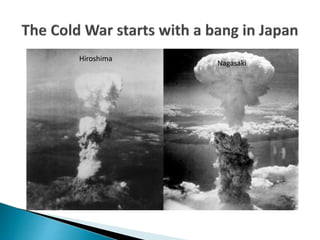
Hiroshima
Nagasaki
 “a continuing state of political conflict, military tension, proxy
wars, and economic competition between the powers of the
Western world, led by the United States and its NATO allies,
and the communist world, led by the Soviet Union, its satellite
states and allies”
 The USSR (and especially Stalin) is not to be trusted
 USSR is aggressive – look at Eastern Europe!
Don’t try and appease Russia – the same tactic was tried with
Hitler and failed.
 US Ambassador George Kennan supported this view, as did
Winston Churchill
 As Stalin and Russia continued to extend their influence in
Eastern Europe, setting up “Puppet” Governments , it seemed
Truman was correct.
 Why would Stalin (and Russia) behave like this?
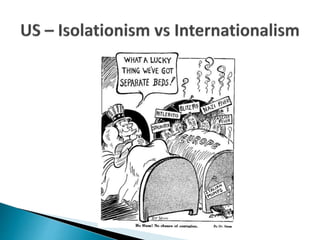
 After WW2 the US was divided on this point – should America
avoid getting involved in others problems?
 Or tackle them before they become a crisis?
 After two world wars, it was decided that America should act
to avoid a third – that meant an Internationalist approach
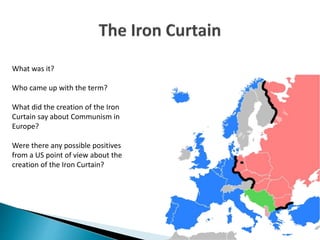
What was it?
Who came up with the term?
What did the creation of the Iron
Curtain say about Communism in
Europe?
Were there any possible positives
from a US point of view about the
creation of the Iron Curtain?
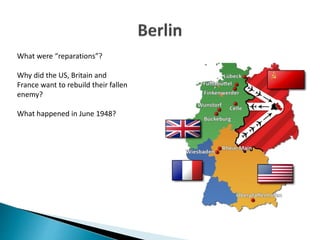
What were “reparations”?
Why did the US, Britain and
France want to rebuild their fallen
enemy?
What happened in June 1948?
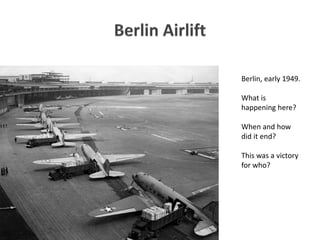
Berlin, early 1949.
What is
happening here?
When and how
did it end?
This was a victory
for who?
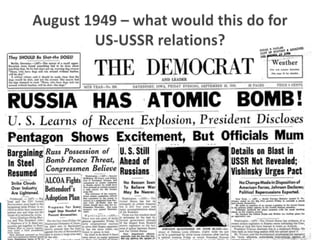
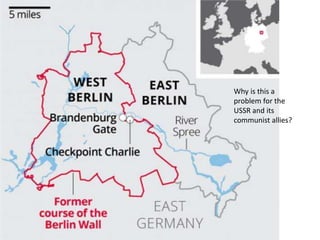
Why is this a
problem for the
USSR and its
communist allies?
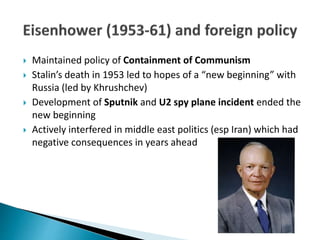
 Maintained policy of Containment of Communism
 Stalin’s death in 1953 led to hopes of a “new beginning” with
Russia (led by Khrushchev)
 Development of Sputnik and U2 spy plane incident ended the
new beginning
 Actively interfered in middle east politics (esp Iran) which had
negative consequences in years ahead
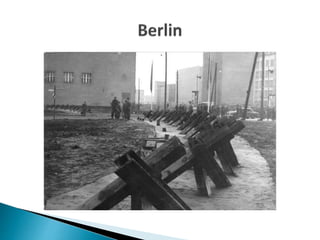
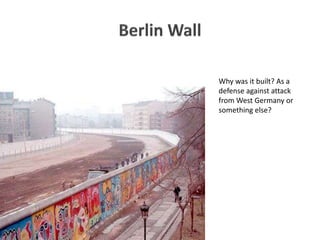
Why was it built? As a
defense against attack
from West Germany or
something else?
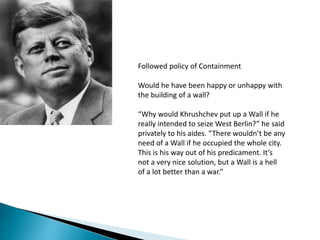
Followed policy of Containment
Would he have been happy or unhappy with
the building of a wall?
“Why would Khrushchev put up a Wall if he
really intended to seize West Berlin?” he said
privately to his aides. “There wouldn’t be any
need of a Wall if he occupied the whole city.
This is his way out of his predicament. It’s
not a very nice solution, but a Wall is a hell
of a lot better than a war.”
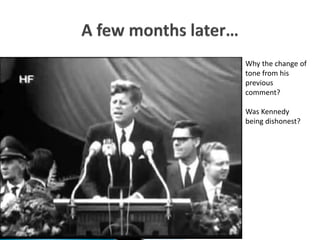
Why the change of
tone from his
previous
comment?
Was Kennedy
being dishonest?
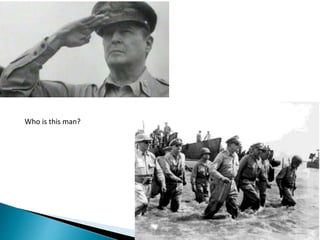
Who is this man?
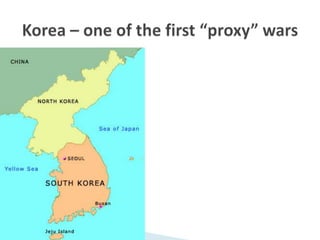
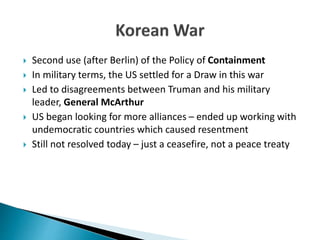
 Second use (after Berlin) of the Policy of Containment
 In military terms, the US settled for a Draw in this war
 Led to disagreements between Truman and his military
leader, General McArthur
 US began looking for more alliances – ended up working with
undemocratic countries which caused resentment
 Still not resolved today – just a ceasefire, not a peace treaty
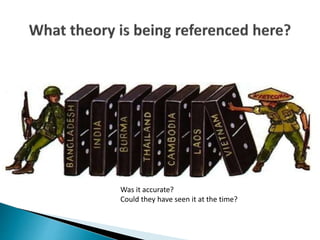
Was it accurate?
Could they have seen it at the time?
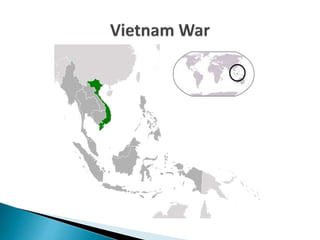
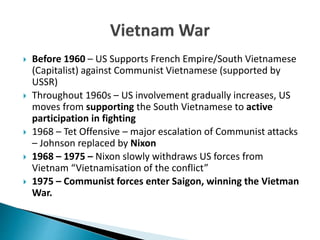
 Before 1960 – US Supports French Empire/South Vietnamese
(Capitalist) against Communist Vietnamese (supported by
USSR)
 Throughout 1960s – US involvement gradually increases, US
moves from supporting the South Vietnamese to active
participation in fighting
 1968 – Tet Offensive – major escalation of Communist attacks
– Johnson replaced by Nixon
 1968 – 1975 – Nixon slowly withdraws US forces from
Vietnam “Vietnamisation of the conflict”
 1975 – Communist forces enter Saigon, winning the Vietman
War.
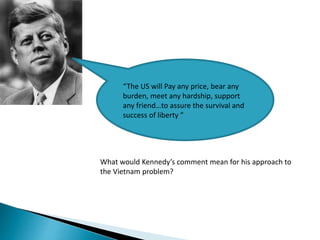
“The US will Pay any price, bear any
burden, meet any hardship, support
any friend…to assure the survival and
success of liberty ”
What would Kennedy’s comment mean for his approach to
the Vietnam problem?
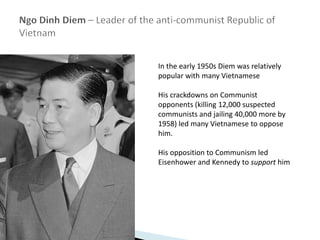
In the early 1950s Diem was relatively
popular with many Vietnamese
His crackdowns on Communist
opponents (killing 12,000 suspected
communists and jailing 40,000 more by
1958) led many Vietnamese to oppose
him.
His opposition to Communism led
Eisenhower and Kennedy to support him
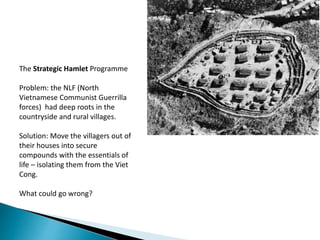
The Strategic Hamlet Programme
Problem: the NLF (North
Vietnamese Communist Guerrilla
forces) had deep roots in the
countryside and rural villages.
Solution: Move the villagers out of
their houses into secure
compounds with the essentials of
life – isolating them from the Viet
Cong.
What could go wrong?
“This forcible moving of peasants into secure compounds was
supported by Diem and did a great deal to further the
opposition to him in the South. American television reporters
relayed to the US public that ‘Strategic Hamlet’ destroyed
decades, if not hundreds, of years of village life in the South
and that the process might only take half-a-day. Here was a
super-power effectively orchestrating the forced removal of
peasants by the South Vietnamese Army who were not asked
if they wanted to move. To those who knew about US
involvement in Vietnam and were opposed to it, ‘Strategic
Hamlet’ provided them with an excellent propaganda
opportunity”.
 Strategic Hamlet
◦ Aim: to reduce National Liberation Front – Peasant links
◦ Result: 300% increase in peasants joining the NLF
 What effect would this have had on US policy towards
Diem (South Vietnamese anti-communist leader)?
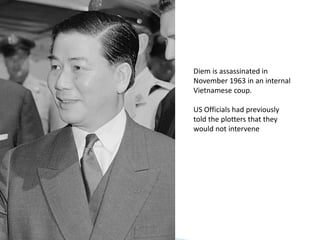
Diem is assassinated in
November 1963 in an internal
Vietnamese coup.
US Officials had previously
told the plotters that they
would not intervene
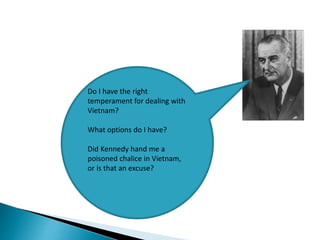
Do I have the right
temperament for dealing with
Vietnam?
What options do I have?
Did Kennedy hand me a
poisoned chalice in Vietnam,
or is that an excuse?
Withdrawal from Vietnam Escalation of the war
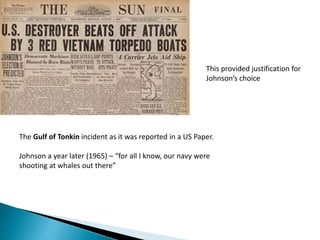
The Gulf of Tonkin incident as it was reported in a US Paper.
Johnson a year later (1965) – “for all I know, our navy were
shooting at whales out there”
This provided justification for
Johnson’s choice
 I believe we can continue the Great Society while we fight in
Vietnam.
President Johnson
If you let a bully come in your front yard, he'll be on your porch the
next day and the day after that he'll rape your wife in your own bed.
- President Johnson
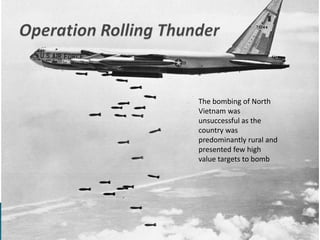
The bombing of North
Vietnam was
unsuccessful as the
country was
predominantly rural and
presented few high
value targets to bomb
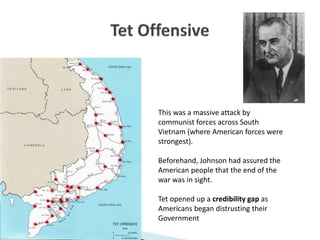
This was a massive attack by
communist forces across South
Vietnam (where American forces were
strongest).
Beforehand, Johnson had assured the
American people that the end of the
war was in sight.
Tet opened up a credibility gap as
Americans began distrusting their
Government
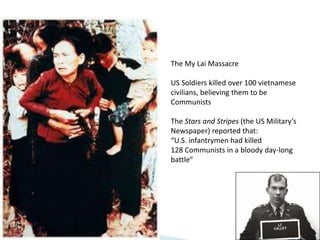
The My Lai Massacre
US Soldiers killed over 100 vietnamese
civilians, believing them to be
Communists
The Stars and Stripes (the US Military’s
Newspaper) reported that:
“U.S. infantrymen had killed
128 Communists in a bloody day-long
battle”
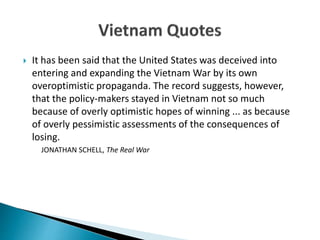
 It has been said that the United States was deceived into
entering and expanding the Vietnam War by its own
overoptimistic propaganda. The record suggests, however,
that the policy-makers stayed in Vietnam not so much
because of overly optimistic hopes of winning ... as because
of overly pessimistic assessments of the consequences of
losing.
JONATHAN SCHELL, The Real War
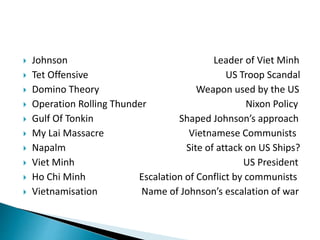
 Johnson Leader of Viet Minh
 Tet Offensive US Troop Scandal
 Domino Theory Weapon used by the US
 Operation Rolling Thunder Nixon Policy
 Gulf Of Tonkin Shaped Johnson’s approach
 My Lai Massacre Vietnamese Communists
 Napalm Site of attack on US Ships?
 Viet Minh US President
 Ho Chi Minh Escalation of Conflict by communists
 Vietnamisation Name of Johnson’s escalation of war
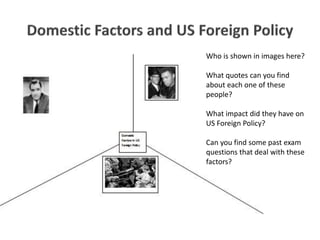
Who is shown in images here?
What quotes can you find
about each one of these
people?
What impact did they have on
US Foreign Policy?
Can you find some past exam
questions that deal with these
factors?
 Public Opinion – as measured by elections or opinion
polls. NOTE: Unlike Ireland, there are no referendums
in America
 Military Industrial Complex – the armed forces,
supportive politicians and companies involved in the
production of weaponry
Us Foreign Policy after 1945

Us Foreign Policy after 1945

  • 1.
  • 2.
  • 3.
     “a continuingstate of political conflict, military tension, proxy wars, and economic competition between the powers of the Western world, led by the United States and its NATO allies, and the communist world, led by the Soviet Union, its satellite states and allies”
  • 5.
     The USSR(and especially Stalin) is not to be trusted  USSR is aggressive – look at Eastern Europe! Don’t try and appease Russia – the same tactic was tried with Hitler and failed.  US Ambassador George Kennan supported this view, as did Winston Churchill  As Stalin and Russia continued to extend their influence in Eastern Europe, setting up “Puppet” Governments , it seemed Truman was correct.  Why would Stalin (and Russia) behave like this?
  • 7.
     After WW2the US was divided on this point – should America avoid getting involved in others problems?  Or tackle them before they become a crisis?  After two world wars, it was decided that America should act to avoid a third – that meant an Internationalist approach
  • 8.
    What was it? Whocame up with the term? What did the creation of the Iron Curtain say about Communism in Europe? Were there any possible positives from a US point of view about the creation of the Iron Curtain?
  • 9.
    What were “reparations”? Whydid the US, Britain and France want to rebuild their fallen enemy? What happened in June 1948?
  • 10.
    Berlin, early 1949. Whatis happening here? When and how did it end? This was a victory for who?
  • 13.
    Why is thisa problem for the USSR and its communist allies?
  • 15.
     Maintained policyof Containment of Communism  Stalin’s death in 1953 led to hopes of a “new beginning” with Russia (led by Khrushchev)  Development of Sputnik and U2 spy plane incident ended the new beginning  Actively interfered in middle east politics (esp Iran) which had negative consequences in years ahead
  • 16.
    Why was itbuilt? As a defense against attack from West Germany or something else?
  • 17.
    Followed policy ofContainment Would he have been happy or unhappy with the building of a wall? “Why would Khrushchev put up a Wall if he really intended to seize West Berlin?” he said privately to his aides. “There wouldn’t be any need of a Wall if he occupied the whole city. This is his way out of his predicament. It’s not a very nice solution, but a Wall is a hell of a lot better than a war.”
  • 18.
    Why the changeof tone from his previous comment? Was Kennedy being dishonest?
  • 21.
  • 22.
     Second use(after Berlin) of the Policy of Containment  In military terms, the US settled for a Draw in this war  Led to disagreements between Truman and his military leader, General McArthur  US began looking for more alliances – ended up working with undemocratic countries which caused resentment  Still not resolved today – just a ceasefire, not a peace treaty
  • 26.
    Was it accurate? Couldthey have seen it at the time?
  • 27.
     Before 1960– US Supports French Empire/South Vietnamese (Capitalist) against Communist Vietnamese (supported by USSR)  Throughout 1960s – US involvement gradually increases, US moves from supporting the South Vietnamese to active participation in fighting  1968 – Tet Offensive – major escalation of Communist attacks – Johnson replaced by Nixon  1968 – 1975 – Nixon slowly withdraws US forces from Vietnam “Vietnamisation of the conflict”  1975 – Communist forces enter Saigon, winning the Vietman War.
  • 28.
    “The US willPay any price, bear any burden, meet any hardship, support any friend…to assure the survival and success of liberty ” What would Kennedy’s comment mean for his approach to the Vietnam problem?
  • 29.
    In the early1950s Diem was relatively popular with many Vietnamese His crackdowns on Communist opponents (killing 12,000 suspected communists and jailing 40,000 more by 1958) led many Vietnamese to oppose him. His opposition to Communism led Eisenhower and Kennedy to support him
  • 30.
    The Strategic HamletProgramme Problem: the NLF (North Vietnamese Communist Guerrilla forces) had deep roots in the countryside and rural villages. Solution: Move the villagers out of their houses into secure compounds with the essentials of life – isolating them from the Viet Cong. What could go wrong?
  • 31.
    “This forcible movingof peasants into secure compounds was supported by Diem and did a great deal to further the opposition to him in the South. American television reporters relayed to the US public that ‘Strategic Hamlet’ destroyed decades, if not hundreds, of years of village life in the South and that the process might only take half-a-day. Here was a super-power effectively orchestrating the forced removal of peasants by the South Vietnamese Army who were not asked if they wanted to move. To those who knew about US involvement in Vietnam and were opposed to it, ‘Strategic Hamlet’ provided them with an excellent propaganda opportunity”.
  • 33.
     Strategic Hamlet ◦Aim: to reduce National Liberation Front – Peasant links ◦ Result: 300% increase in peasants joining the NLF  What effect would this have had on US policy towards Diem (South Vietnamese anti-communist leader)?
  • 34.
    Diem is assassinatedin November 1963 in an internal Vietnamese coup. US Officials had previously told the plotters that they would not intervene
  • 35.
    Do I havethe right temperament for dealing with Vietnam? What options do I have? Did Kennedy hand me a poisoned chalice in Vietnam, or is that an excuse?
  • 36.
    Withdrawal from VietnamEscalation of the war
  • 37.
    The Gulf ofTonkin incident as it was reported in a US Paper. Johnson a year later (1965) – “for all I know, our navy were shooting at whales out there” This provided justification for Johnson’s choice
  • 38.
     I believewe can continue the Great Society while we fight in Vietnam. President Johnson If you let a bully come in your front yard, he'll be on your porch the next day and the day after that he'll rape your wife in your own bed. - President Johnson
  • 39.
    The bombing ofNorth Vietnam was unsuccessful as the country was predominantly rural and presented few high value targets to bomb
  • 43.
    This was amassive attack by communist forces across South Vietnam (where American forces were strongest). Beforehand, Johnson had assured the American people that the end of the war was in sight. Tet opened up a credibility gap as Americans began distrusting their Government
  • 45.
    The My LaiMassacre US Soldiers killed over 100 vietnamese civilians, believing them to be Communists The Stars and Stripes (the US Military’s Newspaper) reported that: “U.S. infantrymen had killed 128 Communists in a bloody day-long battle”
  • 46.
     It hasbeen said that the United States was deceived into entering and expanding the Vietnam War by its own overoptimistic propaganda. The record suggests, however, that the policy-makers stayed in Vietnam not so much because of overly optimistic hopes of winning ... as because of overly pessimistic assessments of the consequences of losing. JONATHAN SCHELL, The Real War
  • 47.
     Johnson Leaderof Viet Minh  Tet Offensive US Troop Scandal  Domino Theory Weapon used by the US  Operation Rolling Thunder Nixon Policy  Gulf Of Tonkin Shaped Johnson’s approach  My Lai Massacre Vietnamese Communists  Napalm Site of attack on US Ships?  Viet Minh US President  Ho Chi Minh Escalation of Conflict by communists  Vietnamisation Name of Johnson’s escalation of war
  • 50.
    Who is shownin images here? What quotes can you find about each one of these people? What impact did they have on US Foreign Policy? Can you find some past exam questions that deal with these factors?
  • 51.
     Public Opinion– as measured by elections or opinion polls. NOTE: Unlike Ireland, there are no referendums in America  Military Industrial Complex – the armed forces, supportive politicians and companies involved in the production of weaponry

Editor's Notes

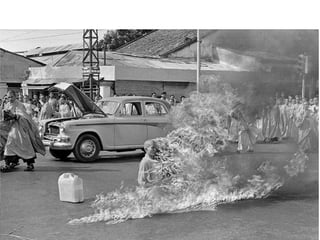
  • #33 Buddhist Monk Thich Quang Duc burning himself to death in protest at the US Government backed policies (such as Strategic Hamlet). 11 June 1963