


6/16/2015
1
Institute of Geology, Punjab university Lahore
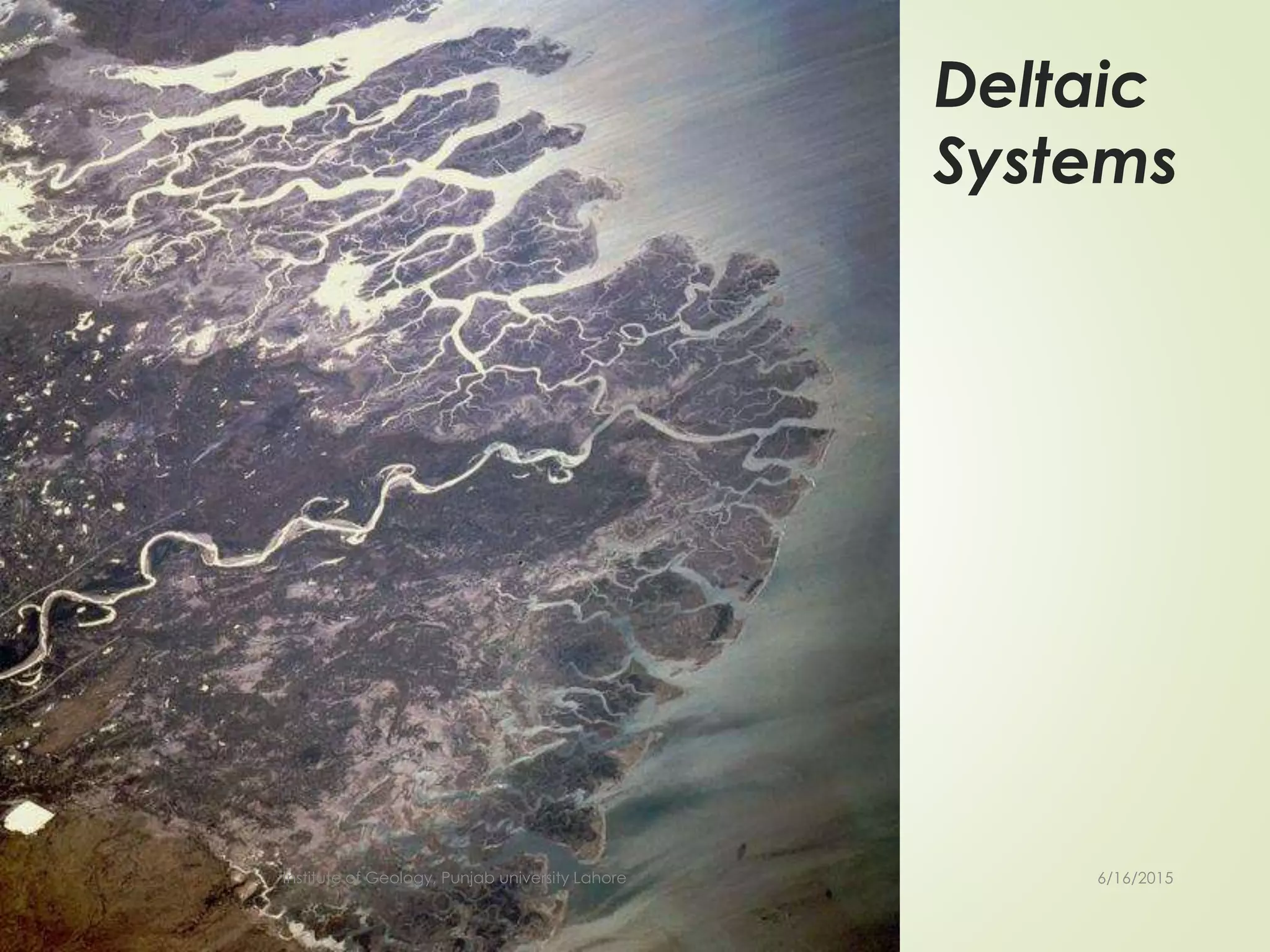
Deltaic
Systems
6/16/2015
2
Institute of Geology, Punjab university Lahore
Presented to:
Prof. Dr. Shahid Ghazi
Presented by:
UsMaan Sikandar
Roll No. 29
6/16/2015
3
Institute of Geology, Punjab university Lahore
Contents
 Introduction
 Delta Classification
 Fan Delta
 Physiographic Characteristics of Deltas
 Ancient Deltaic Systems
 Indus River Delta
 Conclusion
6/16/2015
4
Institute of Geology, Punjab university Lahore
Introduction
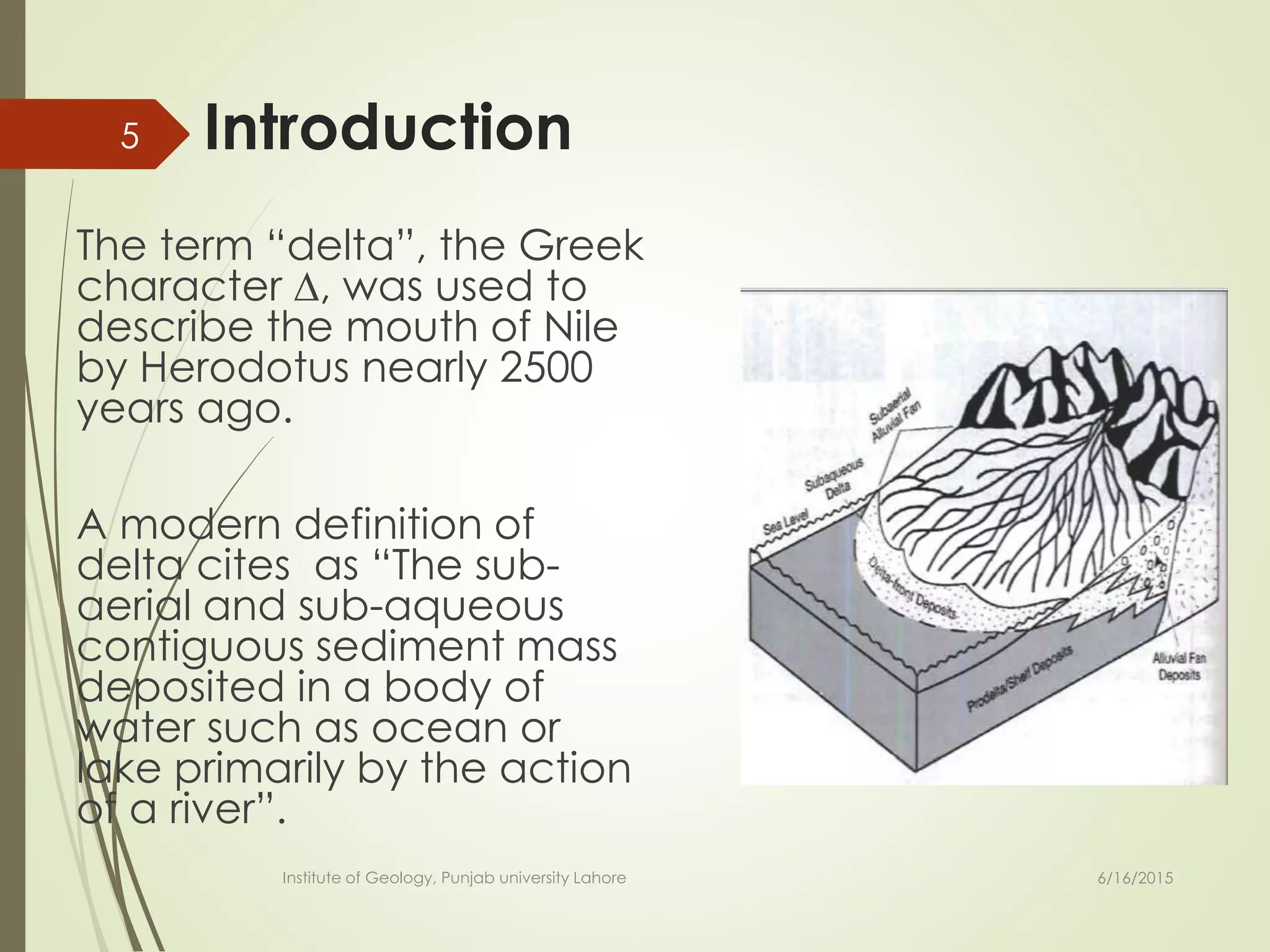
The term “delta”, the Greek
character ∆, was used to
describe the mouth of Nile
by Herodotus nearly 2500
years ago.
A modern definition of
delta cites as “The sub-
aerial and sub-aqueous
contiguous sediment mass
deposited in a body of
water such as ocean or
lake primarily by the action
of a river”.
6/16/2015
5
Institute of Geology, Punjab university Lahore
6/16/2015
6
Institute of Geology, Punjab university Lahore
Introduction
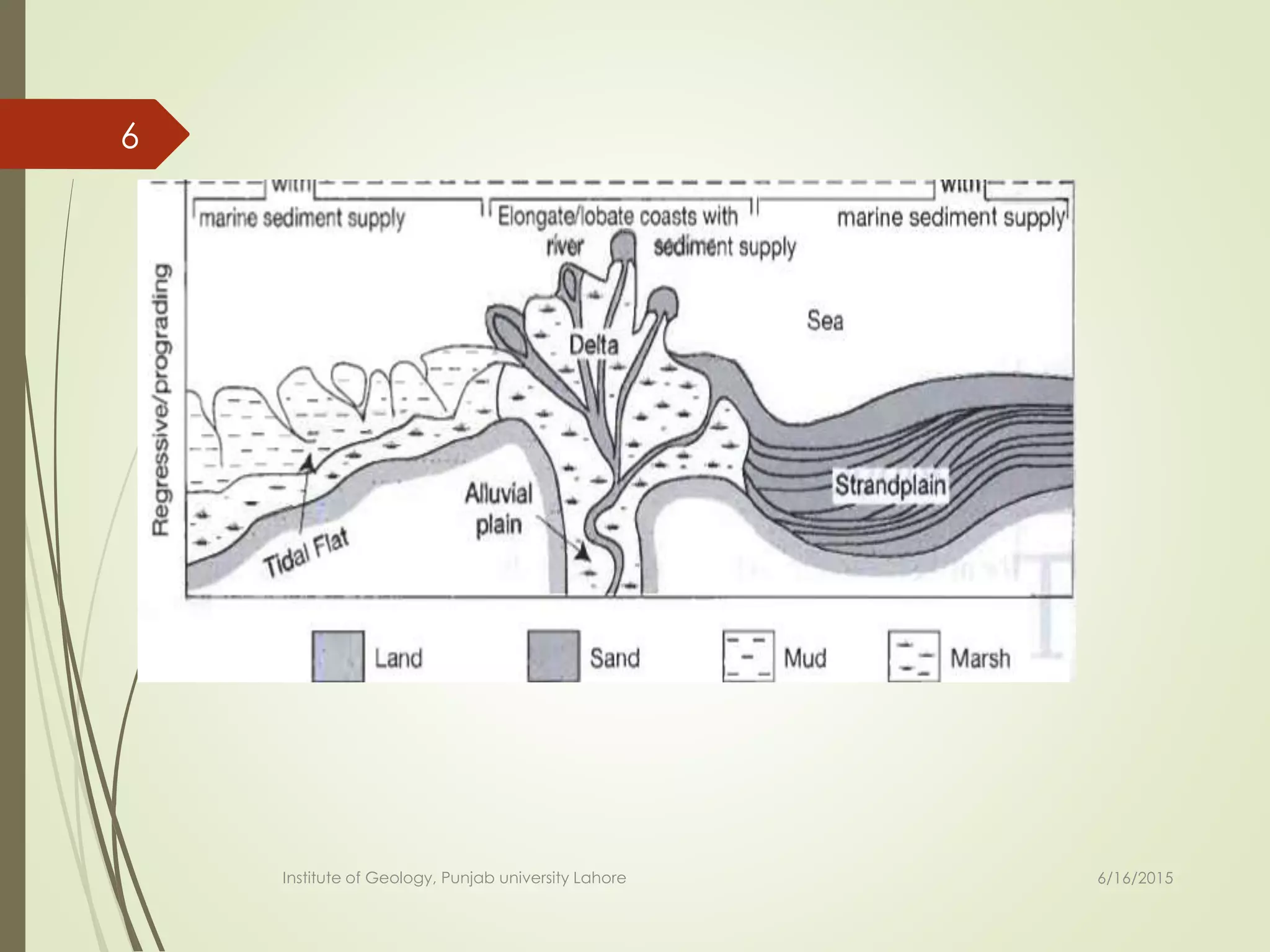
Deltas can form in lakes and inland seas as well as in
the ocean, but they are most important in the open
ocean. Much of the siliciclastic sediment transported
to coastal zones throughout geologic time has been
deposited in deltas.
Conditions required forming deltas
1. The river must carry a large amount of sediments.
2. The waves or current along the coast must not be
strong enough to remove the sediments
deposited by the river, at least not faster than the river
can deposit them.
3. The slope of the sea floor or lake at the river mouth
must be gentle or flat.
6/16/2015
7
Institute of Geology, Punjab university Lahore
6/16/2015
8
Institute of Geology, Punjab university Lahore
Introduction
Ancient deltaic deposits have been identified in
stratigraphic successions of many ages, and deltaic
sediments are known to be important hosts for
petroleum and natural gas, coal, and some
minerals such as uranium.
Deltas are particularly common in the modern
ocean owing to post-Pleistocene sea-level rise
coupled with high sediment loads carried by many
rivers. High sea level increases sedimentation rates
on deltas because sediments are trapped by the
rising water, inhibiting sediment removal by
currents.
6/16/2015
9
Institute of Geology, Punjab university Lahore
Delta Classification
The distribution and characteristics of deltas are controlled
by a complex set of interrelated fluvial and
marine/lacustrine processes and environmental conditions
such as:
 climate
 water and sediment discharge
 river-mouth processes
 near shore wave power
 tides
 near shore currents
 winds
 slope and inclination
6/16/2015
10
Institute of Geology, Punjab university Lahore
Delta Classification
Deltas can be classified in several ways,
however, classification on the basis of delta-
front regime appears to be favored by most
geologists. Deltas are classified thus as
(1) Fluvial-dominated,
(2) Tide-dominated,
(3) Wave-dominated,
(4) Mixed process-dominated
6/16/2015
11
Institute of Geology, Punjab university Lahore
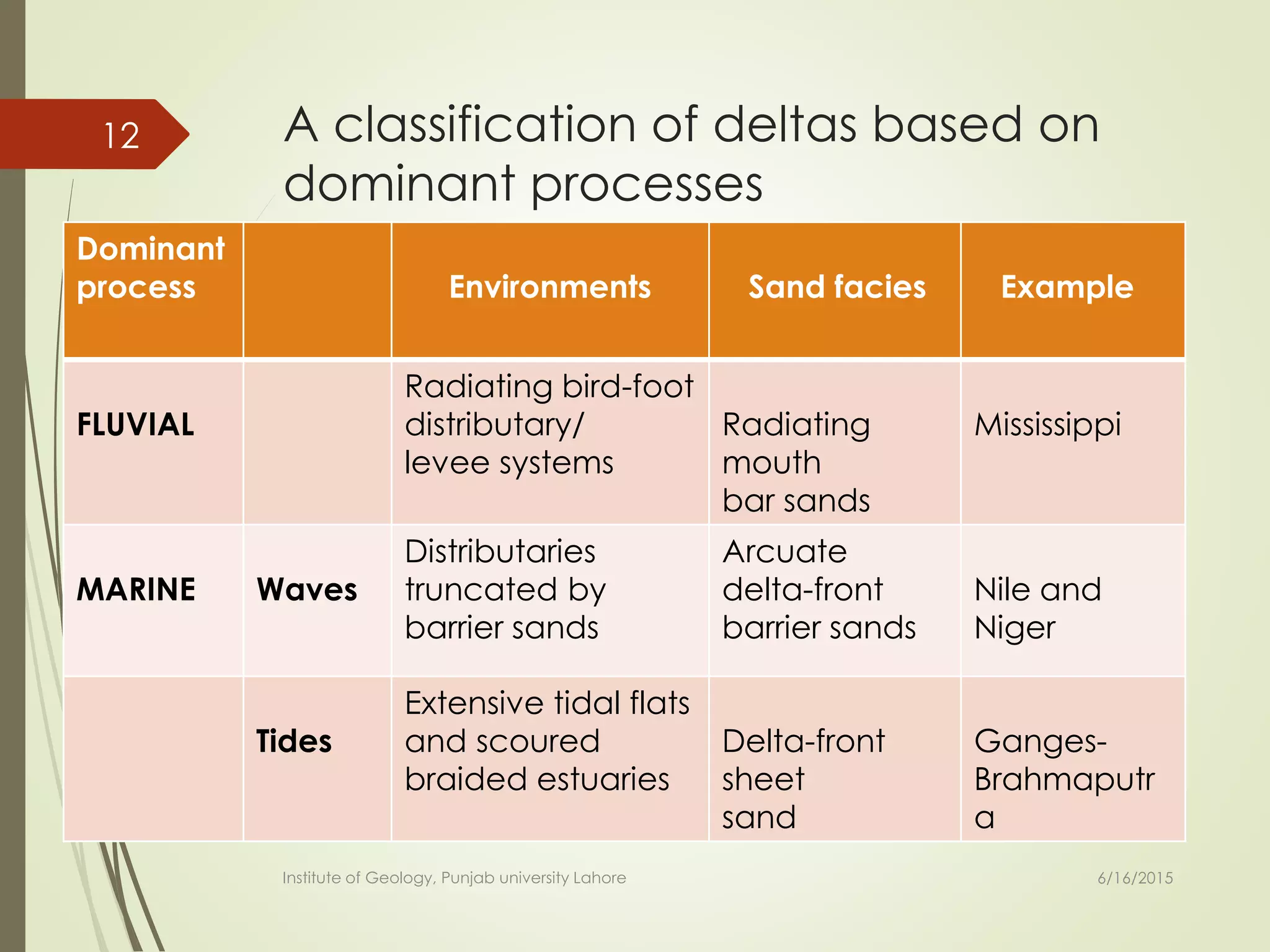
A classification of deltas based on
dominant processes
Dominant
process Environments Sand facies Example
FLUVIAL
Radiating bird-foot
distributary/
levee systems
Radiating
mouth
bar sands
Mississippi
MARINE Waves
Distributaries
truncated by
barrier sands
Arcuate
delta-front
barrier sands
Nile and
Niger
Tides
Extensive tidal flats
and scoured
braided estuaries
Delta-front
sheet
sand
Ganges-
Brahmaputr
a
6/16/2015
12
Institute of Geology, Punjab university Lahore
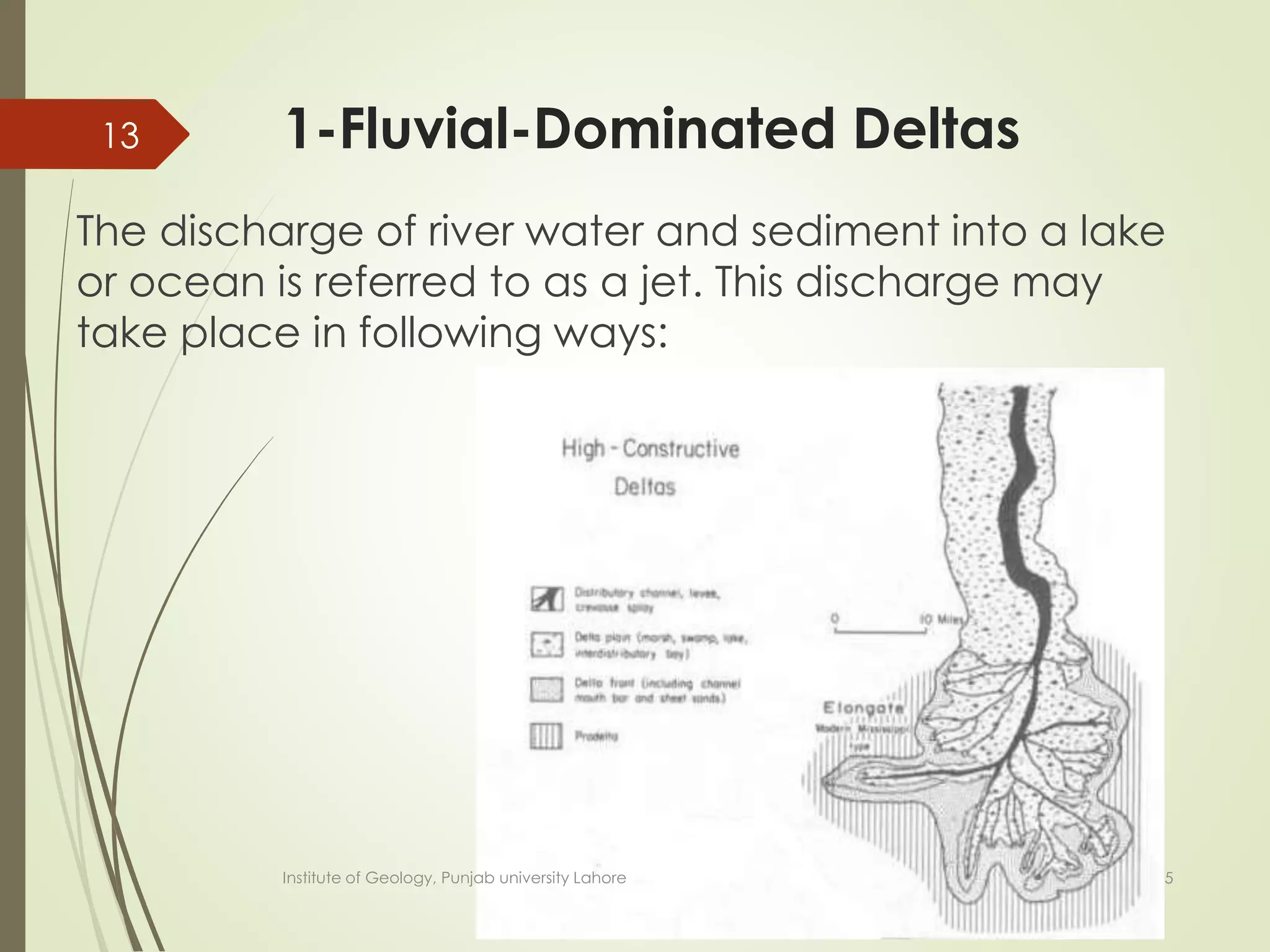
1-Fluvial-Dominated Deltas
The discharge of river water and sediment into a lake
or ocean is referred to as a jet. This discharge may
take place in following ways:
6/16/2015
13
Institute of Geology, Punjab university Lahore
1-Fluvial-Dominated Deltas
Homopycnal flow :occurs when the density of the river
water is equal to the density of the standing water in
the basin. This type of flow is associated with rapid
mixing throughout the general flow. There is also abrupt
deposition of the sediments carried to the basin by the
river as the two water sources meet.
6/16/2015
14
Institute of Geology, Punjab university Lahore
1-Fluvial-Dominated Deltas
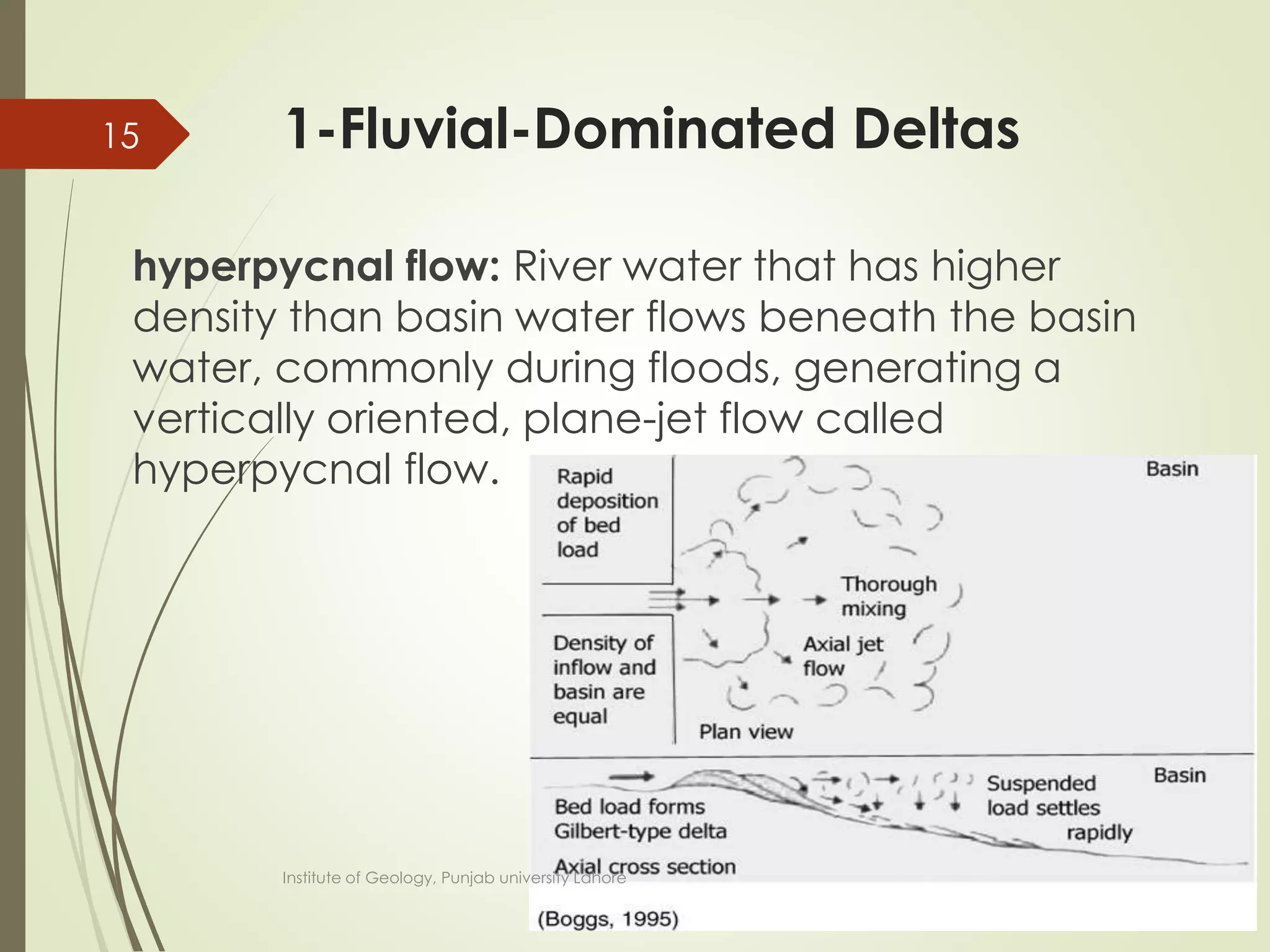
hyperpycnal flow: River water that has higher
density than basin water flows beneath the basin
water, commonly during floods, generating a
vertically oriented, plane-jet flow called
hyperpycnal flow.
6/16/2015
15
Institute of Geology, Punjab university Lahore
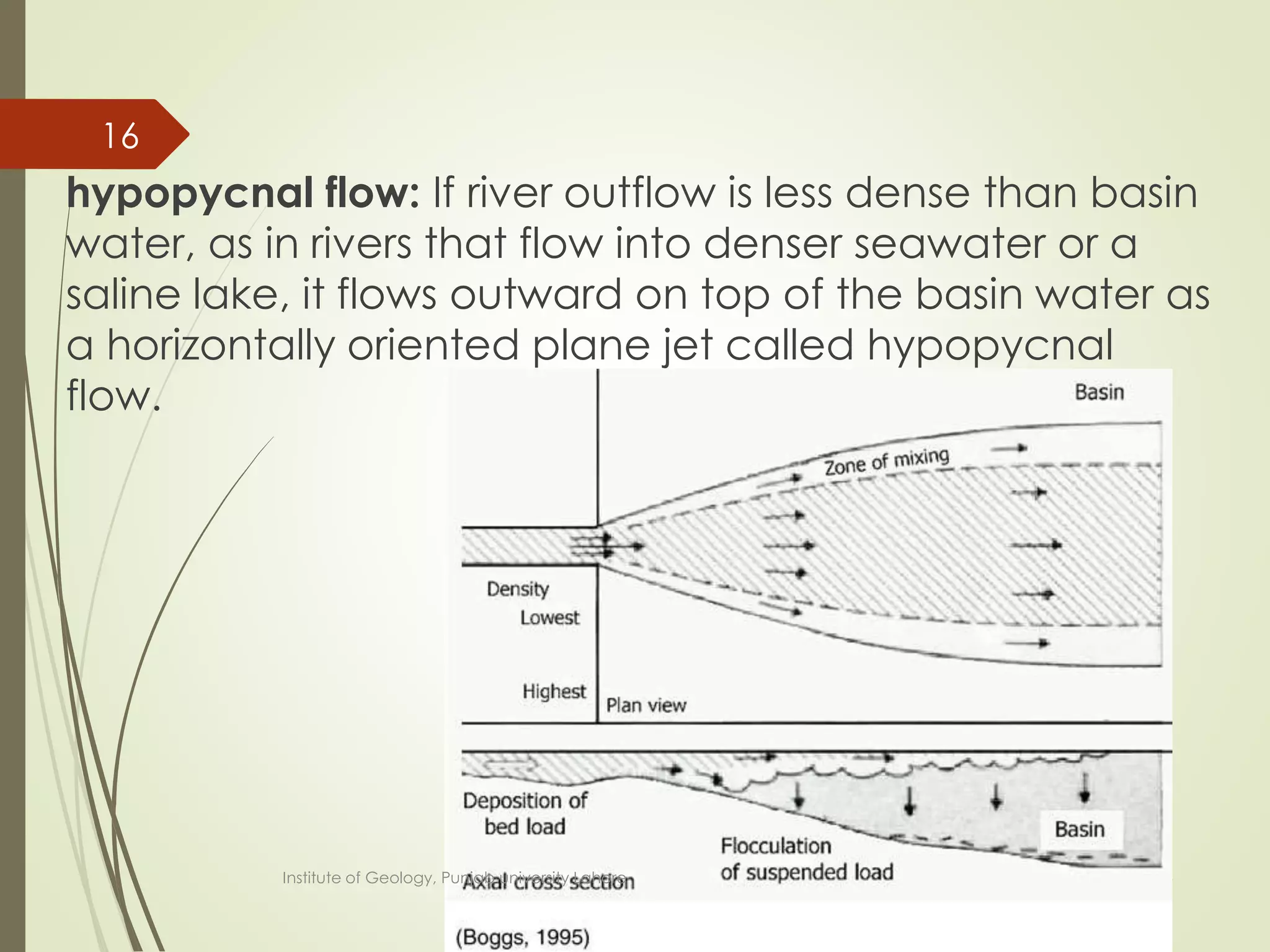
hypopycnal flow: If river outflow is less dense than basin
water, as in rivers that flow into denser seawater or a
saline lake, it flows outward on top of the basin water as
a horizontally oriented plane jet called hypopycnal
flow.
6/16/2015
16
Institute of Geology, Punjab university Lahore
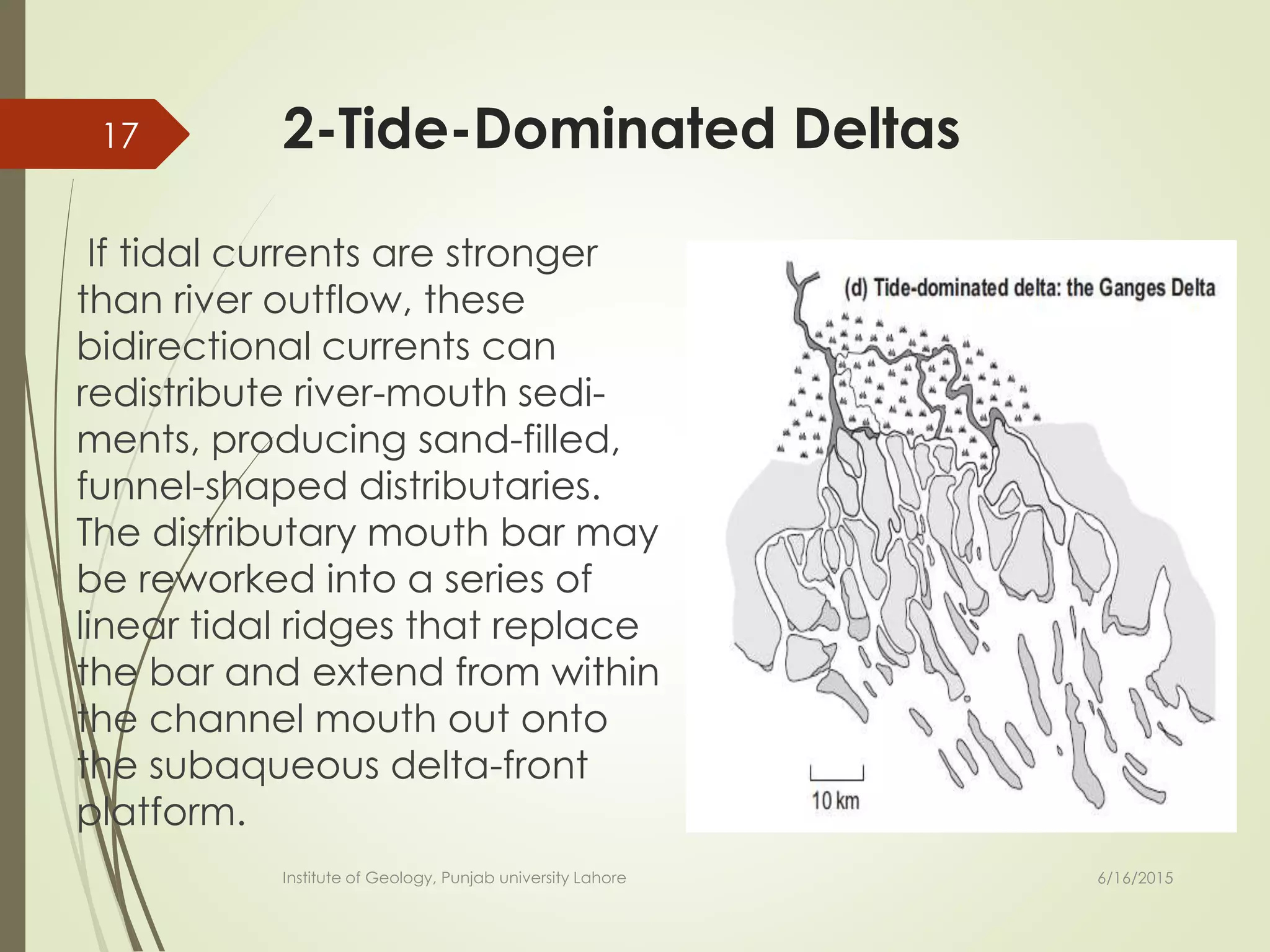
2-Tide-Dominated Deltas
If tidal currents are stronger
than river outflow, these
bidirectional currents can
redistribute river-mouth sedi-
ments, producing sand-filled,
funnel-shaped distributaries.
The distributary mouth bar may
be reworked into a series of
linear tidal ridges that replace
the bar and extend from within
the channel mouth out onto
the subaqueous delta-front
platform.
6/16/2015
17
Institute of Geology, Punjab university Lahore
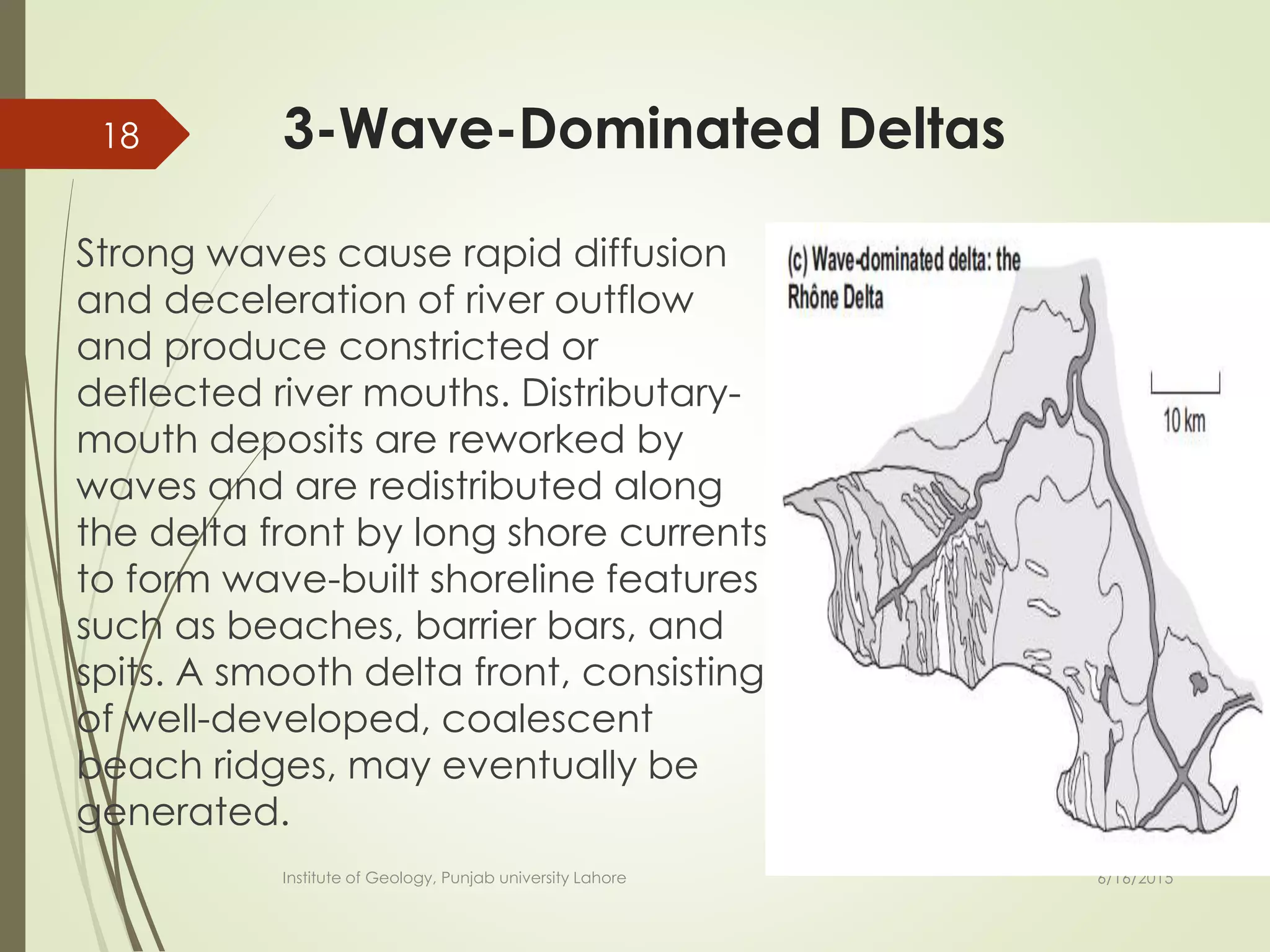
3-Wave-Dominated Deltas
Strong waves cause rapid diffusion
and deceleration of river outflow
and produce constricted or
deflected river mouths. Distributary-
mouth deposits are reworked by
waves and are redistributed along
the delta front by long shore currents
to form wave-built shoreline features
such as beaches, barrier bars, and
spits. A smooth delta front, consisting
of well-developed, coalescent
beach ridges, may eventually be
generated.
6/16/2015
18
Institute of Geology, Punjab university Lahore
4-Mixed-Process Deltas
Mixed-process
deltas illustrate some
differences in
characteristics of
modern deltas that
are shaped by
processes that are
predominantly
fluvial, tidal, or
wave-related.
6/16/2015
19
Institute of Geology, Punjab university Lahore
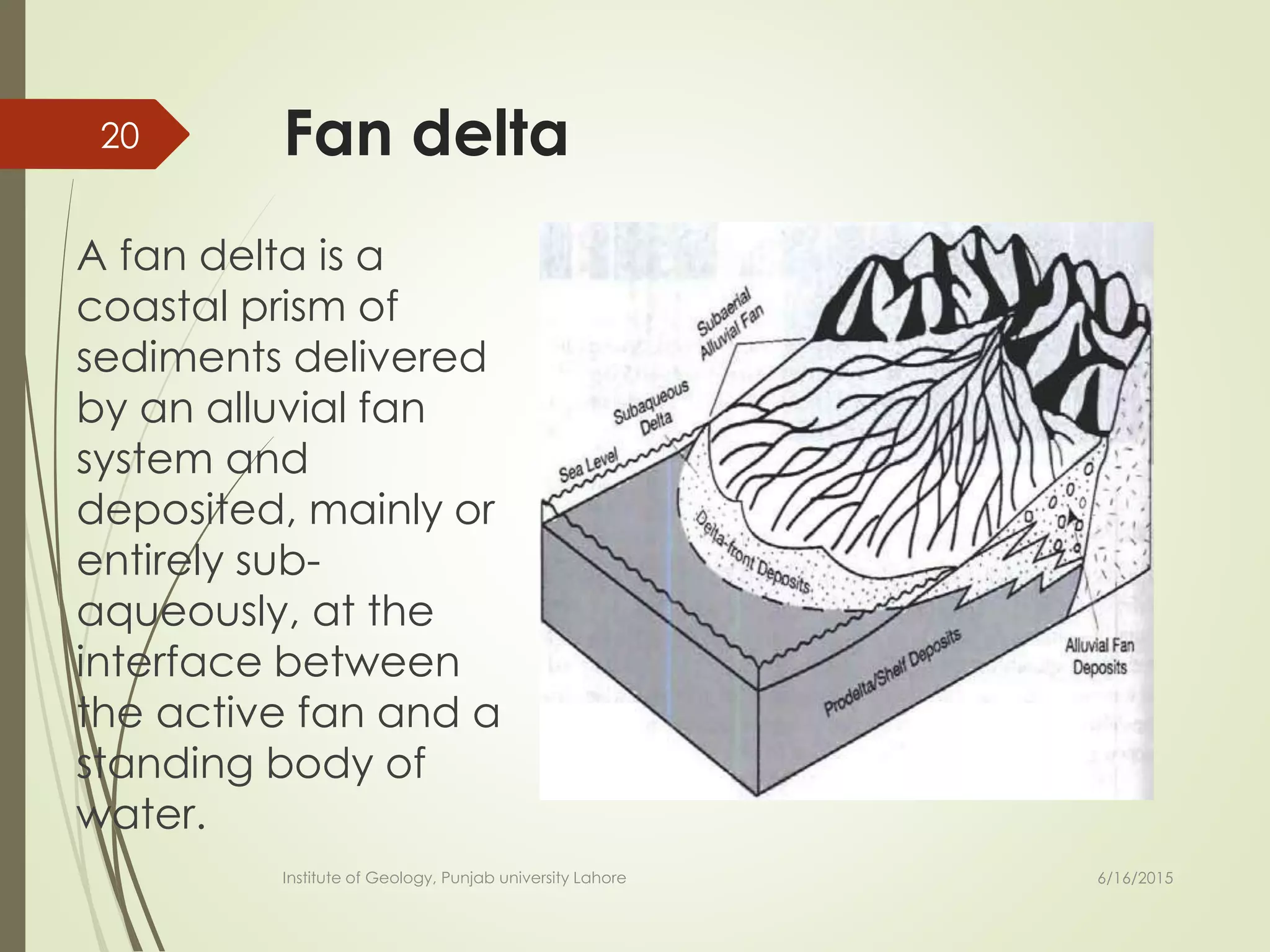
Fan delta
A fan delta is a
coastal prism of
sediments delivered
by an alluvial fan
system and
deposited, mainly or
entirely sub-
aqueously, at the
interface between
the active fan and a
standing body of
water.
6/16/2015
20
Institute of Geology, Punjab university Lahore
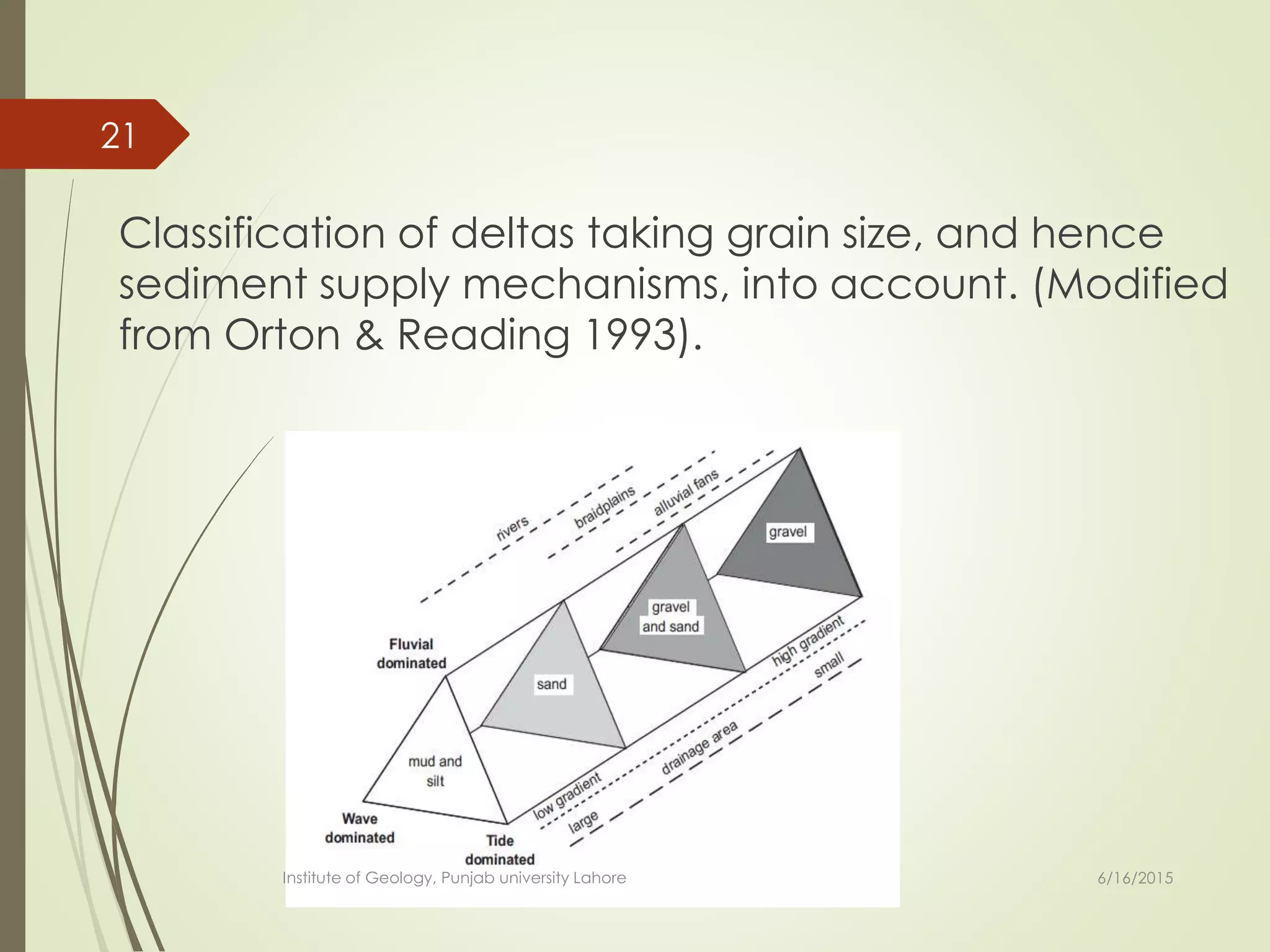
Classification of deltas taking grain size, and hence
sediment supply mechanisms, into account. (Modified
from Orton & Reading 1993).
6/16/2015
21
Institute of Geology, Punjab university Lahore
Physiographic Characteristics
of Deltas
All deltas can be divided into sub aerial and sub
aqueous components, each of which can be
further subdivided.
Deltaic plain
The sub-aerial component of deltas, generally
larger than the subaqueous component. It is
divided into
 upper delta plain, which lies largely above high-
tide level
 lower delta plain, lying between low-tide mark
and the upper limit of tidal influence.
6/16/2015
22
Institute of Geology, Punjab university Lahore
Physiographic Characteristics
of Deltas
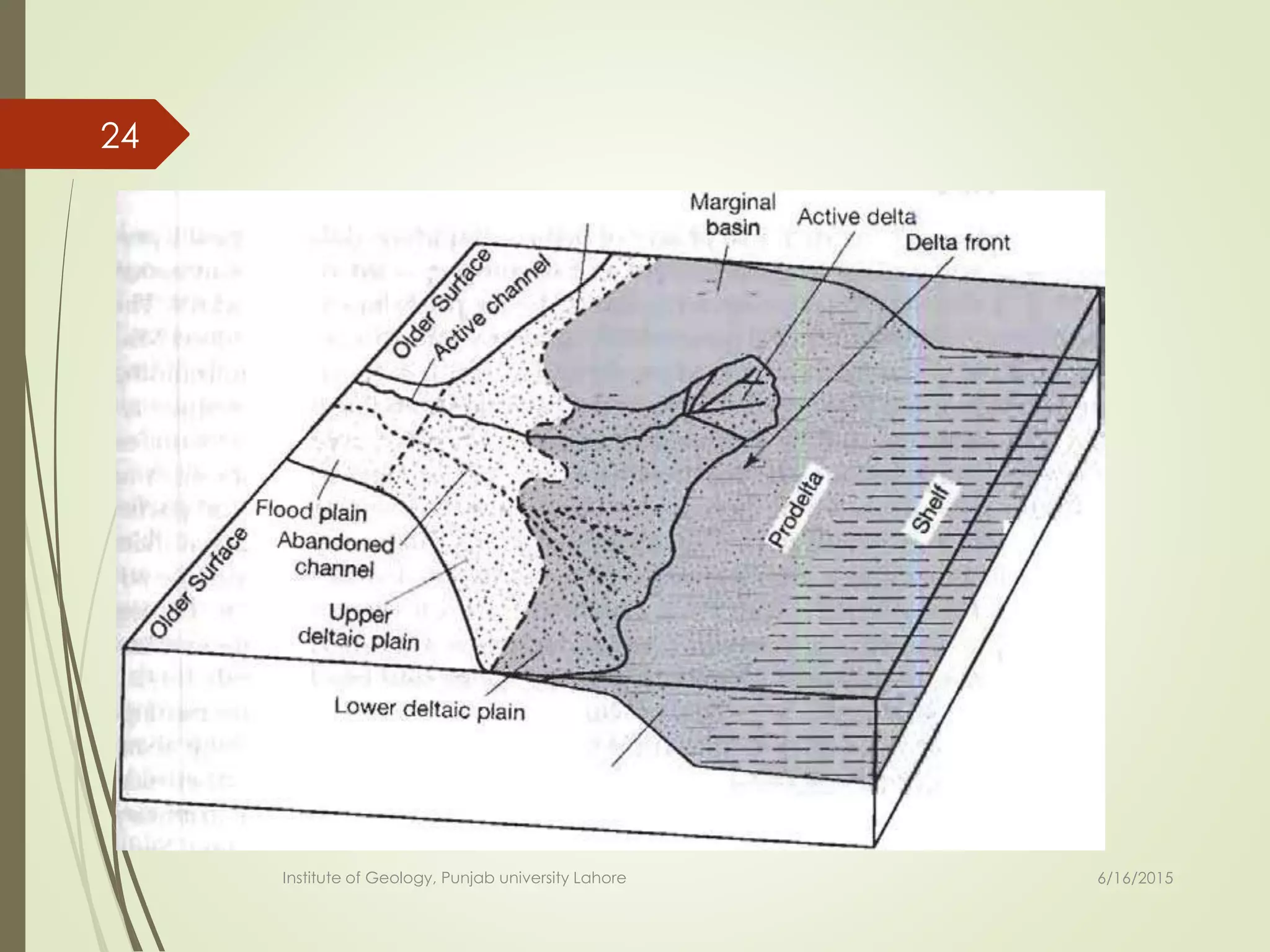
The subaqueous delta plain lies seaward of the
lower deltaic plain below low-tide water level.
Delta Front
The uppermost part of the subaqueous delta, lying
at water depths down to 10m or so.
Pro-delta
The remaining sea ward part of the subaqueous
delta.
The subaqueous delta may extend outward for
distances of a few kilometers to tens of kilometers,
and the pro-delta may extend to water depths as
much as 200-300 m.
6/16/2015
23
Institute of Geology, Punjab university Lahore
6/16/2015
24
Institute of Geology, Punjab university Lahore
Ancient Deltaic systems
Ancient deltaic sediments have been reported in
stratigraphic successions of most ages, but they
appear to be particularly common in rocks of
Carboniferous and Tertiary age. These deltaic
sediments are known to be important hosts for
petroleum and natural gas, coal, and some minerals.
These deltas have same sedimentary processes which
are present in modern deltaic systems.
6/16/2015
25
Institute of Geology, Punjab university Lahore
Indus River Delta
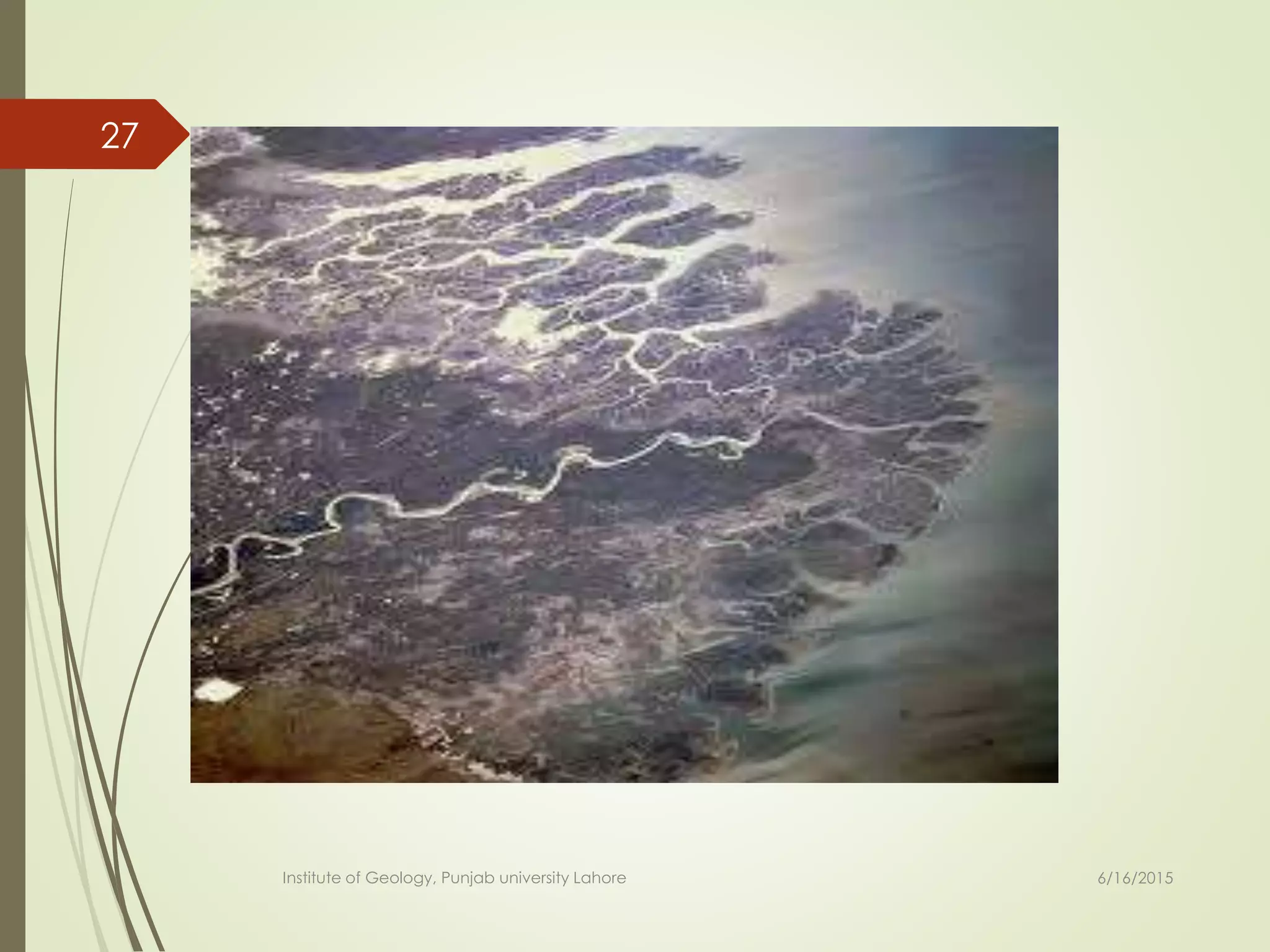
 The present delta of the Indus is typically
triangular in shape and extends from Thatta up
to the sea. It covers an area of approximately
2600km2.
 Indus River Delta receives the highest average
wave energy of any major delta in the world at a
water depth of 10m. At the shoreline the Indus
Delta receives more wave energy in one day
than the Mississippi Delta gets in one year.
 The sediment discharged by the Indus settle on
the continental shelf but some are also
transported to the southeast by long-shore
currents. The lower margin of deltaic flood plain
is also rimmed by the tidal delta.
6/16/2015
26
Institute of Geology, Punjab university Lahore
6/16/2015
27
Institute of Geology, Punjab university Lahore
Conclusions
 Deltas are important indicators of paleo-
climates, they provide us with drinking water,
and they can be good reservoirs for oil and gas.
 Deltas are commonly divided into constructive
deltas and destructive deltas.
 Modern delta characteristics can tell us about
ancient formations.
 In Pakistan, Indus River Delta is one of the largest
deltas of
the world which is destructive delta in its type.
6/16/2015
28
Institute of Geology, Punjab university Lahore
6/16/2015
29
Institute of Geology, Punjab university Lahore

Deltaic systems usmaan

  • 1.
    6/16/2015 1 Institute of Geology,Punjab university Lahore
  • 2.
  • 3.
    Presented to: Prof. Dr.Shahid Ghazi Presented by: UsMaan Sikandar Roll No. 29 6/16/2015 3 Institute of Geology, Punjab university Lahore
  • 4.
    Contents  Introduction  DeltaClassification  Fan Delta  Physiographic Characteristics of Deltas  Ancient Deltaic Systems  Indus River Delta  Conclusion 6/16/2015 4 Institute of Geology, Punjab university Lahore
  • 5.
    Introduction The term “delta”,the Greek character ∆, was used to describe the mouth of Nile by Herodotus nearly 2500 years ago. A modern definition of delta cites as “The sub- aerial and sub-aqueous contiguous sediment mass deposited in a body of water such as ocean or lake primarily by the action of a river”. 6/16/2015 5 Institute of Geology, Punjab university Lahore
  • 6.
    6/16/2015 6 Institute of Geology,Punjab university Lahore
  • 7.
    Introduction Deltas can formin lakes and inland seas as well as in the ocean, but they are most important in the open ocean. Much of the siliciclastic sediment transported to coastal zones throughout geologic time has been deposited in deltas. Conditions required forming deltas 1. The river must carry a large amount of sediments. 2. The waves or current along the coast must not be strong enough to remove the sediments deposited by the river, at least not faster than the river can deposit them. 3. The slope of the sea floor or lake at the river mouth must be gentle or flat. 6/16/2015 7 Institute of Geology, Punjab university Lahore
  • 8.
    6/16/2015 8 Institute of Geology,Punjab university Lahore
  • 9.
    Introduction Ancient deltaic depositshave been identified in stratigraphic successions of many ages, and deltaic sediments are known to be important hosts for petroleum and natural gas, coal, and some minerals such as uranium. Deltas are particularly common in the modern ocean owing to post-Pleistocene sea-level rise coupled with high sediment loads carried by many rivers. High sea level increases sedimentation rates on deltas because sediments are trapped by the rising water, inhibiting sediment removal by currents. 6/16/2015 9 Institute of Geology, Punjab university Lahore
  • 10.
    Delta Classification The distributionand characteristics of deltas are controlled by a complex set of interrelated fluvial and marine/lacustrine processes and environmental conditions such as:  climate  water and sediment discharge  river-mouth processes  near shore wave power  tides  near shore currents  winds  slope and inclination 6/16/2015 10 Institute of Geology, Punjab university Lahore
  • 11.
    Delta Classification Deltas canbe classified in several ways, however, classification on the basis of delta- front regime appears to be favored by most geologists. Deltas are classified thus as (1) Fluvial-dominated, (2) Tide-dominated, (3) Wave-dominated, (4) Mixed process-dominated 6/16/2015 11 Institute of Geology, Punjab university Lahore
  • 12.
    A classification ofdeltas based on dominant processes Dominant process Environments Sand facies Example FLUVIAL Radiating bird-foot distributary/ levee systems Radiating mouth bar sands Mississippi MARINE Waves Distributaries truncated by barrier sands Arcuate delta-front barrier sands Nile and Niger Tides Extensive tidal flats and scoured braided estuaries Delta-front sheet sand Ganges- Brahmaputr a 6/16/2015 12 Institute of Geology, Punjab university Lahore
  • 13.
    1-Fluvial-Dominated Deltas The dischargeof river water and sediment into a lake or ocean is referred to as a jet. This discharge may take place in following ways: 6/16/2015 13 Institute of Geology, Punjab university Lahore
  • 14.
    1-Fluvial-Dominated Deltas Homopycnal flow:occurs when the density of the river water is equal to the density of the standing water in the basin. This type of flow is associated with rapid mixing throughout the general flow. There is also abrupt deposition of the sediments carried to the basin by the river as the two water sources meet. 6/16/2015 14 Institute of Geology, Punjab university Lahore
  • 15.
    1-Fluvial-Dominated Deltas hyperpycnal flow:River water that has higher density than basin water flows beneath the basin water, commonly during floods, generating a vertically oriented, plane-jet flow called hyperpycnal flow. 6/16/2015 15 Institute of Geology, Punjab university Lahore
  • 16.
    hypopycnal flow: Ifriver outflow is less dense than basin water, as in rivers that flow into denser seawater or a saline lake, it flows outward on top of the basin water as a horizontally oriented plane jet called hypopycnal flow. 6/16/2015 16 Institute of Geology, Punjab university Lahore
  • 17.
    2-Tide-Dominated Deltas If tidalcurrents are stronger than river outflow, these bidirectional currents can redistribute river-mouth sedi- ments, producing sand-filled, funnel-shaped distributaries. The distributary mouth bar may be reworked into a series of linear tidal ridges that replace the bar and extend from within the channel mouth out onto the subaqueous delta-front platform. 6/16/2015 17 Institute of Geology, Punjab university Lahore
  • 18.
    3-Wave-Dominated Deltas Strong wavescause rapid diffusion and deceleration of river outflow and produce constricted or deflected river mouths. Distributary- mouth deposits are reworked by waves and are redistributed along the delta front by long shore currents to form wave-built shoreline features such as beaches, barrier bars, and spits. A smooth delta front, consisting of well-developed, coalescent beach ridges, may eventually be generated. 6/16/2015 18 Institute of Geology, Punjab university Lahore
  • 19.
    4-Mixed-Process Deltas Mixed-process deltas illustratesome differences in characteristics of modern deltas that are shaped by processes that are predominantly fluvial, tidal, or wave-related. 6/16/2015 19 Institute of Geology, Punjab university Lahore
  • 20.
    Fan delta A fandelta is a coastal prism of sediments delivered by an alluvial fan system and deposited, mainly or entirely sub- aqueously, at the interface between the active fan and a standing body of water. 6/16/2015 20 Institute of Geology, Punjab university Lahore
  • 21.
    Classification of deltastaking grain size, and hence sediment supply mechanisms, into account. (Modified from Orton & Reading 1993). 6/16/2015 21 Institute of Geology, Punjab university Lahore
  • 22.
    Physiographic Characteristics of Deltas Alldeltas can be divided into sub aerial and sub aqueous components, each of which can be further subdivided. Deltaic plain The sub-aerial component of deltas, generally larger than the subaqueous component. It is divided into  upper delta plain, which lies largely above high- tide level  lower delta plain, lying between low-tide mark and the upper limit of tidal influence. 6/16/2015 22 Institute of Geology, Punjab university Lahore
  • 23.
    Physiographic Characteristics of Deltas Thesubaqueous delta plain lies seaward of the lower deltaic plain below low-tide water level. Delta Front The uppermost part of the subaqueous delta, lying at water depths down to 10m or so. Pro-delta The remaining sea ward part of the subaqueous delta. The subaqueous delta may extend outward for distances of a few kilometers to tens of kilometers, and the pro-delta may extend to water depths as much as 200-300 m. 6/16/2015 23 Institute of Geology, Punjab university Lahore
  • 24.
    6/16/2015 24 Institute of Geology,Punjab university Lahore
  • 25.
    Ancient Deltaic systems Ancientdeltaic sediments have been reported in stratigraphic successions of most ages, but they appear to be particularly common in rocks of Carboniferous and Tertiary age. These deltaic sediments are known to be important hosts for petroleum and natural gas, coal, and some minerals. These deltas have same sedimentary processes which are present in modern deltaic systems. 6/16/2015 25 Institute of Geology, Punjab university Lahore
  • 26.
    Indus River Delta The present delta of the Indus is typically triangular in shape and extends from Thatta up to the sea. It covers an area of approximately 2600km2.  Indus River Delta receives the highest average wave energy of any major delta in the world at a water depth of 10m. At the shoreline the Indus Delta receives more wave energy in one day than the Mississippi Delta gets in one year.  The sediment discharged by the Indus settle on the continental shelf but some are also transported to the southeast by long-shore currents. The lower margin of deltaic flood plain is also rimmed by the tidal delta. 6/16/2015 26 Institute of Geology, Punjab university Lahore
  • 27.
    6/16/2015 27 Institute of Geology,Punjab university Lahore
  • 28.
    Conclusions  Deltas areimportant indicators of paleo- climates, they provide us with drinking water, and they can be good reservoirs for oil and gas.  Deltas are commonly divided into constructive deltas and destructive deltas.  Modern delta characteristics can tell us about ancient formations.  In Pakistan, Indus River Delta is one of the largest deltas of the world which is destructive delta in its type. 6/16/2015 28 Institute of Geology, Punjab university Lahore
  • 29.
    6/16/2015 29 Institute of Geology,Punjab university Lahore