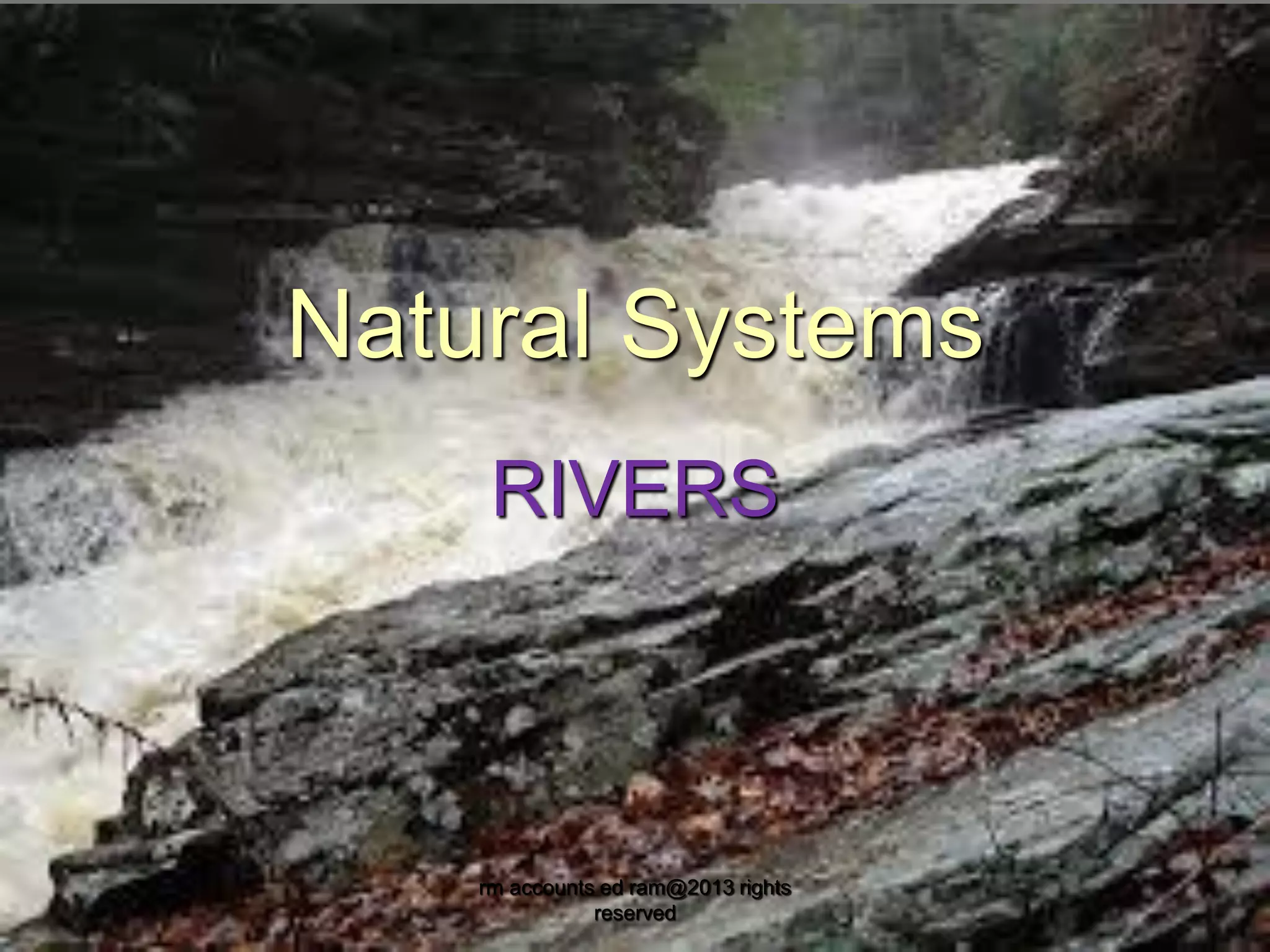
Natural Systems
RIVERS

rm accounts ed ram@2013 rights
reserved
Rivers
• Definition
– The natural flow of water from areas of
highland towards low-lying areas a long a
definite course (water course); and emptying itself
in
–
–
–
–
–

The Sea
Another river (tributary)
A Lake
A Swamp
A Swallow Hole (reemerge as springs)
rm accounts ed ram@2013 rights
reserved
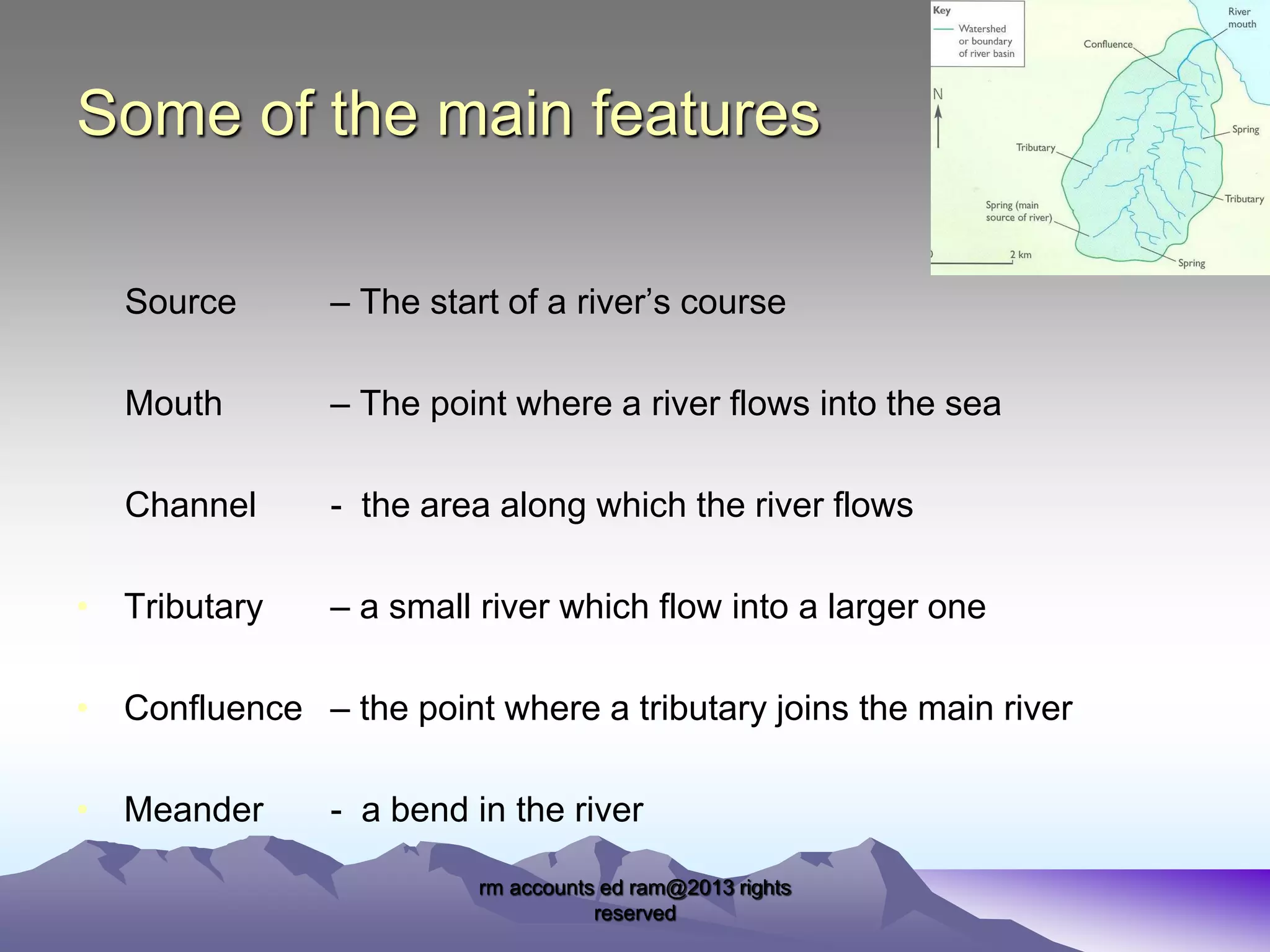
Some of the main features
Source

– The start of a river’s course

Mouth

– The point where a river flows into the sea

Channel

- the area along which the river flows

• Tributary

– a small river which flow into a larger one

• Confluence – the point where a tributary joins the main river
• Meander

- a bend in the river
rm accounts ed ram@2013 rights
reserved
Stream Ordering
Streams are ordered from the number 1
onward i.e. there are:
– 1st order streams (the main river)

– 2nd order streams (a tributary which feeds the main river)
– 3rd order streams (a tributary which feeds another tributary
which in turn feeds the main river)

rm accounts ed ram@2013 rights
reserved
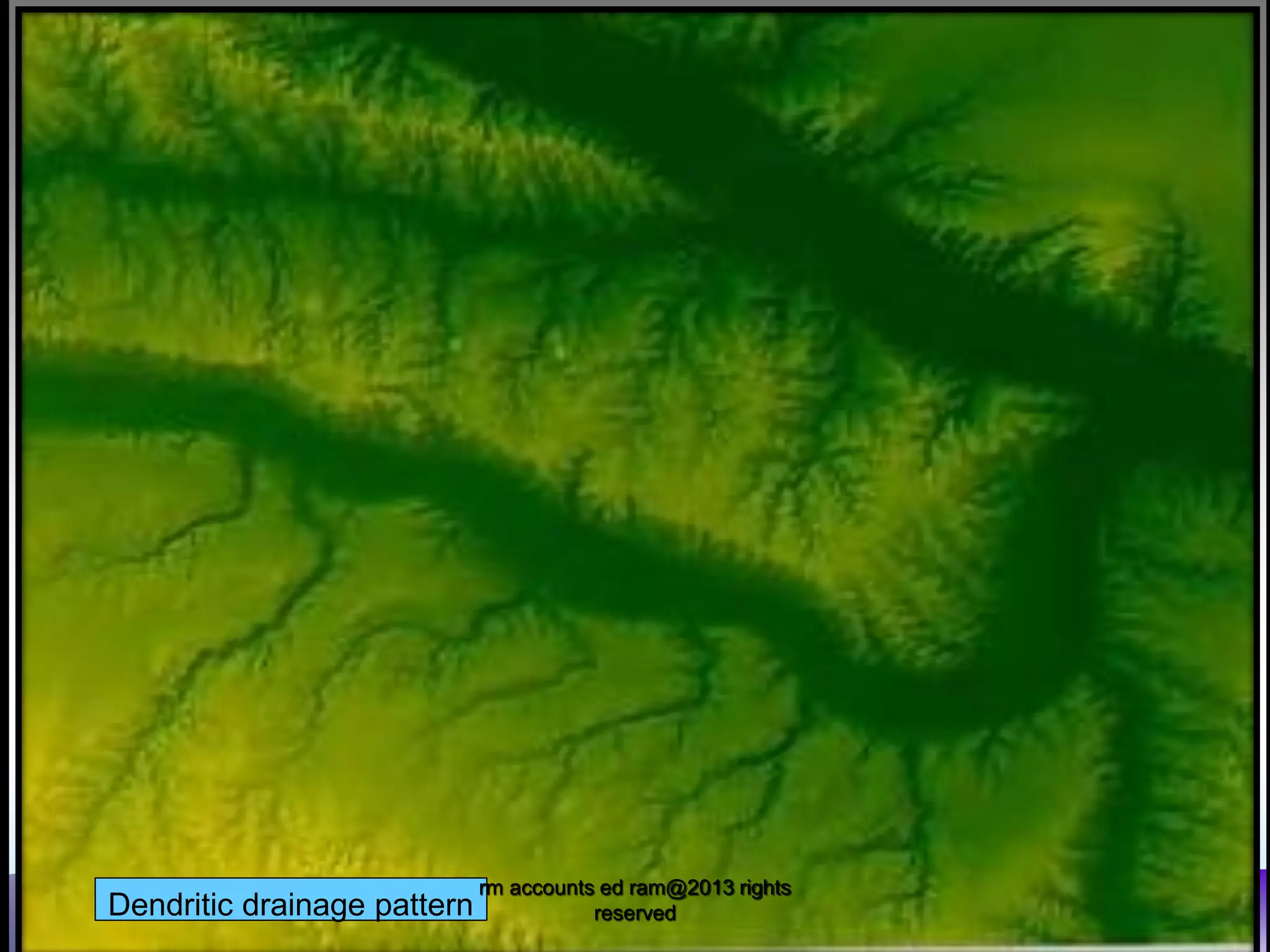
Dendritic drainage pattern

rm accounts ed ram@2013 rights
reserved
The drainage pattern is
• the pattern created by a river and its tributaries
as seen from above.
• the pattern is based on a number of factors:
– The type and structure of the underlying rock
– The shape of the land mass
– The topography (layout of the land)

rm accounts ed ram@2013 rights
reserved
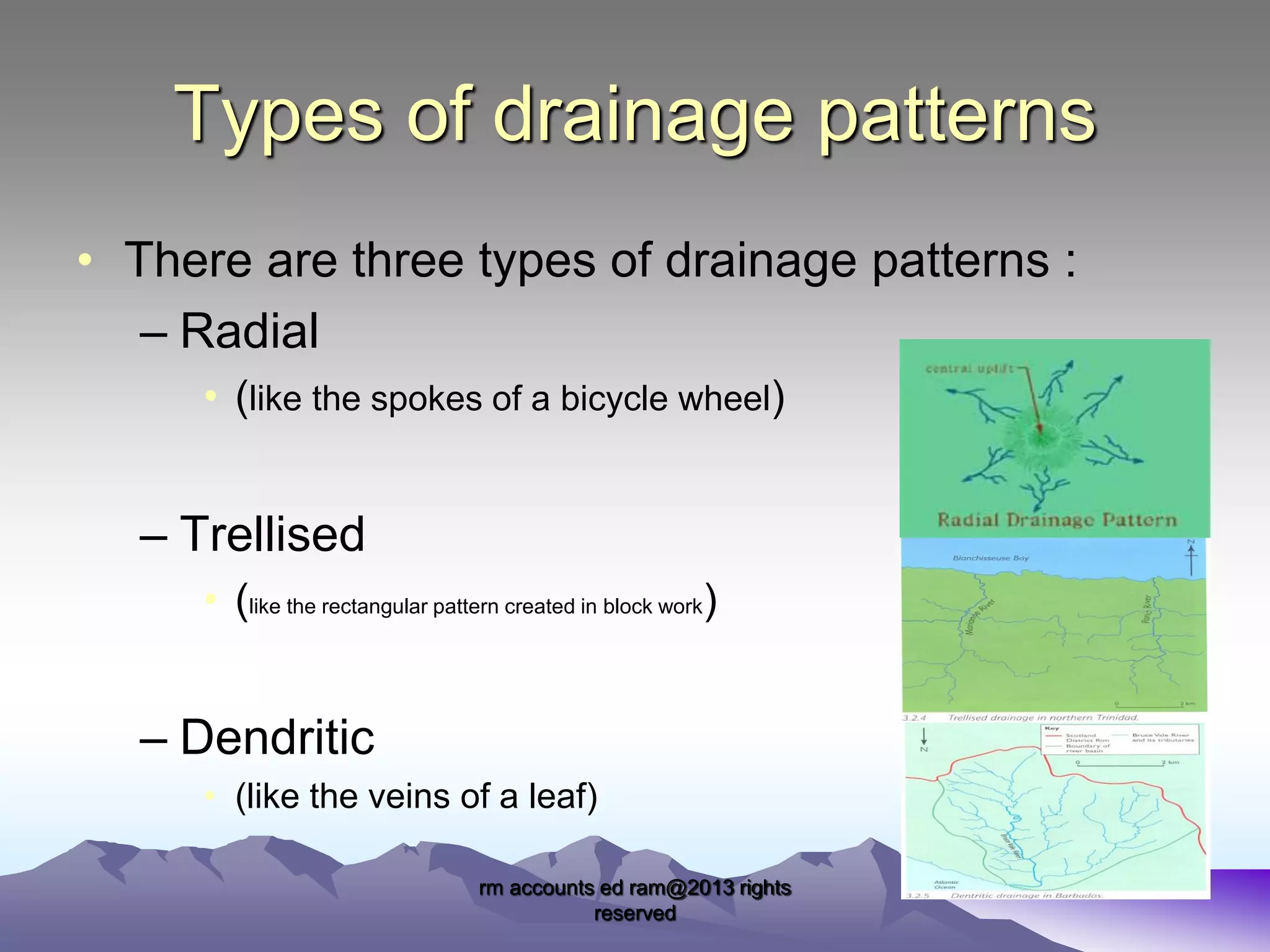
Types of drainage patterns
• There are three types of drainage patterns :
– Radial
• (like the spokes of a bicycle wheel)

– Trellised
• (like the rectangular pattern created in block work)

– Dendritic
• (like the veins of a leaf)
rm accounts ed ram@2013 rights
reserved
RIVERS
RIVER PROCESSES

rm accounts ed ram@2013 rights
reserved
Energy and Friction
• The type of work a river performs over time
depends on
– the size and shape of its channel,
– the volume of water it carries, as well as
– the land surface over which it flows.

• These factors determine the river’s speed
(friction factor) and its power (energy factor).

rm accounts ed ram@2013 rights
reserved
Rivers
• ERODE
– (wear away the earth’s surface due to its rapid speed and steep channel)

• TRANSPORT
– (remove eroded earth material due to loss of speed as channel widens and
gradient decreases)

• DEPOSIT
– (build up with eroded material due to its very slow speed and its relatively flat
and wide channel)

rm accounts ed ram@2013 rights
reserved
River Erosion involves…
• Corrosion

(the water dissolves and removes soluble material in its path)

• Abrasion

(the water scours the bed and sides of its channel with its load)

• Corrasion

(

[see abrasion] the water uses the load to mechanically gouge of areas of the channel

• Hydraulic Action (the force of the water dislodges material from the channel)

• Attrition

(the material in load bumps into each other an disintegrate)
rm accounts ed ram@2013 rights
reserved

)
River Transportation involves…
• Suspension (the lightest materials float along in the water’s currents)
• Traction

(

the heaviest materials bounce or roll along by the force of the water

• Saltation

(

some of the material hops and floats as the water moves downward

• Solution

(the dissolved minerals are carried along in the water itself)
rm accounts ed ram@2013 rights
reserved

)
)
Deposition is a result of…
• Rivers drop off their load when
– Gradient or slope of the river bed decreases
– The channel widens or becomes shallow
– It enters an arid region and loses discharge and
volume
– It reaches a lake or sea, slowing it down

rm accounts ed ram@2013 rights
reserved
rm accounts ed ram@2013 rights
reserved
RIVERS
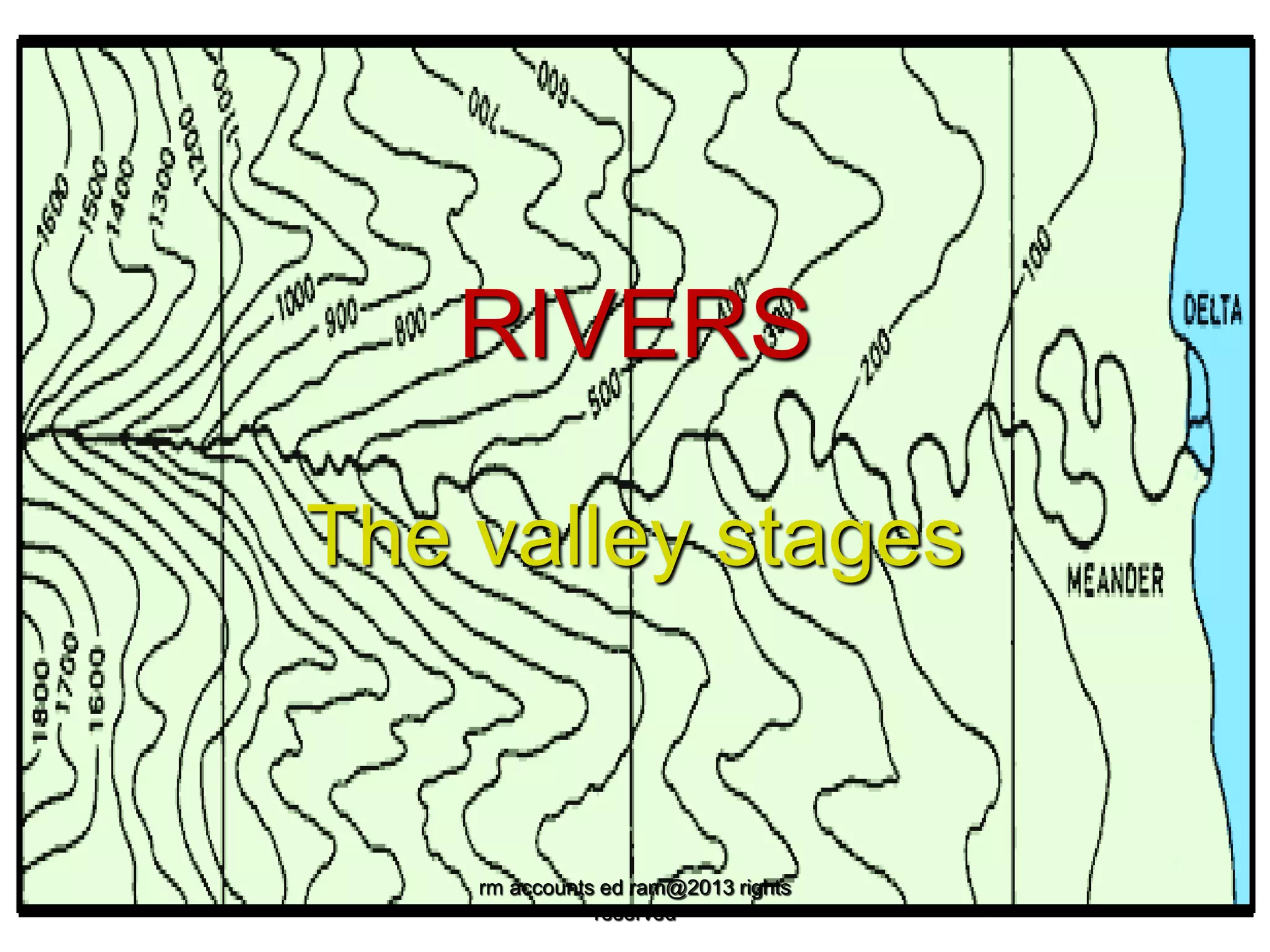
The valley stages

rm accounts ed ram@2013 rights
reserved
There are three life stages
• The Youthful stage

(Torrent, Upper)

• The Mature stage

(Middle)

• The Old Age stage

(Lower)

rm accounts ed ram@2013 rights
reserved
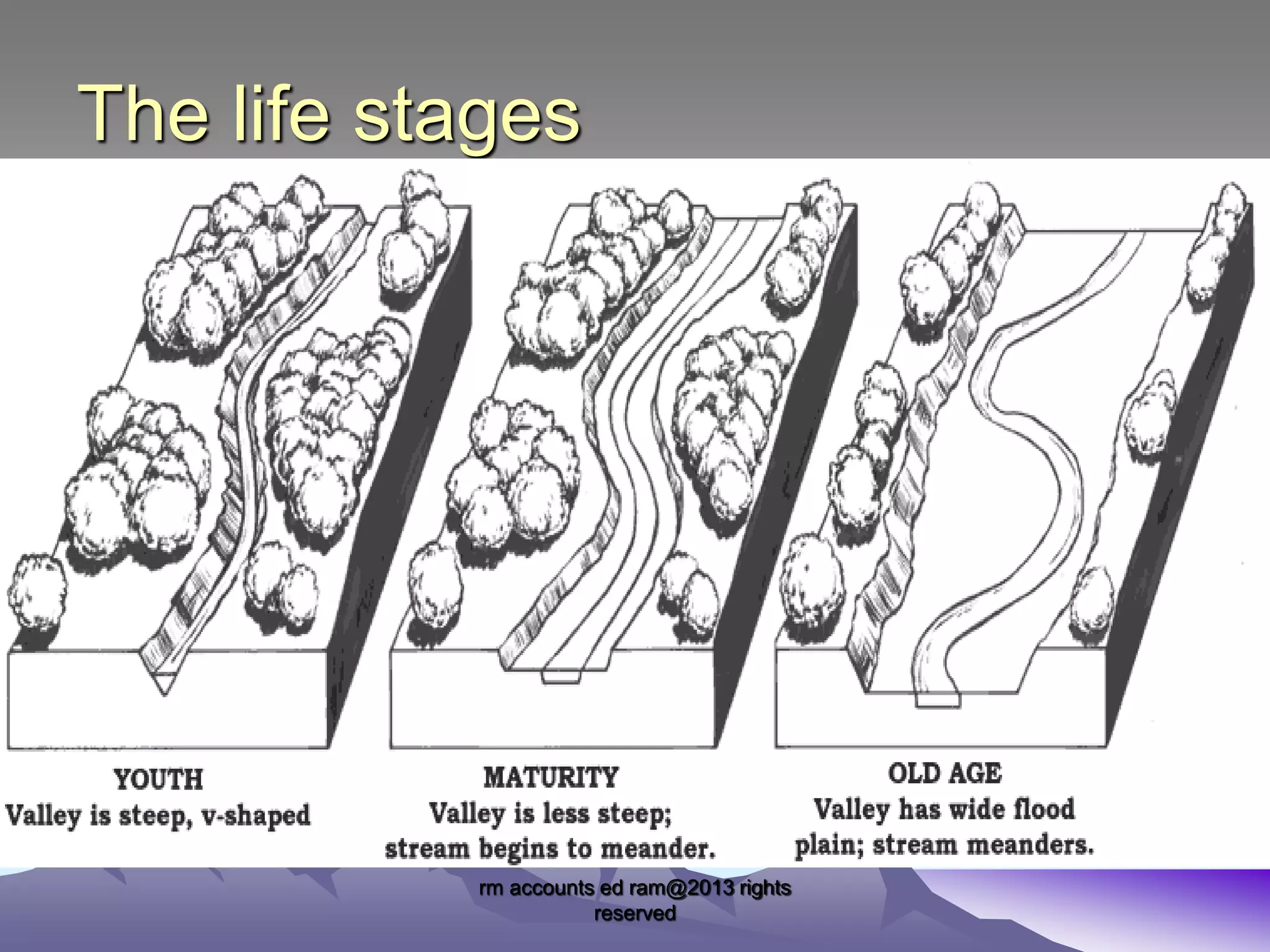
The life stages

rm accounts ed ram@2013 rights
reserved
Characteristics of the upper stage
– Gradient averages 1 in 10
– Vertical corrasion is dominant
– Valley sides are steep with a narrow V-shaped cross

section
– The river flows around spurs or interlocking spurs

rm accounts ed ram@2013 rights
reserved
rm accounts ed ram@2013 rights
reserved
Erosional features
• Potholes
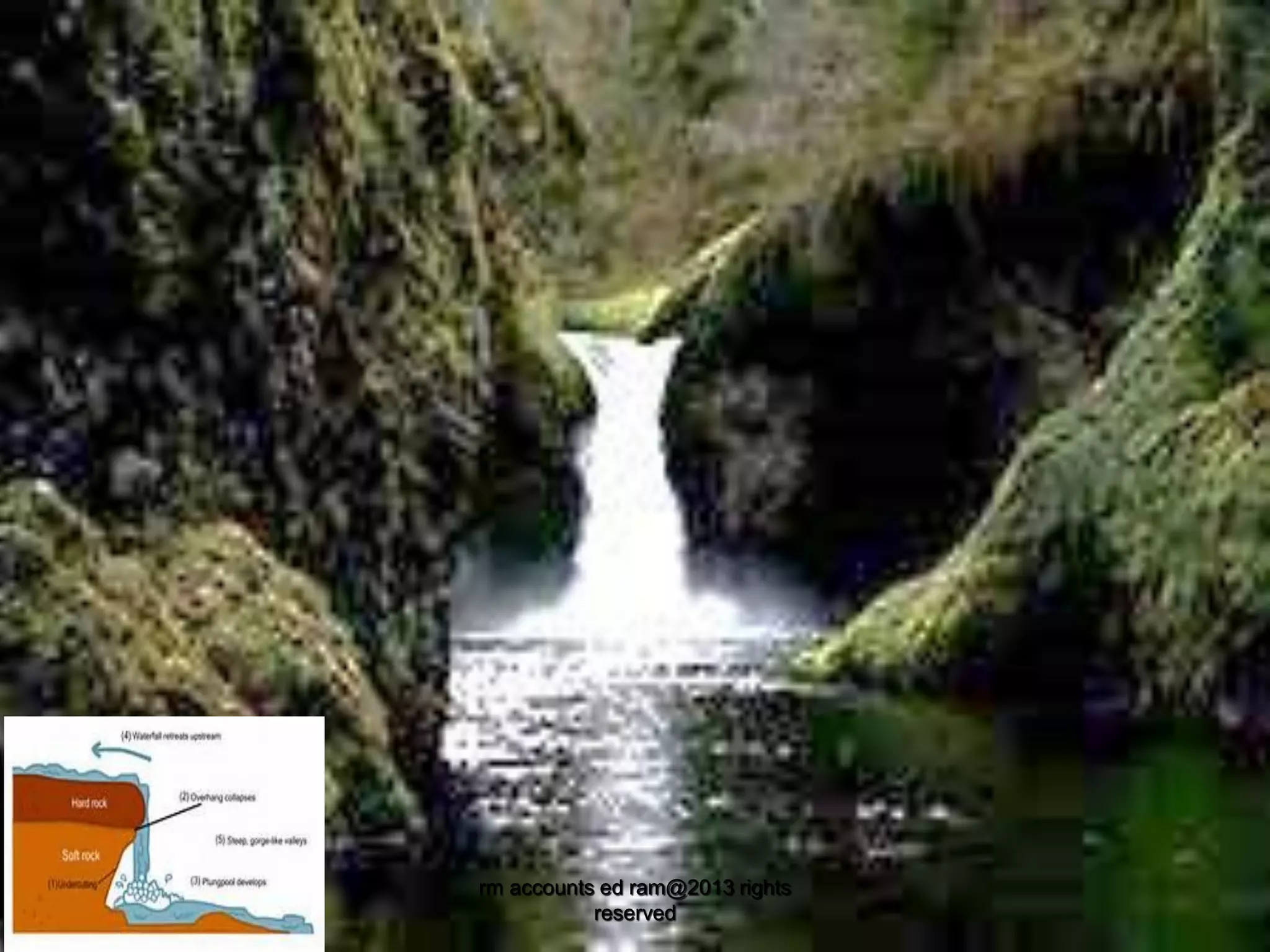
• Plunge pools

(explain how each is formed)

(circular depressions on the river bed)

(a large (deep) depression at the foot of a waterfall)

• Waterfalls

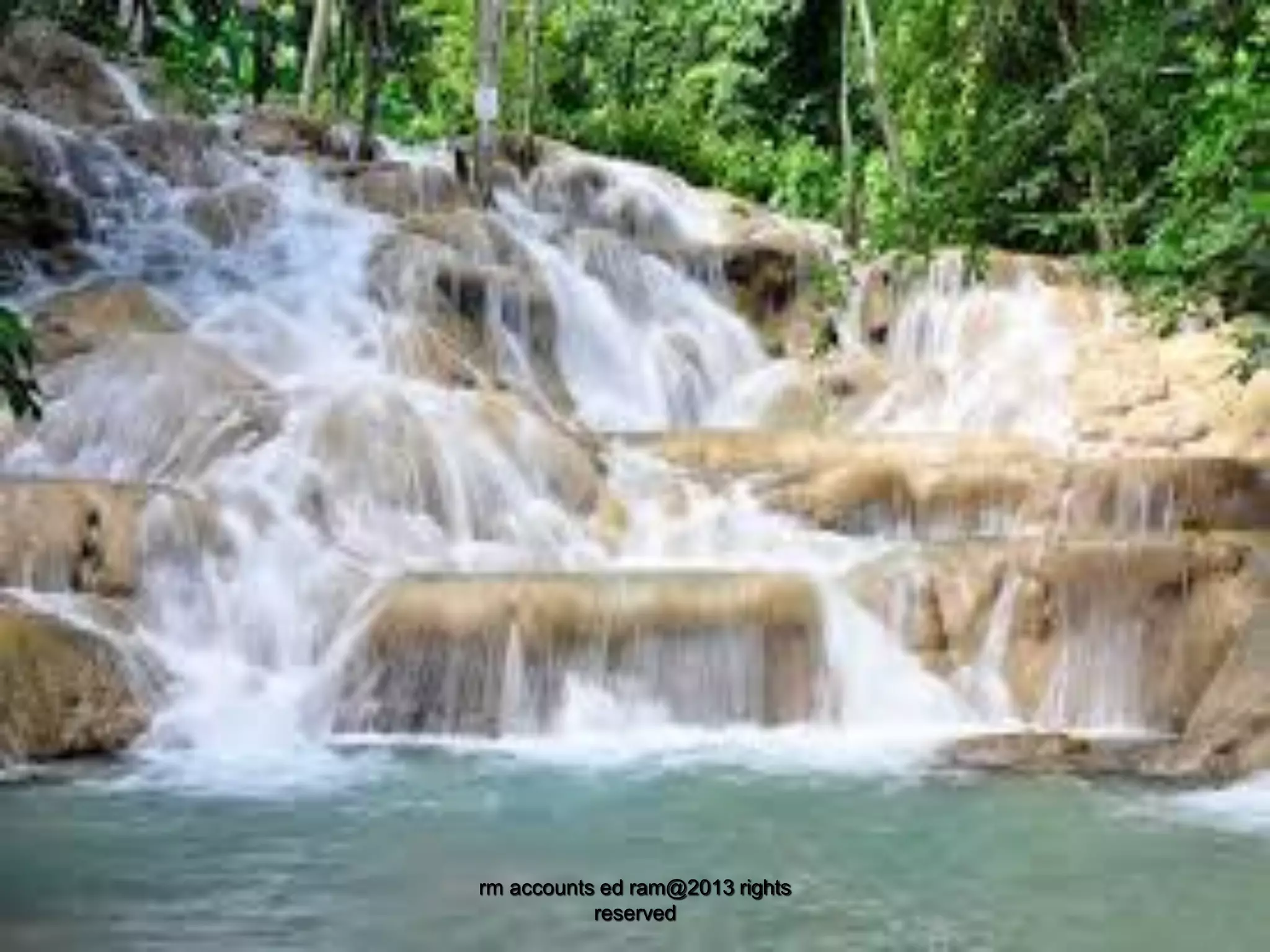
(fast moving vertical flow of water from great height)

• Rapids

(a series of short, fast falls)

• Gorges

(steep sided, deep, narrow valleys)

•

rm accounts ed ram@2013 rights
reserved
rm accounts ed ram@2013 rights
reserved
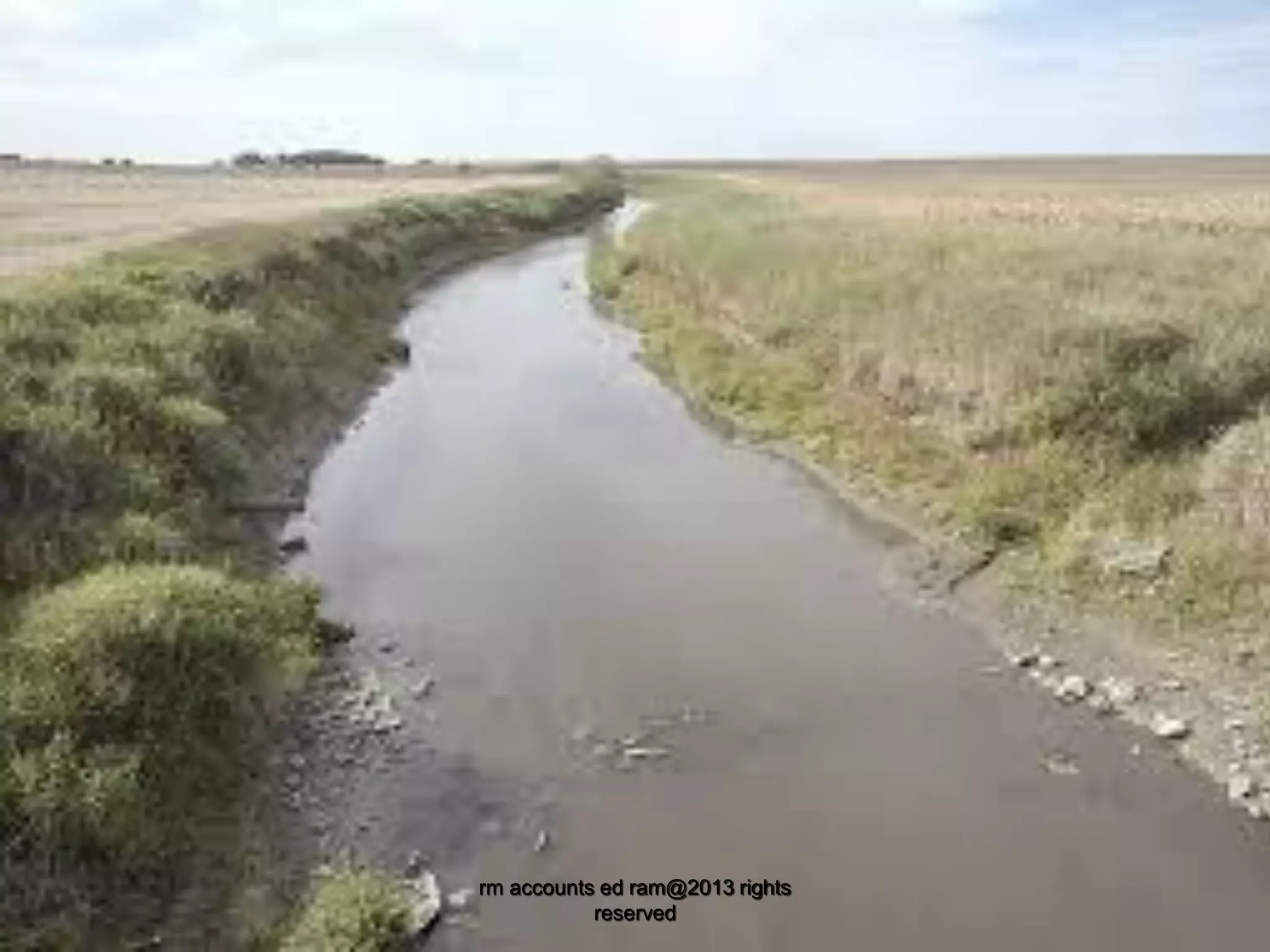
Characteristics of the middle stage
– Gradient is not as steep as the Youthful stage
– lateral erosion is dominant
– Valley sides are less steep with an open V-shaped

(closer to a U) cross section
– The river flows appear to meander across the channel
as the interlocking spurs are being cut away.

rm accounts ed ram@2013 rights
reserved
rm accounts ed ram@2013 rights
reserved
Characteristics of the old age stage
– Gradient is rather low

– deposition is dominant
– Valley has a flat bedded U shaped (like a box) cross section
creating a wide flood plain.
– The river flows slowly as meanders are more pronounced.
– Silting and emerging vegetation hampers its flow in some areas.

rm accounts ed ram@2013 rights
reserved
rm accounts ed ram@2013 rights
reserved
Depositional features
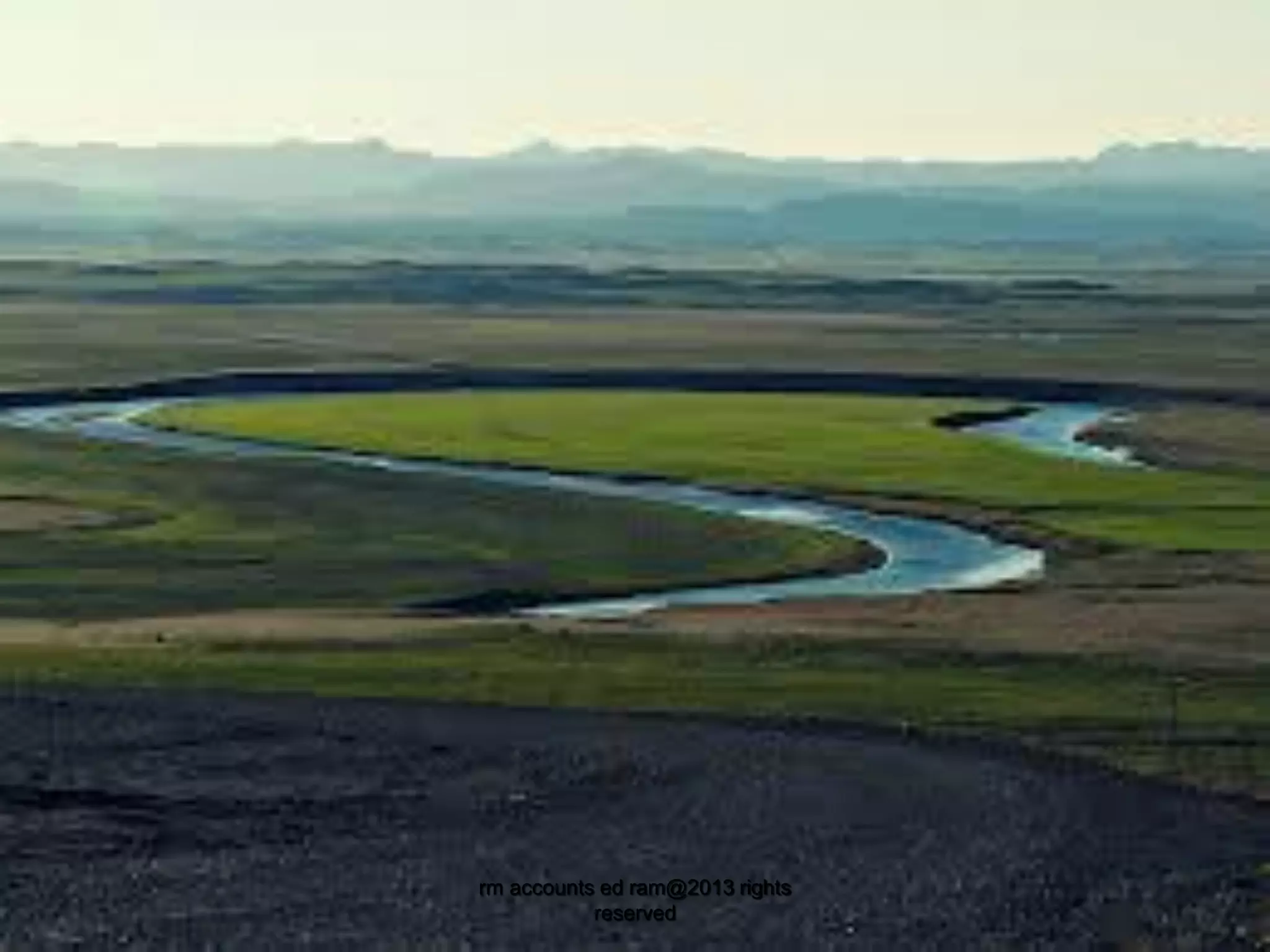
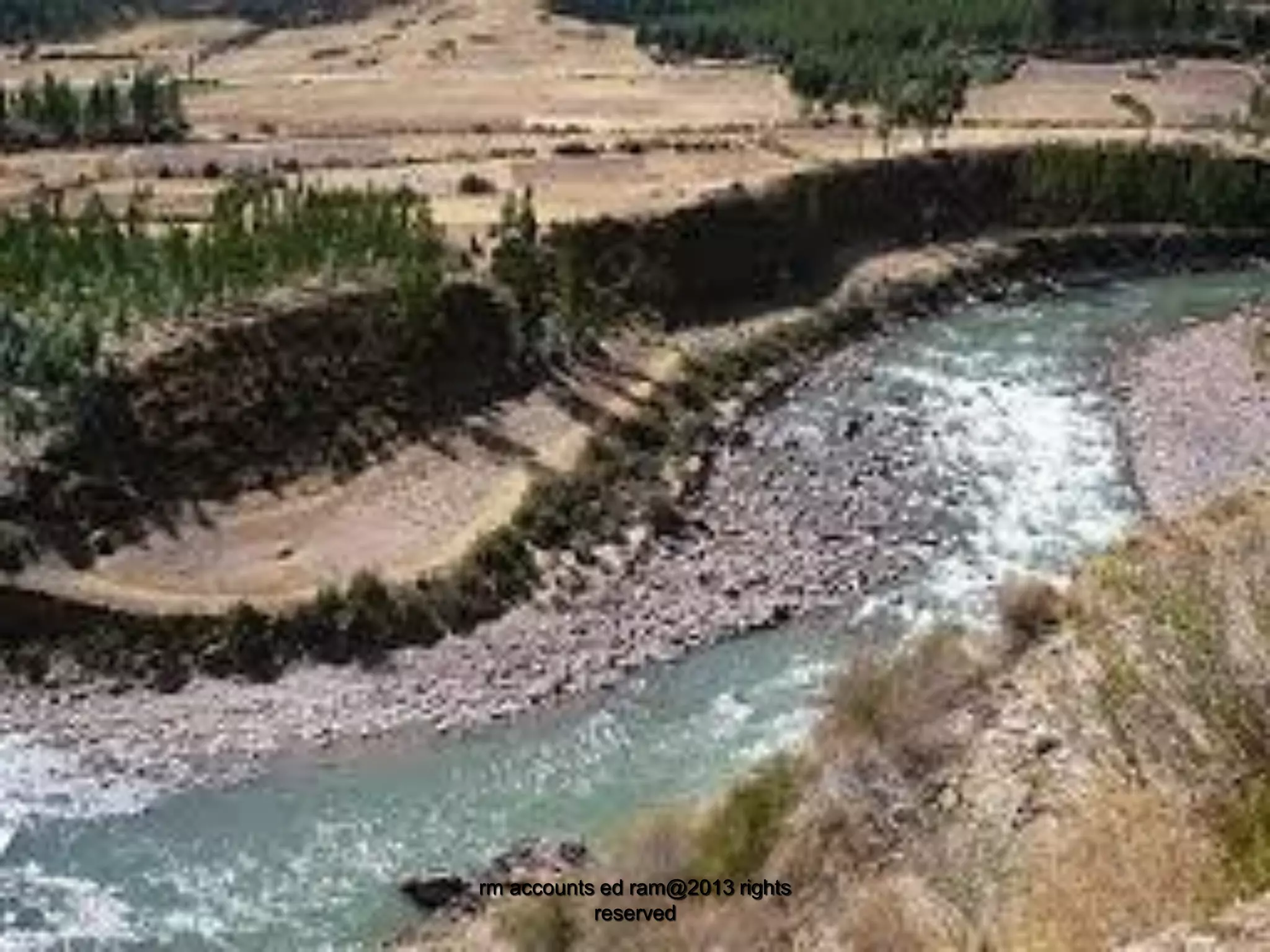
• Meanders

(explain how each is formed)

(a loop or definite bend in the river)

• Ox-bow lake (a crescent-shaped lake at the cut off of a meander’s neck)
• Deltas

(a flat piece of land built up by deposits at the river’s mouth)

• Flood plains

(a low-lying plain resulting from continuous overflowing of the river’s banks)

• Levees

(natural embankments built up by the river on the banks of the channel)

•

rm accounts ed ram@2013 rights
reserved
rm accounts ed ram@2013 rights
reserved
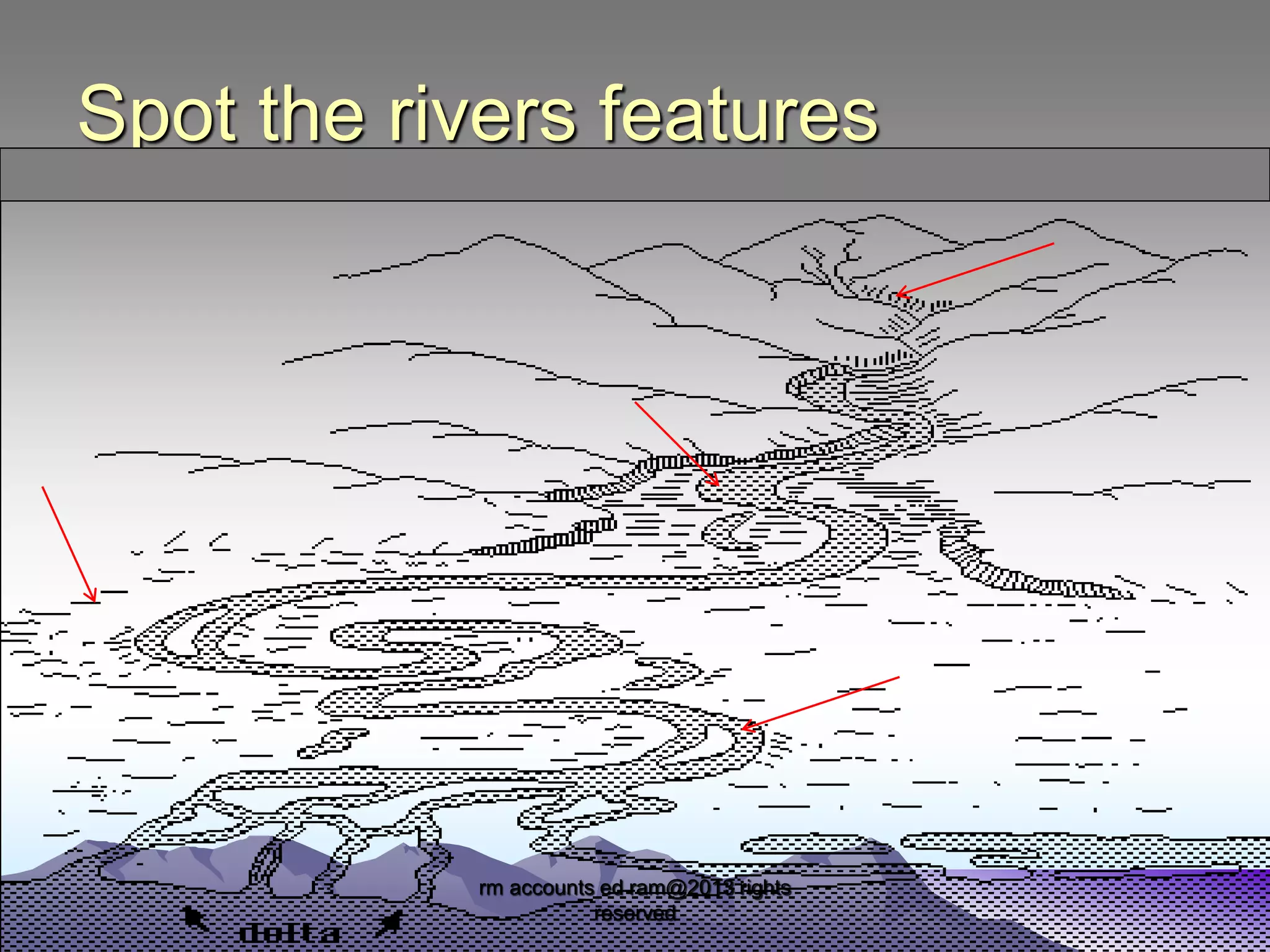
Spot the rivers features

rm accounts ed ram@2013 rights
reserved

Rivers CSEC Geography

  • 1.
    Natural Systems RIVERS rm accountsed ram@2013 rights reserved
  • 2.
    Rivers • Definition – Thenatural flow of water from areas of highland towards low-lying areas a long a definite course (water course); and emptying itself in – – – – – The Sea Another river (tributary) A Lake A Swamp A Swallow Hole (reemerge as springs) rm accounts ed ram@2013 rights reserved
  • 3.
    Some of themain features Source – The start of a river’s course Mouth – The point where a river flows into the sea Channel - the area along which the river flows • Tributary – a small river which flow into a larger one • Confluence – the point where a tributary joins the main river • Meander - a bend in the river rm accounts ed ram@2013 rights reserved
  • 4.
    Stream Ordering Streams areordered from the number 1 onward i.e. there are: – 1st order streams (the main river) – 2nd order streams (a tributary which feeds the main river) – 3rd order streams (a tributary which feeds another tributary which in turn feeds the main river) rm accounts ed ram@2013 rights reserved
  • 5.
    Dendritic drainage pattern rmaccounts ed ram@2013 rights reserved
  • 6.
    The drainage patternis • the pattern created by a river and its tributaries as seen from above. • the pattern is based on a number of factors: – The type and structure of the underlying rock – The shape of the land mass – The topography (layout of the land) rm accounts ed ram@2013 rights reserved
  • 7.
    Types of drainagepatterns • There are three types of drainage patterns : – Radial • (like the spokes of a bicycle wheel) – Trellised • (like the rectangular pattern created in block work) – Dendritic • (like the veins of a leaf) rm accounts ed ram@2013 rights reserved
  • 8.
    RIVERS RIVER PROCESSES rm accountsed ram@2013 rights reserved
  • 9.
    Energy and Friction •The type of work a river performs over time depends on – the size and shape of its channel, – the volume of water it carries, as well as – the land surface over which it flows. • These factors determine the river’s speed (friction factor) and its power (energy factor). rm accounts ed ram@2013 rights reserved
  • 10.
    Rivers • ERODE – (wearaway the earth’s surface due to its rapid speed and steep channel) • TRANSPORT – (remove eroded earth material due to loss of speed as channel widens and gradient decreases) • DEPOSIT – (build up with eroded material due to its very slow speed and its relatively flat and wide channel) rm accounts ed ram@2013 rights reserved
  • 11.
    River Erosion involves… •Corrosion (the water dissolves and removes soluble material in its path) • Abrasion (the water scours the bed and sides of its channel with its load) • Corrasion ( [see abrasion] the water uses the load to mechanically gouge of areas of the channel • Hydraulic Action (the force of the water dislodges material from the channel) • Attrition (the material in load bumps into each other an disintegrate) rm accounts ed ram@2013 rights reserved )
  • 12.
    River Transportation involves… •Suspension (the lightest materials float along in the water’s currents) • Traction ( the heaviest materials bounce or roll along by the force of the water • Saltation ( some of the material hops and floats as the water moves downward • Solution (the dissolved minerals are carried along in the water itself) rm accounts ed ram@2013 rights reserved ) )
  • 13.
    Deposition is aresult of… • Rivers drop off their load when – Gradient or slope of the river bed decreases – The channel widens or becomes shallow – It enters an arid region and loses discharge and volume – It reaches a lake or sea, slowing it down rm accounts ed ram@2013 rights reserved
  • 14.
    rm accounts edram@2013 rights reserved
  • 15.
    RIVERS The valley stages rmaccounts ed ram@2013 rights reserved
  • 16.
    There are threelife stages • The Youthful stage (Torrent, Upper) • The Mature stage (Middle) • The Old Age stage (Lower) rm accounts ed ram@2013 rights reserved
  • 17.
    The life stages rmaccounts ed ram@2013 rights reserved
  • 18.
    Characteristics of theupper stage – Gradient averages 1 in 10 – Vertical corrasion is dominant – Valley sides are steep with a narrow V-shaped cross section – The river flows around spurs or interlocking spurs rm accounts ed ram@2013 rights reserved
  • 19.
    rm accounts edram@2013 rights reserved
  • 20.
    Erosional features • Potholes •Plunge pools (explain how each is formed) (circular depressions on the river bed) (a large (deep) depression at the foot of a waterfall) • Waterfalls (fast moving vertical flow of water from great height) • Rapids (a series of short, fast falls) • Gorges (steep sided, deep, narrow valleys) • rm accounts ed ram@2013 rights reserved
  • 21.
    rm accounts edram@2013 rights reserved
  • 22.
    Characteristics of themiddle stage – Gradient is not as steep as the Youthful stage – lateral erosion is dominant – Valley sides are less steep with an open V-shaped (closer to a U) cross section – The river flows appear to meander across the channel as the interlocking spurs are being cut away. rm accounts ed ram@2013 rights reserved
  • 23.
    rm accounts edram@2013 rights reserved
  • 24.
    Characteristics of theold age stage – Gradient is rather low – deposition is dominant – Valley has a flat bedded U shaped (like a box) cross section creating a wide flood plain. – The river flows slowly as meanders are more pronounced. – Silting and emerging vegetation hampers its flow in some areas. rm accounts ed ram@2013 rights reserved
  • 25.
    rm accounts edram@2013 rights reserved
  • 26.
    Depositional features • Meanders (explainhow each is formed) (a loop or definite bend in the river) • Ox-bow lake (a crescent-shaped lake at the cut off of a meander’s neck) • Deltas (a flat piece of land built up by deposits at the river’s mouth) • Flood plains (a low-lying plain resulting from continuous overflowing of the river’s banks) • Levees (natural embankments built up by the river on the banks of the channel) • rm accounts ed ram@2013 rights reserved
  • 27.
    rm accounts edram@2013 rights reserved
  • 28.
    Spot the riversfeatures rm accounts ed ram@2013 rights reserved