Allegheny River Navigation ChartsAllegheny River Navigation Charts
Pittsburgh, Pennsylvania to East Brady, Pennsylvania
January 2004
NOTE: LOCKS 5 THRU 9 HAVE LIMITED HOURS OF OPERATION
FOR HOURS OF OPERATION, CONTACT ONE OF THE
FOLLOWING;
PITTSBURGH DISTRICT OFFICE (412)395-7171
OHIO-ALLEGHENY AREA OFFICE (412)395-7650/7654
CALL FRONT COVER:
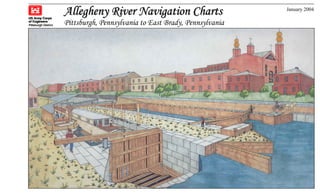
(412) 936-1212 ALLEHENY LIFT LOCK NO. 4 & WEIGH LOCK 1829 -1861
TO HEAR IF HAZARDOUS Artist rendering by GAI, Inc. based on sketch from
BOATING CONDITIONS EXIST. Pennsylvania Archives.
NAVIGATION CHARTS
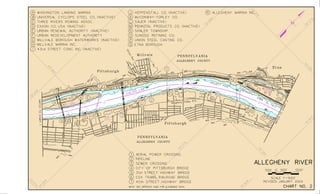
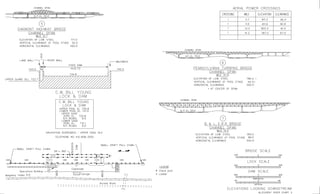
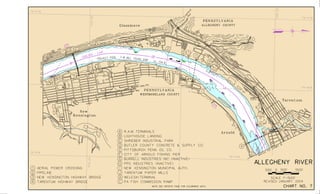
ALLEGHENY RIVER
U.S. ARMY ENGINEER DISTRICT, PITTSBURGH
PITTSBURGH, PA. TO EAST BRADY, PA.
U.S. ARMY ENGINEER DISTRICT, PITTSBURGH
WILLIAM S. MOORHEAD FEDERAL BUILDING
1000 LIBERTY AVENUE
PITTSBURGH, PENNSYLVANIA 15222-4186
BRIEF INDEX
GENERAL NOTES................................................................................................................................................................................................................................... SHEET A
REGULATIONS, SECTION 7 OF RIVER AND HARBOR ACT 1917......................................................................................................................SHEETS B THROUGH E
EXTRACTS FROM SECTIONS OF THE RIVER AND HARBOR ACT OF 1899..............................................................................................................SHEETS F AND G
U.S. COAST GUARD INFORMATION.................................................................................................................................................................................................. SHEET H
CHARACTERISTICS OF LIGHTS AND NOTES ...................................................................................................................................................................................SHEET I
AIDS TO NAVIGATION AND LEGEND ................................................................................................................................................................................................SHEET J
TABULAR INDEX TO NAVIGATION CHARTS................................................................................................................................................................................. SHEET K
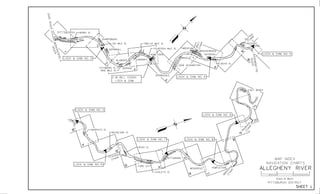
MAP INDEX TO NAVIGATION CHARTS ............................................................................................................................................................................................SHEET L
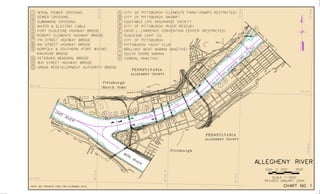
NAVIGATION CHARTS .......................................................................................................................................................................................................NOS. 1 TO 21 INCL.
ALLEGHENY RIVER TERMINALS ............................................................................................................................................................................SHEETS 1 THROUGH 3
ALLEGHENY RIVER SMALL BOAT HARBORS, RAMPS, LANDINGS, ETC....................................................................................................SHEETS 4 THROUGH 10
Revised: 1 January 2004
Information shown on this chart is a general depiction of the waterway and adjacent areas only and is not in anyway to be construed as representing precise or accurate dimensions, portrayals, features, or other data. Major changes which
occur will be published in “NOTICES TO NAVIGATION INTERESTS.”
The general locations of AIDS-TO NAVIGATION are shown, as they existed on the last editing date of this book. They may subsequently have been moved, destroyed or discontinued. They should in no event be used to fix the position
of a vessel.
The following applies for Charts 1 through 10:
The source mapping used to develop and portray the information shown on these charts were compiled from aerial photography exposed in 1992 and 1993. The Geographic Coordinates represented were converted from the source mapping
Horizontal Grid Data, State Plane Coordinate System, Pennsylvania South Zone, NAD 83 (86) utilizing Conversion software. The grid annotated on these charts are for general reference and not to be used for precise location of features.
The minimum channel depth depicted on these charts was developed from soundings data obtained on June 1992, and June 1996 for charts 1 thru 10.
The following applies for Charts 10 through 21:
The source mapping used to develop and portray the information shown on these charts were compiled from aerial photography exposed in 1999. The Geographic Coordinates represented were converted from the source mapping
Horizontal Grid Data, State Plane Coordinate System, Pennsylvania South Zone, NAD 83 (86) utilizing Conversion software. The grid annotated on these charts are for general reference and not to be used for precise location of features.
NAVIGATION CHARTS AND NOTICES
Spiral-bound Allegheny, Monongahela and Ohio River Navigation Charts are
available for purchase from the U.S. Government Printing Office by internet,
telephone, fax or mail order.
Internet U.S. Government Online Bookstore at
http://bookstore.gpo.gov
Telephone (202) 512-1800 or Toll-Free (866) 512-1800
Monday through Friday, 7:30 a.m. - 9:00 p.m. EST
Fax (202) 512-2250
Mail Order Superintendent of Documents
P.O. Box 371954
Pittsburgh, PA 15250-7954
Payment must accompany all orders and can be made by check, money order,
Visa, MasterCard, Discover/NOVUS, American Express or Superintendent of
Documents Deposit Account. Checks and money orders should be made
payable to the Superintendent of Documents. All credit card orders must
include the account number and expiration date of the credit card. Payments
made by Superintendent of Documents deposit account must include the
account number.
When ordering by internet, enter "River Navigation Charts" in the Search the
Sales Product Catalog field and click on the Submit button. Click on the Add to
Cart icon and follow the instructions provided to order your navigation chart(s).
Information on how to order spiral-bound copies of navigation charts for the
Allegheny, Monongahela and Ohio Rivers is also available on the Pittsburgh
District internet site at www.lrp.usace.army.mil/nav/navcharts.htm. Links to
access navigation charts outside the Pittsburgh District boundaries are also
available on our internet site.
Notices to Navigation Interests, containing data on channel conditions and
location of dredges, are issued as occasions demand. Pittsburgh District’s
Notices to Navigation Interests are available on our internet site
(www.lrp.usace.army.mil) for viewing and printing. Interested parties, who
send a request to:
Chief, Regulatory Branch
U.S. Army Engineer District, Pittsburgh
William S. Moorhead Federal Building
1000 Liberty Avenue
Pittsburgh, PA 15222-4186
are placed on a mailing list to receive either electronic or printed copies of
these notices.
NAVIGATION CHARTS
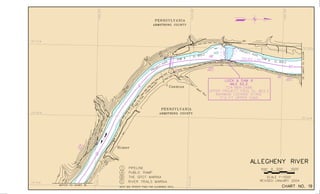
Allegheny River: Charts 1 – 21
Monongahela River: Charts 1 – 34
Ohio River (Cairo, IL to Foster, KY): Charts 1 – 122
Ohio River (Foster, KY to New Martinsville, WV): Charts 122 – 186
Ohio River (New Martinsville, WV to Pittsburgh, PA): Charts 187 – 224
MILE POINTS
Mile points are shown on the charts at one mile intervals, with figures
designating mileage above (the Point) Pittsburgh, Pennsylvania.
BUOYS
Buoys used to mark channels in the Mississippi River System conform to the
standard lateral system of buoyage on the Western Rivers of the United
States. Generally, the unlighted buoys in the Allegheny, Monongahela and
Ohio Rivers are equipped with radar reflectors. All buoys are equipped with
reflective material; buoys on the left descending side of the channel reflect red;
buoys on the right descending side of the channel reflect green.
GAGES
All gages read 9 feet at normal pool level, except as otherwise noted on charts.
All elevations based on N.G.V.D. (National Geodetic Vertical Datum).
PERMITS-JURISDICTION
In the administration of laws enacted by Congress for the protection and
preservation of navigation and the navigable waters of the United States, the
U.S. Army Corps of Engineers exercises jurisdiction over the Allegheny,
Monongahela and Ohio Rivers. Work or structures in, under, or over the
Allegheny, Monongahela and Ohio Rivers between the limits of ordinary high
water lines on both banks of the stream require prior authorization. Inquiries
regarding permits for such work or structures should be addressed to:
District Engineer
U.S. Army Engineer District, Pittsburgh
William S. Moorhead Federal Building
1000 Liberty Avenue
Pittsburgh, PA 15222-4186
or may be made by telephone to: (412) 395-7152
PITTSBURGH DISTRICT INTERNET
SITES OF INTEREST TO NAVIGATION
Pittsburgh District:
www.lrp.usace.army.mil
Navigation Chart Information:
www.lrp.usace.army.mil/nav/navcharts.htm
Notices to Navigation Interests:
www.lrp.usace.army.mil/or/navrpt.htm
Current River Conditions:
http://wmw.lrp.usace.army.mil/current
Permit and Regulatory Information:
www.lrp.usace.army.mil/or/or-f/permits.htm
GENERAL NOTES
NAVIGATION CHARTS
ALLEGHENY RIVER
U.S. ARMY ENGINEER DISTRICT, PITTSBURGH
Revised: 1 January 2004
SHEET A
REGULATIONS
PRESCRIBED BY THE SECRETARY OF THE ARMY FOR THE
OHIO AND MISSISSIPPI RIVERS, ABOVE CAIRO, IL, AND THEIR TRIBUTARIES;
USE, ADMINISTRATION AND NAVIGATION
THE LAW
Section 7 of the River and harbor Act of August 8, 1917, provides
as follows:
"That it shall be the duty of the Secretary of War to prescribe
such regulations for the use, administration, and navigation of the
navigable waters of the United States as in his judgment the public
necessity may require for the protection of life and property, or of
operations of the United States in channel improvement, covering all
matters not specifically delegated by law to some other executive
department. Such regulations shall be posted, in conspicuous and
appropriate places, for the information of the public; and every
person and every corporation which shall violate such regulations
shall be deemed guilty of a misdemeanor and, on conviction thereof
in any district court of the United States within those territorial
jurisdiction such offense may have been committed, shall be
punished by a fine not exceeding $500, or by imprisonment (in the
case of a natural person) not exceeding six months, in the discretion
of the court."
In pursuance of the law above quoted, the following regulations
were prescribed to govern the use, administration, and navigation of
the Ohio River above Cairo, Ill., and its tributaries.
207.300 Ohio River, above Cairo, Ill., and their tributaries; use,
administration, and navigation.
(a) Authority of Lockmasters. The lockmaster shall be charged
with the immediate control and management of the lock, and of the
area set aside as the lock area, including the lock approach
channels. He shall see that all laws, rules, and regulations for the
use of the lock and lock area are duly complied with, to which end
he is authorized to give all necessary orders and directions in
accordance therewith, both to employees of the Government and to
any and every person within the limits of the lock or lock area,
whether navigating the lock or not. No one shall cause any
movement of any vessel, boat, or other floating thing in the lock or
approaches except by or under the direction of the lockmaster or
his assistant. In the event of an emergency, the lockmaster may
depart from these regulations as he deems necessary. The
lockmasters shall also be charged with the control and
management of Federally constructed mooring facilities.
(b) Safety Rules for Vessels Using Navigation Locks. The
following safety rules are hereby prescribed for vessels in the
locking process, including the act of approaching or departing a
lock:
(1)Tows with Flammable or Hazardous Cargo Barges, Loaded
or Empty.
(i) Stripping barges or transferring cargo is prohibited.
(ii) All hatches on barges used to transport flammable or
hazardous materials shall be closed and latched, except those
barges carrying a gas-free certificate.
(iii) Spark-proof protective rubbing fenders ("possums") shall
be used.
(2) All Vessels.
(i) Leaking vessels may be excluded from locks until they have
been repaired to the satisfaction of the lockmaster.
(ii) Smoking, open flames, and chipping or other spark-
producing activities are prohibited on deck during the locking cycle.
(iii) Painting will not be permitted in the lock chamber during
the locking cycle.
(iv) Tow speeds shall be reduced to a rate of travel such that
the tow can be stopped by checking should mechanical difficulties
develop. Pilots should check with the individual lockmasters
concerning prevailing conditions. It is also
recommended that pilots check their ability to reverse their
energies prior to beginning an approach. Engines shall not be
turned of in the lock until the tow has stopped and been made
fast.
(v) U.S. Coast Guard Regulations require all vessels to have on
board life saving devices for prevention of drowning. All crew
members of vessels required to carry work vests (life jackets) shall
wear them during a lockage, except those persons in an area
enclosed with a handrail or other device which would reasonably
preclude the possibility of falling overboard. All deckhands
handling lines during locking procedures shall wear a life jacket.
Vessels not required by Coast Guard Regulations to have work
vests aboard shall have at least the prescribed life saving devices,
located for ready access and use if needed. The lockmaster may
refuse lockage to any vessel which fails to conform to the above.
(c) Reporting of Navigation Incidents. In furtherance of
increased safety on waterways the following safety rules are
hereby prescribed for all navigation interests:
(1) Any incident resulting in uncontrolled barges shall
immediately be reported to the nearest lock. The report shall
include information as to the number of loose barges, their cargo,
and the time and location where they broke loose. The
lockmaster or locks shall be kept informed of the progress being
made in bringing the barges under control so that he can initiate
whatever actions may be warranted.
(2) Whenever barges are temporally moored at other than
commercial terminals or established fleeting areas, and their
breaking away could endanger a lock, the nearest lock shall be so
notified, preferably the downstream lock.
(3) Sunken or sinking barges shall be reported to the nearest
lock both downstream and upstream of the location in order that
other traffic passing these points may be advised of the hazards.
(4) In the event of an oil spill, notify the nearest lock
downstream, specifying the time and location of the incident, type
of oil, amount of spill, and what recovery or controlling measures
are being employed.
(5) Any other activity on the waterways that could
conceivably endanger navigation or a navigation structure shall be
reported to the nearest lock.
(6) Whenever it is necessary to report an incident involving
uncontrolled, sunken or sinking barges, cargo in the barges shall
be accurately identified.
(d) Precedence at Locks.
(1) The vessel arriving first at a lock shall normally be first to
lock through, but precedence shall be given to vessels belonging
to the United States. Licensed commercial passenger vessels
SHEET B
operating on a published schedule or regularly operating in the "for
hire" trade shall have precedence over cargo tows and like craft.
Commercial cargo tows shall have precedence over recreational
craft, except as described in paragraph (f).
(2) Arrival posts or markers may be established above and/or
below the locks. Vessels arriving at or opposite such posts or
markers will be considered as having arrived at the locks within the
meaning of this paragraph. Precedence may be established visually
or by radio communication. The lockmaster may prescribe such
departure from the normal order of precedence as in his judgment
is warranted to achieve best lock utilization.
(e) Unnecessary Delay at Locks. Masters and pilots must use
every precaution to prevent unnecessary delay in entering or
leaving locks. Vessels failing to enter locks with reasonable
promptness when signaled to do so shall lose their turn.
Rearranging or switching of barges in the locks or in approaches is
prohibited unless approved or directed by the lockmaster. This is
not meant to curtail "jackknifing" or set-overs where normally
practiced.
(f)Lockage of Recreation Craft.
In order to fully utilize the capacity of the lock, the lockage of
recreational craft shall be expedited by locking them through with
commercial craft, provided that both parties agree to joint use of
the chamber. When recreational craft are locked simultaneously
with commercial tows, the lockmaster will direct, whenever
practicable, that the recreational craft enter the lock and depart
while the tow is secured in the lock. Recreational craft will not be
locked through with vessels carrying volatile cargoes or other
substances likely to emit toxic or explosive vapors. If the lockage
of recreational craft can not be accomplished within the time
required for three other lockages, a separate lockage of recreational
craft shall be made. Recreational craft operators are advised that
many locks have a pull chain located at each end of the lock which
signals the lockmaster that lockage is desired.
(g) Simultaneous Lockage of Tows with Dangerous Cargoes.
Simultaneous lockage of other rows with tows carrying dangerous
cargoes or containing flammable vapors normally will only be
permitted when there is agreement between the lockmaster and
both vessel masters that the simultaneous lockage can be executed
safely. He shall make a separate decision each time such action
seems safe and appropriate, provided:
(1) The first vessel or tow in and the last vessel out are
secured before the other enters or leaves.
(2) Any vessel or tow carrying dangerous cargoes is not
leaking.
(3) All masters involved have agreed to the joint use of the
lock chamber.
(h) Stations While Awaiting Lockage. Vessels awaiting their
turn to lock shall remain sufficiently clear of the structure to allow
unobstructed departure for the vessel leaving the lock. However,
to the extent practicable under the prevailing conditions, vessels
and tows shall position themselves so as to minimize approach
time when signaled to do so.
(i) Stations While Awaiting Access Through Navigable Pass.
When navigable dams are up or are in the process of being raised
or lowered, vessels desiring to use the pass shall wait outside the
limits of the approach points unless authorized otherwise by the
lockmaster.
(j) Signals. Signals from vessels shall ordinarily be by whistle;
signals from locks to vessels shall be by whistle, another sound
devise, or visual means. When a whistle is used, long blasts of
the whistle shall not exceed 10 seconds and short blasts of the
whistle shall not exceed 3 seconds. Where a lock is not provided
with a sound or visual signal installation, the lockmaster will
indicate by voice or by the wave of a hand when the vessels may
enter or leave the lock. Vessels must approach the locks with
caution and shall not enter nor leave the lock until signaled to do
so by the lockmaster.
The following lockage signals are prescribed:
(1) Sound Signals by Means of a Whistle. These signals apply
at either a single lock or twin locks.
(i) Vessels desiring lockage shall on approaching a lock give
the following signals at a distance of not more than one mile from
the lock:
(a) If a single lockage only is required: One long blast of the
whistle followed by one short blast.
(b) If a double lockage is required: One long blast of the
whistle followed by two short blasts.
(ii) When the lock is ready for entrance, the lock will give the
following signals:
(a) One long blast of the whistle indicates permission to enter
the lock chamber in the case of a single lock or to enter the
landward chamber in the case of twin locks.
(b) Two long blasts of the whistle indicates permission to
enter the riverward chamber in the case of twin locks.
(iii) Permission to leave the locks will be indicated by the
following signals given by the lock:
(a) One short blast of the whistle indicates permission to leave
the lock chamber in the case of a single lock or to leave the
landward chamber in the case of twin locks.
(b) Two short blasts of the whistle indicates permission to
leave the riverward chamber in the case of twin locks.
(iv) Four or more short blasts of the lock whistle delivered in
rapid succession will be used as a means of attracting attention, it
indicate caution, and to signal danger. This signal will be used to
attract the attention of the captain and crews of vessels using or
approaching the lock or navigating in its vicinity and to indicate
that something unusual involving or requiring special caution is
happening or is about to take place. When this signal is given by
the lock, the captains and crews of vessels in the vicinity shall
immediately become on the alert to determine the reason for the
signal and shall take the necessary steps to cope with the
situation.
(2) Lock Signal Lights. At locks where density of traffic or
other local conditions make it advisable, the sound signals from the
lock will be supplemented by signal lights. Flashing lights (showing
a one-second flash followed by a two-second eclipse) will be
located on or near each end of the land wall to control use of a
single lock or of the landward lock of double locks. In addition, at
double locks, interrupted flashing lights (showing a one-second
flash, a one-second eclipse, followed by a three-second eclipse)
will be located on or near each end of the intermediate wall to
control use of the riverward
lock. Navigation will be governed as follows:
Red Light. Locks cannot be made ready immediately. Vessel
shall stand clear.
Amber Light. Lock is being made ready. Vessel may approach
but under full control.
Green Light. Lock is ready for entrance.
Green and Amber. Lock is ready for entrance but gates cannot
be recessed completely. Vessel may enter under full control and
with extreme caution.
(3) Radio Communications. VHF-FM radios, operating on the
FCC authorized Maritime Band, have been installed at all
operational locks. Radio contact may be made by any vessel
desiring passage. Commercial tows are especially requested to
make contact at least one half hour before arrival in order that the
pilot may be informed of current river and traffic conditions that
may affect the safe passage of this tow.
SHEET C
All locks monitor 156.8 MHz (Ch. 16) and 156.65 MHz (Ch.
13) and can work 156.65 MHz (Ch.13) and 156.7 MHz (Ch. 14)
Ch. 16 is the authorized call, reply and distress frequency, and
locks are not permitted to work on this frequency except in an
emergency involving the risk of immediate loss of life or property.
Vessels may call and work Ch. 13, without switching, but are
cautioned that vessel to lock traffic must not interrupt or delay
Bridge to Bridge traffic which has priority at all times.
(k) Rafts. Rafts to be locked through shall be moored in such
manner as not to obstruct the entrance of the lock and if to be
locked in sections, shall be brought to the lock as directed by the
lockmaster. After passing the lock the sections shall be
reassembled at such distance beyond the lock as not to interfere
with other vessels.
(l) Entrance to and Exit from Locks. In case two or more boats
or tows are to enter for the same lockage, their order of entry shall
be determined by the lockmaster. Except as directed by the
lockmaster, no boat shall pass another in the lock. In no case will
boats be permitted to enter or leave the locks until directed to do
so by the lockmaster. The sides of all craft passing through any
lock shall be free from projections of any kind which might injure
the lock walls. All vessels shall be provided with suitable fenders,
and shall be used to protect the lock and guide walls until it has
cleared the lock and guide walls.
(m) Mooring.
(1) At Locks.
(i) All vessels when in the locks shall be moored as directed by
the lockmaster. Vessels shall be moored with bow and stern lines
leading in opposite directions to prevent the vessels from "running"
in the lock. All vessels will have one additional line available on the
head of the tow for emergency use. The pilothouse shall be
attended by qualified personnel during the entire locking procedure.
When the vessel is securely moored, the pilot shall not cause
movement of the propellers except in emergency or unless directed
by the lockmaster. Tying to lock ladders is strictly prohibited.
(ii) Mooring of unattended or nonpropelled vessels or small
craft at the upper or lower channel approaches will not be
permitted within 1200 feet of the lock.
(2) Outside of Locks.
(i) No vessel or other craft shall regularly or permanently moor
in any reach of a navigation channel. The approximate centerline
of such channels are as marked as the sailing line on the Corps of
Engineers' navigation charts. Nor shall any floating craft, except in
an emergency, moor in any narrow or hazardous section of the
waterway. Furthermore, all vessels or other craft are prohibited from
regularly or permanently mooring in any section of navigable
waterways which are congested with commercial facilities or traffic
unless it is moored at facilities approved by the Secretary of the
Army or his authorized representative. The limit of congested areas
shall be marked on Corps of Engineers' navigation charts. However,
the District Engineer may authorize in writing exceptions to any of
the above if, in his judgment, such mooring would not adversely
affect navigation and anchorage.
(ii) No vessel or other craft shall be moored to railroad tracks, to
riverbanks in the vicinity of railroad tracks when such mooring
threatens the safety of equipment using tracks, to telephone poles
or power poles, or to bridges or similar structures used by the public.
(iii) Except in case of great emergency, no vessel or craft shall
anchor over revetted banks of the river, and no floating plant other
than launches and similar small craft shall land against banks
protected by revetment except a regular commercial landings. In all
cases, every precaution to avoid damage to the revetment works
shall be exercised. The construction of log rafts along mattressed or
paved banks or the tying up and landing of log rafts
against such banks shall be performed in such a manner as to
cause no damage to the mattress work or bank paving. Generally,
mattress work extends out into the river 600 feet from the low water
line.
(iv) Any vessel utilizing a federally constructed mooring facility
(e.g., cells, buoys, anchor rings) at the point designated on the
current issue of the Corps' navigation charts shall advise the
lockmaster at the nearest lock that from point by the most
expeditious means.
(n) Draft of Vessels. No vessel shall attempt to enter a lock
unless its draft is at least three inches less than the least depth of
water over the guard sills, or over the gate sill if there be no guard
sills. Information concerning controlling depth over sills can be
obtained from the lockmaster at each lock or by inquiry at the office
of the district engineer of the district in which the lock is
located.
(o) Handling Machinery. No one but employees of the United
States shall move any lock machinery except as directed by the
lockmaster. Tampering or meddling with the machinery or other
parts of the lock is strictly forbidden.
(p) Refuse in Locks. Placing or discharging refuse of any
description into the lock, on lock walls or esplanade, canal or canal
bank is prohibited.
(q) Damage to Locks or Other Work. To avoid damage to plant
and structures connected with the construction or repair of locks and
dams, vessels passing structures in the process of construction or
repair shall reduce their speed and navigate with special caution while
in the vicinity of such work. The restrictions
and admonitions contained in these regulations shall not affect the
liability of the owners and operators of floating craft for any damage
to locks or other structures caused by the operation of such craft.
(r) Trespass on Lock Property. Trespass on locks or dams or
other United States property pertaining to the locks or dams is
strictly prohibited except in those areas specifically permitted.
Parties committing any injury to the locks or dams or to any part
thereof will be responsible therefore. Any person committing a willful
injury to any United States property will be prosecuted. No fishing
will be permitted from lock walls, guide walls, or guard walls of any
lock or from any dam except in areas designated and posted by the
responsible District Engineer as fishing areas. Personnel from
commercial and recreational craft will be allowed on the lock
structure for legitimate business reasons: e.g., crew changes,
emergency phone calls, etc.
(s) Restricted Areas at Locks and Dams. All waters
immediately above and below each dam, as posted by the respective
District Engineers, are hereby designated as restricted areas. No
vessel or other floating craft shall enter any such restricted area at
any time. The limits of the restricted areas at each dam will be
determined by the responsible District Engineer and marked by signs
and/or red flashing lights installed in conspicuous and appropriate
places.
(t) Statistical Information.
(1) Masters of vessels shall furnish to the lockmaster such
statistics of passengers or cargo as may be requested.
(2) The owners or masters of vessels sunk in the navigable
waters of the United States shall provide the appropriate District
Engineer with a copy of the sunken vessel report furnished to the
SHEET D
U.S. Coast Guard Marine Inspection Office in accordance with
Code of Federal Regulations Title 33 Subpart 64.10-1.
(u) Operations during High Water and Floods in Designated
Vulnerable Areas. Vessels operating on these waters during
periods when river stages exceed the level of "ordinary high
water", as designated on Corps of Engineers' navigation charts,
shall exercise reasonable care to minimize the effect of their bow
waves and propeller washes on river banks; submerged structures
or habitations; terrestrial growth such as trees and bushes; and
manmade amenities that may be present. Vessels shall operate
carefully when passing close to levees and other flood protection
works, and shall observe minimum distance from banks which may
be prescribe from time to time in Notices to Navigation Interests.
Pilots should exercise particular care not to direct propeller wash at
river banks, levees, revetments, structures or other appurtenances
subject to damage from wave action.
(v) Navigation Lights for Use at All Locks and Dams.
(1) At locks at all fixed dams and at locks at all movable dams
when the dams are up so that there is no navigable pass through
the dam, the following navigation lights will be displayed during
hours of darkness.
(a) Three green lights visible through an arc of 360º arranged
in a vertical line on the upstream end of the river (guard) wall
unless the intermediate wall extends farther upstream. In the
latter case, the lights will be placed on the upstream end of the
intermediate wall.
(b) Two green lights visible through an arc of 360º arranged in
a vertical line on the downstream end of the river (guard) wall
unless the intermediate wall extends farther downstream. In the
latter case, the lights will be placed on the downstream end of the
intermediate wall.
(c) A single red light, visible through an arc of 360º on each
end (upstream and downstream) of the land (guide) wall.
(2) At movable dams when the dam has been lowered or
partly lowered so that there is an unobstructed navigable pass
through the dam, the navigation lights indicated in the following
paragraphs will be displayed during hours of darkness until lock
walls and weir piers are awash.
(a) Three red lights visible through an arc of 360º arranged in a
vertical line on the upstream end of the river (guard) wall.
(b) Two red lights visible through an arc of 360º arranged in a
vertical line on the downstream end of the river (guard) wall.
(c) A single red light visible through an arc of 360º on each
end (upstream and downstream) of the land (guide) wall.
(3) After lock walls and weir piers are awash they will be
marked as prescribed in paragraph (x) below.
(4) If one or more bear traps or weirs are open or partially
open, and may cause a set in current conditions at the upper
approach to the locks, this fact will be indicated by displaying a
white circular disk 5 feet in diameter, on or near the light support
on the upstream end of the land (guide) wall during the hours of
daylight, and will be indicated during hours of darkness by
displaying a white (amber) light vertically under and 5 feet below
the red light on the upstream end of the land (guide) wall.
(x) Buoys at Moveable Dams.
(1) Whenever the river (guard) wall of the lock and any portion
of the dam are awash, and until covered by a depth of water equal
to the project depth, the limits of the navigable pass through the
dam will be marked by buoys located at the upstream and
downstream ends of the river (guard) wall, and by a single buoy
over the end or ends of the portion or portions of the dam adjacent
to the navigable pass over which project depth is not available. A
red nun-type buoy will be used for such structures located on the
left-hand side (facing downstream) of the river and a green can-
type buoy for such structures located on the right-hand side.
Buoys will be lighted, if practicable.
(2) Where powerhouses or other substantial structures
projecting considerably above the level of the lock wall are located
on the river (guard) wall, a single red light located on top of one of
these structures may be used instead of river wall buoys prescribed
above until these structures are awash, after which they will be
marked by a buoy of appropriate type and color (red nun or green
can buoy) until covered by a depth of water equal to the project
depth. Buoys will be lighted, if practicable.
(y) Vessels to Carry Regulations. A copy of these regulations
shall be kept at all times on board each vessel regularly engaged in
navigating the rivers to which these regulations apply. Copies may
be obtained from any lock office or District Engineer's office on
request. Masters of such vessels are encouraged to have on board
copies of the current edition of appropriate navigation charts.
NOTE: These regulations are those in effect 31 July 1975.
SHEET E
EXTRACT FROM SECTIONS 15 AND 16 OF THE RIVER AND HARBOR ACT OF 1899
SECTION 15. That it shall not be lawful to tie up or anchor vessels or other craft in
navigable channels in such a manner as to prevent or obstruct the passage of other
vessels or other craft; or to sink, or permit or cause to be sunk, vessels or craft in
navigable channels; or to float loose timber and logs, or to float what is known as
sack rafts of timber and logs in streams or channels actually navigated by
steamboats in such manner as to obstruct, impede, or endanger navigation. And
whenever a vessel, raft, or other craft is wrecked and sunk in a navigable channel, it
shall be the duty of the owner, lessee, or operator of such sunken craft to
immediately mark it with a buoy or beacon during the day and a lighted lantern at
night, and to maintain such marks until the sunken craft is removed or abandoned,
and the neglect or failure of the said owner, lessee, or operator so to do shall be
unlawful; and it shall be the duty of the owner, lessee, or operator of such sunken
craft to commence the immediate removal of the same, and prosecute such removal
diligently and failure to do so shall be considered as an abandonment of such craft,
and subject the same to removal by the United States as hereinafter provided for (30
Stat. 1152; 33 U.S.C. $ 409).
SECTION 16. That every person and every corporation that shall violate, or that
shall knowingly aid, abet, authorize, or instigate a violation or the provisions of
sections thirteen, fourteen, and fifteen of this Act shall be guilty of a misdemeanor,
and on conviction thereof shall be punished by a fine not exceeding twenty-five
hundred dollars nor less than five hundred dollars, or by imprisonment (in the case of
a natural person) for not less than thirty days nor more than one year, or by both
such fine and imprisonment, in the discretion of the court, one-half of said fine to be
paid to the person or persons giving information which shall lead to conviction (30
Stat. 1153; 33 U.S.C $411). And any and every master, pilot, and engineer, or
person or persons acting in such capacity, respectively, on board of any boat or
vessel who shall knowingly engage in towing any scow, boat, or vessel loaded with
any material specified in section thirteen of this Act to any point or place or deposit
or discharge in any harbor or navigable water, elsewhere than within the limits
defined and permitted by the Secretary of War, or who shall willfully injure or destroy
any work of the United States contemplated in section fourteen of this Act, or who
willfully obstruct the channel of any waterway in the manner contemplated in section
fifteen of this Act, shall be deemed guilty of a violation of this Act, and shall upon
conviction be punished hereinbefore provided in this section, and shall also have his
license revoked or suspended for a term to be fixed by the judge before whom tried
and convicted. And any boat, vessel, scow, raft, or other craft used or employed in
violating any of the provisions of sections thirteen, fourteen, and fifteen of this Act
shall be liable for the pecuniary penalties specified in this section, and in addition
thereto for the amount of the damages done by said boat, vessel, scow, raft, or
other craft, which latter sum of the harbor or waterway in which the damage
occurred, and said boat, vessel, scow, raft, or other craft may be proceeded against
summarily by way of libel in any district court of the United States having jurisdiction
thereof (30 Stat. 1153: 33 U.S.C $ 412).
SHEET F
EXTRACT FROM SECTIONS 19 AND 20 OF THE RIVER AND HARBOR ACT OF 1899
SECTION 19. (a) That whenever the navigation of any river, lake, harbor, sound,
bay, canal, or other navigable waters of the United States shall be obstructed or
endangered by any sunken vessel, boat, watercraft, raft, or other similar
obstruction, and such obstruction has existed for a longer period than thirty days, or
whenever the abandonment of such obstruction can be legally established in a less
space of time, the sunken vessel, boat, watercraft, raft, or other obstruction shall
be subject to be broken up, removed, sold or otherwise disposed of by the Secretary
of War at his discretion, without liability for any damage to the owners of the same;
PROVIDED, that in his discretion, the Secretary of War may cause reasonable notice
of such obstruction of not less than thirty days, unless the legal abandonment of the
obstruction can be established in a less time, to be given by publication, addressed
"To whom it may concern", in a newspaper published nearest to the locality of the
obstruction, requiring the removal thereof; AND PROVIDED ALSO, that the
Secretary of War may, in his discretion, at or after the time of giving such notice,
cause sealed proposals to be solicited by public advertisement, giving reasonable
notice of less than ten days, for the removal of such obstructions as soon as
possible after the expiration of the above specified thirty days' notice, in case it has
not in the meantime been so removed, these proposals and contracts, at his
discretion, to be conditioned that such vessel, boat, watercraft, raft, or other
obstruction, and all cargo and property contained therein, shall become the property
of the contractor, and the contract shall be awarded to the bidder making the
proposition most advantageous to the United States; PROVIDED, that such bidder
shall give satisfactory security to execute the work; PROVIDED FURTHER, that any
money received from the sale of any such wreck, or from any contractor for the
removal of wrecks, under this paragraph shall be covered into the Treasury of the
United States (30 Sat. 1154;33 U.S.C.
$ 414).
(b) The owner, lessee, or operator of such vessel, boat, watercraft, raft, or
other obstruction as described in this section shall be liable to the United States
for the cost of removal or destruction and disposal as described which exceeds
the costs recovered under subsection (a). Any amount recovered from the
owner, lessee, or operator lessee, or operator of such vessel pursuant to this
sub section to recover costs in excess of the proceeds from the sale or
disposition of such vessel shall be deposited in the general fund of the Treasury
of The United States.
SECTION 20. (a) That under emergency, in the case of any vessel, boat, watercraft,
raft, or other similar obstruction, sinking or grounding, or being unnecessarily delayed in
any Government canal or lock, or in any navigable waters mentioned in section
nineteen, in such manner as to stop, seriously interfere with, or specially endanger
navigation, in the opinion of the Secretary of War, or any agent of the United States to
whom the Secretary may delegate proper authority, the Secretary of War or any such
agent shall have the right to take immediate possession of such boat, vessel, or other
watercraft, or raft, so far as to remove or to destroy it and to clear immediately the
canal, lock, or navigable waters aforesaid of the obstruction thereby caused, using his
best judgment to prevent any unnecessary injury; and no one shall interfere with or
prevent such removal or destruction; PROVIDED, that the officer or agent charged with
the removal or destruction of an obstruction under this section may in his discretion give
notice in writing to the owners of any such obstruction requiring them to remove it;
AND PROVIDE FURTHER, that the expense of removing any such obstruction as
aforesaid shall be a charge against such craft and cargo; and if the owners thereof fail
or refuse to reimburse the United States for such expense within thirty days after
notification, then the officer or agent aforesaid may sell the craft or cargo, or any part
thereof that may not have been destroyed in removal, and the proceeds of such sale
shall be covered into the Treasury of the United States (30 Stat. 1154; 33 U.S.C. 4
415)
(b). The owner, lessee, or operator of such vessel, boat, watercraft, raft, or other
obstruction as described in this section shall be liable to the United States for the cost of
removal or destruction and disposal as described which exceeds the costs recovered under
subsection (a). Any amount recovered from the owner, lessee, or operator of such vessel
pursuant to this subsection to recover costs in excess of the proceeds from the sale or
disposition of such vessel shall be deposited in the general fund of the Treasury of the
United States.
SHEET G
JURISDICTIONAL LIMITS, ADDRESSES, AND TELEPHONE NUMBERS OF COAST GUARD OFFICIALS
The following information in the guidance and assistance of those persons required by law to, or who otherwise desire to contact, cognizant Coast Guard official.
U.S. COAST GUARD INFORMATION: Coast Guard units listed herein are under the operational and administrative control of:
Commanding Officer, Marine Safety Office Rescue Coordination Center (314)425-4614
1430 Olive Street Aids to Navigation Branch (314)425-4604
St. Louis, MO 63103 Merchant Marine Safety Division (314)425-4655
Commanding Office, Marine Safety Office (412)644-5808 All Monongahela and Allegheny Rivers
U.S. Coast Guard Ohio River to Mile 121.6
Suite 700 Kossman Bldg., Forbes Ave. & Stanwix St. Youghiogheny River, 0 to Mile 3.0
Pittsburgh, PA 15222-4186
Commanding Officer, Marine Safety Office (304)529-5524 Mile 121.6 to 374.8
U.S. Coast Guard
P.O. Box 2412
Huntington, WV 27725
Commanding Officer, Marine Safety Office (513)684-3295 Mile 374.8 to 546.8
U.S. Coast Guard
4335 River Rd.
Cincinnati, OH 45204
Commanding Officer, Marine Safety Office (502)582-5194 Mile 546.4 to 867.3
U.S. Coast Guard or 582-5195
P.O. Box 1153, Room 360
Louisville, KY 40201
Commanding Officer, Marine Safety Office( (502)442-1621 Mile 867.3 to 981.0
U.S. Coast Guard
P.O. Box 7509
Paducah, KY 42002-7509
After working hours and non-work days, marine accidents and deficiencies
in aids to navigation may be reported to the following:
Coast Guard Group Ohio Valley (502)582-6474
U.S. Customs - Court House
Snyder Building
601 West Broadway Street
Louisville, KY 40202-2229
U.S. COAST GUARD
INFORMATION
NAVIGATION CHARTS
ALLEGHENY RIVER
U.S. ARMY ENGINEER DISTRICT, PITTSBURGH
SHEET H
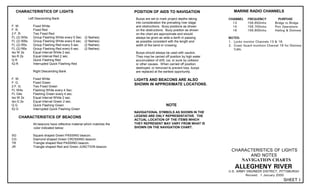
CHARACTERISTICS OF LIGHTS
Left Descending Bank
F. W. Fixed White
F. R. Fixed Red
2 F. R. Two Fixed Red
FL (2) W5s Group Flashing White every 5 Sec. (2 flashes)
FL (2) W6s Group Flashing White every 6 sec. (2 flashes)
FL (2) R5s Group Flashing Red every 5 sec. (2 flashes)
FL (2) R6s Group Flashing Red every 6 sec. (2 flashes)
Iso W 2s Equal Interval White 2 sec.
Iso R 2s Equal Interval Red 2 sec.
Q R Quick Flashing Red
IQ R Interrupted Quick Flashing Red
Right Descending Bank
F. W. Fixed White
F. G. Fixed Green
2 F. G. Two Fixed Green
FL W4s Flashing White every 4 Sec.
FL G4s Flashing Green every 4 sec.
Iso W 2s Equal Interval White 2 sec.
Iso G 2s Equal Interval Green 2 sec.
Q G Quick Flashing Green
IQ G Interrupted Quick Flashing Green
CHARACTERISTICS OF BEACONS
All beacons have reflective material which matches the
color indicated below:
SG Square shaped Green PASSING beacon.
CG Diamond shaped Green CROSSING beacon.
TR Triangle shaped Red PASSING beacon.
JR Triangle shaped Red and Green JUNCTION beacon.
POSITION OF AIDS TO NAVIGATION
Buoys are set to mark project depths taking
into consideration the prevailing river stage
and obstructions. Buoy positions as shown
on the obstructions. Buoy position as shown
on the chart are approximate and should
always be given as wide a berth in passing
as possible consistent with the length and
width of the bend or crossing.
Buoys should always be used with caution.
They may be carried off position by high water
accumulation of drift, ice, or sunk by collision
or other causes. When carried off position
destroyed, or removed to prevent loss, buoys
are replaced at the earliest opportunity.
LIGHTS AND BEACONS ARE ALSO
SHOWN IN APPROXIMATE LOCATIONS.
NOTE
NAVIGATIONAL SYMBOLS AS SHOWN IN THE
LEGEND ARE ONLY REPRESENTATIVE. THE
ACTUAL LOCATION OF THE ITEMS WHICH
THEY REPRESENT MAY VARY FROM WHAT IS
SHOWN ON THE NAVIGATION CHART.
MARINE RADIO CHANNELS
CHANNEL FREQUENCY PURPOSE
13 156.650mhz Bridge to Bridge
14 156.700mhz Port Operations
16 156.800mhz Hailing & Distress
NOTES:
1. Locks monitor Channels 13 & 16.
2. Coast Guard monitors Channel 16 for Distress
Calls.
CHARACTERISTICS OF LIGHTS
AND NOTES
NAVIGATION CHARTS
ALLEGHENY RIVER
U.S. ARMY ENGINEER DISTRICT, PITTSBURGH
Revised: 1 January 2000
SHEET I
Chart
Nos.
Locality
Chart
Nos.
Locality
1
2
3
3
4
5
5
6
7
8
8
9
10
EMSWORTH LOCKS & DAMS
(Project Pool El. 710.0)
Pittsburgh, Herrs Island
Pittsburgh, Herrs Island, Girtys Run, Pine Creek
Six Mile Island
LOCK & DAM 2
(Mile 6.7, Project Pool El. 721.0)
Pittsburgh, Lock & Dam 2 (Phone 412-661-2217), Aspinwall
Blawnox, Sycamore Island, Nine Mile Island, Verona, Oakmont
Twelve Mile Island, Fourteen Mile Island
C.W. BILL YOUNG LOCK & DAM
(Mile 14.5, Project Pool El. 734.5)
Lock & Dam 3 (Phone 412-828-3550), Fourteen Mile Island
Springdale, New Kensington
New Kensington, Arnold, Tarentum, Bull Creek
Brackenridge, Natrona
LOCK & DAM 4
(Mile 24.2 Project Pool El. 745.4)
Lock & Dam 4 (Phone 724-224-2666), Jacks Island
Jacks Island
Buffalo Creek, Freeport, Kiskiminetas River
10
11
12
13
14
15
15
16
17
18
19
20
21
LOCK & DAM 5
(Mile 30.4, Project Pool El. 757.0)
Lock & Dam 5 (Phone 724-295-2261), Schenley
Murphys Island
LOCK & DAM 6
(Mile 36.3, Project Pool El. 769.4)
Lock & Dam 6 (Phone 724-295-3775), Nicholson Island
Ross Island, Crook Creek
Ford City, Cogleys Island
West Kittanning, Kittanning
LOCK & DAM 7
(Mile 45.7, Project Pool El. 782.4)
Kittanning, Lock & Dam 7 (Phone 724-543-2551)
Moagrove
LOCK & DAM 8
(Mile 52.6, Project Pool El. 800.2)
Lock & Dam 8 (Phone 724-548-5119), Templeton
Mahoning, Reesedale
LOCK & DAM 9
(Mile 62.2, Project Pool El. 822.2)
Lock & Dam 9 (Phone 724-868-2486)
Redbank Creek, Wattersonville
East Brady, End of Navigation.
TABULAR INDEX
NAVIGATION CHARTS
ALLEGHENY RIVER
U.S. ARMY ENGINEER DISTRICT, PITTSBURGH
SHEET K
ALLEGHENY RIVER
RIVER TERMINALS
MILE LOCATION NAME COMMODITIES SHELTER FACILITIES RAIL REMARKS
0.0L
1.2R
2.7L
2.8R
3.4R
3.5L
3.9L
4.4L
5.0L
5.3R
5.5L
7.1R
7.6L
15.7R
16.2L
16.4R
Pittsburgh, PA
Pittsburgh, PA
35th Street,
Pittsburgh PA
Pittsburgh, PA
Pittsburgh, PA
43rd Street
Pittsburgh, PA
51st Street,
Pittsburgh, PA
54th Street,
Pittsburgh, PA
57th Street,
Pittsburgh, PA
Etna, PA
62nd Street,
Pittsburgh, PA
Aspinwall, PA
Pittsburgh, PA
Springdale, PA
Acmetonia, PA
Cheswick, PA
City of Pittsburgh (Wharf)
City Of Pittsburgh
Exxon Co., Inc.
Urban Redevelopment
Authority
Para Enterprises, Inc.
43rd Street Concrete & Supply
Inc.
Sauer
Pennzoil Products Co.
SUNOCO
Hanson Aggregates PMA, Inc.
D & D Auto Salvage
AZCON Scrap Corp.
Hanson Aggregates PMA, Inc.
Relient Energy Mid West
Eastern Marine Services Inc.
United Refining Co.
General Merchandise
None
Gasoline, Oil
None
None
Sand, Gravel
Sand, Gravel, Scrap
Petroleum Products
Petroleum
Sand & Gravel
Scrap
Scrap
Miscellaneous
Coal
None
Asphalt Products
None
None
None
None
None
None
None
None
None
None
None
None
None
None
None
None
None
None
Pipeline
Pipeline
None
Crane
Crane
Pipeline
Pipeline
Crane
Crane
Crane
None
Barge Unloaded
None
Pipelines
None
None
CSX Trans.
None
None
None
Allegheny Valley R.R.
Norfolk Southern R.R.
Allegheny Valley R.R.
Norfolk Southern R.R.
None
None
Allegheny Valley R.R.
None
Wharf, Restricted Public Mooring, No
Mooring During Events.
Landing.
Inactive.
Inactive.
Embedded Barge. Inactive.
Natural Bank.
Steel Pile Wall.
2 Sheet Pile Cells. Inactive.
Inactive.
Facilities Removed.
Inactive.
Barge Scraping.
2 Concrete Ice Breakers. Inactive.
Sheet Pile Cells & Ice Breakers. Dock
1260 feet.
2 Sheet Pile Cells & Ice Breakers.
Inactive.
3 steel posts.
Sheet 1
ALLEGHENY RIVER
RIVER TERMINALS
MILE LOCATION NAME COMMODITIES SHELTER FACILITIES RAIL REMARKS
16.5R
17.0R
17.7R
17.7L
18.0L
18.3L
18.7L
19.6L
19.7R
20.4L
20.8R
21.6R
24.9R
29.6R
30.8L
32.9R
43.8R
44.1R
44.7L
Springdale, PA
Cheswick, PA
Springdale, PA
New Kensington, PA
New Kensington, PA
New Kensington, PA
New Kensington, PA
Creighton, PA
Tarentum, PA
Arnold, PA
Creighton, PA
Tarentum, PA
Brackenridge, PA
Freeport, PA
Schenley, PA
Murphys Bottoms, PA
Applewold, PA
Applewold, PA
Kittanning, PA
R.I. Lampus Co.
Lane Construction
Allegheny Energy Supply Co.
Penn Glenn Oil Co.
Hanson Aggregates East
R. A. M. Terminals
Butler County Concrete &
Supply Co.
Pittsburgh Penn Oil Co.
Burrell Industries, Inc.
Pittsburgh Plate Glass Co.
Weleski Terminal
Allegheny-Ludlum Steel Corp.
Freeport Terminals, Inc.
Armstrong Terminal, Inc.
Pioneer Mid-Atlantic, Inc.
R.J. Brown Towing
The Ashbury Graphite Mills,
Inc.
Kittanning Builders Supply
Sand & Gravel
Sand & Gravel
Coal
Petroleum
Sand & Gravel
Sand & Gravel
General Commodities
Concrete & Supplies
Petroleum
Raw Materials
Glass
Sand & Gravel
Steel Ores
Petroleum Products, Raw
Materials & Coal
Dry Bulk
Sand & Gravel
General Commodities
Miscellaneous
Sand & Gravel
None
None
None
None
None
None
Yes
None
None
None
None
None
None
None
None
None
None
None
None
Crane
Crane & Conveyor
Conveyor, Pipelines
Pipe
Crane
Crane & Conveyor
Crane & Conveyor
Crane
Pipelines
Crane & Hopper
None
Crane
Traveling Cranes
Pipe, Crane, &
Conveyor
Crane
Conveyor
Truck Chute, Crane
None
Crane
None
None
None
None
None
None
None
None
None
None
None
None
None
None
None
None
None
None
None
Natural Bank.
Portable Unloading Facility.
Dock, also Oil Dock & Ice Breakers.
2 Steel Cells.
1 Steel Post, Sheet Pile Bulkhead.
Unloading Only.
Natural Bank. Inactive.
170' Precast Wall.
1 Cell.
Embedded Barges.
Concrete Wall. Inactive.
Cell & 2 Mooring Posts.
Sheet Pile Docks & Cells.
3 Steel Posts & Harbor.
Sheet Pile Wall.
Protected Harbor. Inactive.
Embedded Barges.
6 Steel Mooring Cells.
Steel Pile Wall. Inactive.
Sheet 2
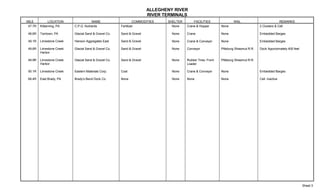
ALLEGHENY RIVER
RIVER TERMINALS
MILE LOCATION NAME COMMODITIES SHELTER FACILITIES RAIL REMARKS
47.7R
48.6R
49.1R
49.6R
49.9R
50.1R
69.4R
Kittanning, PA
Tarrtown, PA
Limestone Creek
Limestone Creek
Harbor
Limestone Creek
Harbor
Limestone Creek
East Brady, PA
C.P.G. Nutrients
Glacial Sand & Gravel Co.
Hanson Aggregates East
Glacial Sand & Gravel Co.
Eastern Materials Corp.
Brady’s Bend Dock Co.
Fertilizer
Sand & Gravel
Sand & Gravel
Sand & Gravel
Sand & Gravel
Coal
None
None
None
None
None
None
None
None
Crane & Hopper
Crane
Crane & Conveyor
Conveyor
Rubber Tires, Front
Loader
Crane & Conveyor
None
None
None
None
Pittsburg Shawmut R.R.
None
None
2 Clusters & Cell
Embedded Barges
Embedded Barges
Dock Approximately 400 feet
Embedded Barges
Cell. Inactive
Sheet 3
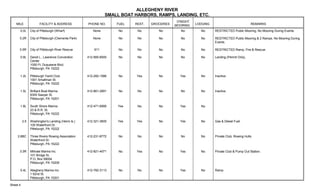
ALLEGHENY RIVER
SMALL BOAT HARBORS, RAMPS, LANDING, ETC.
MILE FACILITY & ADDRESS PHONE NO. FUEL REST. GROCERIES
O'NIGHT
MOORING LODGING REMARKS
0.0L
0.2R
0.5R
0.9L
1.2L
1.5L
1.8L
2.5
2.6BC
3.3R
5.4L
City of Pittsburgh (Wharf)
City of Pittsburgh (Clemente Park)
City of Pittsburgh River Rescue
David L.. Lawrence Convention
Center
1000 Ft. Duquesne Blvd.
Pittsburgh, PA 15222
Pittsburgh Yacht Club
1501 Smallman St.
Pittsburgh, PA 15222
Brilliant Boat Marina
6305 Sawyer St.
Pittsburgh, PA 15201
South Shore Marina
23 & R.R. St.
Pittsburgh, PA 15222
Washington's Landing (Herrs Is.)
100 Waterfront Dr.
Pittsburgh, PA 15222
Three Rivers Rowing Association
Waterfront Dr.
Pittsburgh, PA 15222
Millvale Marina Inc.
101 Bridge St.
P.O. Box 58004
Pittsburgh, PA 15209
Allegheny Marina Inc.
1 62nd St.
Pittsburgh, PA 15201
None
None
911
412-565-6000
412-282-1586
412-661-2891
412-471-6995
412-321-3600
412-231-8772
412-821-4071
412-782-3113
No
No
No
No
No
No
Yes
Yes
No
No
No
No
No
No
No
Yes
No
No
Yes
No
Yes
No
No
No
No
No
No
No
No
No
No
No
No
No
No
No
No
Yes
No
Yes
Yes
No
Yes
Yes
No
No
No
No
No
No
No
No
No
No
No
RESTRICTED Public Mooring, No Mooring During Events.
RESTRICTED Public Mooring & 2 Ramps. No Mooring During
Events.
RESTRICTED Ramp, Fire & Rescue.
Landing (Permit Only).
Inactive.
Inactive.
Gas & Diesel Fuel.
Private Club, Rowing Hulls.
Private Club & Pump Out Station.
Ramp
Sheet 4
ALLEGHENY RIVER
SMALL BOAT HARBORS, RAMPS, LANDING, ETC.
MILE FACILITY & ADDRESS PHONE NO. FUEL REST. GROCERIES
O'NIGHT
MOORING LODGING REMARKS
5.9R
6.35R
7.25R
7.3L
9.0R
10.55L
10.6R
10.6L
10.65L
10.7L
Sharpsburg Boat Docks
13th & River Rd.
Sharpsburg, PA 15215
Silkies Crows Nest Marina
P. O. Box 7761
19
th
St. & River Rd.
Sharpsburg, PA 15215
Aspinwall Boat Club
285 River Ave.
Pittsburgh, PA 15215
Brilliant Boat Club
Foot of Washington Blvd.
Pittsburgh, PA 15206
Fox Chapel Sea Ray Marina
1366 Old Freeport Rd.
Pittsburgh, PA 15238
Sylvan Canoe Club
132 Arch St.
Verona, PA 15147
Bell Harbor
1 River Rd.
Blawnox,, PA 15238
Duquesne Canoe Club
152 Arch St.
Verona, PA 15147
Algonquin Canoe Club
216 Arch St.
Verona, PA 15147
Outboard Haven
228 Arch St.
Verona, PA 15147
412-782-0220
412-782-3707
412-781-2340
412-661-2891
412-967-1500
412-828-9897
412-828-3477
412-828-4970
412-828-9886
412-828-4944
No
No
Yes
No
Yes
No
No
No
No
Yes
No
Yes
No
No
No
No
Yes
No
No
Yes
No
No
No
No
No
No
No
No
No
No
No
Yes
Yes
Yes
Yes
No
Yes
No
No
No
No
No
No
No
No
No
No
No
No
No
Ramp
Travel Lift to 60’.
Showers, Telephone.
Repairs, Rest Rooms & Ramp.
Services, Showers.
Ice, Rest Rooms, Shower & Boat Service.
Sheet 5
ALLEGHENY RIVER
SMALL BOAT HARBORS, RAMPS, LANDING, ETC.
MILE FACILITY & ADDRESS PHONE NO. FUEL REST. GROCERIES
O'NIGHT
MOORING LODGING REMARKS
10.9L
11.1R
11.95L
12.0L
13.1R
13.19R
14.2R
15.0R
16.2R
16.3R
Allegheny River Boat Club
314 Arch St.
Verona, PA 15147
O'Hara Landing Boat Club
14 River Rd.
Pittsburgh, PA 15238
Riverside Landing
10 Washington Ave.
Oakmont, PA 15139
Oakmont Yacht Club
11 Washington Ave.
Oakmont, PA 15139
Rodak Boat Sales
Harmar Marina
2526 Wenzel Dr.
Harmarville, PA 15238
Pennsylvania Fish Commission
Burkhart Siebert Marina
P.O. Box 34
1 Harbor View Dr.
Cheswick, PA 15024
Rick Reid Marina
P.O. Box 71
Blockdale St.
Cheswick, PA 15024
Springdale Marina
Coalfax St.
Springdale, PA 15144
Pennsylvania Fish Commission
412-828-7775
412-828-9151
412-793-4565
412-828-9847
412-828-9684
None
724-274-4088
724-274-6304
412-274-6608
None
No
No
No
No
No
No
No
No
No
No
Yes
Yes
Yes
Yes
Yes
No
No
No
No
No
No
No
No
No
No
No
No
No
No
No
Yes
Yes
Yes
No
Yes
No
No
Yes
Yes
No
No
No
No
No
No
No
No
No
No
No
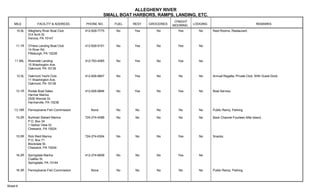
Rest Rooms, Restaurant..
Annual Regatta; Private Club, With Guest Dock.
Boat Service.
Public Ramp, Parking.
Back Channel Fourteen Mile Island.
Snacks.
Public Ramp, Parking.
Sheet 6
ALLEGHENY RIVER
SMALL BOAT HARBORS, RAMPS, LANDING, ETC.
MILE FACILITY & ADDRESS PHONE NO. FUEL REST. GROCERIES
O'NIGHT
MOORING LODGING REMARKS
16.6L
17.4L
18.9L
21.8R
22.2R
22.3R
22.4R
22.5R
22.5R
22.6R
Old Lock 3 Marina
301 Barking Rd.
New Kensington, PA 15068
Cessna's Marina
138 Coxcomb Rd.
New Kensington, PA 15068
Lighthouse Landing
799 Industrial Blvd.
New Kennsington, PA 15068
Pennsylvania Fish Commission
W.S.W. Marina
19 Kurtz St.
Natrona, PA 15065
Brackenridge Boat Docks
P.O. Box 111261
Pittsburgh, PA 15238
Mark Kaminski
1339 9
th
Ave..
Natrona Heights, PA 15605
Morgan Gamble
5009 Freeport Rd.
Natrona Heights, PA 15605
Alberta Simpson
921 Summet St.
Tarentum, PA 15084
Tim Connelly
919 First Ave.
Brackenridge, PA 15014
724-337-8460
724-337-9172
724-335-6200
None
724-224-9236
724-224-8165
724-224-6950
724- 224-0394
724-224-0394
None
724-224-2504
No
Yes
Yes
No
No
No
No
No
No
No
No
Yes
No
No
No
No
No
No
No
No
No
No
No
No
No
No
No
No
No
No
Yes
Yes
Yes
No
No
No
No
No
No
No
No
No
No
No
No
No
No
No
No
No
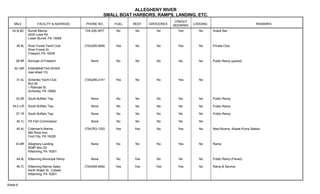
Snack Bar.
Crane, Ramp.
Public Ramp.
Sheet 7
ALLEGHENY RIVER
SMALL BOAT HARBORS, RAMPS, LANDING, ETC.
MILE FACILITY & ADDRESS PHONE NO. FUEL REST. GROCERIES
O'NIGHT
MOORING LODGING REMARKS
24.5LBC
26.9L
28.9R
30.16R
31.0L
33.5R
34.5 L/R
37.1R
40.1L
40.4L
43.8R
44.9L
46.7L
Burrell Marina
4224 Lowe Rd.
Lower Burrell, PA 15068
River Forest Yacht Club
River Forest Dr.
Freeport, PA 16239
Borough of Freeport
KISKIMINETAS RIVER
(see sheet 10)
Schenley Yacht Club
Box 62
1 Railroad St.
Schenley, PA 15682
South Buffalo Twp
South Buffalo Twp.
South Buffalo Twp.
PA Fish Commission
Coleman's Marina
682 Ross Ave.
Ford City, PA 16226
Allegheny Landing
RD#7 Box 3D
Kittanning, PA 16201
Kittanning Municipal Ramp
Kittanning Marine Sales
North Water St., Colwell
Kittanning, PA 16201
724-226-3977
(724)295-9956
None
(724)295-2141
None
None
None
None
(724)763-1202
None
None
(724)545-9492
No
Yes
No
Yes
No
No
No
No
Yes
No
No
Yes
No
No
No
No
No
No
No
No
Yes
No
Yes
Yes
No
No
No
No
No
No
No
No
No
No
No
Yes
Yes
Yes
No
Yes
No
No
No
No
Yes
Yes
No
Yes
No
No
No
No
No
No
No
No
No
No
No
No
Snack Bar.
Private Club.
Public Ramp (paved).
Public Ramp.
Public Ramp.
Public Ramp.
Rest Rooms, Waste Pump Station.
Ramp.
Public Ramp (Paved).
Ramp & Service.
Sheet 8
ALLEGHENY RIVER
SMALL BOAT HARBORS, RAMPS, LANDING, ETC.
MILE FACILITY& ADDRESS PHONE NO. FUEL REST. GROCERIES
O'NIGHT
MOORING LODGING REMARKS
48.6L
50.5L
54.0L
54.5R
59.0R
60.1R
60.1R
61.8R
66.5L
66.8L
69.0L
69.6R
Pennsylvania Fish Commission
Trestle Grove
RD #5 Box 605
New Castle, PA 16105
Nautical Mile Marina
Pennsylvania Fish Commission
Allegheny River Association
Public Ramp
The Spot Marina
R.D. 1
Adrian, PA 16210
River Trail Marina
R.D. 1
Cowansville, PA 16218
Botler Boat Club
106 Crest Haven Dr.
Butler, PA 16001
Phillipston Yacht Club
Waterfront Boatworks
P.O. Box 472
Corner of Broad & Second St.
East Brady, PA 16028
Pennsylvania Fish Commission
None
(724)652-7191
(724)594-BOAT
None
None
None
(724)543-5052
(724)545-6855
(724)283-0573
(724)287-0313
(724)526-5665
None
No
No
No
No
No
No
Yes
No
No
No
Yes
No
No
No
No
No
No
No
No
Yes
No
No
No
No
No
No
No
No
No
No
Yes
Yes
No
No
No
No
No
No
No
No
No
No
Yes
Yes
No
No
Yes
No
No
No
No
No
No
No
No
No
No
No
No
No
300' Up Cowanshannock Creek.
Ramp.
Ramp.
Public Ramp, Parking.
Ramp.
Private Club, Ramp.
Private Club, Ramp.
Ramp, Service.
Public Ramp & Parking Area.
Sheet 9
ALLEGHENY RIVER
SMALL BOAT HARBORS, RAMPS, LANDING, ETC.
MILE FACILITY & ADDRESS PHONE NO. FUEL REST. GROCERIES
O'NIGHT
MOORING LODGING REMARKS
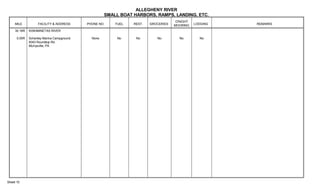
30.16R
0.05R
KISKIMINETAS RIVER
Schenley Marina Campground
4043 Roundtop Rd.
Murrysville, PA
None No No No No No
Sheet 10
ILMI Allegheny River Navigation Chart

ILMI Allegheny River Navigation Chart

  • 1.
    Allegheny River NavigationChartsAllegheny River Navigation Charts Pittsburgh, Pennsylvania to East Brady, Pennsylvania January 2004
  • 2.
    NOTE: LOCKS 5THRU 9 HAVE LIMITED HOURS OF OPERATION FOR HOURS OF OPERATION, CONTACT ONE OF THE FOLLOWING; PITTSBURGH DISTRICT OFFICE (412)395-7171 OHIO-ALLEGHENY AREA OFFICE (412)395-7650/7654 CALL FRONT COVER: (412) 936-1212 ALLEHENY LIFT LOCK NO. 4 & WEIGH LOCK 1829 -1861 TO HEAR IF HAZARDOUS Artist rendering by GAI, Inc. based on sketch from BOATING CONDITIONS EXIST. Pennsylvania Archives.
  • 3.
    NAVIGATION CHARTS ALLEGHENY RIVER U.S.ARMY ENGINEER DISTRICT, PITTSBURGH PITTSBURGH, PA. TO EAST BRADY, PA. U.S. ARMY ENGINEER DISTRICT, PITTSBURGH WILLIAM S. MOORHEAD FEDERAL BUILDING 1000 LIBERTY AVENUE PITTSBURGH, PENNSYLVANIA 15222-4186 BRIEF INDEX GENERAL NOTES................................................................................................................................................................................................................................... SHEET A REGULATIONS, SECTION 7 OF RIVER AND HARBOR ACT 1917......................................................................................................................SHEETS B THROUGH E EXTRACTS FROM SECTIONS OF THE RIVER AND HARBOR ACT OF 1899..............................................................................................................SHEETS F AND G U.S. COAST GUARD INFORMATION.................................................................................................................................................................................................. SHEET H CHARACTERISTICS OF LIGHTS AND NOTES ...................................................................................................................................................................................SHEET I AIDS TO NAVIGATION AND LEGEND ................................................................................................................................................................................................SHEET J TABULAR INDEX TO NAVIGATION CHARTS................................................................................................................................................................................. SHEET K MAP INDEX TO NAVIGATION CHARTS ............................................................................................................................................................................................SHEET L NAVIGATION CHARTS .......................................................................................................................................................................................................NOS. 1 TO 21 INCL. ALLEGHENY RIVER TERMINALS ............................................................................................................................................................................SHEETS 1 THROUGH 3 ALLEGHENY RIVER SMALL BOAT HARBORS, RAMPS, LANDINGS, ETC....................................................................................................SHEETS 4 THROUGH 10 Revised: 1 January 2004 Information shown on this chart is a general depiction of the waterway and adjacent areas only and is not in anyway to be construed as representing precise or accurate dimensions, portrayals, features, or other data. Major changes which occur will be published in “NOTICES TO NAVIGATION INTERESTS.” The general locations of AIDS-TO NAVIGATION are shown, as they existed on the last editing date of this book. They may subsequently have been moved, destroyed or discontinued. They should in no event be used to fix the position of a vessel. The following applies for Charts 1 through 10: The source mapping used to develop and portray the information shown on these charts were compiled from aerial photography exposed in 1992 and 1993. The Geographic Coordinates represented were converted from the source mapping Horizontal Grid Data, State Plane Coordinate System, Pennsylvania South Zone, NAD 83 (86) utilizing Conversion software. The grid annotated on these charts are for general reference and not to be used for precise location of features. The minimum channel depth depicted on these charts was developed from soundings data obtained on June 1992, and June 1996 for charts 1 thru 10. The following applies for Charts 10 through 21: The source mapping used to develop and portray the information shown on these charts were compiled from aerial photography exposed in 1999. The Geographic Coordinates represented were converted from the source mapping Horizontal Grid Data, State Plane Coordinate System, Pennsylvania South Zone, NAD 83 (86) utilizing Conversion software. The grid annotated on these charts are for general reference and not to be used for precise location of features.
  • 4.
    NAVIGATION CHARTS ANDNOTICES Spiral-bound Allegheny, Monongahela and Ohio River Navigation Charts are available for purchase from the U.S. Government Printing Office by internet, telephone, fax or mail order. Internet U.S. Government Online Bookstore at http://bookstore.gpo.gov Telephone (202) 512-1800 or Toll-Free (866) 512-1800 Monday through Friday, 7:30 a.m. - 9:00 p.m. EST Fax (202) 512-2250 Mail Order Superintendent of Documents P.O. Box 371954 Pittsburgh, PA 15250-7954 Payment must accompany all orders and can be made by check, money order, Visa, MasterCard, Discover/NOVUS, American Express or Superintendent of Documents Deposit Account. Checks and money orders should be made payable to the Superintendent of Documents. All credit card orders must include the account number and expiration date of the credit card. Payments made by Superintendent of Documents deposit account must include the account number. When ordering by internet, enter "River Navigation Charts" in the Search the Sales Product Catalog field and click on the Submit button. Click on the Add to Cart icon and follow the instructions provided to order your navigation chart(s). Information on how to order spiral-bound copies of navigation charts for the Allegheny, Monongahela and Ohio Rivers is also available on the Pittsburgh District internet site at www.lrp.usace.army.mil/nav/navcharts.htm. Links to access navigation charts outside the Pittsburgh District boundaries are also available on our internet site. Notices to Navigation Interests, containing data on channel conditions and location of dredges, are issued as occasions demand. Pittsburgh District’s Notices to Navigation Interests are available on our internet site (www.lrp.usace.army.mil) for viewing and printing. Interested parties, who send a request to: Chief, Regulatory Branch U.S. Army Engineer District, Pittsburgh William S. Moorhead Federal Building 1000 Liberty Avenue Pittsburgh, PA 15222-4186 are placed on a mailing list to receive either electronic or printed copies of these notices. NAVIGATION CHARTS Allegheny River: Charts 1 – 21 Monongahela River: Charts 1 – 34 Ohio River (Cairo, IL to Foster, KY): Charts 1 – 122 Ohio River (Foster, KY to New Martinsville, WV): Charts 122 – 186 Ohio River (New Martinsville, WV to Pittsburgh, PA): Charts 187 – 224 MILE POINTS Mile points are shown on the charts at one mile intervals, with figures designating mileage above (the Point) Pittsburgh, Pennsylvania. BUOYS Buoys used to mark channels in the Mississippi River System conform to the standard lateral system of buoyage on the Western Rivers of the United States. Generally, the unlighted buoys in the Allegheny, Monongahela and Ohio Rivers are equipped with radar reflectors. All buoys are equipped with reflective material; buoys on the left descending side of the channel reflect red; buoys on the right descending side of the channel reflect green. GAGES All gages read 9 feet at normal pool level, except as otherwise noted on charts. All elevations based on N.G.V.D. (National Geodetic Vertical Datum). PERMITS-JURISDICTION In the administration of laws enacted by Congress for the protection and preservation of navigation and the navigable waters of the United States, the U.S. Army Corps of Engineers exercises jurisdiction over the Allegheny, Monongahela and Ohio Rivers. Work or structures in, under, or over the Allegheny, Monongahela and Ohio Rivers between the limits of ordinary high water lines on both banks of the stream require prior authorization. Inquiries regarding permits for such work or structures should be addressed to: District Engineer U.S. Army Engineer District, Pittsburgh William S. Moorhead Federal Building 1000 Liberty Avenue Pittsburgh, PA 15222-4186 or may be made by telephone to: (412) 395-7152 PITTSBURGH DISTRICT INTERNET SITES OF INTEREST TO NAVIGATION Pittsburgh District: www.lrp.usace.army.mil Navigation Chart Information: www.lrp.usace.army.mil/nav/navcharts.htm Notices to Navigation Interests: www.lrp.usace.army.mil/or/navrpt.htm Current River Conditions: http://wmw.lrp.usace.army.mil/current Permit and Regulatory Information: www.lrp.usace.army.mil/or/or-f/permits.htm GENERAL NOTES NAVIGATION CHARTS ALLEGHENY RIVER U.S. ARMY ENGINEER DISTRICT, PITTSBURGH Revised: 1 January 2004 SHEET A
  • 5.
    REGULATIONS PRESCRIBED BY THESECRETARY OF THE ARMY FOR THE OHIO AND MISSISSIPPI RIVERS, ABOVE CAIRO, IL, AND THEIR TRIBUTARIES; USE, ADMINISTRATION AND NAVIGATION THE LAW Section 7 of the River and harbor Act of August 8, 1917, provides as follows: "That it shall be the duty of the Secretary of War to prescribe such regulations for the use, administration, and navigation of the navigable waters of the United States as in his judgment the public necessity may require for the protection of life and property, or of operations of the United States in channel improvement, covering all matters not specifically delegated by law to some other executive department. Such regulations shall be posted, in conspicuous and appropriate places, for the information of the public; and every person and every corporation which shall violate such regulations shall be deemed guilty of a misdemeanor and, on conviction thereof in any district court of the United States within those territorial jurisdiction such offense may have been committed, shall be punished by a fine not exceeding $500, or by imprisonment (in the case of a natural person) not exceeding six months, in the discretion of the court." In pursuance of the law above quoted, the following regulations were prescribed to govern the use, administration, and navigation of the Ohio River above Cairo, Ill., and its tributaries. 207.300 Ohio River, above Cairo, Ill., and their tributaries; use, administration, and navigation. (a) Authority of Lockmasters. The lockmaster shall be charged with the immediate control and management of the lock, and of the area set aside as the lock area, including the lock approach channels. He shall see that all laws, rules, and regulations for the use of the lock and lock area are duly complied with, to which end he is authorized to give all necessary orders and directions in accordance therewith, both to employees of the Government and to any and every person within the limits of the lock or lock area, whether navigating the lock or not. No one shall cause any movement of any vessel, boat, or other floating thing in the lock or approaches except by or under the direction of the lockmaster or his assistant. In the event of an emergency, the lockmaster may depart from these regulations as he deems necessary. The lockmasters shall also be charged with the control and management of Federally constructed mooring facilities. (b) Safety Rules for Vessels Using Navigation Locks. The following safety rules are hereby prescribed for vessels in the locking process, including the act of approaching or departing a lock: (1)Tows with Flammable or Hazardous Cargo Barges, Loaded or Empty. (i) Stripping barges or transferring cargo is prohibited. (ii) All hatches on barges used to transport flammable or hazardous materials shall be closed and latched, except those barges carrying a gas-free certificate. (iii) Spark-proof protective rubbing fenders ("possums") shall be used. (2) All Vessels. (i) Leaking vessels may be excluded from locks until they have been repaired to the satisfaction of the lockmaster. (ii) Smoking, open flames, and chipping or other spark- producing activities are prohibited on deck during the locking cycle. (iii) Painting will not be permitted in the lock chamber during the locking cycle. (iv) Tow speeds shall be reduced to a rate of travel such that the tow can be stopped by checking should mechanical difficulties develop. Pilots should check with the individual lockmasters concerning prevailing conditions. It is also recommended that pilots check their ability to reverse their energies prior to beginning an approach. Engines shall not be turned of in the lock until the tow has stopped and been made fast. (v) U.S. Coast Guard Regulations require all vessels to have on board life saving devices for prevention of drowning. All crew members of vessels required to carry work vests (life jackets) shall wear them during a lockage, except those persons in an area enclosed with a handrail or other device which would reasonably preclude the possibility of falling overboard. All deckhands handling lines during locking procedures shall wear a life jacket. Vessels not required by Coast Guard Regulations to have work vests aboard shall have at least the prescribed life saving devices, located for ready access and use if needed. The lockmaster may refuse lockage to any vessel which fails to conform to the above. (c) Reporting of Navigation Incidents. In furtherance of increased safety on waterways the following safety rules are hereby prescribed for all navigation interests: (1) Any incident resulting in uncontrolled barges shall immediately be reported to the nearest lock. The report shall include information as to the number of loose barges, their cargo, and the time and location where they broke loose. The lockmaster or locks shall be kept informed of the progress being made in bringing the barges under control so that he can initiate whatever actions may be warranted. (2) Whenever barges are temporally moored at other than commercial terminals or established fleeting areas, and their breaking away could endanger a lock, the nearest lock shall be so notified, preferably the downstream lock. (3) Sunken or sinking barges shall be reported to the nearest lock both downstream and upstream of the location in order that other traffic passing these points may be advised of the hazards. (4) In the event of an oil spill, notify the nearest lock downstream, specifying the time and location of the incident, type of oil, amount of spill, and what recovery or controlling measures are being employed. (5) Any other activity on the waterways that could conceivably endanger navigation or a navigation structure shall be reported to the nearest lock. (6) Whenever it is necessary to report an incident involving uncontrolled, sunken or sinking barges, cargo in the barges shall be accurately identified. (d) Precedence at Locks. (1) The vessel arriving first at a lock shall normally be first to lock through, but precedence shall be given to vessels belonging to the United States. Licensed commercial passenger vessels SHEET B
  • 6.
    operating on apublished schedule or regularly operating in the "for hire" trade shall have precedence over cargo tows and like craft. Commercial cargo tows shall have precedence over recreational craft, except as described in paragraph (f). (2) Arrival posts or markers may be established above and/or below the locks. Vessels arriving at or opposite such posts or markers will be considered as having arrived at the locks within the meaning of this paragraph. Precedence may be established visually or by radio communication. The lockmaster may prescribe such departure from the normal order of precedence as in his judgment is warranted to achieve best lock utilization. (e) Unnecessary Delay at Locks. Masters and pilots must use every precaution to prevent unnecessary delay in entering or leaving locks. Vessels failing to enter locks with reasonable promptness when signaled to do so shall lose their turn. Rearranging or switching of barges in the locks or in approaches is prohibited unless approved or directed by the lockmaster. This is not meant to curtail "jackknifing" or set-overs where normally practiced. (f)Lockage of Recreation Craft. In order to fully utilize the capacity of the lock, the lockage of recreational craft shall be expedited by locking them through with commercial craft, provided that both parties agree to joint use of the chamber. When recreational craft are locked simultaneously with commercial tows, the lockmaster will direct, whenever practicable, that the recreational craft enter the lock and depart while the tow is secured in the lock. Recreational craft will not be locked through with vessels carrying volatile cargoes or other substances likely to emit toxic or explosive vapors. If the lockage of recreational craft can not be accomplished within the time required for three other lockages, a separate lockage of recreational craft shall be made. Recreational craft operators are advised that many locks have a pull chain located at each end of the lock which signals the lockmaster that lockage is desired. (g) Simultaneous Lockage of Tows with Dangerous Cargoes. Simultaneous lockage of other rows with tows carrying dangerous cargoes or containing flammable vapors normally will only be permitted when there is agreement between the lockmaster and both vessel masters that the simultaneous lockage can be executed safely. He shall make a separate decision each time such action seems safe and appropriate, provided: (1) The first vessel or tow in and the last vessel out are secured before the other enters or leaves. (2) Any vessel or tow carrying dangerous cargoes is not leaking. (3) All masters involved have agreed to the joint use of the lock chamber. (h) Stations While Awaiting Lockage. Vessels awaiting their turn to lock shall remain sufficiently clear of the structure to allow unobstructed departure for the vessel leaving the lock. However, to the extent practicable under the prevailing conditions, vessels and tows shall position themselves so as to minimize approach time when signaled to do so. (i) Stations While Awaiting Access Through Navigable Pass. When navigable dams are up or are in the process of being raised or lowered, vessels desiring to use the pass shall wait outside the limits of the approach points unless authorized otherwise by the lockmaster. (j) Signals. Signals from vessels shall ordinarily be by whistle; signals from locks to vessels shall be by whistle, another sound devise, or visual means. When a whistle is used, long blasts of the whistle shall not exceed 10 seconds and short blasts of the whistle shall not exceed 3 seconds. Where a lock is not provided with a sound or visual signal installation, the lockmaster will indicate by voice or by the wave of a hand when the vessels may enter or leave the lock. Vessels must approach the locks with caution and shall not enter nor leave the lock until signaled to do so by the lockmaster. The following lockage signals are prescribed: (1) Sound Signals by Means of a Whistle. These signals apply at either a single lock or twin locks. (i) Vessels desiring lockage shall on approaching a lock give the following signals at a distance of not more than one mile from the lock: (a) If a single lockage only is required: One long blast of the whistle followed by one short blast. (b) If a double lockage is required: One long blast of the whistle followed by two short blasts. (ii) When the lock is ready for entrance, the lock will give the following signals: (a) One long blast of the whistle indicates permission to enter the lock chamber in the case of a single lock or to enter the landward chamber in the case of twin locks. (b) Two long blasts of the whistle indicates permission to enter the riverward chamber in the case of twin locks. (iii) Permission to leave the locks will be indicated by the following signals given by the lock: (a) One short blast of the whistle indicates permission to leave the lock chamber in the case of a single lock or to leave the landward chamber in the case of twin locks. (b) Two short blasts of the whistle indicates permission to leave the riverward chamber in the case of twin locks. (iv) Four or more short blasts of the lock whistle delivered in rapid succession will be used as a means of attracting attention, it indicate caution, and to signal danger. This signal will be used to attract the attention of the captain and crews of vessels using or approaching the lock or navigating in its vicinity and to indicate that something unusual involving or requiring special caution is happening or is about to take place. When this signal is given by the lock, the captains and crews of vessels in the vicinity shall immediately become on the alert to determine the reason for the signal and shall take the necessary steps to cope with the situation. (2) Lock Signal Lights. At locks where density of traffic or other local conditions make it advisable, the sound signals from the lock will be supplemented by signal lights. Flashing lights (showing a one-second flash followed by a two-second eclipse) will be located on or near each end of the land wall to control use of a single lock or of the landward lock of double locks. In addition, at double locks, interrupted flashing lights (showing a one-second flash, a one-second eclipse, followed by a three-second eclipse) will be located on or near each end of the intermediate wall to control use of the riverward lock. Navigation will be governed as follows: Red Light. Locks cannot be made ready immediately. Vessel shall stand clear. Amber Light. Lock is being made ready. Vessel may approach but under full control. Green Light. Lock is ready for entrance. Green and Amber. Lock is ready for entrance but gates cannot be recessed completely. Vessel may enter under full control and with extreme caution. (3) Radio Communications. VHF-FM radios, operating on the FCC authorized Maritime Band, have been installed at all operational locks. Radio contact may be made by any vessel desiring passage. Commercial tows are especially requested to make contact at least one half hour before arrival in order that the pilot may be informed of current river and traffic conditions that may affect the safe passage of this tow. SHEET C
  • 7.
    All locks monitor156.8 MHz (Ch. 16) and 156.65 MHz (Ch. 13) and can work 156.65 MHz (Ch.13) and 156.7 MHz (Ch. 14) Ch. 16 is the authorized call, reply and distress frequency, and locks are not permitted to work on this frequency except in an emergency involving the risk of immediate loss of life or property. Vessels may call and work Ch. 13, without switching, but are cautioned that vessel to lock traffic must not interrupt or delay Bridge to Bridge traffic which has priority at all times. (k) Rafts. Rafts to be locked through shall be moored in such manner as not to obstruct the entrance of the lock and if to be locked in sections, shall be brought to the lock as directed by the lockmaster. After passing the lock the sections shall be reassembled at such distance beyond the lock as not to interfere with other vessels. (l) Entrance to and Exit from Locks. In case two or more boats or tows are to enter for the same lockage, their order of entry shall be determined by the lockmaster. Except as directed by the lockmaster, no boat shall pass another in the lock. In no case will boats be permitted to enter or leave the locks until directed to do so by the lockmaster. The sides of all craft passing through any lock shall be free from projections of any kind which might injure the lock walls. All vessels shall be provided with suitable fenders, and shall be used to protect the lock and guide walls until it has cleared the lock and guide walls. (m) Mooring. (1) At Locks. (i) All vessels when in the locks shall be moored as directed by the lockmaster. Vessels shall be moored with bow and stern lines leading in opposite directions to prevent the vessels from "running" in the lock. All vessels will have one additional line available on the head of the tow for emergency use. The pilothouse shall be attended by qualified personnel during the entire locking procedure. When the vessel is securely moored, the pilot shall not cause movement of the propellers except in emergency or unless directed by the lockmaster. Tying to lock ladders is strictly prohibited. (ii) Mooring of unattended or nonpropelled vessels or small craft at the upper or lower channel approaches will not be permitted within 1200 feet of the lock. (2) Outside of Locks. (i) No vessel or other craft shall regularly or permanently moor in any reach of a navigation channel. The approximate centerline of such channels are as marked as the sailing line on the Corps of Engineers' navigation charts. Nor shall any floating craft, except in an emergency, moor in any narrow or hazardous section of the waterway. Furthermore, all vessels or other craft are prohibited from regularly or permanently mooring in any section of navigable waterways which are congested with commercial facilities or traffic unless it is moored at facilities approved by the Secretary of the Army or his authorized representative. The limit of congested areas shall be marked on Corps of Engineers' navigation charts. However, the District Engineer may authorize in writing exceptions to any of the above if, in his judgment, such mooring would not adversely affect navigation and anchorage. (ii) No vessel or other craft shall be moored to railroad tracks, to riverbanks in the vicinity of railroad tracks when such mooring threatens the safety of equipment using tracks, to telephone poles or power poles, or to bridges or similar structures used by the public. (iii) Except in case of great emergency, no vessel or craft shall anchor over revetted banks of the river, and no floating plant other than launches and similar small craft shall land against banks protected by revetment except a regular commercial landings. In all cases, every precaution to avoid damage to the revetment works shall be exercised. The construction of log rafts along mattressed or paved banks or the tying up and landing of log rafts against such banks shall be performed in such a manner as to cause no damage to the mattress work or bank paving. Generally, mattress work extends out into the river 600 feet from the low water line. (iv) Any vessel utilizing a federally constructed mooring facility (e.g., cells, buoys, anchor rings) at the point designated on the current issue of the Corps' navigation charts shall advise the lockmaster at the nearest lock that from point by the most expeditious means. (n) Draft of Vessels. No vessel shall attempt to enter a lock unless its draft is at least three inches less than the least depth of water over the guard sills, or over the gate sill if there be no guard sills. Information concerning controlling depth over sills can be obtained from the lockmaster at each lock or by inquiry at the office of the district engineer of the district in which the lock is located. (o) Handling Machinery. No one but employees of the United States shall move any lock machinery except as directed by the lockmaster. Tampering or meddling with the machinery or other parts of the lock is strictly forbidden. (p) Refuse in Locks. Placing or discharging refuse of any description into the lock, on lock walls or esplanade, canal or canal bank is prohibited. (q) Damage to Locks or Other Work. To avoid damage to plant and structures connected with the construction or repair of locks and dams, vessels passing structures in the process of construction or repair shall reduce their speed and navigate with special caution while in the vicinity of such work. The restrictions and admonitions contained in these regulations shall not affect the liability of the owners and operators of floating craft for any damage to locks or other structures caused by the operation of such craft. (r) Trespass on Lock Property. Trespass on locks or dams or other United States property pertaining to the locks or dams is strictly prohibited except in those areas specifically permitted. Parties committing any injury to the locks or dams or to any part thereof will be responsible therefore. Any person committing a willful injury to any United States property will be prosecuted. No fishing will be permitted from lock walls, guide walls, or guard walls of any lock or from any dam except in areas designated and posted by the responsible District Engineer as fishing areas. Personnel from commercial and recreational craft will be allowed on the lock structure for legitimate business reasons: e.g., crew changes, emergency phone calls, etc. (s) Restricted Areas at Locks and Dams. All waters immediately above and below each dam, as posted by the respective District Engineers, are hereby designated as restricted areas. No vessel or other floating craft shall enter any such restricted area at any time. The limits of the restricted areas at each dam will be determined by the responsible District Engineer and marked by signs and/or red flashing lights installed in conspicuous and appropriate places. (t) Statistical Information. (1) Masters of vessels shall furnish to the lockmaster such statistics of passengers or cargo as may be requested. (2) The owners or masters of vessels sunk in the navigable waters of the United States shall provide the appropriate District Engineer with a copy of the sunken vessel report furnished to the SHEET D
  • 8.
    U.S. Coast GuardMarine Inspection Office in accordance with Code of Federal Regulations Title 33 Subpart 64.10-1. (u) Operations during High Water and Floods in Designated Vulnerable Areas. Vessels operating on these waters during periods when river stages exceed the level of "ordinary high water", as designated on Corps of Engineers' navigation charts, shall exercise reasonable care to minimize the effect of their bow waves and propeller washes on river banks; submerged structures or habitations; terrestrial growth such as trees and bushes; and manmade amenities that may be present. Vessels shall operate carefully when passing close to levees and other flood protection works, and shall observe minimum distance from banks which may be prescribe from time to time in Notices to Navigation Interests. Pilots should exercise particular care not to direct propeller wash at river banks, levees, revetments, structures or other appurtenances subject to damage from wave action. (v) Navigation Lights for Use at All Locks and Dams. (1) At locks at all fixed dams and at locks at all movable dams when the dams are up so that there is no navigable pass through the dam, the following navigation lights will be displayed during hours of darkness. (a) Three green lights visible through an arc of 360º arranged in a vertical line on the upstream end of the river (guard) wall unless the intermediate wall extends farther upstream. In the latter case, the lights will be placed on the upstream end of the intermediate wall. (b) Two green lights visible through an arc of 360º arranged in a vertical line on the downstream end of the river (guard) wall unless the intermediate wall extends farther downstream. In the latter case, the lights will be placed on the downstream end of the intermediate wall. (c) A single red light, visible through an arc of 360º on each end (upstream and downstream) of the land (guide) wall. (2) At movable dams when the dam has been lowered or partly lowered so that there is an unobstructed navigable pass through the dam, the navigation lights indicated in the following paragraphs will be displayed during hours of darkness until lock walls and weir piers are awash. (a) Three red lights visible through an arc of 360º arranged in a vertical line on the upstream end of the river (guard) wall. (b) Two red lights visible through an arc of 360º arranged in a vertical line on the downstream end of the river (guard) wall. (c) A single red light visible through an arc of 360º on each end (upstream and downstream) of the land (guide) wall. (3) After lock walls and weir piers are awash they will be marked as prescribed in paragraph (x) below. (4) If one or more bear traps or weirs are open or partially open, and may cause a set in current conditions at the upper approach to the locks, this fact will be indicated by displaying a white circular disk 5 feet in diameter, on or near the light support on the upstream end of the land (guide) wall during the hours of daylight, and will be indicated during hours of darkness by displaying a white (amber) light vertically under and 5 feet below the red light on the upstream end of the land (guide) wall. (x) Buoys at Moveable Dams. (1) Whenever the river (guard) wall of the lock and any portion of the dam are awash, and until covered by a depth of water equal to the project depth, the limits of the navigable pass through the dam will be marked by buoys located at the upstream and downstream ends of the river (guard) wall, and by a single buoy over the end or ends of the portion or portions of the dam adjacent to the navigable pass over which project depth is not available. A red nun-type buoy will be used for such structures located on the left-hand side (facing downstream) of the river and a green can- type buoy for such structures located on the right-hand side. Buoys will be lighted, if practicable. (2) Where powerhouses or other substantial structures projecting considerably above the level of the lock wall are located on the river (guard) wall, a single red light located on top of one of these structures may be used instead of river wall buoys prescribed above until these structures are awash, after which they will be marked by a buoy of appropriate type and color (red nun or green can buoy) until covered by a depth of water equal to the project depth. Buoys will be lighted, if practicable. (y) Vessels to Carry Regulations. A copy of these regulations shall be kept at all times on board each vessel regularly engaged in navigating the rivers to which these regulations apply. Copies may be obtained from any lock office or District Engineer's office on request. Masters of such vessels are encouraged to have on board copies of the current edition of appropriate navigation charts. NOTE: These regulations are those in effect 31 July 1975. SHEET E
  • 9.
    EXTRACT FROM SECTIONS15 AND 16 OF THE RIVER AND HARBOR ACT OF 1899 SECTION 15. That it shall not be lawful to tie up or anchor vessels or other craft in navigable channels in such a manner as to prevent or obstruct the passage of other vessels or other craft; or to sink, or permit or cause to be sunk, vessels or craft in navigable channels; or to float loose timber and logs, or to float what is known as sack rafts of timber and logs in streams or channels actually navigated by steamboats in such manner as to obstruct, impede, or endanger navigation. And whenever a vessel, raft, or other craft is wrecked and sunk in a navigable channel, it shall be the duty of the owner, lessee, or operator of such sunken craft to immediately mark it with a buoy or beacon during the day and a lighted lantern at night, and to maintain such marks until the sunken craft is removed or abandoned, and the neglect or failure of the said owner, lessee, or operator so to do shall be unlawful; and it shall be the duty of the owner, lessee, or operator of such sunken craft to commence the immediate removal of the same, and prosecute such removal diligently and failure to do so shall be considered as an abandonment of such craft, and subject the same to removal by the United States as hereinafter provided for (30 Stat. 1152; 33 U.S.C. $ 409). SECTION 16. That every person and every corporation that shall violate, or that shall knowingly aid, abet, authorize, or instigate a violation or the provisions of sections thirteen, fourteen, and fifteen of this Act shall be guilty of a misdemeanor, and on conviction thereof shall be punished by a fine not exceeding twenty-five hundred dollars nor less than five hundred dollars, or by imprisonment (in the case of a natural person) for not less than thirty days nor more than one year, or by both such fine and imprisonment, in the discretion of the court, one-half of said fine to be paid to the person or persons giving information which shall lead to conviction (30 Stat. 1153; 33 U.S.C $411). And any and every master, pilot, and engineer, or person or persons acting in such capacity, respectively, on board of any boat or vessel who shall knowingly engage in towing any scow, boat, or vessel loaded with any material specified in section thirteen of this Act to any point or place or deposit or discharge in any harbor or navigable water, elsewhere than within the limits defined and permitted by the Secretary of War, or who shall willfully injure or destroy any work of the United States contemplated in section fourteen of this Act, or who willfully obstruct the channel of any waterway in the manner contemplated in section fifteen of this Act, shall be deemed guilty of a violation of this Act, and shall upon conviction be punished hereinbefore provided in this section, and shall also have his license revoked or suspended for a term to be fixed by the judge before whom tried and convicted. And any boat, vessel, scow, raft, or other craft used or employed in violating any of the provisions of sections thirteen, fourteen, and fifteen of this Act shall be liable for the pecuniary penalties specified in this section, and in addition thereto for the amount of the damages done by said boat, vessel, scow, raft, or other craft, which latter sum of the harbor or waterway in which the damage occurred, and said boat, vessel, scow, raft, or other craft may be proceeded against summarily by way of libel in any district court of the United States having jurisdiction thereof (30 Stat. 1153: 33 U.S.C $ 412). SHEET F
  • 10.
    EXTRACT FROM SECTIONS19 AND 20 OF THE RIVER AND HARBOR ACT OF 1899 SECTION 19. (a) That whenever the navigation of any river, lake, harbor, sound, bay, canal, or other navigable waters of the United States shall be obstructed or endangered by any sunken vessel, boat, watercraft, raft, or other similar obstruction, and such obstruction has existed for a longer period than thirty days, or whenever the abandonment of such obstruction can be legally established in a less space of time, the sunken vessel, boat, watercraft, raft, or other obstruction shall be subject to be broken up, removed, sold or otherwise disposed of by the Secretary of War at his discretion, without liability for any damage to the owners of the same; PROVIDED, that in his discretion, the Secretary of War may cause reasonable notice of such obstruction of not less than thirty days, unless the legal abandonment of the obstruction can be established in a less time, to be given by publication, addressed "To whom it may concern", in a newspaper published nearest to the locality of the obstruction, requiring the removal thereof; AND PROVIDED ALSO, that the Secretary of War may, in his discretion, at or after the time of giving such notice, cause sealed proposals to be solicited by public advertisement, giving reasonable notice of less than ten days, for the removal of such obstructions as soon as possible after the expiration of the above specified thirty days' notice, in case it has not in the meantime been so removed, these proposals and contracts, at his discretion, to be conditioned that such vessel, boat, watercraft, raft, or other obstruction, and all cargo and property contained therein, shall become the property of the contractor, and the contract shall be awarded to the bidder making the proposition most advantageous to the United States; PROVIDED, that such bidder shall give satisfactory security to execute the work; PROVIDED FURTHER, that any money received from the sale of any such wreck, or from any contractor for the removal of wrecks, under this paragraph shall be covered into the Treasury of the United States (30 Sat. 1154;33 U.S.C. $ 414). (b) The owner, lessee, or operator of such vessel, boat, watercraft, raft, or other obstruction as described in this section shall be liable to the United States for the cost of removal or destruction and disposal as described which exceeds the costs recovered under subsection (a). Any amount recovered from the owner, lessee, or operator lessee, or operator of such vessel pursuant to this sub section to recover costs in excess of the proceeds from the sale or disposition of such vessel shall be deposited in the general fund of the Treasury of The United States. SECTION 20. (a) That under emergency, in the case of any vessel, boat, watercraft, raft, or other similar obstruction, sinking or grounding, or being unnecessarily delayed in any Government canal or lock, or in any navigable waters mentioned in section nineteen, in such manner as to stop, seriously interfere with, or specially endanger navigation, in the opinion of the Secretary of War, or any agent of the United States to whom the Secretary may delegate proper authority, the Secretary of War or any such agent shall have the right to take immediate possession of such boat, vessel, or other watercraft, or raft, so far as to remove or to destroy it and to clear immediately the canal, lock, or navigable waters aforesaid of the obstruction thereby caused, using his best judgment to prevent any unnecessary injury; and no one shall interfere with or prevent such removal or destruction; PROVIDED, that the officer or agent charged with the removal or destruction of an obstruction under this section may in his discretion give notice in writing to the owners of any such obstruction requiring them to remove it; AND PROVIDE FURTHER, that the expense of removing any such obstruction as aforesaid shall be a charge against such craft and cargo; and if the owners thereof fail or refuse to reimburse the United States for such expense within thirty days after notification, then the officer or agent aforesaid may sell the craft or cargo, or any part thereof that may not have been destroyed in removal, and the proceeds of such sale shall be covered into the Treasury of the United States (30 Stat. 1154; 33 U.S.C. 4 415) (b). The owner, lessee, or operator of such vessel, boat, watercraft, raft, or other obstruction as described in this section shall be liable to the United States for the cost of removal or destruction and disposal as described which exceeds the costs recovered under subsection (a). Any amount recovered from the owner, lessee, or operator of such vessel pursuant to this subsection to recover costs in excess of the proceeds from the sale or disposition of such vessel shall be deposited in the general fund of the Treasury of the United States. SHEET G
  • 11.
    JURISDICTIONAL LIMITS, ADDRESSES,AND TELEPHONE NUMBERS OF COAST GUARD OFFICIALS The following information in the guidance and assistance of those persons required by law to, or who otherwise desire to contact, cognizant Coast Guard official. U.S. COAST GUARD INFORMATION: Coast Guard units listed herein are under the operational and administrative control of: Commanding Officer, Marine Safety Office Rescue Coordination Center (314)425-4614 1430 Olive Street Aids to Navigation Branch (314)425-4604 St. Louis, MO 63103 Merchant Marine Safety Division (314)425-4655 Commanding Office, Marine Safety Office (412)644-5808 All Monongahela and Allegheny Rivers U.S. Coast Guard Ohio River to Mile 121.6 Suite 700 Kossman Bldg., Forbes Ave. & Stanwix St. Youghiogheny River, 0 to Mile 3.0 Pittsburgh, PA 15222-4186 Commanding Officer, Marine Safety Office (304)529-5524 Mile 121.6 to 374.8 U.S. Coast Guard P.O. Box 2412 Huntington, WV 27725 Commanding Officer, Marine Safety Office (513)684-3295 Mile 374.8 to 546.8 U.S. Coast Guard 4335 River Rd. Cincinnati, OH 45204 Commanding Officer, Marine Safety Office (502)582-5194 Mile 546.4 to 867.3 U.S. Coast Guard or 582-5195 P.O. Box 1153, Room 360 Louisville, KY 40201 Commanding Officer, Marine Safety Office( (502)442-1621 Mile 867.3 to 981.0 U.S. Coast Guard P.O. Box 7509 Paducah, KY 42002-7509 After working hours and non-work days, marine accidents and deficiencies in aids to navigation may be reported to the following: Coast Guard Group Ohio Valley (502)582-6474 U.S. Customs - Court House Snyder Building 601 West Broadway Street Louisville, KY 40202-2229 U.S. COAST GUARD INFORMATION NAVIGATION CHARTS ALLEGHENY RIVER U.S. ARMY ENGINEER DISTRICT, PITTSBURGH SHEET H
  • 12.
    CHARACTERISTICS OF LIGHTS LeftDescending Bank F. W. Fixed White F. R. Fixed Red 2 F. R. Two Fixed Red FL (2) W5s Group Flashing White every 5 Sec. (2 flashes) FL (2) W6s Group Flashing White every 6 sec. (2 flashes) FL (2) R5s Group Flashing Red every 5 sec. (2 flashes) FL (2) R6s Group Flashing Red every 6 sec. (2 flashes) Iso W 2s Equal Interval White 2 sec. Iso R 2s Equal Interval Red 2 sec. Q R Quick Flashing Red IQ R Interrupted Quick Flashing Red Right Descending Bank F. W. Fixed White F. G. Fixed Green 2 F. G. Two Fixed Green FL W4s Flashing White every 4 Sec. FL G4s Flashing Green every 4 sec. Iso W 2s Equal Interval White 2 sec. Iso G 2s Equal Interval Green 2 sec. Q G Quick Flashing Green IQ G Interrupted Quick Flashing Green CHARACTERISTICS OF BEACONS All beacons have reflective material which matches the color indicated below: SG Square shaped Green PASSING beacon. CG Diamond shaped Green CROSSING beacon. TR Triangle shaped Red PASSING beacon. JR Triangle shaped Red and Green JUNCTION beacon. POSITION OF AIDS TO NAVIGATION Buoys are set to mark project depths taking into consideration the prevailing river stage and obstructions. Buoy positions as shown on the obstructions. Buoy position as shown on the chart are approximate and should always be given as wide a berth in passing as possible consistent with the length and width of the bend or crossing. Buoys should always be used with caution. They may be carried off position by high water accumulation of drift, ice, or sunk by collision or other causes. When carried off position destroyed, or removed to prevent loss, buoys are replaced at the earliest opportunity. LIGHTS AND BEACONS ARE ALSO SHOWN IN APPROXIMATE LOCATIONS. NOTE NAVIGATIONAL SYMBOLS AS SHOWN IN THE LEGEND ARE ONLY REPRESENTATIVE. THE ACTUAL LOCATION OF THE ITEMS WHICH THEY REPRESENT MAY VARY FROM WHAT IS SHOWN ON THE NAVIGATION CHART. MARINE RADIO CHANNELS CHANNEL FREQUENCY PURPOSE 13 156.650mhz Bridge to Bridge 14 156.700mhz Port Operations 16 156.800mhz Hailing & Distress NOTES: 1. Locks monitor Channels 13 & 16. 2. Coast Guard monitors Channel 16 for Distress Calls. CHARACTERISTICS OF LIGHTS AND NOTES NAVIGATION CHARTS ALLEGHENY RIVER U.S. ARMY ENGINEER DISTRICT, PITTSBURGH Revised: 1 January 2000 SHEET I
  • 14.
    Chart Nos. Locality Chart Nos. Locality 1 2 3 3 4 5 5 6 7 8 8 9 10 EMSWORTH LOCKS &DAMS (Project Pool El. 710.0) Pittsburgh, Herrs Island Pittsburgh, Herrs Island, Girtys Run, Pine Creek Six Mile Island LOCK & DAM 2 (Mile 6.7, Project Pool El. 721.0) Pittsburgh, Lock & Dam 2 (Phone 412-661-2217), Aspinwall Blawnox, Sycamore Island, Nine Mile Island, Verona, Oakmont Twelve Mile Island, Fourteen Mile Island C.W. BILL YOUNG LOCK & DAM (Mile 14.5, Project Pool El. 734.5) Lock & Dam 3 (Phone 412-828-3550), Fourteen Mile Island Springdale, New Kensington New Kensington, Arnold, Tarentum, Bull Creek Brackenridge, Natrona LOCK & DAM 4 (Mile 24.2 Project Pool El. 745.4) Lock & Dam 4 (Phone 724-224-2666), Jacks Island Jacks Island Buffalo Creek, Freeport, Kiskiminetas River 10 11 12 13 14 15 15 16 17 18 19 20 21 LOCK & DAM 5 (Mile 30.4, Project Pool El. 757.0) Lock & Dam 5 (Phone 724-295-2261), Schenley Murphys Island LOCK & DAM 6 (Mile 36.3, Project Pool El. 769.4) Lock & Dam 6 (Phone 724-295-3775), Nicholson Island Ross Island, Crook Creek Ford City, Cogleys Island West Kittanning, Kittanning LOCK & DAM 7 (Mile 45.7, Project Pool El. 782.4) Kittanning, Lock & Dam 7 (Phone 724-543-2551) Moagrove LOCK & DAM 8 (Mile 52.6, Project Pool El. 800.2) Lock & Dam 8 (Phone 724-548-5119), Templeton Mahoning, Reesedale LOCK & DAM 9 (Mile 62.2, Project Pool El. 822.2) Lock & Dam 9 (Phone 724-868-2486) Redbank Creek, Wattersonville East Brady, End of Navigation. TABULAR INDEX NAVIGATION CHARTS ALLEGHENY RIVER U.S. ARMY ENGINEER DISTRICT, PITTSBURGH SHEET K
  • 56.
    ALLEGHENY RIVER RIVER TERMINALS MILELOCATION NAME COMMODITIES SHELTER FACILITIES RAIL REMARKS 0.0L 1.2R 2.7L 2.8R 3.4R 3.5L 3.9L 4.4L 5.0L 5.3R 5.5L 7.1R 7.6L 15.7R 16.2L 16.4R Pittsburgh, PA Pittsburgh, PA 35th Street, Pittsburgh PA Pittsburgh, PA Pittsburgh, PA 43rd Street Pittsburgh, PA 51st Street, Pittsburgh, PA 54th Street, Pittsburgh, PA 57th Street, Pittsburgh, PA Etna, PA 62nd Street, Pittsburgh, PA Aspinwall, PA Pittsburgh, PA Springdale, PA Acmetonia, PA Cheswick, PA City of Pittsburgh (Wharf) City Of Pittsburgh Exxon Co., Inc. Urban Redevelopment Authority Para Enterprises, Inc. 43rd Street Concrete & Supply Inc. Sauer Pennzoil Products Co. SUNOCO Hanson Aggregates PMA, Inc. D & D Auto Salvage AZCON Scrap Corp. Hanson Aggregates PMA, Inc. Relient Energy Mid West Eastern Marine Services Inc. United Refining Co. General Merchandise None Gasoline, Oil None None Sand, Gravel Sand, Gravel, Scrap Petroleum Products Petroleum Sand & Gravel Scrap Scrap Miscellaneous Coal None Asphalt Products None None None None None None None None None None None None None None None None None None Pipeline Pipeline None Crane Crane Pipeline Pipeline Crane Crane Crane None Barge Unloaded None Pipelines None None CSX Trans. None None None Allegheny Valley R.R. Allegheny Valley R.R. Allegheny Valley R.R. Norfolk Southern R.R. Allegheny Valley R.R. Norfolk Southern R.R. None None Allegheny Valley R.R. None Wharf, Restricted Public Mooring, No Mooring During Events. Landing. Inactive. Inactive. Embedded Barge. Inactive. Natural Bank. Steel Pile Wall. 2 Sheet Pile Cells. Inactive. Inactive. Facilities Removed. Inactive. Barge Scraping. 2 Concrete Ice Breakers. Inactive. Sheet Pile Cells & Ice Breakers. Dock 1260 feet. 2 Sheet Pile Cells & Ice Breakers. Inactive. 3 steel posts. Sheet 1
  • 57.
    ALLEGHENY RIVER RIVER TERMINALS MILELOCATION NAME COMMODITIES SHELTER FACILITIES RAIL REMARKS 16.5R 17.0R 17.7R 17.7L 18.0L 18.3L 18.7L 19.6L 19.7R 20.4L 20.8R 21.6R 24.9R 29.6R 30.8L 32.9R 43.8R 44.1R 44.7L Springdale, PA Cheswick, PA Springdale, PA New Kensington, PA New Kensington, PA New Kensington, PA New Kensington, PA Creighton, PA Tarentum, PA Arnold, PA Creighton, PA Tarentum, PA Brackenridge, PA Freeport, PA Schenley, PA Murphys Bottoms, PA Applewold, PA Applewold, PA Kittanning, PA R.I. Lampus Co. Lane Construction Allegheny Energy Supply Co. Penn Glenn Oil Co. Hanson Aggregates East Hanson Aggregates East R. A. M. Terminals Butler County Concrete & Supply Co. Pittsburgh Penn Oil Co. Burrell Industries, Inc. Pittsburgh Plate Glass Co. Weleski Terminal Allegheny-Ludlum Steel Corp. Freeport Terminals, Inc. Armstrong Terminal, Inc. Pioneer Mid-Atlantic, Inc. R.J. Brown Towing The Ashbury Graphite Mills, Inc. Kittanning Builders Supply Sand & Gravel Sand & Gravel Coal Petroleum Sand & Gravel Sand & Gravel General Commodities Concrete & Supplies Petroleum Raw Materials Glass Sand & Gravel Steel Ores Petroleum Products, Raw Materials & Coal Dry Bulk Sand & Gravel General Commodities Miscellaneous Sand & Gravel None None None None None None Yes None None None None None None None None None None None None Crane Crane & Conveyor Conveyor, Pipelines Pipe Crane Crane & Conveyor Crane & Conveyor Crane Pipelines Crane & Hopper None Crane Traveling Cranes Pipe, Crane, & Conveyor Crane Conveyor Truck Chute, Crane None Crane None None None None None None None None None None None None None None None None None None None Natural Bank. Portable Unloading Facility. Dock, also Oil Dock & Ice Breakers. 2 Steel Cells. 1 Steel Post, Sheet Pile Bulkhead. Unloading Only. Natural Bank. Inactive. 170' Precast Wall. 1 Cell. Embedded Barges. Concrete Wall. Inactive. Cell & 2 Mooring Posts. Sheet Pile Docks & Cells. 3 Steel Posts & Harbor. Sheet Pile Wall. Protected Harbor. Inactive. Embedded Barges. 6 Steel Mooring Cells. Steel Pile Wall. Inactive. Sheet 2
  • 58.
    ALLEGHENY RIVER RIVER TERMINALS MILELOCATION NAME COMMODITIES SHELTER FACILITIES RAIL REMARKS 47.7R 48.6R 49.1R 49.6R 49.9R 50.1R 69.4R Kittanning, PA Tarrtown, PA Limestone Creek Limestone Creek Harbor Limestone Creek Harbor Limestone Creek East Brady, PA C.P.G. Nutrients Glacial Sand & Gravel Co. Hanson Aggregates East Glacial Sand & Gravel Co. Glacial Sand & Gravel Co. Eastern Materials Corp. Brady’s Bend Dock Co. Fertilizer Sand & Gravel Sand & Gravel Sand & Gravel Sand & Gravel Coal None None None None None None None None Crane & Hopper Crane Crane & Conveyor Conveyor Rubber Tires, Front Loader Crane & Conveyor None None None None Pittsburg Shawmut R.R. Pittsburg Shawmut R.R. None None 2 Clusters & Cell Embedded Barges Embedded Barges Dock Approximately 400 feet Embedded Barges Cell. Inactive Sheet 3
  • 59.
    ALLEGHENY RIVER SMALL BOATHARBORS, RAMPS, LANDING, ETC. MILE FACILITY & ADDRESS PHONE NO. FUEL REST. GROCERIES O'NIGHT MOORING LODGING REMARKS 0.0L 0.2R 0.5R 0.9L 1.2L 1.5L 1.8L 2.5 2.6BC 3.3R 5.4L City of Pittsburgh (Wharf) City of Pittsburgh (Clemente Park) City of Pittsburgh River Rescue David L.. Lawrence Convention Center 1000 Ft. Duquesne Blvd. Pittsburgh, PA 15222 Pittsburgh Yacht Club 1501 Smallman St. Pittsburgh, PA 15222 Brilliant Boat Marina 6305 Sawyer St. Pittsburgh, PA 15201 South Shore Marina 23 & R.R. St. Pittsburgh, PA 15222 Washington's Landing (Herrs Is.) 100 Waterfront Dr. Pittsburgh, PA 15222 Three Rivers Rowing Association Waterfront Dr. Pittsburgh, PA 15222 Millvale Marina Inc. 101 Bridge St. P.O. Box 58004 Pittsburgh, PA 15209 Allegheny Marina Inc. 1 62nd St. Pittsburgh, PA 15201 None None 911 412-565-6000 412-282-1586 412-661-2891 412-471-6995 412-321-3600 412-231-8772 412-821-4071 412-782-3113 No No No No No No Yes Yes No No No No No No No Yes No No Yes No Yes No No No No No No No No No No No No No No No No Yes No Yes Yes No Yes Yes No No No No No No No No No No No RESTRICTED Public Mooring, No Mooring During Events. RESTRICTED Public Mooring & 2 Ramps. No Mooring During Events. RESTRICTED Ramp, Fire & Rescue. Landing (Permit Only). Inactive. Inactive. Gas & Diesel Fuel. Private Club, Rowing Hulls. Private Club & Pump Out Station. Ramp Sheet 4
  • 60.
    ALLEGHENY RIVER SMALL BOATHARBORS, RAMPS, LANDING, ETC. MILE FACILITY & ADDRESS PHONE NO. FUEL REST. GROCERIES O'NIGHT MOORING LODGING REMARKS 5.9R 6.35R 7.25R 7.3L 9.0R 10.55L 10.6R 10.6L 10.65L 10.7L Sharpsburg Boat Docks 13th & River Rd. Sharpsburg, PA 15215 Silkies Crows Nest Marina P. O. Box 7761 19 th St. & River Rd. Sharpsburg, PA 15215 Aspinwall Boat Club 285 River Ave. Pittsburgh, PA 15215 Brilliant Boat Club Foot of Washington Blvd. Pittsburgh, PA 15206 Fox Chapel Sea Ray Marina 1366 Old Freeport Rd. Pittsburgh, PA 15238 Sylvan Canoe Club 132 Arch St. Verona, PA 15147 Bell Harbor 1 River Rd. Blawnox,, PA 15238 Duquesne Canoe Club 152 Arch St. Verona, PA 15147 Algonquin Canoe Club 216 Arch St. Verona, PA 15147 Outboard Haven 228 Arch St. Verona, PA 15147 412-782-0220 412-782-3707 412-781-2340 412-661-2891 412-967-1500 412-828-9897 412-828-3477 412-828-4970 412-828-9886 412-828-4944 No No Yes No Yes No No No No Yes No Yes No No No No Yes No No Yes No No No No No No No No No No No Yes Yes Yes Yes No Yes No No No No No No No No No No No No No Ramp Travel Lift to 60’. Showers, Telephone. Repairs, Rest Rooms & Ramp. Services, Showers. Ice, Rest Rooms, Shower & Boat Service. Sheet 5
  • 61.
    ALLEGHENY RIVER SMALL BOATHARBORS, RAMPS, LANDING, ETC. MILE FACILITY & ADDRESS PHONE NO. FUEL REST. GROCERIES O'NIGHT MOORING LODGING REMARKS 10.9L 11.1R 11.95L 12.0L 13.1R 13.19R 14.2R 15.0R 16.2R 16.3R Allegheny River Boat Club 314 Arch St. Verona, PA 15147 O'Hara Landing Boat Club 14 River Rd. Pittsburgh, PA 15238 Riverside Landing 10 Washington Ave. Oakmont, PA 15139 Oakmont Yacht Club 11 Washington Ave. Oakmont, PA 15139 Rodak Boat Sales Harmar Marina 2526 Wenzel Dr. Harmarville, PA 15238 Pennsylvania Fish Commission Burkhart Siebert Marina P.O. Box 34 1 Harbor View Dr. Cheswick, PA 15024 Rick Reid Marina P.O. Box 71 Blockdale St. Cheswick, PA 15024 Springdale Marina Coalfax St. Springdale, PA 15144 Pennsylvania Fish Commission 412-828-7775 412-828-9151 412-793-4565 412-828-9847 412-828-9684 None 724-274-4088 724-274-6304 412-274-6608 None No No No No No No No No No No Yes Yes Yes Yes Yes No No No No No No No No No No No No No No No Yes Yes Yes No Yes No No Yes Yes No No No No No No No No No No No Rest Rooms, Restaurant.. Annual Regatta; Private Club, With Guest Dock. Boat Service. Public Ramp, Parking. Back Channel Fourteen Mile Island. Snacks. Public Ramp, Parking. Sheet 6
  • 62.
    ALLEGHENY RIVER SMALL BOATHARBORS, RAMPS, LANDING, ETC. MILE FACILITY & ADDRESS PHONE NO. FUEL REST. GROCERIES O'NIGHT MOORING LODGING REMARKS 16.6L 17.4L 18.9L 21.8R 22.2R 22.3R 22.4R 22.5R 22.5R 22.6R Old Lock 3 Marina 301 Barking Rd. New Kensington, PA 15068 Cessna's Marina 138 Coxcomb Rd. New Kensington, PA 15068 Lighthouse Landing 799 Industrial Blvd. New Kennsington, PA 15068 Pennsylvania Fish Commission W.S.W. Marina 19 Kurtz St. Natrona, PA 15065 Brackenridge Boat Docks P.O. Box 111261 Pittsburgh, PA 15238 Mark Kaminski 1339 9 th Ave.. Natrona Heights, PA 15605 Morgan Gamble 5009 Freeport Rd. Natrona Heights, PA 15605 Alberta Simpson 921 Summet St. Tarentum, PA 15084 Tim Connelly 919 First Ave. Brackenridge, PA 15014 724-337-8460 724-337-9172 724-335-6200 None 724-224-9236 724-224-8165 724-224-6950 724- 224-0394 724-224-0394 None 724-224-2504 No Yes Yes No No No No No No No No Yes No No No No No No No No No No No No No No No No No No Yes Yes Yes No No No No No No No No No No No No No No No No No Snack Bar. Crane, Ramp. Public Ramp. Sheet 7
  • 63.
    ALLEGHENY RIVER SMALL BOATHARBORS, RAMPS, LANDING, ETC. MILE FACILITY & ADDRESS PHONE NO. FUEL REST. GROCERIES O'NIGHT MOORING LODGING REMARKS 24.5LBC 26.9L 28.9R 30.16R 31.0L 33.5R 34.5 L/R 37.1R 40.1L 40.4L 43.8R 44.9L 46.7L Burrell Marina 4224 Lowe Rd. Lower Burrell, PA 15068 River Forest Yacht Club River Forest Dr. Freeport, PA 16239 Borough of Freeport KISKIMINETAS RIVER (see sheet 10) Schenley Yacht Club Box 62 1 Railroad St. Schenley, PA 15682 South Buffalo Twp South Buffalo Twp. South Buffalo Twp. PA Fish Commission Coleman's Marina 682 Ross Ave. Ford City, PA 16226 Allegheny Landing RD#7 Box 3D Kittanning, PA 16201 Kittanning Municipal Ramp Kittanning Marine Sales North Water St., Colwell Kittanning, PA 16201 724-226-3977 (724)295-9956 None (724)295-2141 None None None None (724)763-1202 None None (724)545-9492 No Yes No Yes No No No No Yes No No Yes No No No No No No No No Yes No Yes Yes No No No No No No No No No No No Yes Yes Yes No Yes No No No No Yes Yes No Yes No No No No No No No No No No No No Snack Bar. Private Club. Public Ramp (paved). Public Ramp. Public Ramp. Public Ramp. Rest Rooms, Waste Pump Station. Ramp. Public Ramp (Paved). Ramp & Service. Sheet 8
  • 64.
    ALLEGHENY RIVER SMALL BOATHARBORS, RAMPS, LANDING, ETC. MILE FACILITY& ADDRESS PHONE NO. FUEL REST. GROCERIES O'NIGHT MOORING LODGING REMARKS 48.6L 50.5L 54.0L 54.5R 59.0R 60.1R 60.1R 61.8R 66.5L 66.8L 69.0L 69.6R Pennsylvania Fish Commission Trestle Grove RD #5 Box 605 New Castle, PA 16105 Nautical Mile Marina Pennsylvania Fish Commission Allegheny River Association Public Ramp The Spot Marina R.D. 1 Adrian, PA 16210 River Trail Marina R.D. 1 Cowansville, PA 16218 Botler Boat Club 106 Crest Haven Dr. Butler, PA 16001 Phillipston Yacht Club Waterfront Boatworks P.O. Box 472 Corner of Broad & Second St. East Brady, PA 16028 Pennsylvania Fish Commission None (724)652-7191 (724)594-BOAT None None None (724)543-5052 (724)545-6855 (724)283-0573 (724)287-0313 (724)526-5665 None No No No No No No Yes No No No Yes No No No No No No No No Yes No No No No No No No No No No Yes Yes No No No No No No No No No No Yes Yes No No Yes No No No No No No No No No No No No No 300' Up Cowanshannock Creek. Ramp. Ramp. Public Ramp, Parking. Ramp. Private Club, Ramp. Private Club, Ramp. Ramp, Service. Public Ramp & Parking Area. Sheet 9
  • 65.
    ALLEGHENY RIVER SMALL BOATHARBORS, RAMPS, LANDING, ETC. MILE FACILITY & ADDRESS PHONE NO. FUEL REST. GROCERIES O'NIGHT MOORING LODGING REMARKS 30.16R 0.05R KISKIMINETAS RIVER Schenley Marina Campground 4043 Roundtop Rd. Murrysville, PA None No No No No No Sheet 10