Drainage Basins 
Year 12 geography GCE
What is a drainage basin? 
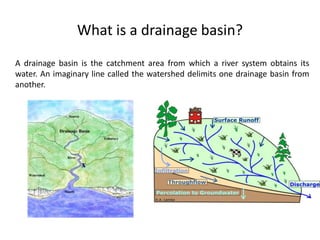
A drainage basin is the catchment area from which a river system obtains its 
water. An imaginary line called the watershed delimits one drainage basin from 
another.
How can we show the functions of a 
drainage basin? 
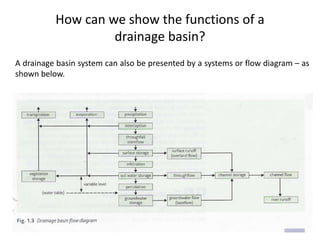
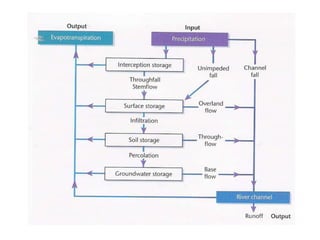
A drainage basin system can also be presented by a systems or flow diagram – as 
shown below.
Why is a drainage basin an open system? 
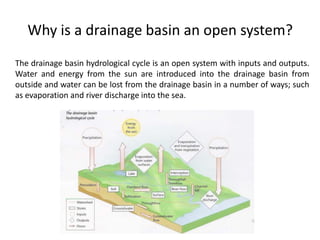
The drainage basin hydrological cycle is an open system with inputs and outputs. 
Water and energy from the sun are introduced into the drainage basin from 
outside and water can be lost from the drainage basin in a number of ways; such 
as evaporation and river discharge into the sea.
What are inputs, stores, transfers and outputs? 
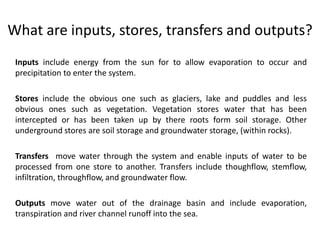
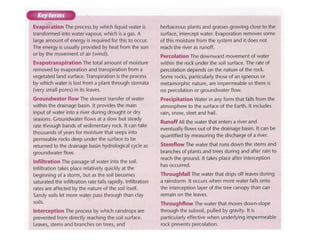
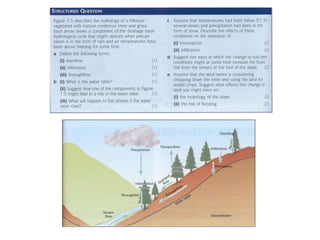
Inputs include energy from the sun for to allow evaporation to occur and 
precipitation to enter the system. 
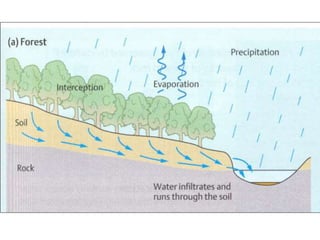
Stores include the obvious one such as glaciers, lake and puddles and less 
obvious ones such as vegetation. Vegetation stores water that has been 
intercepted or has been taken up by there roots form soil storage. Other 
underground stores are soil storage and groundwater storage, (within rocks). 
Transfers move water through the system and enable inputs of water to be 
processed from one store to another. Transfers include thoughflow, stemflow, 
infiltration, throughflow, and groundwater flow. 
Outputs move water out of the drainage basin and include evaporation, 
transpiration and river channel runoff into the sea.
Drainage Basins VLE
Drainage Basins VLE
Drainage Basins VLE
Drainage Basins VLE
Drainage Basins VLE
Drainage Basins VLE
Drainage Basins VLE

Drainage Basins VLE

  • 1.
    Drainage Basins Year12 geography GCE
  • 2.
    What is adrainage basin? A drainage basin is the catchment area from which a river system obtains its water. An imaginary line called the watershed delimits one drainage basin from another.
  • 3.
    How can weshow the functions of a drainage basin? A drainage basin system can also be presented by a systems or flow diagram – as shown below.
  • 4.
    Why is adrainage basin an open system? The drainage basin hydrological cycle is an open system with inputs and outputs. Water and energy from the sun are introduced into the drainage basin from outside and water can be lost from the drainage basin in a number of ways; such as evaporation and river discharge into the sea.
  • 5.
    What are inputs,stores, transfers and outputs? Inputs include energy from the sun for to allow evaporation to occur and precipitation to enter the system. Stores include the obvious one such as glaciers, lake and puddles and less obvious ones such as vegetation. Vegetation stores water that has been intercepted or has been taken up by there roots form soil storage. Other underground stores are soil storage and groundwater storage, (within rocks). Transfers move water through the system and enable inputs of water to be processed from one store to another. Transfers include thoughflow, stemflow, infiltration, throughflow, and groundwater flow. Outputs move water out of the drainage basin and include evaporation, transpiration and river channel runoff into the sea.