Rivers
SEC ONE TEXTBOOK
PAGE 101
What is a river?
• A river is a natural watercourse,
usually freshwater, flowing
towards the sea.
• Without the hydrological cycle,
rivers cannot be formed.
HYDROLOGICal CYCLE
HYDROLOGICAL
CYCLE
SURFACE
RUNOFF
INFILTRATION
CONDENSATION
TRANSPIRATION
AND EVAPORATION
PRECIPITATION
HYDROLOGICAL CYCLE
• Precipitation – water
from clouds come to the
Earth’s surface as rain,
snow and hail
• Transpiration – plants
release water vapour into
atmosphere
HYDROLOGICAL CYCLE
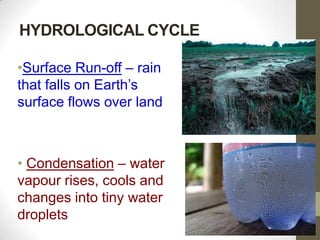
•Surface Run-off – rain
that falls on Earth’s
surface flows over land
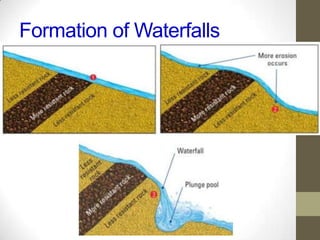
• Condensation – water
vapour rises, cools and
changes into tiny water
droplets
HYDROLOGICal CYCLE
• Infiltration – water
that soaks into the soil
subsurface
• Percolation – water
moves further down
into the underlying soil
after infiltration
HYDROLOGICal CYCLE
•Throughflow –
infiltrated water that
flows sideways in
the soil subsurface
• Interception –
water is absorbed
by trees
RIVER SYSTEM
• Source – the
starting point of a
river
• Mouth – the ending
point of a river
• Drainage Basin –
The area drained by
a river and its
tributaries
RIVER SYSTEM
•Confluence – the
point at which a
tributary joins the
main river
• Watershed – The
boundary formed
by the edges of the
drainage basin
Waterfalls
• Sudden, steep and vertical flow of fast-
flowing water falling from great heights
• Formed by river erosion
Niagara Falls on Niagara River,
Canada and USA
• formed by
erosion of
rock of
different
resistance
Formation of Waterfalls
• River flows across rocks of different
resistance.
Formation of Waterfalls
• River erodes the less resistant rock more
rapidly
• This cause a change in the gradient of the river
course.
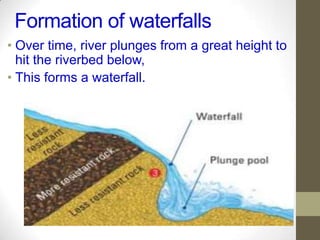
Formation of waterfalls
• Over time, river plunges from a great height to
hit the riverbed below,
• This forms a waterfall.
Formation of plunge pools
• Repeated pounding of the river bed leads to a
depression at the base of a waterfall
• A plunge pool is formed.
Meander
• A river that follows a
winding course, usually
forming hoop-like bends.
• River may meander
because
Lower gradient  lower
speed  lower river
energy river turns to
avoid obstacles
Meander
Note:
Outer Bank = Concave Bank
Note:
Inner Bank = Concave Bank
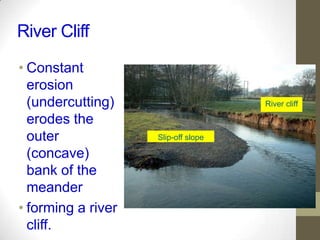
River Cliff
• Constant
erosion
(undercutting)
erodes the
outer
(concave)
bank of the
meander
• forming a river
cliff.
Slip-off slope
River cliff
Slip-off slope
• Constant
deposition at
the outer
(convex) bank
deposits
sediments
• forming a slip-
off slope.
Slip-off
slope
River cliff
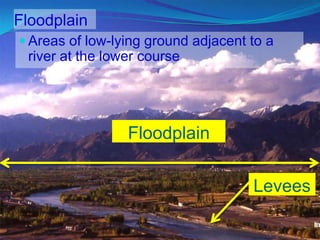
Floodplain
Levees
Floodplain
 Areas of low-lying ground adjacent to a
river at the lower course
Formation of Floodplain and Levee
Floodplain and Levee
• During a heavy rainfall, river water
overflows its bank. River loses speed as it
encounters friction.
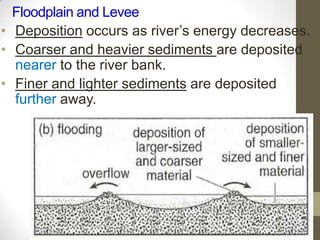
Floodplain and Levee
• Deposition occurs as river’s energy decreases.
• Coarser and heavier sediments are deposited
nearer to the river bank.
• Finer and lighter sediments are deposited
further away.
Formation of Floodplain and Levee
Floodplain and Levee
• Overtime, the accumulation of fine
sediments results in the formation of flat
plains
• Coarser and heavier sediments are
acculumated
• Results in the formation of raised banks
• Known as levees.
Formation of Delta
• At the river mouth, a river loses energy and
starts to deposit its sediments.
Formation of Delta
• As the
sediments build
up, the mouth
will be blocked
• The river also
split into several
small channels
called
distributaries to
flow to the sea.
DistributariesDelta
Over time, the accumulated
sediments that rise over the water
and the distributaries form a delta.
Positive Impact of river
• Rivers provide water
for domestic
purposes such as
drinking, bathing and
washing.
• Rivers are a good
source of food such
as fish and prawns.
Positive Impact of river
• Rivers are important
waterways for
transporting people
and goods.
Negative Impact of river
• River water
overflows river
bank cause lives
to be lost and
destroy property
and crops.
• .
Negative Impact of river
• Consuming
contaminated
river water can
cause people to
fall ill
• Eg contract
diseases such
as cholera.

Sec 2 rivers 2013