RIVER CHANNEL PROCESSES & LANDFORMS, FLOOD & MANAGEMENT (1) RIVER PROCESSES. (2) DEPOSITION & SEDIMENTATION (HJULSTROM CURVE) (3) VELOCITY & DISCHARGE (4) PATTERNS OF FLOW (5) CHANNEL TYPES (6) CHANNEL LANDFORMS (7) FLOOD (CAUSES, IMPACT AND MANAGEMENT)
RIVER PROCESSES: Three river processes: Transportation Deposition Erosion
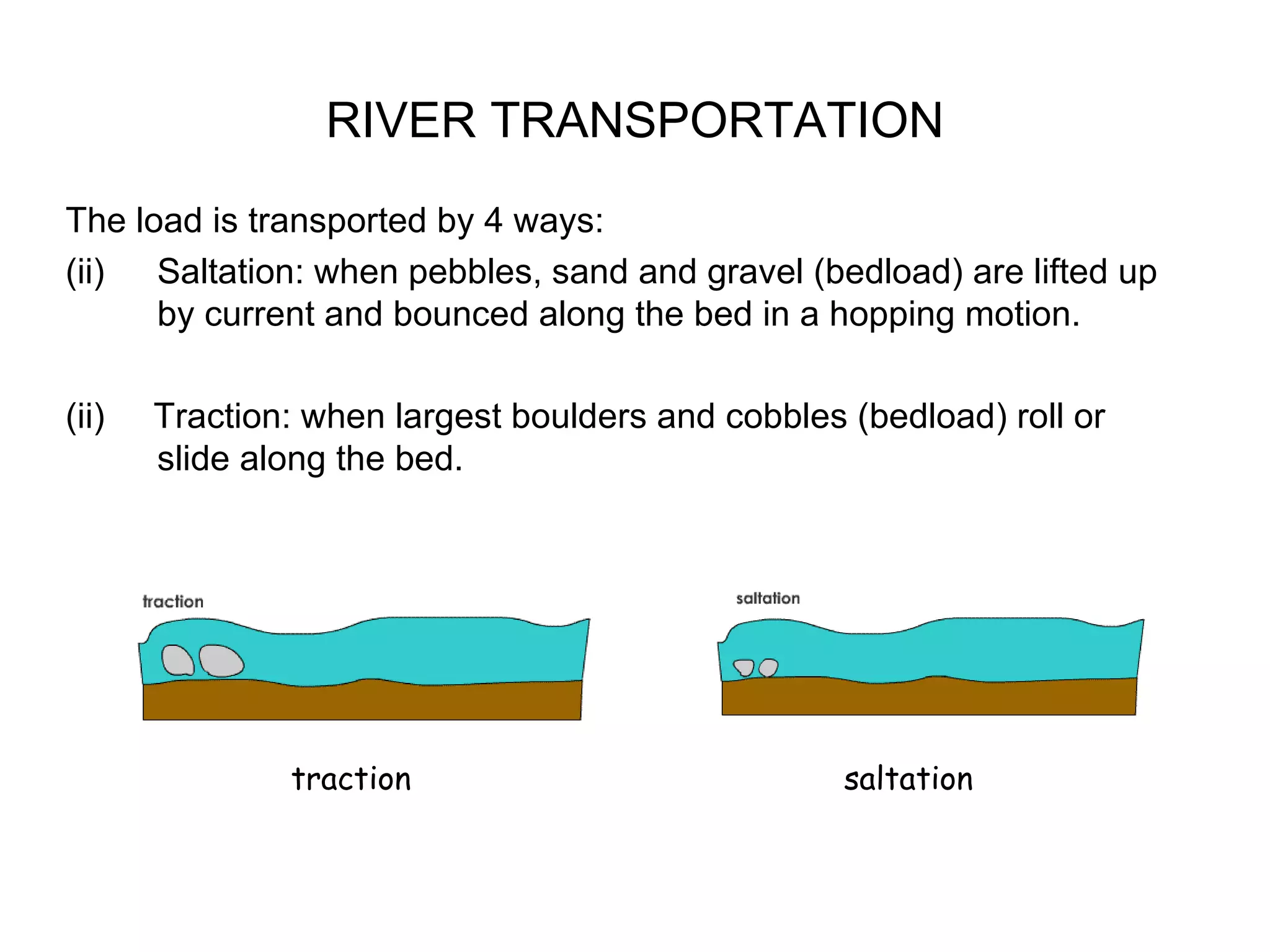
RIVER TRANSPORTATION The load is transported by 4 ways: Saltation: when pebbles, sand and gravel (bedload) are lifted up by current and bounced along the bed in a hopping motion. (ii)  Traction: when largest boulders and cobbles (bedload) roll or slide along the bed. traction saltation
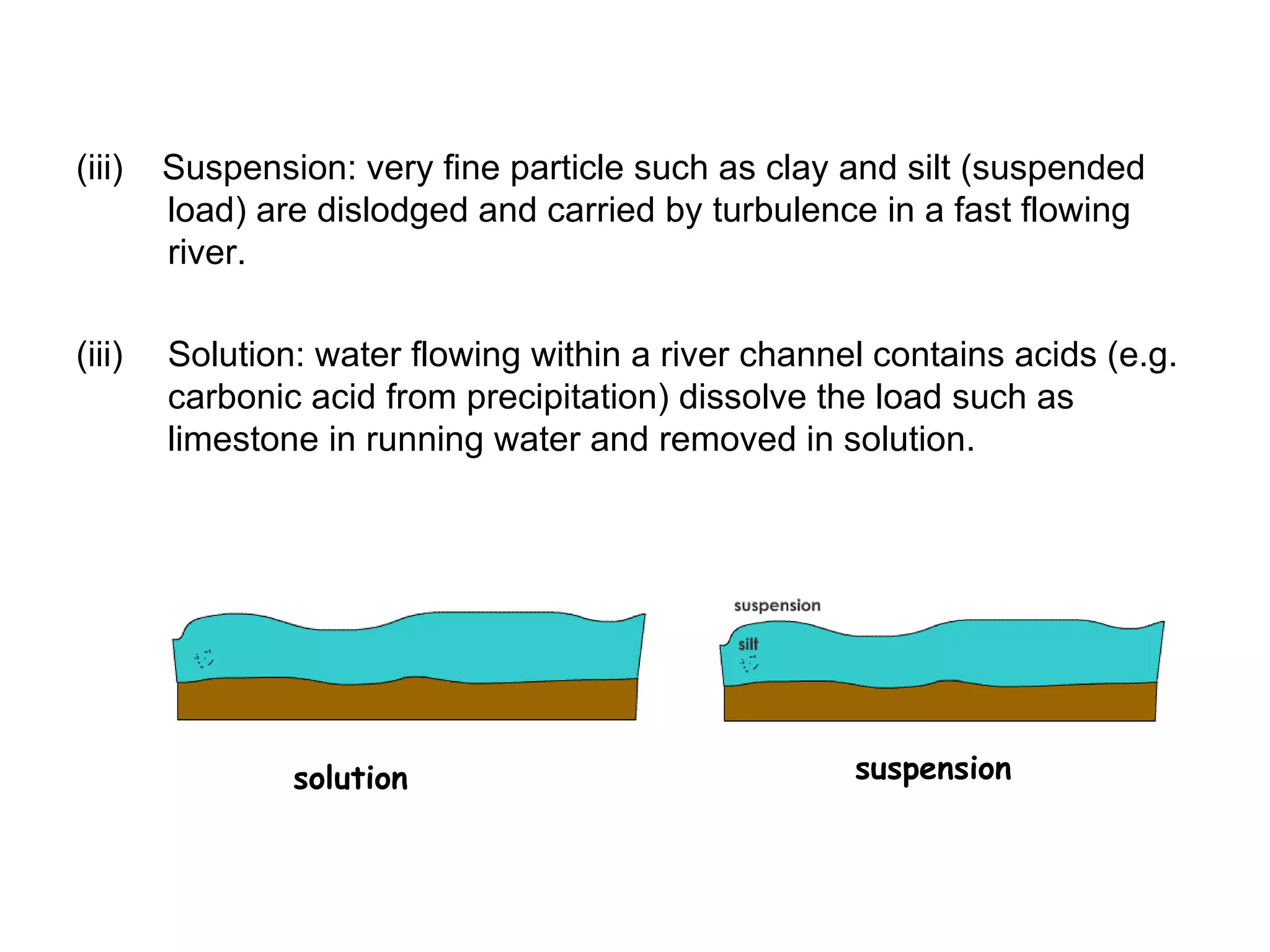
(iii)  Suspension: very fine particle such as clay and silt (suspended load) are dislodged and carried by turbulence in a fast flowing river. Solution: water flowing within a river channel contains acids (e.g. carbonic acid from precipitation) dissolve the load such as limestone in running water and removed in solution. solution suspension
River deposition Deposition : when velocity begins to fall, it has less energy and no  longer had competence and capacity to carry all its load so largest  particles, materials begins to be deposited. When occur? Low discharge during period of low precipitation Less velocity when river enter sea or lake. Shallow water occurs on inside of a meander. The load suddenly increase (debris from landslide) River overflow its bank so velocity outside channel is reduced. (resulting in floodplain)
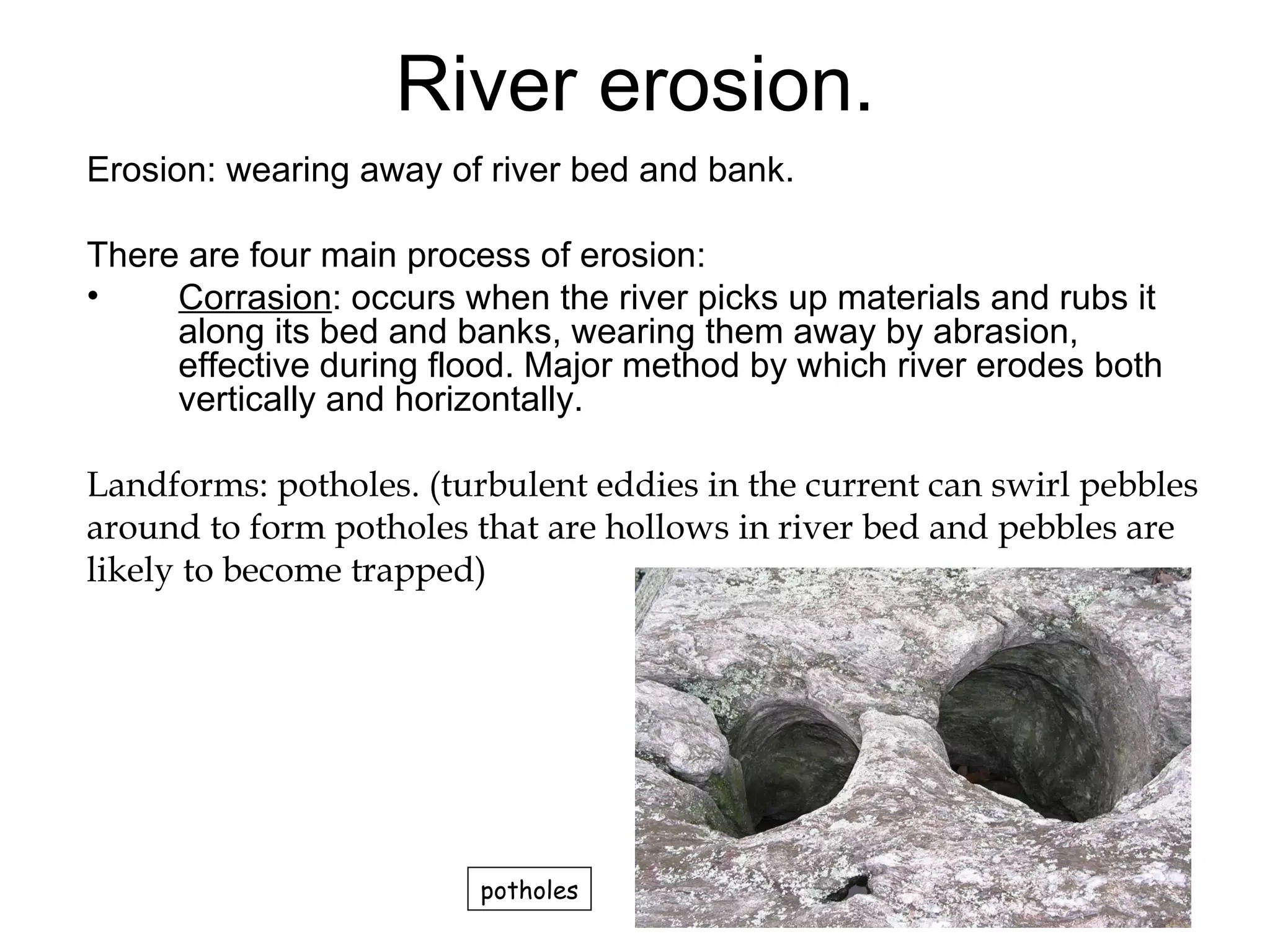
River erosion. Erosion: wearing away of river bed and bank.  There are four main process of erosion: Corrasion : occurs when the river picks up materials and rubs it along its bed and banks, wearing them away by abrasion, effective during flood. Major method by which river erodes both vertically and horizontally.  Landforms: potholes. (turbulent eddies in the current can swirl pebbles around to form potholes that are hollows in river bed and pebbles are  likely to become trapped) potholes
Attrition : As bedload moved downstream, boulders collide with  other material and the impact may break the rock into smaller pieces. In time angular rocks become increasingly rounded. (iii) Hydraulic action : The sheer force of the water as the turbulent current hits banks (outside of meander) pushes water into cracks. The air in cracks compressed, pressure increased and in time bank will collapse. Cavitation: is a form of hydraulic action caused by bubbles of air collapsing. (iv)  Solution/corrosion : This process in independent of river discharge and velocity. It is related to chemical composition of water e.g. concentration of carbonic acid and humid acid.
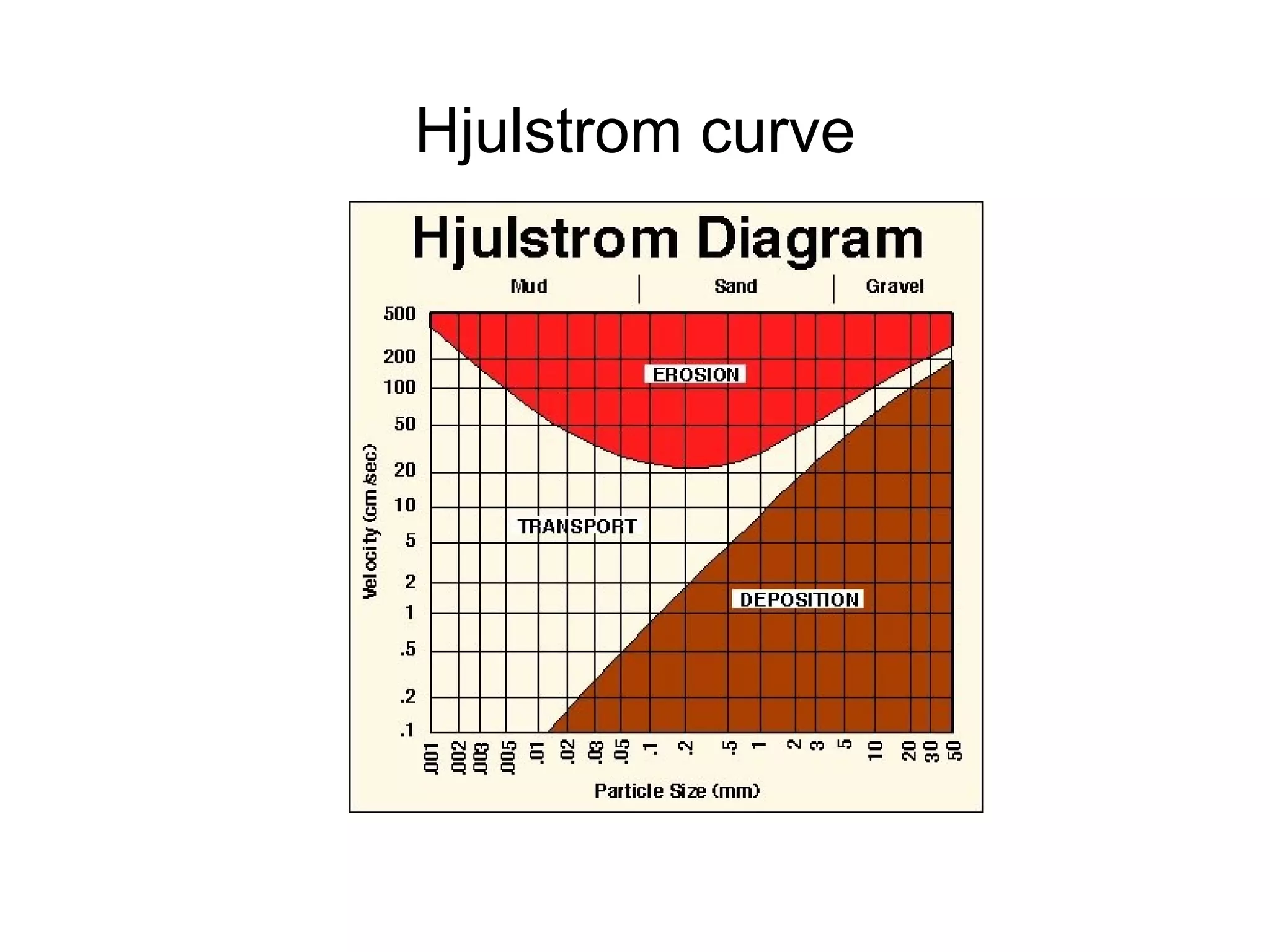
Hjulstrom curve
Hjulstrom   curve The  Hjulstrøm curve  is a  graph  used by  hydrologists  to determine whether a  river  will  erode , transport or deposit sediment. The graph takes sediment size and channel velocity into account. The curve shows several key ideas about the relationships between erosion, transportation and deposition.  The Hjulstrøm Curve shows that particles of a size around 1mm require the least energy to erode, as they are sands that do not coagulate. Particles smaller than these fine sands are often clays which require a higher velocity to produce the energy required to split the small clay particles which have coagulated.  Larger particles such as pebbles are eroded at higher velocities and very large objects such as boulders require the highest velocities to erode. When the velocity drops below this velocity called the  line of critical velocity , particles will be deposited or transported, instead of being eroded, depending on the river's energy.
Velocity and Discharge: Discharge : is the amount of water originating  as precipitation which reaches the channel  by surface runoff, throughflow and baseflow. Q = A X V  (Q: discharge, A: cross-sectional area and  V: velocity)
Velocity: 1. Velocity: speed of a river (m/s) 2. Velocity of a river is influence by 3 factors: Channel shape in cross-section. Roughness of the channel’s bed and banks. Channel slope.
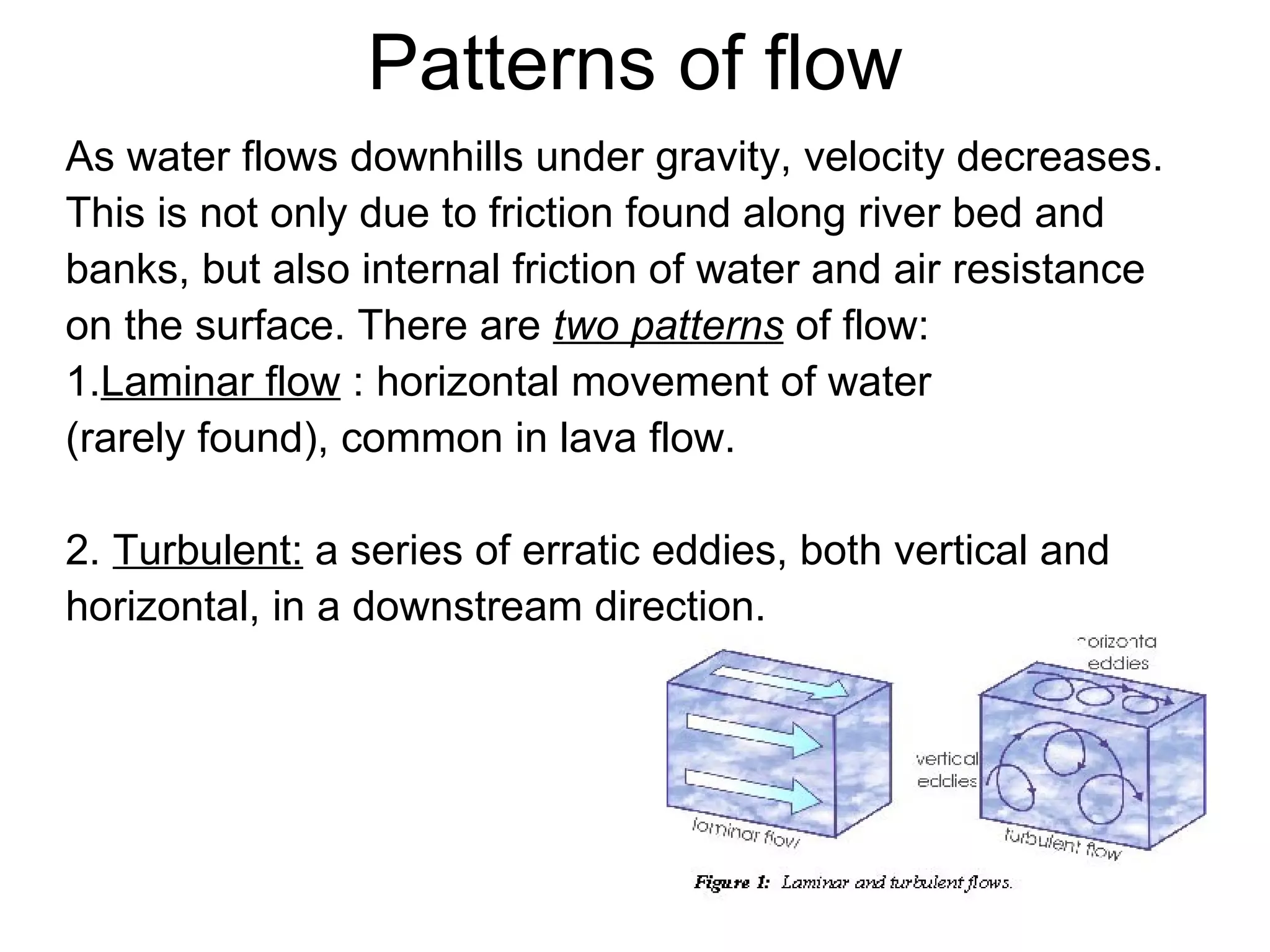
Patterns of flow As water flows downhills under gravity, velocity decreases. This is not only due to friction found along river bed and  banks, but also internal friction of water and air resistance  on the surface. There are  two patterns  of flow: 1. Laminar flow  : horizontal movement of water (rarely found), common in lava flow. 2.  Turbulent:  a series of erratic eddies, both vertical and  horizontal, in a downstream direction.
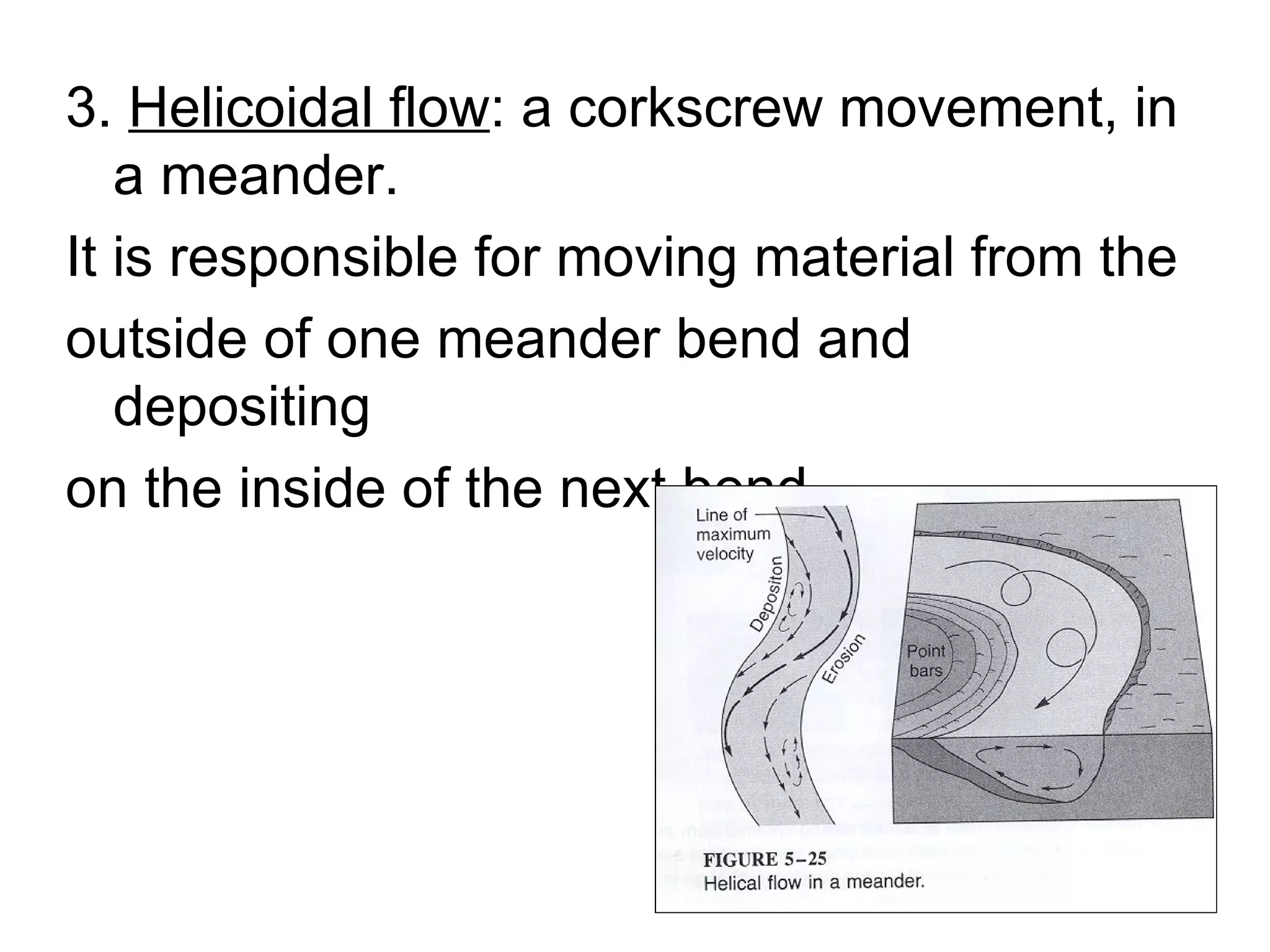
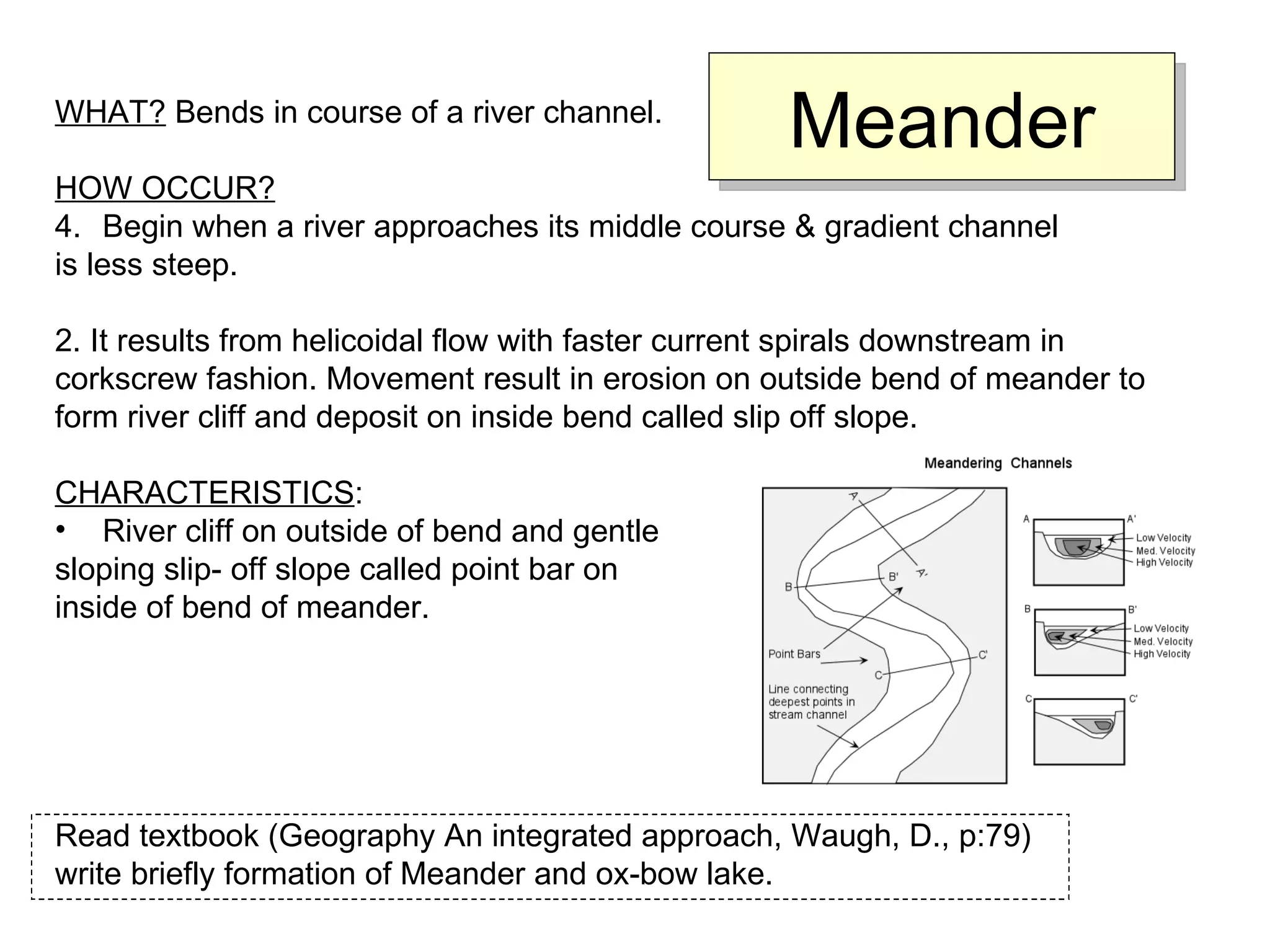
3.  Helicoidal flow : a corkscrew movement, in a meander.  It is responsible for moving material from the  outside of one meander bend and depositing  on the inside of the next bend.
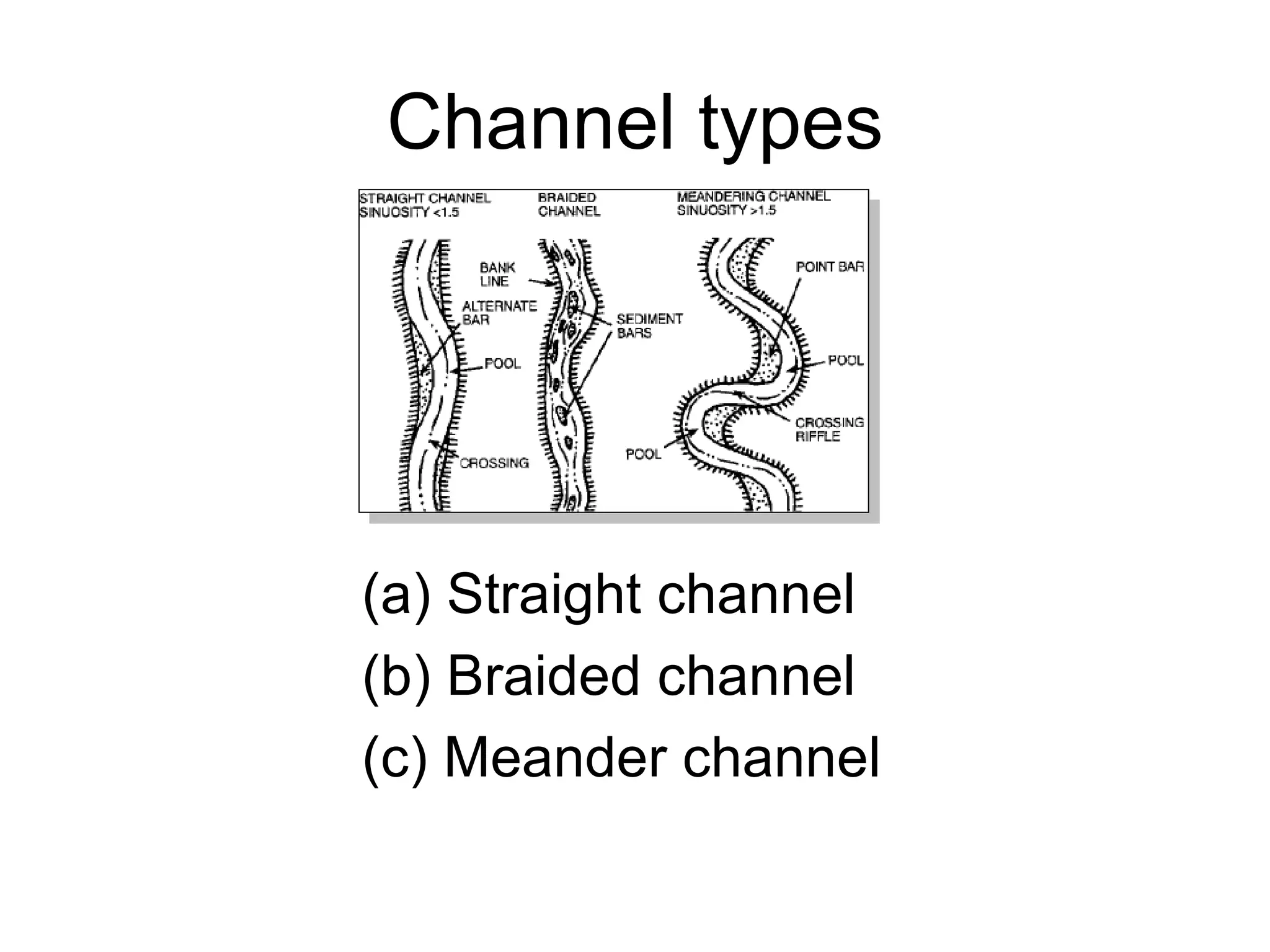
Channel types (a) Straight channel (b) Braided channel (c) Meander channel
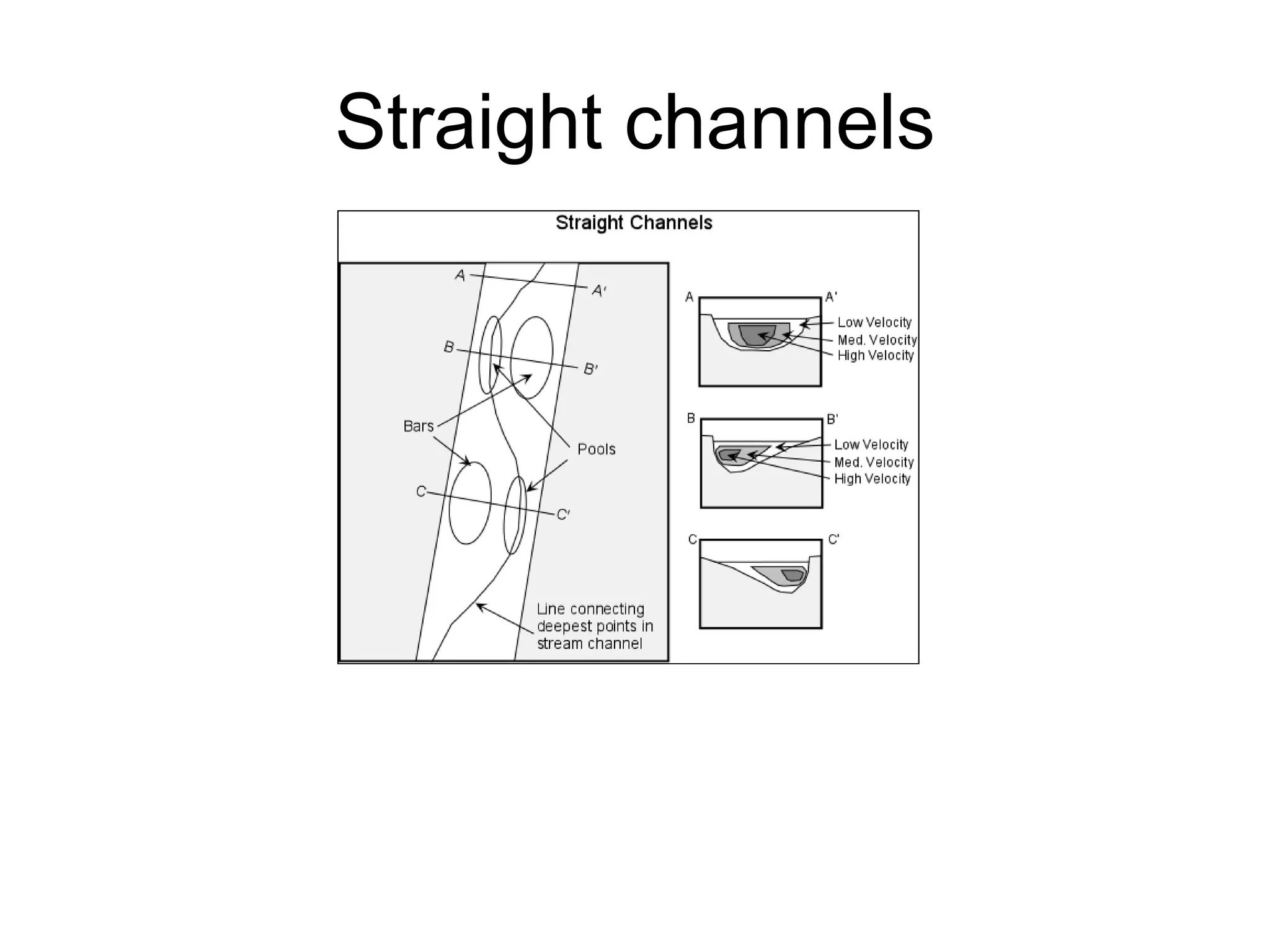
Straight channels
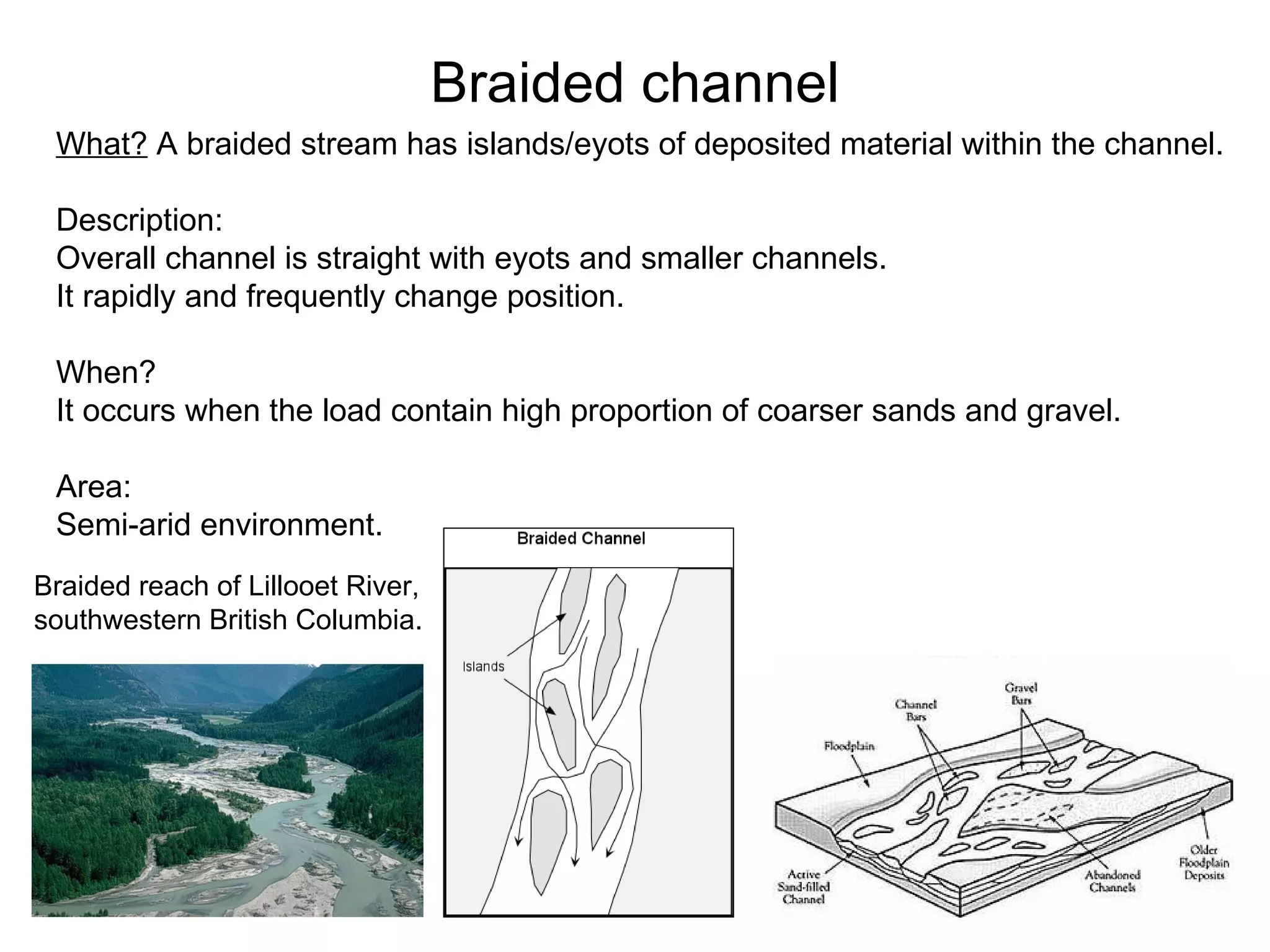
Braided channel Braided reach of Lillooet River,  southwestern British Columbia.  What?  A braided stream has islands/eyots of deposited material within the channel. Description: Overall channel is straight with eyots and smaller channels. It rapidly and frequently change position. When? It occurs when the load contain high proportion of coarser sands and gravel. Area: Semi-arid environment.
Meander WHAT?  Bends in course of a river channel. HOW OCCUR? Begin when a river approaches its middle course & gradient channel  is less steep. 2. It results from helicoidal flow with faster current spirals downstream in  corkscrew fashion. Movement result in erosion on outside bend of meander to  form river cliff and deposit on inside bend called slip off slope. CHARACTERISTICS : River cliff on outside of bend and gentle  sloping slip- off slope called point bar on  inside of bend of meander. Read textbook (Geography An integrated approach, Waugh, D., p:79) write briefly formation of Meander and ox-bow lake.
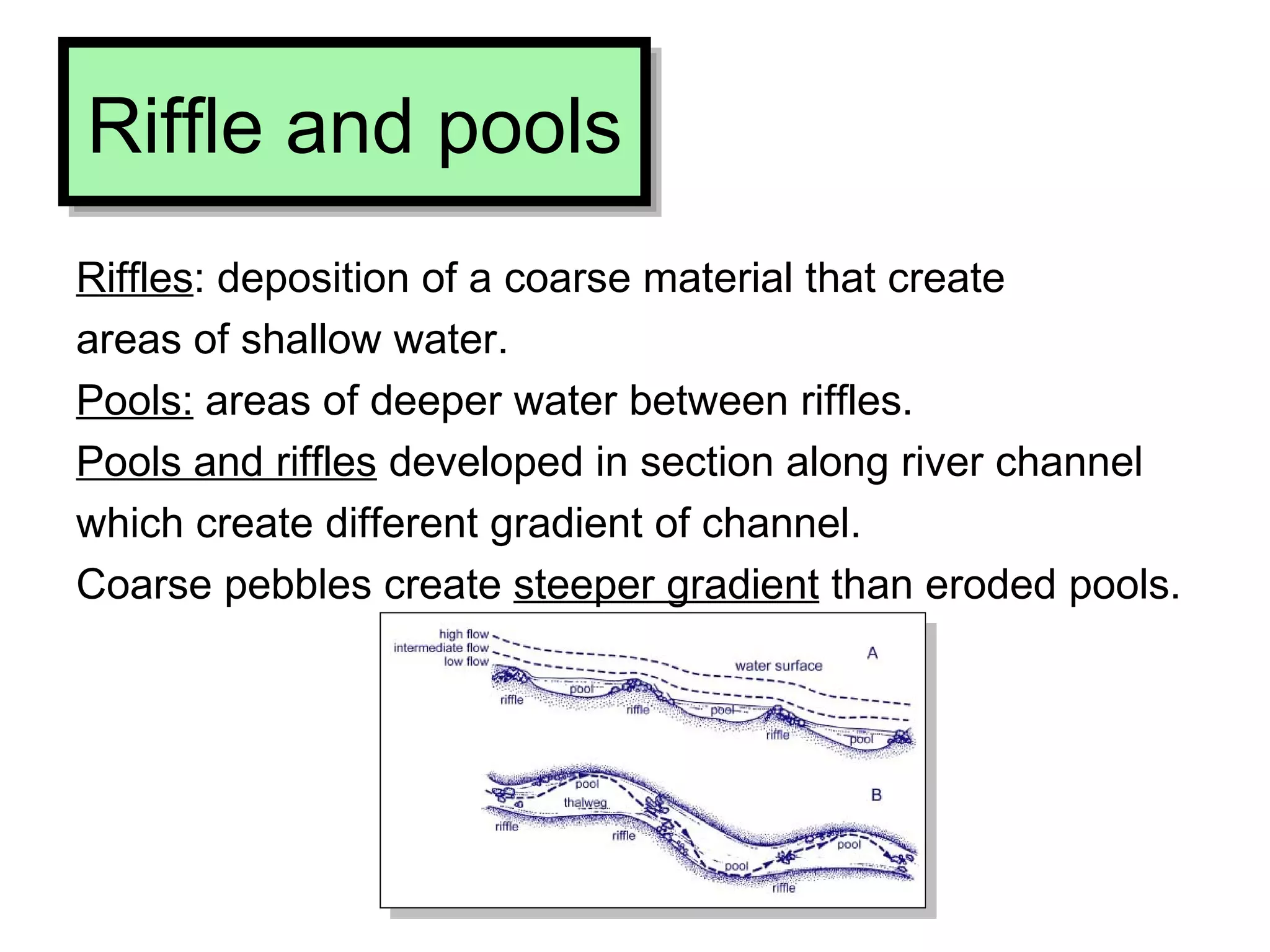
Riffle and pools Riffles : deposition of a coarse material that create  areas of shallow water. Pools:  areas of deeper water between riffles. Pools and riffles  developed in section along river channel  which create different gradient of channel.  Coarse pebbles create  steeper gradient  than eroded pools.
Fluvial landforms Effects of fluvial erosion: (a)  V-shaped valleys A river erode vertically by traction or saltation which resulted in a steep- sided valley called a V-shaped valley. Steepness of valley sides depend of factors such as: Climate: valley are steeper where there is sufficient rainfall. (for mass movement and allow river to transport bedload and erode vertically) Rock structure: resistant, permeable rocks such as limestone produce vertical sides. Vegetation: it helps to bind soil together and keep the hillslope more stable.
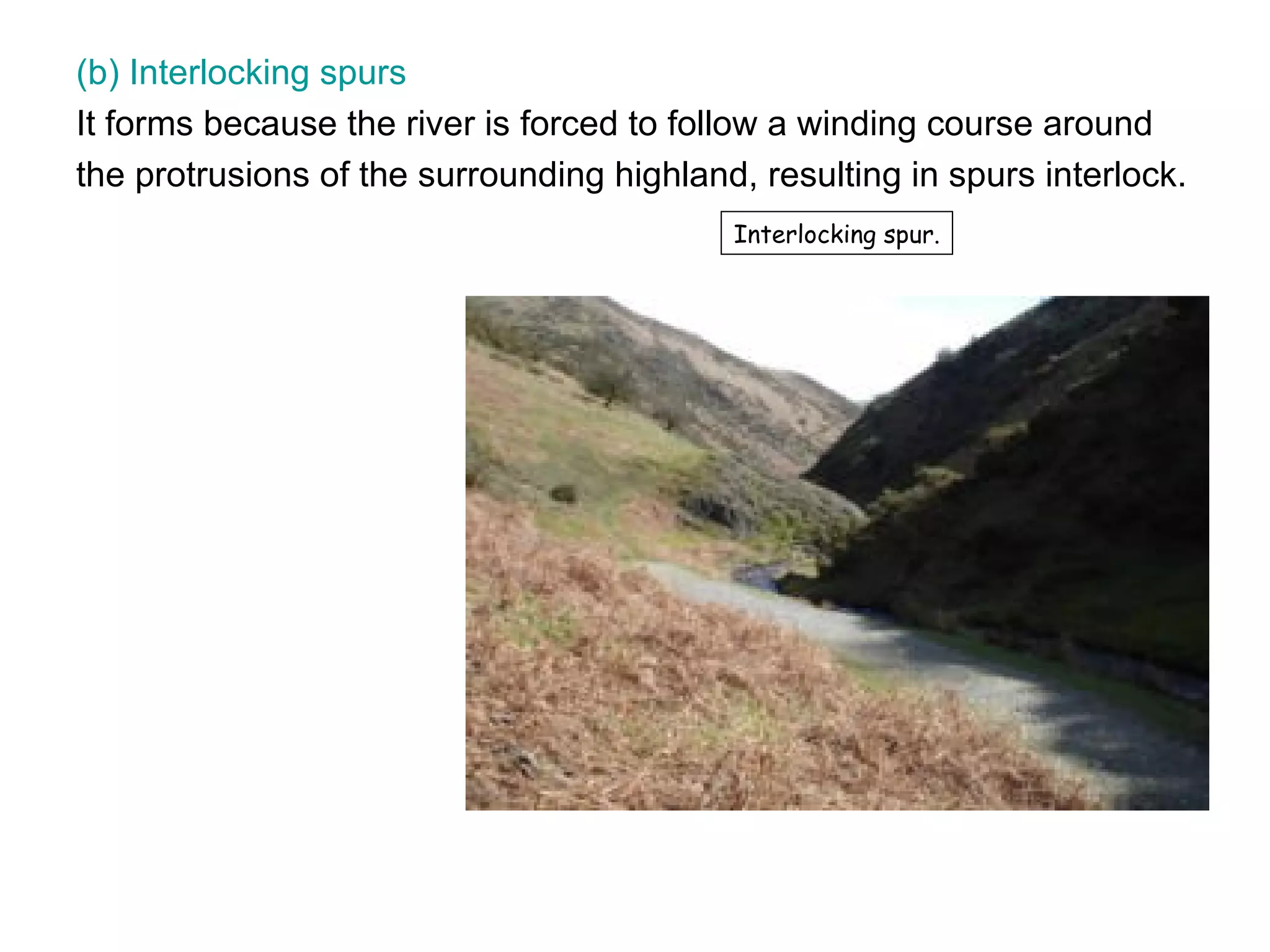
(b) Interlocking spurs  It forms because the river is forced to follow a winding course around  the protrusions of the surrounding highland, resulting in spurs interlock. Interlocking spur.
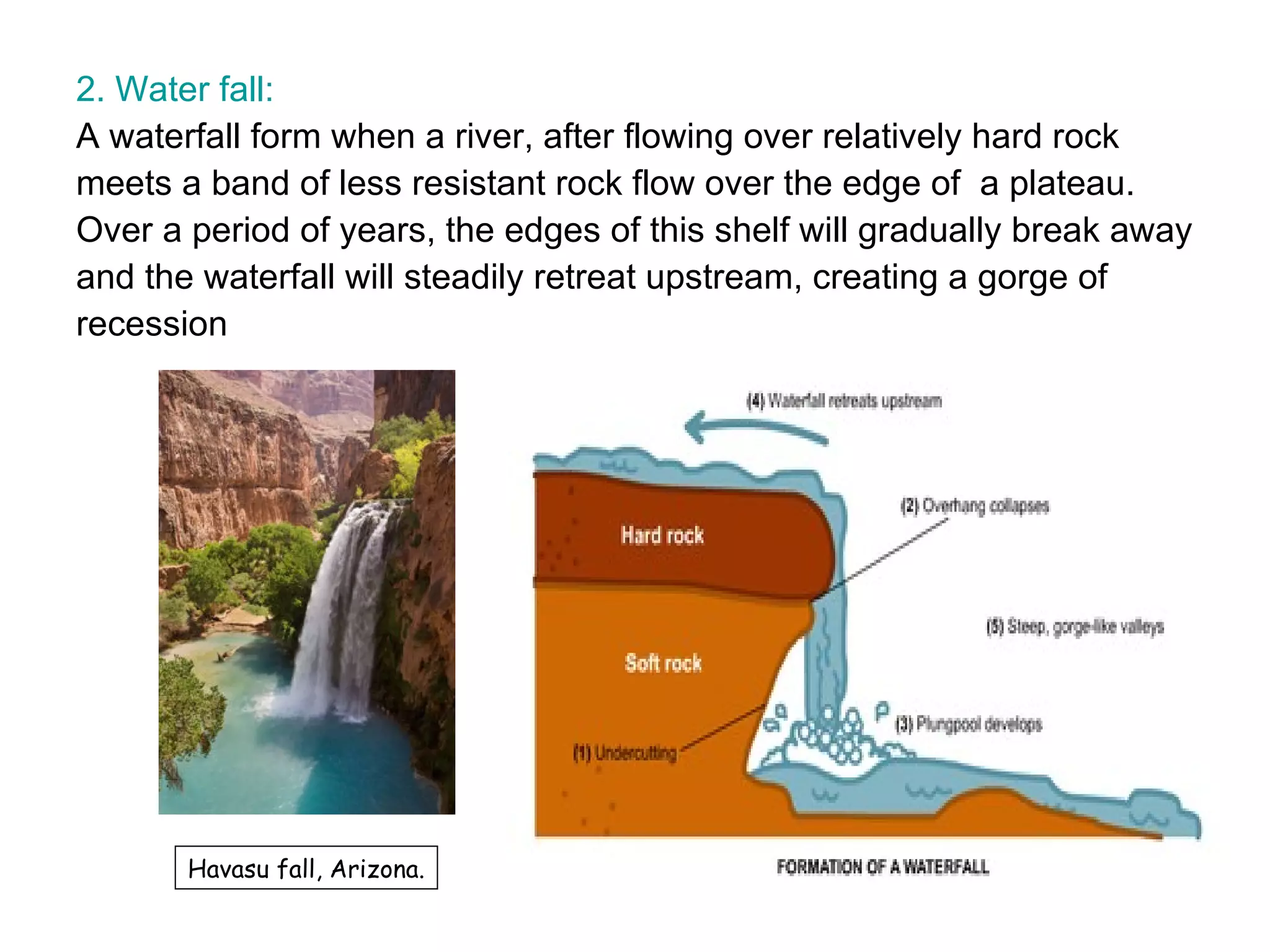
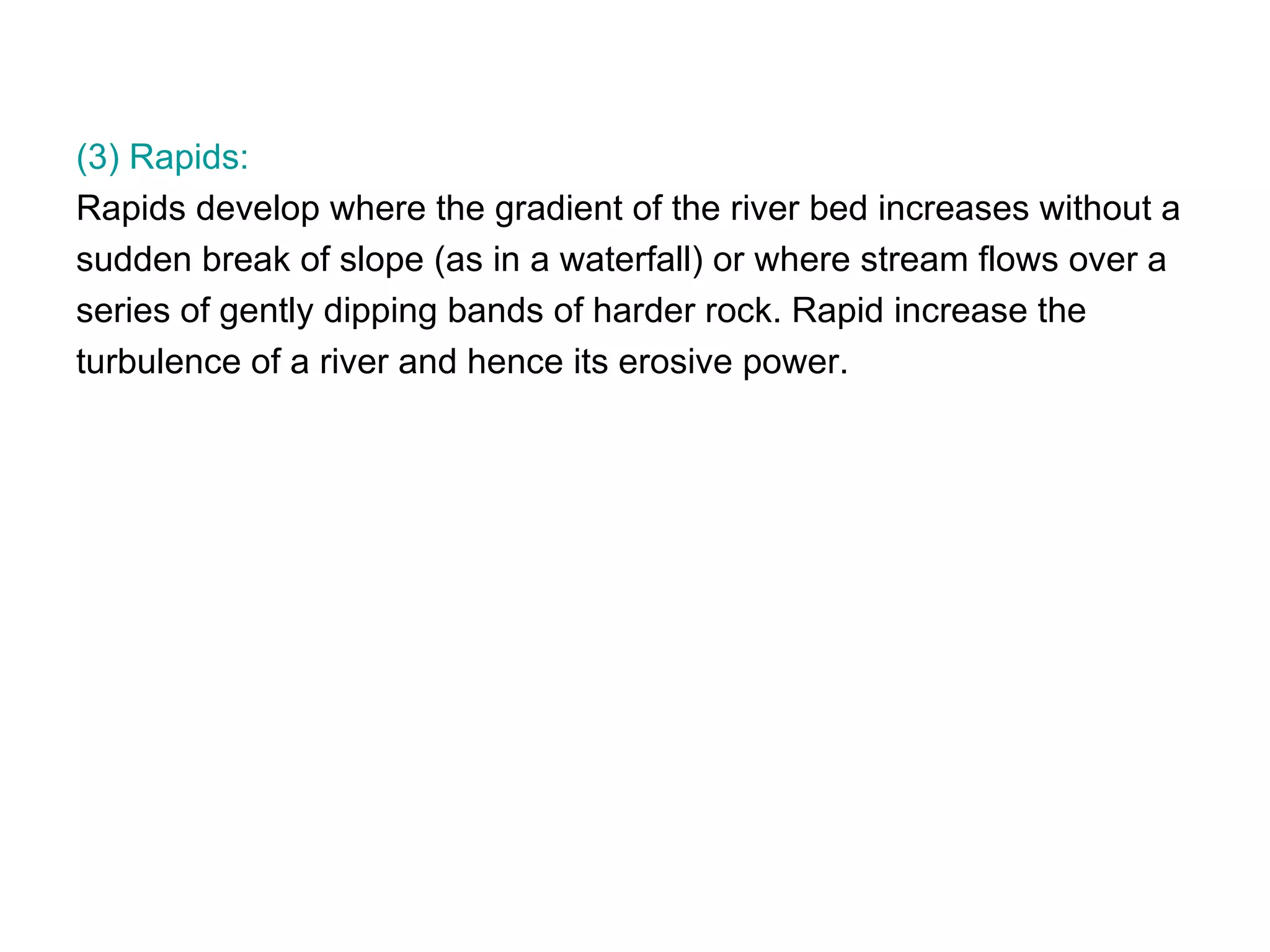
2. Water fall: A waterfall form when a river, after flowing over relatively hard rock  meets a band of less resistant rock flow over the edge of  a plateau. Over a period of years, the edges of this shelf will gradually break away  and the waterfall will steadily retreat upstream, creating a gorge of  recession Havasu fall, Arizona.
(3) Rapids: Rapids develop where the gradient of the river bed increases without a  sudden break of slope (as in a waterfall) or where stream flows over a  series of gently dipping bands of harder rock. Rapid increase the  turbulence of a river and hence its erosive power.
Effect of fluvial deposition. Deposition of sediment takes place where there is  a decrease in energy   or  an increase in capacity  which makes  the river less competent to  transport its load. It can occur anywhere from upper course, where boulders may be left,  to the mouth where fine clays may be deposited. FLUVIAL LANDFORMS: Floodplains :  A floodplain is a mostly flat area of land bordering a river subjected to  periodic flooding. It is made of silts and sands which have been  deposited over many years by the river.
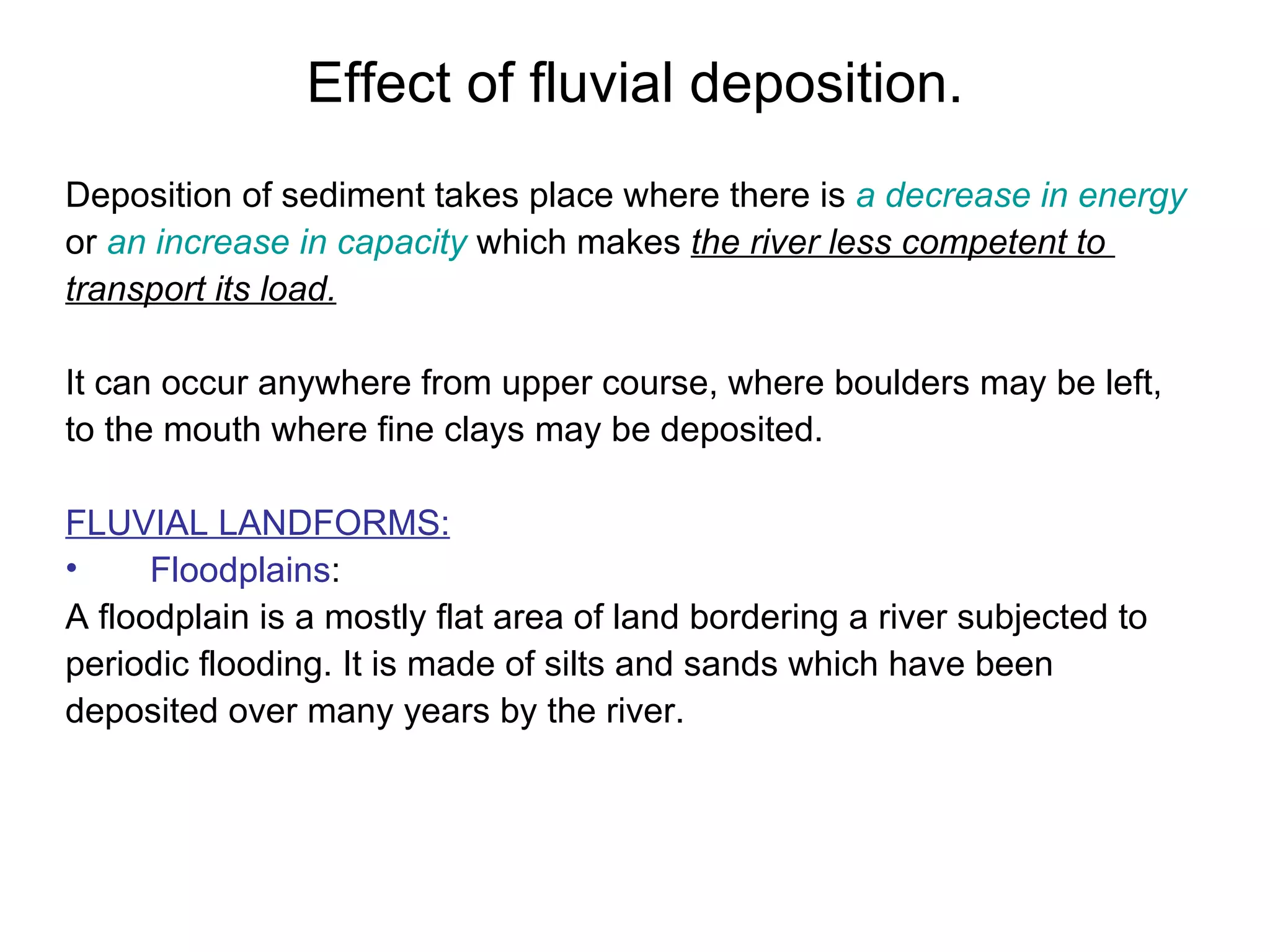
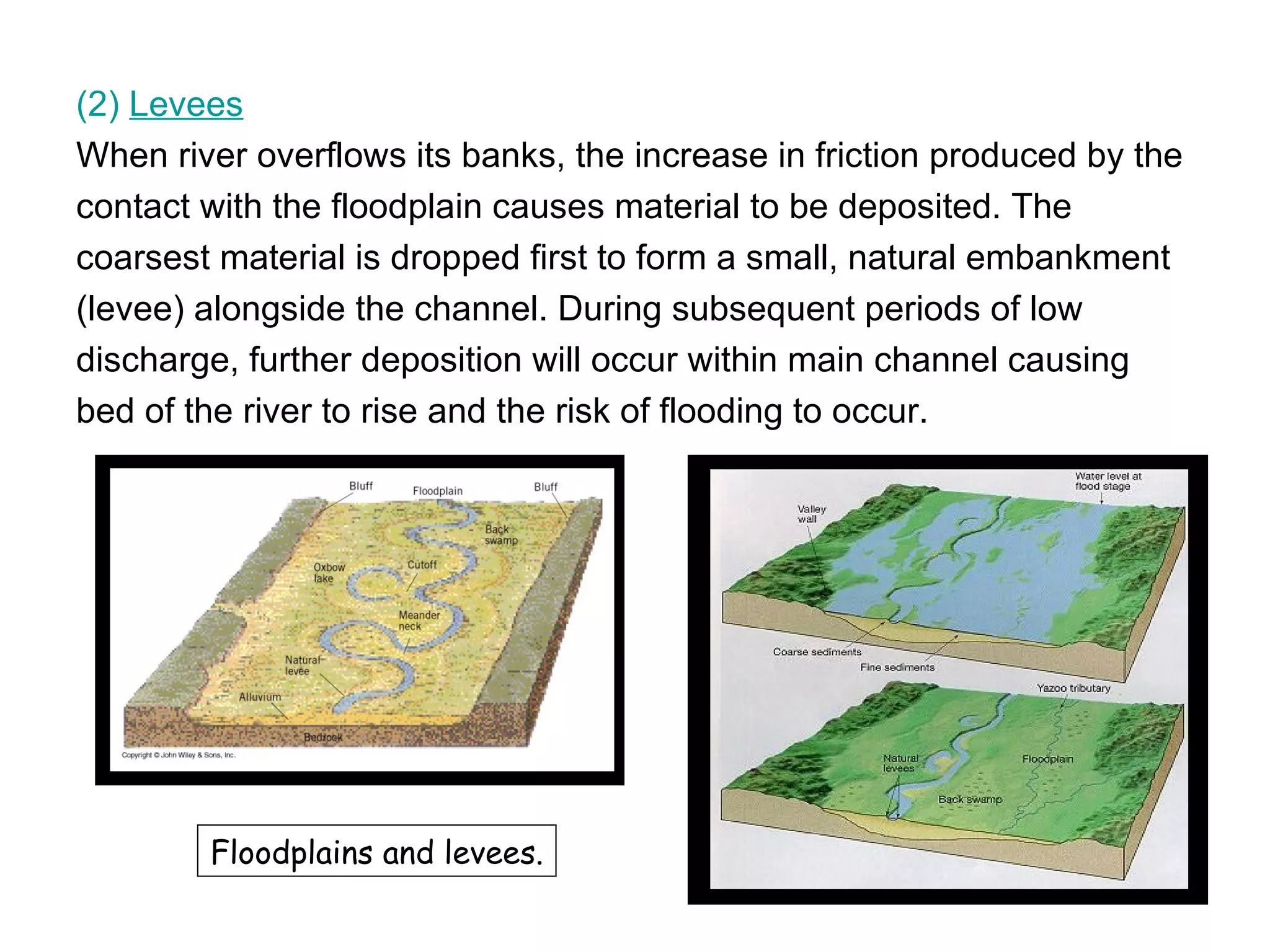
(2)  Levees When river overflows its banks, the increase in friction produced by the  contact with the floodplain causes material to be deposited. The  coarsest material is dropped first to form a small, natural embankment  (levee) alongside the channel. During subsequent periods of low  discharge, further deposition will occur within main channel causing  bed of the river to rise and the risk of flooding to occur.  Floodplains and levees.
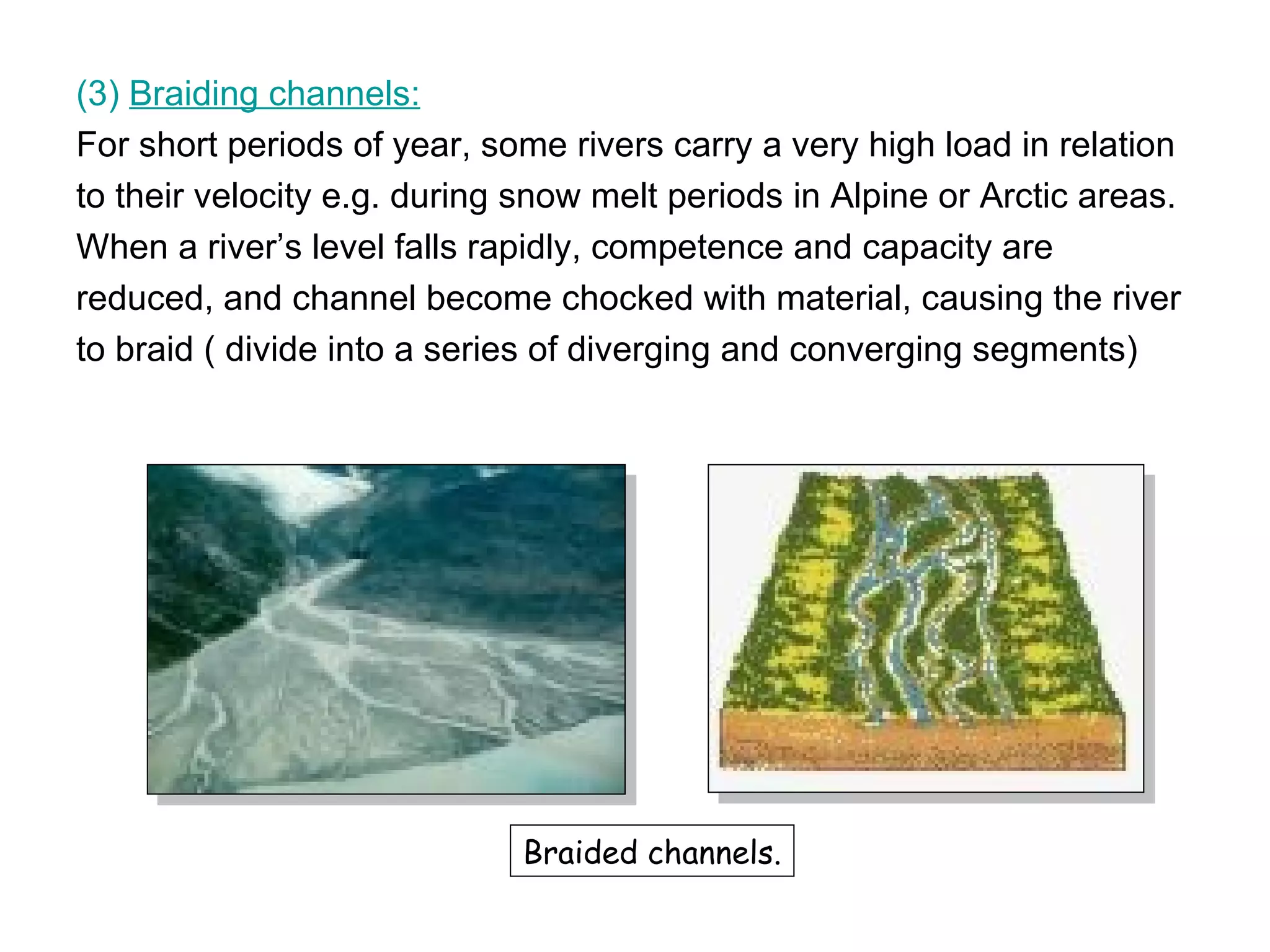
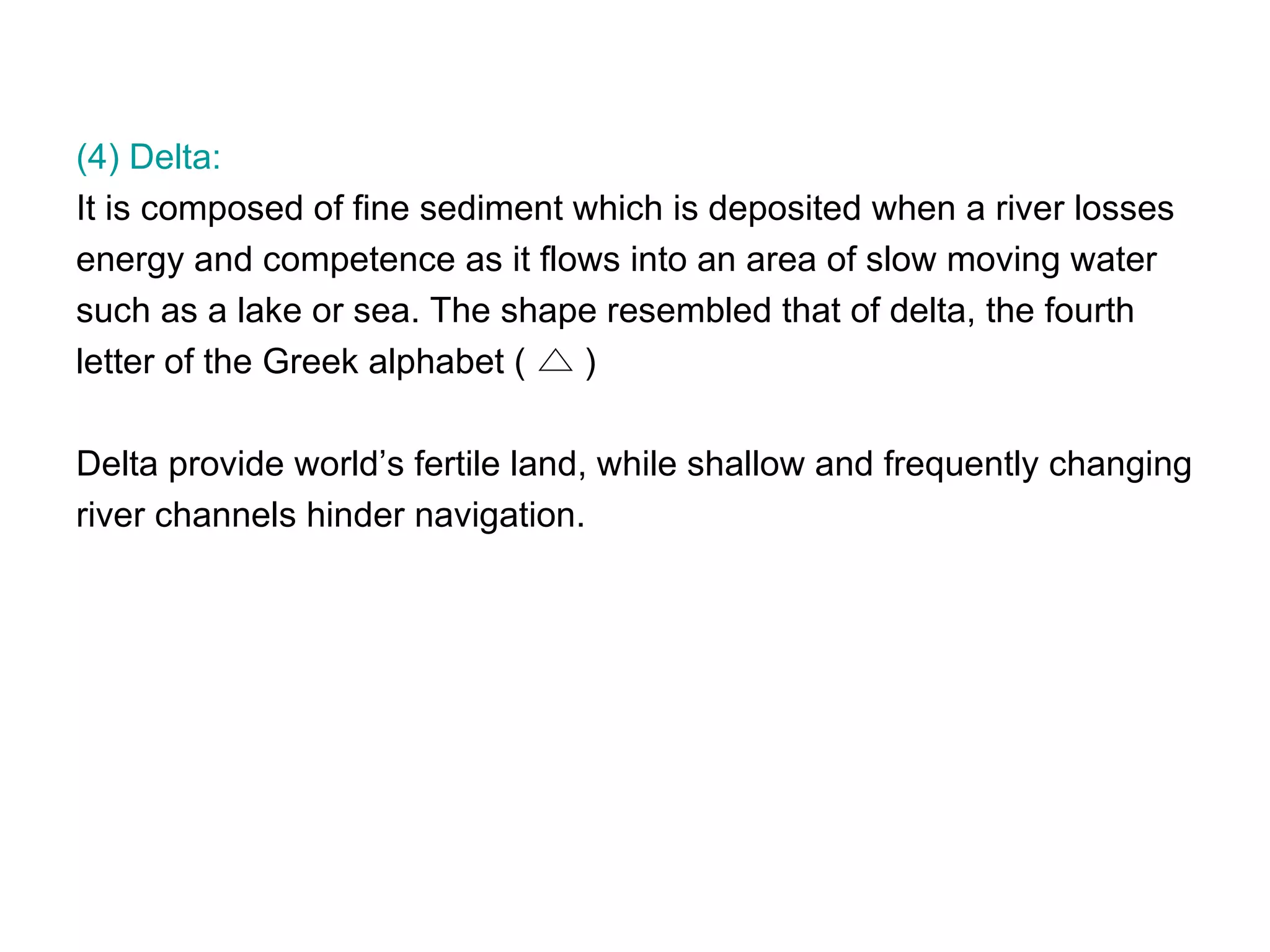
(3)  Braiding channels: For short periods of year, some rivers carry a very high load in relation  to their velocity e.g. during snow melt periods in Alpine or Arctic areas.  When a river’s level falls rapidly, competence and capacity are reduced, and channel become chocked with material, causing the river  to braid ( divide into a series of diverging and converging segments) Braided channels.
(4) Delta:  It is composed of fine sediment which is deposited when a river losses  energy and competence as it flows into an area of slow moving water  such as a lake or sea. The shape resembled that of delta, the fourth  letter of the Greek alphabet (  ) Delta provide world’s fertile land, while shallow and frequently changing  river channels hinder navigation.
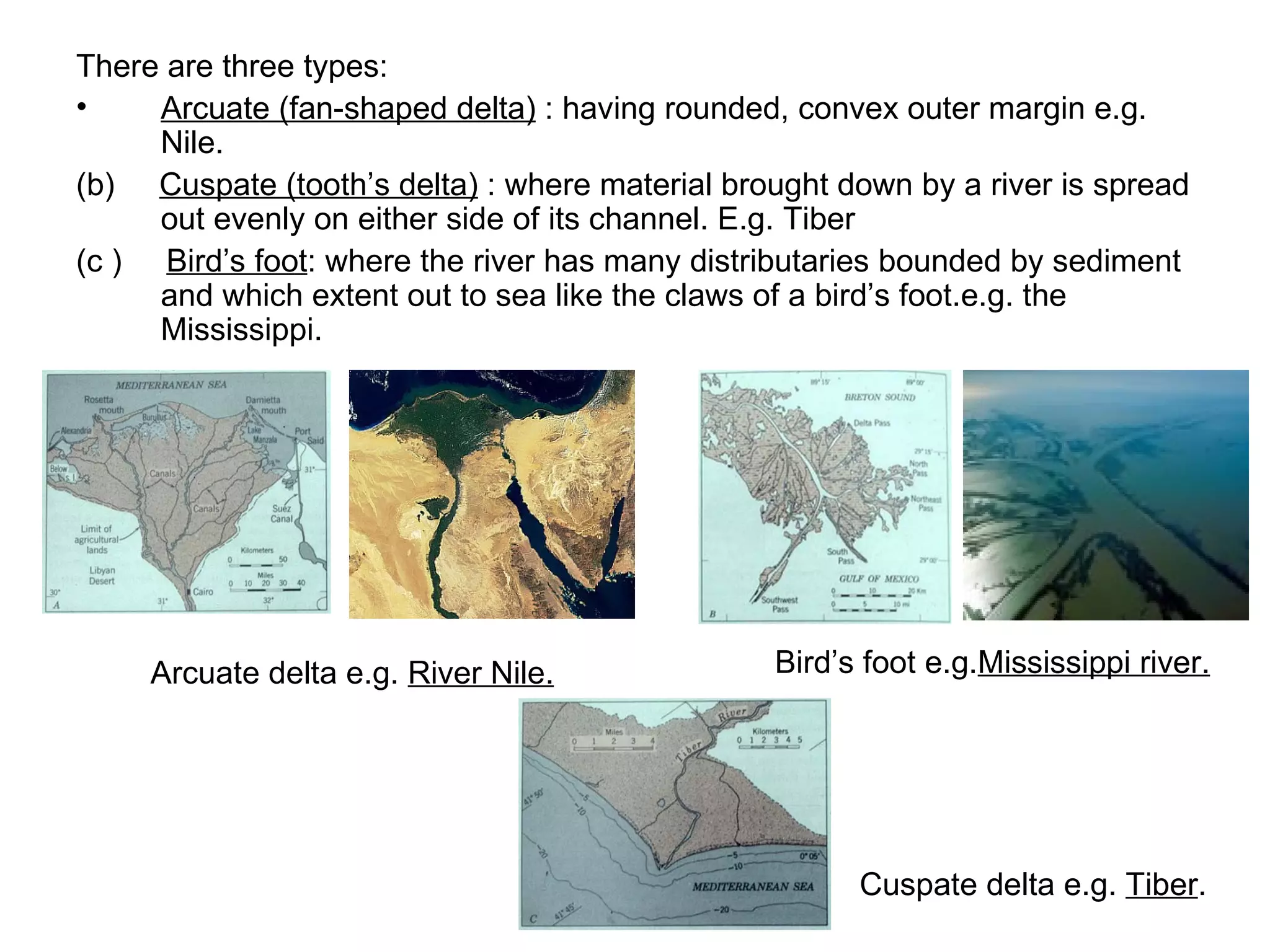
There are three types: Arcuate (fan-shaped delta)  : having rounded, convex outer margin e.g. Nile. (b)  Cuspate (tooth’s delta)  : where material brought down by a river is spread out evenly on either side of its channel. E.g. Tiber (c )  Bird’s foot : where the river has many distributaries bounded by sediment and which extent out to sea like the claws of a bird’s foot.e.g. the Mississippi. Arcuate delta e.g.  River Nile. Bird’s foot e.g. Mississippi river. Cuspate delta e.g.  Tiber .
FLOOD Causes Impact Management Case studies
Flooding   CAUSES (Human and physical factors) (I) PHYSICAL FACTORS: When does flooding occur? Water overflows river banks onto surrounding area. Occur when water available is more than infiltration capacity. When does water overflow? Intense precipitation Prolong rainfall in saturated soil. i.e. clay prone to overlandflow (smaller pores) Soil already saturated thus reduce infitration capacity. (prone to flood) 3. Sudden increase in temperature (rapid snow melt) (II)  HUMAN FACTORS : Dam burst Land use (drainage system, digging ditch, ploughing up and down slope) Urbanisation (land made impermeable in road building) Deforestation.
Impact of flooding  (case study: uk and brazil) Reference: AS Geography Pallister J. & Bowen, Ann, p: 34-38) Flood management  (Colorado & Bangladesh) Ref: AS Geography, Pallister J. & Bowen, Ann, p:39-43) IMPACTS AND FLOOD MANAGEMENT Read from textbook below, draw a mind map/concept map

River Channel Processes & Landforms

  • 1.
    RIVER CHANNEL PROCESSES& LANDFORMS, FLOOD & MANAGEMENT (1) RIVER PROCESSES. (2) DEPOSITION & SEDIMENTATION (HJULSTROM CURVE) (3) VELOCITY & DISCHARGE (4) PATTERNS OF FLOW (5) CHANNEL TYPES (6) CHANNEL LANDFORMS (7) FLOOD (CAUSES, IMPACT AND MANAGEMENT)
  • 2.
    RIVER PROCESSES: Threeriver processes: Transportation Deposition Erosion
  • 3.
    RIVER TRANSPORTATION Theload is transported by 4 ways: Saltation: when pebbles, sand and gravel (bedload) are lifted up by current and bounced along the bed in a hopping motion. (ii) Traction: when largest boulders and cobbles (bedload) roll or slide along the bed. traction saltation
  • 4.
    (iii) Suspension:very fine particle such as clay and silt (suspended load) are dislodged and carried by turbulence in a fast flowing river. Solution: water flowing within a river channel contains acids (e.g. carbonic acid from precipitation) dissolve the load such as limestone in running water and removed in solution. solution suspension
  • 5.
    River deposition Deposition: when velocity begins to fall, it has less energy and no longer had competence and capacity to carry all its load so largest particles, materials begins to be deposited. When occur? Low discharge during period of low precipitation Less velocity when river enter sea or lake. Shallow water occurs on inside of a meander. The load suddenly increase (debris from landslide) River overflow its bank so velocity outside channel is reduced. (resulting in floodplain)
  • 6.
    River erosion. Erosion:wearing away of river bed and bank. There are four main process of erosion: Corrasion : occurs when the river picks up materials and rubs it along its bed and banks, wearing them away by abrasion, effective during flood. Major method by which river erodes both vertically and horizontally. Landforms: potholes. (turbulent eddies in the current can swirl pebbles around to form potholes that are hollows in river bed and pebbles are likely to become trapped) potholes
  • 7.
    Attrition : Asbedload moved downstream, boulders collide with other material and the impact may break the rock into smaller pieces. In time angular rocks become increasingly rounded. (iii) Hydraulic action : The sheer force of the water as the turbulent current hits banks (outside of meander) pushes water into cracks. The air in cracks compressed, pressure increased and in time bank will collapse. Cavitation: is a form of hydraulic action caused by bubbles of air collapsing. (iv) Solution/corrosion : This process in independent of river discharge and velocity. It is related to chemical composition of water e.g. concentration of carbonic acid and humid acid.
  • 8.
  • 9.
    Hjulstrom curve The Hjulstrøm curve is a graph used by hydrologists to determine whether a river will erode , transport or deposit sediment. The graph takes sediment size and channel velocity into account. The curve shows several key ideas about the relationships between erosion, transportation and deposition. The Hjulstrøm Curve shows that particles of a size around 1mm require the least energy to erode, as they are sands that do not coagulate. Particles smaller than these fine sands are often clays which require a higher velocity to produce the energy required to split the small clay particles which have coagulated. Larger particles such as pebbles are eroded at higher velocities and very large objects such as boulders require the highest velocities to erode. When the velocity drops below this velocity called the line of critical velocity , particles will be deposited or transported, instead of being eroded, depending on the river's energy.
  • 10.
    Velocity and Discharge:Discharge : is the amount of water originating as precipitation which reaches the channel by surface runoff, throughflow and baseflow. Q = A X V (Q: discharge, A: cross-sectional area and V: velocity)
  • 11.
    Velocity: 1. Velocity:speed of a river (m/s) 2. Velocity of a river is influence by 3 factors: Channel shape in cross-section. Roughness of the channel’s bed and banks. Channel slope.
  • 12.
    Patterns of flowAs water flows downhills under gravity, velocity decreases. This is not only due to friction found along river bed and banks, but also internal friction of water and air resistance on the surface. There are two patterns of flow: 1. Laminar flow : horizontal movement of water (rarely found), common in lava flow. 2. Turbulent: a series of erratic eddies, both vertical and horizontal, in a downstream direction.
  • 13.
    3. Helicoidalflow : a corkscrew movement, in a meander. It is responsible for moving material from the outside of one meander bend and depositing on the inside of the next bend.
  • 14.
    Channel types (a)Straight channel (b) Braided channel (c) Meander channel
  • 15.
  • 16.
    Braided channel Braidedreach of Lillooet River, southwestern British Columbia. What? A braided stream has islands/eyots of deposited material within the channel. Description: Overall channel is straight with eyots and smaller channels. It rapidly and frequently change position. When? It occurs when the load contain high proportion of coarser sands and gravel. Area: Semi-arid environment.
  • 17.
    Meander WHAT? Bends in course of a river channel. HOW OCCUR? Begin when a river approaches its middle course & gradient channel is less steep. 2. It results from helicoidal flow with faster current spirals downstream in corkscrew fashion. Movement result in erosion on outside bend of meander to form river cliff and deposit on inside bend called slip off slope. CHARACTERISTICS : River cliff on outside of bend and gentle sloping slip- off slope called point bar on inside of bend of meander. Read textbook (Geography An integrated approach, Waugh, D., p:79) write briefly formation of Meander and ox-bow lake.
  • 18.
    Riffle and poolsRiffles : deposition of a coarse material that create areas of shallow water. Pools: areas of deeper water between riffles. Pools and riffles developed in section along river channel which create different gradient of channel. Coarse pebbles create steeper gradient than eroded pools.
  • 19.
    Fluvial landforms Effectsof fluvial erosion: (a) V-shaped valleys A river erode vertically by traction or saltation which resulted in a steep- sided valley called a V-shaped valley. Steepness of valley sides depend of factors such as: Climate: valley are steeper where there is sufficient rainfall. (for mass movement and allow river to transport bedload and erode vertically) Rock structure: resistant, permeable rocks such as limestone produce vertical sides. Vegetation: it helps to bind soil together and keep the hillslope more stable.
  • 20.
    (b) Interlocking spurs It forms because the river is forced to follow a winding course around the protrusions of the surrounding highland, resulting in spurs interlock. Interlocking spur.
  • 21.
    2. Water fall:A waterfall form when a river, after flowing over relatively hard rock meets a band of less resistant rock flow over the edge of a plateau. Over a period of years, the edges of this shelf will gradually break away and the waterfall will steadily retreat upstream, creating a gorge of recession Havasu fall, Arizona.
  • 22.
    (3) Rapids: Rapidsdevelop where the gradient of the river bed increases without a sudden break of slope (as in a waterfall) or where stream flows over a series of gently dipping bands of harder rock. Rapid increase the turbulence of a river and hence its erosive power.
  • 23.
    Effect of fluvialdeposition. Deposition of sediment takes place where there is a decrease in energy or an increase in capacity which makes the river less competent to transport its load. It can occur anywhere from upper course, where boulders may be left, to the mouth where fine clays may be deposited. FLUVIAL LANDFORMS: Floodplains : A floodplain is a mostly flat area of land bordering a river subjected to periodic flooding. It is made of silts and sands which have been deposited over many years by the river.
  • 24.
    (2) LeveesWhen river overflows its banks, the increase in friction produced by the contact with the floodplain causes material to be deposited. The coarsest material is dropped first to form a small, natural embankment (levee) alongside the channel. During subsequent periods of low discharge, further deposition will occur within main channel causing bed of the river to rise and the risk of flooding to occur. Floodplains and levees.
  • 25.
    (3) Braidingchannels: For short periods of year, some rivers carry a very high load in relation to their velocity e.g. during snow melt periods in Alpine or Arctic areas. When a river’s level falls rapidly, competence and capacity are reduced, and channel become chocked with material, causing the river to braid ( divide into a series of diverging and converging segments) Braided channels.
  • 26.
    (4) Delta: It is composed of fine sediment which is deposited when a river losses energy and competence as it flows into an area of slow moving water such as a lake or sea. The shape resembled that of delta, the fourth letter of the Greek alphabet ( ) Delta provide world’s fertile land, while shallow and frequently changing river channels hinder navigation.
  • 27.
    There are threetypes: Arcuate (fan-shaped delta) : having rounded, convex outer margin e.g. Nile. (b) Cuspate (tooth’s delta) : where material brought down by a river is spread out evenly on either side of its channel. E.g. Tiber (c ) Bird’s foot : where the river has many distributaries bounded by sediment and which extent out to sea like the claws of a bird’s foot.e.g. the Mississippi. Arcuate delta e.g. River Nile. Bird’s foot e.g. Mississippi river. Cuspate delta e.g. Tiber .
  • 28.
    FLOOD Causes ImpactManagement Case studies
  • 29.
    Flooding CAUSES (Human and physical factors) (I) PHYSICAL FACTORS: When does flooding occur? Water overflows river banks onto surrounding area. Occur when water available is more than infiltration capacity. When does water overflow? Intense precipitation Prolong rainfall in saturated soil. i.e. clay prone to overlandflow (smaller pores) Soil already saturated thus reduce infitration capacity. (prone to flood) 3. Sudden increase in temperature (rapid snow melt) (II) HUMAN FACTORS : Dam burst Land use (drainage system, digging ditch, ploughing up and down slope) Urbanisation (land made impermeable in road building) Deforestation.
  • 30.
    Impact of flooding (case study: uk and brazil) Reference: AS Geography Pallister J. & Bowen, Ann, p: 34-38) Flood management (Colorado & Bangladesh) Ref: AS Geography, Pallister J. & Bowen, Ann, p:39-43) IMPACTS AND FLOOD MANAGEMENT Read from textbook below, draw a mind map/concept map