F- Distribution
F- Distribution
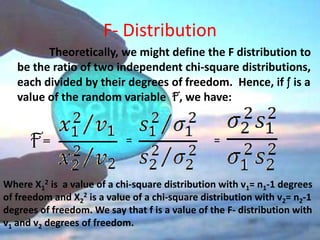
         Theoretically, we might define the F distribution to
   be the ratio of two independent chi-square distributions,
   each divided by their degrees of freedom. Hence, if f is a
   value of the random variable F, we have:


      F=                    =                    =


Where X12 is a value of a chi-square distribution with v1= n1-1 degrees
of freedom and X22 is a value of a chi-square distribution with v2= n2-1
degrees of freedom. We say that f is a value of the F- distribution with
v1 and v2 degrees of freedom.
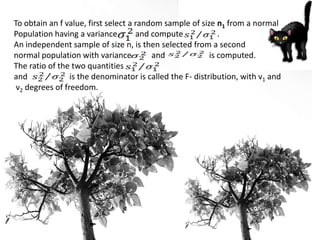
To obtain an f value, first select a random sample of size n1 from a normal
Population having a variance         and compute             .
An independent sample of size n, is then selected from a second
normal population with variance          and              is computed.
The ratio of the two quantities
and              is the denominator is called the F- distribution, with v1 and
 v2 degrees of freedom.
• The number of degrees of freedom associated
  with the sample variance in the numerator is
  always stated first, followed by the number of
  degrees of freedom associated with the
  sample variance in the denominator. Thus the
  curve of the F distribution depends not only
  on the two parameters v1 and v2 but also on
  the order in which we state them. Once
  these two values are given, we can identify
  the curve.
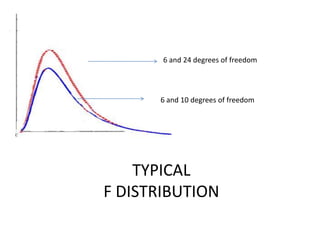
6 and 24 degrees of freedom


      6 and 10 degrees of freedom


    TYPICAL
F DISTRIBUTION
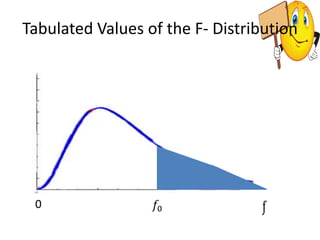
• Let be the f value above which we find an
  area equal to . This is illustrated by the
  shaded region.
• Example: The f value with 6 and 10 degrees of
  freedom, leaving an area of 0.05 to the right,
  is     = 3.22. By means of the following
  theorem, Table A.7 can be used to find values
  of     and      .
Tabulated Values of the F- Distribution


 0                               f
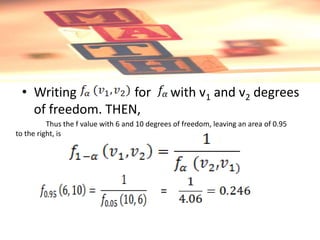
• Writing         for                          with v1 and v2 degrees
   of freedom. THEN,
          Thus the f value with 6 and 10 degrees of freedom, leaving an area of 0.95
to the right, is


                                            =
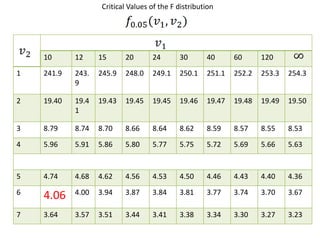
Critical Values of the F distribution


    10      12     15      20      24       30       40      60      120
1   241.9   243.   245.9   248.0   249.1    250.1    251.1   252.2   253.3   254.3
            9

2   19.40   19.4   19.43   19.45   19.45    19.46    19.47   19.48   19.49   19.50
            1

3   8.79    8.74   8.70    8.66    8.64     8.62     8.59    8.57    8.55    8.53
4   5.96    5.91   5.86    5.80    5.77     5.75     5.72    5.69    5.66    5.63


5   4.74    4.68   4.62    4.56    4.53     4.50     4.46    4.43    4.40    4.36
6           4.00   3.94    3.87    3.84     3.81     3.77    3.74    3.70    3.67
    4.06
7   3.64    3.57   3.51    3.44    3.41     3.38     3.34    3.30    3.27    3.23
• The F distribution is applied primarily in the
  analysis of variance where we wish to test the
  equality of several means simultaneously. We
  shall use the F distribution to make inferences
  concerning the variance of two normal
  populations.
TEST ABOUT TWO VARIANCES OR
     STANDARD DEVIATION
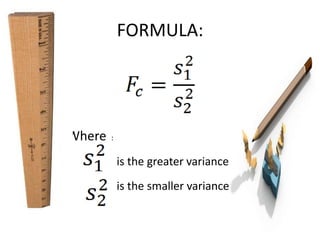
FORMULA:


Where   :


            is the greater variance
            is the smaller variance
• Example 9.1.31.
      A group of Mass Communication students
  study telephone calls at the registrar’s office.
  The students monitor the time of the
  incoming and outgoing calls for one day. They
  that 17 incoming calls last an average of 4.13
  minutes with a variance of 1.36 test the
  hypothesis that the variances of the samples
  are equal. Use the 0.05 level of significance.
• Solution: We follow the steps in hypothesis
  testing.
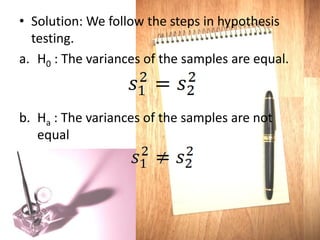
a. H0 : The variances of the samples are equal.


b. Ha : The variances of the samples are not
   equal
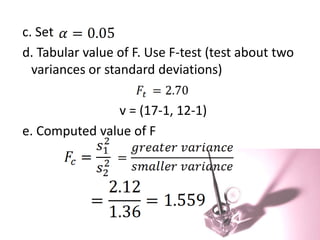
c. Set
d. Tabular value of F. Use F-test (test about two
  variances or standard deviations)

               v = (17-1, 12-1)
e. Computed value of F
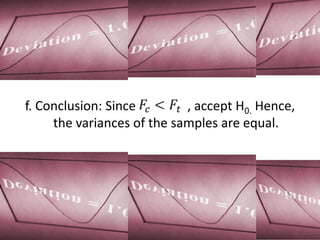
f. Conclusion: Since        , accept H0. Hence,
     the variances of the samples are equal.
Here’s the Solution:
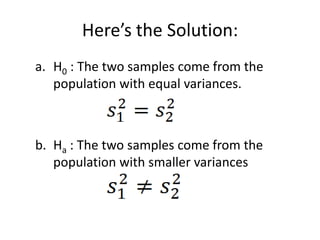
a. H0 : The two samples come from the
   population with equal variances.


b. Ha : The two samples come from the
   population with smaller variances
SEATWORK:
    From sample of 25 observations, the
estimate of the standards, the estimate of the
variance of the population was found to 15.0
From another sample of 14 observations, the
estimate variance was found to be 9.7 Can we
accept the hypothesis that the two samples
come from populations with equal variance,
or must we conclude that the variance of the
second population is smaller? Use the 0.01
level of significance.
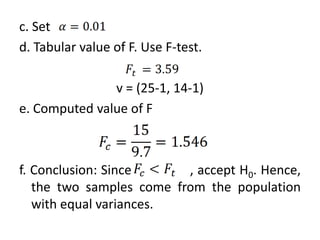
c. Set
d. Tabular value of F. Use F-test.

               v = (25-1, 14-1)
e. Computed value of F


f. Conclusion: Since      , accept H0. Hence,
   the two samples come from the population
   with equal variances.
PROCEED TO THE FAVORITE PART
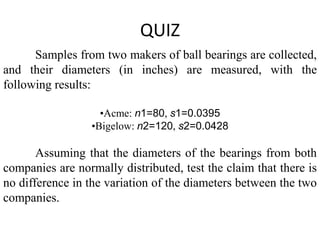
QUIZ
      Samples from two makers of ball bearings are collected,
and their diameters (in inches) are measured, with the
following results:

                    •Acme: n1=80, s1=0.0395
                  •Bigelow: n2=120, s2=0.0428

       Assuming that the diameters of the bearings from both
companies are normally distributed, test the claim that there is
no difference in the variation of the diameters between the two
companies.
LET’s CHECK!
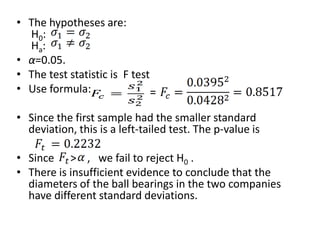
• The hypotheses are:
  H0:
  Ha :
• α=0.05.
• The test statistic is F test
• Use formula:                 =

• Since the first sample had the smaller standard
  deviation, this is a left-tailed test. The p-value is

• Since > , we fail to reject H0 .
• There is insufficient evidence to conclude that the
  diameters of the ball bearings in the two companies
  have different standard deviations.
F-Distribution

F-Distribution

  • 1.
  • 2.
    F- Distribution Theoretically, we might define the F distribution to be the ratio of two independent chi-square distributions, each divided by their degrees of freedom. Hence, if f is a value of the random variable F, we have: F= = = Where X12 is a value of a chi-square distribution with v1= n1-1 degrees of freedom and X22 is a value of a chi-square distribution with v2= n2-1 degrees of freedom. We say that f is a value of the F- distribution with v1 and v2 degrees of freedom.
  • 3.
    To obtain anf value, first select a random sample of size n1 from a normal Population having a variance and compute . An independent sample of size n, is then selected from a second normal population with variance and is computed. The ratio of the two quantities and is the denominator is called the F- distribution, with v1 and v2 degrees of freedom.
  • 4.
    • The numberof degrees of freedom associated with the sample variance in the numerator is always stated first, followed by the number of degrees of freedom associated with the sample variance in the denominator. Thus the curve of the F distribution depends not only on the two parameters v1 and v2 but also on the order in which we state them. Once these two values are given, we can identify the curve.
  • 5.
    6 and 24degrees of freedom 6 and 10 degrees of freedom TYPICAL F DISTRIBUTION
  • 6.
    • Let bethe f value above which we find an area equal to . This is illustrated by the shaded region. • Example: The f value with 6 and 10 degrees of freedom, leaving an area of 0.05 to the right, is = 3.22. By means of the following theorem, Table A.7 can be used to find values of and .
  • 7.
    Tabulated Values ofthe F- Distribution 0 f
  • 8.
    • Writing for with v1 and v2 degrees of freedom. THEN, Thus the f value with 6 and 10 degrees of freedom, leaving an area of 0.95 to the right, is =
  • 9.
    Critical Values ofthe F distribution 10 12 15 20 24 30 40 60 120 1 241.9 243. 245.9 248.0 249.1 250.1 251.1 252.2 253.3 254.3 9 2 19.40 19.4 19.43 19.45 19.45 19.46 19.47 19.48 19.49 19.50 1 3 8.79 8.74 8.70 8.66 8.64 8.62 8.59 8.57 8.55 8.53 4 5.96 5.91 5.86 5.80 5.77 5.75 5.72 5.69 5.66 5.63 5 4.74 4.68 4.62 4.56 4.53 4.50 4.46 4.43 4.40 4.36 6 4.00 3.94 3.87 3.84 3.81 3.77 3.74 3.70 3.67 4.06 7 3.64 3.57 3.51 3.44 3.41 3.38 3.34 3.30 3.27 3.23
  • 10.
    • The Fdistribution is applied primarily in the analysis of variance where we wish to test the equality of several means simultaneously. We shall use the F distribution to make inferences concerning the variance of two normal populations.
  • 11.
    TEST ABOUT TWOVARIANCES OR STANDARD DEVIATION
  • 12.
    FORMULA: Where : is the greater variance is the smaller variance
  • 13.
    • Example 9.1.31. A group of Mass Communication students study telephone calls at the registrar’s office. The students monitor the time of the incoming and outgoing calls for one day. They that 17 incoming calls last an average of 4.13 minutes with a variance of 1.36 test the hypothesis that the variances of the samples are equal. Use the 0.05 level of significance.
  • 14.
    • Solution: Wefollow the steps in hypothesis testing. a. H0 : The variances of the samples are equal. b. Ha : The variances of the samples are not equal
  • 15.
    c. Set d. Tabularvalue of F. Use F-test (test about two variances or standard deviations) v = (17-1, 12-1) e. Computed value of F
  • 16.
    f. Conclusion: Since , accept H0. Hence, the variances of the samples are equal.
  • 17.
    Here’s the Solution: a.H0 : The two samples come from the population with equal variances. b. Ha : The two samples come from the population with smaller variances
  • 18.
    SEATWORK: From sample of 25 observations, the estimate of the standards, the estimate of the variance of the population was found to 15.0 From another sample of 14 observations, the estimate variance was found to be 9.7 Can we accept the hypothesis that the two samples come from populations with equal variance, or must we conclude that the variance of the second population is smaller? Use the 0.01 level of significance.
  • 20.
    c. Set d. Tabularvalue of F. Use F-test. v = (25-1, 14-1) e. Computed value of F f. Conclusion: Since , accept H0. Hence, the two samples come from the population with equal variances.
  • 21.
    PROCEED TO THEFAVORITE PART
  • 22.
    QUIZ Samples from two makers of ball bearings are collected, and their diameters (in inches) are measured, with the following results: •Acme: n1=80, s1=0.0395 •Bigelow: n2=120, s2=0.0428 Assuming that the diameters of the bearings from both companies are normally distributed, test the claim that there is no difference in the variation of the diameters between the two companies.
  • 23.
  • 24.
    • The hypothesesare: H0: Ha : • α=0.05. • The test statistic is F test • Use formula: = • Since the first sample had the smaller standard deviation, this is a left-tailed test. The p-value is • Since > , we fail to reject H0 . • There is insufficient evidence to conclude that the diameters of the ball bearings in the two companies have different standard deviations.