NADEEM UDDIN
ASSOCIATE PROFESSOR
OF STATISTICS
NEGATIVE BINOMIAL
DISTRIBUTION
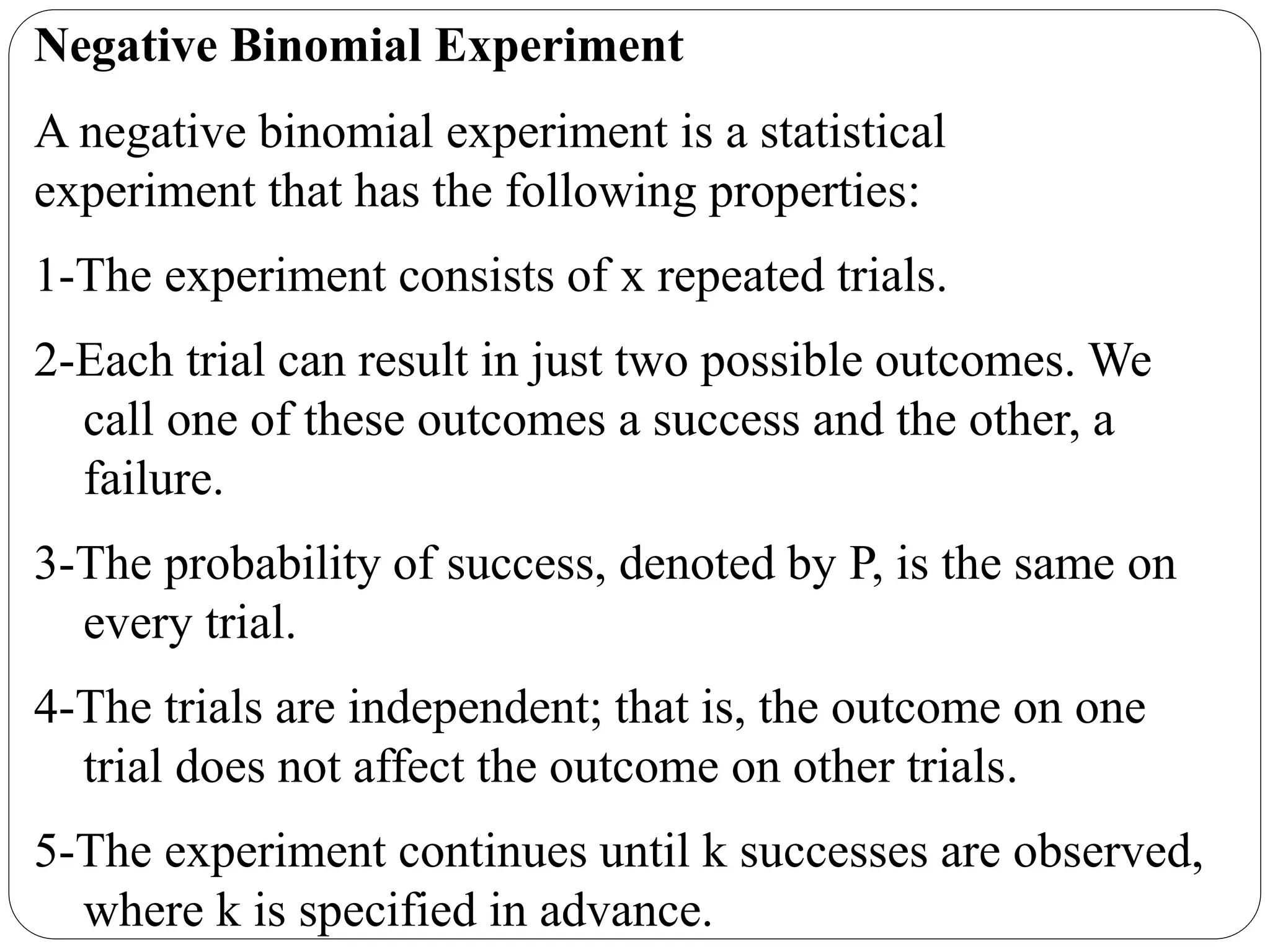
Negative Binomial Experiment
A negative binomial experiment is a statistical
experiment that has the following properties:
1-The experiment consists of x repeated trials.
2-Each trial can result in just two possible outcomes. We
call one of these outcomes a success and the other, a
failure.
3-The probability of success, denoted by P, is the same on
every trial.
4-The trials are independent; that is, the outcome on one
trial does not affect the outcome on other trials.
5-The experiment continues until k successes are observed,
where k is specified in advance.
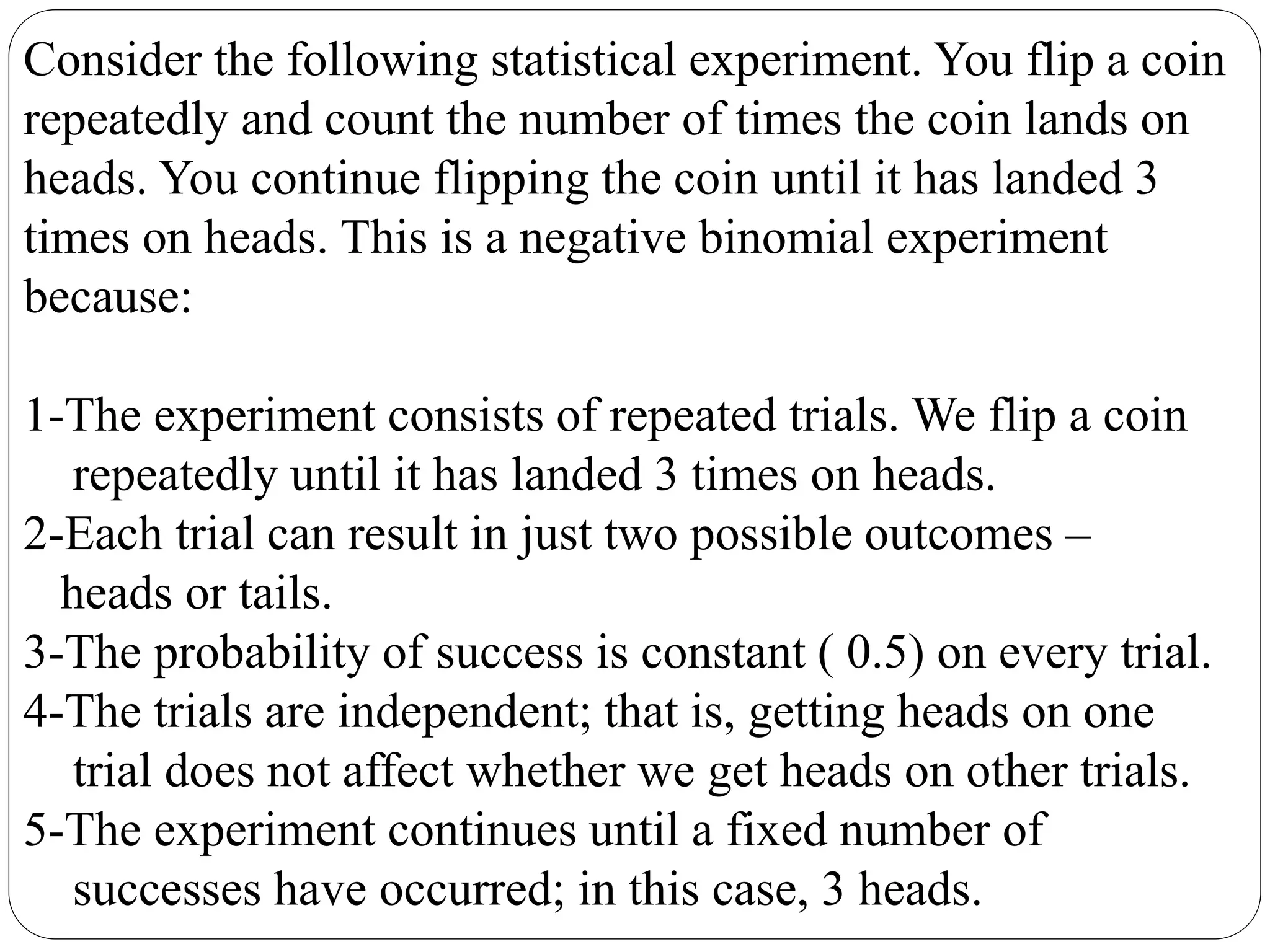
Consider the following statistical experiment. You flip a coin
repeatedly and count the number of times the coin lands on
heads. You continue flipping the coin until it has landed 3
times on heads. This is a negative binomial experiment
because:
1-The experiment consists of repeated trials. We flip a coin
repeatedly until it has landed 3 times on heads.
2-Each trial can result in just two possible outcomes –
heads or tails.
3-The probability of success is constant ( 0.5) on every trial.
4-The trials are independent; that is, getting heads on one
trial does not affect whether we get heads on other trials.
5-The experiment continues until a fixed number of
successes have occurred; in this case, 3 heads.
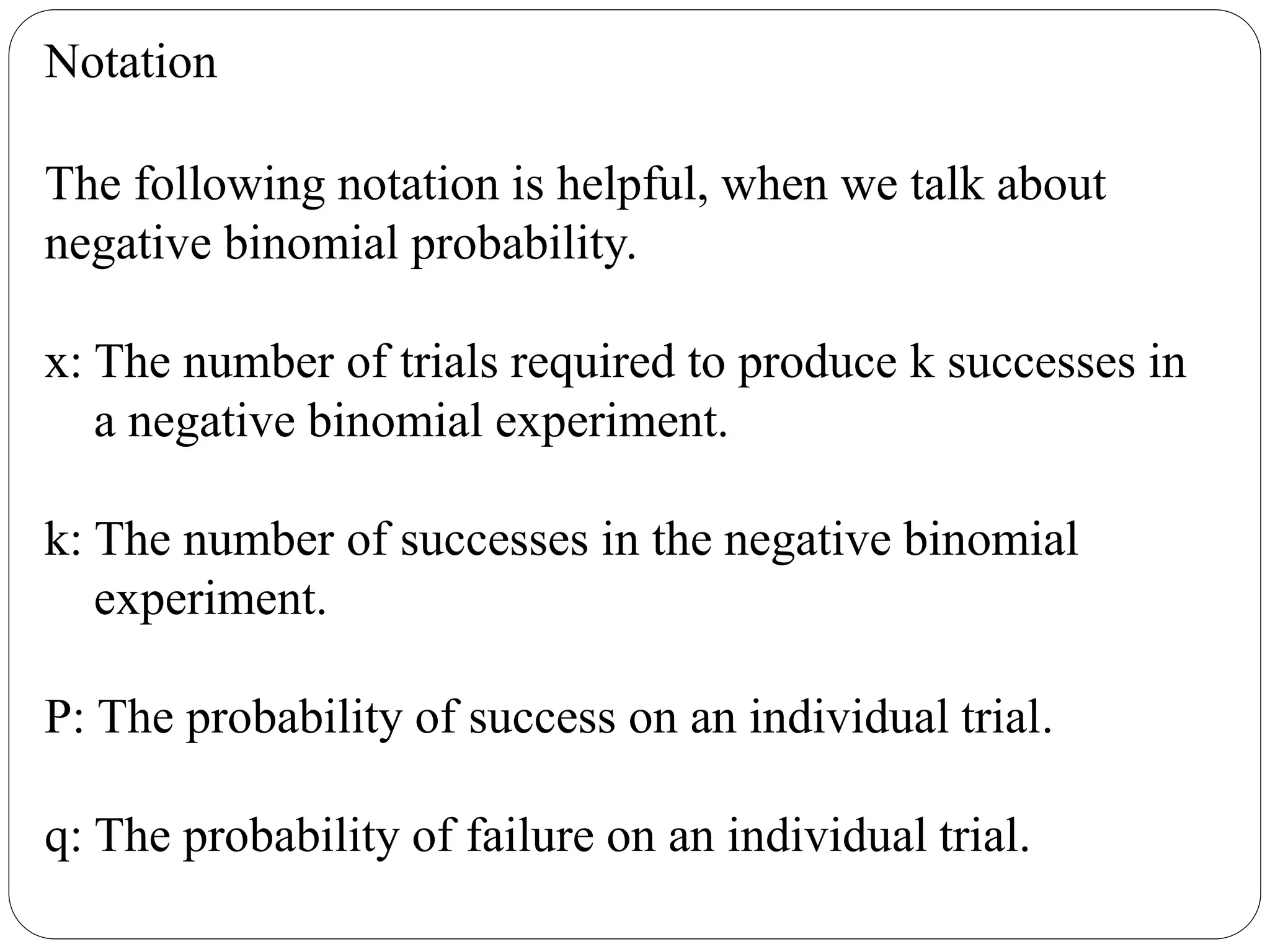
Notation
The following notation is helpful, when we talk about
negative binomial probability.
x: The number of trials required to produce k successes in
a negative binomial experiment.
k: The number of successes in the negative binomial
experiment.
P: The probability of success on an individual trial.
q: The probability of failure on an individual trial.
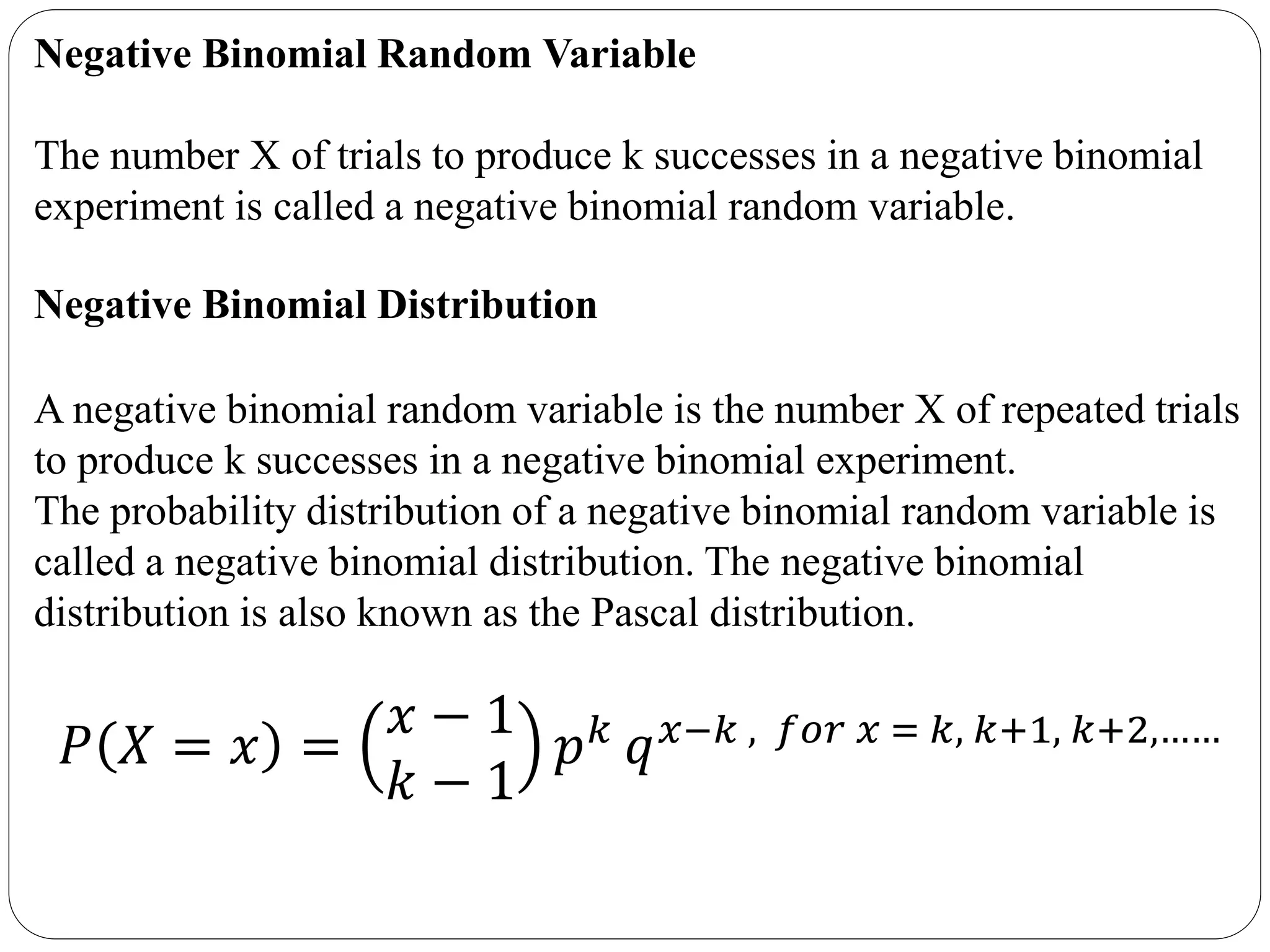
Negative Binomial Random Variable
The number X of trials to produce k successes in a negative binomial
experiment is called a negative binomial random variable.
Negative Binomial Distribution
A negative binomial random variable is the number X of repeated trials
to produce k successes in a negative binomial experiment.
The probability distribution of a negative binomial random variable is
called a negative binomial distribution. The negative binomial
distribution is also known as the Pascal distribution.
𝑃 𝑋 = 𝑥 =
𝑥 − 1
𝑘 − 1
𝑝 𝑘
𝑞 𝑥−𝑘 , 𝑓𝑜𝑟 𝑥 = 𝑘, 𝑘+1, 𝑘+2,……
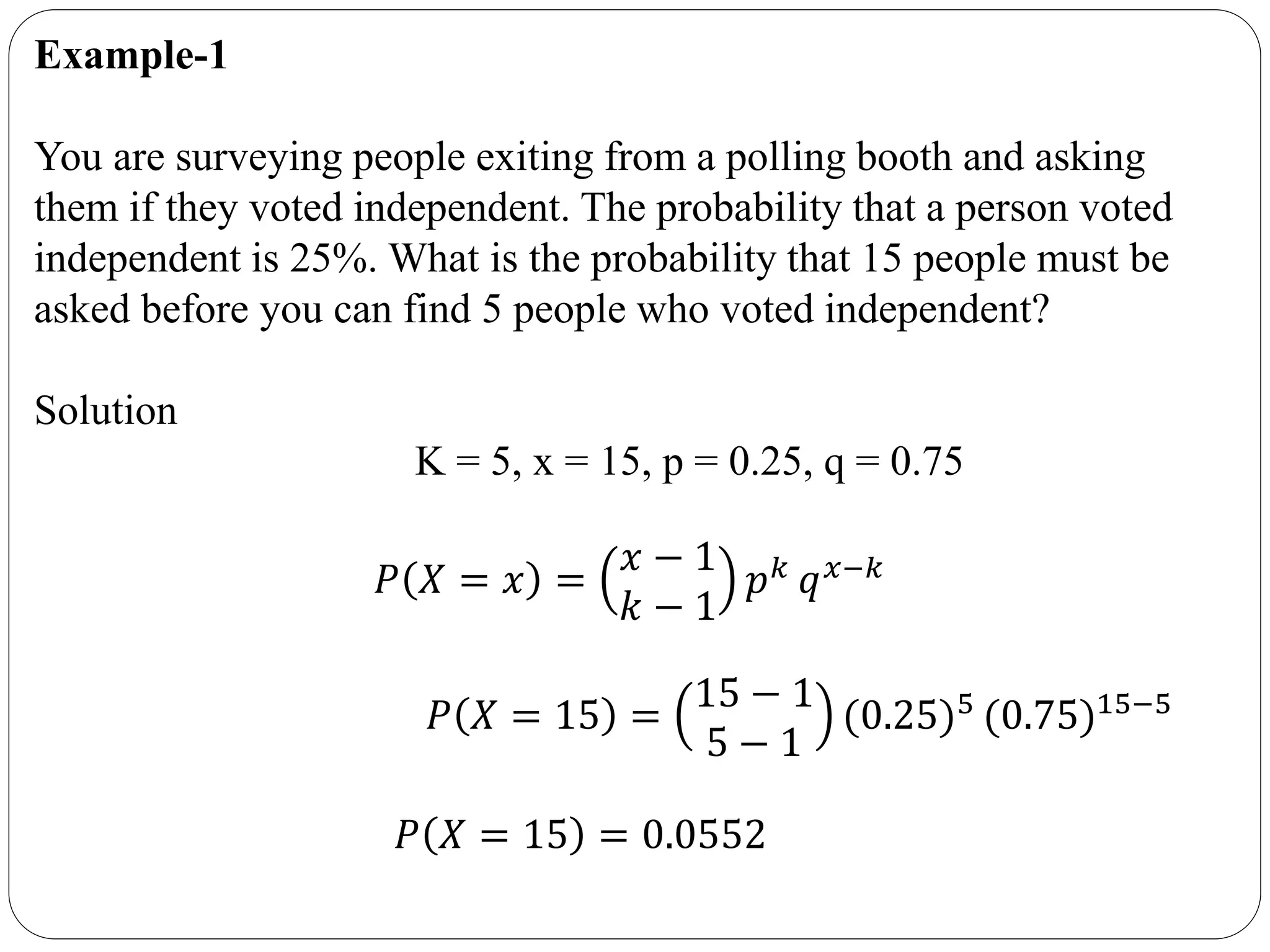
Example-1
You are surveying people exiting from a polling booth and asking
them if they voted independent. The probability that a person voted
independent is 25%. What is the probability that 15 people must be
asked before you can find 5 people who voted independent?
Solution
K = 5, x = 15, p = 0.25, q = 0.75
𝑃 𝑋 = 𝑥 =
𝑥 − 1
𝑘 − 1
𝑝 𝑘
𝑞 𝑥−𝑘
𝑃 𝑋 = 15 =
15 − 1
5 − 1
(0.25)5 (0.75)15−5
𝑃 𝑋 = 15 = 0.0552
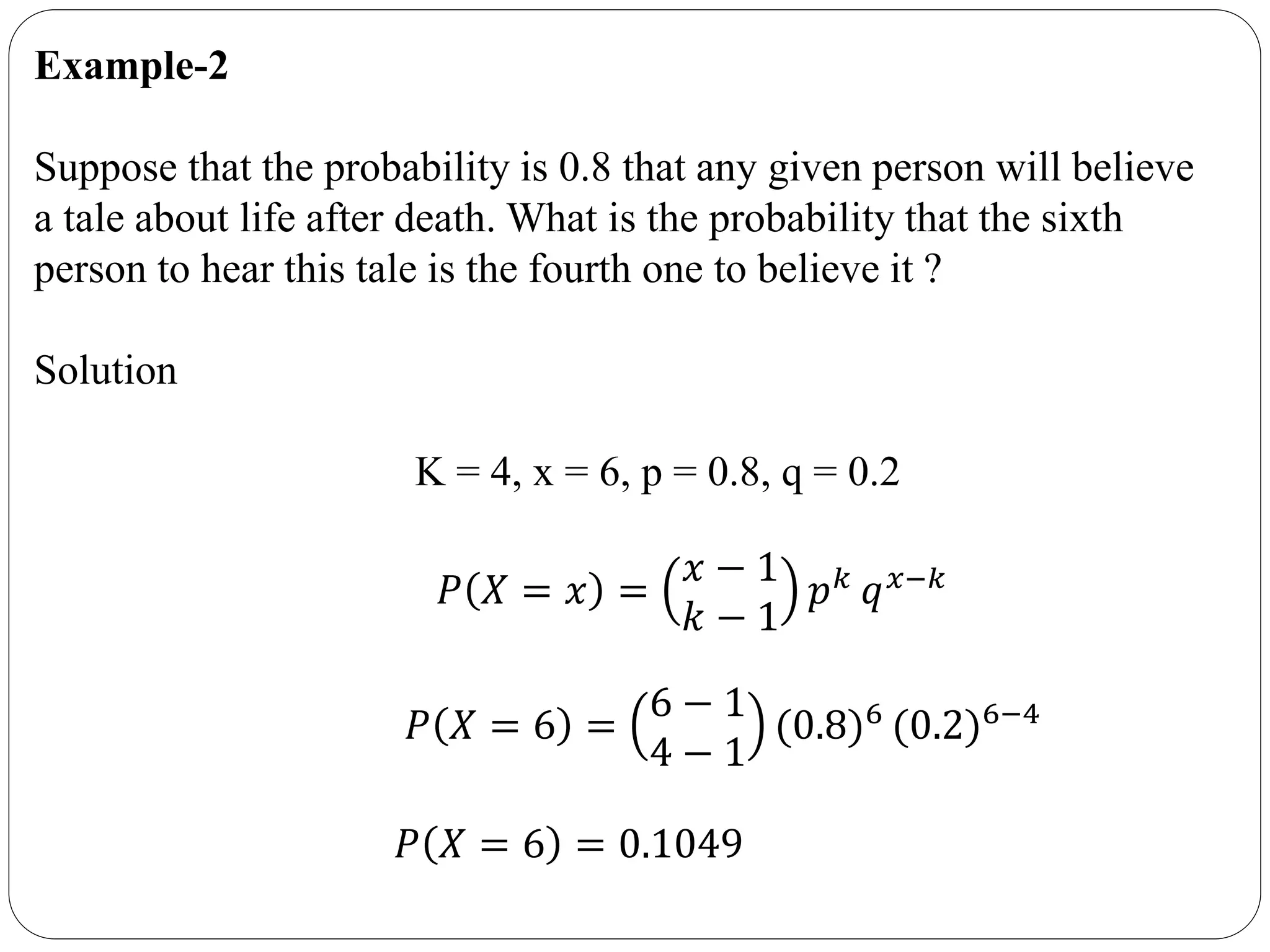
Example-2
Suppose that the probability is 0.8 that any given person will believe
a tale about life after death. What is the probability that the sixth
person to hear this tale is the fourth one to believe it ?
Solution
K = 4, x = 6, p = 0.8, q = 0.2
𝑃 𝑋 = 𝑥 =
𝑥 − 1
𝑘 − 1
𝑝 𝑘
𝑞 𝑥−𝑘
𝑃 𝑋 = 6 =
6 − 1
4 − 1
(0.8)6 (0.2)6−4
𝑃 𝑋 = 6 = 0.1049
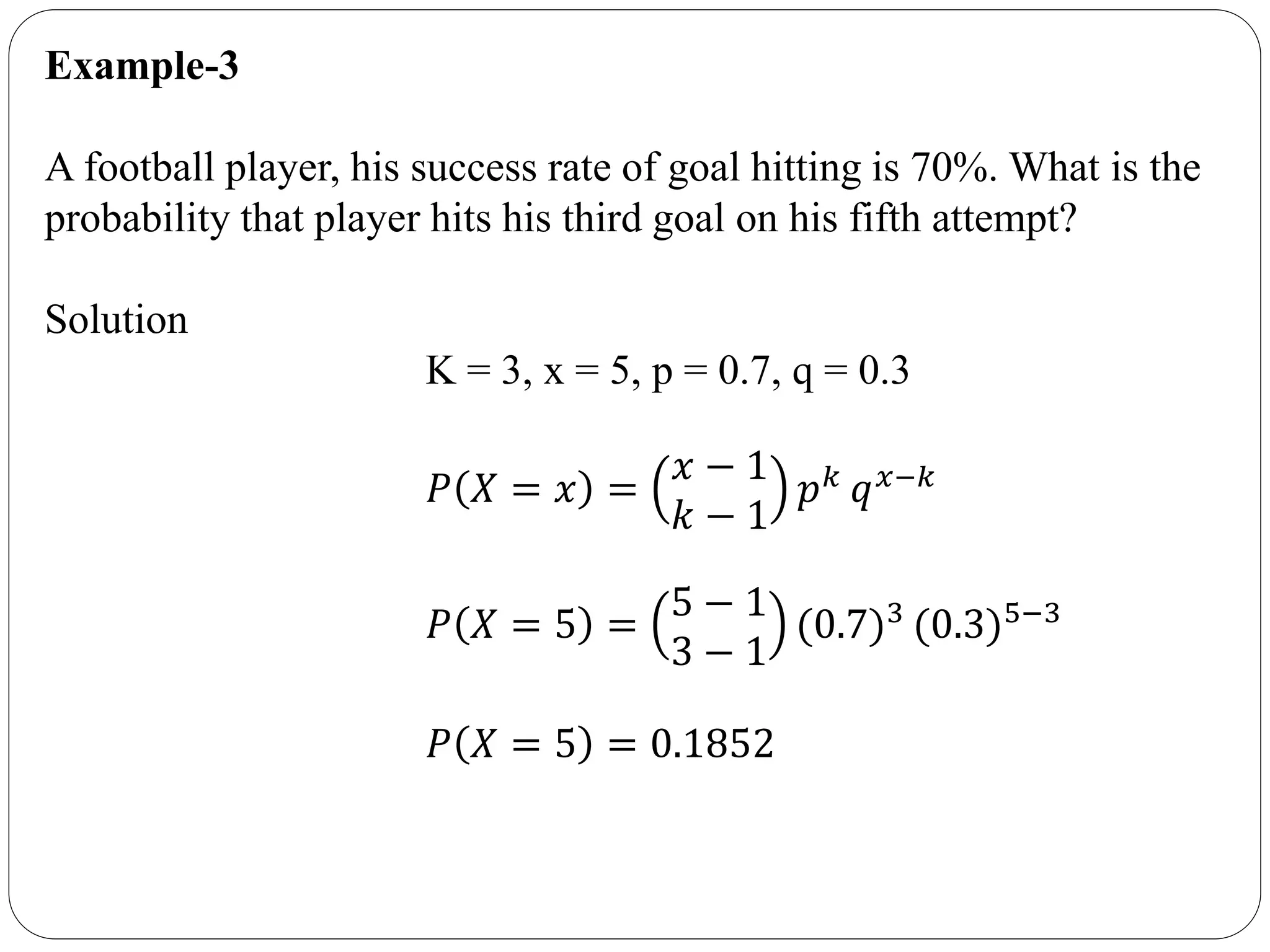
Example-3
A football player, his success rate of goal hitting is 70%. What is the
probability that player hits his third goal on his fifth attempt?
Solution
K = 3, x = 5, p = 0.7, q = 0.3
𝑃 𝑋 = 𝑥 =
𝑥 − 1
𝑘 − 1
𝑝 𝑘 𝑞 𝑥−𝑘
𝑃 𝑋 = 5 =
5 − 1
3 − 1
(0.7)3 (0.3)5−3
𝑃 𝑋 = 5 = 0.1852
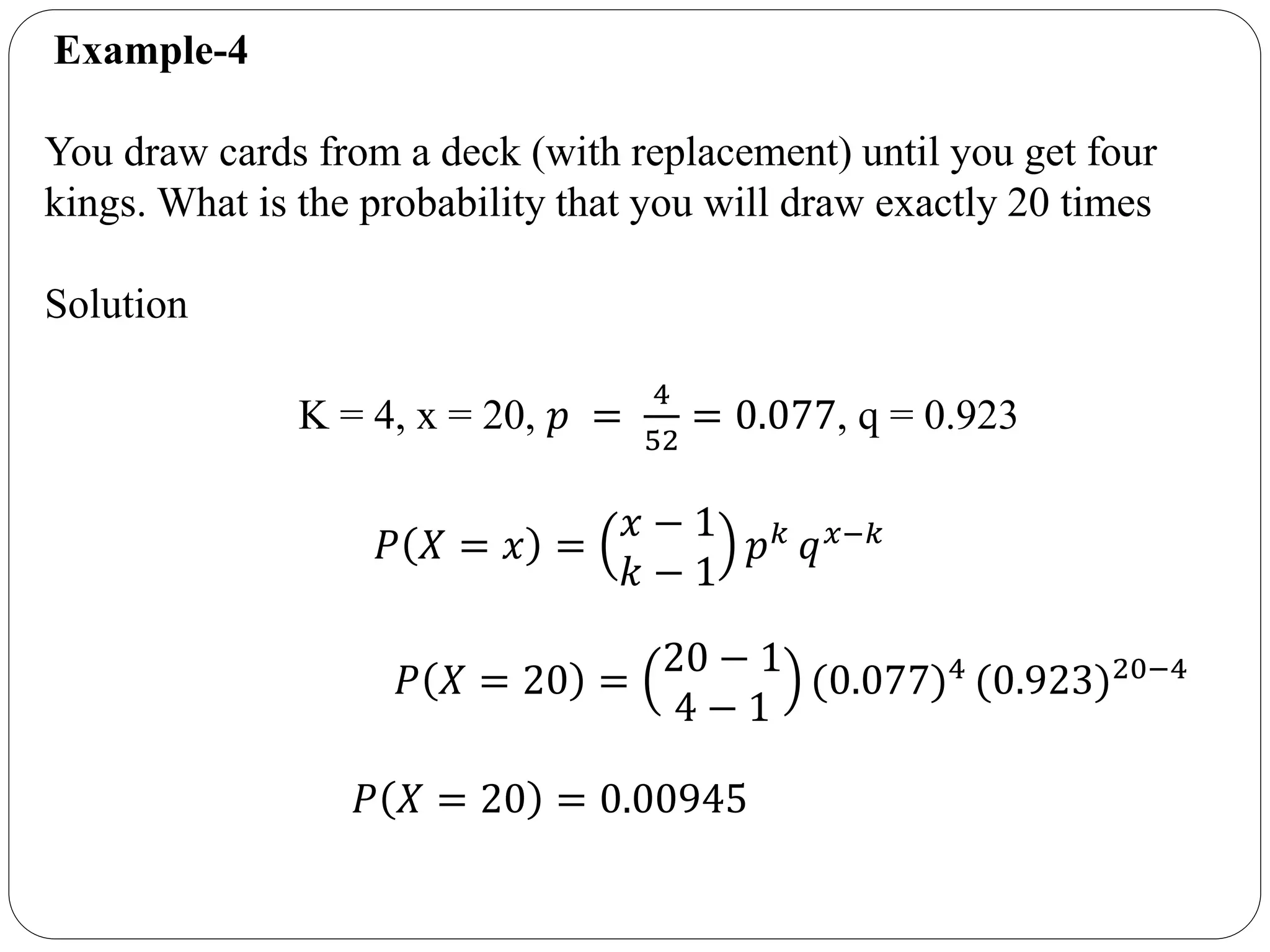
Example-4
You draw cards from a deck (with replacement) until you get four
kings. What is the probability that you will draw exactly 20 times
Solution
K = 4, x = 20, 𝑝 =
4
52
= 0.077, q = 0.923
𝑃 𝑋 = 𝑥 =
𝑥 − 1
𝑘 − 1
𝑝 𝑘 𝑞 𝑥−𝑘
𝑃 𝑋 = 20 =
20 − 1
4 − 1
(0.077)4
(0.923)20−4
𝑃 𝑋 = 20 = 0.00945
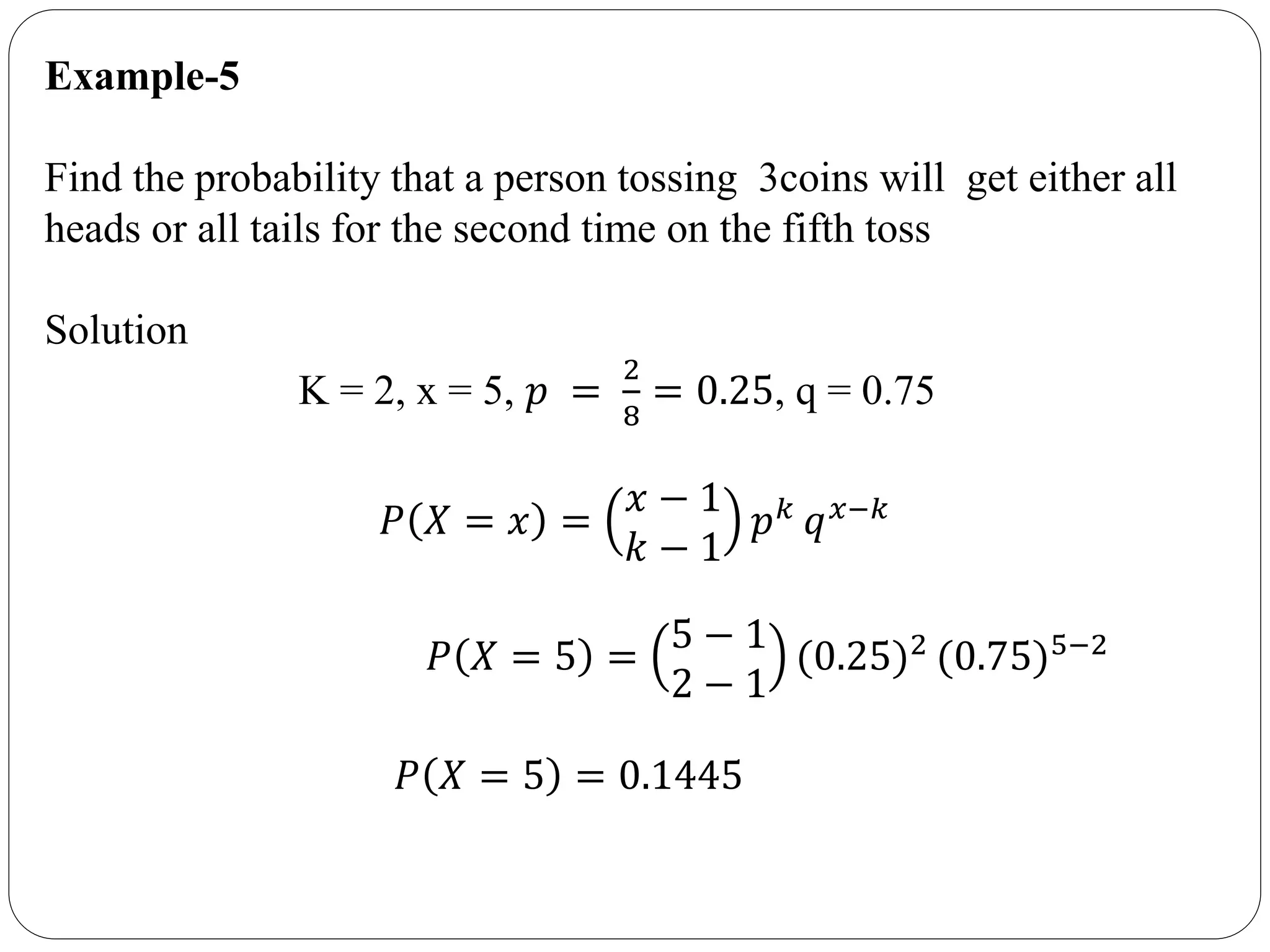
Example-5
Find the probability that a person tossing 3coins will get either all
heads or all tails for the second time on the fifth toss
Solution
K = 2, x = 5, 𝑝 =
2
8
= 0.25, q = 0.75
𝑃 𝑋 = 𝑥 =
𝑥 − 1
𝑘 − 1
𝑝 𝑘
𝑞 𝑥−𝑘
𝑃 𝑋 = 5 =
5 − 1
2 − 1
(0.25)2 (0.75)5−2
𝑃 𝑋 = 5 = 0.1445

Negative binomial distribution

  • 1.
    NADEEM UDDIN ASSOCIATE PROFESSOR OFSTATISTICS NEGATIVE BINOMIAL DISTRIBUTION
  • 2.
    Negative Binomial Experiment Anegative binomial experiment is a statistical experiment that has the following properties: 1-The experiment consists of x repeated trials. 2-Each trial can result in just two possible outcomes. We call one of these outcomes a success and the other, a failure. 3-The probability of success, denoted by P, is the same on every trial. 4-The trials are independent; that is, the outcome on one trial does not affect the outcome on other trials. 5-The experiment continues until k successes are observed, where k is specified in advance.
  • 3.
    Consider the followingstatistical experiment. You flip a coin repeatedly and count the number of times the coin lands on heads. You continue flipping the coin until it has landed 3 times on heads. This is a negative binomial experiment because: 1-The experiment consists of repeated trials. We flip a coin repeatedly until it has landed 3 times on heads. 2-Each trial can result in just two possible outcomes – heads or tails. 3-The probability of success is constant ( 0.5) on every trial. 4-The trials are independent; that is, getting heads on one trial does not affect whether we get heads on other trials. 5-The experiment continues until a fixed number of successes have occurred; in this case, 3 heads.
  • 4.
    Notation The following notationis helpful, when we talk about negative binomial probability. x: The number of trials required to produce k successes in a negative binomial experiment. k: The number of successes in the negative binomial experiment. P: The probability of success on an individual trial. q: The probability of failure on an individual trial.
  • 5.
    Negative Binomial RandomVariable The number X of trials to produce k successes in a negative binomial experiment is called a negative binomial random variable. Negative Binomial Distribution A negative binomial random variable is the number X of repeated trials to produce k successes in a negative binomial experiment. The probability distribution of a negative binomial random variable is called a negative binomial distribution. The negative binomial distribution is also known as the Pascal distribution. 𝑃 𝑋 = 𝑥 = 𝑥 − 1 𝑘 − 1 𝑝 𝑘 𝑞 𝑥−𝑘 , 𝑓𝑜𝑟 𝑥 = 𝑘, 𝑘+1, 𝑘+2,……
  • 6.
    Example-1 You are surveyingpeople exiting from a polling booth and asking them if they voted independent. The probability that a person voted independent is 25%. What is the probability that 15 people must be asked before you can find 5 people who voted independent? Solution K = 5, x = 15, p = 0.25, q = 0.75 𝑃 𝑋 = 𝑥 = 𝑥 − 1 𝑘 − 1 𝑝 𝑘 𝑞 𝑥−𝑘 𝑃 𝑋 = 15 = 15 − 1 5 − 1 (0.25)5 (0.75)15−5 𝑃 𝑋 = 15 = 0.0552
  • 7.
    Example-2 Suppose that theprobability is 0.8 that any given person will believe a tale about life after death. What is the probability that the sixth person to hear this tale is the fourth one to believe it ? Solution K = 4, x = 6, p = 0.8, q = 0.2 𝑃 𝑋 = 𝑥 = 𝑥 − 1 𝑘 − 1 𝑝 𝑘 𝑞 𝑥−𝑘 𝑃 𝑋 = 6 = 6 − 1 4 − 1 (0.8)6 (0.2)6−4 𝑃 𝑋 = 6 = 0.1049
  • 8.
    Example-3 A football player,his success rate of goal hitting is 70%. What is the probability that player hits his third goal on his fifth attempt? Solution K = 3, x = 5, p = 0.7, q = 0.3 𝑃 𝑋 = 𝑥 = 𝑥 − 1 𝑘 − 1 𝑝 𝑘 𝑞 𝑥−𝑘 𝑃 𝑋 = 5 = 5 − 1 3 − 1 (0.7)3 (0.3)5−3 𝑃 𝑋 = 5 = 0.1852
  • 9.
    Example-4 You draw cardsfrom a deck (with replacement) until you get four kings. What is the probability that you will draw exactly 20 times Solution K = 4, x = 20, 𝑝 = 4 52 = 0.077, q = 0.923 𝑃 𝑋 = 𝑥 = 𝑥 − 1 𝑘 − 1 𝑝 𝑘 𝑞 𝑥−𝑘 𝑃 𝑋 = 20 = 20 − 1 4 − 1 (0.077)4 (0.923)20−4 𝑃 𝑋 = 20 = 0.00945
  • 10.
    Example-5 Find the probabilitythat a person tossing 3coins will get either all heads or all tails for the second time on the fifth toss Solution K = 2, x = 5, 𝑝 = 2 8 = 0.25, q = 0.75 𝑃 𝑋 = 𝑥 = 𝑥 − 1 𝑘 − 1 𝑝 𝑘 𝑞 𝑥−𝑘 𝑃 𝑋 = 5 = 5 − 1 2 − 1 (0.25)2 (0.75)5−2 𝑃 𝑋 = 5 = 0.1445