Introduction to applied statistics
& applied statistical methods
Prof. Dr. Chang Zhu1
Overview
• Independent ANOVA
• Repeated measures ANOVA
• MANOVA
Analysis of Variance
• Enormously useful
• T-test compare two sets of scores or two
groups of participants
• ANOVA can be used for analysing more than
two groups or more than two conditions
Conditions before conducting
ANOVA
• The dependent variables should be interval or
ratio data
• Normal distribution of residuals
• Variances are equal
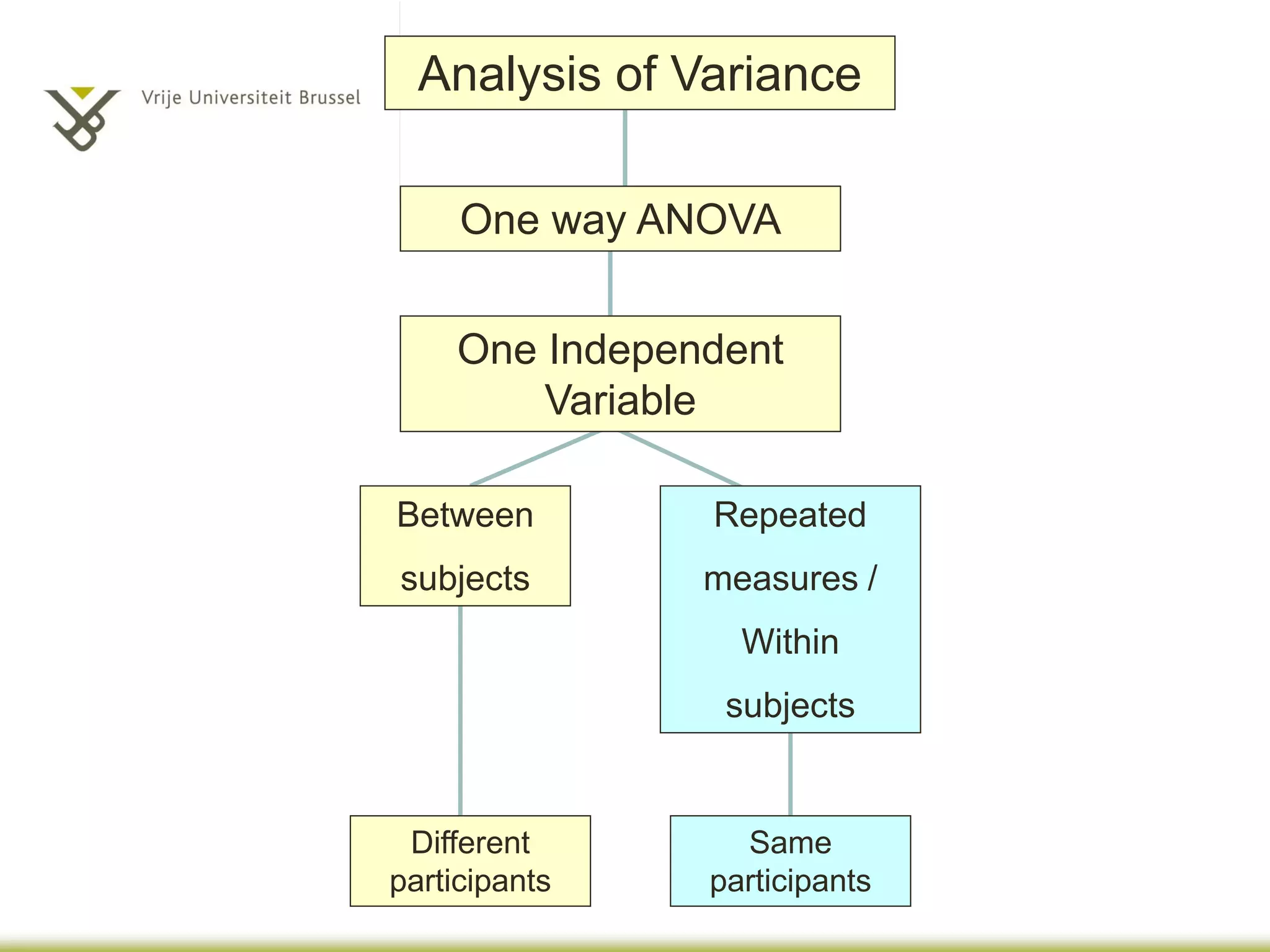
Analysis of Variance
One way ANOVA
One Independent
Variable
Between
subjects
Repeated
measures /
Within
subjects
Different
participants
Same
participants
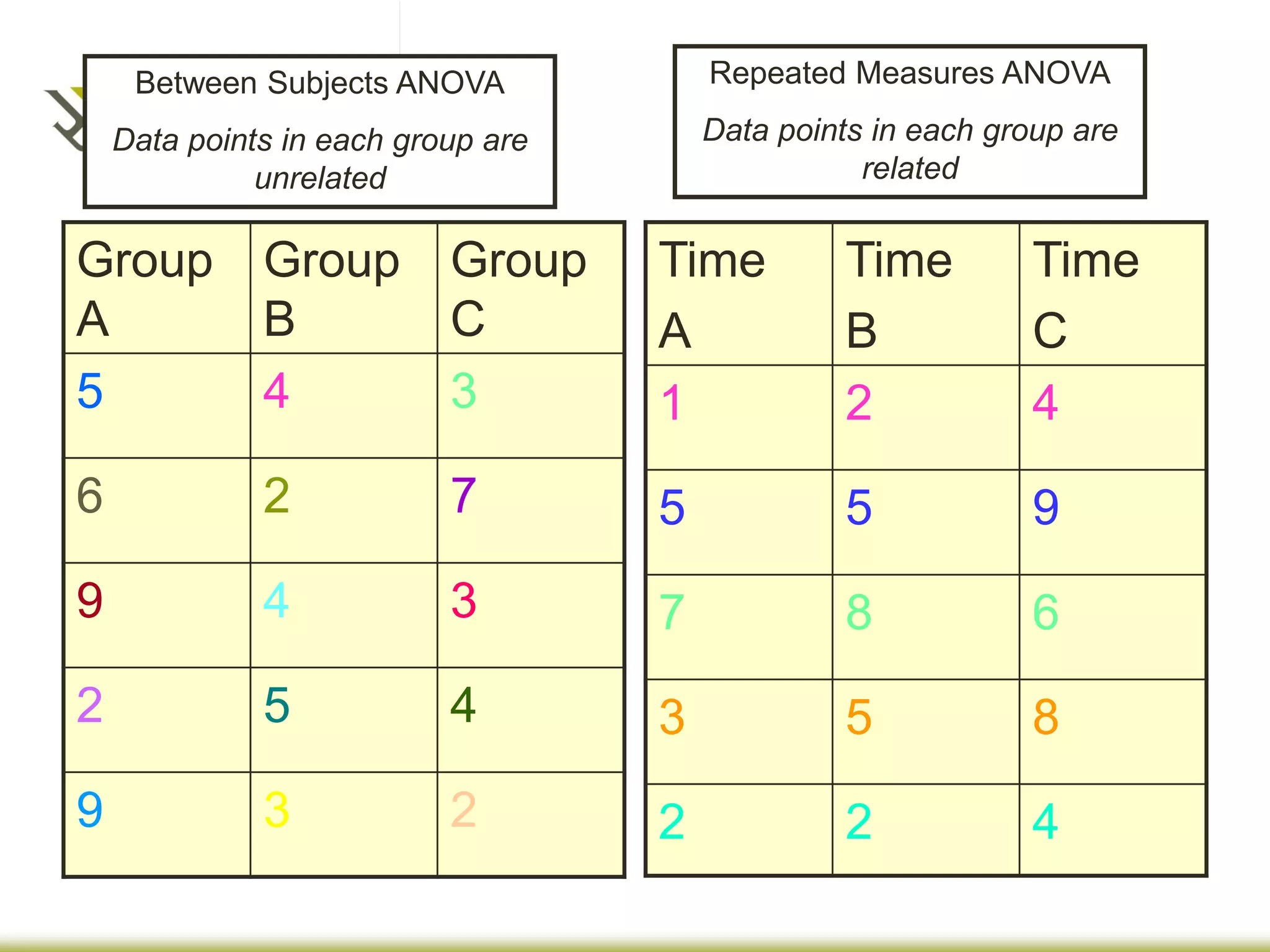
Group
A
Group
B
Group
C
5 4 3
6 2 7
9 4 3
2 5 4
9 3 2
Time
A
Time
B
Time
C
1 2 4
5 5 9
7 8 6
3 5 8
2 2 4
Between Subjects ANOVA
Data points in each group are
unrelated
Repeated Measures ANOVA
Data points in each group are
related
One-way ANOVA
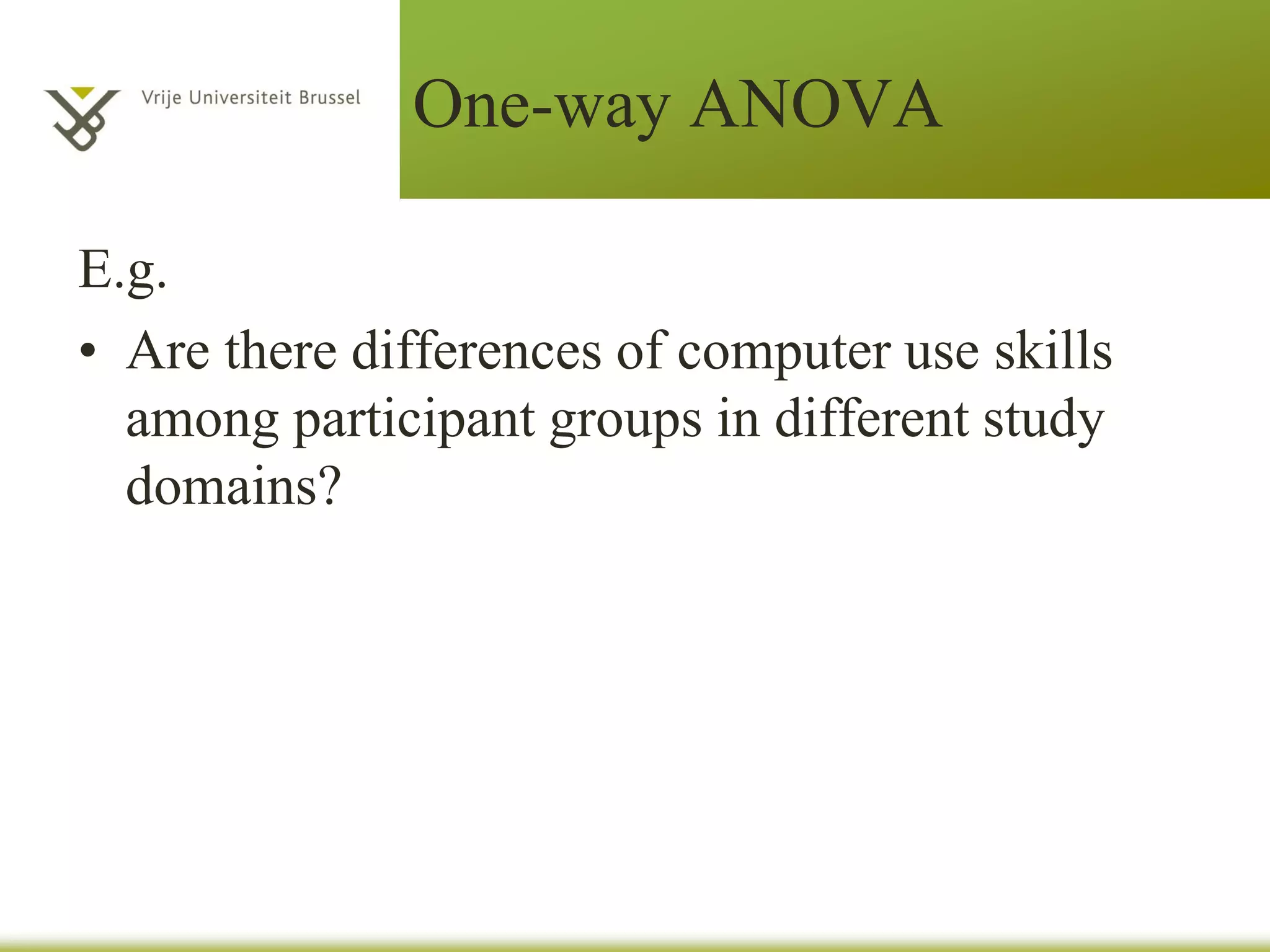
E.g.
• Are there differences of computer use skills
among participant groups in different study
domains?
One-way ANOVA
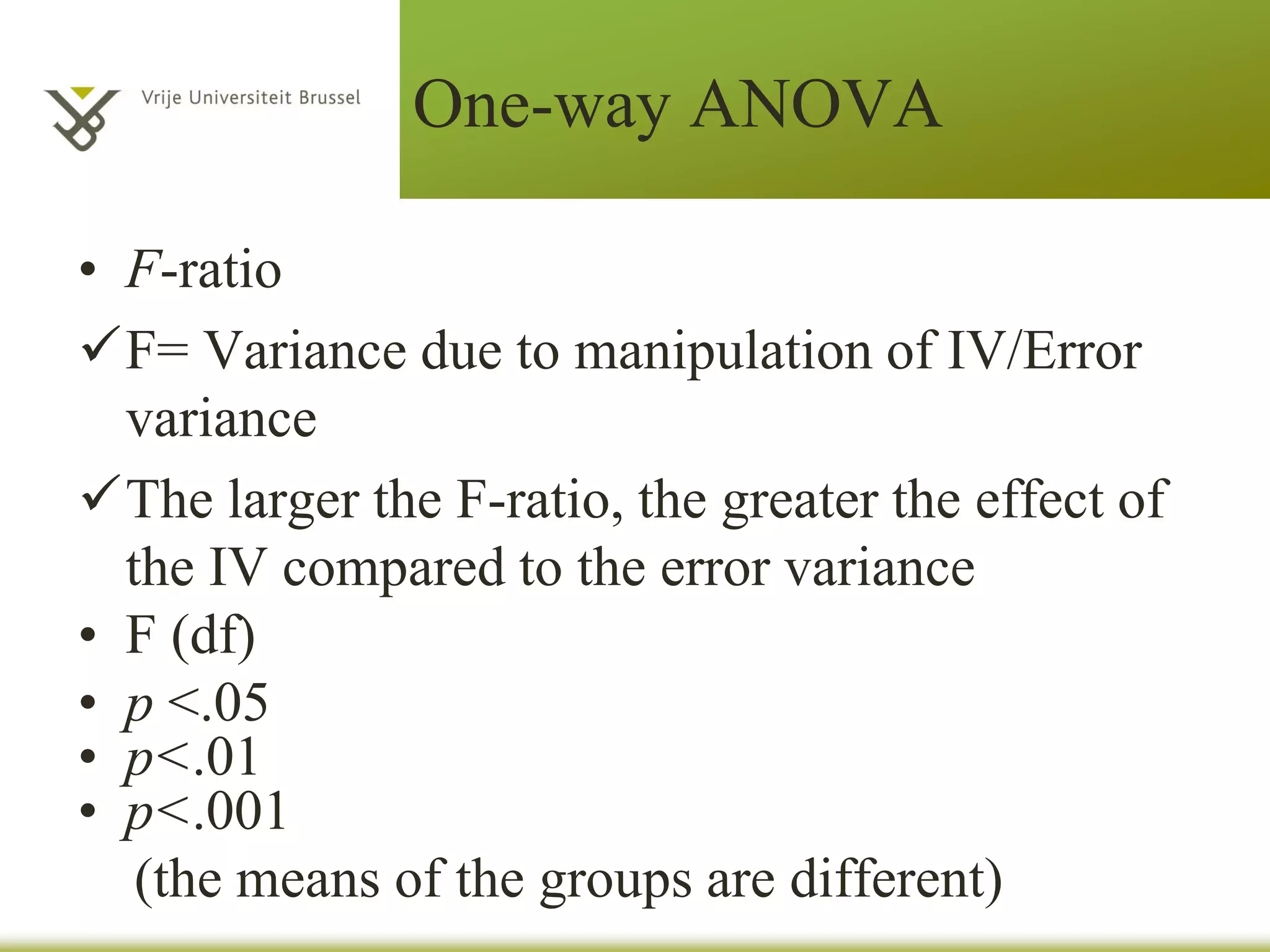
• F-ratio
F= Variance due to manipulation of IV/Error
variance
The larger the F-ratio, the greater the effect of
the IV compared to the error variance
• F (df)
• p <.05
• p<.01
• p<.001
(the means of the groups are different)
Post Hoc Analysis
• What ANOVA tells us:
– Rejection of the H0 tells you that there is a high
PROBABILITY that AT LEAST ONE difference
exists among the groups
• What ANOVA doesn’t tell us:
– Where the differences lie
• Post hoc analysis is needed to determine which
mean(s) is(are) different
One-way ANOVA post-hoc
analysis
• ANOVA determined that differences exist
among the means.
• Post hoc tests determine which means differ.
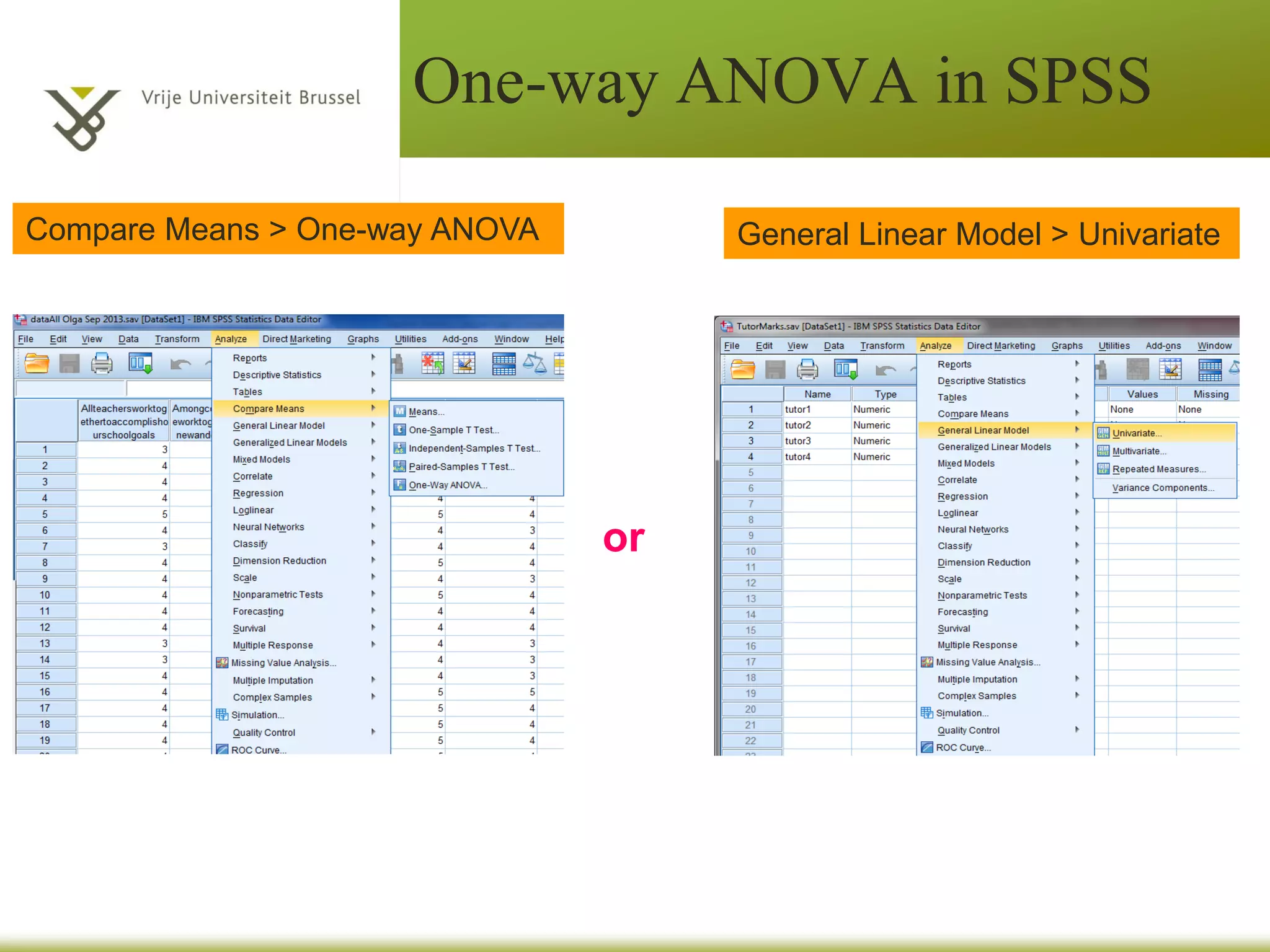
or
One-way ANOVA in SPSS
Compare Means > Means General Linear Model > Univariate
The ANOVA analysis results
• Brief report:
e.g.
• The ANOVA results show that there were
significant differences of xxxx (eg. the
powerpoint use) among the groups of
participants (F(df)=…., p<.05)
Results: brief example report
•Post-hoc analyses show that group x was
different to group y (mean difference=xx,
p<xx) and group z (mean difference=xx,
p<xx) ….
Effect size
• In experiential research, effect size is a useful measure.
• Effect size is the magnitude of the difference between groups
• For ANOVAs, the effect size can be calculated by:
r (or η: eta) , ω (omega) : effect
size
SSM: between-group effect
SST: total amount of variance in the
data
MSR: within-subject effect
dfM: degree of freedom, which is
the number of the groups minus 1
(these values are in the SPSS output)
Practice
Practice 1: independent ANOVA
H1: reward will lead to better exam
results than either punish or
indifferent.
H2: indifferent will lead to better
exam results than punish.
1
2
3
Practice 1: independent ANOVA
Carry out a one-way ANOVA and use planned
comparisons to test the hypotheses that
H1: reward results in better exam results than
either punishment or indifferent; and
H2: indifferent will lead to significantly better
exam results than punishment.
Analyze > Compare Means > One-way ANOVAs
The data file is teach.sav.
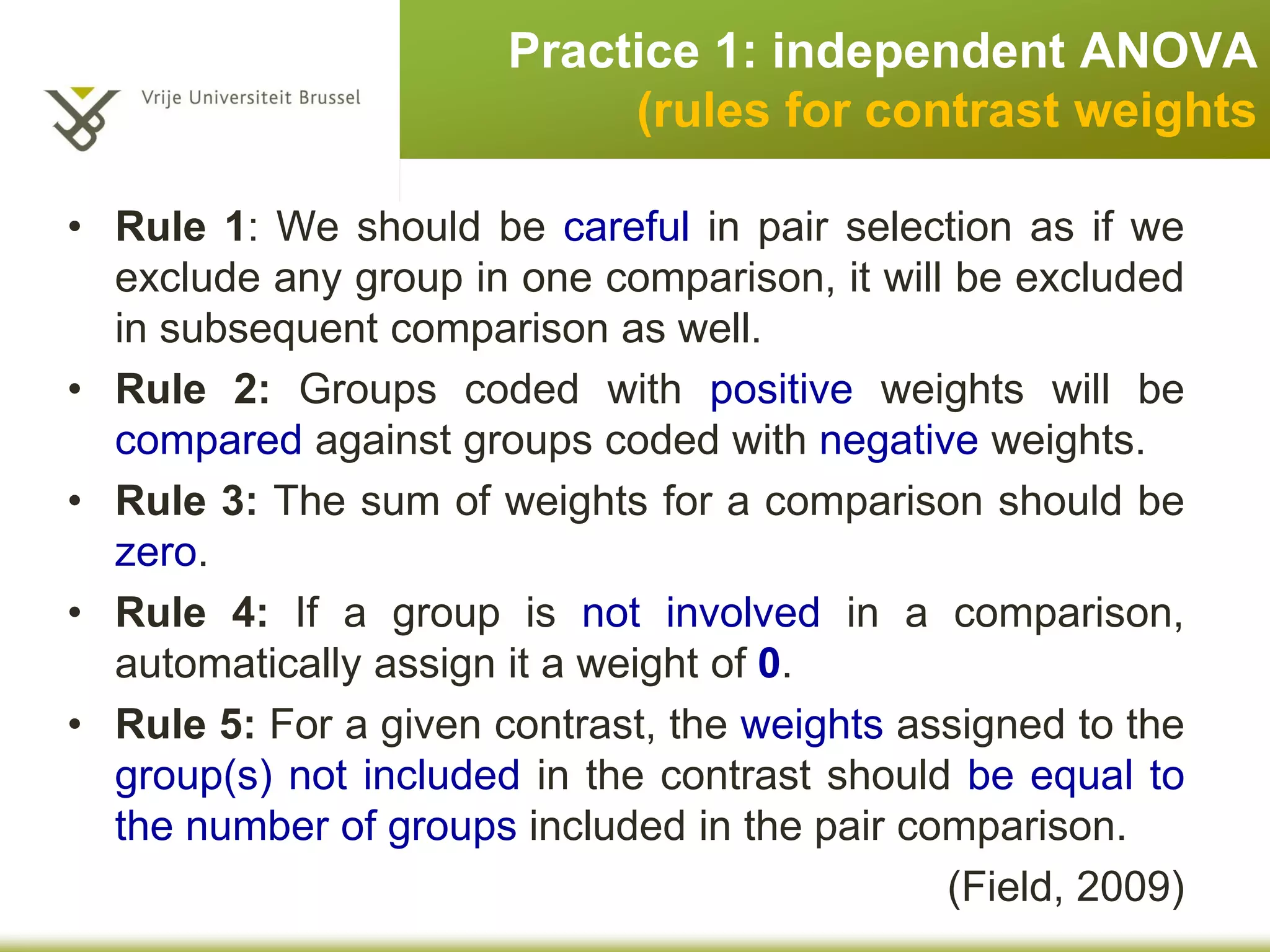
• Rule 1: We should be careful in pair selection as if we
exclude any group in one comparison, it will be excluded
in subsequent comparison as well.
• Rule 2: Groups coded with positive weights will be
compared against groups coded with negative weights.
• Rule 3: The sum of weights for a comparison should be
zero.
• Rule 4: If a group is not involved in a comparison,
automatically assign it a weight of 0.
• Rule 5: For a given contrast, the weights assigned to the
group(s) not included in the contrast should be equal to
the number of groups included in the pair comparison.
(Field, 2009)
Practice 1: independent ANOVA
rules for contrast weights
Practice 1: independent ANOVA
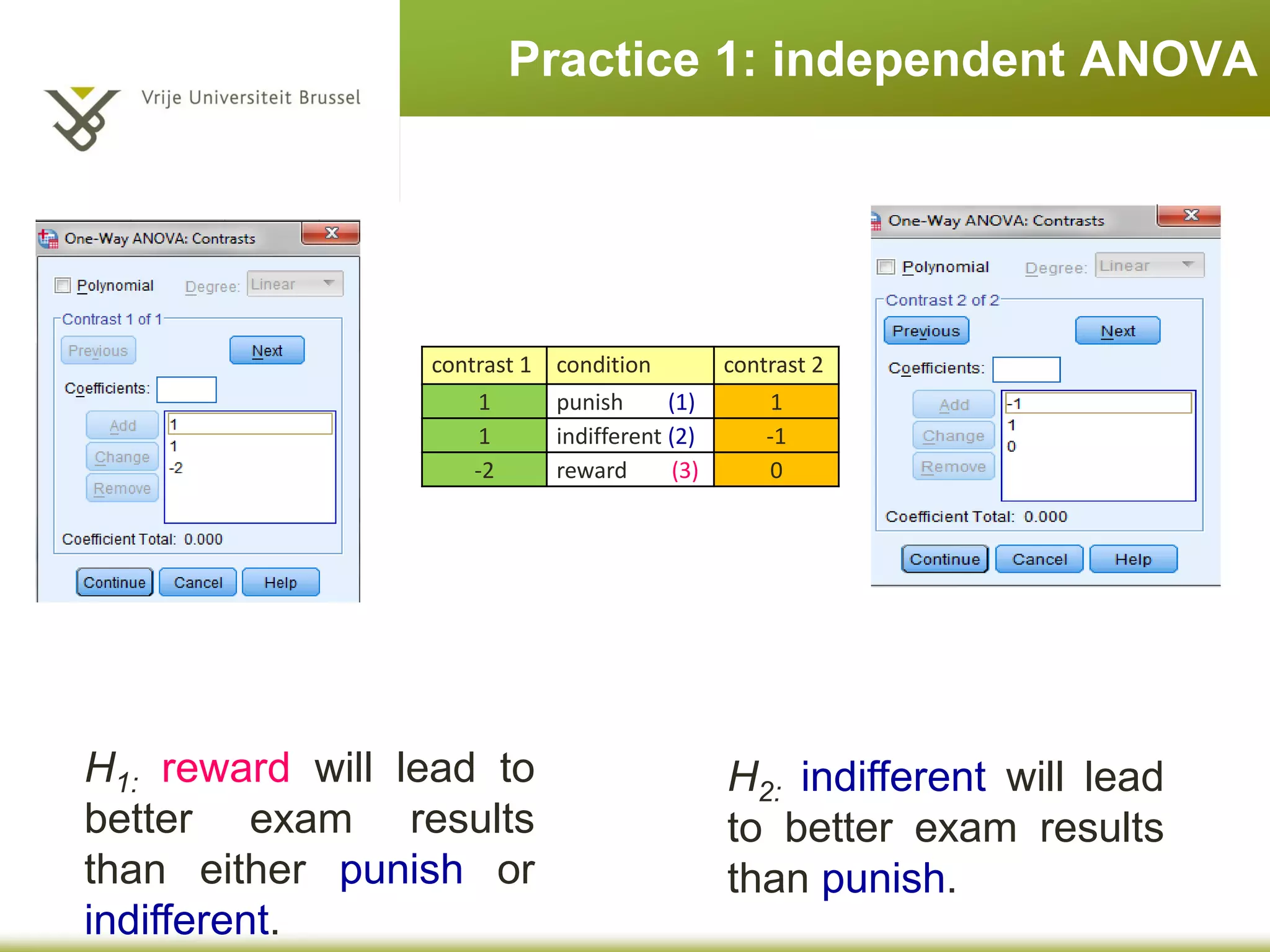
H2: indifferent will lead
to better exam results
than punish.
H1: reward will lead to
better exam results
than either punish or
indifferent.
contrast 1 condition contrast 2
1 punish (1) 1
1 indifferent (2) -1
-2 reward (3) 0
Practice 1: independent ANOVA
(Post Hoc)
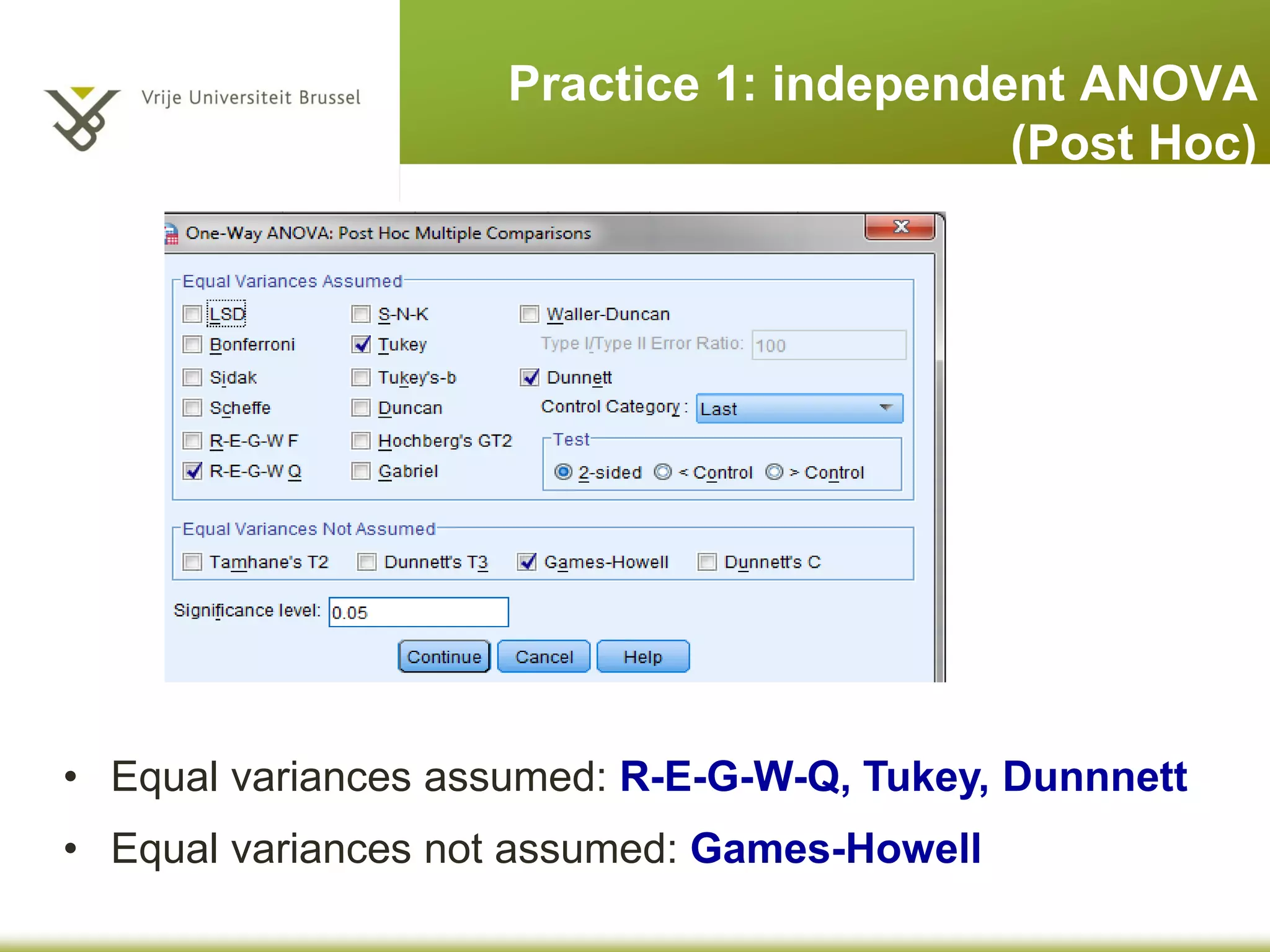
• Equal variances assumed: R-E-G-W-Q, Tukey, Dunnnett
• Equal variances not assumed: Games-Howell
Practice 1: independent ANOVA
(SPSS output)
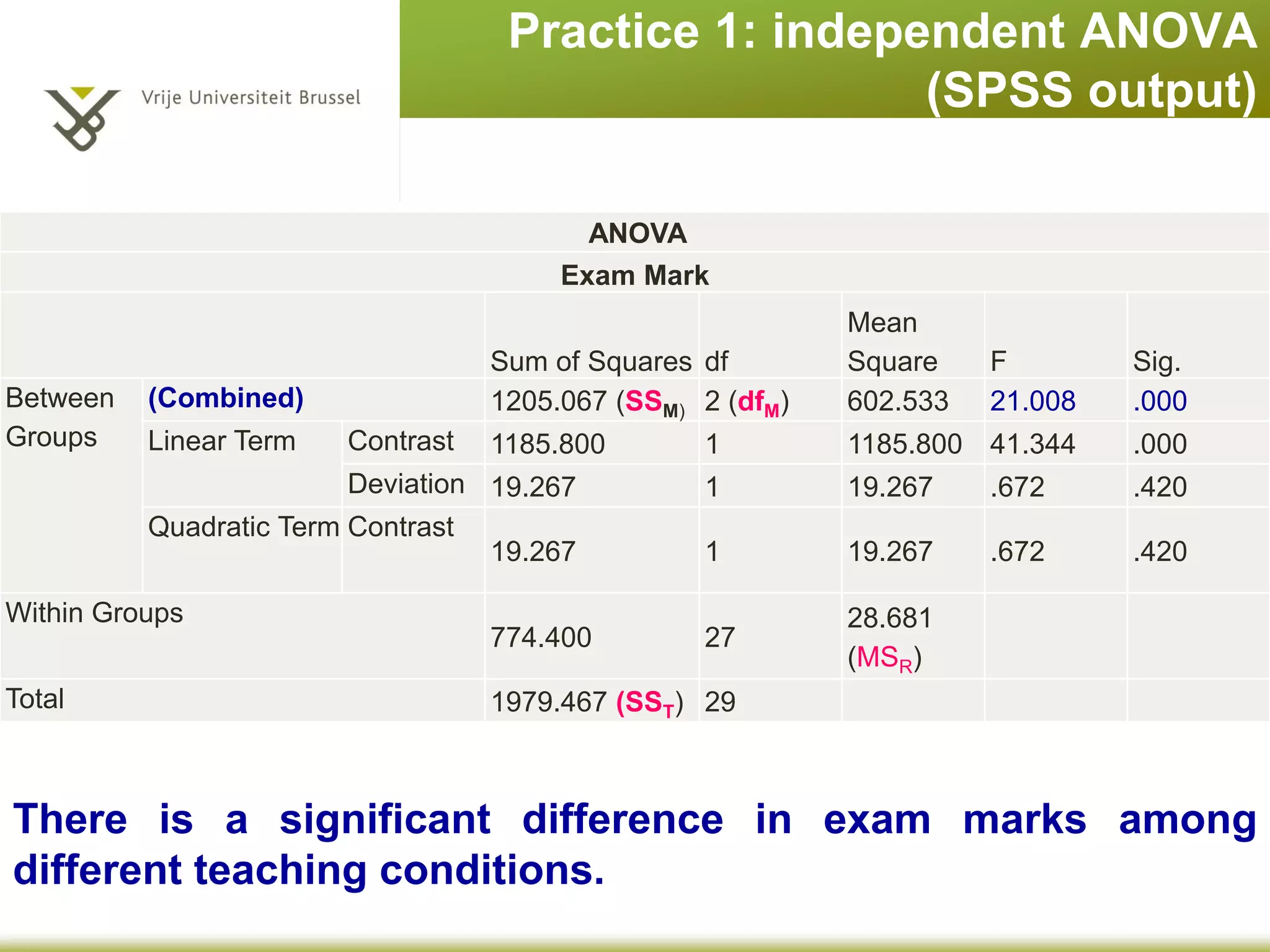
ANOVA
Exam Mark
Sum of Squares df
Mean
Square F Sig.
Between
Groups
(Combined) 1205.067 (SSM) 2 (dfM) 602.533 21.008 .000
Linear
Term
Contrast 1185.800 1 1185.800 41.344 .000
Deviation 19.267 1 19.267 .672 .420
Quadratic
Term
Contrast
19.267 1 19.267 .672 .420
Within Groups
774.400 27
28.681
(MSR)
Total 1979.467 (SST) 29
There is a significant difference in exam marks among
different teaching conditions.
Practice 1: independent ANOVA
(SPSS output)
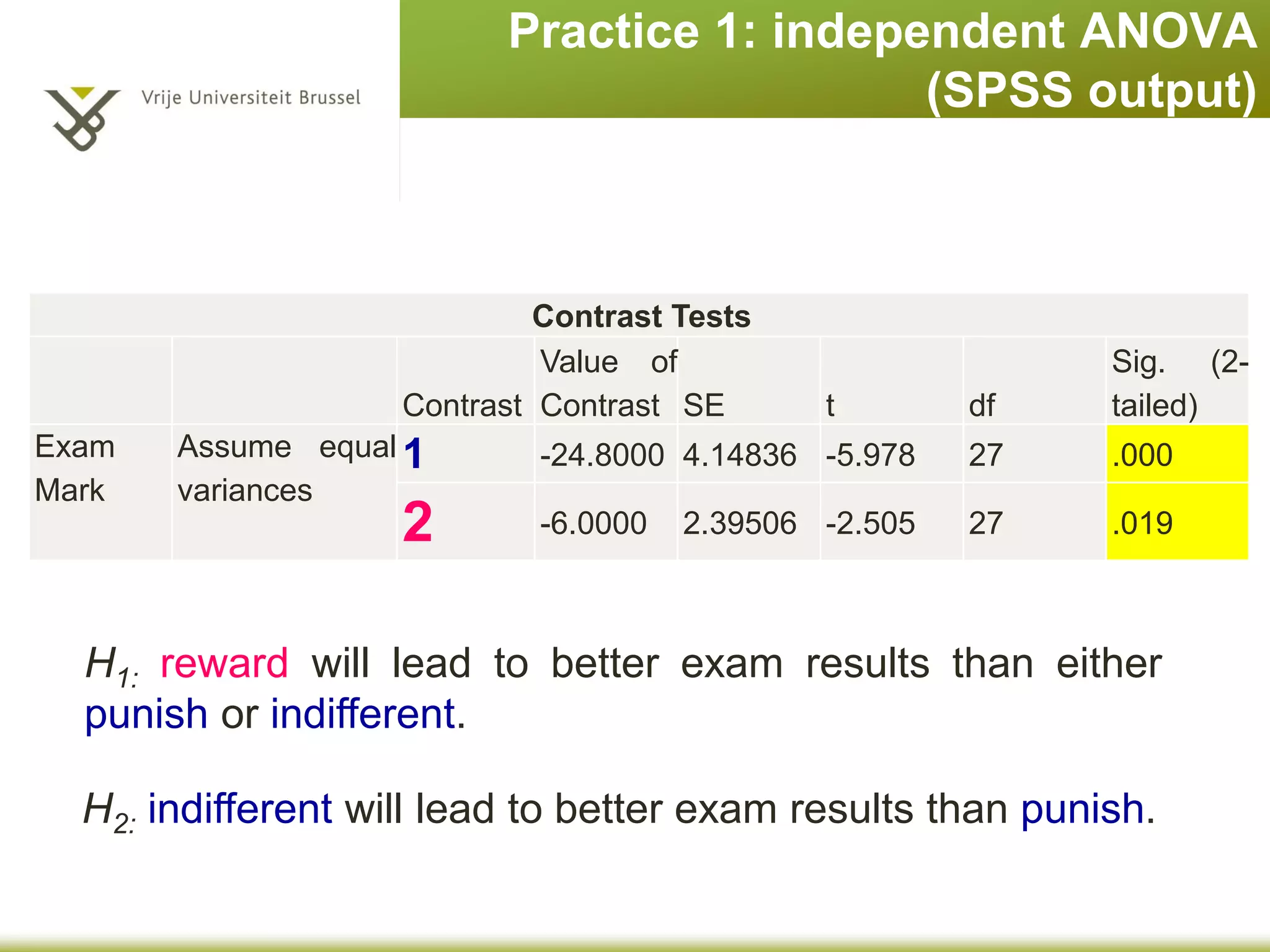
Contrast Tests
Contrast
Value of
Contrast SE t df
Sig. (2-
tailed)
Exam
Mark
Assume equal
variances
1 -24.8000 4.14836 -5.978 27 .000
2 -6.0000 2.39506 -2.505 27 .019
H1: reward will lead to better exam results than either
punish or indifferent.
H2: indifferent will lead to better exam results than punish.
Practice 1: independent ANOVA
(report)
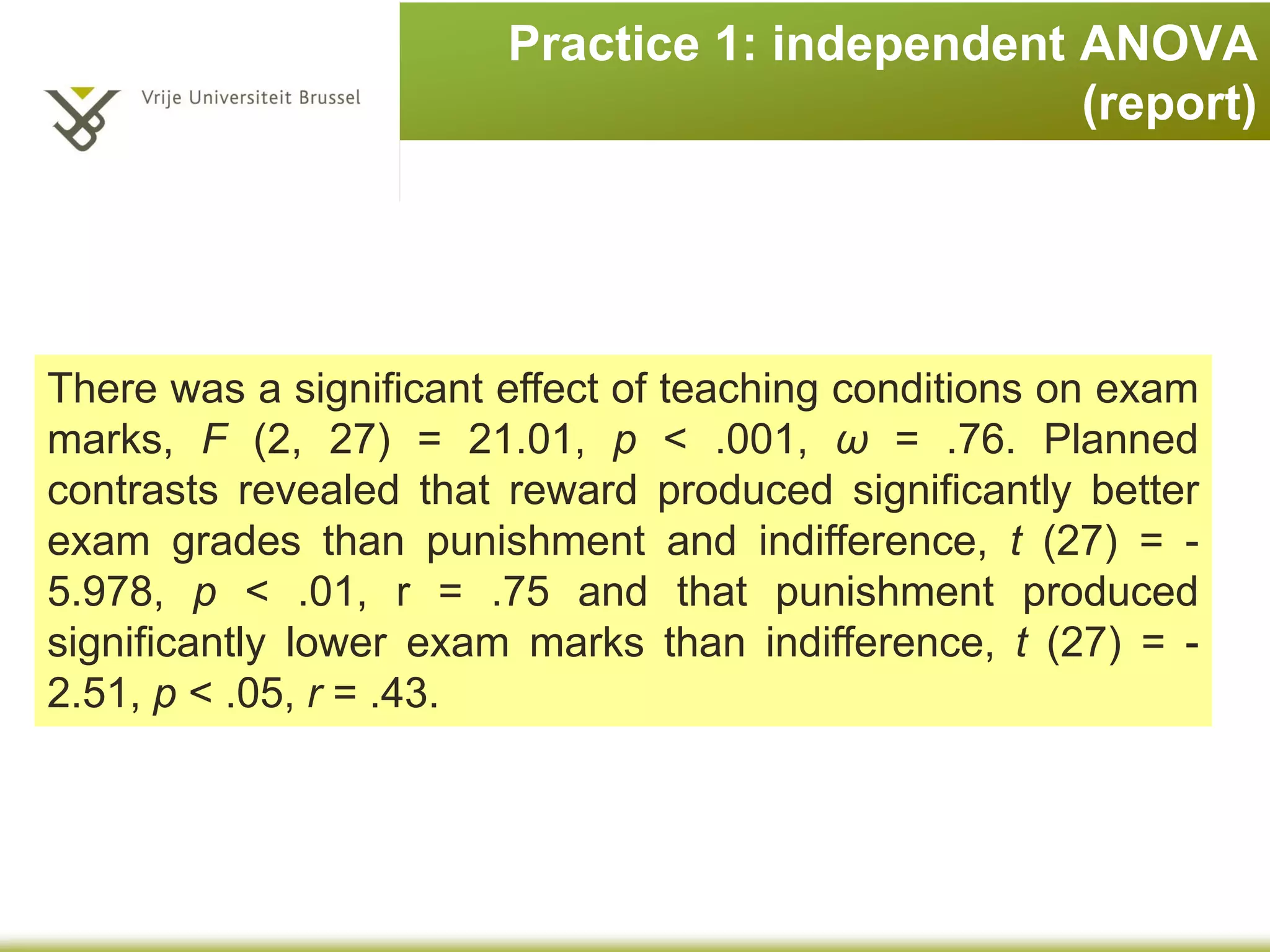
There was a significant effect of teaching conditions on exam
marks, F (2, 27) = 21.01, p < .001, ω = .76. Planned
contrasts revealed that reward produced significantly better
exam grades than punishment and indifference, t (27) = -
5.978, p < .01, r = .75 and that punishment produced
significantly lower exam marks than indifference, t (27) = -
2.51, p < .05, r = .43.
Independent vs. Repeated measures
ANOVA
• There are two possible scenarios when
obtaining various sets of data for comparison:
– Independent samples: The data in the first sample
is completely independent from the data in the
other samples.
– Dependent/Related samples: The sets of data are
dependent on one another. There is a relationship
between/among the sets of data.
• Three or more data sets?
– If three or more sets of data are
independent of one another Analysis of
Variance Independent (ANOVA)?
– If three or more sets of data are dependent
on one another Repeated Measures
ANOVA
Independent vs. Repeated measures
ANOVA
D1
Slide 25
D1 Dear Prof. shoud we changed to: Independent ANOVA?
DiepNguyet, 10/12/2014
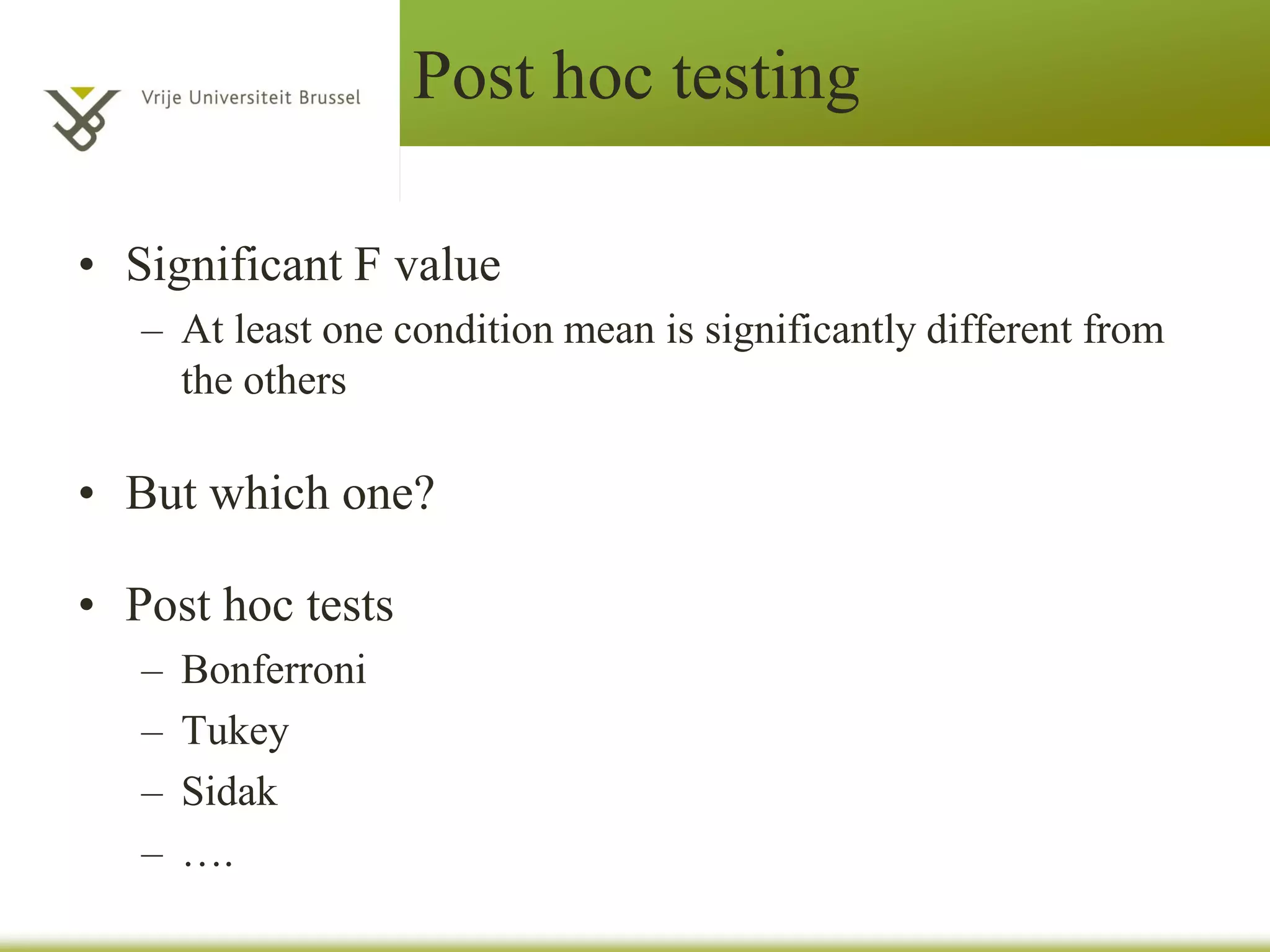
Post hoc testing
• Significant F value
– At least one condition mean is significantly different from
the others
• But which one?
• Post hoc tests
– Bonferroni
– Tukey
– Sidak
– ….
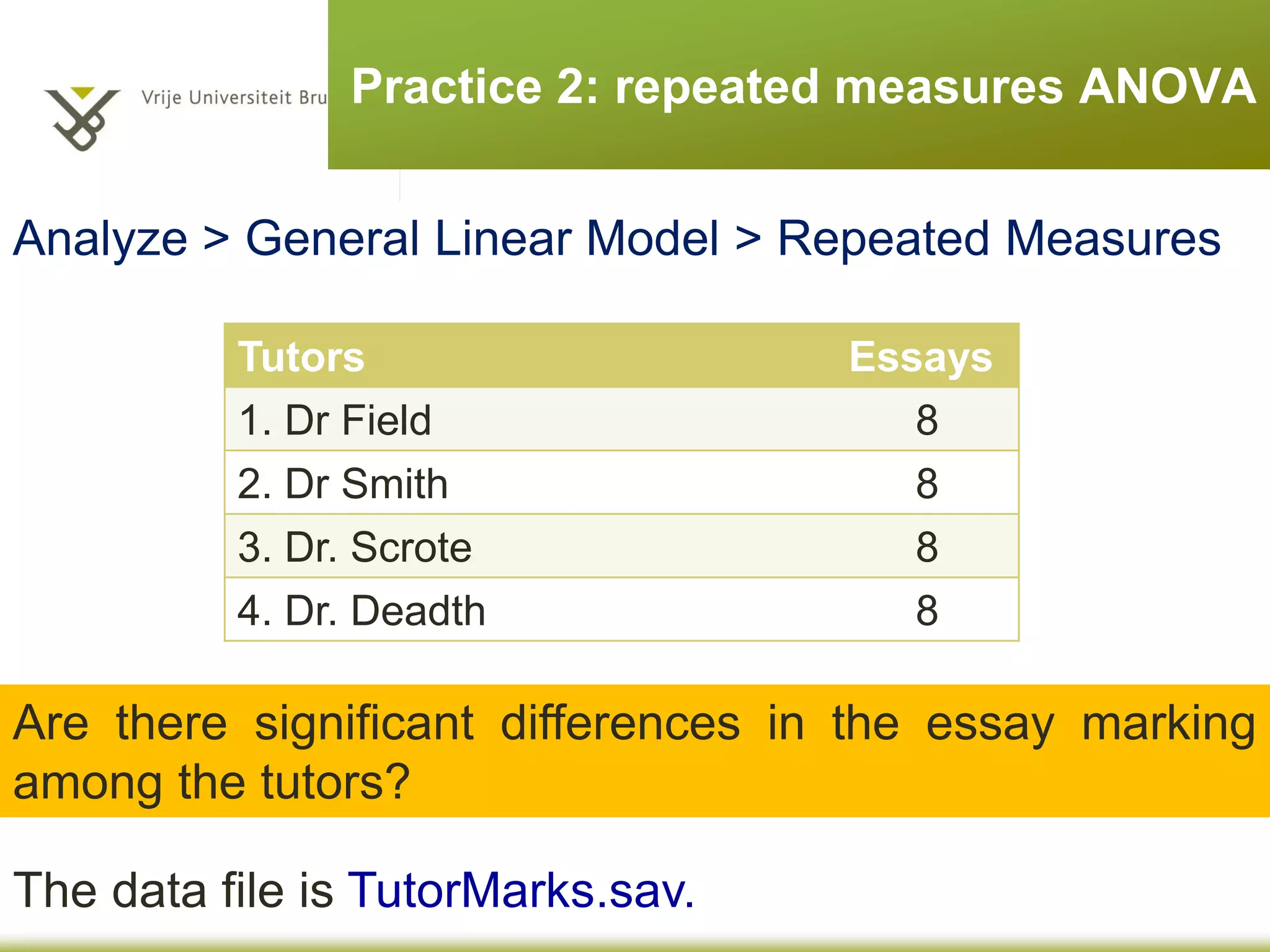
Practice 2: repeated measures ANOVA
Tutors Essays
1. Dr Field 8
2. Dr Smith 8
3. Dr. Scrote 8
4. Dr. Deadth 8
Are there significant differences in the essay marking
among the tutors?
Analyze > General Linear Model > Repeated Measures
The data file is TutorMarks.sav.
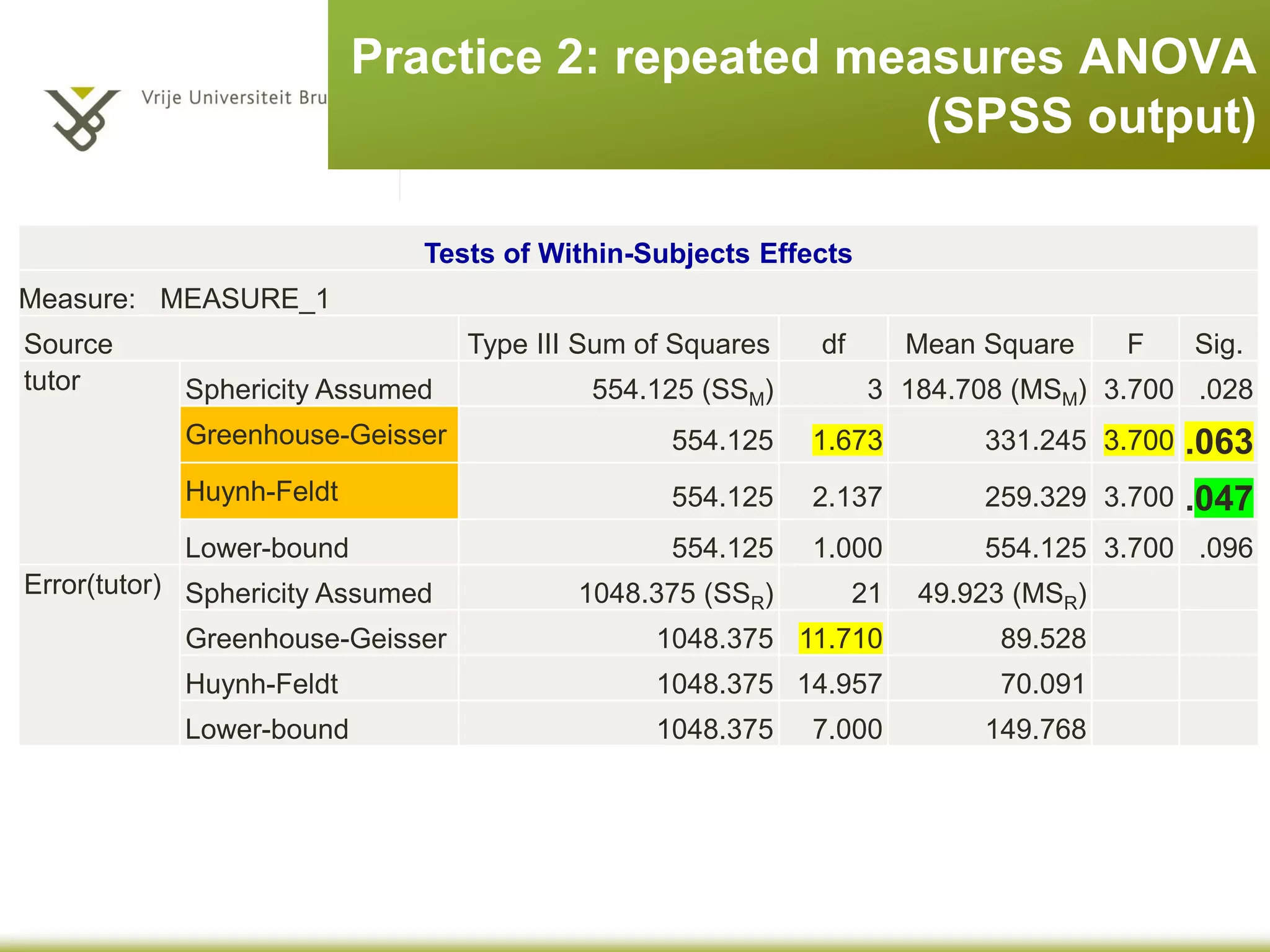
Practice 2: repeated measures ANOVA
(SPSS output)
Tests of Within-Subjects Effects
Measure: MEASURE_1
Source Type III Sum of Squares df Mean Square F Sig.
tutor Sphericity Assumed 554.125 (SSM) 3 184.708 (MSM) 3.700 .028
Greenhouse-Geisser 554.125 1.673 331.245 3.700 .063
Huynh-Feldt 554.125 2.137 259.329 3.700 .047
Lower-bound 554.125 1.000 554.125 3.700 .096
Error(tutor) Sphericity Assumed 1048.375 (SSR) 21 49.923 (MSR)
Greenhouse-Geisser 1048.375 11.710 89.528
Huynh-Feldt 1048.375 14.957 70.091
Lower-bound 1048.375 7.000 149.768
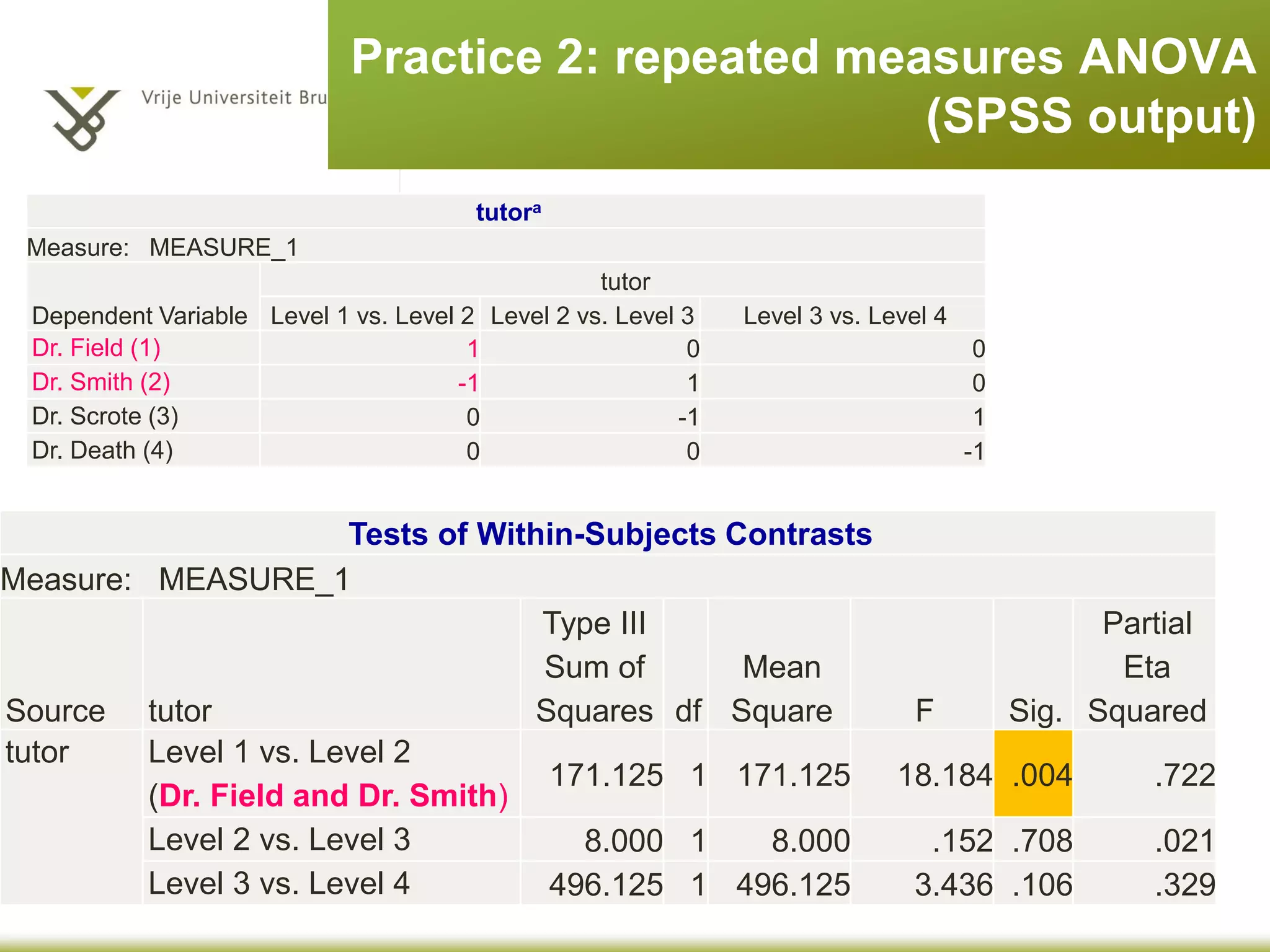
Practice 2: repeated measures ANOVA
(SPSS output)
Tests of Within-Subjects Contrasts
Measure: MEASURE_1
Source tutor
Type III
Sum of
Squares df
Mean
Square F Sig.
Partial
Eta
Squared
tutor Level 1 vs. Level 2
(Dr. Field and Dr. Smith)
171.125 1 171.125 18.184 .004 .722
Level 2 vs. Level 3 8.000 1 8.000 .152 .708 .021
Level 3 vs. Level 4 496.125 1 496.125 3.436 .106 .329
tutora
Measure: MEASURE_1
Dependent Variable
tutor
Level 1 vs. Level 2 Level 2 vs. Level 3 Level 3 vs. Level 4
Dr. Field (1) 1 0 0
Dr. Smith (2) -1 1 0
Dr. Scrote (3) 0 -1 1
Dr. Death (4) 0 0 -1
Practice 2: repeated measure ANOVA
(report)
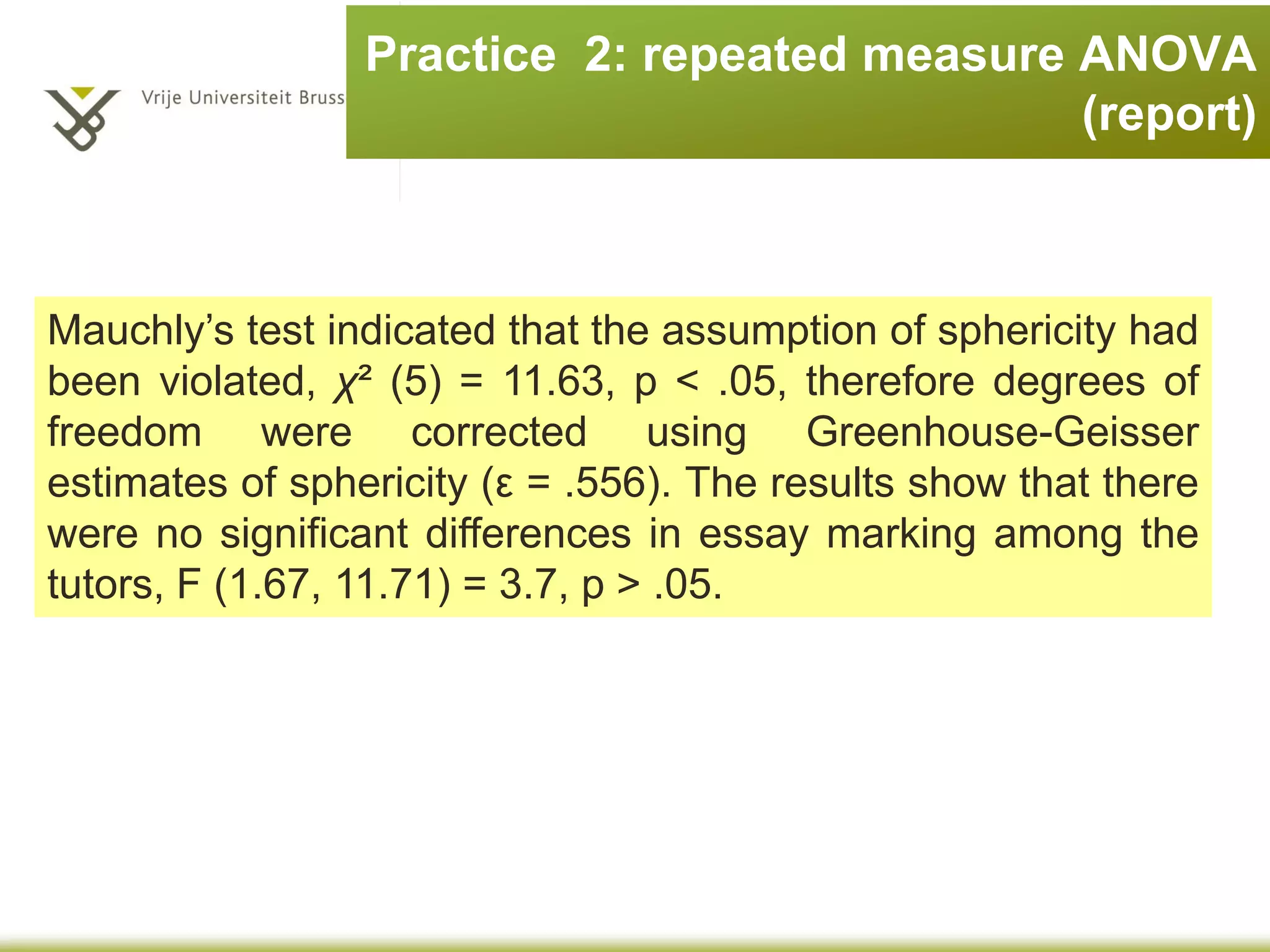
Mauchly’s test indicated that the assumption of sphericity had
been violated, χ² (5) = 11.63, p < .05, therefore degrees of
freedom were corrected using Greenhouse-Geisser
estimates of sphericity (ε = .556). The results show that there
were no significant differences in essay marking among the
tutors, F (1.67, 11.71) = 3.7, p > .05.
MANOVA
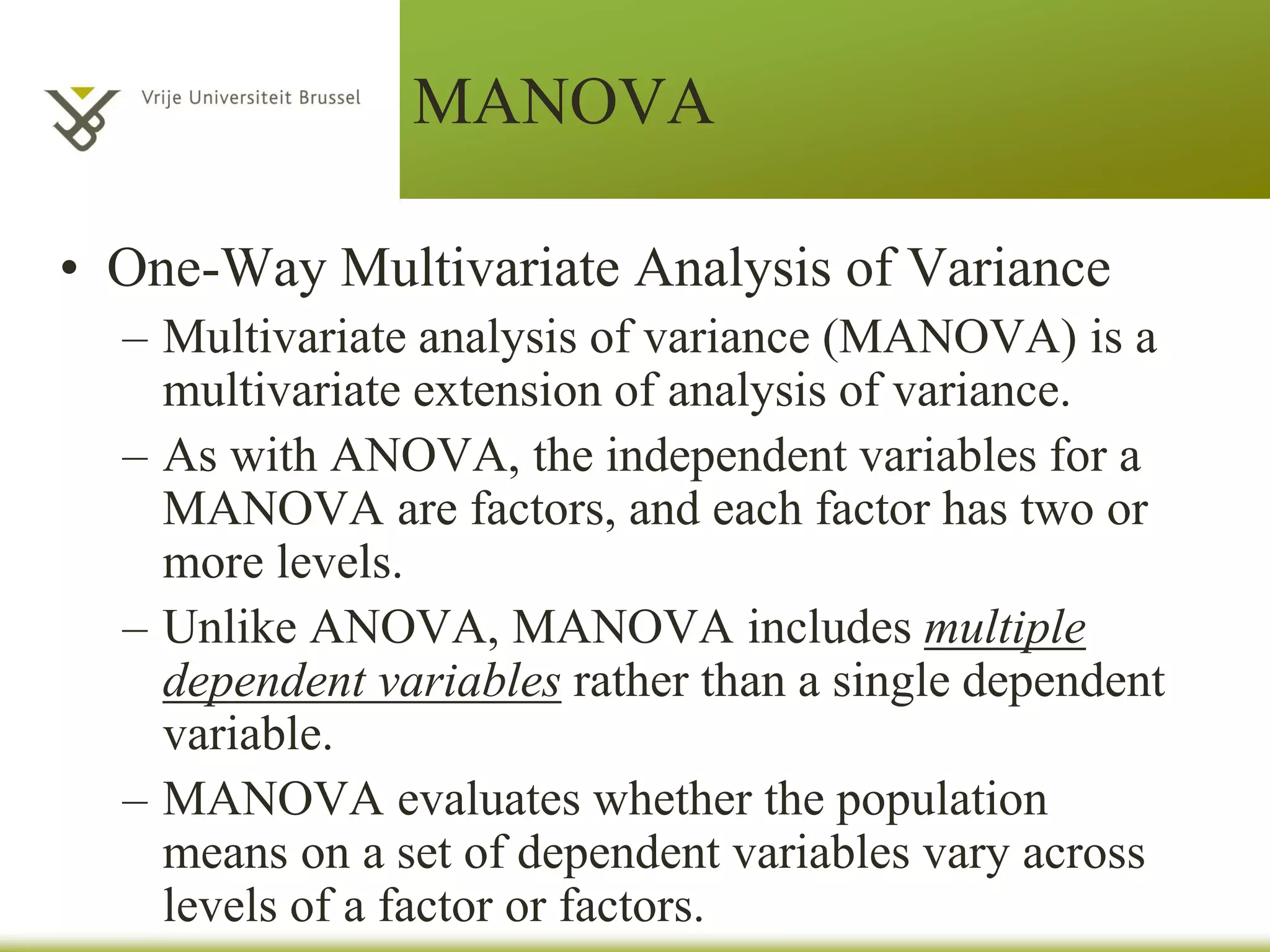
• One-Way Multivariate Analysis of Variance
– Multivariate analysis of variance (MANOVA) is a
multivariate extension of analysis of variance.
– As with ANOVA, the independent variables for a
MANOVA are factors, and each factor has two or
more levels.
– Unlike ANOVA, MANOVA includes multiple
dependent variables rather than a single dependent
variable.
– MANOVA evaluates whether the population
means on a set of dependent variables vary across
levels of a factor or factors.
MANOVA
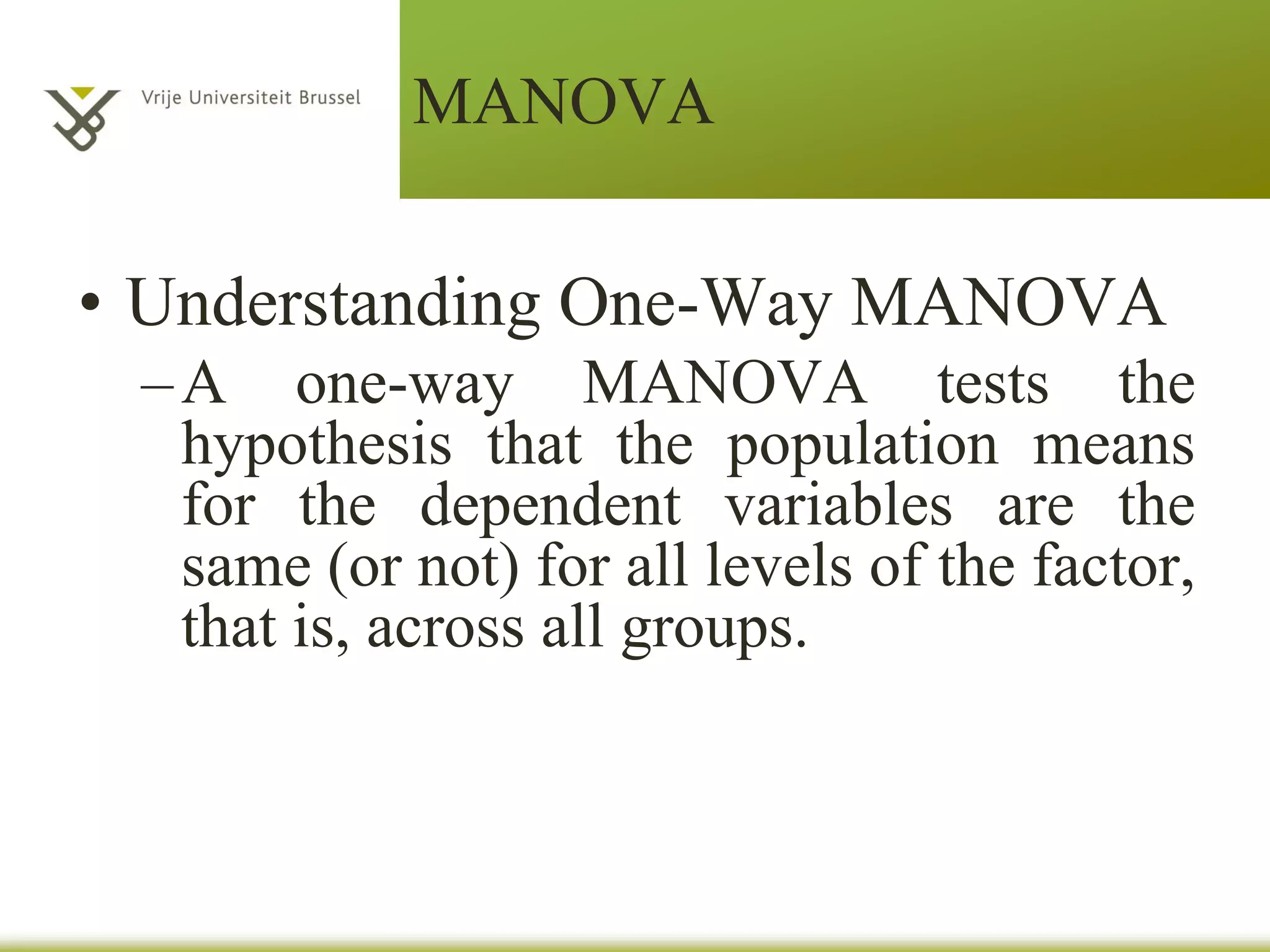
• Understanding One-Way MANOVA
–A one-way MANOVA tests the
hypothesis that the population means
for the dependent variables are the
same (or not) for all levels of the factor,
that is, across all groups.
MANOVA
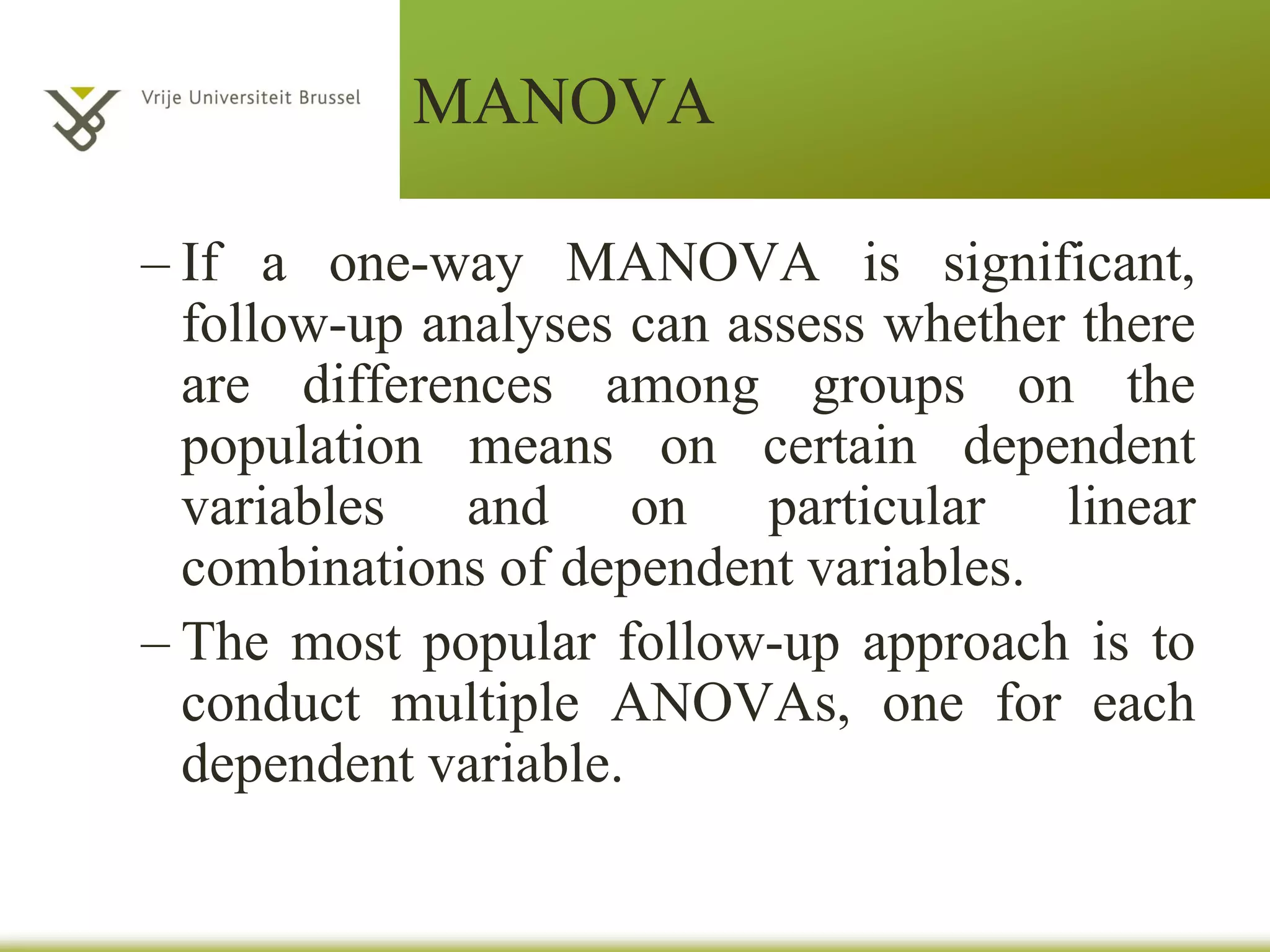
– If a one-way MANOVA is significant,
follow-up analyses can assess whether there
are differences among groups on the
population means on certain dependent
variables and on particular linear
combinations of dependent variables.
– The most popular follow-up approach is to
conduct multiple ANOVAs, one for each
dependent variable.
ANOVA vs. MANOVA
• In all cases ANOVAs have only 1 dependent
variable (they are univariate tests)
• When you have more than 1 related dependent
variables you need to conduct a MANOVA
– 2 or more DVs (interval / ratio)
– 1 or more categorical IVs
• MANOVA can be one-way, two-way,
between-groups, repeated measures and mixed
ANOVA vs. MANOVA
• Why not multiple ANOVAs?
• ANOVAs run separately cannot take into
account the pattern of covariation among the
dependent measures
– It may be possible that multiple ANOVAs may show no
differences while the MANOVA brings them out.
– MANOVA is sensitive not only to mean differences but
also to the direction and size of correlations among the
dependent variables.
MANOVA
• an extension of ANOVA in which main effects
and interactions are assessed on a combination
of DVs.
• MANOVA tests whether mean differences
among groups on a combination of DVs is
likely to occur (by chance or not).
MANOVA
– SPSS reports a number of statistics to
evaluate the MANOVA hypothesis, labeled
Wilks’ Lambda, Pillai’s Trace, Hotelling’s
Trace, and Roy’s Largest Root.
• Each statistic evaluates a multivariate
hypothesis that the population means are equal.
• We will use Wilks’ lambda (Λ) because it is
frequently reported in social science and
business literatures.
• Pillai’s trace (V) is a reasonable alternative to
Wilks’ lambda.
Interpretation of the output
2 important tables:
• Multivariate tests
– Wilks’ Lambda (most commonly used)
– Pillai’s Trace (most robust)
(see Tabachnick & Fidell, 2007)
• Tests of between-subjects effects (ANOVAs)
– Use a Bonferroni Adjustment
– Check Sig. column
Interpretation of the output
• Effect size
– Partial Eta Squared: the proportion of the variance in the
DV that can be explained by the IV (see Cohen, 1988)
• Comparing group means
– Estimated marginal means
• Follow-up analyses
(see Hair et al., 1998; Weinfurt, 1995)
Weinfurt, K. P. (1995). Multivariate analysis of variance.
In L. G. Grimm, & P. R. Yarnold (Eds.), Reading and understanding multivariate
statistics. Washington, DC: APA. [QA278 .R43 1995]
Post-hoc analysis
• If the multivariate test chosen is significant,
you’ll want to continue your analysis to discern
the nature of the differences.
• A first step would be to check the plots of mean
group differences for each DV.
• Graphical display will enhance interpretability
and understanding of what might be going on
(however it is still in ‘univariate’ mode).
• A discriminant analysis following a MANOVA
is also recommended.
Practice 3: MANOVA
Five knowledge tests
1.Exper (experimental psychology
such as cognitive and
neuropsychology etc.)
2.Stats (statistics);
3.Social (social psychology);
4.Develop (developmental
psychology);
5.Person (personality).
Three cohorts:
•First year
•Second year
•Third year
Are there are overall group differences along these five
measures?
The data file is
psychology.sav.
Practice 3: MANOVA
Five knowledge tests
1.Exper (experimental psychology
such as cognitive and
neuropsychology etc.)
2.Stats (statistics);
3.Social (social psychology);
4.Develop (developmental
psychology);
5.Person (personality).
Three cohorts:
•First year
•Second year
•Third year
Are there are overall group differences along these five
measures?
The data file is
psychology.sav.
Analyze > General Linear Model > Multivariate
Practice 3: MANOVA
(report)
Using Pillai’s trace, there was a significant difference in the
scores on the five knowledge tests among the first, second,
and third year students, V = .51, F (10, 68) = 2.33, p < .05.
Assignment 8
• Detail:
Lecture 8_practical guidelines_assignment
(p. 17)
• Questions?
45

Applied statistics lecture_8

  • 1.
    Introduction to appliedstatistics & applied statistical methods Prof. Dr. Chang Zhu1
  • 2.
    Overview • Independent ANOVA •Repeated measures ANOVA • MANOVA
  • 3.
    Analysis of Variance •Enormously useful • T-test compare two sets of scores or two groups of participants • ANOVA can be used for analysing more than two groups or more than two conditions
  • 4.
    Conditions before conducting ANOVA •The dependent variables should be interval or ratio data • Normal distribution of residuals • Variances are equal
  • 5.
    Analysis of Variance Oneway ANOVA One Independent Variable Between subjects Repeated measures / Within subjects Different participants Same participants
  • 6.
    Group A Group B Group C 5 4 3 62 7 9 4 3 2 5 4 9 3 2 Time A Time B Time C 1 2 4 5 5 9 7 8 6 3 5 8 2 2 4 Between Subjects ANOVA Data points in each group are unrelated Repeated Measures ANOVA Data points in each group are related
  • 7.
    One-way ANOVA E.g. • Arethere differences of computer use skills among participant groups in different study domains?
  • 8.
    One-way ANOVA • F-ratio F=Variance due to manipulation of IV/Error variance The larger the F-ratio, the greater the effect of the IV compared to the error variance • F (df) • p <.05 • p<.01 • p<.001 (the means of the groups are different)
  • 9.
    Post Hoc Analysis •What ANOVA tells us: – Rejection of the H0 tells you that there is a high PROBABILITY that AT LEAST ONE difference exists among the groups • What ANOVA doesn’t tell us: – Where the differences lie • Post hoc analysis is needed to determine which mean(s) is(are) different
  • 10.
    One-way ANOVA post-hoc analysis •ANOVA determined that differences exist among the means. • Post hoc tests determine which means differ.
  • 11.
    or One-way ANOVA inSPSS Compare Means > Means General Linear Model > Univariate
  • 12.
    The ANOVA analysisresults • Brief report: e.g. • The ANOVA results show that there were significant differences of xxxx (eg. the powerpoint use) among the groups of participants (F(df)=…., p<.05)
  • 13.
    Results: brief examplereport •Post-hoc analyses show that group x was different to group y (mean difference=xx, p<xx) and group z (mean difference=xx, p<xx) ….
  • 14.
    Effect size • Inexperiential research, effect size is a useful measure. • Effect size is the magnitude of the difference between groups • For ANOVAs, the effect size can be calculated by: r (or η: eta) , ω (omega) : effect size SSM: between-group effect SST: total amount of variance in the data MSR: within-subject effect dfM: degree of freedom, which is the number of the groups minus 1 (these values are in the SPSS output)
  • 15.
  • 16.
    Practice 1: independentANOVA H1: reward will lead to better exam results than either punish or indifferent. H2: indifferent will lead to better exam results than punish. 1 2 3
  • 17.
    Practice 1: independentANOVA Carry out a one-way ANOVA and use planned comparisons to test the hypotheses that H1: reward results in better exam results than either punishment or indifferent; and H2: indifferent will lead to significantly better exam results than punishment. Analyze > Compare Means > One-way ANOVAs The data file is teach.sav.
  • 18.
    • Rule 1:We should be careful in pair selection as if we exclude any group in one comparison, it will be excluded in subsequent comparison as well. • Rule 2: Groups coded with positive weights will be compared against groups coded with negative weights. • Rule 3: The sum of weights for a comparison should be zero. • Rule 4: If a group is not involved in a comparison, automatically assign it a weight of 0. • Rule 5: For a given contrast, the weights assigned to the group(s) not included in the contrast should be equal to the number of groups included in the pair comparison. (Field, 2009) Practice 1: independent ANOVA rules for contrast weights
  • 19.
    Practice 1: independentANOVA H2: indifferent will lead to better exam results than punish. H1: reward will lead to better exam results than either punish or indifferent. contrast 1 condition contrast 2 1 punish (1) 1 1 indifferent (2) -1 -2 reward (3) 0
  • 20.
    Practice 1: independentANOVA (Post Hoc) • Equal variances assumed: R-E-G-W-Q, Tukey, Dunnnett • Equal variances not assumed: Games-Howell
  • 21.
    Practice 1: independentANOVA (SPSS output) ANOVA Exam Mark Sum of Squares df Mean Square F Sig. Between Groups (Combined) 1205.067 (SSM) 2 (dfM) 602.533 21.008 .000 Linear Term Contrast 1185.800 1 1185.800 41.344 .000 Deviation 19.267 1 19.267 .672 .420 Quadratic Term Contrast 19.267 1 19.267 .672 .420 Within Groups 774.400 27 28.681 (MSR) Total 1979.467 (SST) 29 There is a significant difference in exam marks among different teaching conditions.
  • 22.
    Practice 1: independentANOVA (SPSS output) Contrast Tests Contrast Value of Contrast SE t df Sig. (2- tailed) Exam Mark Assume equal variances 1 -24.8000 4.14836 -5.978 27 .000 2 -6.0000 2.39506 -2.505 27 .019 H1: reward will lead to better exam results than either punish or indifferent. H2: indifferent will lead to better exam results than punish.
  • 23.
    Practice 1: independentANOVA (report) There was a significant effect of teaching conditions on exam marks, F (2, 27) = 21.01, p < .001, ω = .76. Planned contrasts revealed that reward produced significantly better exam grades than punishment and indifference, t (27) = - 5.978, p < .01, r = .75 and that punishment produced significantly lower exam marks than indifference, t (27) = - 2.51, p < .05, r = .43.
  • 24.
    Independent vs. Repeatedmeasures ANOVA • There are two possible scenarios when obtaining various sets of data for comparison: – Independent samples: The data in the first sample is completely independent from the data in the other samples. – Dependent/Related samples: The sets of data are dependent on one another. There is a relationship between/among the sets of data.
  • 25.
    • Three ormore data sets? – If three or more sets of data are independent of one another Analysis of Variance Independent (ANOVA)? – If three or more sets of data are dependent on one another Repeated Measures ANOVA Independent vs. Repeated measures ANOVA D1
  • 26.
    Slide 25 D1 DearProf. shoud we changed to: Independent ANOVA? DiepNguyet, 10/12/2014
  • 27.
    Post hoc testing •Significant F value – At least one condition mean is significantly different from the others • But which one? • Post hoc tests – Bonferroni – Tukey – Sidak – ….
  • 28.
    Practice 2: repeatedmeasures ANOVA Tutors Essays 1. Dr Field 8 2. Dr Smith 8 3. Dr. Scrote 8 4. Dr. Deadth 8 Are there significant differences in the essay marking among the tutors? Analyze > General Linear Model > Repeated Measures The data file is TutorMarks.sav.
  • 29.
    Practice 2: repeatedmeasures ANOVA (SPSS output) Tests of Within-Subjects Effects Measure: MEASURE_1 Source Type III Sum of Squares df Mean Square F Sig. tutor Sphericity Assumed 554.125 (SSM) 3 184.708 (MSM) 3.700 .028 Greenhouse-Geisser 554.125 1.673 331.245 3.700 .063 Huynh-Feldt 554.125 2.137 259.329 3.700 .047 Lower-bound 554.125 1.000 554.125 3.700 .096 Error(tutor) Sphericity Assumed 1048.375 (SSR) 21 49.923 (MSR) Greenhouse-Geisser 1048.375 11.710 89.528 Huynh-Feldt 1048.375 14.957 70.091 Lower-bound 1048.375 7.000 149.768
  • 30.
    Practice 2: repeatedmeasures ANOVA (SPSS output) Tests of Within-Subjects Contrasts Measure: MEASURE_1 Source tutor Type III Sum of Squares df Mean Square F Sig. Partial Eta Squared tutor Level 1 vs. Level 2 (Dr. Field and Dr. Smith) 171.125 1 171.125 18.184 .004 .722 Level 2 vs. Level 3 8.000 1 8.000 .152 .708 .021 Level 3 vs. Level 4 496.125 1 496.125 3.436 .106 .329 tutora Measure: MEASURE_1 Dependent Variable tutor Level 1 vs. Level 2 Level 2 vs. Level 3 Level 3 vs. Level 4 Dr. Field (1) 1 0 0 Dr. Smith (2) -1 1 0 Dr. Scrote (3) 0 -1 1 Dr. Death (4) 0 0 -1
  • 31.
    Practice 2: repeatedmeasure ANOVA (report) Mauchly’s test indicated that the assumption of sphericity had been violated, χ² (5) = 11.63, p < .05, therefore degrees of freedom were corrected using Greenhouse-Geisser estimates of sphericity (ε = .556). The results show that there were no significant differences in essay marking among the tutors, F (1.67, 11.71) = 3.7, p > .05.
  • 32.
    MANOVA • One-Way MultivariateAnalysis of Variance – Multivariate analysis of variance (MANOVA) is a multivariate extension of analysis of variance. – As with ANOVA, the independent variables for a MANOVA are factors, and each factor has two or more levels. – Unlike ANOVA, MANOVA includes multiple dependent variables rather than a single dependent variable. – MANOVA evaluates whether the population means on a set of dependent variables vary across levels of a factor or factors.
  • 33.
    MANOVA • Understanding One-WayMANOVA –A one-way MANOVA tests the hypothesis that the population means for the dependent variables are the same (or not) for all levels of the factor, that is, across all groups.
  • 34.
    MANOVA – If aone-way MANOVA is significant, follow-up analyses can assess whether there are differences among groups on the population means on certain dependent variables and on particular linear combinations of dependent variables. – The most popular follow-up approach is to conduct multiple ANOVAs, one for each dependent variable.
  • 35.
    ANOVA vs. MANOVA •In all cases ANOVAs have only 1 dependent variable (they are univariate tests) • When you have more than 1 related dependent variables you need to conduct a MANOVA – 2 or more DVs (interval / ratio) – 1 or more categorical IVs • MANOVA can be one-way, two-way, between-groups, repeated measures and mixed
  • 36.
    ANOVA vs. MANOVA •Why not multiple ANOVAs? • ANOVAs run separately cannot take into account the pattern of covariation among the dependent measures – It may be possible that multiple ANOVAs may show no differences while the MANOVA brings them out. – MANOVA is sensitive not only to mean differences but also to the direction and size of correlations among the dependent variables.
  • 37.
    MANOVA • an extensionof ANOVA in which main effects and interactions are assessed on a combination of DVs. • MANOVA tests whether mean differences among groups on a combination of DVs is likely to occur (by chance or not).
  • 38.
    MANOVA – SPSS reportsa number of statistics to evaluate the MANOVA hypothesis, labeled Wilks’ Lambda, Pillai’s Trace, Hotelling’s Trace, and Roy’s Largest Root. • Each statistic evaluates a multivariate hypothesis that the population means are equal. • We will use Wilks’ lambda (Λ) because it is frequently reported in social science and business literatures. • Pillai’s trace (V) is a reasonable alternative to Wilks’ lambda.
  • 39.
    Interpretation of theoutput 2 important tables: • Multivariate tests – Wilks’ Lambda (most commonly used) – Pillai’s Trace (most robust) (see Tabachnick & Fidell, 2007) • Tests of between-subjects effects (ANOVAs) – Use a Bonferroni Adjustment – Check Sig. column
  • 40.
    Interpretation of theoutput • Effect size – Partial Eta Squared: the proportion of the variance in the DV that can be explained by the IV (see Cohen, 1988) • Comparing group means – Estimated marginal means • Follow-up analyses (see Hair et al., 1998; Weinfurt, 1995) Weinfurt, K. P. (1995). Multivariate analysis of variance. In L. G. Grimm, & P. R. Yarnold (Eds.), Reading and understanding multivariate statistics. Washington, DC: APA. [QA278 .R43 1995]
  • 41.
    Post-hoc analysis • Ifthe multivariate test chosen is significant, you’ll want to continue your analysis to discern the nature of the differences. • A first step would be to check the plots of mean group differences for each DV. • Graphical display will enhance interpretability and understanding of what might be going on (however it is still in ‘univariate’ mode). • A discriminant analysis following a MANOVA is also recommended.
  • 42.
    Practice 3: MANOVA Fiveknowledge tests 1.Exper (experimental psychology such as cognitive and neuropsychology etc.) 2.Stats (statistics); 3.Social (social psychology); 4.Develop (developmental psychology); 5.Person (personality). Three cohorts: •First year •Second year •Third year Are there are overall group differences along these five measures? The data file is psychology.sav.
  • 43.
    Practice 3: MANOVA Fiveknowledge tests 1.Exper (experimental psychology such as cognitive and neuropsychology etc.) 2.Stats (statistics); 3.Social (social psychology); 4.Develop (developmental psychology); 5.Person (personality). Three cohorts: •First year •Second year •Third year Are there are overall group differences along these five measures? The data file is psychology.sav. Analyze > General Linear Model > Multivariate
  • 44.
    Practice 3: MANOVA (report) UsingPillai’s trace, there was a significant difference in the scores on the five knowledge tests among the first, second, and third year students, V = .51, F (10, 68) = 2.33, p < .05.
  • 45.
    Assignment 8 • Detail: Lecture8_practical guidelines_assignment (p. 17)
  • 46.